
LDP-FL: Practical Private Aggregation in Federated Learning with Local Differential Privacy
Proceedings of the Thirtieth International Joint Conference on Artificial Intelligence. Main Track. Pages 1571-1578.
https://doi.org/10.24963/ijcai.2021/217
Keywords
- Data Mining: Privacy Preserving Data Mining
- AI Ethics, Trust, Fairness: Trustable Learning
- Data Mining: Federated Learning
- Agent-based and Multi-agent Systems: Multi-agent Learning
Abstract
Training deep learning models on sensitive user data has raised increasing privacy concerns in many areas. Federated learning is a popular approach for privacy protection that collects the local gradient information instead of raw data. One way to achieve a strict privacy guarantee is to apply local differential privacy into federated learning. However, previous works do not give a practical solution due to two issues. First, the range difference of weights in different deep learning model layers has not been explicitly considered when applying local differential privacy mechanism. Second, the privacy budget explodes due to the high dimensionality of weights in deep learning models and many query iterations of federated learning. In this paper, we proposed a novel design of local differential privacy mechanism for federated learning to address the abovementioned issues. It makes the local weights update differentially private by adapting to the varying ranges at different layers of a deep neural network, which introduces a smaller variance of the estimated model weights, especially for deeper models. Moreover, the proposed mechanism bypasses the curse of dimensionality by parameter shuffling aggregation. A series of empirical evaluations on three commonly used datasets in prior differential privacy works, MNIST, Fashion-MNIST and CIFAR-10, demonstrate that our solution can not only achieve superior deep learning performance but also provide a strong privacy guarantee at the same time.
- [Balle et al., 2019] Borja Balle, James Bell, Adria Gascón, and Kobbi Nissim. The privacy blanket of the shuffle model. In Annual International Cryptology Conference, pages 638- 667. Springer, 2019.
- [Belesi, 2016] Rosette Belesi. How to change your ip address. https://blogs.opera.com/news/2016/09/ how-to-change-ip-address/, 2016. Accessed: 08/30/2020. Link
- [Bhowmick et al., 2018] Abhishek Bhowmick, John Duchi, Julien Freudiger, Gaurav Kapoor, and Ryan Rogers. Pro- tection against reconstruction and its applications in private federated learning. arXiv preprint arXiv:1812.00984, 2018.
- [Bittau et al., 2017] Andrea Bittau, Úlfar Erlingsson, Petros Maniatis, Ilya Mironov, Ananth Raghunathan, David Lie, Mitch Rudominer, Ushasree Kode, Julien Tinnes, and Bern- hard Seefeld. Prochlo: Strong privacy for analytics in the crowd. In SOSP. ACM, 2017.
- [Che et al., 2021] Sicong Che, Hao Peng, Lichao Sun, Yong Chen, and Lifang He. Federated multi-view learning for private medical data integration and analysis. arXiv preprint arXiv:2105.01603, 2021.
- [Cheu et al., 2019] Albert Cheu, Adam Smith, Jonathan Ull- man, David Zeber, and Maxim Zhilyaev. Distributed differ- ential privacy via shuffling. In Eurocrypt. Springer, 2019.
- [Dingledine et al., 2004] Roger Dingledine, Nick Mathew- son, and Paul Syverson. Tor: The second-generation onion- router. In USENIX Security, 2004.
- [Duchi et al., 2013] John C Duchi, Michael I Jordan, and Martin J Wainwright. Local privacy and statistical min- imax rates. In FOCS, 2013.
- [Duchi et al., 2018] John C Duchi, Michael I Jordan, and Martin J Wainwright. Minimax optimal procedures for locally private estimation. ASA, 2018.
- [Dwork et al., 2014] Cynthia Dwork, Aaron Roth, et al. The algorithmic foundations of differential privacy. Foundations and Trends® in Theoretical Computer Science, 2014.
- [Dwork, 2011] Cynthia Dwork. Differential privacy. Ency- clopedia of Cryptography and Security, 2011.
- [Erlingsson et al., 2014] Úlfar Erlingsson, Vasyl Pihur, and Aleksandra Korolova. Rappor: Randomized aggregatable privacy-preserving ordinal response. In CCS, 2014.
- [Erlingsson et al., 2019] Úlfar Erlingsson, Vitaly Feldman, Ilya Mironov, Ananth Raghunathan, Kunal Talwar, and Abhradeep Thakurta. Amplification by shuffling: From lo- cal to central differential privacy via anonymity. In SODA. SIAM, 2019.
- [Geyer et al., 2017] Robin C Geyer, Tassilo Klein, and Moin Nabi. Differentially private federated learning: A client level perspective. arXiv preprint arXiv:1712.07557, 2017.
- [Konečnỳ et al., 2016] Jakub Konečnỳ, H Brendan McMa- han, Felix X Yu, Peter Richtárik, Ananda Theertha Suresh, and Dave Bacon. Federated learning: Strategies for improving communication efficiency. arXiv preprint arXiv:1610.05492, 2016.
- [Lyu et al., 2020] Lingjuan Lyu, Han Yu, Xingjun Ma, Lichao Sun, Jun Zhao, Qiang Yang, and Philip S Yu. Privacy and robustness in federated learning: Attacks and defenses. arXiv preprint arXiv:2012.06337, 2020.
- [McMahan et al., 2016] H Brendan McMahan, Eider Moore, Daniel Ramage, Seth Hampson, et al. Communication- efficient learning of deep networks from decentralized data. arXiv preprint arXiv:1602.05629, 2016.
- [McMahan et al., 2017] H Brendan McMahan, Daniel Ra- mage, Kunal Talwar, and Li Zhang. Learning differen- tially private recurrent language models. arXiv preprint arXiv:1710.06963, 2017.
- [Nguyên et al., 2016] Thông T Nguyên, Xiaokui Xiao, Yin Yang, Siu Cheung Hui, Hyejin Shin, and Junbum Shin. Collecting and analyzing data from smart device users with local differential privacy. arXiv, 2016.
- [Papernot et al., 2017] Nicolas Papernot, Martin Abadi, Ul- far Erlingsson, Ian Goodfellow, and Kunal Talwar. Semi- supervised knowledge transfer for deep learning from pri- vate training data. In ICLR, 2017.
- [Robbins and Monro, 1951] Herbert Robbins and Sutton Monro. A stochastic approximation method. The Annals of Mathematical Statistics, 22(3):400-407, 1951.
- [Seif et al., 2020] Mohamed Seif, Ravi Tandon, and Ming Li. Wireless federated learning with local differential privacy. arXiv preprint arXiv:2002.05151, 2020.
- [Simonyan and Zisserman, 2014] Karen Simonyan and An- drew Zisserman. Very deep convolutional networks for large-scale image recognition. arXiv, 2014.
- [Sun and Lyu, 2020] Lichao Sun and Lingjuan Lyu. Feder- ated model distillation with noise-free differential privacy. arXiv preprint arXiv:2009.05537, 2020.
- [Truex et al., 2020] Stacey Truex, Ling Liu, Ka-Ho Chow, Mehmet Emre Gursoy, and Wenqi Wei. Ldp-fed: federated learning with local differential privacy. In arXiv, 2020.
- [Xu et al., 2021] Xiaohang Xu, Hao Peng, Lichao Sun, Md Zakirul Alam Bhuiyan, Lianzhong Liu, and Lifang He. Fedmood: Federated learning on mobile health data for mood detection. arXiv preprint arXiv:2102.09342, 2021.
References were extracted automatically from the PDF and may contain errors.
Full text extracted automatically from the PDF; figures, tables and equations may differ. The PDF is the version of record.
1 Introduction
Many attractive applications involve training models on highly sensitive data, e.g., diagnosis of diseases with medical records, or genetic sequences [Xu et al., 2021; Che et al., 2021]. In order to protect the privacy of the training data, the federated learning framework is of particular interest since it can provide a well-trained model without touching any sensitive data directly [McMahan et al., 2016]. The original purpose of the federated learning (FL) framework is to share the weights of the model trained on sensitive data instead of data directly. However, some studies show that the weights also can leak privacy and the original sensitive data can be recovered [Papernot et al., 2017]. In order to solve the problem, recent works start to use differential privacy to protect the private data in federated learning [Nguyên et al., 2016; Lyu et al., 2020; Sun and Lyu, 2020], but most of them cannot give a practical solution for deep learning on complex datasets due to the trade-off between privacy budget and performance.
∗Corresponding Author
Notably, there are at least two remaining challenges in applying local differential privacy (LDP) in FL. First, existing approaches have assumed a fixed range of weights for simplicity. However, in complicated models such as those used in deep learning tasks, the range of model weights at different neural network layer varies significantly. Assuming weights in all layers to be in a fixed range will introduce a large variance of the estimated model weights, which leads to the poor model accuracy. Second, when client uploads the local model to the server, the server can explore the private connections of model weights, which causes the privacy budget explosion due to the high dimensionality of deep learning models.
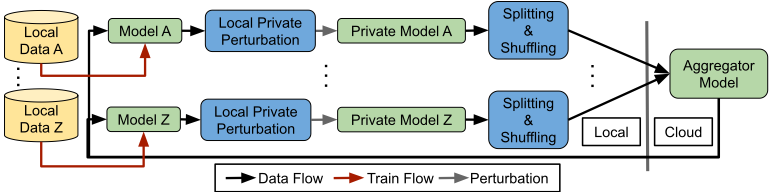
In this paper, we proposed Locally Differential Private Federated Learning (LDP-FL), a new local differential privacy mechanism to solve the above issues, as shown in Fig. 1. Our main contributions are multifold. First, we propose a new data perturbation with adaptive range by considering that model weights at different deep neural network (DNN) layer could vary significantly. We derive a more general LDP mechanism to illustrate the impact of the range on the variance of the estimated model weights. We also further demonstrate how the proposed adaptive range settings can greatly improve the accuracy of aggregated model, especially in deeper models. To the best of our knowledge, this is the first work that has considered and studied the necessity and effectiveness of adapting to the different model weights' ranges when applying LDP in federated learning. Second, we propose a parameter shuffling mechanism to each clients' weights to mitigate the privacy degradation caused by the high data dimensionality of deep learning models and many query iterations. Last, we evaluate LDP-FL on three commonly used datasets in previous works, MNIST, Fashion-MNIST and CIFAR-10 [Sun and Lyu, 2020]. The proposed mechanism achieves a privacy budget of ϵ = 1 with 0.97% accuracy loss on MNIST, a privacy budget of ϵ = 4 with 1.32% accuracy loss on FMNIST, and a privacy budget of ϵ = 10 with 1.09% accuracy loss on CIFAR-10, respectively. Our work gives the first practical LDP solution for federated deep learning with a superior performance. Due to space limitation, all proofs are in the appendix.
2 Preliminary
Federated Learning. FL [McMahan et al., 2016; Koneˇcn`y et al., 2016] has been proposed and widely used in different approaches. The motivation is to share the model weights instead of the private data for better privacy protection. Each client, the owner of private training data, updates a model locally, and sends all gradients or weights information to the cloud. The cloud aggregates such information from clients, updates a new central model (e.g., averaging all clients' weights), and then distributes it back to a fraction of clients for another round of model update. Such process is continued iteratively until a satisfying performance is achieved. Note that, to minimize communication, each client might take several mini-batch gradient descent steps in local model computation.
Local Differential Privacy. To enhance the privacy protection, differential privacy (DP) has been applied to federated learning [Bhowmick et al., 2018; Geyer et al., 2017]. Traditional DP requires a central trusted party which is often not realistic. To remove that limitation, local differential privacy has been proposed. The definition of ϵ-LDP is given as below:
Definition 1. [Dwork, 2011] A randomized mechanismM satisfies ϵ-LDP, for any pair input x and x′ in D, and any output Y ofM,
The privacy guarantee of mechanism M is controlled by privacy budget [Dwork, 2011], denoted as ϵ. A smaller value of ϵ indicates a stronger privacy guarantee.
3 Overview of LDP-FL
In this section, we introduce LDP-FL, a federated learning framework with LDP as shown in Fig.1. It consists of two steps, as described by Algorithm 1.
Cloud Update. First, the cloud initializes the weights randomly at the beginning. Let n be the total number of local clients. Then, in the r-th communication round, the cloud will randomly select kr ≤ n clients to update their weights for local-side optimization. Unlike the previous works [Bhowmick et al., 2018; Erlingsson et al., 2014; Seif et al., 2020], where they assume that the aggregator already knows the identities (e.g., IP addresses) of the users but not their private data, our approach assumes the client remains anonymous to the cloud.
Local Update. For each client, it contains its own private dataset. In each communication, the selected local clients will update their local models by the weight from the cloud. Next, each local model uses Stochastic Gradient Descent (SGD) [Robbins and Monro, 1951] to optimize the distinct local models' weights in parallel. In order to provide a practical privacy protection approach, each local client applies a split and shuffle mechanism on the weights of local model and sends each weight through an anonymous mechanism to the cloud. For splitting, we separate all parameters of the trained model, and tag them with their location in the network structure. For shuffling, we randomly generate a time t in Algorithm 3 to prevent the cloud from tracking the client owner of each parameter. Detailed description and discussion on parameter shuffling mechanism are given in the later section.
3.1 Privacy-PreservingMechanism
In this section, we describe in details the two major components in LDP-FL for privacy-preservation.
Data Perturbation with Adaptive Range
To better understand the necessity of adaptive range in data perturbation, we first generalize the LDP mechanism in [Duchi et al., 2018] by considering model weights' range.
Given the weights W of a model, the algorithm returns a perturbed tuple W ∗ by randomizing each dimension of W. Let M be our mechanism, for each weight/entry w ∈ W, assuming w ∈ [c - r, c + r] where c is the center of w's range and r is the radius of the range (c, r depend on how we clip the weight). Therefore, we design the following LDP mechanism to perturb w.
where w∗ is the reported noisy weight by our proposed LDP, and "w.p." stands for "with probability". Algorithm 2 shows the pseudo-code of this mechanism.
Algorithm 1: LDP-FL
Input: n is the number of local clients; B is the local mini-batch size, E the number of local epochs, γ is the learning rate.
1 CloudUpdate
2 Initialize weights W0 = {w0 id | ∀id}, where id indicates the position of each weight; 3 Initialize the range by (C0, R0) for layers of W0; 4 SendToClient(W0, k0,C0,R0); 5 for each round l = 1, 2, . . . do 6 randomly select kl(kl ≤ n) local clients; 7 collect all weights updates {(id, wid) | ∀id} from selected clients with SendT oCloud; 8 %Now calculate and update model weights Wl; 9 for each element w ∈Wl do 10 determine the id for w; 11 w ← 1 kl ∑ wid; % Compute mean of local models; 12 for each layer of Wl do 13 update C and R from Wl; 14 SendToClient(Wl, kl,Cl,Rl) %Update clients; 15 LocalUpdate(Wl, kl,Cl,Rl) 16 Receive weights Wl, kl,Cl,Rl from cloud by SendT oClient; 17 for each local client s ∈ kl in parallel do 18 W s l+1 ← Wl; 19 for each local epoch i = 1, 2, ...E do 20 for each batch b ∈ B do 21 W s l+1 ← W s l+1 - γ ▽ L(W s l+1 ; b); 22 DataPertubation(W s l+1 , Cl , Rl ); 23 ParameterShuffling(W s l+1 );From (2), we can see that, with a certain privacy budget ϵ, the larger range which indicates the larger r, the larger range of perturbed weights w∗ which intuitively indicates a noisier perturbed weight. In Section 4, we give a formal privacy and utility analysis which shows that the larger r, the larger variance of the estimated model weights. This observation motivates us to consider the range variation of model weights when applying LDP. Therefore, we propose the adaptive range settings. The proposed adaptive range setting in private federated learning consists of several steps:
- All clients and the server agree to the same weight range, represented by (C0, R0) based on prior knowledge at the beginning when initializing weights.
- In local update, based on the weight range (cl, rl) of each layer where cl ∈ C and rl ∈ R, each local client can perturb its weights by the proposed LDP data perturbation given by (2).
- In cloud update, the cloud calculates and updates C and R from the local weights update received from clients. The updated C and R will be distributed to the clients when the cloud distributes the updated weights.
Algorithm 2: DataPertubation
Input: Original local weights W s l+1 , range represented by Cl and Rl, privacy budget ϵ Output: Perturbed weights W s l+1 1 for each w ∈W s l+1 and corresponding c ∈ Cl and r ∈ Rl do 2 Sample a Bernoulli variable u such that 3 Pr[u = 1] = (w-c)(eϵ-1)+r(eϵ+1) 2r(eϵ+1) ; 4 if u==1 then 5 w∗ = c + r · eϵ+1 eϵ-1 ; 6 else 7 w∗ = c - r · eϵ+1 eϵ-1 ; 8 w ←w∗ ; % update W s l+1 ; 9 return.Algorithm 3: ParameterShufflingInput: Perturbed weights W s l+1 after Algorithm 2 1 label the position id of each element of W; 2 for each element ws ∈W do 3 label the element position with a unique id tsid ← U(0, T ) % Randomly sample a small latency between 0 and T ; 4 SendToCloud(id,wid) at time tsid ; 5 return.Note that range parameters C and R are calculated layer-wise, i.e., they are vectors with each element corresponding to one layer in the model. A pseudo-code of adaptive range settings is given in Algorithm 1. Our adaptive range setting gives a new feasible approach to set up the weight range and improves the utility for complex deep learning tasks.
Parameter Shuffling
As noted in [Dwork et al., 2014], a sophisticated privacypreserving system composites multiple locally differentiate algorithms that lead to a composition of privacy cost of such algorithms. That is, a combination of locally differentiate algorithm with privacy budget ϵ1 and ϵ2 consumes a privacy budget of ϵ1 + ϵ2. Training a DNN using federated learning requires clients to upload gradient updates to the cloud in multiple iterations. If LDP is applied at each iteration along the iterative training process, the privacy budget will accumulate, which causes the explosion of the total privacy budget.
Previous efforts [Bittau et al., 2017; Erlingsson et al., 2019] have shown that when data reports are properly anonymized at each timestep and unlinkable over the time, the overall privacy guarantee can be greatly improved. That is, by adding anonymity onto the local model updates in LDP-FL, it can break the linkage from the received data at the cloud to a specific client and decouple the gradient updates sent from the same client in each iteration. This can be achieved by multiple existing mechanisms, depending on how the server tracks clients in the specific scenario. As a typically best practice for privacy, a certain level of anonymity of each client to the server is applied to disassociate clients' individually-identifiable information from their weight updates. For example, if the server tracks clients by IP address, each client can adopt an untraceable IP address by using a network proxy, a VPN service [Belesi, 2016], public WiFi access, and/or the Tor [Dingledine et al., 2004]. For another example, if the server tracks clients by software-generated metadata such as an ID, each client can randomize this metadata before sending it to the server.
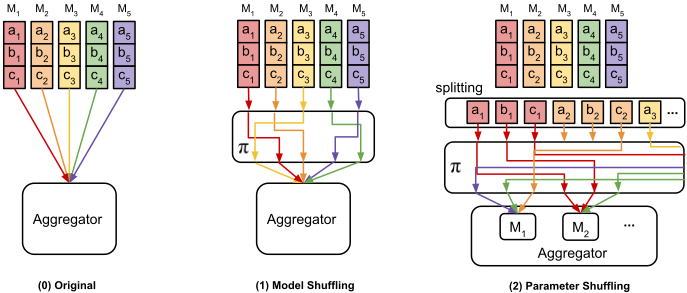
However, we argue that client anonymity is not sufficient to prevent side-channel linkage attacks, e.g., the cloud can still link a large number of weight updates together if the client uploaded them at the same time in each iteration. Therefore, we design the local parameter shuffling mechanism to break the linkage among the model weight updates from the same clients and to mix them among updates from other clients, making it harder for the cloud to combine more than one piece of updates to infer more information about any client.
Fig. 2 illustrates the idea of parameter shuffling of the weights of each local client model. For local model M1,M2,M3,M4,M5, each model has the same structure but with different weight values. In comparison, original federated learning sends the models' information to the cloud, as shown in Fig. 2 (0), and [Balle et al., 2019; Cheu et al., 2019; Erlingsson et al., 2019] uses the model shuffling to anonymize the communications between cloud and client, as shown in Fig. 2 (1). However, prior works doesn't consider the privacy issue due to the high dimensionality of the DNN weights. To solve the curse of the high dimensionality of DNN models, parameter shuffling is executed in two steps. In the first step, each client splits the weights of their local model, but labels each weight with an id to indicate its location of the weight in the network structure. In the second step, each client samples a small random latency t from a uniform distribution U(0, T), where T > 0, for each weight and waits for t before sending the weight to the cloud. Note that T is agreed by all clients at the beginning of federated learning, e.g., by broadcasting their proposed T and computing the median of them (not computing average because average is vulnerable to a single dishonest client's influence). Since all uploads happen uniformly randomly during the same period of time, the cloud cannot distinguish them by upload time and cannot associate the weights updates from the same client. An approach is given in Algorithm 3.
In practical scenarios, the clients might spend different time in training (due to different hardwares) and in communications (due to different network conditions). The above design of the random delay for each client can accommodate such a heterogeneity with a minor adjustment. For client i, we denote the local computing time, the communication time, the proposed random delay for j-th model parameter by tiLC , tiC and tij , respectively. Define TS = maxi{tiLC + tiC }, which represents the response time of the slowest client without parameter shuffling. At the beginning of each iteration, TS can be estimated from clients' predictions of the corresponding tiLC and tiC based on their hardware specifications and communication settings. Instead of having tij ∼ U(0, T) as originally proposed in the paper, we set tij = T iW + ˜ tij , where T iW = TS - tiLC - tiC and ˜ tij ∼ U(0, T). That is, when sending any parameter, client i waits T iW before adding a random delay uniformly distributed from 0 to T . The resulting response time for j-th model parameter by client i, defined as tiLC + tij + tiC , can be then rewritten as TS + ˜ tij . This shows that adding T iW has no negative effect and the additional delay overhead is still controlled by T , as the delay of each iteration is decided by the slowest client (at least TS). The response times of all parameter updates are still random and uniformly distributed. Therefore, the client anonymity is preserved, and the privacy budget won't accumulate. Besides, additional methods, such as not selecting the slower device (as the reviewer also mentioned), optimizing the local computing or applying asynchronous FL, can be applied regardlessly.
In theory, T can be as small as clients and cloud can support, to add enough randomness to the parameter shuffling. In practice, T might be given a safe margin by considering the imperfectness of time synchronization and the estimation of TS, and the unavoidable randomness in local computing (for example, device sluggish) and communications (for example, packet drop), so that the parameter updates reaches the cloud randomly. In any case, T is expected to be a small impact on the time cost of each FL iteration.
4 Privacy and Utility Analysis
In this section, we analyze the privacy guarantee and utility cost of our approach, and compare it with other LDP mechanisms. Due to limited space, all proofs of lemmas and theorems are given in the appendix.
Local Differential Privacy. We prove the proposed random noise mechanism M satisfies LDP w.r.t. a bounding range.
Theorem 1. Given any single number w ∈ [c - r, c + r], where c is the center of w's range and r is the radius of the range, the proposed mechanismM in Eq. 2 satisfies ϵ-LDP w.r.t. [c - r, c + r].
Both ϵ, r affect the privacy level. ϵ determines how well the data is hidden in a "crowd" and r determines the size of the "crowd". Suppose the true average weights in an iteration is ¯w = 1n ∑u wu for each w ∈ W, the proposed LDP mechanism in Eq. 2 induces zero bias in calculating the average weight M(w) = 1n ∑u M(wu).
Lemma 1. Algorithm 2 introduces zero bias to estimating average weights, i.e., E[M(w)] = ¯w.
The following lemmas show the variance of the data obtained by the cloud. First, the proposed mechanism leads to a variance to each reported weight M(w).
Lemma 2. Let Mbe the proposed data perturbation mechanism. Given any number w, the variance of the mechanism is
Then, for the variance of the estimated average weight M(w), we have the lower bound and upper bound as below.
It can be seen from Lemma 3 that, with enough clients (a large n), we can achieve a low variance on the estimated average weight with a wide range of perturbed data (a large r) and a small privacy cost (a small ϵ). With the above lemmas, we conclude the following theorem that shows the accuracy guarantee for calculating average weights on the cloud.
Adaptive Range Setting. If the weights' ranges are adaptive, clients may choose different c, r to bound their weights and a client may choose different c, r for each of its weights in each round. In such cases, LDP is still satisfied because the noise is applied to each weight separately. It is straightforward that the bias of the estimated average weight is still 0. For variance, we can derive a corollary from Lemma 3.
Parameter Shuffling. As we claimed before, LDP-FL uses parameter shuffling to bypass the curse of dimensionality. Since the weights are split and uploaded anonymously, the cloud is unable to link different weight values from the same client, so it cannot infer more information about a particular client. Therefore, it is sufficient to protect ϵ-LDP for each weight. Likewise, because of the client anonymity, the cloud is unable to link weights from the same client at different iterations. Without parameter shuffling, the privacy budget of LDP will grow to Tdϵ, where T is the iteration number and d is the number of weights in the model. Model shuffling [Balle et al., 2019; Cheu et al., 2019; Erlingsson et al., 2019] can deduce the privacy budget to dϵ, which still cursed by the high dimension of DNN weight. Similar discussion can be found in [Erlingsson et al., 2014; Erlingsson et al., 2019]. Unlike our approach, the previous works shuffle the ordered sequential information.
5 Experiments
In this section, we examine the effect of different weights based on the image benchmark datasets, MNIST, FashionMNIST (FMNIST) and then verify the performance improvement based on CIFAR-10 and the preceding three datasets. For MNIST and FMNIST, we implement a two-layer CNN for image classification. However, for CIFAR-10, the default network from Pytorch library only achieves around 50% accuracy without data perturbation, and we re-design a small VGG [Simonyan and Zisserman, 2014] for the task. The training data and the testing data are fed into the network directly in each client, and for each client, the size of the training data is the total number of the training samples divided by the number of the clients. In this case, a larger number of clients indicates the small size of the training data of each client. For each weight, we clip them in a fixed range. In this work, we set (c, r) = (0, 0.075) and (0, 0.015) by default for MNIST and FMNIST, respectively. However, for CIFAR-10, instead of using a fixed range, due to the complexity of the model, we set c and r adaptively by the weight range of each layer. The learning rate γ is set as 0.03 for MNIST/FMNIST and 0.015 for CIFAR-10. Considering the randomness during perturbation, we run the test experiments ten times independently to obtain an averaged value. In order to evaluate the performance of different learning approaches, we use different metrics including accuracy for utility, ϵ for privacy cost and m, the number of communication rounds (CRs), for communication cost. Any approach with a high accuracy, a small ϵ and a small communication round indicates a good and practical solution. The proposed models are implemented using Pytorch, and all experiments are done with a single GPU NVIDIA Tesla V100 on the local server. Experiments on MNIST and FMNIST can be finished within an hour with 10 CRs, and experiments on CIFAR-10 need about 2 hours with 15 CRs.
5.1 Parameter Analysis
Fig. 4 shows the change of the performance with varying fr and m. In this work, we evaluate the proposed model on MNIST, FMNIST and CIFAR. To evaluate the parameter fr, we first fix the number of the client as 500. It can be found that when fr is too small, it does not affect the performance
(a) Effect of n on MNIST
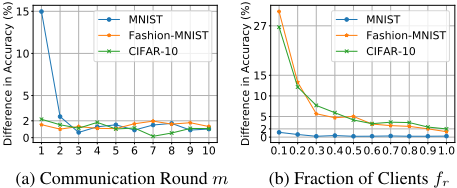
on MNIST, but affects significantly the performance on FMNIST and CIFAR-10. When fr is close to 1, LDP-FL can achieve almost the same performance as the noise-free results on MNIST, FMNIST and CIFAR-10, as shown in Fig. 5(a-c). Another important parameter is the communication rounds between cloud and clients. It is not hard to see that with more communications, we can train a better model on all datasets through the proposed model. However, due to the complexity of data and tasks, CIFAR-10 needs more communication rounds for a better model.
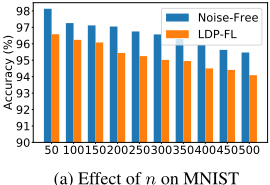
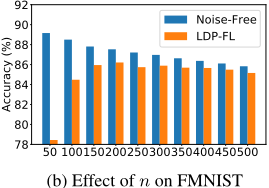
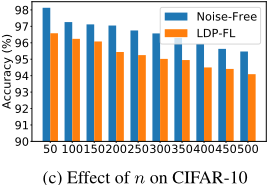
Fig. 3 shows that LDP-FL can achieve a high accuracy with a low privacy cost because of the new design of the communication and the new local data perturbation. While increasing the number of clients n in training, the LDP-FL can perform as close as the noise-free federated learning. Compared with MNIST (n = 100, ϵ = 1), FMNIST (n = 200, ϵ = 5), CIFAR-10 (n = 500, ϵ = 10) needs more clients, which indicates that for a more complex task with a larger neural network model, it requires more local data and more clients for a better performance against the data perturbation. The privacy budget also affects the performance of the central model, but more details will be discussed in the next section.
5.2 Performance Analysis and Comparison
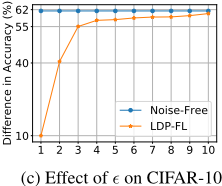
In Fig.5(a-c), LDP-FL can achieve 96.24% accuracy with ϵ = 1 and n = 100, 86.26% accuracy with ϵ = 4, n = 200 and 61.46% accuracy with ϵ = 10, n = 500 on MNIST, FMNIST and CIFAR-10, respectively. Our results are very competitive comparing to other previous works. [Geyer et al., 2017] first apply DP on federated learning. While they use
100 clients, they can only achieve 78%, 92% and 96% accuracy with (ϵ, m) = (8, 11), (8, 54) and (8, 412) guaranteed on MNIST with differential privacy, where (ϵ,m) represents the privacy budget and the communication rounds. [Bhowmick et al., 2018] first utilize the LDP in federated learning. Due to the high variance of their mechanism, it requires more than 200 communication rounds and spends much more privacy budgets, i.e., MNIST (ϵ = 500) and CIFAR-10 (ϵ = 5000). Last, the most recent work [Truex et al., 2020] utilizes Condensed Local Differential Privacy (α-CLDP) into federated learning, with 86.93% accuracy on FMNIST dataset. However, α-CLDP achieved that performance by requiring a relatively large privacy budget ϵ = α · 2c · 10ρ (e.g. α = 1, c = 1, ρ = 10), which results in a weak privacy guarantee. Compared to existing works, our approach needs many fewer communication rounds between clients and cloud (i.e., 10 for MNIST, 15 for FMNIST and CIFAR-10), which makes the whole solution more practical in real scenarios. Overall, LDP-FL achieves better performance on both effectiveness, efficiency and privacy cost than prior works.
5.3 Analysis of Privacy Budget
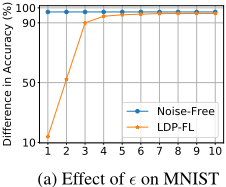
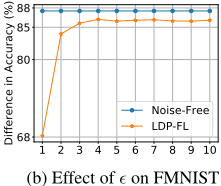
To analyze the impact of privacy budgets on performance, we present the accuracy results with ϵ from 0.1 to 1 for MNIST, 1 to 10 FMNIST and 1 to 10 for CIFAR-10 in Fig. 5 (a-c). It shows that LDP-FL can maintain the accuracy at a high value for a wide range of privacy budgets on MNIST (ϵ > 0.3), FMNIST (ϵ > 2) and CIFAR-10 (ϵ > 5). While ϵ < 0.3 for MNIST, ϵ < 2 for FMNIST and ϵ < 3 for CIFAR-10, the accuracy drops significantly. It is obvious that more complex data and tasks require more privacy cost. The main reason is that the complex task requires a sophisticated neural network, which contains a large number of model weights. Meanwhile, the range of each weight is also wider in the complex task, which causes a larger variance for the estimated weights.
5.4 Analysis of Adaptive Range Setting
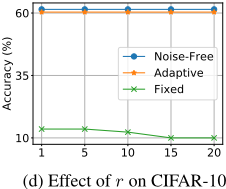
To analyze the effectiveness of the adaptive weight range, we compare the accuracy with fixed range versus that with adaptive range for all three benchmark datasets in Table 1. We run the experiments for the privacy budget of ϵ = 5, and ϵ = 10, respectively. Clearly, for CIFAR-10, the adaptive range setting presents the greatest performance improvement over the fixed range setting. For example, in CIFAR-10 with ϵ = 10, if (c, r) = (0, 1) is chosen for the fixed ranging setting, the adaptive range setting improves the accuracy by 45% over the fixed range setting. While on less complex datasets such as FMNIST and MNIST, we observe that the advantage of adaptive range setting gradually disappears. Specifically, on the MNIST dataset, there is no obvious difference in the accuracy achieved by the adaptive range setting and by the fixed range. This is because the model on CIFAR-10 is much deeper and more complex, such that the model weights' range in each layer differs significantly. In such a case, the adaptive range setting is able to reduce the variance of the estimated weights in some layers when the corresponding weight range is small. This improves the model accuracy dramatically. The results also explain why previous approach using fixed range can achieve a good accuracy on simple and shallow model.
| ϵ | Fixed | Adaptive | |
|---|---|---|---|
| MNIST (n=100) | 5 | 96.34% | 96.06% |
| MNIST (n=100) | 10 | 96.39% | 96.11% |
| FMNIST (n=200) | 5 | 85.95% | 87.54% |
| FMNIST (n=200) | 10 | 86.10% | 87.57% |
| CIFAR (n=500) | 5 | 13.54% | 58.89% |
| CIFAR (n=500) | 10 | 14.28% | 60.37% |
We take a closer look at the performance for CIFAR-10 with ϵ = 10. As illustrated in Figure 5(d), no matter how we tune the value of r for fixed range setting, the model accuracy always stay around 20% and can never be improved. The reason might be that the larger r increases the variance of model weights estimation, while the smaller r may generate the perturbed weights irrelevant to the true data range and cause an accuracy loss. We argue that for deeper neural networks, the fixed range setting might completely fail.
6 RelatedWork
Differential privacy [Dwork et al., 2014] provides a mathematically provable framework to design and evaluate a privacy protection scheme. Traditional differential privacy [Dwork et al., 2014], also known as Central Differential Privacy (CDP), considers the private data publication of the aggregated raw data. It usually assumes that a trusted data curator in the cloud perturbs the data statistic information by differential privacy mechanism. However, such assumption is often unrealistic in many use cases. Therefore, a new differential privacy model, Local Differential Privacy (LDP), was recently proposed [Duchi et al., 2013], in which, the raw data is perturbed before being sent to the data curator in the cloud.
Recently, more works studies how to use DP in federated learning [Geyer et al., 2017; McMahan et al., 2017] or use LDP in the federated learning [Bhowmick et al., 2018; Nguyên et al., 2016; Seif et al., 2020; Truex et al., 2020]. However, existing approaches can not be applied practically on deep learning. Some of them [Nguyên et al., 2016; Seif et al., 2020] only focus on small tasks and simple datasets and do not support deep learning approaches yet. The other works [Bhowmick et al., 2018; Truex et al., 2020] studied the LDP on federated learning problem. However, as we discussed in the experiments part, both of them hardly achieve a good performance with a small limited budget. Bhowmick et al. [Bhowmick et al., 2018] is the first work focus on the LDP on federated learning with deep learning models. However, it first need a strong assumption that attacker has little prior acknowledge about user data. Meanwhile, it spends ϵ = 500 for MINST and ϵ = 5000 for CIFAR-10, which means the LDP is not practical and needs traditional differential privacy for second protection. Last, they did not report the absolute performance on MNIST and CIFAR-10. Truex et al. [Truex et al., 2020] is another recent work. It uses It contains two obvious problems. First, it replaces LDP by Condensed LDP (CLDP), which spends a large privacy budget ϵ with a large clip bound reported in the work. Second, this work does not provide a complete privacy utility analysis of the number of weights and communication rounds. Due to the high variance of the noises in their approaches, it requires more communication rounds between cloud and clients, which spends more privacy cost in their framework. Our approach focus on solving the weakness of all previous approaches and accelerates the practical solution on complex dataset.
7 Conclusion
In this paper, we propose a new LDP mechanism for federated learning with DNNs. By giving a generalized data perturbation that is applicable for arbitrary input ranges, we proposed an adaptive range setting for improving privacy/utility trade-off. We also designed a parameter shuffling mechanism to mitigate the privacy degradation caused by high data dimension and many query iterations. Our empirical studies demonstrate that the performance of LDP-FL is superior to the previous related works on the same image classification tasks. Hopefully, our work can considerably accelerate the practical applications of LDP in federated learning.
@inproceedings{ijcai2021p217,
  title     = {LDP-FL: Practical Private Aggregation in Federated Learning with Local Differential Privacy},
  author    = {Sun, Lichao and Qian, Jianwei and Chen, Xun},
  booktitle = {Proceedings of the Thirtieth International Joint Conference on
               Artificial Intelligence, {IJCAI-21}},
  publisher = {International Joint Conferences on Artificial Intelligence Organization},
  editor    = {Zhi-Hua Zhou},
  pages     = {1571--1578},
  year      = {2021},
  month     = {8},
  note      = {Main Track},
  doi       = {10.24963/ijcai.2021/217},
  url       = {https://doi.org/10.24963/ijcai.2021/217},
}
TY - CPAPER TI - LDP-FL: Practical Private Aggregation in Federated Learning with Local Differential Privacy AU - Sun, Lichao AU - Qian, Jianwei AU - Chen, Xun T2 - Proceedings of the Thirtieth International Joint Conference on Artificial Intelligence, IJCAI-21 PB - International Joint Conferences on Artificial Intelligence Organization PY - 2021 SP - 1571 EP - 1578 DO - 10.24963/ijcai.2021/217 UR - https://doi.org/10.24963/ijcai.2021/217 ER -Copied
Machine-readable versions of this paper, for tools and AI agents:





