
Weaving a Semantic Web of Credibility Reviews for Explainable Misinformation Detection (Extended Abstract)
Proceedings of the Thirtieth International Joint Conference on Artificial Intelligence. Sister Conferences Best Papers. Pages 4760-4764.
https://doi.org/10.24963/ijcai.2021/646
Keywords
- Natural Language Processing: NLP Applications and Tools
- AI Ethics, Trust, Fairness: Societal Impact of AI
- AI Ethics, Trust, Fairness: Explainability
- Knowledge Representation and Reasoning: Semantic Web
Abstract
This paper summarises work where we combined semantic web technologies with deep learning systems to obtain state-of-the art explainable misinformation detection. We proposed a conceptual and computational model to describe a wide range of misinformation detection systems based around the concepts of credibility and reviews. We described how Credibility Reviews (CRs) can be used to build networks of distributed bots that collaborate for misinformation detection which we evaluated by building a prototype based on publicly available datasets and deep learning models.
- [Babakar and Moy, 2016] Mevan Babakar and Will Moy. The State of Automated Factchecking. https://fullfact.org/media/uploads/full fact-the state of automated factchecking aug 2016.pdf, August 2016. Accessed: 2021-06-26. Link
- [Cazalens et al., 2018] Sylvie Cazalens, Philippe Lamarre, Julien Leblay, Ioana Manolescu, and Xavier Tannier. A Content Management Perspective on Fact-Checking. In The Web Conference, 2018.
- [Denaux and Perez-Gomez, 2020] Ronald Denaux and Jose Manuel Perez-Gomez. Linked Credibility Reviews for Explainable Misinformation Detection. In 19th International Semantic Web Conference, nov 2020.
- [Denaux et al., 2020] Ronald Denaux, Flavio Merenda, and Jose Manuel Perez-Gomez. Towards Crowdsourcing Tasks for Accurate Misinformation Detection. In Seman- tics for Online Misinformation Detection, Monitoring, and Prediciton. SEMIFORM@ISWC20, volume 2722. CEUR- WS, nov 2020.
- [Guha et al., 2016] Ramanathan V Guha, Dan Brickley, and Steve Macbeth. Schema. org: evolution of structured data on the web. Communications of the ACM, 59(2):44-51, 2016.
- [Hassan et al., 2017] Naeemul Hassan, Gensheng Zhang, Fatma Arslan, Josue Caraballo, Damian Jimenez, Sid- dhant Gawsane, Shohedul Hasan, Minumol Joseph, Aa- ditya Kulkarni, Anil Kumar Nayak, Vikas Sable, Chengkai Li, and Mark Tremayne. Claim buster: The first-ever end- to-end fact-checking system. Proceedings of the VLDB Endowment, 10(12):1945-1948, 2017.
- [Marwick and Lewis, 2017] Alice Marwick and Rebecca Lewis. Media manipulation and disinformation online. New York: Data & Society Research Institute, 2017.
- [Mensio and Alani, 2019a] Martino Mensio and Harith Alani. MisinfoMe: Who's Interacting with Misinforma- tion? In 18th International Semantic Web Conference: Posters & Demonstrations, 2019.
- [Mensio and Alani, 2019b] Martino Mensio and Harith Alani. News Source Credibility in the Eyes of Different Assessors. In Conference for Truth and Trust Online. In Press, 2019.
- [Nakov et al., 2018] Preslav Nakov, Alberto Barrón-Cedeño, Reem Suwaileh, Lluís M ' Arquez, Wajdi Zaghouani, Pepa Atanasova, Spas Kyuchukov, Giovanni Da, and San Mar- tino. Overview of the CLEF-2018 CheckThat! Lab on Au- tomatic Identification and Verification of Political Claims. In International Conference of the Cross-Language Eval- uation Forum for European Languages, pages 372--387, 2018.
- [Papadopoulos et al., 2016] Symeon Papadopoulos, Kalina Bontcheva, Eva Jaho, Mihai Lupu, and Carlos Castillo. Overview of the special issue on trust and veracity of infor- mation in social media. ACM Transactions on Information Systems (TOIS), 34(3):1-5, 2016.
- [Pérez-Rosas et al., 2018] Verónica Pérez-Rosas, Bennett Kleinberg, Alexandra Lefevre, and Rada Mihalcea. Au- tomatic Detection of Fake News. In COLING, 2018.
- [Pomerleau and Rao, 2017] Dean Pomerleau and Delip Rao. The fake news challenge: Exploring how artificial intel- ligence technologies could be leveraged to combat fake news. http://www.fakenewschallenge.org/, 2017. Ac- cessed: 2021-06-26. Link
- [Schiller et al., 2021] Benjamin Schiller, Johannes Daxen- berger, and Iryna Gurevych. Stance Detection Bench- mark: How Robust Is Your Stance Detection? KI- Künstliche Intelligenz, March 2021. https://doi.org/10. 1007/s13218-021-00714-w. DOI
- [Shu et al., 2020] Kai Shu, Deepak Mahudeswaran, Suhang Wang, Dongwon Lee, and Huan Liu. FakeNewsNet: A Data Repository with News Content, Social Context and Spatialtemporal Information for Studying Fake News on Social Media. Big Data, 8:171-188, 2020.
- [Wang et al., 2018] Dongsheng Wang, Jakob Grue Simon- sen, Birger Larsen, and Christina Lioma. The Copenhagen Team Participation in the Factuality Task of the Competi- tion of Automatic Identification and Verification of Claims in Political Debates of the CLEF-2018 Fact Checking Lab. CLEF (Working Notes), 2125, 2018.
- [Zubiaga et al., 2018] Arkaitz Zubiaga, Ahmet Aker, Kalina Bontcheva, Maria Liakata, and Rob Procter. Detection and resolution of rumours in social media: A survey. ACM Computing Surveys, 51(2), 2018.
References were extracted automatically from the PDF and may contain errors.
Full text extracted automatically from the PDF; figures, tables and equations may differ. The PDF is the version of record.
1 Introduction
Although misinformation is not a new problem, the Web -due to the pace of news cycles combined with social media, and the information bubbles it creates- has increasingly evolved into an ecosystem where misinformation can thrive [Marwick and Lewis, 2017] with negative societal effects. Tackling misinformation 1 is not something that can be achieved by a single organization -as evidenced by struggling efforts by the major social networks- as it requires decentralisation, common conceptualisations, transparency and collaboration [Cazalens et al., 2018].
Technical solutions for computer-aided misinformation detection and fact-checking have recently been proposed [Babakar and Moy, 2016; Hassan et al., 2017] and are essential due to the scale of the Web. The research community has defined various NLP and information retrieval tasks including check-worthiness [Nakov et al., 2018] and stance detection [Schiller et al., 2021; Pomerleau and Rao, 2017], while others aim to use text classification as a means of detecting deceptive language [P´erez-Rosas et al., 2018] or rumours [Zubiaga et al., 2018]. However, these systems only solve part of the problem and it requires custom integration. Furthermore, a lack of hand-curated data, maturity and scope of current AI systems, means assessing veracity [Papadopoulos et al., 2016] is not feasible and often such systems do not generalize well to new types of data. Hence the value of the current systems is not so much their accuracy, but rather their capacity of retrieving potentially relevant information that can help human fact-checkers, who are the main intended users of such systems and are ultimately responsible for verifying/filtering the results such systems provide. Therefore, a main challenge is developing automated systems which can help the general public, and social media users in particular, to assess the credibility of web content, which requires explainable results by AI systems. This points towards the need for hybrid approaches that enable the use of the best of deep learning-based approaches, but also of symbolic knowledge graphs to enable better collaboration between large platforms, fact-checkers, the general public and other stakeholders like policy-makers, journalists, webmasters, and influencers.
1 https://ec.europa.eu/digital-single-market/en/tackling-onlinedisinformation
Our intuition was to focus on credibility rather than accuracy. Credibility, defined as an estimation of factuality based on available signals or evidence, stems from earlier work MisinfoMe [Mensio and Alani, 2019b; Mensio and Alani, 2019a] which in turn borrowed from social science, media literacy and journalism research. There is also ongoing work on W3C Credibilty Signals 2 , which aims to define a vocabulary to specify credibility indicators that may be relevant for assessing the credibility of some web content. To the best of our knowledge, this is still work in progress and no systems are implementing the proposed vocabularies.
In this paper, we summarize work presented at the International Semantic Web Conference [Denaux and Perez-Gomez, 2020], where we proposed a design on how to use semantic web technologies to aid in resolving such challenges. Our contributions are:
- a datamodel and architecture of distributed agents for composable credibility reviews, including a lightweight extension to schema.org to support provenance and explainability (section 2)
- an implementation of the architecture demonstrating feasibility and value
- an evaluation on three datasets establishing state-of-theart in one (Clef'18 CheckThat! Factuality task) and demonstrating capabilities and limitations of our approach (section 3)
2 https://credweb.org/signals-beta/
2 Linked Credibility Reviews
Linked Credibility Reviews (LCR) [Denaux and PerezGomez, 2020], is a (conceptual and data) model for composable and explainable misinformation detection. Our conceptual model defines a Credibility Reviews (CR) and implements it as an extension of a Review as defined by the Schema.org vocabulary [Guha et al., 2016] 3 . We define a CR as a tuple 〈d, r, c, p〉, where the CR:
- reviews a data item d, this can be any linked-data node but will typically refer to articles, claims, websites, images, social media posts, people, publishers, etc.
- assigns a credibility rating r to the data item under review and qualifies it with a rating confidence c.
- provides mandatory provenance information p about:
- credibility signals used to derive the credibility rating, which can be either (i) CRs for data items relevant to the data item under review or (ii) ground credibility signals (GCS), resources (which are not CRs) in databases curated by a trusted party.
- the author of the review. The author can be a person, organization or bot. Bots are automated agents that produce CRs for supported data items based on a variety of strategies.
A key insight is that calculations of credibility are ultimately subjective and have to be modeled accordingly. Hence, the credibility rating provides a subjective (from the point-of-view of the author) measure of how much the credibility signals support or refute the content in data item. Provenance information is therefore crucial as it allows humans - e.g. end-users, bot developers- to retrace the CRs back to the ground credibility signals and assess the accuracy of the (possibly long) chain of bots (and ultimately humans) that were involved in reviewing the initial data item. The provenance also enables the generation of explanations for each step of the credibility review chain in a composable manner as each bot (or author) can describe its own strategy to derive the credibility rating based on the used credibility signals.
2.1 Reviewing Strategies and Implementations
In our ISWC paper [Denaux and Perez-Gomez, 2020], we formally define strategies for computing CRs and thus implementing bots that can collaborate in the construction of chained credibility reviews. Intuitively, the identified strategies were:
- ground credibility signal lookup from some trusted source. CR bots map simple queries to ground credibility signals. We demonstrated this by implementing two bots. The first one returns ClaimReview instances for known claims 4 . Our implementation is based on a database of 45K ClaimReviews. A second bot was derived by writing a wrapper around the existing MisinfoMe aggregation service [Mensio and Alani, 2019b],
3 See also https://schema.org/Review
4 ClaimReview markup 5 , is defined by schema.org and enables fact-checkers to publish their work as machine readable structured data.
- which produces credibility values for websites from existing services and datasets like OpenSources 6 .
- linking some web content to review d with n other data items d′i of the same type, for which a CR is available. In these cases, the polar similarity (e.g. similar but disagreeing) between contents have to be taken into account when propagating the credibility scores (and their confidences). We implemented a linking bot by combining two RoBERTa deep learning models for semantic similarity and stance detection.
- decomposing whereby the bot identifies relevant parts d′i of the item-to-review d and requests CRs for those parts CRd′i . Like the linking bots, these require deriving new credibility ratings CRdi and confidences based on the relation between the whole and the parts. We implemented a decomposing bot using a proprietary (but common) sentence detection system optionally filtered using a RoBERTa checkworthiness checker.
2.2 Representing and Aggregating Ratings
For ease of computation, we recommend to represent credibility ratings and their confidences as follows:
- r ∈ ℜ, must be in the range of [-1.0, 1.0] where -1.0 means not credible and 1.0 means credible
- c ∈ ℜ, must be in the range of [0.0, 1.0] where 0.0 means no confidence at all and 1.0 means full confidence in the accuracy of r, based on the available evidence in p.
This representations makes it possible to define generic, relatively straightforward aggregation functions like selecting sub-reviews with the highest confidence value or the lowest credibility rating.
2.3 Extending schema.org for LCR
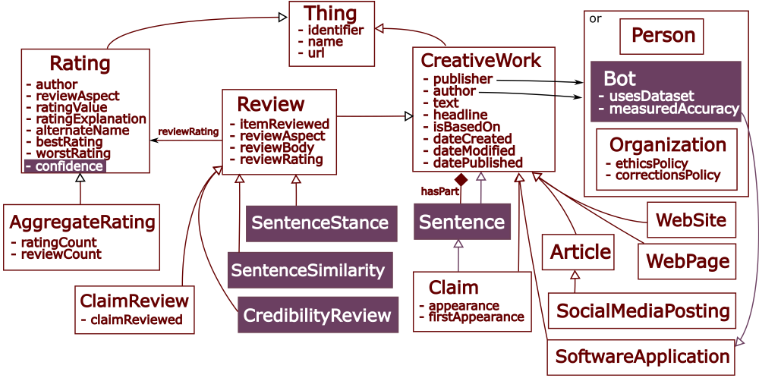
A large proportion of content online is already described by webmasters using schema.org, which already provides a vocabulary to describe Reviews. We identified some basic extensions compliant with the original definitions which allow us to contribute to the schema.org ecosystem. Mainly, we added various new subtypes of Reviews, a Sentence type, a confidence property to schema:Rating and we allow Bots to also author CreativeWorks. An overview of the schema.org based data model and our extensions is depicted in figure 1.
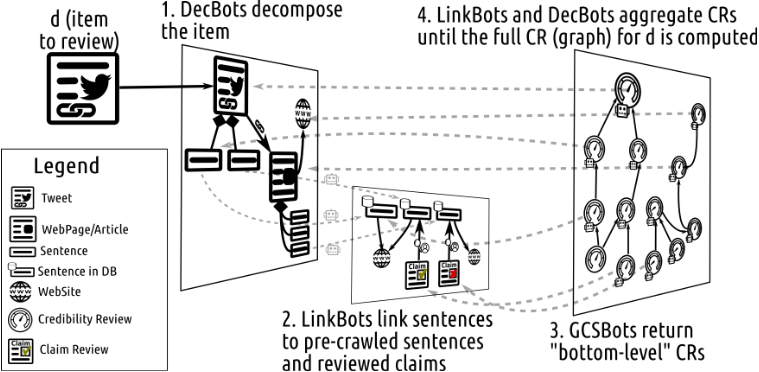
Figure 2 shows a diagram depicting how the various CR bots compose and collaborate to review a tweet. Example reviews generated by out bots are presented in table 1. Our implementation, acred, is available on GitHub 7 .
3 Evaluation
We evaluated acred on three different datasets: first the Clef'18 CheckThat! Factuality Task (English part) [Nakov et al., 2018] for predicting whether a check-worthy claim is true, half-true or false. It contains 74 and 139 claims for training and testing respectively. The second Bot
6 https://github.com/BigMcLargeHuge/opensources
7 https://github.com/rdenaux/acred
Example explanation
LookupBot ClaimRev Claim 'Ford is moving all of their small-car productin to Mexico.' is mostly not credible based on a fact-check by politifact with normalised numeric ratingValue 2 in range [1-5]
LinkBot SemSim Sentence
DecBotSocMedia Sentence When Senator Clinton or President Clinton asserts that I said that the Republicans had had better economic policies since 1980, that is not the case. seems not credible as it agrees with sentence:
Obama said that 'since 1992, the Republicans have had all the good
ideas...' that seems not credible based on a fact-check by politifact with textual rating 'false'. Take into account that the sentence appeared in site www.cnn.com that seems credible based on 2 review(s) by external rater(s) NewsGuard or Web Of Trust
Sentence Absolutely fantastic, there is know difference between the two facist socialist powers of today's EU in Brussels, and the yesteryears of Nazi Germany in tweet agrees with:
'You see the Nazi platform from the early 1930s ... look at it compared to the (Democratic Party) platform of today, you're saying, 'Man, those things are awfully similar.'' that seems not credible based on a fact-check by politifact with textual claim-review rating 'false'"
Table 1: Example explanations generated by our bots.
| label | r | c |
|---|---|---|
| credible | r ≥ 0.5 | c > 0.7 |
| mostly credible | 0.5 > r ≥ 0.25 | c > 0.7 |
| uncertain | 0.25 > r ≥ -0.25 | c > 0.7 |
| mostly not credible | -0.25 > r ≥ -0.5 | c > 0.7 |
| not credible | -0.5 > r | c > 0.7 |
| not verifiable | any | c ≤ 0.7 |
| system | MAE | F1 | Macro AvgR |
|---|---|---|---|
| acred | 0.6835 | 0.4247 | 0.4367 |
| acred+ | 0.6475 | 0.3741 | 0.4202 |
| Copenhagen | 0.7050 | 0.4008 | 0.4502 |
| random | 0.8345 | 0.3569 | 0.3589 |
Table 3: Results on clef18 English test dataset compared to baselines . MAE (Mean Average Error) is the official metric in the competition.
dataset was the Politifact fragment of FakeNewsNet [Shu et al., 2020] where the task is to predict whether articles are fake (420) or real (528). Finally, coinform250 8 is a dataset of 250 annotated tweets previously reviewed by factcheckers and with associated ClaimReviews retrieved by MisinfoMe [Mensio and Alani, 2019a]. The original factchecker labels were mapped onto six labels (see table 2) by 7 human raters achieving Fleiss κ 0.52 (moderate agreement). The fine-grained labels make this challenging but realistic.
For each dataset our prediction procedure consisted in steps to (i) read samples, (ii) convert them to the appropriate schema.org data items (Sentence, Article or SocialMediaPost), (iii) request a review from the approriate acred CR bot and (iv) map the produced CR onto the dataset labels by defining confidence c and credibility rating r thresholds. For clef18 we set t = 0.75, so that r values above t are TRUE, below -t are FALSE and in between is HALF-TRUE. Table 2 shows thresholds for coinform250.
3.1 Results
Initial evauation on the datasets showed that acred was overly confident in some cases; this prompted us to introduce a modified version, acred+ with custom heuristics to reduce the confidence and rating values for Articles when only website credibility signals are available and when stance was either "unrelated" or "discuss".
On clef18, acred established a new state-of-the-art result, which was further improved with acred+ as shown in table 3. This result is noteworthy as the baseline systems, Copenhangen [Wang et al., 2018] and random [Nakov et al., 2018], used the training set of clef18; by contrast, acred did not use this data to finetune the underlying models.
On FakeNewsNet, acred+ obtained state of the art results and acred obtained competitive results in line with strong baseline systems reported in the original paper [Shu et al., 2020], shown in table 4. We consider as baselines systems which only use the article content, since acred does not use social context signals yet. Baselines used 80% of the data for training and 20% for testing, while we used 100% for testing.
8 https://github.com/co-inform/Datasets
| System | Accuracy | Precision | Recall | F1 |
|---|---|---|---|---|
| acred | 0.586 | 0.499 | 0.823 | 0.622 |
| acred+ | 0.716 | 0.674 | 0.601 | 0.713 |
| CNN | 0.629 | 0.807 | 0.456 | 0.583 |
| SAF/S | 0.654 | 0.600 | 0.789 | 0.681 |
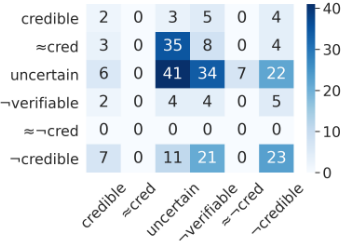
Finally, for the coinform250 dataset, acred+ obtains 0.279 accuracy which is well above a baseline of random predictions, which obtains 0.167 accuracy. The confusion matrix shown in figure 3 shows that acred tends to be overconfident in its predictions, while acred+ is more cautious.
3.2 Discussion and FutureWork
Our evaluation results show that our approach is capable of producing good results by integrating many readily available components. The proposed architecture initially does not require finetuning and can be reused to review a wide variety of web contents: single claims, tweets and articles; demonstrating composability and reusability. As a downside, errors in low-level modules (e.g. stance detection), may require handcrafting heuristic rules to correct. In the future it may be better to find automated ways to correct such errors. A caveat with our experimental results is that most datasets are (often indirectly) derived from fact-check articles and so is our database of claims (via ClaimReviews). This is bound to introduce noise, but lack of better datasets and evidence databases makes it hard to perform better experiments.
Our implementation can produce human understandable explanations and complex evidence graphs. We are researching how these outputs can be used to get user feedback to pinpoint the source of errors [Denaux et al., 2020].
Acknowledgments
This work was supported by the European Comission under grant 770302 - Co-Inform - as part of the Horizon 2020 research and innovation programme.
@inproceedings{ijcai2021p646,
  title     = {Weaving a Semantic Web of Credibility Reviews for Explainable Misinformation Detection (Extended Abstract)},
  author    = {Denaux, Ronald and Mensio, Martino and Gomez-Perez, Jose Manuel and Alani, Harith},
  booktitle = {Proceedings of the Thirtieth International Joint Conference on
               Artificial Intelligence, {IJCAI-21}},
  publisher = {International Joint Conferences on Artificial Intelligence Organization},
  editor    = {Zhi-Hua Zhou},
  pages     = {4760--4764},
  year      = {2021},
  month     = {8},
  note      = {Sister Conferences Best Papers},
  doi       = {10.24963/ijcai.2021/646},
  url       = {https://doi.org/10.24963/ijcai.2021/646},
}
TY - CPAPER TI - Weaving a Semantic Web of Credibility Reviews for Explainable Misinformation Detection (Extended Abstract) AU - Denaux, Ronald AU - Mensio, Martino AU - Gomez-Perez, Jose Manuel AU - Alani, Harith T2 - Proceedings of the Thirtieth International Joint Conference on Artificial Intelligence, IJCAI-21 PB - International Joint Conferences on Artificial Intelligence Organization PY - 2021 SP - 4760 EP - 4764 DO - 10.24963/ijcai.2021/646 UR - https://doi.org/10.24963/ijcai.2021/646 ER -Copied
Machine-readable versions of this paper, for tools and AI agents:





