
Characteristic Examples: High-Robustness, Low-Transferability Fingerprinting of Neural Networks
Proceedings of the Thirtieth International Joint Conference on Artificial Intelligence. Main Track. Pages 575-582.
https://doi.org/10.24963/ijcai.2021/80
Keywords
- Multidisciplinary Topics and Applications: Validation and Verification
- Multidisciplinary Topics and Applications: Security and Privacy
- AI Ethics, Trust, Fairness: AI and Law, Governance, Regulation
Abstract
This paper proposes Characteristic Examples for effectively fingerprinting deep neural networks, featuring high-robustness to the base model against model pruning as well as low-transferability to unassociated models. This is the first work taking both robustness and transferability into consideration for generating realistic fingerprints, whereas current methods lack practical assumptions and may incur large false positive rates. To achieve better trade-off between robustness and transferability, we propose three kinds of characteristic examples: vanilla C-examples, RC-examples, and LTRC-example, to derive fingerprints from the original base model. To fairly characterize the trade-off between robustness and transferability, we propose Uniqueness Score, a comprehensive metric that measures the difference between robustness and transferability, which also serves as an indicator to the false alarm problem. Extensive experiments demonstrate that the proposed characteristic examples can achieve superior performance when compared with existing fingerprinting methods. In particular, for VGG ImageNet models, using LTRC-examples gives 4X higher uniqueness score than the baseline method and does not incur any false positives.
- [Adi et al., 2018] Yossi Adi, Carsten Baum, Moustapha Cisse, and et al. Turning your weakness into a strength: Watermarking deep neural networks by backdooring. In {USENIX} Security, 2018.
- [Aramoon et al., 2021] Omid Aramoon, Pin-Yu Chen, and et al. Don't forget to sign the gradients! MLSyS, 2021.
- [Athalye et al., 2018] Anish Athalye, Nicholas Carlini, and David Wagner. Obfuscated gradients give a false sense of security: Circumventing defenses to adversarial examples. In ICML, 2018.
- [Brown and et al., 2020] Tom B Brown and et al. Language models are few-shot learners. NeurIPS, 2020.
- [Chen et al., 2019] Huili Chen, Bita Darvish Rouhani, Cheng Fu, and et al. Deepmarks: A secure fingerprinting framework for digital rights management of deep learning models. In ICMR, 2019.
- [Cheng et al., 2019] Shuyu Cheng, Yinpeng Dong, Tianyu Pang, and et al. Improving black-box adversarial attacks with a transfer-based prior. In NeurIPS, 2019.
- [Darvish Rouhani et al., 2019] Bita Darvish Rouhani, Huili Chen, and Farinaz Koushanfar. Deepsigns: An end-to-end watermarking framework for ownership protection of deep neural networks. In ASPLOS, 2019.
- [Deng et al., 2009] Jia Deng, Wei Dong, and et al. Imagenet: A large-scale hierarchical image database. In CVPR, 2009.
- [Fan and et al., 2019] Lixin Fan and et al. Rethinking deep neural network ownership verification: Embedding pass- ports to defeat ambiguity attacks. In NeurIPS, 2019.
- [Goodfellow et al., 2014] Ian J Goodfellow, Jonathon Shlens, and Christian Szegedy. Explaining and harnessing adversarial examples. arXiv, 2014.
- [Gu et al., 2017] Tianyu Gu, Brendan Dolan-Gavitt, and Sid- dharth Garg. Badnets: Identifying vulnerabilities in the machine learning model supply chain. arXiv, 2017.
- [Guo and Potkonjak, 2018] Jia Guo and Miodrag Potkonjak. Watermarking deep neural networks for embedded sys- tems. In ICCAD, 2018.
- [Guo et al., 2018] Chuan Guo, Jared S Frank, and et al. Low frequency adversarial perturbation. arXiv, 2018.
- [Guo et al., 2020] Yiwen Guo, Qizhang Li, and Hao Chen. Backpropagating linearly improves transferability of ad- versarial examples. NeurIPS, 2020.
- [Han et al., 2015] Song Han, Jeff Pool, John Tran, and William Dally. Learning both weights and connections for efficient neural network. In NeurIPS, 2015.
- [He and et al., 2016] Kaiming He and et al. Deep residual learning for image recognition. In CVPR, 2016.
- [He et al., 2019] Zecheng He, Tianwei Zhang, and Ruby Lee. Sensitive-sample fingerprinting of deep neural net- works. In CVPR, 2019.
- [Huang et al., 2017] Gao Huang, Zhuang Liu, Laurens Van Der Maaten, and Kilian Q Weinberger. Densely connected convolutional networks. In CVPR, 2017.
- [Krizhevsky and others, 2009] Alex Krizhevsky et al. Learn- ing multiple layers of features from tiny images. Citeseer, 2009.
- [Kurakin et al., 2016] Alexey Kurakin, Ian J Goodfellow, and Samy Bengio. Adversarial machine learning at scale. In ICLR, 2016.
- [Le Merrer et al., 2019] Erwan Le Merrer, Patrick Perez, and Gilles Trédan. Adversarial frontier stitching for remote neural network watermarking. Neural Computing and Ap- plications, 2019.
- [LeCun et al., 1998] Yann LeCun, Léon Bottou, Yoshua Bengio, and et al. Gradient-based learning applied to doc- ument recognition. IEEE, 1998.
- [Lin, 2007] Chih-Jen Lin. Projected gradient methods for nonnegative matrix factorization. NC, 2007.
- [Liu et al., 2018] Xuanqing Liu, Minhao Cheng, Huan Zhang, and Cho-Jui Hsieh. Towards robust neural net- works via random self-ensemble. In ECCV, 2018.
- [Lukas et al., 2019] Nils Lukas, Yuxuan Zhang, and Florian Kerschbaum. Deep neural network fingerprinting by con- ferrable adversarial examples. arXiv, 2019.
- [Madry et al., 2018] Aleksander Madry, Aleksandar Makelov, and et al. Towards deep learning models resistant to adversarial attacks. In ICLR, 2018.
- [Namba and Sakuma, 2019] Ryota Namba and Jun Sakuma. Robust watermarking of neural network with exponential weighting. In ASIACCS, 2019.
- [Rao and Yip, 2014] K Ramamohan Rao and Ping Yip. Dis- crete cosine transform: algorithms, advantages, applica- tions. Academic press, 2014.
- [Sharma et al., 2019] Yash Sharma, Gavin Weiguang Ding, and Marcus A Brubaker. On the effectiveness of low fre- quency perturbations. In AAAI, 2019. IJCAI
- [Simonyan and Zisserman, 2015] Karen Simonyan and An- drew Zisserman. Very deep convolutional networks for large-scale image recognition. 2015.
- [Szegedy and et al., 2013] Christian Szegedy and et al. In- triguing properties of neural networks. arXiv, 2013.
- [Uchida et al., 2017] Yusuke Uchida, Yuki Nagai, Shigeyuki Sakazawa, and Shin'ichi Satoh. Embedding watermarks into deep neural networks. In ICMR, 2017.
- [Wallace, 1992] Gregory K Wallace. The jpeg still picture compression standard. IEEE transactions on consumer electronics, 38(1), 1992.
- [Wang et al., 2019] Xiao Wang, Siyue Wang, Pin-Yu Chen, and et al. Protecting neural networks with hierarchical ran- dom switching: Towards better robustness-accuracy trade- off for stochastic defenses. In IJCAI, 2019.
- [Xie et al., 2019] Cihang Xie, Zhishuai Zhang, Yuyin Zhou, and et al. Improving transferability of adversarial exam- ples with input diversity. In CVPR, 2019.
- [Zhao et al., 2019] Yiren Zhao, Ilia Shumailov, and et al. To compress or not to compress: Understanding the interac- tions between adversarial attacks and neural network com- pression. MLSyS, 2019.
References were extracted automatically from the PDF and may contain errors.
Full text extracted automatically from the PDF; figures, tables and equations may differ. The PDF is the version of record.
1 Introduction
With the rapid development of machine learning and artificial intelligence, the efforts and resources spent in developing state-of-the-art machine learning models such as deep neural networks (DNNs) can be tremendous, and therefore it is of utmost importance to be able to claim the ownership of a well-trained model and its derived versions (e.g. pruned models). For instance, the cost of training current state-of-theart transformer based language model, GPT-3 [Brown and et al., 2020], is estimated to be at least 4.6 million US dollars 1 .
∗Equal Contribution
1 https://bdtechtalks.com/2020/08/17/
Imagine an unethical model thief purposely pruned the pretrained GPT-3 model and attempted to claim the ownership of the resulting compressed model. The solution to the challenge of "how to protect intellectual property for DNN models and reliably identify model ownership?" is literally worth million dollars.
Another motivating example is the surging trend of broad usage of neural network models across applications in cloudbased or embedded systems. For model owners deploying a model on the cloud, it is essential for them to verify the identity of the model to make sure that the model has not been tampered or replaced. Towards this direction, extensive research have been made to protect the IP of the neural network from different perspectives, which can be regard as fingerprinting/watermarking using weights embedding and image examples. However, most of these methods for DNN IP protection require intervention in training phase, which may cause performance degradation of the DNN (i.e., accuracy drop) and leave hidden danger of adversary to attack the DNN (i.e., backdoor attacks). Meanwhile, existing works often overlook the false positive problem of the DNN (i.e., mistakenly claiming the ownership of irrelevant models), which is of practical importance when designing fingerprints.
To better address the aforementioned limitations, this work proposes a novel approach to fingerprinting neural networks using Characteristic Examples (C-examples). Its advantages lies in (i) its generation process does not intervene with the training phase; and (ii) it does not require any realistic data from the training/testing set. By applying uniform random noise to the weights of the neural network with the combination of gradient mean descending technique, the proposed C-examples achieve high-robustness to the resulting models pruned from the base model where the fingerprints are extracted. When further equipped with a high-pass filter in the frequency domain of image data during the generation process, C-examples attain low-transferability to other models that are different from the base model.
Below we summarize our main contributions.
- We propose a novel and practical fingerprinting method called C-examples that achieves better robustness and transferability trade-off than current DNN fingerprinting methods without intervening with the training phase nor the dataset. In particular, we develop three kinds of Cexamples: vanilla C-examples, RC-examples, and LTRC-
examples to further improve fingerprinting performance.
- To better evaluate the trade-off between robustness and transferability, we propose a novel metric called Uniqueness Score that quantifies the utility of fingerprinting. The uniqueness scores of the proposed C-examples outperform other fingerprinting methods by a large margin. Specifically, LTRC-examples gives 4× higher uniqueness score than the baseline.
- This is the first work that thoroughly considers the false alarm problem in designing fingerprints. Our mechanisms featuring high-robustness and low-transferability can significantly decrease the false positive rate and achieve nearly perfect AUC and F1-score with LTRC-examples.
2 Background and RelatedWork
2.1 IP Protection of Deep Neural Networks
Extensive research efforts have been done recently on the DNN watermarking / fingerprinting methods for the DNN intellectual property protection and model integrity verification. These works can be classified as two main categories: (1) DNN watermarking or fingerprinting by weights embedding; (2) Watermarking or fingerprinting using image samples.
DNN watermarking following the first approach embeds watermarks into the model weight parameters through training from scratch, retraining, distillation, and requires whitebox access to the model to be tested. Towards this approach, Uchida et al. takes the first step to investigate the DNN watermarking by embedding a watermark in model weight parameters, using a parameter regularizer [Uchida et al., 2017]. Later on Rouhani et al. propose an end-to-end IP protection framework that enables the insertion of digital watermarks in the target DNN model before distributing the model [Darvish Rouhani et al., 2019]. Other works proposed by Chen et al. [Chen et al., 2019] and Fan et al. [Fan and et al., 2019] also contribute towards this approach.
The second approach extracts the watermarks by using a set of image samples. This line of work includes embedding watermarks in input gradients [Aramoon et al., 2021], or watermarking by using DNN backdoor attacks [Gu et al., 2017] to embed watermarks into the DNN model representation while using trigger images to test intellectual property infringement [Adi et al., 2018; Guo and Potkonjak, 2018; Namba and Sakuma, 2019]. Another direction is to extracts adversarial examples [Le Merrer et al., 2019; Lukas et al., 2019] or sensitive examples [He et al., 2019] from a DNN as its fingerprints. The main advantage of using adversarial examples is that it eliminates the need of training or re-training and enables the black-box testing capability.
2.2 Frequency Components and Transferability
It has been exploited in the area of signal processing and image compression that most of the critical content-defining information in natural images lies in the low end of the frequency spectrum [Wallace, 1992]. Based on this exploration, the relationship between frequency components of the images and its transferability have been discussed recently to generate adversarial examples as an attack to the neural networks with low frequency adversarial perturbations in order to achieve high-transferability [Guo et al., 2018; Sharma et al., 2019]. Specifically, by utilizing the wellknown discrete cosine transform (DCT), Sharma et al. propose a systematic experiments to evaluate the effectiveness of the low frequency adversarial perturbations by manipulating specific frequency components. They show that the application of using a low-pass filter in the frequency domain of the perturbation can effectively improve the transferability thus lead to higher attack success rate, the same phenomenon is also discussed in [Guo et al., 2018].
3 Characteristic Examples for Neural Network Fingerprinting
This section introduces our novel DNN fingerprinting technique through generating Characteristic Examples (Cexamples). The proposed C-examples are significantly different from widely-known adversarial examples [Szegedy and et al., 2013; Goodfellow et al., 2014] causing model misprediction. Instead, C-examples are data-free and aim to achieve high-robustness for passing through pruned variants of the base model and low-transferability for screening out any other models different from the base model.
We consider three types of DNN models that are of interest in C-examples. 1© Base Model: the pre-trained model to fulfill some designated task, such as image classification. 2© Pruned Models: the models pruned from the base model and implemented on the edge devices for inference execution. 3© Other Models: any other models that are neither 1© nor 2©. For example, if VGG16 is the Base Model, then VGG19, the ResNet family, etc. all belong to Other Models.
The proposed DNN fingerprinting framework is as follows: The 1© Base Model is used to generate C-examples with labels. Therefore C-examples have 100% accuracy on the Base Model. Then C-examples are used as fingerprints to test the models implemented on edge devices. A high accuracy is expected if the implemented model is 2©; while a low accuracy is expected if the implemented model is 3©.
It is a non-trival task to design C-examples that are both robust to 2© Pruned Models and exhibiting low-transferability on 3© Other Models. Adversarial example based other fingerprinting methods [Le Merrer et al., 2019; He et al., 2019] could not accomplish the above mentioned two objectives. High-transferability of adversarial examples to both pruned and variant models are regarded as an important property and been widely used in evaluating the attack effectiveness. In the context of adversarial examples, it is discussed in [Zhao et al., 2019] that transferability of adversarial samples between pruned and full models remains when the test accuracy of the networks drops slightly. Extensive research also proposed to improve the transferability of adversarial examples [Xie et al., 2019; Guo et al., 2020]. However, adversarial examples are not ideal fingerprints because their restricted assumptions on high similarity to true data and the goal of invoking incorrect model predictions.
3.1 Proposed C-Examples
In this section, our main methods are introduced in the context of image classification task by DNNs. We stress, however, that the proposed approach can be generalized to other types of tasks, data, and classification models. Let x ∈ R3×H×W denote a colored RGB image, where H and W are the image height and width, respectively. We scale pixel values of x to [0, 1] for mathematical simplicity. Fθ denotes the Base Model, which outputs y = Fθ(x) as a probability distribution for a total of M classes. The element yi represents the probability that an input x belongs to the i-th class.
The Base Model Fθ parameterized with θ is pre-trained. Then, C-examples are generated from Fθ. If we are given with a subset {l1, l2, . . . , lP} of P labels randomly chosen from the labels of training dataset, then a set of η-optimal C-examples X∗ can be characterized as:
We set η to 1 × 10⁻⁶ in order to guarantee the convergence of the generation. The Lossθ(·) denotes the loss function of Fθ. A C-example x minimizing the loss for a specified label l should satisfy the above constraint.
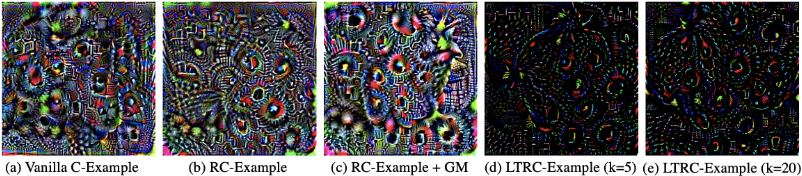
In order to be independent of data when extracting the base model features, we simply use a random seed to generate a Cexample, and therefore the generated C-examples are distinct from natural images for the human perception. A vanilla version C-example is shown in Figure 3 (a).
We choose to use the projected gradient decent (PGD) algorithm [Lin, 2007; Kurakin et al., 2016; Madry et al., 2018], which has been widely used as a general approach for solving constrained optimization problems. Then the C-example generation problem (1) can be solved with the PGD algorithm as follows:
where t is the iteration step index; x0 is the random starting point; α is the step size; sign(·) returns the element-wise sign of a vector; ∇x(·) calculates gradients; and Clip(·) denotes the clipping operation to satisfy the x ∈ [0, 1]n constraint. In summary, the PGD algorithm generates a C-example by iteratively making updates based on the gradients and then clipping into the ℓ∞-ball ([0, 1]n ).
3.2 C-Examples with Enhanced Robustness
All the existing works [Le Merrer et al., 2019; He et al., 2019] perform fingerprinting or watermarking for a neural network as it is. They can not differentiate the (benign) model compression - an essential step in implementing neural network models for on-the-edge inference execution, from other adversarial model perturbations. In our work, we tackle this challenge by improving the robustness of C-examples on 2© Pruned Models. It means that the C-examples generated from the 1© Base Model should also preserve a high test accuracy on 2© Pruned Models that are derived from the 1© Base Model. To achieve this, we propose an enhancement named Robust C-examples (RCexamples) over the vanilla version proposed in Section 3.1, by adding noise bounded by δ to the neural network parameter θ to mimic the model perturbation due to the model compression procedure for its implementation on edge devices. Here the loss is changed to Lossθ+∆, which similar idea of adding noises to DNN models has also been applied as a defense against adversarial example attacks [Liu et al., 2018;
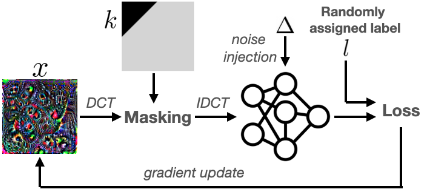
Wang et al., 2019]. ∆ presents the uniformly distributed weight perturbations within [-δ, δ], and we set δ as 0.001, 0.003, 0.005, 0.007 for ImageNet and 0.01, 0.03, 0.05, 0.07 for CIFAR-10, respectively, in the experiments.
Further Robustness Enhancement with Gradient Mean (GM). Furthermore, motivated by the Expectation Over Transformation (EOT) method [Athalye et al., 2018; Wang et al., 2019] towards stronger adversarial attacks, the proposed RC-examples can be further enhanced by calculating the mean of the input gradients in each iteration step. When computing input gradient, we sample input gradients for q = 10 times and use the mean of gradients in each iteration step of generating RC-examples.
3.3 RC-Examples with Low-Transferability
Besides enhancing the robustness of C-examples on 2© Pruned Models, it is desirable to exhibit low-transferability to 3©Other Models. In other words, the C-examples should be able to distinguish the implemented inference model on the edge device, if it is an 3© Other Model. Therefore, we further improve the RC-examples proposed in Section 3.2 by enforcing low-transferability, i.e., we propose the LowTransferability RC-examples (LTRC-examples). In this way, we can improve the capability of C-examples in detection for false positive cases, where positive means claiming the model ownership as ours in IP protection.
The frequency analysis [Guo et al., 2018; Sharma et al., 2019; Cheng et al., 2019] suggests that low frequency components can improve transferability of adversarial examples. Inspired by that, we propose to leverage high frequency components to achieve C-examples with low-transferability. Specifically, we apply a frequency mask on the Discrete Cosine Transform (DCT) [Rao and Yip, 2014] to implement a highpass filter in the frequency domain of the C-example.
As an important tool in signal processing, the DCT decomposes a given signal into cosine functions oscillating at different frequencies and amplitudes. For a 2D image, the DCT performed as ω = DCT(x) can transform the image x into the frequency domain, and ω(i,j) is the magnitude of its corresponding cosine functions with the values of i and j representing frequencies, where smaller values mean lower frequencies. The DCT is invertible, and the Inverse DCT (IDCT) is denoted as x = IDCT(ω). Note that here we apply DCT and IDCT for different color channels independently.
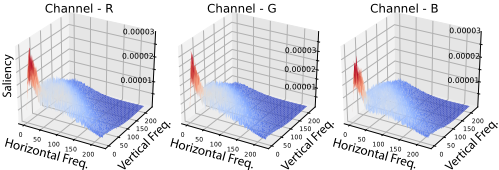
For most ImageNet images, we found that the lowfrequency components are mostly salient for deep learning classifiers. As shown in Figure 1, the low-frequency components in the red area around (0,0) have a larger contribution (with larger gradients) to the classification loss. Inspired by this phenomenon that the low-frequencies play a more important role in classifications and therefore are more transferable, we believe that filtering out these components can effectively lower the fingerprints transferability. To demonstrate this, we design the high-pass frequency mask as shown in Figure 2, where the high-frequency band size k controls the range of the filtered low-frequency components. The frequency mask is designed to be a 2D matrix with elements being either 0 or 1, i.e., m ∈ {0, 1}H×W which performs element-wise product with the DCT of C-example. At each iteration step to generate the fingerprints, the high-pass mask sets the lowfrequency components to 0, i.e., ω(i,j) = 0 if 1 ≤ i + j ≤ k, while keeping the rest of the high-frequency components. On ImageNet dataset with mask size H = W = 224 (H = W = 32 for CIFAR-10 dataset), the high-frequency band size k = 20 leads to 12 × 202 /2242 ≈ 0.4% of the frequency components set to 0.
By using the high-pass frequency mask, the LTRCexample at the (t + 1)-th iteration step can be derived by:
where the HighPass filter is defined as:
4 Performance Evaluation
4.1 Implementation Details
The experiments are conducted on machines with 8 NVIDIA GTX 1080 TI GPUs. We adopt the widely used public image datasets and models in the literature, including CNN model for CIFAR-10 [Krizhevsky and others, 2009] and VGG-16 [Simonyan and Zisserman, 2015] model for ImageNet [Deng et al., 2009] datasets, respectively.
Unless specified, the same set of hyper-parameters is used for generating C-examples on the same dataset in our experiments. To control the trade-off between robustness and transferability, we set the weight perturbation bound δ to 0.001, 0.003, 0.005, 0.007 separately for ImageNet dataset and 0.01, 0.03, 0.05, 0.07 for CIFAR-10 dataset. For each C-examples generation method, 100 C-examples are generated (with randomly picked target labels) with a total of 500 iteration steps
(i.e., t = 0, 1, ..., 499 as in Eq. (2)). We visualize the generated C-examples on ImageNet dataset in Figure 3.
In our experiment, we use the accuracy of the C-examples on the pruned model to indicate its robustness and the accuracy on the variant model (with similar functionality to the base model, e.g. VGG-19 model to the base VGG16 model) to indicate its transferabilty. Originally, the accuracy of all kinds of C-examples on the base model is 100% during generation. To effectively evaluate the tradeoff between robustness of the pruned models and transferability to other variant models, we define the difference between the robustness and transferability as Uniqueness Score (Uniqueness Score = Robustness - Transferability), where higher Uniqueness Score means the C-examples are more robust to pruned models and less transferable to variant models. Intuitively, a better fingerprint method should achieve higher uniqueness score. Uniqueness Score can also be used to indicate the false positive problem, i.e., if Uniqueness Score is negative, the corresponding fingerprint method is prone to make false model claims.
4.2 Comparative Methods
There are two works that are most relevant to our paper. [Le Merrer et al., 2019] extracts adversarial examples to watermark neural networks. Their experiment was conducted on MNIST dataset [LeCun et al., 1998] which only contains binary images of handwritten digits. Although, the method in [Le Merrer et al., 2019] is similar to our vanilla C-examples, we highlight that we use random initialization instead of true data and therefore our method is data-free. In our experiments, we report the performance of the vanilla C-examples as a baseline rather than the watermarking method [Le Merrer et al., 2019] due to their similarity. Another work proposes sensitive examples [He et al., 2019] from a DNN as its fingerprints. Similar to [Le Merrer et al., 2019], its fingerprinting also relies on adversarial examples. This paper regards all the pruned models as compression attack and reject the pruned models even the test accuracy degradation after pruning is minor (e.g., 0.65%). Different from [He et al., 2019], we believe that an effective fingerprinting method should be robust to pruned models and recognize pruned models as non-attack. To demonstrate the robustness problem of [He et al., 2019], we use pruned models to evaluate the robustness of sensitive examples. With 8 sensitive samples, the Robustness (i.e., accuracy on pruned models) is only 0.04%, demonstrating that pruning is treated as illegitimate by sensitive samples, which is unreasonable due to the wide application of DNN pruning for size reduction and inference acceleration especially on edge devices with limited resources.
4.3 Uniqueness Evaluation
We demonstrate the effectiveness of proposed C-examples, RC-examples, LTRC-examples on different pruned models using the base VGG-16 model on ImageNet dataset with different pruning ratio for evaluating robustness. For testing transferability to other variant models (such as VGG19, ResNet "Family", DenseNet "Family"), as VGG-19 is the most similar architecture to VGG-16 and more transferable for fingerprints generated on VGG-16, we only report The experiment is evaluated on 100 C-examples generated from VGG-16.
| Method | δ | Base Model VGG-16 (%) | Transferability to VGG-19 (%) | Uniqueness Score (%) | ||||
|---|---|---|---|---|---|---|---|---|
| 40% Pruned | 50% Pruned | 60% Pruned | 70% Pruned | 80% Pruned | ||||
| Vanilla C-Example | 0 | 100 | 47 | +13 | +13 | +13 | -5 | -22 |
| RC-Example | 0.001 | 100 | 60 | +30 | +30 | +23 | +22 | +0 |
| 0.003 | 100 | 88 | +6 | +11 | +5 | +2 | -3 | |
| 0.005 | 100 | 86 | +12 | +12 | +12 | +9 | +2 | |
| 0.007 | 100 | 95 | +4 | +4 | +3 | +2 | +3 | |
| RC-Example+GM | 0.001 | 100 | 55 | +34 | +37 | +35 | +23 | -7 |
| 0.003 | 100 | 67 | +30 | +38 | +38 | +21 | +19 | |
| 0.005 | 100 | 85 | +15 | +15 | +15 | +15 | +15 | |
| 0.007 | 100 | 100 | +0 | +0 | +0 | +0 | +0 | |
| LTRC-Example | 0 | 100 | 16 | +53 | +51 | +50 | +23 | +13 |
| 0.001 | 100 | 24 | +65 | +65 | +65 | +58 | +32 | |
| 0.003 | 100 | 75 | +25 | +25 | +25 | +25 | +23 | |
| 0.005 | 100 | 96 | +4 | +4 | +4 | +4 | +3 | |
| 0.007 | 100 | 98 | +2 | +2 | +2 | +2 | +2 | |
| Method | δ | Base Model | Transferability | Uniqueness Score (%) | ||||
|---|---|---|---|---|---|---|---|---|
| VGG-16 (%) | to VGG-19 (%) | 40% Pruned | 50% Pruned | 60% Pruned | 70% Pruned | 80% Pruned | ||
| LTRC-Example (k = 5) | 0.001 | 100 | 26 | +53 | +52 | +62 | + 45 | +14 |
| LTRC-Example (k = 10)) | 0.001 | 100 | 31 | +50 | +49 | +49 | +38 | +24 |
| LTRC-Example (k = 20) | 0.001 | 100 | 24 | +65 | +65 | +65 | +58 | +32 |
| LTRC-Example (k = 30) | 0.001 | 100 | 28 | +54 | +63 | +52 | +52 | +35 |
The experiment is evaluated on 100 C-examples generated from VGG-16.
Table 2: An Ablation Study of Uniqueness Score of LTRC-examples Generated with Various k Value.
the transferability on VGG-19 and omit the transferability results on other models such as ResNet "Family" or DenseNet "Family". Note that the transferability to other models should be lower than VGG-19, leading to better performance with higher uniqueness score.
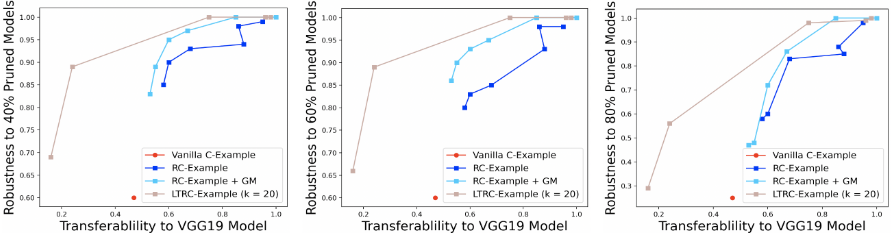
We plot and visualize the trade-off curve between robustness to the pruned models and transferability to variant models in Figure 4, and Table 1 further summarizes the corresponding Uniqueness Score with respect to each method. For better comparison, we only take our best choice of k = 20
| Method | δ | Base Model | Transferability to | Uniqueness Score (%) | ||
|---|---|---|---|---|---|---|
| CNN-1 (%) | Variant CNNs (%) | 80% Pruned | 90% Pruned | 95% Pruned | ||
| Vanilla C-Example | 0 | 100 | 68 | +17 | +5 | -30 |
| RC-Example | 0.01 | 100 | 74 | +26 | +18 | -5 |
| 0.03 | 100 | 78 | +22 | +16 | +2 | |
| 0.05 | 100 | 94 | +6 | +6 | +3 | |
| 0.07 | 100 | 96 | +4 | +4 | +2 | |
| LTRC-Example (k = 1) | 0 | 100 | 59 | +39 | +20 | -5 |
| 0.01 | 100 | 64 | +35 | +18 | -9 | |
| 0.03 | 100 | 78 | +21 | +15 | +1 | |
| 0.05 | 100 | 80 | +11 | +6 | -9 | |
| 0.07 | 100 | 83 | +10 | +5 | -3 | |
| LTRC-Example (k = 2) | 0 | 100 | 28 | +42 | + 40 | +35 |
| 0.01 | 100 | 31 | +48 | +44 | +38 | |
| 0.03 | 100 | 51 | +49 | +48 | +43 | |
| 0.05 | 100 | 61 | +39 | +36 | +35 | |
| 0.07 | 100 | 69 | +31 | +31 | +30 | |
| LTRC-Example (k = 3) | 0 | 100 | 36 | +20 | +19 | +15 |
| 0.01 | 100 | 39 | +25 | +21 | +17 | |
| 0.03 | 100 | 60 | +15 | +13 | +9 | |
| 0.05 | 100 | 71 | +13 | +9 | +4 | |
| 0.07 | 100 | 75 | +12 | +9 | -3 | |
The experiment is evaluated on 100 examples generated from base model CNN-1.
Table 3: Uniqueness Score of C-examples on Implemented Models by Different Weight Pruning Methods on the Base model CNN-1 with CIFAR-10 Dataset: The base model has 80.5% accuracy on test set. The base model is pruned by unstructured pruning [Han et al., 2015] with various pruning ratio, where it is pruned for 5 times at each pruning ratio and the average accuracy degradation for pruning ratio 80%, 90%, and 95% are 0.2%, 0.2%, and 0.8%, respectively. Here we use an optimal setting for LTRC-examples with k = 1, 2, 3. The robustness at each pruning ratio is reported by the summation of Uniqueness Score and the averaged accuracy of 20 variant CNN models representing the transferability of each group of C-examples.
for LTRC-examples. More details can be found in Table 2 for the ablation study of k value.
We summarize our findings from experiments as follows:
- For evaluating the trade-off between robustness and transferability, as shown in Figure 4, both RC-examples, RC-examples+GM, and LTRC-examples clearly outperforms the baseline vanilla C-examples as fingerprinting methods. By comparing RC-examples and RCexamples+GM, applying GM to the input gradients can significantly help with the fingerprinting performance on both robustness and transferability. The proposed LTRC-examples clearly outperforms C-examples, RCexamples, and RC-examples+GM for all pruned models, as LTRC-example applies both random perturbations to the weights and high-pass filters to remove the hightransferable low-frequency components during generation. Specifically, as the classification mainly relies on low-frequency components, LTRC-example can significantly decrease its transferbility to other models by applying the high-pass frequency mask.
- As shown in Table 1, uniqueness scores of RCexamples, RC-examples+GM, and LTRC-examples are higher than that of the baseline vanilla C-examples. We notice that C-examples suffer from negative uniqueness scores due to their high transferability to other models when the pruning ratios are 70% and 80%. We can observe that LTRC-examples with δ = 0.001 achieve the best uniqueness scores with relatively large margins (about 1.9X, 2.1X, and 5X that of the RCexamples+GM, RC-examples, and C-examples).
- In general, for a given method with fixed δ, the uniqueness score decreases if the pruning ratio increases since
larger pruning ratio degrades the test accuracy, leading to weaker model functionalities with less robustness after pruning. Meanwhile, we observe that with increasing δ, there are more uncertainty in the model with larger random perturbations, leading to more general C-examples to incorporate larger uncertainty. Thus they become more transferable to other variant models, resulting in increasing transferability and decreasing uniqueness score. For example, for LTRC-examples with δ = 0.001, with 40% pruned model, the uniqueness score is 65 while it becomes 2 with δ = 0.007.
The above findings and observations can also applied to CIFAR-10 dataset, where we use a CNN model (referred as CNN-1) as our base model to generate C-examples. The CNN-1 model has 13 convolutinal layers and 3 fullyconnected layers and can achieve an accuracy of 80.5% on test set. To test the transferability, we apply 20 variant CNN models with an average accuracy of 80.4% on the test set. They share the same model architecture as the base CNN-1 model but are trained from different random initialized weights. We summarize the experimental results for Cexamples on CIFAR-10 dataset in Table 3. We observe that LTRC-examples with k = 2 and δ = 0.03 achieve the best uniqueness scores than other methods.
4.4 Ablation Study on High-frequency Band Size k
In order to investigate the effect of k value in our experiment for LTRC-examples, we further perform ablation study on k. Motivated by our findings in Figure 1 that low-frequency components concentrated within the range of [0, 20], the value k is set to 5, 10, 20, and 30. We test the effectiveness of LTRC-examples with different k values using the best δ = 0.001 in Table 2. More detailed results with different δ
| Method | Base Model VGG-16 (%) | Transferability (%) | Uniqueness | Score | (%) | |||||
|---|---|---|---|---|---|---|---|---|---|---|
| δ | to VGG-19 | 40% Pruned | 50% Pruned | 60% Pruned | 70% Pruned | 80% Pruned | ||||
| LTRC-Example (k = 5) | 0 | 100 | 21 | +49 | + 49 | +50 | +33 | + 10 | ||
| 0.001 | 100 | 26 | +53 | +52 | +62 | + 45 | +14 | |||
| 0.003 | 100 | 68 | + 26 | +28 | +28 | +26 | +12 | |||
| 0.005 | 100 | 90 | +8 | +8 | +6 | +5 | -4 | |||
| 0.007 | 100 | 93 | +7 | +7 | +7 | +7 | +6 | |||
| LTRC-Example (k = 10)) | 0 | 100 | 18 | +48 | + 45 | +46 | +26 | +10 | ||
| 0.001 | 100 | 31 | +50 | +49 | +49 | +38 | +24 | |||
| 0.003 | 100 | 67 | +29 | +31 | +31 | +30 | +22 | |||
| 0.005 | 100 | 90 | +8 | +9 | +10 | +10 | +8 | |||
| 0.007 | 100 | 93 | +3 | +3 | +4 | +4 | +6 | |||
| LTRC-Example | 0 | 100 | 16 | +53 | +51 | +50 | +23 | +13 | ||
| (k = 20) | 0.001 | 100 | 24 | +65 | +65 | +65 | +58 | +32 | ||
| 0.003 | 100 | 75 | +25 | +25 | +25 | +25 | +23 | |||
| 0.005 | 100 | 96 | +4 | +4 | +4 | +4 | +3 | |||
| 0.007 | 100 | 98 | +2 | +2 | +2 | +2 | +2 | |||
| LTRC-Example (k = 30) | 0 | 100 | 18 | +53 | +50 | +52 | +19 | +8 | ||
| 0.001 | 100 | 28 | +54 | +63 | +52 | +52 | +35 | |||
| 0.003 | 100 | 76 | +24 | +24 | +24 | +22 | +19 | |||
| 0.005 | 100 | 98 | +2 | +2 | +2 | +2 | +0 | |||
| 0.007 | 100 | 98 | +2 | +2 | +2 | +2 | +0 | |||
Table 4: An Ablation Study of Uniqueness Score of LTRC-examples Generated with Various k Value.
are summarized in Table 4.
We observe that with k = 20, LTRC-examples achieve superior performance in uniqueness score demonstrating better trade-off between robustness and transferability. We notice that when k increases from 5 to 20, uniqueness score increases, as larger k values can remove more low-frequency components of the generated examples, making them less transferable to variant models. Furthermore, as we increase k from 20 to 30, uniqueness score drops. The reason behind is that as larger k removes more low-frequency components, the test accuracy of pruned models suffers from relatively larger degradation, making the robustness reduction dominant in uniqueness score decreasing.
4.5 False Alarm and Utility Analysis
We evaluate the proposed C-examples under false alarm scenario, which is essential in practical usage. Given a group of legally pruned models (test accuracy drop < 2%) and other widely used variant models on ImageNet dataset including VGG19 [Simonyan and Zisserman, 2015], ResNet50 [He and et al., 2016], ResNet101, ResNet152, DenseNet121 [Huang et al., 2017], DenseNet169, and DenseNet201, we evaluate the effectiveness of C-examples by calculating the receiver operating characteristic (ROC) curve of each method with different δ and report the area under the curve (AUC) and F1-score corresponding to each method, shown in Table 5. For the pruned models, we test with 5 pruned models corresponding to pruning ratios of 40%, 50%, 60%, 70%, and 80%, respectively. We can observe that with LTRC-examples, the AUC and F1-score both reached the ideal case of 1 with all δ values, meaning with an appropriate threshold, LTRCexamples as fingerprints won't cause the false alarm problem (i.e., recognize other variant models as base model). Meanwhile, we notice that incorporating enhanced robustness (RCexamples v.s. C-examples), GM (RC-examples+GM v.s. RCexamples) or low-transferability (LTRC-examples v.s. RCexamples+GM) can help with false detection issues and improve the AUC and F1-score.
| Method | δ | AUC | F1-score |
|---|---|---|---|
| Vanilla C-Example | 0 | 0.87 | 0.91 |
| RC-Example | 0.001 0.003 0.005 0.007 | 0.94 0.96 0.98 0.97 | 0.91 0.91 0.95 0.95 |
| 0.001 0.003 | 0.97 0.99 | 0.95 0.95 | |
| RC-Example +GM | 0.005 | 0.99 | 0.95 |
| LTRC-Example | 0.007 0.001 0.003 | 0.86 1 | 0.95 1 |
| 0.005 | 1 | ||
| 1 | 1 | ||
| 1 | |||
| 0.007 | 1 | 1 |
5 Conclusion
Towards achieving high-robustness and low-transferability for fingerprinting DNNs, we design three kinds of characteristic examples with increasing performance by applying random noise to the model parameters and using a high-pass filter to remove low-frequency components. To fairly characterize the trade-off between robustness and transferability, we propose an evaluation metric named Uniqueness Score. Extensive experiments demonstrate that the proposed methods have superior performance in achieving high-robustness and low-transferability than current watermarking/fingerprinting methods.
Acknowledgements
This research is partially funded by National Science Foundation CNS-1929300.
@inproceedings{ijcai2021p80,
  title     = {Characteristic Examples: High-Robustness, Low-Transferability Fingerprinting of Neural Networks},
  author    = {Wang, Siyue and Wang, Xiao and Chen, Pin-Yu and Zhao, Pu and Lin, Xue},
  booktitle = {Proceedings of the Thirtieth International Joint Conference on
               Artificial Intelligence, {IJCAI-21}},
  publisher = {International Joint Conferences on Artificial Intelligence Organization},
  editor    = {Zhi-Hua Zhou},
  pages     = {575--582},
  year      = {2021},
  month     = {8},
  note      = {Main Track},
  doi       = {10.24963/ijcai.2021/80},
  url       = {https://doi.org/10.24963/ijcai.2021/80},
}
TY - CPAPER TI - Characteristic Examples: High-Robustness, Low-Transferability Fingerprinting of Neural Networks AU - Wang, Siyue AU - Wang, Xiao AU - Chen, Pin-Yu AU - Zhao, Pu AU - Lin, Xue T2 - Proceedings of the Thirtieth International Joint Conference on Artificial Intelligence, IJCAI-21 PB - International Joint Conferences on Artificial Intelligence Organization PY - 2021 SP - 575 EP - 582 DO - 10.24963/ijcai.2021/80 UR - https://doi.org/10.24963/ijcai.2021/80 ER -Copied
Machine-readable versions of this paper, for tools and AI agents:





