
Learning Target-aware Representation for Visual Tracking via Informative Interactions
Proceedings of the Thirty-First International Joint Conference on Artificial Intelligence. Main Track. Pages 927-934.
https://doi.org/10.24963/ijcai.2022/130
Keywords
- Computer Vision: Motion and Tracking
Abstract
We introduce a novel backbone architecture to improve target-perception ability of feature representation for tracking. Having observed de facto frameworks perform feature matching simply using the backbone outputs for target localization, there is no direct feedback from the matching module to the backbone network, especially the shallow layers. Concretely, only the matching module can directly access the target information, while the representation learning of candidate frame is blind to the reference target. Therefore, the accumulated target-irrelevant interference in shallow stages may degrade the feature quality of deeper layers. In this paper, we approach the problem by conducting multiple branch-wise interactions inside the Siamese-like backbone networks (InBN). The core of InBN is a general interaction modeler (GIM) that injects the target information to different stages of the backbone network, leading to better target-perception of candidate feature representation with negligible computation cost. The proposed GIM module and InBN mechanism are general and applicable to different backbone types including CNN and Transformer for improvements, as evidenced on multiple benchmarks. In particular, the CNN version improves the baseline with 3.2/6.9 absolute gains of SUC on LaSOT/TNL2K. The Transformer version obtains SUC of 65.7/52.0 on LaSOT/TNL2K, which are on par with recent SOTAs.
- [Bertinetto et al., 2016] Luca Bertinetto, Jack Valmadre, João F Henriques, Andrea Vedaldi, and Philip H S Torr. Fully-convolutional siamese networks for object tracking. In European Conference on Computer Vision Workshops, 2016.
- [Bhat et al., 2019] Goutam Bhat, Martin Danelljan, Luc Van Gool, and Radu Timofte. Learning discriminative model prediction for tracking. In Proceedings of the IEEE/CVF International Conference on Computer Vision, 2019.
- [Carion et al., 2020] Nicolas Carion, Francisco Massa, Gabriel Synnaeve, Nicolas Usunier, Alexander Kirillov, and Sergey Zagoruyko. End-to-end object detection with transformers. In European Conference on Computer Vision, 2020.
- [Chen et al., 2021] Xin Chen, Bin Yan, Jiawen Zhu, Dong Wang, Xiaoyun Yang, and Huchuan Lu. Transformer tracking. In Proceedings of the IEEE/CVF Conference on Computer Vision and Pattern Recognition, 2021.
- [Chu et al., 2021] Xiangxiang Chu, Zhi Tian, Yuqing Wang, Bo Zhang, Haibing Ren, Xiaolin Wei, Huaxia Xia, and Chunhua Shen. Twins: Revisiting spatial attention design in vision transformers. In Proceedings of the 35th Interna- tional Conference on Neural Information Processing Sys- tems, 2021.
- [Danelljan et al., 2017] Martin Danelljan, Goutam Bhat, Fa- had Shahbaz Khan, and Michael Felsberg. ECO: Efficient convolution operators for tracking. In Proceedings of the IEEE/CVF Conference on Computer Vision and Pattern Recognition, 2017.
- [Danelljan et al., 2019] Martin Danelljan, Goutam Bhat, Fa- had Shahbaz Khan, and Michael Felsberg. ATOM: Accu- rate tracking by overlap maximization. In Proceedings of the IEEE/CVF Conference on Computer Vision and Pat- tern Recognition, 2019.
- [Dosovitskiy et al., 2020] Alexey Dosovitskiy, Lucas Beyer, Alexander Kolesnikov, Dirk Weissenborn, Xiaohua Zhai, Thomas Unterthiner, Mostafa Dehghani, Matthias Min- derer, Georg Heigold, Sylvain Gelly, et al. An image is worth 16x16 words: Transformers for image recognition at scale. arXiv preprint arXiv:2010.11929, 2020.
- [Fan et al., 2019] Heng Fan, Liting Lin, Fan Yang, Peng Chu, Ge Deng, Sijia Yu, Hexin Bai, Yong Xu, Chunyuan Liao, and Haibin Ling. LaSOT: A high-quality benchmark for large-scale single object tracking. In Proceedings of the IEEE/CVF Conference on Computer Vision and Pat- tern Recognition, 2019.
- [Guo et al., 2020] Dongyan Guo, Jun Wang, Ying Cui, Zhenhua Wang, and Shengyong Chen. SiamCAR: Siamese fully convolutional classification and regression for visual tracking. In Proceedings of the IEEE/CVF Conference on Computer Vision and Pattern Recognition, 2020.
- [Henriques et al., 2008] João F Henriques, Rui Caseiro, Pe- dro Martins, and Jorge Batista. High-speed tracking with kernelized correlation filters. In ICVS, 2008. Huang et al., 2019] Lianghua Huang, Xin Zhao, and Kaiqi Huang. Got-10k: A large high-diversity benchmark for generic object tracking in the wild. TPAMI, 2019.
- [Kiani Galoogahi et al., 2017] Hamed Kiani Galoogahi, Ashton Fagg, Chen Huang, Deva Ramanan, and Simon Lucey. Need for speed: A benchmark for higher frame rate object tracking. In Proceedings of the IEEE/CVF International Conference on Computer Vision, 2017.
- [Li et al., 2013] Xi Li, Weiming Hu, Chunhua Shen, Zhongfei Zhang, Anthony Dick, and Anton Van Den Hen- gel. A survey of appearance models in visual object track- ing. ACM transactions on Intelligent Systems and Tech- nology (TIST), 2013.
- [Li et al., 2018] Bo Li, Junjie Yan, Wei Wu, Zheng Zhu, and Xiaolin Hu. High performance visual tracking with siamese region proposal network. In Proceedings of the IEEE/CVF Conference on Computer Vision and Pattern Recognition, 2018.
- [Li et al., 2019] Bo Li, Wei Wu, Qiang Wang, Fangyi Zhang, Junliang Xing, and Junjie Yan. Siamrpn++: Evolution of siamese visual tracking with very deep networks. In Pro- ceedings of the IEEE/CVF Conference on Computer Vision and Pattern Recognition, 2019.
- [Lin et al., 2014] Tsung-Yi Lin, Michael Maire, Serge J. Be- longie, Lubomir D. Bourdev, Ross B. Girshick, James Hays, Pietro Perona, Deva Ramanan, Piotr Dollár, and C. Lawrence Zitnick. Microsoft COCO: Common objects in context. In European Conference on Computer Vision, 2014.
- [Liu et al., 2021] Ze Liu, Yutong Lin, Yue Cao, Han Hu, Yixuan Wei, Zheng Zhang, Stephen Lin, and Baining Guo. Swin transformer: Hierarchical vision transformer using shifted windows. In Proceedings of the IEEE/CVF Inter- national Conference on Computer Vision, 2021.
- [Luo et al., 2016] Wenjie Luo, Yujia Li, Raquel Urtasun, and Richard Zemel. Understanding the effective receptive field in deep convolutional neural networks. In Proceedings of the 30th International Conference on Neural Information Processing Systems, 2016.
- [Mueller et al., 2016] Matthias Mueller, Neil Smith, and Bernard Ghanem. A benchmark and simulator for UAV tracking. In European Conference on Computer Vision, 2016.
- [Muller et al., 2018] Matthias Muller, Adel Bibi, Silvio Gi- ancola, Salman Alsubaihi, and Bernard Ghanem. Track- ingNet: A large-scale dataset and benchmark for object tracking in the wild. In European Conference on Com- puter Vision, 2018.
- [Ren et al., 2015] Shaoqing Ren, Kaiming He, Ross Gir- shick, and Jian Sun. Faster R-CNN: Towards real-time object detection with region proposal networks. In Pro- ceedings of the 29th International Conference on Neural Information Processing Systems, 2015.
- [Smeulders et al., 2013] Arnold WM Smeulders, Dung M Chu, Rita Cucchiara, Simone Calderara, Afshin Dehghan, and Mubarak Shah. Visual tracking: An experimental sur- vey. TPAMI, 2013.
- [Strudel et al., 2021] Robin Strudel, Ricardo Garcia, Ivan Laptev, and Cordelia Schmid. Segmenter: Transformer for semantic segmentation. arXiv preprint arXiv:2105.05633, 2021.
- [Sun et al., 2020a] Peize Sun, Yi Jiang, Rufeng Zhang, Enze Xie, Jinkun Cao, Xinting Hu, Tao Kong, Ze- huan Yuan, Changhu Wang, and Ping Luo. Transtrack: Multiple-object tracking with transformer. arXiv preprint arXiv:2012.15460, 2020.
- [Sun et al., 2020b] Zhiqing Sun, Shengcao Cao, Yiming Yang, and Kris Kitani. Rethinking transformer-based set prediction for object detection. arXiv preprint arXiv:2011.10881, 2020.
- [Vaswani et al., 2017] Ashish Vaswani, Noam Shazeer, Niki Parmar, Jakob Uszkoreit, Llion Jones, Aidan N Gomez, Łukasz Kaiser, and Illia Polosukhin. Attention is all you need. In Proceedings of the 31th International Conference on Neural Information Processing Systems, 2017.
- [Wang and Yeung, 2013] Naiyan Wang and Dit Yan Yeung. Learning a deep compact image representation for visual tracking. Proceedings of the 27th International Confer- ence on Neural Information Processing Systems, 2013.
- [Wang et al., 2021a] Ning Wang, Wengang Zhou, Jie Wang, and Houqiang Li. Transformer meets tracker: Exploiting temporal context for robust visual tracking. In Proceed- ings of the IEEE/CVF Conference on Computer Vision and Pattern Recognition, 2021.
- [Wang et al., 2021b] Xiao Wang, Xiujun Shu, Zhipeng Zhang, Bo Jiang, Yaowei Wang, Yonghong Tian, and Feng Wu. Towards more flexible and accurate object tracking with natural language: Algorithms and benchmark. In Pro- ceedings of the IEEE/CVF Conference on Computer Vision and Pattern Recognition, 2021.
- [Weisstein, 2014] Eric W Weisstein. Einstein summation. https://mathworld. wolfram. com/, 2014. Link
- [Wu et al., 2015] Yi Wu, Jongwoo Lim, and Ming Hsuan Yang. Object tracking benchmark. TPAMI, 2015.
- [Yu et al., 2020] Yuechen Yu, Yilei Xiong, Weilin Huang, and Matthew R Scott. Deformable siamese attention net- works for visual object tracking. In Proceedings of the IEEE/CVF Conference on Computer Vision and Pattern Recognition, 2020.
- [Zhang and Peng, 2019] Zhipeng Zhang and Houwen Peng. Deeper and wider siamese networks for real-time visual tracking. In Proceedings of the IEEE/CVF Conference on Computer Vision and Pattern Recognition, 2019.
- [Zhang et al., 2019] Lichao Zhang, Abel Gonzalez-Garcia, Joost van de Weijer, Martin Danelljan, and Fahad Shah- baz Khan. Learning the model update for siamese trackers. In Proceedings of the IEEE/CVF Conference on Computer Vision and Pattern Recognition, 2019.
- [Zhang et al., 2020] Zhipeng Zhang, Houwen Peng, Jian- long Fu, Bing Li, and Weiming Hu. Ocean: Object-aware anchor-free tracking. In European Conference on Com- puter Vision, 2020.
- [Zhang et al., 2021] Zhipeng Zhang, Yihao Liu, Xiao Wang, Bing Li, and Weiming Hu. Learn to match: Automatic matching network design for visual tracking. Proceedings of the IEEE/CVF International Conference on Computer Vision, 2021.
References were extracted automatically from the PDF and may contain errors.
Full text extracted automatically from the PDF; figures, tables and equations may differ. The PDF is the version of record.
1 Introduction
As one of the most fundamental tasks in computer vision, visual object tracking (VOT) aims to estimate the trajectory of the designated target in a video sequence [Smeulders et al., 2013; Li et al., 2013]. Embracing powerful deep networks for appearance modeling, unprecedented achievement has been witnessed in the past years in tracking community. One representative paradigm, namely two-stream network, has been widely adopted in recent tracking methods, e.g., Siamese and Correlation-Filter based approaches [Bertinetto et al., 2016; Danelljan et al., 2019]. The consensus for constructing a robust two-stream tracker is to learn an informative visual representation, i.e., "feature matters" [Wang and Yeung, 2013].
∗Equal Contribution.
†Corresponding author.
For tracking task, an informative feature requires the target representation clearly distinguishable from background and objects with similar semantics (i.e., distractors). Fortunately, other vision tasks, e.g. classification, detection and segmentation, also enjoy sharp contrast between background and objects. A new paradigm from the basic classification task, i.e., backbone network, can thus be seamlessly transferred to advance other fields. Object tracking also benefits from this bonus, where different backbone networks are introduced to learn strong visual representation [Zhang and Peng, 2019; Li et al., 2019]. But itch of scabies for tracking mostly attributes to surrounding distractors. Besides better feature extractors, a tracking algorithm should also consider how to reinforce target-relevant representation as well as avoiding negative influence from distractors. Previous works, e.g., SiamAttn [Yu et al., 2020], try to alleviate this issue by injecting prior knowledge of the reference image (i.e., the first frame) to enhance features of candidate frame. However, only using the target-guided candidate feature for matching without direct feedback to backbone network is not enough. The potential problem is that the branch corresponding to the candidate image cannot well "sense" information of the reference target in its feature learning. Besides, the accumulation effect of target-irrelevant interference in the shallow stages may degrade the feature quality of deeper layers. In a nutshell, the under utilization of target information during representation learning may compromise the ability of filtering unrelated distractors, which results in inferior performance.
In this paper, we set out to address the aforementioned issues by proposing a mechanism called "interaction inside the backbone network (InBN)". As discussed, the anaemic distractor-aware ability at the early learning stages blames on less exposure to prior information. Therefore, one intuitive but rational solution is to increase the branch-wise interaction frequency inside the backbone network of a twostream paradigm. In our design, we take inspiration from recent arising vision Transformer architecture [Dosovitskiy et al., 2020], which is adept on modeling global visual relations [Luo et al., 2016] and can naturally process features from multi-modalities. The proposed general interaction modeler, dubbed as GIM, strengthens the representation of candidate image by learning its relation with reference representation. The relation learning is realized by the contextaware self-attention (CSA) and target-aware cross-attention (TCA) modules (as described later).
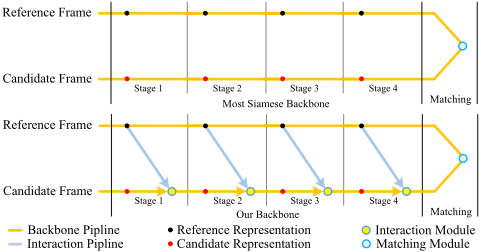
For the first time, we integrate the cross-processing modeler into different stages of a backbone network in visual tracking, which can continuously expose prior information to backbone modeling, as shown in Fig. 1. The multiple interactions pattern improves the distractor-aware ability of the early stages at a backbone network through feature aggregation in CSA and relation learning in TCA. Notably, the proposed method can not only adapt to a CNN network but also work well with a Transformer backbone. When equipping the transformer backbone with the proposed GIM and InBN mechanism, we surprisingly observe that complicated matching networks as in TransT [Chen et al., 2021] and AutoMatch [Zhang et al., 2021] are not necessary, where a simple cross-correlation can show promising results.
A series of experiments are conducted to prove the generality and effectiveness of the proposed LiBN and GIM. Taking SiamCAR [Guo et al., 2020] as the baseline tracker, we directly apply GIM and LiBN to its CNN backbone, achieving 3.2 points gains on LaSOT (53.9 vs 50.7). When employing Transformer backbone, our model further improves the performance to SUC of 65.7 on LaSOT.
The main contributions of this work are as follows:
- We present the first work demonstrating that information flow between reference and candidate frames can be realized inside the backbone network, which is clearly different from previous feature matching way that does not provide direct feedback to backbones in visual tracking.
- We prove the effectiveness of the proposed GIM module and InBN mechanism on both CNN and Transformer backbone networks, which makes it a general modeler to improve representation qualities in tracking.
2 RelatedWork
Visual Object Tracking. The Siamese network has been widely used in visual object tracking in recent years [Henriques et al., 2008; Bertinetto et al., 2016; Li et al., 2018; Li et al., 2019; Zhang et al., 2020; Zhang and Peng, 2019; Chen et al., 2021; Danelljan et al., 2019; Bhat et al., 2019]. SiamFC [Bertinetto et al., 2016] first adopts cross-correlation in the Siamese framework, which tracks a target by template matching. By exploiting the region proposal network (RPN) [Ren et al., 2015], SiamRPN [Li et al., 2018] and its variants [Guo et al., 2020; Yu et al., 2020] achieve more precise target scale estimation and fast speed. Later, further improvements upon Siamese trackers have been made, including enhancing feature representations by deeper convolutional backbones [Li et al., 2019; Zhang and Peng, 2019], designing more practical update mechanism [Zhang et al., 2019], introducing anchor-free regression to target estimation [Guo et al., 2020; Zhang et al., 2020], replacing cross-correlation with the automatically learned matching networks [Zhang et al., 2021], introducing vision Transformer [Chen et al., 2021], and so on. Another important branch, i.e., online trackers, always construct models with discriminative correlation filter [Danelljan et al., 2017; Danelljan et al., 2019; Bhat et al., 2019]. Despite of their success, only relying on a sole backbone to extract image representation without any interactive learning may introduce distractors and limit the tracking performance. In this work, we introduce a general interaction modeler to alleviate this issue.
Vision Transformer. Transformer is originally proposed in [Vaswani et al., 2017] for the task of machine translation. Recently it has been introduced into vision tasks and shows great potential. The core idea of Transformer is selfattention mechanism, which takes a sequence as the input, and builds similarity scores of each two feature vectors as attention weights to reinforce or suppress visual representations of corresponding positions. ViT [Dosovitskiy et al., 2020] and its follow ups [Liu et al., 2021; Chu et al., 2021], adopt a convolution-free transformer architecture for image classification, which processes the input image into a sequence of patch tokens. In addition to classification, Transformer is also used in other vision tasks and achieves comparable performances, such as object detection [Carion et al., 2020; Sun et al., 2020b], semantic segmentation [Strudel et al., 2021], multiple object tracking [Sun et al., 2020a], etc. In visual tracking, TrDiMP [Wang et al., 2021a] uses transformer to learn temporal relations between frames, and TransT [Chen et al., 2021] employs cross-attention in matching process to enhance semantic messages. Transformer is naturally suitable for processing multi-modality features. Surprisingly, no prior works in visual tracking consider building interactions inside the two-stream backbone network. The information in the reference image (or template image named in some works) is crucial to explore more target-relevant clues and track targets in complex scenes, especially in the presence of similar distractors. Our work aims to narrow these gaps by proposing an general interaction modeler which promotes the representation of candidate image at different stages of the backbone network.
3 Tracking with General InteractionModeler
In this section, we elaborate on the proposed General Interaction Modeler (GIM) and its integration to different backbone networks via the proposed InBN mechanism for improving representation learning in visual tracking.
3.1 General InteractionModeler
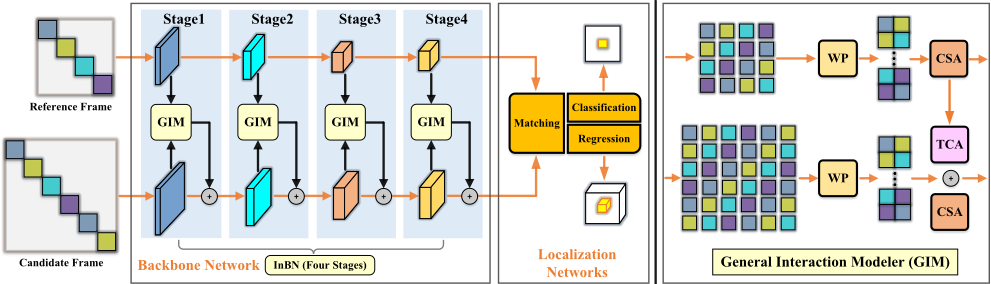
General Interaction Modeler (GIM) contains three essential components including window process (WP), context-aware self-attention (CSA) module and target-aware cross-attention (TCA) module, as illustrated in Fig. 2. The WP module is designed to decrease computational complexity and meanwhile increase the local perception ability. The CSA module aggregates context information by global attention modeling. The TCA module enhances target-related features and suppresses distractor responses by injecting prior knowledge of the reference image to representation learning. In the following, we will detail each module one by one.
Local Perception via Window Process (WP)
Our GIM is built upon the Transformer-like structure as described above. The Achilles' Heel is its quadratic cost for global attention learning and lack of local perception ability [Liu et al., 2021; Chu et al., 2021]. Motivated by recent vision transformers [Liu et al., 2021], we design the window process to merge feature vectors of non-overlapping local areas before attention modules.
Window process (WP) first partitions the input feature f ∈ RB×H×W×C (B is the batch size) by performing nonoverlapping win × win windows (win = 7) on it. Then each group containing win2 feature vectors is regarded as a modeling unit and forms a new dimension with size of fgroup ∈ RB×win2× H win × W win ×C . To fit the requirement of following attention modules, we flatten the spatial dimension of fgroup to fWP ∈ RB×win2× HW win2 ×C , whose sequence length is HW win2 . We perform attention on dimensions of HW win2 and C instead of win2 and C as in Swin-Trans [Liu et al., 2021], which ensures the feasibility to compute the crossattention weights Wattn ∈ RB×win2× HxWx win2 × HzWz win2 with Einstein Summation Convention [Weisstein, 2014] (z and x represent the reference and candidate images respectively). By regarding each window as a computing unit and then modeling relations between different windows, local clues are used without affecting global receptive fields.
Context-aware Self-attention (CSA)
The proposed CSA aggregates context information by performing multi-head self-attention (MHSA) on the partitioned input feature fWP . In particular, given an input feature sequence fseq ∈ RB×HW×C , the inner single-head attention function first maps it into query Q ∈ RB×NQ×d , key K ∈ RB×NK×d and value V ∈ RB×NV ×d (NQ, NK and NV are sequence lengths) with mapping weights WQ,WK,WV ∈ RC×d , then performs dot-product on them,
where d is the number of channels. In our model, we directly split the features along channel dimension for multiple heads, which is computed as follows,
where Qi ∈ RB×NQ× dn , Ki ∈ RB×NK× dn , Vi ∈ RB×NV × dn are divided parts, and Wmap ∈ Rd×C is mapping weights. We employ n = 4, C = 256, and d = 256 to achieve real-time tracking speed without other specified.
CSAs are applied on features of both reference and candidate images. It computes similarity scores between each two positions and uses the scores as attention weights to aggregate context visual features. By considering fWP as a sequence, the sequence length after WP is HW win2 instead of original HW, which has linear cost and promotes modeling speed. In a nutshell, the mechanism of CSA for the input fWP ∈ RB×win2× HW win2 ×C can be summarized as
where WQ,WK,WV ∈ RC×d are mapping weights, fCSA ∈ RB×win2× HW win2 ×C is the output of CSA.
Target-aware Cross-attention (TCA)
As mentioned before, Siamese tracking is conducted on a two-stream network, which is different from the typical onestream classification model. Therefore, it is reasonable to consider the interaction between these two branches during backbone design. In this work, we propose the target-aware cross-attention (TCA) to inject the reference information to the branch of the candidate image, which guides the backbone to perceive the target and filter irrelevant distractors.
For implementation, TCA takes two window-processed features (fxWP ∈ RB×win2× HxWx win2 ×C for candidate image and fzWP ∈ RB×win2× HzWz win2 ×C for reference image) as inputs and maps them to Q and K,V respectively. Through multi-head attention, fxWP are refined by the prior knowledge in fzWP , where the target-related ones are strengthened and the irrelevant ones are suppressed. TCA is formulated as,
where WQ,WK,WV ∈ RC×d are mapping weights, fTCA ∈ RB×win2× HxWx win2 ×C is the output of TCA.
Here we analyze how WP could make the computation of attention learning linear complexity. Without loss of generality, we assume H%win = 0 and W%win = 0. Taking each window as the computing unit, the sequence length is HW win2 . CSA or TCA first computes relations between feature vectors of the same position in different windows, and the computation cost is O( H2W 2 win4 d). Then the total cost for win2 positions is O( H2W 2 win2 d). If we let k1 = H win and k2 = W win , the cost can be computed as O(k1k2HWd), which is significantly more efficient when k1 ≪ H and k2 ≪ W and grows linearly with HW if k1 and k2 are fixed.
3.2 Building Backbone Network
To demonstrate the generality and effectiveness of the proposed GIM, we follow the InBN mechanism and build two types of backbone networks for Siamese tracking, i.e., CNN and Transformer as shown in Tab. 1. To unleash the targetperception ability of shallow layers, we adopt a hierarchical design to employ the GIM, which is named as InBN mechanism. We arrange the proposed GIM to different stages of a tracking backbone to conduct multiple interactions. Based on the reference presentation of different resolutions, the network knows what target is the one being tracked, which eventually enhances target-related messages and suppresses distractors hierarchically.
| CNN Backbone | Transformer Backbone | ||||||
|---|---|---|---|---|---|---|---|
| Output Size Layer Name | Parameter Output | Size Layer Name | Parameter | ||||
| Stage 1 | H4 × W4 | Convolution Block P1 = 4; C1 | = 256 | H4 × W4 Patch Embedding | P1 = 4; C1 = 96 | ||
| GIM | WP CSA (T CA) | × 1 | GIM (T | WP CSA CA) × 2 | |||
| Stage 2 | H8 × W8 | Convolution Block P2 = 2; C2 = 512 | H8 × W8 | Patch Embedding | P2 = 2; C2 = 192 | ||
| GIM | WP CSA (T CA) | × 1 | GIM | WP CSA (T CA) | × 2 | ||
| Stage 3 | H8 × W8 Block | Convolution P3 = 1; C3 = 1024 | H 16 × W16 | Patch Embedding | P3 = 2; C3 = 384 | ||
| GIM | WP CSA (T CA) | × 1 | GIM | WP CSA (T CA) | × 6 | ||
| Stage 4 | H8 × W8 | Convolution Block P4 = 1; C4 = 2048 | H 16 × W16 | Patch Embedding | P4 = 1; C4 = 768 | ||
| GIM | WP CSA (T CA) | × 1 | GIM | WP CSA (T CA) | × 2 | ||
| Output | H8 × W8 | Mapping C = 256 | H8 × W8 | Fusion | C = 256 | ||
For the CNN-based model, we take the ResNet-50 in SiamCAR [Guo et al., 2020] as the basic CNN backbone. Following the InBN paradigm, we modify it by directly applying the GIM after each stage. The mapping layers are attached at each stage to unify the output feature dimensions to 256 (see more details in [Guo et al., 2020]).
For the Transformer-based model, we refer to the structure of Swin-Trans [Liu et al., 2021] to build two-stream backbone by stacking the GIMs. As illustrated in Tab. 1, the backbone network is divided into four stages, which contain 2, 2, 6, 2 GIMs, respectively. Notably, we only use the TCA module in the last GIM of each stage, which avoids bringing high computation costs. The InBN mechanism allows backbone to enhance target-relevant ability gradually by hierarchical interactions. For the output features of each stage, we first map their channel dimensions into the same number of 256 with a 1 × 1 linear layer. We upsample or downsample these features to same resolution to align spatial dimension. Finally, we concatenate all features along channel dimension and use a 1×1 linear transformation to shrink channel number to 256.
3.3 Comparison with Other Tracking Backbones
To our best knowledge, this is the first tracking framework that considers branch-wise interactions inside the backbone network for better feature representation. As shown in Fig. 1, we categorize existing backbone networks in visual tracking into two types. The first one (see the first row in Fig. 1), which is employed in the most trackers, simply uses a backbone to extract feature representation and then performs matching without direct feedback for tracking. The lack of reference information makes it hard to robustly locate the target object. Differently, equipping with GIM with InBN mechanism, our backbone network (see the second row in Fig. 1) is able to not only perform multiple interactions to bridge the target information to candidate frame during feature learning, but also exploit global modeling to enrich target-related representation, resulting in improved feature representations in all layers for better performance, yet with negligible computation.
| Method | Source | LaSOT | TNL2K | UAV123 | NFS | FPS | ||||||
|---|---|---|---|---|---|---|---|---|---|---|---|---|
| AUC | PNorm | P | AUC | PNorm | P | AUC | P | AUC | P | |||
| TransInMo* TransInMo TransT | Ours Ours CVPR2021 | 65.7 65.3 64.9 | 76.0 74.6 73.8 | 70.7 69.9 69.0 | 52.0 51.5 50.7 | 58.5 57.8 57.1 | 52.7 52.6 51.7 | 69.0 68.2 68.1 | 89.0 90.5 87.6 | 66.8 66.4 65.7 | 80.2 80.7 78.8 | 34 67 50 |
| Ours CVPR2020 | 53.9 | - 61.6 | 53.9 51.0 | 42.2 35.3 | 48.6 43.6 | 41.9 38.4 | 62.9 | 87.2 | 66.5 | 78.4 | 26 | |
| TrDiMP | 50.7 | 61.4 | - | - | - | 67.5 | ||||||
| CVPR2021 | 81.8 76.0 | 56.0 52.9 | 68.5 | |||||||||
| CNNInMo | 63.9 | 61.4 | 47 | |||||||||
| SiamCAR AutoMatch | ICCV2021 | 58.3 | 60.0 - | 59.9 | 47.2 | - | 43.5 | 63.9 | - | 60.6 | 65.7 - | 52 50 |
| Ocean | ECCV2020 | 56.0 | 65.1 | 56.6 | 38.4 | 45.4 | 37.7 | 62.1 | - | 55.3 | - | 58 |
| KYS | ECCV2020 | 55.4 | 63.3 | - | 44.9 | 51.1 | 43.5 | - | - | 63.5 | 77.0 | 20 |
| SiamFC++ | AAAI2020 | 54.4 | 62.3 | 54.7 | 38.6 | 45.0 | 36.9 | 63.1 | 76.9 | 58.1 | - | 90 |
| PrDiMP | CVPR2020 | 59.8 | 68.8 | 60.8 | 47.0 | 54.0 | 45.9 | 66.8 | 87.6 | 63.5 | 76.5 | 30 |
| CGACD | CVPR2020 | 51.8 | 62.6 | 53.5 | - | - | - | 63.3 | 83.3 | - | - | 70 |
| SiamAttn | CVPR2020 | 56.0 | 64.8 | - | - | - | - | 65.0 | 84.5 | - | - | 45 |
| SiamBAN | CVPR2020 | 51.4 | 59.8 | 52.1 | 41.0 | 48.5 | 41.7 | 63.1 | 83.3 | 59.4 | 70.0 | 40 |
| DiMP | ICCV2019 | 56.9 | 65.0 | 56.7 | 44.7 | 51.3 | 43.4 | 65.4 | 85.6 | 62.7 | 75.1 | 40 |
| SiamPRN++ | CVPR2019 | 49.6 | 56.9 | 49.1 | 41.3 | 48.2 | 41.2 | 61.3 | 80.7 | 50.8 | 50.9 | 35 |
| ATOM | CVPR2019 | 51.5 | 57.6 | 50.5 | 40.1 | 46.5 | 39.2 | 65.0 | 85.8 | 59.0 | 69.4 | 30 |
| SiamPRN | CVPR2018 | 49.6 | 56.9 | 49.1 | 32.9 | 36.2 | 28.1 | 55.7 | 71.0 | 48.8 | 56.7 | 160 |
| ECO SiamFC | ICCV2017 ECCV2016 | 32.4 33.6 | 33.8 42.0 | 30.1 33.9 | 32.6 29.5 | 37.7 45.0 | 31.7 28.6 | 52.5 48.5 | 68.8 64.8 | 46.6 - | 54.7 - | 60 58 |
4 Experiments
4.1 Implementation Details
For CNN-based tracker, we apply the proposed Interaction Modeler to the baseline tracker SiamCAR [Guo et al., 2020] (named as CNNInMo). For transformer-based tracker (named as TransInMo), we build backbone network following the structions in Sec. 3.2. A simple depth-wise correlation layer is used for feature matching. Two three-layer MLPs are respectively conducted for classification and regression heads, as similar in [Chen et al., 2021]. Moreover, we test the influence of complicated matching process by equipping TransInMo with the matching module from TransT [Chen et al., 2021] (named as TransInMo*). The training settings for CNNInMo/TransInMo follow the baseline trackers SiamCAR and TransT, respectively (we recommend the readers to [Guo et al., 2020] and [Chen et al., 2021] for more details). In particular, the training splits of LaSOT [Fan et al., 2019], TrackingNet [Muller et al., 2018] and GOT-10k [Huang et al., 2019] and COCO [Lin et al., 2014] are used during learning.
4.2 State-of-the-art Comparisons
We compare our methods with recent state-of-the-art trackers on six tracking benchmarks. The detailed comparison results on the LaSOT [Fan et al., 2019], TNL2K [Wang et al., 2021b], TrackingNet [Muller et al., 2018], UAV123 [Mueller et al., 2016], NFS [Kiani Galoogahi et al., 2017] and OTB100 [Wu et al., 2015] are reported in Tab. 2 and Tab. 3. Notably, CNNInMo runs at 47 fps on GTX2080Ti GPU, while TransInMo/TransInMo* run at 67/34 fps respectively. LaSOT is a large-scale tracking benchmark containing 1,400 videos. We evaluate different tracking algorithms on its 280
| TransInMo* | TransInMo | CNNInMo | TransT | SiamCAR | |
|---|---|---|---|---|---|
| TrackingNet | 81.7 | 81.6 | 72.1 | 81.4 | 65.3 |
| OTB100 | 71.1 | 70.6 | 70.3 | 69.4 | 70.0 |
testing videos. As reported in Tab. 2, when applying GIM and InBN to SiamCAR without any other modifications, CNNInMo obtains gains of 3.2/2.9 points on success (SUC) and precision (P) scores, respectively. This evidences the effectiveness of the proposed interaction module and mechanism. Our transformer version with simple cross-correlation matching outperforms recent state of the arts TransT [Chen et al., 2021] and TrDiMP [Wang et al., 2021a].
TNL2K is a recently proposed large-scale benchmark for tracking by natural language and bounding box initialization. We evaluate our tracker on its 700 testing videos. CNNInMo outperforms the baseline tracker SiamCAR for 6.9/3.5 points on SUC and precision, respectively.
UAV123 contains 123 aerial sequences captured from a UAV platform. As shown in Tab. 2, the proposed methods (Transformer versions) perform the best among all compared trackers. The CNN version CNNInMo exceeds 1.5 SUC points than the baseline tracker SiamCAR.
NFS consists of 100 challenging videos with fast-moving objects. We evaluate the proposed trackers on the 30 fps version, as presented in Tab. 2. TransInMo and TransInMo* obtain the best two performances on success and precision scores, which shows that our method can improve the robustness of tracking fast-tracking moving targets.
| # NUM | Method | WP | TCA | LaSOT | FPS | ||
|---|---|---|---|---|---|---|---|
| AUC | PNorm | P | |||||
| ① | TransInMo* | 61.1 | 70.3 | 64.9 | 30 | ||
| ② | TransInMo* | √ | √ | 64.6 | 74.7 | 68.8 | 37 |
| ③ | TransInMo* | √ | √ | 63.2 | 73.6 | 68.0 | 27 |
| ④ | TransInMo* | 65.7 | 76.0 | 70.7 | 34 | ||
| Matching in TransT | LaSOT | |||||||
|---|---|---|---|---|---|---|---|---|
| # NUM | Method | DW | Encoder Layer Num | Decoder Layer Num | AUC | PNorm | P | FPS |
| ① | TransInMo | √ | 65.3 | 74.6 | 69.9 | 67 | ||
| ② | TransInMo* | 0 | 1 | 65.0 | 74.3 | 69.8 | 59 | |
| ③ | TransInMo* | 1 | 1 | 65.3 | 73.7 | 69.0 | 52 | |
| ④ | TransInMo* | 2 | 1 | 65.5 | 73.7 | 69.0 | 46 | |
| ⑤ | TransInMo* | 3 | 1 | 65.7 | 74.1 | 69.2 | 40 | |
| ⑥ | TransInMo* | 4 | 1 | 65.7 | 76.0 | 70.7 | 34 | |
TrackingNet and OTB100 We further evaluate proposed trackers on TrackingNet and OTB100. As presented in Tab. 3, CNNInMo surpasses the baseline SiamCAR for 6.8 points on TrackingNet. TransInMo and TransInMo* are on par with (slightly better than) TransT on these two benchmarks.
4.3 Ablation Study
Components in GIM. As shown in Tab. 4, we analyze the influence of WP and TCA in GIM based on TransInMo*. CSA is the basic modeling layer in GIM, hence we only ablate the other two modules. Tab. 4 shows that without WP and TCA, the tracker obtains an AUC score of 61.1 on LaSOT. When integrating WP into the model, it brings 3.5 points gains (② vs ①) with faster running speed (37 fps vs 30 fps). The TCA module builds branch-wise interaction between the reference and candidate images inside the backbone. As in Tab. 4, TCA brings gains of 2.1 points on AUC (③). When applying WP and TCA together, further improvement is obtained with an AUC score of 65.7 (④), which proves the rationality of our design.
Matching Process. We ablate different matching process for our trackers as shown in Tab. 5. With simple depth-wise correlation (DW) (①, i.e. TransInMo), the tracker has already achieved compelling performance and speed. We then replace DW with more complex matching modules in TransT with different Transformer encoder numbers. Surprisingly, it (⑥) does not obtain significant gains. As we decrease the encoder layers, the performance is even worse than simple DW (①). Our framework indicates that a tracker with InBN mechanism reduces the demand of fussy matching network to filter target-irrelevant distractors. Matching inside the backbone may be a worth choice in future work.
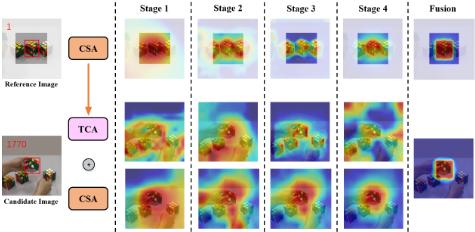
Activation Map Visualization. To better understand our CSA and TCA, we visualize their activation maps in Fig. 3. As shown, when the target appearance changes heavily or similar distractors exist, the branch-wise interaction of TCA can help the backbone sense the target-relevant areas. Then self-attention of CSA employs the context messages to filter useless messages and focus on the target area.
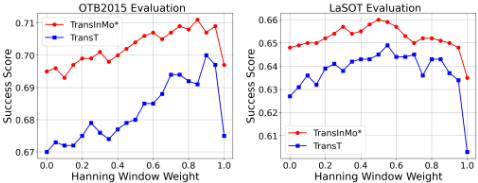
HanningWindow Influence. In Fig. 4, we present the influence of post-processing (i.e. Hanning window) used in our TransInMo* and TransT on two benchmarks. From Fig. 4, we observe that the proposed TransInMo* is more stable. In the case without post-processing (i.e. weight=0), our tracker still shows compelling performance, which indicates the effectiveness of feature representation learned by our backbone.
Due to limited space, more experiments with in-depth analysis, e.g., tracking result visualization, failure case analysis, are presented in the appendix.
5 Conclusions
This work presents a novel mechanism that conducts branchwise interactions inside the visual tracking backbone network (InBN) via the proposed general interaction modeler (GIM). We prove that both the CNN network and the Transformer backbone can enjoy bonus brought by InBN. The backbone network can build more robust feature representation under complex environments with the improved target-perception ability. Our method achieves compelling tracking performance by applying the backbones to Siamese tracking.
Acknowledgments
This work was supported by the National Key Research and Development Program (2020AAA0106800), the Beijing Natural Science Foundation under Grant (Z180006, L211016), the National Natural Science Foundation of China under Grant (62176020) and CAAI-Huawei MindSpore Open Fund. This work is co-supervised by Prof. Liping Jing and Dr. Zhipeng Zhang.
@inproceedings{ijcai2022p130,
  title     = {Learning Target-aware Representation for Visual Tracking via Informative Interactions},
  author    = {Guo, Mingzhe and Zhang, Zhipeng and Fan, Heng and Jing, Liping and Lyu, Yilin and Li, Bing and Hu, Weiming},
  booktitle = {Proceedings of the Thirty-First International Joint Conference on
               Artificial Intelligence, {IJCAI-22}},
  publisher = {International Joint Conferences on Artificial Intelligence Organization},
  editor    = {Luc De Raedt},
  pages     = {927--934},
  year      = {2022},
  month     = {7},
  note      = {Main Track},
  doi       = {10.24963/ijcai.2022/130},
  url       = {https://doi.org/10.24963/ijcai.2022/130},
}
TY - CPAPER TI - Learning Target-aware Representation for Visual Tracking via Informative Interactions AU - Guo, Mingzhe AU - Zhang, Zhipeng AU - Fan, Heng AU - Jing, Liping AU - Lyu, Yilin AU - Li, Bing AU - Hu, Weiming T2 - Proceedings of the Thirty-First International Joint Conference on Artificial Intelligence, IJCAI-22 PB - International Joint Conferences on Artificial Intelligence Organization PY - 2022 SP - 927 EP - 934 DO - 10.24963/ijcai.2022/130 UR - https://doi.org/10.24963/ijcai.2022/130 ER -Copied
Machine-readable versions of this paper, for tools and AI agents:





