
PlaceNet: Neural Spatial Representation Learning with Multimodal Attention
Proceedings of the Thirty-First International Joint Conference on Artificial Intelligence. Main Track. Pages 1031-1038.
https://doi.org/10.24963/ijcai.2022/144
Keywords
- Robotics: Perception
- Humans and AI: Cognitive Systems
- Computer Vision: Scene analysis and understanding
- Machine Learning: Multi-modal learning
- Machine Learning: Representation learning
Abstract
Spatial representation capable of learning a myriad of environmental features is a significant challenge for natural spatial understanding of mobile AI agents.
Deep generative models have the potential of discovering rich representations of observed 3D scenes.
However, previous approaches have been mainly evaluated on simple environments, or focused only on high-resolution rendering of small-scale scenes, hampering generalization of the representations to various spatial variability.
To address this, we present PlaceNet, a neural representation that learns through random observations in a self-supervised manner, and represents observed scenes with triplet attention using visual, topographic, and semantic cues.
We evaluate the proposed method on a large-scale multimodal scene dataset consisting of 120 million indoor scenes, and show that PlaceNet successfully generalizes to various environments with lower training loss, higher image quality and structural similarity of predicted scenes, compared to a competitive baseline model.
Additionally, analyses of the representations demonstrate that PlaceNet activates more specialized and larger numbers of kernels in the spatial representation, capturing multimodal spatial properties in complex environments.
- [Bailey and Durrant-Whyte, 2006] Tim Bailey and Hugh Durrant-Whyte. Simultaneous localization and mapping (SLAM): Part II. IEEE Robotics & Automation Magazine, 13(3):108-117, 2006.
- [Cadena et al., 2016] Cesar Cadena, Luca Carlone, Henry Carrillo, Yasir Latif, Davide Scaramuzza, José Neira, Ian Reid, and John J Leonard. Past, present, and future of simultaneous localization and mapping: Toward the robust-perception age. IEEE Transactions on Robotics, 32(6):1309-1332, 2016.
- [Chen and Williams, 1993] Shenchang Eric Chen and Lance Williams. View interpolation for image synthesis. In Pro- ceedings of the Annual Conference on Computer Graphics and Interactive Techniques (SIGGRAPH), pages 279-288, 1993.
- [Chen et al., 2017] Liang-Chieh Chen, George Papandreou, Florian Schroff, and Hartwig Adam. Rethinking atrous convolution for semantic image segmentation. arXiv preprint arXiv:1706.05587, 2017.
- [Eslami et al., 2018] SM Ali Eslami, Danilo Jimenez Rezende, Frederic Besse, Fabio Viola, Ari S Morcos, Marta Garnelo, Avraham Ruderman, Andrei A Rusu, Ivo Danihelka, Karol Gregor, et al. Neural scene represen- tation and rendering. Science, 360(6394):1204-1210, 2018.
- [Fu et al., 2019] Jun Fu, Jing Liu, Haijie Tian, Yong Li, Yongjun Bao, Zhiwei Fang, and Hanqing Lu. Dual at- tention network for scene segmentation. In Proceedings of the IEEE/CVF Conference on Computer Vision and Pat- tern Recognition (CVPR), pages 3146-3154, 2019.
- [Gregor et al., 2015] Karol Gregor, Ivo Danihelka, Alex Graves, Danilo Jimenez Rezende, and Daan Wierstra. DRAW: a recurrent neural network for image generation. In Proceedings of the International Conference on Ma- chine Learning (ICML), volume 37, pages 1462-1471, 2015.
- [Gupta et al., 2017] Saurabh Gupta, James Davidson, Sergey Levine, Rahul Sukthankar, and Jitendra Malik. Cognitive mapping and planning for visual navigation. In Proceed- ings of the IEEE/CVF Conference on Computer Vision and Pattern Recognition (CVPR), pages 2616-2625, 2017.
- [Herweg and Kahana, 2018] Nora A Herweg and Michael J Kahana. Spatial representations in the human brain. Fron- tiers in Human Neuroscience, 12:297, 2018.
- [Kingma and Ba, 2014] Diederik P Kingma and Jimmy Ba. Adam: A method for stochastic optimization. arXiv preprint arXiv:1412.6980, 2014.
- [Kingma and Welling, 2013] Diederik P Kingma and Max Welling. Auto-encoding variational bayes. arXiv preprint arXiv:1312.6114, 2013.
- [Mildenhall et al., 2020] Ben Mildenhall, Pratul P Srini- vasan, Matthew Tancik, Jonathan T Barron, Ravi Ra- mamoorthi, and Ren Ng. NeRF: Representing scenes as neural radiance fields for view synthesis. In Proceedings of the European Conference on Computer Vision (ECCV), pages 405-421. Springer, 2020.
- [Moser et al., 2008] Edvard I Moser, Emilio Kropff, and May-Britt Moser. Place cells, grid cells, and the brain's spatial representation system. Annu. Rev. Neurosci., 31:69-89, 2008.
- [O'Keefe, 1976] John O'Keefe. Place units in the hippocam- pus of the freely moving rat. Experimental Neurology, 51(1):78-109, 1976.
- [Poudel et al., 2019] Rudra PK Poudel, Stephan Liwicki, and Roberto Cipolla. Fast-SCNN: fast semantic segmen- tation network. arXiv preprint arXiv:1902.04502, 2019.
- [Rosenbaum et al., 2018] Dan Rosenbaum, Frederic Besse, Fabio Viola, Danilo J Rezende, and SM Eslami. Learning models for visual 3D localization with implicit mapping. arXiv preprint arXiv:1807.03149, 2018.
- [Sitzmann et al., 2019] Vincent Sitzmann, Justus Thies, Fe- lix Heide, Matthias Nießner, Gordon Wetzstein, and Michael Zollhofer. DeepVoxels: Learning persistent 3d feature embeddings. In Proceedings of the IEEE/CVF Conference on Computer Vision and Pattern Recognition (CVPR), pages 2437-2446, 2019.
- [Song et al., 2017] Shuran Song, Fisher Yu, Andy Zeng, An- gel X Chang, Manolis Savva, and Thomas Funkhouser. Semantic scene completion from a single depth image. In Proceedings of the IEEE/CVF Conference on Computer Vision and Pattern Recognition (CVPR), pages 1746- 1754, 2017.
- [Tewari et al., 2020] Ayush Tewari, Ohad Fried, Justus Thies, Vincent Sitzmann, Stephen Lombardi, Kalyan Sunkavalli, Ricardo Martin-Brualla, Tomas Simon, Jason Saragih, Matthias Nießner, et al. State of the art on neu- ral rendering. Computer Graphics Forum, 39(2):701-727, 2020.
- [Tobin et al., 2019] Joshua Tobin, Wojciech Zaremba, and Pieter Abbeel. Geometry-aware neural rendering. In Ad- vances in Neural Information Processing Systems (NIPS), pages 11559-11569, 2019.
- [Wang et al., 2004] Zhou Wang, Alan C Bovik, Hamid R Sheikh, and Eero P Simoncelli. Image quality assessment: from error visibility to structural similarity. IEEE Trans- actions on Image Processing, 13(4):600-612, 2004.
- [Wu et al., 2018] Yi Wu, Yuxin Wu, Georgia Gkioxari, and Yuandong Tian. Building generalizable agents with a realistic and rich 3D environment. arXiv preprint arXiv:1801.02209, 2018.
- [Xingjian et al., 2015] Shi Xingjian, Zhourong Chen, Hao Wang, Dit-Yan Yeung, Wai-Kin Wong, and Wang-chun Woo. Convolutional LSTM network: A machine learn- ing approach for precipitation nowcasting. In Advances in Neural Information Processing Systems (NIPS), pages 802-810, 2015.
- [Yamamoto et al., 2018] Takashi Yamamoto, Koji Terada, Akiyoshi Ochiai, Fuminori Saito, Yoshiaki Asahara, and Kazuto Murase. Development of the research platform of a domestic mobile manipulator utilized for international competition and field test. In International Conference on Intelligent Robots and Systems (IROS), pages 7675-7682, 2018.
- [Zhou et al., 2016] Tinghui Zhou, Shubham Tulsiani, Weilun Sun, Jitendra Malik, and Alexei A Efros. View synthesis by appearance flow. In Proceedings of the European Conference on Computer Vision (ECCV), pages 286-301. Springer, 2016.
- [Zhou et al., 2017] Bolei Zhou, Hang Zhao, Xavier Puig, Sanja Fidler, Adela Barriuso, and Antonio Torralba. Scene parsing through ade20k dataset. In Proceedings of the IEEE/CVF Conference on Computer Vision and Pattern Recognition (CVPR), pages 633-641, 2017.
- [Zhou et al., 2019] Bolei Zhou, Hang Zhao, Xavier Puig, Tete Xiao, Sanja Fidler, Adela Barriuso, and Antonio Torralba. Semantic understanding of scenes through the ade20k dataset. International Journal of Computer Vision, 127(3):302-321, 2019.
References were extracted automatically from the PDF and may contain errors.
Full text extracted automatically from the PDF; figures, tables and equations may differ. The PDF is the version of record.
1 Introduction
While extensive research on spatial perception has been carried out in AI, a significant challenge still remains for a generic representation capable of learning a myriad of environmental features. A flexible, efficient, and informative spatial representation is required for natural spatial understanding of mobile AI agents, which enables the agents to reliably navigate and interact with the objects they encounter [Gupta et al., 2017; Herweg and Kahana, 2018].
Current mobile technology in robots and autonomous vehicles recognizes the surrounding space by a comparison directly between sensory inputs and a metric map represented by simple topographical structures or visual cues (e.g. position of landmarks, obstacles). However, metric map representations have limited scalability for large-scale and dynamic environments, inefficient mapping processes, and lack of expressiveness [Bailey and Durrant-Whyte, 2006; Cadena et al., 2016].
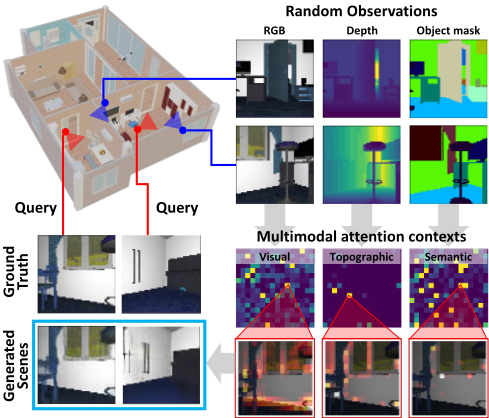
On the other hand, recent progress in deep generative networks has given rise to a new approach that discovers rich representations of 3D scenes, namely neural rendering [Tewari et al., 2020]. Neural rendering approach encodes a scene representation by learning to generate novel views of the scene. However, this approach has been focused only on high-resolution rendering of specific small-scale scenes [Sitzmann et al., 2019; Mildenhall et al., 2020], or evaluated on simple artificial environments with only a few objects [Eslami et al., 2018; Tobin et al., 2019], both hampering generalization of the representation to spatial variability.
To address this, we train deep generative networks with a large-scale 3D house dataset to generalize a neural representation across various indoor environments. Our spatial representation network, named PlaceNet*, deals with spa-
* Named after Place cells [O'Keefe, 1976; Moser et al., 2008].
(a) Representation Networks Observation
(c) Generation Networks
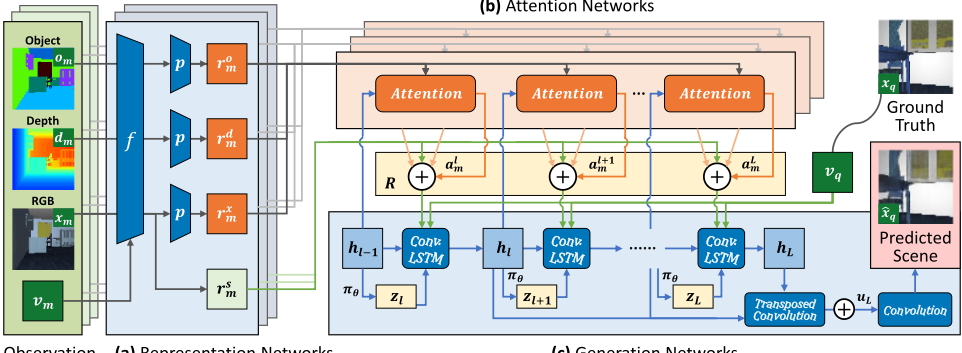
Figure 2: Network architecture of PlaceNet. (a) Representation networks encode multimodal observations. (b) Attention networks extract spatial contexts alm and update the spatial representation R. (c) Generation networks predict a target scene ˆxq corresponding to a queried viewpoint vq by recurrently sampling latent variables z from hidden states h based on R. Note that "+" denotes element-wise summation, and yellow boxes are intermediate representations in each training step.
tial variability of indoor scenes, with an attention mechanism that leverages multimodal scene components, including color, depth images, and semantic masks, as shown in Figure 1.
Generative Query Networks (GQN), one of the breakthroughs in neural rendering, impressively demonstrated that a single neural architecture could learn to perceive, interpret and represent various synthetic 3D scenes without any explicit supervision [Eslami et al., 2018]. However, the single global scene representation network of GQN has limitations in learning diverse spatial features, and shows degraded performance when rendering more complex scenes such as the Minecraft world [Rosenbaum et al., 2018] and 3D house environments [Wu et al., 2018].
In contrast, PlaceNet's attention mechanism propagates additional relevant spatial contexts extracted from different scenes to the hidden states of the model's decoder, allowing the representation network to learn the various spatial features in complex scenes. Consequently, PlaceNet encodes random observations, produces visual, topographic, and semantic contexts with the triplet attention networks, and generates unobserved visual scenes based on the spatial representation updated by the multimodal attention contexts.
Our approach also can be positioned in the context of Novel-View Synthesis (NVS) which constructs 3D structures of the scene from multiple camera views to render unseen parts of the scene [Chen and Williams, 1993; Zhou et al., 2016]. The difference between our work and other NVS methods is the range of scenes generalized and the targets to be optimized. Recent NVS approaches, such as DeepVoxels [Sitzmann et al., 2019] and NeRF [Mildenhall et al., 2020] mainly focus on representing intra-scene variability, limiting their scope to rendering high-resolution views on a few specific scenes. These NVS methods optimize neural networks for volumetric representation, using scene- or object-specific continuous views collected from various angles. In contrast, our approach focuses more on learning generalizable spatial properties by optimizing the neural representations based on multimodal inter-scene variability across numerous scenes. While training, our approach samples a small number of discontinuous contexts from arbitrary viewpoints, allowing for a better representation of the scene that is less dependent on local features that can be inferred by continuous views.
2 PlaceNet
2.1 ProblemFormulation
As a neural scene rendering problem, we consider a framework that trains an implicit neural representation that can accurately generate a visual scene at an arbitrary viewpoint based on one or more observed scenes.
In this framework, a scene consists of a collection of multimodal images including an RGB image x, depth image d, object-aware segmentation mask o, and the corresponding viewpoint v. The observations C contains M randomly sampled scenes: C = {(xm, dm, om, vm)}Mm=1 , where M is also randomized at every training step for better generalization.
PlaceNet receives a set of multimodal observations C and a randomly sampled query viewpoint vq as inputs, and should be able to render a plausible scene ˆxq corresponding to vq. In detail, the model parameterizes a conditional distribution Pθ(xq|C, vq), from which the images are generated.
2.2 Encoding
Firstly, given multimodal observations of a scene, a convolutional encoder f encodes them into low-dimensional latent vectors, as illustrated in Figure 2(a). These latent vectors are aggregated to context representations rxm, rdm, rom, respectively, through an average pooling layer p, as following:
The triplet context representations are then fed into the attention networks to produce an attention context alm, as shown in Figure 2(a-b). Also, latent vectors of the image modality to be generated (i.e. RGB in here) are independently aggregated to the scene representation rsm via an elementwise summation. Here, we use the Tower representation network from GQN [Eslami et al., 2018] for the convolutional encoder f in order to take advantage of its spatially arranged scene representation.
2.3 Multimodal Attention
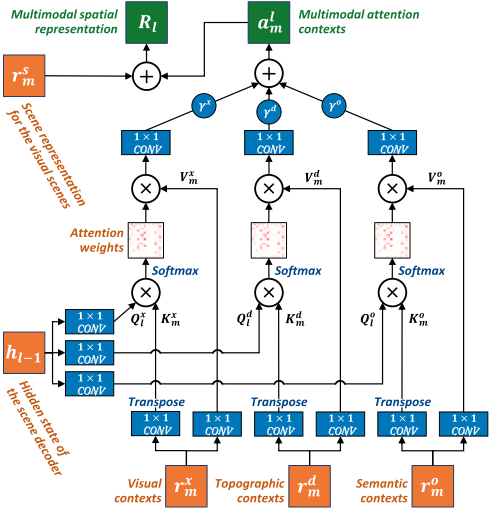
The attention networks map the triplet context representations {rxm, rdm, rom}, given from the representation networks, and a hidden state hl-1 in the previous step of the generation network to an attention context alm with:
where γ c is a learnable parameter for each representation, and Q, K, V stands for queries, keys, and values for attention mechanism, respectively, as illustrated in Figure 3.
The attention contexts alm represent the weighted contributions of aspects of visual, topographic, and semantic features to each spatial position within the scene representations rsm. alm and rsm are then aggregated in a permutation-invariant way to obtain the spatial representation Rl as follows:
Then, we use Rl as the input to the generation networks to produce the next hidden state hl, as depicted in Figure 2(c). Note that the spatial representation is updated in each layer l.
2.4 Generation
The generation networks parameterize an auto-regressive prior distribution over latent variables: πθ(z|vq ,R), using a decoder based on the convolutional Long-Short Term Memory network (CLSTM) [Xingjian et al., 2015; Gregor et al., 2015], as shown in Figure 2(c).
At every iteration l (l ≤ L), the generation networks recurrently sample the latent variable z from a prior π that is parameterized by the hidden states h, by conditioning on Rl and vq. The hidden states hl are updated as follows:
where c refers to the cell states in the CLSTM structure, and u is a canvas matrix that represents a scene to be generated.
The updated hl is decoded into a residual update to ul. Finally, ˆxq is sampled from uL with regularization.
2.5 Training
Given randomly sampled observation C and a query (xq, vq) from the dataset, the training objective is to find the model parameter θ that maximizes the expected log probability of the scene: E[logPθ(xq|C, vq)].
The training is done by minimizing the expected value of the negative log-likelihood of the query image xq given the target distribution, regularized by the cumulative KL divergence between the obtained posterior ρl and prior πl distributions from lth generation step as following:
where ρϕ is an approximation to the true posterior density with variational parameter ϕ [Kingma and Welling, 2013].
Please see the supplementary material's section C for further details on our implementation.
3 Dataset
To train PlaceNet, we built a large-scale dataset consisting of about 120 million complex indoor scene images † . Since houses are distinguished by different layouts, interior designs, and distinct objects arranged in the space, they are considered a suitable environment as a source of data for learning complex spatial representations. We collected the scene and pose information an agent encounters while traversing the realistic 3D virtual houses, previously introduced by [Song et al., 2017], and the House3D simulator [Wu et al., 2018].
It is important to find optimal trajectories allowing an agent to observe every aspect of the scene efficiently while avoiding redundant visits. To accomplish this, we developed a trajectory generation algorithm, which creates natural paths for the 3D house exploration. Further details on this algorithm are given in the supplementary material A.
† Available at: https://github.com/jamixlee/placenet
Our dataset consists of 115,781 training samples and 10,081 evaluation samples extracted from the 25,071 houses as the training dataset, but from different viewpoints. We further generated 6,501 samples for evaluation from 929 houses which were not used to make the training dataset. The two evaluation datasets were labeled as "seen" and "unseen" in the evaluation phase. Each data sample includes 300 frames of color, depth images, object masks, and the corresponding viewpoints. All images were rendered at size 64×64 pixels while moving through the generated trajectories. Viewpoint vectors were composed of the pose {x, y, z} and orientation {yaw, pitch} on the trajectory for each of the 26,000 houses.
To evaluate our model's performance according to the degree of scene complexity, we also made three subsets of our dataset. Here, we assume that the greater the number of unique pixel values constituting each image, the higher the complexity. The data complexity is thus derived by averaging the number of unique pixels within each RGB image, depth image, and object-aware segmented mask from all frames. Consequently, we divided our dataset into the upper 30% (High), the lower 30% (Low), and the remaining 40% (Medium) of the average complexity distribution for each modality of the dataset.
4 Experiments
The experiments are mainly conducted to evaluate the learning performance and scene generation performance of PlaceNet, as well as to compare our method to a competitive baseline, GQN. The proposed models are implemented with a scene encoder's dimension of 256 channels, and the convolutional LSTM's hidden state of 128 channels. The generation network has 12 layers, and weights are not shared between generation steps for better performance. The number of observations given to the models is determined randomly for the training (maximum of 20), and is fixed to 5 for the evaluation phase. For training, we use the Adam optimizer [Kingma and Ba, 2014] with initial learning rate 5e - 4, which linearly decays by a factor of 10 over 1.6M optimizer steps according to the scheduler. Additional hyper-parameters used for the training are shown in the supplementary material B.
4.1 Learning Performance
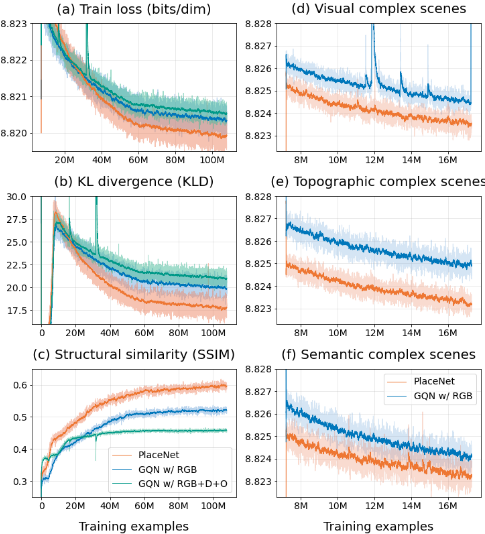
PlaceNet showed improved learning performances, showing a lower training loss and KLD than the baseline results, as seen in Figure 4(a-b). The structural similarity [Wang et al., 2004] between the query and generated scene converges to above 0.6 in PlaceNet's validation result, while the similarity of GQN stops at approximately 0.53, as seen in Figure 4(c). Also, GQN's performance decreased when using multimodal scenes with increased input channels. This is presumably because the three types of heterogeneous inputs disturb the scene representation of the model from recognizing the correct spatial structure in the scene. The loss difference between PlaceNet and the baseline is more distinct in the training of high-complexity datasets, as seen in Figure 4(d-f).
4.2 Scene Generation Performance
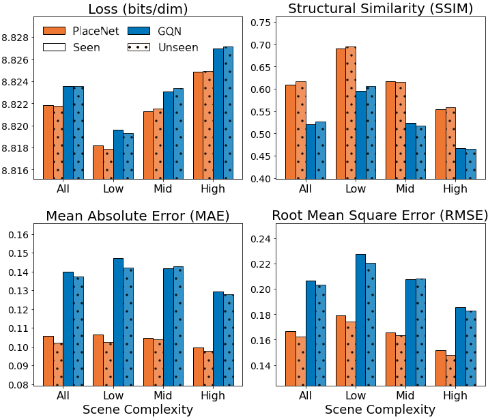
We conducted extensive evaluations with several types of evaluation datasets, which are divided by scene complexity and whether the scenes are seen/unseen during training. For all evaluation settings, PlaceNet consistently shows lower errors and higher similarities, compared to the baseline model, as shown in Figure 5. Interestingly, there was no significant difference in the results between seen and unseen scenes. From this, we can infer that both models were trained sufficiently to achieve acceptable generalization performance.
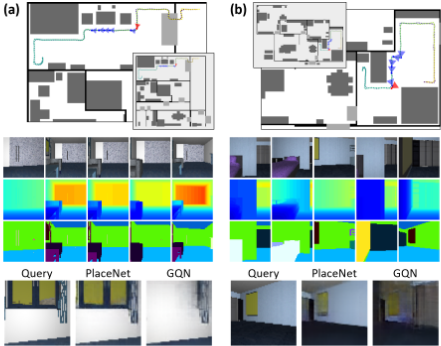
The two examples shown in Figure 6 provide a glimpse into the spatial comprehension capabilities of trained representations. Here, PlaceNet and the baseline model generated scenes, given five multimodal observations and a corresponding query viewpoint on the trajectory in the house. We found PlaceNet correctly generated complicated topographic structures and specific objects in the scene, misrendered in the results of the baseline model. In Figure 6(a), PlaceNet improved the rendering quality (rmse=0.0680; ssim=0.8692) of the GQN model (rmse=0.3340; ssim=0.7217) by rendering the ground truth scene, including the window and a curtain hanging beside the window. Figure 6(b) shows that PlaceNet succeeded in rendering the wall and the window with exact colors and shapes (rmse=0.0520; ssim=0.8853), which were misrepresented in the results rendered by the baseline model without attention (rmse=0.2260; ssim=0.7112).
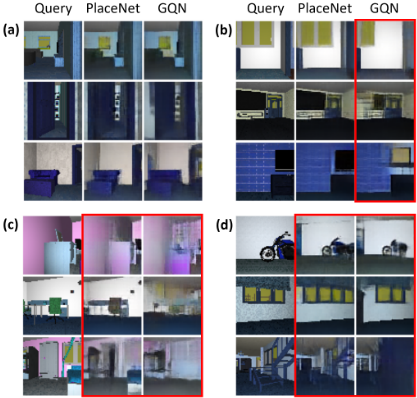
More examples are shown in Figure 7, including failure cases that show incorrect colors and vague patterns in Figure 7(b-c), and wrong perspective, different shape or missing parts of objects in Figure 7(c-d).
Additional results are shown in the supplementary material D and E, including scenes generated according to spatial complexity and incorrectly generated scenes.
4.3 Transferability to Real-World Scenes
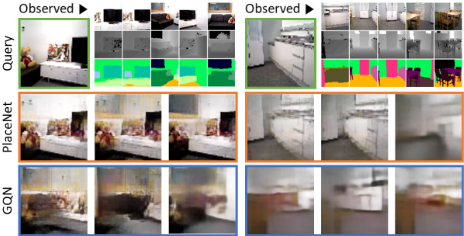
We demonstrated that the spatial representation of PlaceNet trained with the virtual house dataset is also capable of predicting scenes in real-world environments. In this experiment, a mobile robot-Toyota HSR [Yamamoto et al., 2018]-recorded RGB and depth images while navigating a real house, and pose information of the robot-self on the map was acquired using SLAM [Bailey and Durrant-Whyte, 2006]. The semantic segmentation masks were extracted from the RGB images using the DeepLabV3 model [Chen et al., 2017] trained with the ADE20K dataset [Zhou et al., 2017; Zhou et al., 2019]. Finally, a pre-trained PlaceNet generated visual scenes for randomly chosen robot poses among the collected data.
As shown in Figure 8, PlaceNet successfully generated the real-world scenes containing correct visual and topographic structures of the environment as well as the objects in the environment. However, in some results, misrendered or blurry objects such as windows or sinks were found, which was expected due to the low resolution of the observed image. In contrast, the GQN model did not succeed in rendering exact spatial structures in the real-world scenes, which shows its limitation of learning complex indoor environment. These results indicate that PlaceNet can sufficiently learn the general properties of indoor scenes from the virtual house dataset.
4.4 Results of Scene Depth Generation
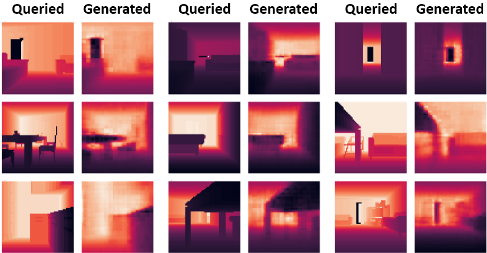
In this section, we provide experimental results of scene depth generation that show the potential of PlaceNet for crossmodal generation. While the model successfully predicted the complex topographic structures in the generated scenes, simple planar parts were generated with noise, as shown in Figure 9. We speculate this problem happened because the model reconstructs scenes using the approximate variational posterior while training (Eq. 5).
4.5 Representation Analyses
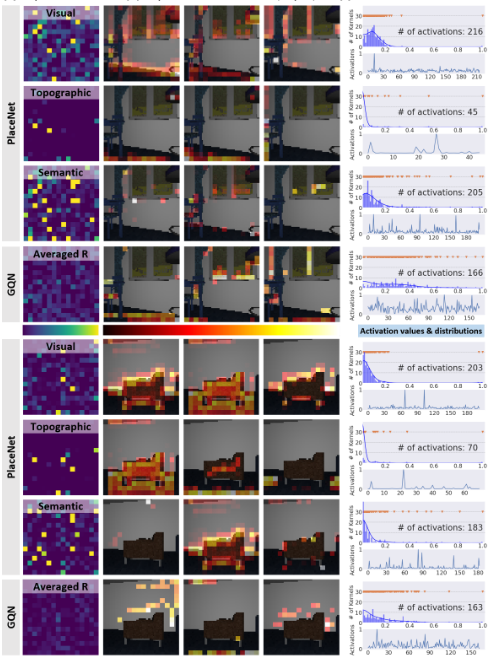
We analyzed each modality's context representations rx , rd , ro in PlaceNet to see the effect of multimodal attention. This was done by visualizing saliency maps of kernel activations in the spatial representations.
The activation values shown in Figure 10(a) indicate the significant kernel positions of the spatial representation R, in terms of visual, topographic, and semantic attention.
Figure 10(b) shows that the kernel activations were spatially arranged on the regions expected to contain relevant features for the target scene. Kernels activated by visual attention overall represented distinguishable areas, generally on the edges. In contrast, topographic attentional activations focused more on planar areas, such as surfaces of objects, walls, or the floor. Semantic attentional activations have a unique characteristic that showed object-awareness while being sparsely activated overall. Also, some kernels highlighted in visual representation were occasionally indicated by representations through other modalities as well. This is presumably because visual properties are most strongly reflected in spatial representations as training losses are computed by comparing RGB scenes. Kernels of the GQN representations without attention also showed activations on reasonable areas but did not reflect spatial features precisely.
Also, we found differences in the distribution of the activation values of kernels, as shown in Figure 10(c). First, the ratio of activated kernels in PlaceNet (82.62±4.5%) was higher than in GQN (59.84 ± 6.6%). Second, while GQN's activations were uniformly distributed into kernels, PlaceNet's activations distributed to relatively specific kernels and showed different patterns for each modality's representation.
To summarize, these results support that PlaceNet activates more specialized and larger numbers of kernels in the spatial representation, and the activations accurately reflect multimodal spatial properties in complex environments.
5 Concluding Remarks
In this paper, we introduced PlaceNet which learns powerful neural representations by leveraging visual, topographic, and semantic spatial features in complex 3D environments. PlaceNet can generalize across various indoor scenes by allowing hidden states of the representation decoder to depend on relevant spatial contexts extracted from the observed scenes. Experimental results show that PlaceNet is capable of learning various indoor scenes with significant improvements in neural scene rendering performance. Furthermore, the generalized representation learned by PlaceNet can be transferred to predict real-world scenes as well.
While this gives us hope that PlaceNet can potentially be used for down-stream tasks such as localization and navigation, we leave that for future work. The limitation of our method requiring object-aware masks can potentially be tackled by state-of-the-art methods for semantic segmentation [Fu et al., 2019; Poudel et al., 2019]. We will further investigate whether the latent size of PlaceNet is sufficient for encoding the expanded scene complexity at higher resolutions.
Acknowledgments
The authors would like to thank Min Whoo Lee, Christina Baek, Dong-Sig Han, Kibeom Kim, and Chris Hickey for their insightful comments and discussion. This research was partly supported by IITP (2015-0-00310-SW.StarLab/40%, 2019-0-01371-BabyMind/10%, 2021-0-02068-AIHub/10%, 2021-0-01343-GSAI/10%, 2022-0-00166-PICA/10%, 20220-00951-LBA/10%) and KIAT (P0006720-ILIAS/10%) grants funded by the Korean government (MSIP, MOTIE).
@inproceedings{ijcai2022p144,
  title     = {PlaceNet: Neural Spatial Representation Learning with Multimodal Attention},
  author    = {Lee, Chung-Yeon and Yoo, Youngjae and Zhang, Byoung-Tak},
  booktitle = {Proceedings of the Thirty-First International Joint Conference on
               Artificial Intelligence, {IJCAI-22}},
  publisher = {International Joint Conferences on Artificial Intelligence Organization},
  editor    = {Luc De Raedt},
  pages     = {1031--1038},
  year      = {2022},
  month     = {7},
  note      = {Main Track},
  doi       = {10.24963/ijcai.2022/144},
  url       = {https://doi.org/10.24963/ijcai.2022/144},
}
TY - CPAPER TI - PlaceNet: Neural Spatial Representation Learning with Multimodal Attention AU - Lee, Chung-Yeon AU - Yoo, Youngjae AU - Zhang, Byoung-Tak T2 - Proceedings of the Thirty-First International Joint Conference on Artificial Intelligence, IJCAI-22 PB - International Joint Conferences on Artificial Intelligence Organization PY - 2022 SP - 1031 EP - 1038 DO - 10.24963/ijcai.2022/144 UR - https://doi.org/10.24963/ijcai.2022/144 ER -Copied
Machine-readable versions of this paper, for tools and AI agents:





