
Learning to Assemble Geometric Shapes
Proceedings of the Thirty-First International Joint Conference on Artificial Intelligence. Main Track. Pages 1046-1052.
https://doi.org/10.24963/ijcai.2022/146
Keywords
- Computer Vision: Applications
- Computer Vision: Machine Learning for Vision
- Machine Learning: Applications
- Machine Learning: Attention Models
Abstract
Assembling parts into an object is a combinatorial problem that arises in a variety of contexts in the real world and involves numerous applications in science and engineering. Previous related work tackles limited cases with identical unit parts or jigsaw-style parts of textured shapes, which greatly mitigate combinatorial challenges of the problem. In this work, we introduce the more challenging problem of shape assembly, which involves textureless fragments of arbitrary shapes with indistinctive junctions, and then propose a learning-based approach to solving it. We demonstrate the effectiveness on shape assembly tasks with various scenarios, including the ones with abnormal fragments (e.g., missing and distorted), the different number of fragments, and different rotation discretization.
- [Bapst et al., 2019] Victor Bapst, Alvaro Sanchez-Gonzalez, Carl Doersch, Kimberly Lauren Stachenfeld, Pushmeet Kohli, Peter W. Battaglia, and Jessica B. Hamrick. Struc- tured agents for physical construction. In Proceedings of the International Conference on Machine Learning (ICML), pages 464-474, Long Beach, California, USA, 2019.
- [Boussaïd et al., 2013] Ilhem Boussaïd, Julien Lepagnot, and Patrick Siarry. A survey on optimization metaheuris- tics. Information Sciences, 237:82-117, 2013.
- [Brochu et al., 2010] Eric Brochu, Vlad M. Cora, and Nando de Freitas. A tutorial on Bayesian optimization of expen- sive cost functions, with application to active user model- ing and hierarchical reinforcement learning. arXiv preprint arXiv:1012.2599, 2010.
- [Brown, 1971] Arthur Robert Brown. Optimum packing and depletion. Macdonald and Co.; New York, American El- sevier, 1971.
- [Cho et al., 2010] Taeg Sang Cho, Shai Avidan, and William T. Freeman. A probabilistic image jigsaw puz- zle solver. In Proceedings of the IEEE International Conference on Computer Vision and Pattern Recognition (CVPR), pages 183-190, San Francisco, California, USA, 2010.
- [Chung et al., 2021] Hyunsoo Chung, Jungtaek Kim, Boris Knyazev, Jinhwi Lee, Graham W. Taylor, Jaesik Park, and Minsu Cho. Brick-by-Brick: Combinatorial construction with deep reinforcement learning. In Advances in Neu- ral Information Processing Systems (NeurIPS), volume 34, pages 5745-5757, Virtual, 2021.
- [Coffman et al., 1996] Edward Grady Coffman, Michael Randolph Garey, and David Stifler Johnson. Approximation algorithms for bin packing: A survey. Approximation Algorithms for NP-hard Problems, pages 46-93, 1996.
- [Derech et al., 2018] Niv Derech, Ayellet Tal, and Ilan Shimshoni. Solving archaeological puzzles. arXiv preprint arXiv:1812.10553, 2018.
- [Goyal and Deng, 2020] Ankit Goyal and Jia Deng. PackIt: A virtual environment for geometric planning. In Proceed- ings of the International Conference on Machine Learning (ICML), pages 3700-3710, Virtual, 2020.
- [Kim et al., 2020] Jungtaek Kim, Hyunsoo Chung, Jinhwi Lee, Minsu Cho, and Jaesik Park. Combinatorial 3D shape generation via sequential assembly. In Neural Infor- mation Processing Systems Workshop on Machine Learn- ing for Engineering Modeling, Simulation, and Design (ML4Eng), Virtual, 2020.
- [Li et al., 2020] Jianan Li, Jimei Yang, Aaron Hertzmann, Jianming Zhang, and Tingfa Xu. LayoutGAN: Synthe- sizing graphic layouts with vector-wireframe adversarial networks. IEEE Transactions on Pattern Analysis and Ma- chine Intelligence, 2020. [
- [Lodi et al., 2002] Andrea Lodi, Silvano Martello, and Michele Monaci. Two-dimensional packing problems: A survey. European Journal of Operational Research, 141(2):241-252, 2002.
- [Noroozi and Favaro, 2016] Mehdi Noroozi and Paolo Favaro. Unsupervised learning of visual representations by solving jigsaw puzzles. In Proceedings of the European Conference on Computer Vision (ECCV), pages 69-84, Amsterdam, The Netherlands, 2016.
- [Pincus, 1970] Martin Pincus. Letter to the editor -a Monte Carlo method for the approximate solution of certain types of constrained optimization problems. Operations Re- search, 18(6):1225-1228, 1970.
- [Roy and Teh, 2008] Daniel M. Roy and Yee Whye Teh. The Mondrian process. In Advances in Neural Information Processing Systems (NeurIPS), volume 21, pages 1377- 1384, Vancouver, British Columbia, Canada, 2008.
- [Sanches and Soma, 2009] Carlos Alberto Alonso Sanches and Nei Yoshihiro Soma. A polynomial-time DNA com- puting solution for the bin-packing problem. Applied Mathematics and Computation, 215(6):2055-2062, 2009.
- [Schumacher et al., 1969] Robert Schumacher, Brigitta Brand, Maurice Gilliland, and Werner Sharp. Study for applying computer-generated images to visual simulation. Technical Report AFHRL-TR-69-14, Air Force Human Resources Laboratory, Air Force Systems Command, 1969.
- [Slocum, 2003] Jerry Slocum. Tangram: The World's First Puzzle Craze. Sterling, 2003.
- [Torsvik, 2003] Trond H. Torsvik. The Rodinia jigsaw puz- zle. Science, 300(5624):1379-1381, 2003.
- [Vaswani et al., 2017] Ashish Vaswani, Noam Shazeer, Niki Parmar, Jakob Uszkoreit, Llion Jones, Aidan N. Gomez, Łukasz Kaiser, and Illia Polosukhin. Attention is all you need. In Advances in Neural Information Processing Systems (NeurIPS), volume 30, pages 5998-6008, Long Beach, California, USA, 2017.
- [Zakka et al., 2020] Kevin Zakka, Andy Zeng, Johnny Lee, and Shuran Song. Form2Fit: Learning shape priors for generalizable assembly from disassembly. In Proceedings of the International Conference on Robotics and Automa- tion (ICRA), pages 9404-9410, Virtual, 2020.
References were extracted automatically from the PDF and may contain errors.
Full text extracted automatically from the PDF; figures, tables and equations may differ. The PDF is the version of record.
1 Introduction
We humans show an excellent ability in solving a shape assembly problem, e.g., tangram [Slocum, 2003], by analyzing a target object and its constituent parts. 1 Machines, however, still fall short of the level of intelligence and often suffer from the combinatorial nature of assembly problems; the number of possible configurations drastically increases with the number of parts. Developing an effective learner that tackles the issue is crucial since the assembly problems are pervasive in science and engineering fields such as manufacturing processes, structure construction, and real-world robot automation [Zakka et al., 2020].
There have been a large volume of studies [Lodi et al., 2002] on different types of shape assembly or composition problems in a variety of fields such as biology [Sanches and Soma, 2009], earth science [Torsvik, 2003], archaeology [Derech et al., 2018], and tiling puzzles [Noroozi and Favaro, 2016]. When part shapes have neither distinct textures nor mating junctions, the assembly problem can be formulated as a combinatorial optimization problem, which aims to occupy a target object using candidate parts [Coffman et al., 1996], such as tangram [Slocum, 2003]. It is also related to the classic problem of bin packing [Brown, 1971; Goyal and Deng, 2020], which is one of the representative problems in combinatorial optimization. Most previous related work, however, tackles shape assembly problems by exploiting mating patterns across parts, e.g., compatible junctions or textures of candidate parts. For example, a jigsaw puzzle problem is typically solved by comparing and matching patterns across fragments where each fragment contains a distinct pattern [Cho et al., 2010]. In general cases where such hints are unavailable (i.e., textureless parts and indistinctive junctions), assembling fragments becomes significantly more challenging.
∗Equal contribution.
1 Supplementary material and implementations are available at https://github.com/POSTECH-CVLab/LAGS.

In this work we first introduce a simple yet challenging problem of assembly and then propose an efficient and effective learning-based approach to solving this problem. We split a two-dimensional target shape into multiple fragments of arbitrary polygons by a stochastic partitioning process [Schumacher et al., 1969; Roy and Teh, 2008] and ask an agent to assemble the target shape given the partitioned fragments while the original poses are hidden. Given a target object and a set of candidate fragments, the proposed model learns to select one of the fragments and place it into a right place. It is designed to process the candidate fragments in a permutation-equivariant manner and is capable of generalizing to cases with an arbitrary number of fragments.
Our experiments show that the proposed method effectively learns to tackle different assembly scenarios such as those with abnormal fragments, different rotation discretization, and colored textures, whereas a brute-force search, metaheuristic optimization [Boussa¨ıd et al., 2013], and Bayesian optimization approach [Brochu et al., 2010] easily fall into a bad local optimum.
2 ProblemDefinition
Suppose that we are given textureless fragments with indistinctive junctions. Our goal is to sequentially assemble the given fragments, which is analogous to a tangram puzzle. Unlike an approach based on the backtracking method, which considers how remaining fragments will fit into unfilled area of the target shape, we attempt to solve such a problem with a learning-based method.
Geometric Shape Assembly. Suppose that we are given a set of fragments X = {xi}Ni=1 and a target geometric shape S on a space Φ. In this work, we assume that both fragments and a target shape are defined on a two-dimensional space. We sequentially assemble those fragments into the target shape; at each step, a fragment xi is sampled without replacement and placed on top of a current shape c. Our goal is to reconstruct S consuming all the fragments.
Shape FragmentationDataset. We create a dataset by partitioning a shape into multiple fragments, which can be easily used to pose its inverse task, i.e., an assembly problem. Inspired by binary space partitioning algorithm [Schumacher et al., 1969], we randomly split a target shape, create a set of random fragments for each target shape, choose the order of fragments, and rotate them at random. In particular, possible rotation is discretized to a fixed number of bins. After K times of binary partitioning, we obtain N = 2K fragments. The details are described in the supplementary material.
3 Geometric Shape Assembly
To tackle the assembly problem, we propose a model that learns to select a fragment from candidates and place it on top of a current shape. The model is fed by two inputs:
- remaining shape S-c, which is a shape to assemblewith the fragments excluding the fragments already placed;
- a set of fragments X, which consists of all candidates for the next assembly.
It then predicts which xi ∈ X should be used and where it should be placed on Φ. We assemble all the fragments by iteratively running our model until no candidate remains.
To carefully make the next decision, the model needs to extract geometric information of the fragments and the target object, and also understand their relations. Our model is trained through the supervision obtained from shape fragmentation processes, which is expressed with a large number of episodes. Each episode contains the information about which fragment is the next and where the fragment is placed.
3.1 Fragment Assembly Networks
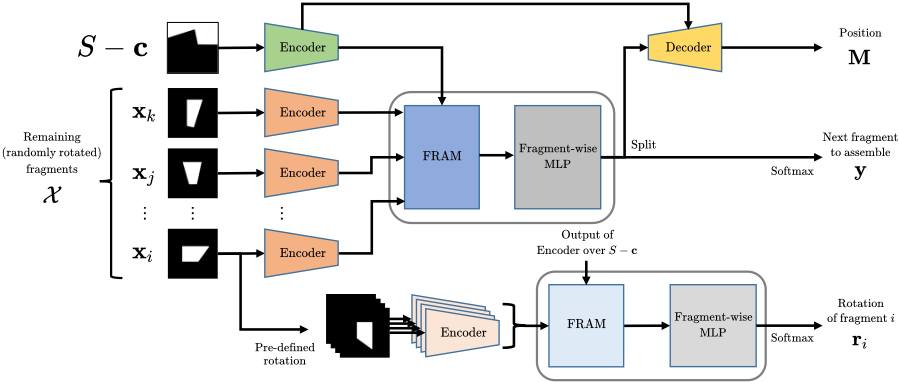
Our model, dubbed Fragment Assembly Network (FAN), considers a candidate fragment xi in the context of the other candidates X \ xi and the remaining shape S - c, and produces three outputs: (i) selection probability for xi, which implies how likely xi is selected; (ii) placement probability map for xi, which means how likely each position is for xi; (optional, iii) rotation probability for xi, which indicates a bin index with respect to rotation angles. As shown in Figure 2, FAN contains two branches for the outputs, fragment selection network (i.e., FAN-Select) and fragment placement network (i.e., FAN-Pose). Both networks share many learnable parameters that are parts of encoders, Fragment Relation Attention Module (FRAM) and fragment-wise MLP. FRAM, inspired by a Transformer network [Vaswani et al., 2017], captures the relational information between the fragments.
Fragment Selection. FAN-Select is a binary classifier taking as inputs xi, S - c, and X \ xi:
where xi ∈ X. Since, in particular, Eq. (1) takes into account relationship between fragments with FRAM, it can choose the next fragment by considering the fragment candidates and remaining shape. Furthermore, the number of parameters in FAN does not depend on the number of fragments, which implies that the cardinality of X can be varied. This property helps our network to handle variable-length set of fragments. Note that y = [yi, . . . , y|X|] ∈ R|X| .
Fragment Placement. FAN-Pose determines the pose of x ∈ X by predicting a probability map over pixels and a probability with respect to rotation angle bins:
where X ′ i is a set of all possible pre-defined rotation of xi. Note that we simplify our problem with pre-defined discrete bins of rotation angles. This network is implemented as an encoder-decoder architecture with skip connections between them, in order to compute pixel-wise probabilities with convolution and transpose convolution operations. This structure reduces the number of parameters due to the absence of the last fully-connected layer. Note that Mi ∈ Rw×h and ri ∈ Rb where b is the number of rotation angle bins.
Fragment Relation Attention Modules. We suggest attention-based FRAM, which considers high-order relations between the remaining fragments using multi-head attentions [Vaswani et al., 2017]. Given X ∈ Rn1×d and Y ∈ Rn2×d , multi-head attention is composed of multiple scaled dot-product attentions:
where Q ∈ Rn1×d1 , K ∈ Rn2×d1 , V ∈ Rn2×d2 , DPi = DP(XWQ i ,YWK i ,YWV i ), σ is a softmax function, h is the number of heads, and WO ∈ Rhd2×d is the parameters. To leverage the expression power of multi-head attention module, X and Y are projected by the different parameter sets WQ ∈ Rd×d1 , WK ∈ Rd×d1 , and WV ∈ Rd×d2 .
To express a set of the fragment candidates to a latent representation h, we utilize the multi-head attention:
where 1 ∈ R1×d is an all-ones matrix. Without loss of generality, Eq. (5) and Eq. (6) can take X (or X ′ i ) and H, respectively. Moreover, Eq. (5) can be stacked by feeding H to the multi-head attention as an input, and Eq. (6) can be stacked in the similar manner. Note that h becomes R1×d , but we can employ it as a Rd -shaped representation. Additionally, FRAM includes a skip connection between an input and an output, in order to partially hold the input information.
| Target Shape | Method | Cov@0.95 | Cov@0.90 | Cov | IoU | Time (sec.) |
|---|---|---|---|---|---|---|
| SA BayesOpt V-GAN Ours | 0.000 0.000 0.000 0.470 | 0.000 0.000 0.000 0.649 | 0.720 0.730 | 0.655 0.664 0.562 | 1,860 155 <1 | |
| Square | SA BayesOpt | 0.000 0.000 | 0.000 0.000 | 0.710 | 0.581 0.660 | 149 |
| 0.720 | ||||||
| 0.914 | 0.882 | <1 | ||||
| Pentagon | 0.697 | 1,854 | ||||
| Ours | 0.452 | 0.696 | 0.922 | 0.884 | <1 | |
| Hexagon | SA | 0.000 | 0.000 | 0.711 | 0.608 | 1,846 |
| BayesOpt | 0.000 | 0.000 | 0.674 | 153 | ||
| 0.727 | 0.882 | |||||
| Ours | 0.439 | 0.684 | 0.916 | <1 |
| Method | Cov@0.95 | Cov@0.90 | Cov | IoU | Time (sec.) |
|---|---|---|---|---|---|
| SA | 0.000 | 0.000 | 0.761 | 0.671 | 153 |
| BayesOpt | 0.000 | 0.000 | 0.756 | 0.704 | 97 |
| V-GAN | 0.000 | 0.000 | 0.549 | 0.545 | <1 |
| Ours | 0.384 | 0.545 | 0.892 | 0.854 | <1 |
FRAM is a generalization of global feature aggregation such as average pooling and max pooling across instances, so that it considers high-order interaction between instances and aggregates intermediate instance-wise representations (i.e., H) with learnable parameters. In Section 4, we show that this module is powerful for assembling fragments via elaborate studies on geometric shape assembly.
The final output is determined by selecting the fragment with the index of maximum yi: i⋆ = argmaxi∈{1,...,|X|} yi. After choosing the next fragment, its pose is selected through the maximum probability on Mi⋆ (and ri⋆ ).
3.2 Training
We train our neural network based on the objective that combines losses for two sub-tasks, fragment selection, i.e., Eq. (7) and fragment placement, i.e., Eq. (8). Since we first choose the next fragment, and then determine the position and angle of the selected fragment, the gradient updates by the summation of two losses should be applied. Given a batch size M, the loss for the fragment selection part is
where tm is one-hot encoding of true fragment, each entry of ym is computed by Eq. (1), and σ is a softmax function. Next, the objective for the fragment placement part is
where τm ∈ Rw×h /ρm ∈ Rr are one-hot encodings of true position/true angle, Mm (and rm) are computed by Eq. (2), L is the number of pooling operations, and max-p/avg-p/v are functions for applying max-pooling/applying averagepooling/vectorizing a matrix. The subscript of pooling operations indicates the size of pooling and stride, and zero-sized pooling returns an original input. Moreover, the coefficients for balancing the objective functions should be multiplied to each term of the objectives; see the supplementary material.
4 Experimental Results
We show that the qualitative and quantitative results comparing to the three baselines for four target geometric shapes. We also provide studies on interesting assembly scenarios.


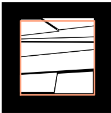
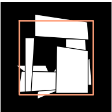
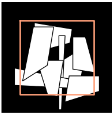
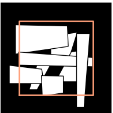
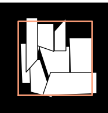
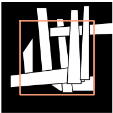
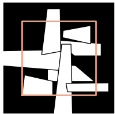

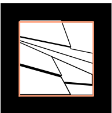
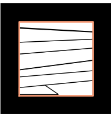
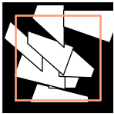
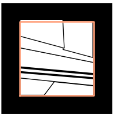
Figure 3: Assembling results for Square.
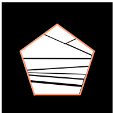
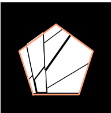
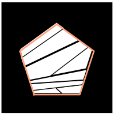
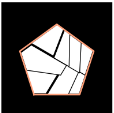
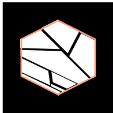
Details of Experiments. As shown in Figure 1, we evaluate our method and existing methods on the following target objects: Square, Mondrian-Square, Pentagon, and Hexagon. Unless specified otherwise, we use 5,000 samples each of them is partitioned into 8 fragments using binary space partitioning and the number of rotation angle bins are set to 1, 4, or 20. We use 64%, 16%, and 20% of the samples for training, validation, and test splits, respectively. An assembly quality is calculated with coverage (Cov) and Intersection over Union (IoU).
where c is an assembled shape and S is a target shape.
Since there exist no prior methods that specifically aim to tackle shape assembly of textureless fragments with indistinctive junctions, we compare ours with two classic optimization methods, simulated annealing [Pincus, 1970], Bayesian optimization [Brochu et al., 2010], and a generative method using generative adversarial networks [Li et al., 2020]. The details can be found in the supplementary material.
4.1 Shape Assembly Experiments
Experiments in this section compare our approach to other baseline methods on the assembly of different target objects. The quantitative results on Square, Mondrian-Square, Pentagon, and Hexagon objects are summarized in Table 1. We find that our method consistently covers much more area than baselines within less time budget.
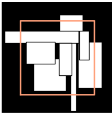
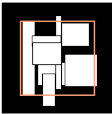
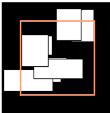
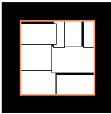
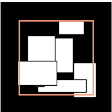
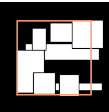
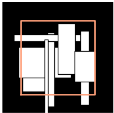
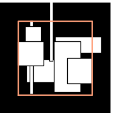
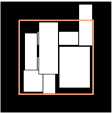
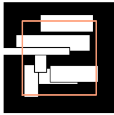
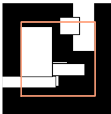
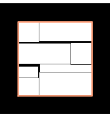
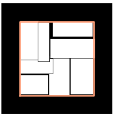
Figure 4: Assembling results for Mondrian-Square.
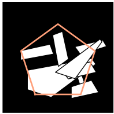
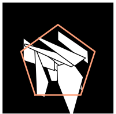
The qualitative results with randomly partitioned fragments from geometric shapes such as Square, Pentagon, and Hexagon are presented in Figure 3, Figure 5, and Figure 6. In Figure 4, the results with axis-aligned partitioning process, Mondrian-Square, is also presented.
V-GAN requires a fixed number of vertices for partitioned fragments, which is only applicable to Square and Mondrian-Square cases. Both SA and BayesOpt struggle to place fragments in the correct position, but many overlaps occur between fragments. They also consume longer time than our method in all experimental conditions. On the other hand, V-GAN consumes less time than other baseline methods while it significantly underperforms compared to other methods.
4.2 Elaborate Study &Ablation Study
We present interesting studies on Mondrian-Square objects, the number of fragments, abnormal fragments, rotation discretization, the effectiveness of FRAM, sequence sampling strategy, and scenarios with texture.
Axis-Aligned Space Partitioning. To create a more challenging problem, we apply axis-aligned space partitioning in the shape fragmentation process. As shown in Figure 1, it generates similar rectangle fragments, which can puzzle our method. Nevertheless, our network successfully assembles the fragments given, as shown in Figure 4 and Table 2.





| #Frags | Target Shape | Cov@0.95 | Cov@0.90 | Cov | IoU |
|---|---|---|---|---|---|
| fragments | Square | 0.972 | 0.989 | 0.991 | 0.962 |
| Pentagon | 0.962 | 0.974 | 0.991 | 0.958 | |
| Hexagon | 0.940 | 0.976 | 0.989 | 0.956 | |
| fragments | Square | 0.010 | 0.076 | 0.769 | 0.730 |
| Pentagon | 0.024 | 0.108 | 0.797 | 0.755 | |
| Hexagon | 0.008 | 0.062 | 0.771 | 0.729 |
Table 3: Study on shape assemblies with 4 and 16 fragments.
Number of Fragments. As mentioned before, our model can be applied to the dataset that consists of a different number of fragments. Thus, we prepare a dataset, given the number of partitions K = 2 or K = 4. The results of our proposed model on the datasets with 4 fragments and 16 fragments of three geometric shapes are shown in Table 3. If the number of fragments is 4, it performs better than the circumstance with 8 fragments. On the contrary, a dataset with 16 fragments deteriorates the performance, but our method covers the target object with relatively small losses.
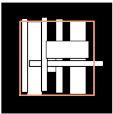
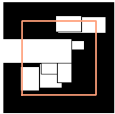
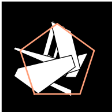
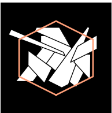
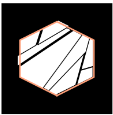
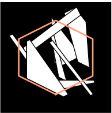
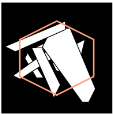
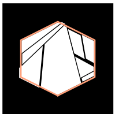
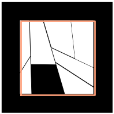
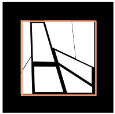
Abnormal Fragments. We consider a particular situation to reconstruct a target object with missing, eroded, or distorted fragments, which can be thought of as the excavation scenario in archaeology; see Figure 8. We assume one fragment is missing, or four fragments are eroded or distorted randomly. We measure the performance of our method excluding the degradation from the ground-truth target object. Our methods outperform other methods as shown in Table 4.
Rotation Discretization. To show the effects of rotation discretization, we test two bin sizes. As shown in Table 5, delicate discretization is more difficult than the case with a small bin size, which follows our expectation.





| Target Shape | Abnormal Type | Cov@0.95 | Cov@0.90 | Cov | IoU |
|---|---|---|---|---|---|
| Square | Missing Eroded Distorted | 0.125 0.108 0.010 | 0.254 0.322 0.060 | 0.808 0.843 0.753 | 0.716 0.803 0.685 |
| Missing Eroded | 0.208 0.049 | 0.407 0.197 | 0.852 0.829 | 0.764 0.791 | |
| Pentagon | Distorted | 0.031 | 0.113 | 0.793 | 0.739 |
| Hexagon | Missing Eroded | 0.253 0.065 | 0.459 0.221 | 0.855 0.814 | 0.778 |
| 0.773 | |||||
| Distorted | 0.026 | 0.125 | 0.778 | 0.723 |
Table 4: Study on missing, eroded, and distorted scenarios.
Effectiveness of FRAM. It empirically validates the effectiveness of FRAM. As summarized in Table 6, FRAM outperforms other aggregation methods. The w/o aggregation model does not have a network for relations between fragments, and the other two models replace our FRAM to the associated aggregation methods among feature vectors.
Sequence Sampling Strategy. As shown in Table 7, our sampling strategy that samples from bottom, left to top, right is effective compared to the random sampling technique that chooses the order of fragments based on the proximity of the fragments previously sampled.
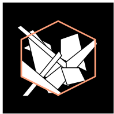
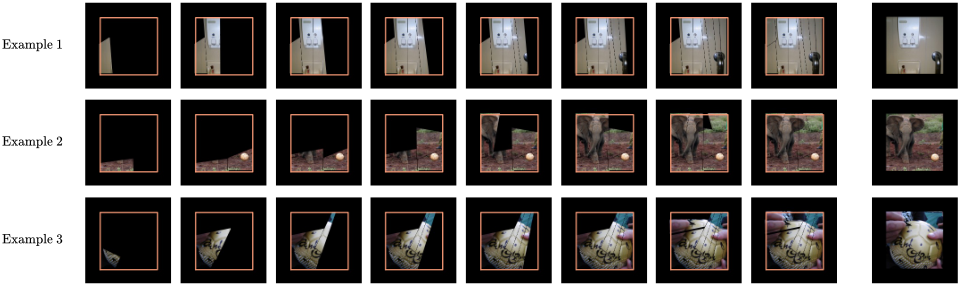
Scenarios with Texture. Our model is also able to handle a scenario with colored textures by allowing it to take RGB images. As shown in Figure 7, our method successfully assembles fragments with texture into the target object.
5 Discussion &RelatedWork
Compared to generic setting of jigsaw puzzle solvers [Cho et al., 2010; Noroozi and Favaro, 2016], our problem is more challenging as it involves textureless fragments and indistinctive junctions as well as arbitrary shapes and rotatable fragments. As presented in Table 1, the empirical results for Pentagon and Hexagon tend to be better than the results for Square. It implies that if a target shape becomes complicated and contains more information, the problem becomes more easily solvable. This tendency is also shown in the experiments with textures; see Figure 7.

(c) Distorted
| Target Shape | #Bins | Cov@0.95 | Cov@0.90 | Cov | IoU |
|---|---|---|---|---|---|
| Square | 4 | 0.010 0.000 | 0.017 0.000 | 0.670 | 0.622 |
| 20 | 0.603 | 0.519 | |||
| Pentagon | 4 | 0.062 | 0.147 | 0.791 | 0.726 |
| 20 | 0.000 | 0.000 | 0.604 | 0.515 | |
| Hexagon | 4 | 0.009 | 0.046 | 0.731 | 0.676 |
| 20 | 0.000 | 0.000 | 0.640 | 0.550 |
Table 5: Study on rotation discretization.
The results with axis-aligned partitioning process, Mondrian-Square, is also presented in Table 2. The outcome by this process, which resembles the paintings by Piet Mondrian as shown in the second example of Figure 1, can be more difficult than the randomly partitioned shape, because fragment shapes and junction information are less expressive than arbitrary fragments. However the results show that our method is still more effective than the other baselines despite the performance loss, which implies that our method is able to select and place fragments although ambiguous choices exist; see Figure 4.
Unlike our random fragmentation, the approaches to solving a sequential assembly problem with fixed primitives [Bapst et al., 2019; Kim et al., 2020; Chung et al., 2021]
| Method | Cov@0.95 | Cov@0.90 | Cov | IoU |
|---|---|---|---|---|
| w/o Aggregation | 0.392 | 0.569 | 0.899 | 0.863 |
| Max Pooling | 0.390 | 0.563 | 0.893 | 0.856 |
| Avg Pooling | 0.431 | 0.580 | 0.899 | 0.863 |
| w/ FRAM | 0.470 | 0.649 | 0.914 | 0.882 |
| Target Shape | Strategy | Cov@0.95 | Cov@0.90 | Cov | IoU |
|---|---|---|---|---|---|
| Square | Random | 0.012 0.470 | 0.109 | 0.814 | 0.770 0.882 |
| ↗ | 0.649 | 0.914 | |||
| Pentagon | Random | 0.016 | 0.115 | 0.802 | 0.751 |
| ↗ | 0.452 | 0.696 | 0.922 | 0.884 | |
| Hexagon | Random | 0.034 | 0.146 | 0.807 | 0.762 |
| ↗ | 0.439 | 0.684 | 0.916 | 0.882 |
have been studied recently. However, they focus on constructing a physical object by assembling given unit primitives, and they utilize explicit supervision such as volumetric (or areal) comparisons and particular rewards.
6 Conclusion
In this paper, we have solved a two-dimensional geometric shape assembly problem. Our model, dubbed FAN, predicts the next fragment and its pose where fragments to assemble are given, with an attention-based module, dubbed FRAM. We showed that our method outperforms other baseline methods including simulated annealing, Bayesian optimization, and a learning-based adversarial network. Moreover, we evaluated our methods in diverse circumstances, such as novel assembly scenarios with axis-aligned space partitioning, degraded fragments, and colored textures.
Acknowledgments
This work was supported by Samsung Research Funding & Incubation Center of Samsung Electronics under Project Number SRFC-TF2103-02.
@inproceedings{ijcai2022p146,
  title     = {Learning to Assemble Geometric Shapes},
  author    = {Lee, Jinhwi and Kim, Jungtaek and Chung, Hyunsoo and Park, Jaesik and Cho, Minsu},
  booktitle = {Proceedings of the Thirty-First International Joint Conference on
               Artificial Intelligence, {IJCAI-22}},
  publisher = {International Joint Conferences on Artificial Intelligence Organization},
  editor    = {Luc De Raedt},
  pages     = {1046--1052},
  year      = {2022},
  month     = {7},
  note      = {Main Track},
  doi       = {10.24963/ijcai.2022/146},
  url       = {https://doi.org/10.24963/ijcai.2022/146},
}
TY - CPAPER TI - Learning to Assemble Geometric Shapes AU - Lee, Jinhwi AU - Kim, Jungtaek AU - Chung, Hyunsoo AU - Park, Jaesik AU - Cho, Minsu T2 - Proceedings of the Thirty-First International Joint Conference on Artificial Intelligence, IJCAI-22 PB - International Joint Conferences on Artificial Intelligence Organization PY - 2022 SP - 1046 EP - 1052 DO - 10.24963/ijcai.2022/146 UR - https://doi.org/10.24963/ijcai.2022/146 ER -Copied
Machine-readable versions of this paper, for tools and AI agents:





