
Emotion-Controllable Generalized Talking Face Generation
Proceedings of the Thirty-First International Joint Conference on Artificial Intelligence. Main Track. Pages 1320-1327.
https://doi.org/10.24963/ijcai.2022/184
Keywords
- Humans and AI: Human-Computer Interaction
- Computer Vision: Applications
- Computer Vision: Machine Learning for Vision
- Computer Vision: Neural generative models, auto encoders, GANs
- Machine Learning: Applications
Abstract
Despite the significant progress in recent years, very few of the AI-based talking face generation methods attempt to render natural emotions. Moreover, the scope of the methods is majorly limited to the characteristics of the training dataset, hence they fail to generalize to arbitrary unseen faces. In this paper, we propose a one-shot facial geometry-aware emotional talking face generation method that can generalize to arbitrary faces. We propose a graph convolutional neural network that uses speech content feature, along with an independent emotion input to generate emotion and speech-induced motion on facial geometry-aware landmark representation. This representation is further used in our optical flow-guided texture generation network for producing the texture. We propose a two-branch texture generation network, with motion and texture branches designed to consider the motion and texture content independently. Compared to the previous emotion talking face methods, our method can adapt to arbitrary faces captured in-the-wild by fine-tuning with only a single image of the target identity in neutral emotion.
- [Cai et al., 2019] Yujun Cai, Liuhao Ge, Jun Liu, Jianfei Cai, Tat-Jen Cham, Junsong Yuan, and Nadia Magnenat Thal- mann. Exploiting spatial-temporal relationships for 3d pose estimation via graph convolutional networks. In Pro- ceedings of the IEEE/CVF International Conference on Computer Vision, pages 2272-2281, 2019.
- [Cao et al., 2014] Houwei Cao, David G Cooper, Michael K Keutmann, Ruben C Gur, Ani Nenkova, and Ragini Figure 7: User Study results. The bar plots represent the average score (range 0-5, high score indicates better performance).
- Verma. Crema-d: Crowd-sourced emotional multimodal actors dataset. IEEE transactions on affective computing, 5:377-390, 2014.
- [Chen et al., 2019] Lele Chen, Ross K Maddox, Zhiyao Duan, and Chenliang Xu. Hierarchical cross-modal talk- ing face generation with dynamic pixel-wise loss. In Pro- ceedings of the IEEE/CVF Conference on Computer Vision and Pattern Recognition, pages 7832-7841, 2019.
- [Chen et al., 2020] Lele Chen, Guofeng Cui, Celong Liu, Zhong Li, Ziyi Kou, Yi Xu, and Chenliang Xu. Talking- head generation with rhythmic head motion. In European Conference on Computer Vision, pages 35-51. Springer, 2020.
- [Chung and Zisserman, 2016] J. S. Chung and A. Zisserman. Out of time: automated lip sync in the wild. In Workshop on Multi-view Lip-reading, ACCV, 2016.
- [Chung et al., 2017] Joon Son Chung, Amir Jamaludin, and Andrew Zisserman. You said that? arXiv preprint arXiv:1705.02966, 2017.
- [Chung et al., 2018] Joon Son Chung, Arsha Nagrani, and Andrew Zisserman. Voxceleb2: Deep speaker recognition. arXiv preprint arXiv:1806.05622, 2018.
- [Das et al., 2020] Dipanjan Das, Sandika Biswas, Sanjana Sinha, and Brojeshwar Bhowmick. Speech-driven facial animation using cascaded gans for learning of motion and texture. In European Conference on Computer Vision, 2020.
- [Delaunay et al., 1934] Boris Delaunay, S Vide, A Lamémoire, and V De Georges. Bulletin de l'académie des sciences de l'urss. Classe des sciences mathématiques et naturelles, 6:793-800, 1934.
- [Deng et al., 2019] Jiankang Deng, Jia Guo, Niannan Xue, and Stefanos Zafeiriou. Arcface: Additive angular margin loss for deep face recognition. In Proceedings of the IEEE Conference on Computer Vision and Pattern Recognition, pages 4690-4699, 2019.
- [Eskimez et al., 2020] Sefik Emre Eskimez, You Zhang, and Zhiyao Duan. Speech driven talking face generation from a single image and an emotion condition. arXiv preprint arXiv:2008.03592, 2020.
- [Guo et al., 2020] Jianzhu Guo, Xiangyu Zhu, Yang Yang, Fan Yang, Zhen Lei, and Stan Z Li. Towards fast, accurate and stable 3d dense face alignment. In Proceedings of the European Conference on Computer Vision (ECCV), 2020.
- [Hannun et al., 2014] Awni Hannun, Carl Case, Jared Casper, Bryan Catanzaro, Greg Diamos, Erich Elsen, Ryan Prenger, Sanjeev Satheesh, Shubho Sengupta, Adam Coates, et al. Deep speech: Scaling up end-to-end speech recognition. arXiv preprint arXiv:1412.5567, 2014.
- [Heusel et al., 2017] Martin Heusel, Hubert Ramsauer, Thomas Unterthiner, Bernhard Nessler, and Sepp Hochre- iter. Gans trained by a two time-scale update rule converge to a local nash equilibrium. In Advances in neural information processing systems, pages 6626-6637, 2017.
- [Ji et al., 2021] Xinya Ji, Hang Zhou, Kaisiyuan Wang, Wayne Wu, Chen Change Loy, Xun Cao, and Feng Xu. Audio-driven emotional video portraits. In Proceedings of the IEEE/CVF Conference on Computer Vision and Pat- tern Recognition, pages 14080-14089, 2021.
- [Kipf and Welling, 2016] Thomas N Kipf and Max Welling. Semi-supervised classification with graph convolutional networks. arXiv preprint arXiv:1609.02907, 2016.
- [Livingstone and Russo, 2018] Steven R Livingstone and Frank A Russo. The ryerson audio-visual database of emo- tional speech and song (ravdess): A dynamic, multimodal set of facial and vocal expressions in north american en- glish. PloS one, 13(5):e0196391, 2018.
- [Mao et al., 2017] Xudong Mao, Qing Li, Haoran Xie, Ray- mond YK Lau, Zhen Wang, and Stephen Paul Smolley. Least squares generative adversarial networks. In Proceed- ings of the IEEE international conference on computer vi- sion, pages 2794-2802, 2017.
- [Narvekar and Karam, 2009] Niranjan D Narvekar and Lina J Karam. A no-reference perceptual image sharpness metric based on a cumulative probability of blur detection. In 2009 International Workshop on Quality of Multimedia Experience, pages 87-91. IEEE, 2009.
- [Prajwal et al., 2020] KR Prajwal, Rudrabha Mukhopad- hyay, Vinay P Namboodiri, and CV Jawahar. A lip sync expert is all you need for speech to lip generation in the wild. In Proceedings of the 28th ACM International Con- ference on Multimedia, pages 484-492, 2020.
- [Sinha et al., 2020] Sanjana Sinha, Sandika Biswas, and Brojeshwar Bhowmick. Identity-preserving realistic talk- ing face generation. In 2020 International Joint Con- ference on Neural Networks (IJCNN), pages 1-10. IEEE, 2020.
- [Song et al., 2020] Linsen Song, Wayne Wu, Chen Qian, Ran He, and Chen Change Loy. Everybody's talkin': Let me talk as you want. arXiv preprint arXiv:2001.05201, 2020.
- [Suwajanakorn et al., 2017] Supasorn Suwajanakorn, Steven M Seitz, and Ira Kemelmacher-Shlizerman. Syn- thesizing obama: learning lip sync from audio. ACM Transactions on Graphics (TOG), 36(4):1-13, 2017.
- [Thies et al., 2019] Justus Thies, Mohamed Elgharib, Ayush Tewari, Christian Theobalt, and Matthias Nießner. Neural voice puppetry: Audio-driven facial reenactment. arXiv preprint arXiv:1912.05566, 2019.
- [Vougioukas et al., 2019] Konstantinos Vougioukas, Stavros Petridis, and Maja Pantic. Realistic speech-driven facial animation with gans. International Journal of Computer Vision, pages 1-16, 2019.
- [Wang et al., 2004] Zhou Wang, Alan C Bovik, Hamid R Sheikh, and Eero P Simoncelli. Image quality assessment: from error visibility to structural similarity. IEEE transac- tions on image processing, 13(4):600-612, 2004.
- [Wang et al., 2020] Kaisiyuan Wang, Qianyi Wu, Linsen Song, Zhuoqian Yang, Wayne Wu, Chen Qian, Ran He, Yu Qiao, and Chen Change Loy. Mead: A large-scale audio-visual dataset for emotional talking-face generation. In European Conference on Computer Vision, pages 700- 717. Springer, 2020.
- [Wang et al., 2021] Suzhen Wang, Lincheng Li, Yu Ding, Changjie Fan, and Xin Yu. Audio2head: Audio-driven one-shot talking-head generation with natural head mo- tion. IJCAI, 2021. IJCAI
- [Wen et al., 2020] Xin Wen, Miao Wang, Christian Richardt, Ze-Yin Chen, and Shi-Min Hu. Photorealistic audio-driven video portraits. IEEE Transactions on Visualization and Computer Graphics, 26(12):3457-3466, 2020.
- [Yan et al., 2018] Sijie Yan, Yuanjun Xiong, and Dahua Lin. Spatial temporal graph convolutional networks for skeleton-based action recognition. In Thirty-second AAAI conference on artificial intelligence, 2018.
- [Yu et al., 2018] Changqian Yu, Jingbo Wang, Chao Peng, Changxin Gao, Gang Yu, and Nong Sang. Bisenet: Bi- lateral segmentation network for real-time semantic seg- mentation. In Proceedings of the European Conference on Computer Vision (ECCV), pages 325-341, 2018.
- [Zhang et al., 2021] Zhimeng Zhang, Lincheng Li, Yu Ding, and Changjie Fan. Flow-guided one-shot talking face gen- eration with a high-resolution audio-visual dataset. In Pro- ceedings of the IEEE/CVF Conference on Computer Vision and Pattern Recognition, pages 3661-3670, 2021.
- [Zhou et al., 2019] Hang Zhou, Yu Liu, Ziwei Liu, Ping Luo, and Xiaogang Wang. Talking face generation by adver- sarially disentangled audio-visual representation. In Pro- ceedings of the AAAI Conference on Artificial Intelligence, volume 33, pages 9299-9306, 2019.
- [Zhou et al., 2020] Yang Zhou, Xintong Han, Eli Shecht- man, Jose Echevarria, Evangelos Kalogerakis, and Dingzeyu Li. Makelttalk: speaker-aware talking-head an- imation. ACM Transactions on Graphics (TOG), 39(6):1- 15, 2020.
- [Zhou et al., 2021] Hang Zhou, Yasheng Sun, Wayne Wu, Chen Change Loy, Xiaogang Wang, and Ziwei Liu. Pose- controllable talking face generation by implicitly modu- larized audio-visual representation. In Proceedings of the IEEE/CVF Conference on Computer Vision and Pattern Recognition, pages 4176-4186, 2021.
References were extracted automatically from the PDF and may contain errors.
Full text extracted automatically from the PDF; figures, tables and equations may differ. The PDF is the version of record.
1 Introduction
Audio-driven realistic talking face generation is a widely studied research problem, with diverse applications in animation, virtual assistant, telepresence, gaming etc. Most of the existing methods [Chung et al., 2017; Suwajanakorn et al., 2017; Chen et al., 2019; Das et al., 2020; Zhou et al., 2019; Sinha et al., 2020; Chen et al., 2020; Zhou et al., 2020; Zhou et al., 2021; Zhang et al., 2021] mainly focus on generating realistic lip synchronization, identity preservation, eye blinks or head motion in the synthesized talking face video. Very few of these methods can render realistic facial emotions (Table 1), due to the limited availability of annotated emotional audio-visual datasets. Some earlier methods [Vougioukas et al., 2019; Chen et al., 2020] have tried to learn the facial emotions implicitly from the audio. However, these Disgusted methods fail to control the facial emotion and often fail to produce realistic animation.
∗Equal contribution
† Former intern at TCS Research
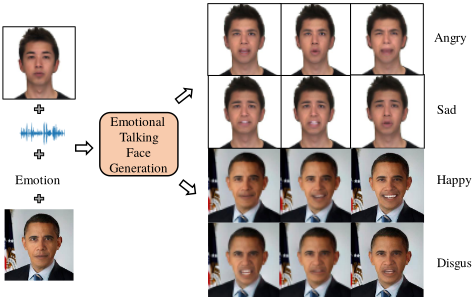
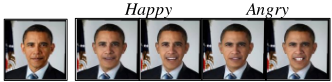
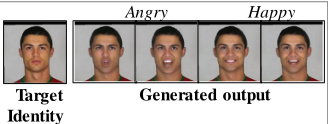
Figure 1: Results of our proposed emotional talking face generation method on arbitrary faces.
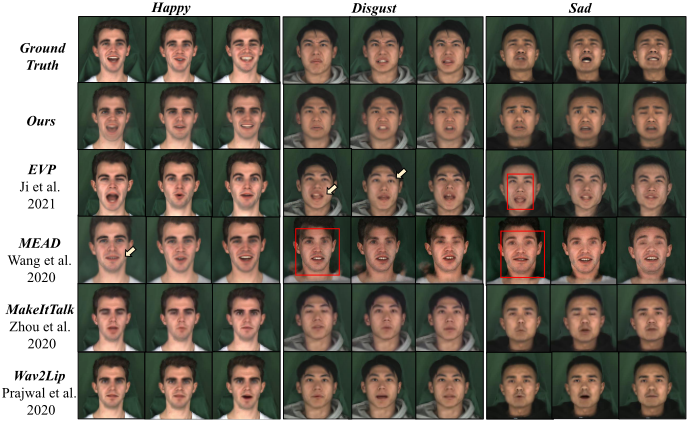
Recently, MEAD [Wang et al., 2020] has proposed a method for emotional talking face generation with explicit emotion control and released the MEAD dataset [Wang et al., 2020] containing well-defined emotions at varying intensities, and a wide variety of sentences. This method [Wang et al., 2020] generates emotion only in the upper face (from external emotion control using one-hot emotion vector) and the lower part of the face is animated from audio independently, which results in inconsistent emotions over the face. A recent video editing method EVP [Ji et al., 2021] focuses on generating consistent emotions over the entire face using a disentangled emotion latent feature learned from the audio. However, all these methods rely on intermediate global landmarks (or edge maps) to generate the texture directly with emotions. To generalize the texture deformation for any unknown face for a given emotion, it is important to learn the relationship between the facial geometry and the emotion-induced local deformations within the face. None of these methods consider learning this relationship, hence show a limited scope of generalization to an arbitrary unknown target face (Fig. 3, Row 3 & 4, refer to the caption for evaluation details). Moreover, MEAD 1 and EVP 2 train target-specific texture models.
1 https://github.com/uniBruce/Mead
2 https://github.com/jixinya/EVP
In this work, we propose a generalized one-shot learningbased emotional talking face generation method. Unlike the previous video-based method EVP (Table 1), for emotion rendering, we need only a single image of the target person, along with speech and an emotion vector as input. We want to achieve speech-independent emotion control so that the same audio can be animated using different emotions. We use features from a pre-trained automatic speech recognition model DeepSpeech [Hannun et al., 2014] for disentangling emotion from speech content of audio. We first propose a graph neural network that encodes the desired emotion and speech content to render emotion and speech-induced motion on a geometry-aware graph representation of the facial landmarks. Unlike previous landmark-based talking face methods [Chen et al., 2019; Zhou et al., 2020; Chen et al., 2020; Ji et al., 2021; Zhang et al., 2021], we construct a graph representation of facial landmarks using [Delaunay et al., 1934] for capturing the spatial configuration of facial landmarks and their inter-dependencies during emotional speech. In the texture generation stage, we learn an emotion-guided optical flow map from the intermediate predicted landmarks to consider the facial structure and emotion-induced local deformations around the landmarks. Despite having high-quality, well-defined emotional speech videos, MEAD dataset has low variety in illumination, background, etc. We carefully design a two-branch texture generation network to disentangle the speech and emotion-induced motion from identityrelated texture content. At inference time, we propose oneshot learning for adapting the texture generation model to the identity of the input target face. This helps in generalization while generating emotions for any arbitrary target face.
We demonstrate the generalization ability of our method by evaluating on different faces outside our training dataset MEAD (Fig.s 1, 4 and 5). To the best of our knowledge, this is the first work on emotional talking face generation that is generalized for any arbitrary face. Our contributions are summarized below:
- We propose a pipeline for facial geometry-aware oneshot emotional talking face generation from audio with independent emotion control.
- We propose a graph convolutional network for inducing speech and emotion on graph-representation of facial landmarks to preserve facial structure and geometry for emotion rendering.
- We propose an optical flow-guided texture generation network that renders emotional talking face animation from a single image of any arbitrary target face in neutral emotion.
2 RelatedWork
Emotional Talking Face Generation. Recent methods in audio-driven talking face generation are listed in (Table 1). Video-based methods that generate only the mouth in a driving video of target [Thies et al., 2019; Song et al., 2020; Prajwal et al., 2020; Wen et al., 2020] are capable of generating photo-realistic facial animation. However, since the facial texture (except the mouth) is copied from the input video frames, facial expressions and emotions in the upper part of the face cannot be manipulated using these methods. Our method uses a single image of the target for generating emotional talking faces without the need for a driving video.
| Audio-driven Talking Face Methods | Input Image/Video | Arbitrary face | Emotion generation |
|---|---|---|---|
| [Das et al., 2020] | Image | ✓ | 5 |
| MakeItTalk [Zhou et al., 2020] | Image | ✓ | 5 |
| [Zhang et al., 2021] | Image | ✓ | 5 |
| [Wang et al., 2021] | Image | ✓ | 5 |
| [Zhou et al., 2021] | Image | ✓ | 5 |
| [Thies et al., 2019] | Video | ✓ | 5 |
| [Song et al., 2020] | Video | ✓ | 5 |
| Wav2Lip [Prajwal et al., 2020] | Video | ✓ | 5 |
| [Wen et al., 2020] | Video | ✓ | 5 |
| [Vougioukas et al., 2019]* | Image | 5 | ✓ |
| [Chen et al., 2020]* | Image | 5 | ✓ |
| [Eskimez et al., 2020] | Image | 5 | ✓ |
| MEAD, [Wang et al., 2020] | Image | 5 | ✓ |
| EVP, [Ji et al., 2021] | Video | 5 | ✓ |
| Ours | Image | ✓ | ✓ |
Some earlier methods [Vougioukas et al., 2019; Chen et al., 2020] render emotional talking face videos that learn the emotion implicitly from the audio. In contrast, we aim for an explicit control for generating consistent emotions in the talking face. Some recent methods MEAD, EVP, [Eskimez et al., 2020] have proposed methods with external control on emotion in the talking face. EVP learns a disentangled emotion latent feature representation from speech input and tries to generate varying emotions by interpolating the emotion latent space. However, the latent emotion representation in EVP depends on the accuracy of the audio-emotion disentanglement; hence it is difficult to achieve completely independent control of emotion from speech. In contrast to the previous methods MEAD, EVP, our method manipulates emotions in the entire face using an emotion control input that is fully independent of the audio.
Generalized Arbitrary-Subject Talking Face. Talking face generation methods (Table 1) that can generalize to arbitrary faces are trained on large-scale audio-visual datasets such as Voxceleb [Chung et al., 2018] having a wide diversity of faces, illumination and background. However these methods cannot render animation in different emotions. Existing emotional talking face generation methods trained on emotional audio-visual datasets CREMA-D [Cao et al., 2014] and MEAD [Wang et al., 2020] have limited scope of generalization owing to lower diversity of these datasets. Previous methods [Vougioukas et al., 2019; Chen et al., 2020; Eskimez et al., 2020] which are trained on CREMA-D lack generalization to faces outside CREMA-D. Recently, MEAD and EVP have used a high quality emotional audio-visual dataset MEAD for training. However, they have trained target subject-specific texture generation models 1 2 ; hence they cannot generalize to arbitrary identities. On the other hand, our method is capable of generalization to any unknown target subject.
3 Methodology
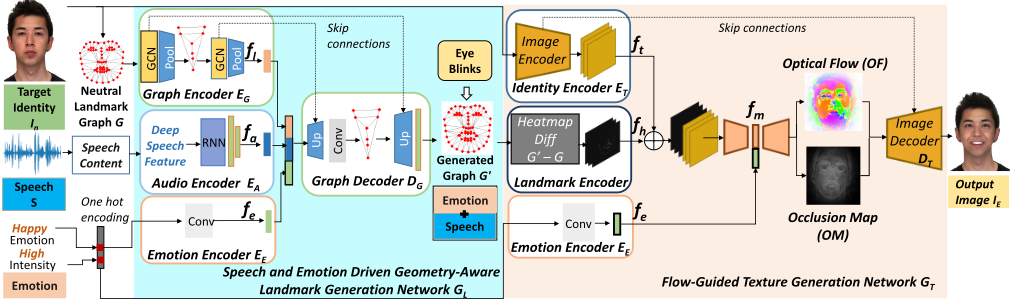
Fig. 2 shows the detailed architecture of our network for generating emotion-controllable talking faces. For a given speech (S), an emotion input, and a single image of the target subject in neutral emotion (In), our method generates an animated face delivering the speech with desired emotion and intensity.
3.1 Speech and Emotion Driven Landmark Generation
We propose facial geometry-aware speech and emotion generation (GL, Fig. 2) on facial landmarks using a graph neural network.
Audio Encoder. EA is a recurrent neural network which creates an emotion-invariant speech embedding feature fa ∈ Rd (d = 128) from speech audio input S. For each audio window of size W corresponding to a video frame, features A = {at ∈ RW×29 } are extracted from the output layer of a pre-trained DeepSpeech network (before applying Softmax). The output layer of Deepspeech represents log probabilities of 29 characters; hence the features are emotion-independent.
Emotion Encoder. EE encodes an emotion vector (e,i). e denotes six types of emotions i.e. happy, angry, sad, surprise, fear and disgust, at two types of intensity levels i (high or low) into a fixed feature representation fe ∈ Rd (d = 128).
Graph Encoder. EG is a graph convolutional network that encodes the geometry of an ordered graph G = (V, E,A), where V = {vi} denotes the set of L = 68 facial landmark vertices, E = {eij} is the set of edges, computed using delaunay triangulation [Delaunay et al., 1934] on facial landmarks, A is the adjacency matrix of G. X = [Xij](Xij ∈ R2 ) is a matrix of vertex feature vectors, i.e, coordinates of the L = 68 facial landmarks of a neutral image (face in neutral emotion and with closed lips). We apply spectral graph convolution [Kipf and Welling, 2016] with a modified propagation rule including learnable edge weights [Yan et al., 2018] :
where I represents the identity matrix, ˜Dii = ∑j (Aij + I ij ), ω = {ωij } are learnable edge weights for determining the contribution of each edge in G, fk is the output of the kth layer, (f0 = X), Wk is a trainable weight matrix of the kth layer, σ(·) is the activation function. Since edges between landmark vertices of semantically connected regions of the face are more significant than the edges connecting two different facial regions, the learnable edge weight ω signifies the contribution of the vertex's feature to its neighboring vertices. Unlike lip movements, emotion has an effect over the entire face and not only a specific region. Inspired by [Cai et al., 2019] we apply a hierarchical "local-to-global" scheme for graph convolution to capture facial deformations. Graph pooling operation helps to aggregate feature level information in different facial regions, which helps local deformations caused by facial expressions. The face landmark graph structure is first divided into K subsets of vertices, each representing a facial region, e.g., eye, nose, etc. Hierarchical graph convolution (GCN) and pooling is done (as shown in Fig. 2) to generate feature fl ∈ Rd (d = 128) representing the entire graph.
Graph Decoder. DG reconstructs the output landmark graph G ′ = (V ′ , E,A) from the concatenation of the feature vectors fa, fl, fe. It learns the mapping f : (fa, fl, fe) → X′ , where X′ = X+ δ represents the vertex positions of the reconstructed facial landmarks with generated displacements δ induced by speech and emotion. ˆX are the ground landmarks. The losses for training GL are as follows: Landmark vertex distance loss:
Adversarial loss: A graph discriminator DL evaluates the realism of the facial expression in a generated graph G ′ . GL
and DL are trained using the LSGAN loss function [Mao et al., 2017]:
where G ′ is the generated graph and ˆ G is the ground truth graph. The combined loss function for training the landmark generation networks are:
where the loss hyperparameters λver = 1 and λgan = 0.5 are experimentally set using validation data.
3.2 Texture Generation
Fig. 2 shows our proposed Texture Generation network GT that generates an emotional talking face from a single image In of the target identity subject in neutral expression and predicted landmarks G ′ from GL. For realism, spontaneous eye blink displacements [Das et al., 2020] are added to the landmark vertices of G ′ before texture generation.
Image Encoder. ET encodes the target identity image In into identity feature ft, that is used for predicting the optical flow and occlusion map in the subsequent stage. The emotion feature fe is generated in a similar manner as presented in the landmark generation network GL.
Heatmap Difference. A heatmap is generated by creating a Gaussian distribution centered at each of the vertices of the landmark graph. The heatmap representation captures the structural information of the face in the image space and the local deformations around the landmark vertices. The difference fh between heatmaps of input graph G and generated graph G ′ models the motion of facial landmarks.
Optical Flow and Occlusion Map Prediction. Optical flow (OF) captures the local deformations over different regions of the face due to speech and emotion induced motions. Whereas, occlusion map (OM) denotes the regions which need to be newly generated (e.g., inside the mouth region for happy emotion) in the final texture. OF and OM are learned in an unsupervised manner (Eqn. 5) and no groundtruth optical flow or occlusion map are used for supervision. At an intermediate stage the network generates OF and OM from heatmap difference, target identity image conditioned on emotion condition. The heatmap difference (fh) and the encoded target identity image feature (ft) are concatenated channel-wise and passed through an encoder network to produce fm. Further, to influence the facial motion by the necessary emotion, the encoded emotion feature fe is concatenated channel-wise with fm and decoded to produce the dense flow map (OF) and occlusion map (OM). Flowguided texture generation from heatmap differences of facial landmarks helps to learn the relationship between the face geometry and emotion-related deformations within the face.
Final AnimationGeneration. The concatenated occlusion map and optical flow maps are given as input to the image decoder DT , which produces the final output image (IE) containing speech and emotion.
Skip connections are added between the layers of target identity encoder (ET ) and the decoder DT . The losses used for training the network are as follows:
Reconstruction loss between predicted IE and GT image ˆ I:
Perceptual loss between VGG16 features of IE and ˆ I:
Adversarial loss with a frame discriminator D:
(8)
The total loss function for training GT :
where the loss hyperparameters λrec, λper, λadv are experimentally set to 1, 10, and 1 respectively.
4 Experiments and Training Details
4.1 Datasets
We use 3 emotional audio-visual datasets MEAD [Wang et al., 2020], CREMA-D [Cao et al., 2014], and RAVDESS [Livingstone and Russo, 2018] for our experiments. We have selected 24 subjects of diverse ethnicity from MEAD for the training of our proposed pipeline, and our method is evaluated on test splits of MEAD, CREMA-D, RAVDESS and also arbitrary unknown faces and speech.
4.2 Implementation Details
The Landmark Generation Network GL and Texture Generation Network GT are trained independently. The architectures of GL and GT are shown in Fig. 2. For training GL and GT , the ground-truth landmarks are extracted (at 30fps) using a combination of 3D landmarks from [Guo et al., 2020] and face parsing [Yu et al., 2018] for accurate mouth shapes. GT uses ground-truth landmarks during training, and predicted landmarks from GL during inference. We train both GL and GT using Pytorch on NVIDIA Quadro P5000 GPUs (16 GB) using Adam Optimizer, with a learning rate of 2e - 4. Training of GL takes around a day with batch size 256 (2GB GPU usage), and the training of GT takes around 7 days (batch size 4 on 16GB GPU).
One-shot learning. MEAD dataset contains a limited variety in illumination and background, which limits generalization to arbitrary target faces. By fine-tuning our texture generation network GT on a single image of any unseen target face in neutral emotion, we can generate emotional talking face generation for the target in different emotions. In order to adapt to the identity of the unknown target neutral, we only update the image encoder (ET ) and decoder (DT ) layer weights using the single image, while keeping the network weights for the rest of GT unchanged. One-shot learning helps bridge the color and illumination gap between the training and testing samples and adapt the generated texture to the identity of the target face while keeping the speech and emotion-induced motion intact.
| Dataset | Method | Texture Quality | Landmark quality ↓ | Emotion accuracy EmoAcc ↑ | Identity CSIM ↑ | Lip Sync Syncconf ↑ | ||||||
|---|---|---|---|---|---|---|---|---|---|---|---|---|
| PSNR ↑ | SSIM ↑ | CPBD ↑ | FID ↓ | M-LD ↓ | M-LVD | F-LD ↓ | F-LVD ↓ | |||||
| MEAD | MEAD [Wang et al., 2020] EVP [Ji et al., 2021] | 28.61 29.53 | 0.68 0.71 | 0.29 0.35 | 22.52 7.99 | 2.52 2.45 | 2.28 1.78 | 3.16 3.01 | 2.01 1.56 | 76.00 83.58 | 0.86 0.67 | 1.83 1.21 |
| 23.57 | 0.70 | 0.22 | 71.12 | 2.90 | 0.42 | 2.80 | 0.34 | 0.51 0.75 | 1.12 4.38 | |||
| Ours | 30.06 | 0.77 | 0.37 | 35.41 | 2.18 | 0.77 | 1.24 | 0.50 | 85.48 | 0.79 | 3.05 | |
| CREMA-D | [Vougioukas et al., 2019] [Eskimez et al., 2020] | 55.26 | ||||||||||
| 30.91 | 0.85 | 0.39 | 218.59 | 6.14 | 0.49 | 5.89 | 0.40 | 65.67 | ||||
| Ours | 31.07 | 0.90 | 0.46 | 68.45 | 2.41 | 0.69 | 1.35 | 0.46 | 75.02 | 0.75 | 3.53 | |
4.3 Quantitative Results
We evaluate our animation results against the state-of-the-art (SOTA) emotional talking face generation methods for assessing all the essential attributes of a talking face, i.e., texture quality, lip sync, identity preservation, landmark accuracy, the accuracy of emotion generation, etc. We present the quantitative results in Table 2. The emotional talking face SOTA methods MEAD, EVP, [Eskimez et al., 2020; Vougioukas et al., 2019] are dataset-specific and do not generalize well for arbitrary identities outside the training dataset. For a fair comparison, the evaluation metrics of SOTA methods have been reported for the respective dataset on which they were trained. However, the performance of our method is not restricted to the training dataset. Our method is trained only on MEAD dataset, but evaluated on both MEAD and CREMA-D.
Texture quality. We have used PSNR, SSIM [Wang et al., 2004], CPBD [Narvekar and Karam, 2009], and FID [Heusel et al., 2017] metrics for quantifying the texture quality of the synthesized image. Our method outperforms the SOTA methods in most of the texture quality metrics. EVP outperforms all the methods in FID because they train person-specific texture models.
Landmark quality. We use Landmark Distance (LD) and Landmark Velocity Difference (LVD) [Ji et al., 2021] to quantify the accuracy of lip displacements (M-LD and MLVD) and facial expressions (F-LD and F-LVD) with respect to the GT. On the CREMA-D dataset, although our velocity error metrics are slightly higher than SOTA methods, our landmark distance error metrics are much lower than the SOTA, indicating more accurate animation.
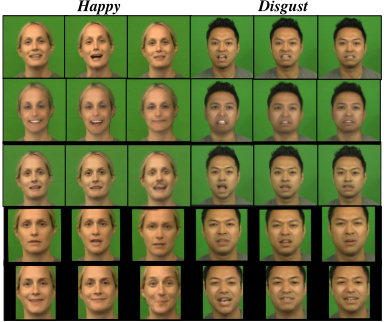
Identity preservation. We compute CSIM (cosine similarity) between ArcFace features [Deng et al., 2019] of the predicted frame and the input identity face of the target. Our method outperforms MEAD. EVP outperforms our method in CSIM as they train texture models specific to each target identity. On the other hand, we use a single generalized texture model for all identities. Our one-shot learning helps to generalize on different subjects using only a single image of the target identity at inference time. Whereas EVP 3 and MEAD 4 require sample images of the target in different emotions for Generated output Target Identity Generated output Happy Disgust Ground Truth Ours Chen et al. 2020
3 https://github.com/jixinya/EVP
4 https://github.com/uniBruce/Mead
Eskimez et al. 2020
Vougioukas et al. 2020
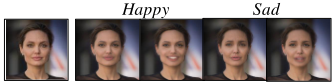
Figure 5: Qualitative comparison on CREMA-D dataset. All the SOTA methods (except [Chen et al., 2020]) are trained on CREMAD, whereas our model is trained on MEAD. [Eskimez et al., 2020] is unable to generate significant emotion. [Chen et al., 2020] produces distorted textures.
training their target-specific models.
Emotion Accuracy. We have used the emotion classifier network in EVP [Ji et al., 2021] for quantifying the accuracy of generated emotions in the final animation. On both the MEAD and CREMA-D datasets, we achieve better emotion classification accuracy than that of the existing methods.
Audio-Visual Synchronization. We use SyncNet [Chung and Zisserman, 2016] to estimate the audio-visual synchronization accuracy in the synthesized videos. Our method achieves better lip sync than both EVP and MEAD on MEAD dataset, and performs better than [Vougioukas et al., 2019] on CREMA-D.
4.4 Qualitative Evaluation
Fig. 3 shows our final animation results on MEAD dataset compared to the recent SOTA methods MEAD, EVP, MakeitTalk[Zhou et al., 2020] and Wav2Lip[Prajwal et al., 2020]. MEAD and EVP are the most relevant works since they render emotion. We have evaluated MEAD using their publicly available pre-trained model 4 , which is specific to subject 1 (First three columns) and fails to generalize for other subjects (column 4 to 9). EVP fails to preserve the identity of the target subject 3 (columns 7 to 9) without fine-tuning 3 . Also, this method uses a latent feature learned from audio for emotion control, which makes the expressions inconsistent (happy emotion can be perceived as surprised or angry for subject 1, columns 1 to 3). Our method can produce better emotion and preserve identity even with one-shot learning using only a single neutral face image of the target person. Fig. 5 shows the comparative results on CREMA-D. Our method can produce realistic emotions on identities from other datasets, such as RAVDESS (Fig. 1 upper face) as well as arbitrary faces (Fig. 1 lower face and Fig. 4).
| Methods | M-LD ↓ | M-LVD ↓ | F-LD ↓ | F-LVD ↓ |
|---|---|---|---|---|
| Ours w/o Graph Encoder Ea | 5.54 | 0.54 | 2.75 | 0.43 |
| Ours w/o skip connections | 5.54 | 0.54 | 2.75 | 0.43 |
| Ours w/o edge weights ω | 2.45 | 0.83 | 1.39 | 0.52 |
| Ours w/o Lgan | 2.52 | 0.86 | 1.42 | 0.53 |
| Ours | 2.18 | 0.77 | 1.24 | 0.5 |
| Methods | PSNR↑ | CSIM ↑ | Emotion Acc.↑ |
|---|---|---|---|
| Ours w/o emotion feature | 29.83 | 0.885 | 45.00 |
| Ours w/o emotional landmark | 29.85 | 0.861 | 59.61 |
| Ours w/o one-shot learning | 29.89 | 0.767 | 84.00 |
| Ours | 30.06 | 0.789 | 85.48 |
4.5 Ablation Study
LandmarkGenerationNetworkGL. An ablation study of GL is presented in Table 3. (1) Ours w/o Graph Encoder is a variation of our network GL with only Audio Encoder EA, Emotion Encoder EE and Graph Decoder DG. (2) Ours w/o skip connections is without skip connections between Graph Encoder EG and Graph Decoder DG (shown Fig. 2). (3) Ours w/o edge weights is without using the learnable edge weights ω in Eqn. 1. (4) Ours w/o Lgan is without adversarial learning. Our proposed network in Fig. 2 trained with the losses in Eqn. 4 leads to improved results (Table 3). In (1) and (2) due to negligible motion of landmarks, M-LVD and F-LVD are lower, but M-LD and F-LD are much higher.
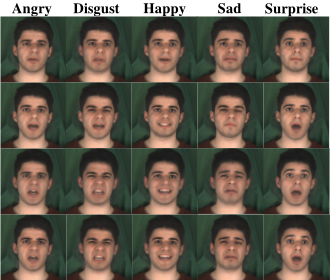
Texture Generation Network GT . An ablation study of GT is presented in Table 4. (1) Ours w/o emotion feature: Without input fe, the emotion accuracy highly degrades (Table 4) as the network cannot generate frowns, eyebrowraising or lowering from emotional landmarks only, as shown in Fig. 6 (second row). As CSIM is calculated between the predicted frame and the input neutral identity face of the target, the value of CSIMwithout emotion feature is higher. (2) Ours w/o emotional landmark: When the texture is generated from only speech-induced landmarks (without emotion) the emotion accuracy decreases. Learning emotion on landmarks helps generate facial expressions especially in the mouth region for emotions like happy, angry, sad, and disgust. Fig. 6 (top row) shows that without emotional landmark, emotion rendering is very restricted. (3) Ours w/o one-shot learning:

Ours
w/o emotional
landmark
Ours w/o emotion feature
Ours w/o one-shot learning
Ours
Figure 6: Qualitative Ablation for Texture Generation Network GT .
One-shot learning helps to achieve better identity preservation. As can be seen in Fig. 6 (last row) the facial structure, skin color of the target subject are better captured in our final animation with one-shot learning.
4.6 User Study
We have conducted a user study for subjective evaluation of our method against SOTA. 26 participants rate total 30 videos from [Vougioukas et al., 2019; Eskimez et al., 2020; Chen et al., 2020], MEAD, EVP and our method. Each video is evaluated for lip sync, identity preservation, and video realism. Additionally, the participants also classify the emotion perceived from the video. The results are shown in Fig. 7. Overall our method achieves comparable performance in lipsync and better performance over SOTA methods in identity preservation, emotion classification accuracy, and realism in video generation.
5 Conclusion
We propose a speech-driven emotion-controllable generalized emotional talking face generation method that uses a single image of an arbitrary target person in neutral emotion to generate animation in different emotions. We use graph convolution for geometry-aware motion and emotion generation on facial landmarks. With one-shot learning, our emotionguided optical flow-based texture deformation network can generalize better for arbitrary target subjects when compared to existing SOTA methods. Our animation results on different benchmark datasets and for different celebrity faces show more realistic animation than SOTA methods. In future work, audio and emotion-driven head movements can be added for enhanced realism of emotional talking face animation.
@inproceedings{ijcai2022p184,
  title     = {Emotion-Controllable Generalized Talking Face Generation},
  author    = {Sinha, Sanjana and Biswas, Sandika and Yadav, Ravindra and Bhowmick, Brojeshwar},
  booktitle = {Proceedings of the Thirty-First International Joint Conference on
               Artificial Intelligence, {IJCAI-22}},
  publisher = {International Joint Conferences on Artificial Intelligence Organization},
  editor    = {Luc De Raedt},
  pages     = {1320--1327},
  year      = {2022},
  month     = {7},
  note      = {Main Track},
  doi       = {10.24963/ijcai.2022/184},
  url       = {https://doi.org/10.24963/ijcai.2022/184},
}
TY - CPAPER TI - Emotion-Controllable Generalized Talking Face Generation AU - Sinha, Sanjana AU - Biswas, Sandika AU - Yadav, Ravindra AU - Bhowmick, Brojeshwar T2 - Proceedings of the Thirty-First International Joint Conference on Artificial Intelligence, IJCAI-22 PB - International Joint Conferences on Artificial Intelligence Organization PY - 2022 SP - 1320 EP - 1327 DO - 10.24963/ijcai.2022/184 UR - https://doi.org/10.24963/ijcai.2022/184 ER -Copied
Machine-readable versions of this paper, for tools and AI agents:





