
Distilling Inter-Class Distance for Semantic Segmentation
Proceedings of the Thirty-First International Joint Conference on Artificial Intelligence. Main Track. Pages 1686-1692.
https://doi.org/10.24963/ijcai.2022/235
Keywords
- Computer Vision: Scene analysis and understanding
- Computer Vision: Segmentation
- Computer Vision: Recognition (object detection, categorization)
- Computer Vision: Transfer, low-shot, semi- and un- supervised learning
Abstract
Knowledge distillation is widely adopted in semantic segmentation to reduce the computation cost. The previous knowledge distillation methods for semantic segmentation focus on pixel-wise feature alignment and intra-class feature variation distillation, neglecting to transfer the knowledge of the inter-class distance in the feature space, which is important for semantic segmentation such a pixel-wise classification task. To address this issue, we propose an Inter-class Distance Distillation (IDD) method to transfer the inter-class distance in the feature space from the teacher network to the student network. Furthermore, semantic segmentation is a position-dependent task, thus we exploit a position information distillation module to help the student network encode more position information. Extensive experiments on three popular datasets: Cityscapes, Pascal VOC and ADE20K show that our method is helpful to improve the accuracy of semantic segmentation models and achieves the state-of-the-art performance. E.g. it boosts the benchmark model (``PSPNet+ResNet18") by 7.50% in accuracy on the Cityscapes dataset.
- [Chen et al., 2017] Liang-Chieh Chen, George Papandreou, Iasonas Kokkinos, Kevin Murphy, and Alan L Yuille. Deeplab: Semantic image segmentation with deep convo- lutional nets, atrous convolution, and fully connected crfs. IEEE transactions on pattern analysis and machine intel- ligence, 40(4):834-848, 2017.
- [Cordts et al., 2016] Marius Cordts, Mohamed Omran, Se- bastian Ramos, Timo Rehfeld, Markus Enzweiler, Rodrigo Benenson, Uwe Franke, Stefan Roth, and Bernt Schiele. The cityscapes dataset for semantic urban scene under- standing. In Proceedings of the IEEE conference on com- puter vision and pattern recognition, pages 3213-3223, 2016.
- [Dong et al., 2020] Genshun Dong, Yan Yan, Chunhua Shen, and Hanzi Wang. Real-time high-performance semantic image segmentation of urban street scenes. IEEE Transac- tions on Intelligent Transportation Systems, 22(6):3258- 3274, 2020.
- [Everingham et al., 2015] Mark Everingham, SM Ali Es- lami, Luc Van Gool, Christopher KI Williams, John Winn, and Andrew Zisserman. The pascal visual object classes challenge: A retrospective. International journal of com- puter vision, 111(1):98-136, 2015.
- [Fan et al., 2021] Mingyuan Fan, Shenqi Lai, Junshi Huang, Xiaoming Wei, Zhenhua Chai, Junfeng Luo, and Xiaolin Wei. Rethinking bisenet for real-time semantic segmen- tation. In Proceedings of the IEEE/CVF Conference on Computer Vision and Pattern Recognition, pages 9716- 9725, 2021.
- [He et al., 2016] Kaiming He, Xiangyu Zhang, Shaoqing Ren, and Jian Sun. Deep residual learning for image recog- nition. In Proceedings of the IEEE conference on computer vision and pattern recognition, pages 770-778, 2016.
- [He et al., 2019] Tong He, Chunhua Shen, Zhi Tian, Dong Gong, Changming Sun, and Youliang Yan. Knowledge adaptation for efficient semantic segmentation. In Pro- ceedings of the IEEE/CVF Conference on Computer Vision and Pattern Recognition, pages 578-587, 2019.
- [Hinton et al., 2015] Geoffrey Hinton, Oriol Vinyals, and Jeff Dean. Distilling the knowledge in a neural network. arXiv preprint arXiv:1503.02531, 2015.
- [Islam et al., 2020] Md Amirul Islam, Sen Jia, and Neil DB Bruce. How much position information do convo- lutional neural networks encode? arXiv preprint arXiv:2001.08248, 2020.
- [Kemker et al., 2018] Ronald Kemker, Carl Salvaggio, and Christopher Kanan. Algorithms for semantic segmenta- tion of multispectral remote sensing imagery using deep learning. ISPRS journal of photogrammetry and remote sensing, 145:60-77, 2018.
- [Liu et al., 2019] Yifan Liu, Ke Chen, Chris Liu, Zengchang Qin, Zhenbo Luo, and Jingdong Wang. Structured knowl- edge distillation for semantic segmentation. In Proceed- ings of the IEEE/CVF Conference on Computer Vision and Pattern Recognition, pages 2604-2613, 2019.
- [Long et al., 2015] Jonathan Long, Evan Shelhamer, and Trevor Darrell. Fully convolutional networks for seman- tic segmentation. In Proceedings of the IEEE conference on computer vision and pattern recognition, pages 3431- 3440, 2015.
- [Mehta et al., 2018] Sachin Mehta, Mohammad Rastegari, Anat Caspi, Linda Shapiro, and Hannaneh Hajishirzi. Es- pnet: Efficient spatial pyramid of dilated convolutions for semantic segmentation. In Proceedings of the european conference on computer vision (ECCV), pages 552-568, 2018.
- [Paszke et al., 2016] Adam Paszke, Abhishek Chaurasia, Sangpil Kim, and Eugenio Culurciello. Enet: A deep neu- ral network architecture for real-time semantic segmenta- tion. arXiv preprint arXiv:1606.02147, 2016.
- [Shu et al., 2021] Changyong Shu, Yifan Liu, Jianfei Gao, Zheng Yan, and Chunhua Shen. Channel-wise knowledge distillation for dense prediction. In Proceedings of the IEEE/CVF International Conference on Computer Vision, pages 5311-5320, 2021.
- [Tu et al., 2019] Zhigang Tu, Hongyan Li, Dejun Zhang, Justin Dauwels, Baoxin Li, and Junsong Yuan. Action- stage emphasized spatiotemporal vlad for video action recognition. IEEE Transactions on Image Processing, 28(6):2799-2812, 2019.
- [Wang et al., 2020] Yukang Wang, Wei Zhou, Tao Jiang, Xi- ang Bai, and Yongchao Xu. Intra-class feature variation distillation for semantic segmentation. In European Con- ference on Computer Vision, pages 346-362. Springer, 2020.
- [Yuan et al., 2018] Yuhui Yuan, Lang Huang, Jianyuan Guo, Chao Zhang, Xilin Chen, and Jingdong Wang. Ocnet: Object context network for scene parsing. arXiv preprint arXiv:1809.00916, 2018.
- [Yuan et al., 2020] Yuhui Yuan, Xilin Chen, and Jingdong Wang. Object-contextual representations for semantic seg- mentation. In Computer Vision-ECCV 2020: 16th Euro- pean Conference, Glasgow, UK, August 23-28, 2020, Pro- ceedings, Part VI 16, pages 173-190. Springer, 2020.
- [Zhao et al., 2017] Hengshuang Zhao, Jianping Shi, Xiao- juan Qi, Xiaogang Wang, and Jiaya Jia. Pyramid scene parsing network. In Proceedings of the IEEE conference on computer vision and pattern recognition, pages 2881- 2890, 2017.
- [Zhao et al., 2018] Hengshuang Zhao, Xiaojuan Qi, Xiaoy- ong Shen, Jianping Shi, and Jiaya Jia. Icnet for real-time semantic segmentation on high-resolution images. In Pro- ceedings of the European conference on computer vision (ECCV), pages 405-420, 2018.
- [Zhou et al., 2017] Bolei Zhou, Hang Zhao, Xavier Puig, Sanja Fidler, Adela Barriuso, and Antonio Torralba. Scene parsing through ade20k dataset. In Proceedings of the IEEE conference on computer vision and pattern recog- nition, pages 633-641, 2017.
- [Zhu et al., 2019] Zhen Zhu, Mengde Xu, Song Bai, Tengteng Huang, and Xiang Bai. Asymmetric non-local neural networks for semantic segmentation. In Proceed- ings of the IEEE/CVF International Conference on Com- puter Vision, pages 593-602, 2019.
References were extracted automatically from the PDF and may contain errors.
Full text extracted automatically from the PDF; figures, tables and equations may differ. The PDF is the version of record.
1 Introduction
Semantic segmentation aims at allocating a label for each pixel of the input image. It is a basic and challenging task in computer vision, which has widely applied in many fields, e.g. autonomous driving [Dong et al., 2020], ground feature changing detection [Kemker et al., 2018], etc. Recently, due to the success of deep learning [Tu et al., 2019] in computer vision, Convolutional Neural Networks (CNNs) based methods have greatly improved the accuracy of semantic segmentation. However, CNN based semantic segmentation algorithms usually have an expensive computational cost, which limits their application in practice, especially for the real-life tasks that demand high efficiency.
To address this issue, many lightweight models have been explored, e.g. ENet [Paszke et al., 2016], ESPNet [Mehta et al., 2018], ICNet [Zhao et al., 2018], and STDC [Fan et Distance al., 2021]. Although researchers have designed excellent networks to reduce the cost of computation, it is difficult to reach a satisfactory compromise between accuracy and model size. Instead of redesigning the backbone, we adopt the knowledge distillation (KD) strategy to train a student network by the guidance of a teacher network, and obtain comparable result.
∗Corresponding author: Zhigang Tu
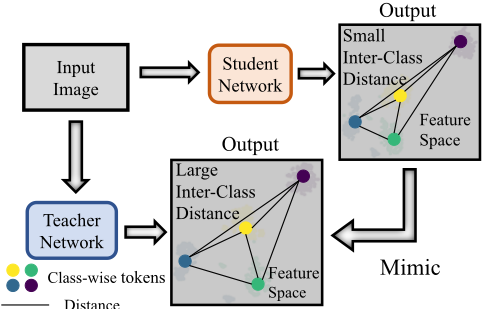
Figure 1: Limited by simple network structure and few parameters, the student network cannot have large inter-class distance like the teacher network in the feature space. Our motivation is to transfer the inter-class distance of the teacher network to help student network improve the segmentation accuracy.
KD [Hinton et al., 2015], as a model compression method, is originally used in the image classification task, which is able to simplify the cumbersome model significantly. Due to the advantage of KD, some semantic segmentation approaches use KD to reduce the model size [Liu et al., 2019; Wang et al., 2020; Shu et al., 2021]. They force the student model to learn the pixel-wise feature and intra-class feature variation from the teacher network. Representatively, Intra-Class Feature Variance Distillation (IFVD) [Wang et al., 2020] focuses on transferring the variation of the intraclass feature from the teacher network to the student network. Channel-wise Knowledge Distillation (CD) [Shu et al., 2021] emphasizes on distilling the most significant areas in each channel. It is worth noting that semantic segmentation is a pixel-wise category prediction task with various categories, thus the inter-class distance in the feature space is ubiquitous in semantic segmentation. Due to the help of numerous parameters and complex network structure, the teacher network has stronger classification ability and large inter-class distance in the feature space. However, Issue 1: the past KD schemes for semantic segmentation neglect to transfer the inter-class distance in the feature space of the teacher network to the student network.
Moreover, CNNs are able to encode the position information implicitly [Islam et al., 2020]. Semantic segmentation is a position-dependent task. Generally, with the simple network structure and a few parameters, Issue 2: the student network is unable to encode as rich position information as the teacher network.
To address the above mentioned issues, we consider to distill the inter-class distance in the feature space and position information from the teacher network to the student network. Accordingly, we propose a novel method (see Figure 1) called Inter-class Distance Distillation (IDD). It consists of two main components. One is the inter-class distance distillation module (IDDM), we design a graph to encode the inter-class distance, and make the student network mimic the large inter-class distance of the teacher network. The other is the position information distillation module (PIDM). We design a position information network to extract the position information implicitly encoded in the feature map. Both the teacher network and the student network will predict the absolute coordinate mask via this network. By minimizing the divergence of them, the student network can encode more position information. With our IDD method, the student network learns more knowledge about inter-class distance and position information, improving the segmentation accuracy of the student network significantly.
The contributions are summarized in three-fold:
- We propose a novel approach named Inter-class Distance Distillation (IDD) for semantic segmentation. It is the first method to distill the inter-class distance among all KD schemes for semantic segmentation to the best of our knowledge.
- We design a position information distillation module (PIDM) to enhance the capability of the student network encoding position information.
- We demonstrate the effectiveness of the IDD method on three famous benchmark datasets, which not only obtains the state-of-the-art accuracy among KD schemes for semantic segmentation, but also is useful for other semantic segmentation models.
2 RelatedWork
Semantic segmentation. CNN based models have greatly promoted the progress of semantic segmentation. Many researchers have tried different methods to make the model to learn rich contextual information. [Zhao et al., 2017] proposed a pyramid pooling strategy to collect context information from multiple scales. DeepLabv2 [Chen et al., 2017] adopted the atrous spatial pyramid pooling approach to get abundant context information. An encoder-decoder module was designed to capture multilevel features and contextual information. OCNet [Yuan et al., 2018] exploited a selfattention mechanism to capture relationships between all pixels. To meet the real-time semantic segmentation requirement of the mobile platform, some lightweight networks were proposed. ENet [Paszke et al., 2016] used an asymmetric encoder-decoder structure and a convolution kernel decomposition operation, which greatly reduce the number of parameters and the floating point operations. Point-wise convolutions and spatial pyramid of dilated convolutions were applied in ESPNet [Mehta et al., 2018] to decrease the cost of computation. ICNet [Zhao et al., 2018] achieved fast semantic segmentation by designing an efficient network structure to process images with different resolutions. [Fan et al., 2021] designed a new real-time segmentation architecture by reducing network redundancy. Different from [Mehta et al., 2018; Zhao et al., 2018], we get the lightweight semantic segmentation network with the usage of KD, which avoids to redesign the network structure, and gains high efficiency.
KD for semantic segmentation. [Hinton et al., 2015] proposed the concept of KD, it is a process of transferring the soft-labels from the teacher network to the student network to improve the performance of the student network. Because of the remarkable performance of KD, some researchers applied KD to semantic segmentation. [Liu et al., 2019] used a structured KD approach to transfer pixel-wise, pair-wise, and holistic knowledge from the teacher network. [He et al., 2019] designed an autoencoder to transform knowledge into a compact formwhich is easier for the student network to learn. [Wang et al., 2020] presented an intra-class feature variation distillation scheme to make the student network simulate the intra-class feature distribution of the teacher network. [Shu et al., 2021] exploited a simple yet effective approach to minimize the channel-wise discrepancy between the teacher network and the student network. Unlike these mentioned approaches, our method pays attention to distilling the interclass distance in the feature space, which is complementary to the previous distillation of pixel-wise feature alignment and intra-class feature variation.
3 ProposedMethod
In this section, we first give an overview the general framework of past KD methods for semantic segmentation and our IDD model, then we describe the IDDM and PIDM in detail.
3.1 Overview
Semantic segmentation is a dense prediction task, aiming to assign a label to each pixel. Though the previous KD based semantic segmentation methods have achieved good progress, they mainly focus on aligning the pixel-wise feature and intra-class feature variance. Their loss function can be generally formulated as:
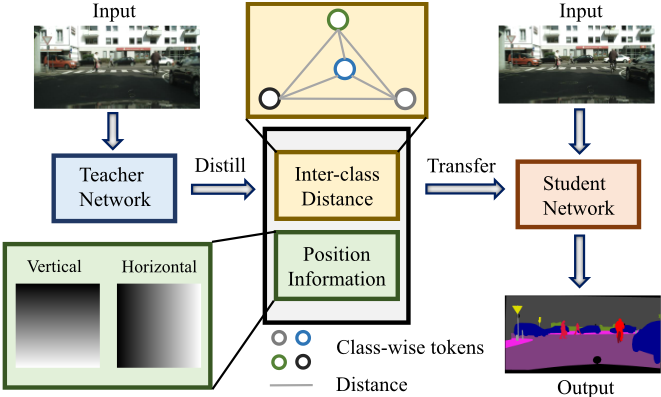
Ltar is the cross-entropy loss, GT is the ground-truth, FS and FT denote the feature map of the student network and the teacher network, respectively. ϕ(·) represents a mapping function. D(GT) and D(FS ) separately denote the groundtruth and the student network's category probability distributions of all pixels. N is the number of pixels, D(GTk) denotes the kth pixel's ground-truth category probability distribution, D(FSk ) is the kth pixel's category probability distribution produced by the student network. λ is a hyper-parameter to control the weight of loss. Ldis(·) is a loss function, such as the mean-squared error loss. Obviously, the prior methods ignore to transfer inter-class distance in the teacher network to the student network. Therefore, as illustrated in Figure 2, we propose the IDD method to transfer the inter-class distance and position information from the teacher to the student. We detail each module in the following subsections.
3.2 Inter-Class Distance DistillationModule
Semantic segmentation is a pixel-wise classification task. Limited by simple network structure and few parameters, the student network has relatively poor discriminating ability and small inter-class distance. We propose the inter-class distance distillation module to deal with this challenge.
As illustrated in Figure 2, we construct a graph G = {V, E} to encode the inter-class category distance, where V = {vi | i = 1, ..., N} is a group of nodes, N denotes the total number of segmentation categories of the processed image and E = {ei,j | i = 1, ...N; j = 1, ...N; i ̸= j} represents a group of edges. vi denotes the token of the ith class, vi is obtained by averaging the feature of all pixels with the same category label i. ei,j is the Euclidean distance between the class-wise tokens of the ith and the j th category, which is defined as:
It represents the feature distance between the ith class and the j th class, and Dis is the Euclidean distance. Due to the deep network and numerous parameters, the teacher network have large inter-class distance. Inspired by this characteristic, to enable the student network to better simulate the teacher network in terms of the inter-class distance, we design an interclass distance loss function Lid, which is defined as:
where eTi,j and eSi,j stand for the ei,j in the teacher network and the student network, respectively.
3.3 Position Information DistillationModule
Semantic segmentation is a position-dependent task. It is reported in [Islam et al., 2020] that CNNs have the ability to encode position information. Inspired by [Islam et al., 2020], we further introduce a position information distillation module to enhance the capability of the student network predicting position information. As a result, the student network can encode more position information in its output features which could be utilized to improve segmentation accuracy.
Specifically, we use A ∈ RC×H×W to represent the input feature map. First, we input A into a pretrained position information network to get the position information masks PHOR ∈ RH×W and PV ER ∈ RH×W , which represent the abscissa and ordinate respectively. In PHOR, each column has the same value, and we use VHOR j (j ∈ [1,H]) to represent the value of column j, where VHOR j = j. In PVER, each row has the same value, and we use VV ER i (i ∈ [1,W]) to denote the value of row i, where VV ER i = i.
We construct a loss function Lpi to transfer the position information of the teacher network to the student network, it is expressed as:
| Backbone | Lskd | Lcw | Lid | Lpi | mIoU (%) |
|---|---|---|---|---|---|
| T: ResNet101 | 78.56 | ||||
| S: ResNet18 | 70.09 | ||||
| S: ResNet18 | ✓ | 73.03 | |||
| S: ResNet18 | ✓ | ✓ | 75.78 | ||
| S: ResNet18 | ✓ | ✓ | ✓ | 76.81 | |
| S: ResNet18 | ✓ | ✓ | ✓ | 76.43 | |
| S: ResNet18 | ✓ | ✓ | ✓ | ✓ | 77.59 |
| Method | mIoU (%) | Params (M) | FLOPs (G) |
|---|---|---|---|
| ENet | 58.3 | 0.358 | 3.612 |
| ESPNet | 60.3 | 0.364 | 4.422 |
| ERFNet | 68.0 | 2.067 | 25.60 |
| ICNet | 69.5 | 26.50 | 28.30 |
| FCN | 62.7 | 134.5 | 333.9 |
| RefineNet | 73.6 | 118.1 | 525.7 |
| OCNet | 80.1 | 62.58 | 548.5 |
| T: PSPNet-R101 | 78.4 | 70.43 | 574.9 |
| S: PSPNet-R18 | 67.60 | 13.07 | 125.8 |
| S: +Ours (IDD) | 76.33 | 13.07 | 125.8 |
where
represent Lpi in the horizontal and the vertical directions, respectively. QVER T j and QV ER S j denote the column j of PVER produced by the teacher network and the student network in the vectorized form. Analogically, QHOR T i and QHOR S i denote the row i of PHOR produced by the teacher network and the student network in the vectorized form.
3.4 Loss Function
Following [Shu et al., 2021], we also apply the channel-wise supervision Lcw to minimize the Kullback-Leibler (KL) divergence of the channel-wise probability map between the teacher network and the student network. The final loss function of our IDD method is formulated as:
where Lskd is a structured KD loss for semantic segmentation [Liu et al., 2019], λ1, λ2 and λ3 are the hyper parameters to balance the weight between different items.
4 Experiments
To verify the effectiveness of our proposed IDD based semantic segmentation method, we conduct comprehensive experiments on three popular benchmarks: Cityscapes [Cordts et al., 2016], Pascal VOC [Everingham et al., 2015], and ADE20K [Zhou et al., 2017]. In the next subsections, we first introduce the datasets, evaluation metrics and implementation details. Next, we perform ablation experiments on the Cityscapes dataset. Finally, we compare our model with the state-of-the-art lightweight models on Cityscapes, Pascal VOC, and ADE20K.
4.1 Datasets and EvaluationMetrics
Datasets. Cityscapes includes 5000 finely annotated images of driving scenes in cities. It consists of 2975, 500 and 1525 images for training, validation and testing, respectively. It is labeled with 19 semantic categories. The resolution of each image is 2048×1024. In our experiments, we do not use the coarsely labeled images. Pascal VOC composes of 1464 images for training, 1449 images for validation and 1456 images for testing. It covers 20 foreground object classes and 1 background class. ADE20k is a challenging scene parsing dataset released by MIT, which contains 20K, 2K, 3K images with 150 classes for training, validation, and testing.
Evaluation metrics. We use the Intersection-over-Union (IoU) of each class and the mean IoU (mIoU) of all classes to measure the segmentation accuracy.The total number of model parameters (Params) is utilized to measure the model size. We adopt an input image with resolution 512 × 1024 to calculate the floating-point operations per second (FLOPs), which is a general metric to measure the model complexity.
4.2 Implementation Details
Networks. To make a fair and comparable evaluation, we carry out experiments on the same teacher and student network as [Liu et al., 2019]. Specifically, in all of our experiments, PSPNet with ResNet101 [He et al., 2016], which are pretrained on ImageNet, is used as the teacher network. For the student network, we perform experiments on different segmentation architectures, such as the representative models PSPNet and Deeplab with the backbones of ResNet18 as well as ESPNet to verify the effectiveness of our IDD method.
Training Details. We use the Pytorch platform to implement our method. Following [Liu et al., 2019] , we train our student networks by mini-batch stochastic gradient descent (SGD) for 40000 iterations. We set the momentum and the weight decay as 0.9 and 0.0005, respectively. We apply the polynomial learning rate policy, and the learning rate is calculated as base lr · (1- iter total iter )power . The base learning rate and power are respectively set to 0.01 and 0.9. For the input images, we crop them to 512×512. The random scaling and random flipping are applied to augment the data.
4.3 Ablative Study
Our loss function consists of four parts, Lskd, Lcw, Lid, and Lpi. To explore the effectiveness of each loss item, we conduct ablation experiments on the Cityscapes validation dataset with the evaluation metric mIoU (%). The teacher network is PSPNet [Zhao et al., 2017] with ResNet101 backbone ("T: PSPNet-R101"), and the student model is PSPNet with ResNet18 ("S: PSPNet-R18") also pretrained in the ImageNet. As can be seen in Table 1, the structured KD loss Lskd boosts the performance of the student network "S: PSPNetR18" from 70.09% to 73.03%. The channel-wise KD loss Lcw further improves the student model to 75.78%. By adopting our inter-class distance distillation approach, the gain increases to 5.34% (76.43% vs 70.09%). Furthermore, after applying our position information loss Lpi, the accuracy of the lightweight student network "S: PSPNet-R18" reaches 77.59%, approximately to the accuracy of the teacher network "T: PSPNet-R101", the mIoU value of which is 78.56%. The experimental results prove that our proposed IDDM and PIDM are effective.
| Method | mIoU (%) | Params (M) | FLOPs (G) | |
|---|---|---|---|---|
| Val | Test | |||
| T: PSPNet-R101 | 78.50 | 78.40 | 70.43 | 574.9 |
| S: ESPNet | 61.40 | 60.30 | 0.3635 | 4.422 |
| + SKD | 63.80 | 62.00 | 0.3635 | 4.422 |
| + IFVD | 65.13 | 63.07 | 0.3635 | 4.422 |
| + CD | 67.27 | 65.32 | 0.3635 | 4.422 |
| + Ours | 68.87 | 67.35 | 0.3635 | 4.422 |
| S: PSPNet-R18 (0.5) | 61.17 | - | 3.271 | 31.53 |
| + SKD | 61.60 | 60.05 | 3.271 | 31.53 |
| + IFVD | 63.35 | 63.68 | 3.271 | 31.53 |
| + CD | 68.57 | 66.75 | 3.271 | 31.53 |
| + Ours | 69.76 | 68.54 | 3.271 | 31.53 |
| S: PSPNet-R18 | 70.09 | 67.60 | 13.07 | 125.8 |
| + SKD | 72.70 | 71.40 | 13.07 | 125.8 |
| + IFVD | 74.54 | 72.74 | 13.07 | 125.8 |
| + CD | 75.90 | 74.58 | 13.07 | 125.8 |
| + Ours | 77.59 | 76.33 | 13.07 | 125.8 |
4.4 Results
Cityscapes
Table 2 shows the quantitative results on the Cityscapes dataset. By using our IDD, the Params and the FLOPs of the our student network ("Ours") reduce by 81.44% (13.07 vs 70.43) and 78.12% (125.8 vs 574.9) compared to the teacher network, while the mIoU accuracy only decreases 2.07% (from 78.4% to 76.33%). Compared with other lightweight models, our method also has remarkable performance. For example, our IDD outperforms ENet [Paszke et al., 2016] and ESPNet [Mehta et al., 2018] by 18.03% and 16.03% in accuracy (mIoU), respectively. Notably, the Params of ours are only half of ICNet [Zhao et al., 2018], but the accuracy of our student network is still 5.0% higher. Although the accuary of OCNet [Yuan et al., 2018] is 3.77% higher than ours, the Params of ours are less than one fifth of OCNet. The results demonstrate that IDD achieves a satisfactory compromise between accuracy and model size.
| Method | mIoU (%) | Params (M) |
|---|---|---|
| T:PSPNet-R101 | 44.94 | 70.43 |
| S:PSPNet-R18 | 24.65 | 13.07 |
| +SKD | 25.02 | 13.07 |
| +IFVD | 25.82 | 13.07 |
| +CD | 26.80 | 13.07 |
| +Ours | 27.69 | 13.07 |
| S:PSPNet-MNV2 | 23.21 | 2.15 |
| +SKD | 24.89 | 2.15 |
| +IFVD | 25.43 | 2.15 |
| +CD | 27.74 | 2.15 |
| +Ours | 28.93 | 2.15 |
We also evaluate the performance of our method and other KD based methods on the Cityscapes, e.g. SKD [He et al., 2019], IFVD [Wang et al., 2020] and CD [Shu et al., 2021]. The student models are ESPNet, PSPNet-R18(0.5) and PSPNet-R18. Experimental results are listed in Table 3. When we adopt ESPNet as the student network, our method leads to a significant improvement of 7.47% and 7.05% on the validation set and the testing set, respectively. Compared with SKD which transfers the intra-class feature variance and CD which transfers the channel-wise feature, our method outperforms them by 3.74% and 1.60%, separately. After using our IDD, the performance of PSPNet-R18(0.5) increases from 61.17% to 69.76%, and surpasses IFVD and CD by 6.41% and 1.19% in the validation set. When PSPNet-R18 is adopted as the student model, with our IDD, the gains reach to 7.50% (70.09% to 77.59%), and outperform IFVD and CD by 3.05% and 1.69% respectively. The experimental results show that our IDD is better than the previous KD strategies for semantic segmentation.
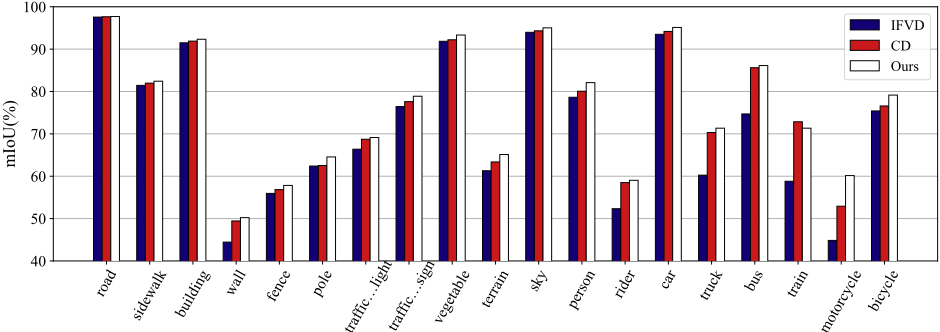
In addition, as shown in Figure 3, we use the PSPNetR18(1.0) as the student network to calculate the mIoU for each class compared with two state-of-the-art methods. Due to our method enables the student network to have large interclass distance and rich position information, it performs well on some categories. For example, rider, car and bus. Table 3 shows the qualitative results, which again demonstrate the effectiveness of our IDD method.
Pascal VOC
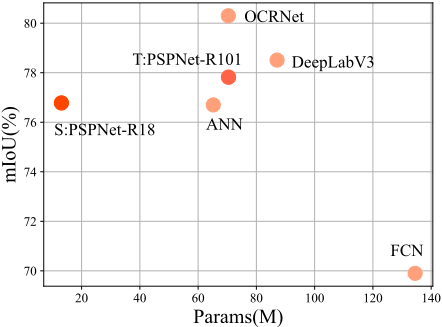
As depicted in Figure 4, we adopt a dot graph to describe the parameters and accuracy of different networks, i.e. OCRNet [Yuan et al., 2020], DeepLabV3, FCN [Long et al., 2015], ANN [Zhu et al., 2019] and PSPNet. By using our spatial knowledge distillation, the PSPNet-R18(1.0) outperforms FCN and ANN by 6.79% and 0.08%, respectively.
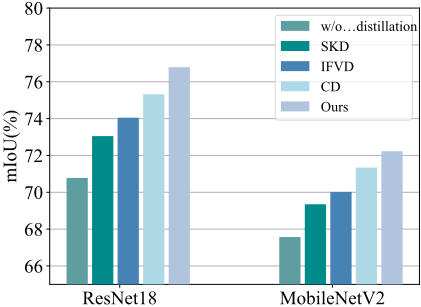
We adopt ResNet18 and MobileNetV2 as the student network to evaluate our approach on the validation set. The results are shown in Figure 5. With ResNet18 as the backbone of the student network, our approach improves the accuracy of the model that without distillation by 6.01%, and is better than the SKD, IFVD and CD respectively by 3.74%, 2.74% and 1.47%. For MobileNetV2, our method exceeds the benchmark model by 4.66%, and improves the SKD, IFVD and CD respectively by 2.88%, 2.21% and 0.89%.
ADE20K
To further verify the effectiveness of our proposed method, we carry out experiments on the challenging dataset ADE20K. The quantitative results are reported in Table 4. When the student model is built on ResNet18, our proposed approach improves the student model from 24.65% to 27.65%, and outperforms SKD, IFVD and CD by 2.67%, 1.87% and 0.89%. With MobileNetV2 as the student backbone, we achieve an improvement to 6.72% compared with the benchmark model, and improves the SKD, IFVD and CD by 4.04%, 3.50% and 1.19%, respectively.
5 Conclusion
In this paper, we present a novel knowledge distillation method for semantic segmentation, helping the student model have large inter-class distance in the feature space and rich position information. Specifically, we propose the inter-class distance distillation module and the position information distillation module to transfer the inter-class distance and position cue from the teacher network to the student network. Ablative experiments show that our explored two modules enable the student network to mimic the teacher network better. We demonstrate the effectiveness of our approach by conducting extensive experiments on three public datasets, i.e. Cityscapes, Pascal VOC and ADE20K.
Acknowledgements
This work was supported by the National Natural Science Foundation of China under Grant 62106177. The numerical calculation was supported by the super-computing system in the Super-computing Center of Wuhan University.
@inproceedings{ijcai2022p235,
  title     = {Distilling Inter-Class Distance for Semantic Segmentation},
  author    = {Zhang, Zhengbo and Zhou, Chunluan and Tu, Zhigang},
  booktitle = {Proceedings of the Thirty-First International Joint Conference on
               Artificial Intelligence, {IJCAI-22}},
  publisher = {International Joint Conferences on Artificial Intelligence Organization},
  editor    = {Luc De Raedt},
  pages     = {1686--1692},
  year      = {2022},
  month     = {7},
  note      = {Main Track},
  doi       = {10.24963/ijcai.2022/235},
  url       = {https://doi.org/10.24963/ijcai.2022/235},
}
TY - CPAPER TI - Distilling Inter-Class Distance for Semantic Segmentation AU - Zhang, Zhengbo AU - Zhou, Chunluan AU - Tu, Zhigang T2 - Proceedings of the Thirty-First International Joint Conference on Artificial Intelligence, IJCAI-22 PB - International Joint Conferences on Artificial Intelligence Organization PY - 2022 SP - 1686 EP - 1692 DO - 10.24963/ijcai.2022/235 UR - https://doi.org/10.24963/ijcai.2022/235 ER -Copied
Machine-readable versions of this paper, for tools and AI agents:





