
Understanding and Mitigating Data Contamination in Deep Anomaly Detection: A Kernel-based Approach
Proceedings of the Thirty-First International Joint Conference on Artificial Intelligence. Main Track. Pages 2319-2325.
https://doi.org/10.24963/ijcai.2022/322
Keywords
- Data Mining: Anomaly/Outlier Detection
- Machine Learning: Kernel Methods
Abstract
Deep anomaly detection has become popular for its capability of handling complex data. However, training a deep detector is fragile to data contamination due to overfitting. In this work, we study the performance of the anomaly detectors under data contamination and construct a data-efficient countermeasure against data contamination. We show that training a deep anomaly detector induces an implicit kernel machine. We then derive an information-theoretic bound of performance degradation with respect to the data contamination ratio. To mitigate the degradation, we propose a contradicting training approach. Apart from learning normality on the contaminated dataset, our approach discourages learning an additional small auxiliary dataset of labeled anomalies. Our approach is much more affordable than constructing a completely clean training dataset. Experiments on public datasets show that our approach significantly improves anomaly detection in the presence of contamination and outperforms some recently proposed detectors.
- [Breunig et al., 2000] Markus M Breunig, Hans-Peter Kriegel, Raymond T Ng, and Jörg Sander. LOF: iden- tifying density-based local outliers. In SIGMOD, pages 93-104, 2000.
- [Chandola et al., 2009] Varun Chandola, Arindam Banerjee, and Vipin Kumar. Anomaly detection: A survey. ACM Computing Surveys, 41(3):1-58, 2009.
- [Diakonikolas et al., 2019] Ilias Diakonikolas, Themis Gouleakis, and Christos Tzamos. Distribution- independent PAC learning of halfspaces with Massart noise. In NeurIPS, 2019.
- [Domingos, 2020] Pedro Domingos. Every model learned by gradient descent is approximately a kernel machine. arXiv preprint arXiv:2012.00152, 2020.
- [Dong et al., 2020] Jiahua Dong, Yang Cong, Gan Sun, Bi- neng Zhong, and Xiaowei Xu. What can be transferred: Unsupervised domain adaptation for endoscopic lesions segmentation. In CVPR, pages 4023-4032, 2020.
- [Han et al., 2018] Bo Han, Quanming Yao, Xingrui Yu, Gang Niu, Miao Xu, Weihua Hu, Ivor Tsang, and Masashi Sugiyama. Co-teaching: Robust training of deep neural networks with extremely noisy labels. In NeurIPS, 2018.
- [Hendrycks et al., 2018] Dan Hendrycks, Mantas Mazeika, Duncan Wilson, and Kevin Gimpel. Using trusted data to train deep networks on labels corrupted by severe noise. In NeurIPS, 2018.
- [Jacot et al., 2018] Arthur Jacot, Clément Hongler, and Franck Gabriel. Neural tangent kernel: Convergence and generalization in neural networks. In NeurIPS, 2018.
- [Jehl et al., 2019] Laura Jehl, Carolin Lawrence, and Stefan Riezler. Learning neural sequence-to-sequence models from weak feedback with bipolar ramp loss. TACL, 7:233- 248, 2019.
- [Li et al., 2020] Mingchen Li, Mahdi Soltanolkotabi, and Samet Oymak. Gradient descent with early stopping is provably robust to label noise for overparameterized neu- ral networks. In AISTATS, pages 4313-4324, 2020.
- [Liu et al., 2012] Fei Tony Liu, Kai Ming Ting, and Zhi-Hua Zhou. Isolation-based anomaly detection. TKDD, 6(1):1- 39, 2012.
- [Mei et al., 2020] Jincheng Mei, Chenjun Xiao, Bo Dai, Li- hong Li, Csaba Szepesvári, and Dale Schuurmans. Escap- ing the gravitational pull of softmax. In NeurIPS, 2020.
- [Northcutt et al., 2021] Curtis G Northcutt, Anish Athalye, and Jonas Mueller. Pervasive label errors in test sets destabilize machine learning benchmarks. arXiv preprint arXiv:2103.14749, 2021.
- [Pang et al., 2019] Guansong Pang, Chunhua Shen, and An- ton van den Hengel. Deep anomaly detection with devia- tion networks. In KDD, page 353-362, 2019.
- [Pang et al., 2021a] Guansong Pang, Chunhua Shen, Long- bing Cao, and Anton Van Den Hengel. Deep learning for anomaly detection: A review. ACM Computing Surveys, 54(2):1-38, 2021.
- [Pang et al., 2021b] Guansong Pang, Anton van den Hengel, Chunhua Shen, and Longbing Cao. Toward deep super- vised anomaly detection: Reinforcement learning from partially labeled anomaly data. In KDD, pages 1298-1308, 2021.
- [Rolnick et al., 2017] David Rolnick, Andreas Veit, Serge Belongie, and Nir Shavit. Deep learning is robust to mas- sive label noise. arXiv preprint arXiv:1705.10694, 2017.
- [Ruff et al., 2018] Lukas Ruff, Robert Vandermeulen, Nico Goernitz, Lucas Deecke, Shoaib Ahmed Siddiqui, Alexan- der Binder, Emmanuel Müller, and Marius Kloft. Deep one-class classification. In ICML, pages 4393-4402, 2018.
- [Ruff et al., 2020] Lukas Ruff, Robert A Vandermeulen, Nico Görnitz, Alexander Binder, Emmanuel Müller, Klaus-Robert Müller, and Marius Kloft. Deep semi- supervised anomaly detection. In ICLR, 2020.
- [Schlegl et al., 2017] Thomas Schlegl, Philipp Seeböck, Se- bastian M Waldstein, Ursula Schmidt-Erfurth, and Georg Langs. Unsupervised anomaly detection with generative adversarial networks to guide marker discovery. In Int. Conf. Info. Proc. Medical Imaging, pages 146-157, 2017.
- [Schölkopf et al., 2001] Bernhard Schölkopf, John C Platt, John Shawe-Taylor, Alex J Smola, and Williamson Robert C. Estimating the support of a high-dimensional distribu- tion. Neural Computation, 13(7):1443-1471, 2001.
- [Shen and Sanghavi, 2019] Yanyao Shen and Sujay Sang- havi. Learning with bad training data via iterative trimmed loss minimization. In ICML, pages 5739-5748, 2019.
- [Wu et al., 2021] Shuang Wu, Zhen Qin, Zhen Wang, Siwei Rao, Qiang Ye, Xingyue Quan, and Guangjian Tian. Flex- ible o&m for telecom networks at huawei: A language model-based approach. In CIKM, pages 4224-4233, 2021.
- [Ye et al., 2021] Ziyu Ye, Yuxin Chen, and Haitao Zheng. Understanding the effect of bias in deep anomaly detec- tion. In IJCAI, 2021. IJCAI
- [Zhang et al., 2017] Chiyuan Zhang, Samy Bengio, Moritz Hardt, Benjamin Recht, and Oriol Vinyals. Understanding deep learning requires rethinking generalization. In ICLR, 2017.
- [Zhang et al., 2020] Zizhao Zhang, Han Zhang, Sercan O Arik, Honglak Lee, and Tomas Pfister. Distilling effec- tive supervision from severe label noise. In ICCV, pages 9294-9303, 2020.
- [Zhang et al., 2021] Huayi Zhang, Lei Cao, Peter VanNos- trand, Samuel Madden, and Elke A Rundensteiner. Elite: Robust deep anomaly detection with meta gradient. In KDD, pages 2174-2182, 2021.
- [Zhou and Paffenroth, 2017] Chong Zhou and Randy Paf- fenroth. Anomaly detection with robust deep autoen- coders. In KDD, page 665-674. ACM, 2017.
References were extracted automatically from the PDF and may contain errors.
Full text extracted automatically from the PDF; figures, tables and equations may differ. The PDF is the version of record.
1 Introduction
Anomaly detection refers to finding data points that deviate significantly from the population majority. It has a wide range of applications in network intrusion detection, disease diagnosis, and fraud identification [Chandola et al., 2009]. In a typical anomaly detection setup, normal data are abundant, while anomalous data are insufficient and cannot cover all possible anomalies. The unbalanced data distribution and insufficiency of anomaly samples make standard supervised learning ineffective. Unsupervised learning thus predominates the anomaly detection models. The standard approach is to build an anomaly scoring model from the normal data. An anomaly is detectable if its anomaly score is high.
In the past two decades, a number of classic anomaly detection models have been proposed for tabular data, e.g., oneclass support vector machine [Sch¨olkopf et al., 2001], local outlier factor [Breunig et al., 2000], and ensemble methods such as isolation forest [Liu et al., 2012]. Classic detectors determine the anomaly scores directly from fixed features.
While these detectors are efficient on tabular data with given features, the manual effort in feature engineering is not applicable for raw data from domains such as visual images, text documents, and multivariate time-series.
Deep learning techniques have recently been popular for building more powerful anomaly detectors [Pang et al., 2021a]. Deep detectors (e.g., Auto-encoder [Zhou and Paffenroth, 2017], Deep SVDD [Ruff et al., 2018], and GAN [Schlegl et al., 2017]) wrap feature mapping and anomaly scoring into one learnable module, which automatically builds useful feature mappings that extract useful information for anomaly scoring.
The powerful modeling capacity exposes deep detectors to performance degradation due to data contamination. Recent studies, such as [Zhang et al., 2017], have shown that the deep neural network can fit any training data even if they are completely random. Being oblivious of unknown anomalies mixed in the training dataset, deep anomaly detectors can be easily misguided to learn anomalies as normal ones and thus unable to detect similar anomalies. To alleviate the degradation, the training data should be free from anomaly contamination. However, manually constructing a large-scale training dataset free of anomalies can be extremely costly.
In this work, we study deep anomaly detectors in presence of training data contamination. We first show that training a deep anomaly detector induces an implicit kernel machine, which shows that the anomaly detector employs a memorybased mechanism to determine anomalies. The detector can thus be misguided by training data contaminated by anomalies. We then derive an information-theoretic degradation bound with respect to the contamination ratio. To mitigate the degradation, we propose a contradicting training approach, which utilizes an additional small dataset of labeled anomalies. Apart from the standard gradient-descent training on the contaminated dataset to memorize normal samples, we perform gradient-ascent training on the labeled anomalies to prevent the memorization of anomalous samples. Our approach only requires an additional small dataset of typical anomalies, which is much more affordable than the prohibitive costs in acquiring a large-scale normal dataset. We evaluate the effectiveness of the approach by comparing it with recently proposed semi-supervised deep anomaly detectors.
Our contributions are three-fold and summarized as follows.
- Theoretically, we develop a kernel-based framework to demonstrate the effects of training data in deep anomaly detection. Utilizing information-theoretic tools, we derive a bound characterizing the performance degradation due to training data contamination.
- Methodologically, we propose the contradicting training approach to mitigate the performance degradation. The approach is data-efficient as it only leverages a few additionally labeled anomalies to prevent the memorization of anomalies in the training dataset.
- Empirically, we conduct empirical studies on synthetic data, and publicly available datasets to validate our theoretic and methodological contributions. Our approach achieves a good detection performance and demonstrates practical effectiveness from sensitivity analysis.
2 RelatedWorks
Anomaly detection with labeled anomalies. Motivated by the intuition that labels provide valuable prior knowledge for improving unsupervised methods, recent works have investigated using additionally labeled anomalies to improve anomaly detection. Pang et al. [Pang et al., 2019] and Ruff et al. [Ruff et al., 2020] incorporate labeled anomalies as additional training objectives. Zhang et al. [Zhang et al., 2021] treated labeled anomalies as validation data to infer anomalies in the training set. Pang et al. [Pang et al., 2021b] utilized labeled anomalies to construct an environment for reinforcement learning. While promising improvements were shown through empirical study, a recent study [Ye et al., 2021] showed that whether the improvements are attainable depends on the similarity between labeled anomalies and normal data. Our work is motivated differently as we focus on the mechanism of detection performance degradation due to data contamination. A detailed comparison is in Section 5.2.
Kernel interpretation of deep learning. Our kernelbased perspective is related to the recently popular neural tangent kernel in the regime of infinitely wide neural networks [Jacot et al., 2018] and the approximate kernel machines [Domingos, 2020] in a continuous-time regime. These works show an equivalence between kernel machine and gradient-based training under various setups. Our work positions the kernel equivalence in the context of anomaly detection, which illustrates the effect of data contamination in a theoretically principled framework.
Learning from noisy data. Our work is also related to classification with label noise [Hendrycks et al., 2018; Diakonikolas et al., 2019; Zhang et al., 2020] as we treat the unlabeled large-scale dataset as noisy normal data. However, their setups consider supervised learning and assume relatively balanced label classes, which is different from anomaly detection problems. Some works [Han et al., 2018; Shen and Sanghavi, 2019; Li et al., 2020] assume that noisy labels induce hard-to-learn examples and attempt to lift classification accuracy by specifically regulating the model for hard-to-learn data. However, this is not applicable for anomaly detection due to under-fitting because it is difficult to distinguish hard-to-learn data from actual contamination.
3 Problem Setup
A deep anomaly detector mainly consists of an anomaly scoring model L(x; θ), where x stands for an input data and θ stands for learnable model parameters. The detector operates in two stages: training and evaluating. The training stage finds parameters that minimize anomaly scores on a training dataset {xi}ni=1 consisting of normal samples as
In the evaluating stage, θ is obtained from solving eqn. (1). An input x is anomalous if L(x; θ) is large, and normal otherwise. The setup is general and covers a number of standard deep anomaly detection approaches such as the normalitylearning framework, the end-to-end anomaly scoring framework, and a binary classification model 1 .
4 Implicit Kernel in Deep Anomaly Detection
We show that training a deep anomaly detector induces an implicit kernel model. As kernels employ memory-based learning that predicts unknowns based on similarities between the input and the training data, deep detectors become ineffective in presence of training data contamination. We derive an information-theoretic bound which quantifies the performance degradation with respect to the contamination ratio.
4.1 ARepresenter Theorem
Training a deep anomaly detector requires solving eqn. (1). This is typically done by using the gradient descent algorithm or its variants to update the parameters iteratively as
where η is the learning rate, which is typically small, and xi is the i-th training data point. The gradient-based training implies a kernel-based perspective for predicting anomalies.
Theorem 1 (Kernel-based detector). Assume that θ is obtained via the gradient-based training in eqn. (2). For sufficiently small η, the anomaly score of an input can be approximated by
The theorem implies that deep detectors employ memorybased learning and similar results on supervised learning was reported in [Domingos, 2020]. In particular, a deep detector detects anomalies by using K(·, ·) to compare the input with the whole training dataset. The kernel-sum ∑ni=1 K(x, xi) reflects the correlations between the input and training data. If an input is anomalous, it is not correlated with the training data and thus yields a large L with ∑ni=1 K(·, xi) being small, which in turn becomes detectable. Otherwise, a normal input similar to the training data yields a small L with ∑ni=1 K(·, xi) being large, which is separable from the large L due to anomalies. This mechanism allows a deep detector to detect inputs that share no similarities with the training dataset. However, if anomalies contaminate the training dataset, the detector cannot detect inputs that are similar to those contaminations.
1 One can set L as the final logit output.
4.2 Information-theoretic Bound
Data contamination is widely observed in large-scale datasets. There can be up to 3% incorrect labels in humanvalidated datasets [Northcutt et al., 2021], let alone data that are automatically collected from real-world production scenarios. Although relatively moderate label noise is tolerable for classification tasks [Rolnick et al., 2017], we will show that a small contamination ratio in the training dataset significantly degrades anomaly detectability.
A maximum likelihood model. Most machine learning problems can be approached in a probabilistic paradigm and the maximum likelihood estimation is one popular technique from this perspective. We consider deep anomaly detection in this framework. In particular, training a deep neural network to minimize anomaly scores on a data sampled from the distribution Ptrain is equivalent to finding a model π that maximizes the likelihood of the sampled data as
The log-likelihood can be interpreted as the normality score of the data point. The average normality score over input data distribution Peval is then
The maximum likelihood perspective echos back Theorem 1. If Peval is similar to Ptrain, the evaluated normality score will be high. Otherwise, the normality score will be small, indicating that Peval contains anomalous data points.
Criterion. Both the model and the similarities between Ptrain and Peval contribute to the detectability of anomalies. To quantify the detectability, we define the following quantity.
Definition 1. Let P and Q be two probabilities measures defined on a sigma-algebra F of subsets of the same sample space Ω. The discriminating power of a model π between the two distributions is
Let P be Ptrain and Q be distributions on anomalies. If P and Q are similar, Dπ(P, Q) is small, showing that anomalies in Q are hard to detect. Conversely, if Q is very different from P , Dπ(P, Q) is large and anomalies are easy to detect.
Assumption. Let P and Q stand for the data distribution of normal and anomalous data, respectively. We consider an α-contaminated training data distribution defined as (1-α)P +αQ. The log-likelihood maximizer in eqn. (3) is π⋆ = Ptrain = (1 - α)P + αQ. We assume that model π
has a powerful fitting capacity and the training data is sufficient to cover (1 - α)P + αQ, which ensures that π = π⋆ is attainable.
Assumption 1 (Attainability). We assume that π⋆ = argmaxπ EPtrain [logπ] is attainable by the model π in eqn. (3) for any 0 ≤ α ≤ 1 in Ptrain = (1 - α)P + αQ.
The performance degradation bound. Under Assumption 1, the model learned from any α-contaminated datasets is πα = (1 - α)P + αQ. By Jensen's inequality, we can obtain that π0 maximizes EP [log πα] and π1 minimizes -EQ[log πα]. Considering the Taylor expansion near α = 0 (or 1), EP [logπα] (or -EQ[logπα]) behaves like a monotonically decreasing quadratic function in α. One naturally wonders whether Dπ(P, Q) = EP [log πα] - EQ[log πα] decreases like a quadratic function. The answer is affirmative as stated in the following Theorem.
Theorem 2 (Quadratic degradation). Under Assumption 1, the discrimianting power Dπ(P,Q) degrades due to αcontamination at least at an order O(α2 ). In particular, there exist positive constants C0, C1, and ε such that
where DKL stands for the Kullback-Leibler (KL) divergence.
Theorem 2 shows that the detection performance monotonically decreases at a quadratic rate with respect to the contamination ratio α (given α is between 0 and 1). The anomaly detection performance degradation due to dataset contamination is amplified.
5 Contradicting Training
We propose a contradicting training approach to mitigate the performance degradation due to training data contamination.
5.1 Proposed Approach
Theorem 1 shows that anomalies become undetectable due to the memory-based prediction. Instead of manually cleaning the contaminated memory, we aim to inject additional kernel components to increase L on anomalous inputs by
where the additional m data points are anomalies, and λ > 0 is a constant responsible for amplifying the contribution due to the additional data points. An input similar to these additional anomalies becomes detectable as L will be large due to the added kernel term. By Theorem 1, this is achievable using eqn. (2) to train the following objective
where Lnoisy stands for the original training objective consisting of both normal and anomalous data and Llabeled stands for m additionally labeled anomalies.
Algorithm 1 Contradicting training for one mini-batch
Input: model Mwith parameter θ, optimizer O mini-batch {(xi)}si=1 of training data xi, labeled index in the mini-batch I ⊆ {1, . . . , s}, hyperparameter λ
1: {Li}si=1 ←M.forward({xi}si=1 ) {forward pass}
2: for j in I do
4: end for
5: L← ∑si=1 Li
6: ∇θL←M.backward( )
{backward prop.}
7: O.setp(∇θL)
{update model}
Remark 1 (Applicability for labeled normal data). The augmented objective in Eqn. (5) is also applicable for labeled normal data as we can further augment +η · Lnormal labeled. Nevertheless, using labeled normal data alone only reduces predicted L for normal inputs but cannot increase L for anomalous inputs.
Data Efficiency. The augmented objective is practical if m ≪ n. Compared with constructing a completely clean dataset, labeling a few additional labeled anomalies is much more affordable. This is attainable as we can amplify the contribution due to labeled anomalies by increasing λ as long as the labeled data are correlated with input anomalies. The contribution of training data to Lfix can be decomposed into
where n′ stands for the number of unlabeled normal data in the training data. For an anomalous input x, as long as the third term is nonzero, there exists a large enough λ yielding a large Lfix. Our approach is thus data-efficient as long as the labeled anomalies are correlated with the anomalies to be detected. Nevertheless, one should be cautious that the labeled data should not be correlated with the normal data. Otherwise, normal data can also be classified into anomalies due to a large λ.
Implementation. Neural network is usually trained from mini-batches. We uniformly draw all samples from the whole training dataset with the labeled anomalies and perform a standard gradient descent algorithm for the losses computed with the augmented objective in eqn. (5). Algorithm 1 shows the pseudo codes for our approach within one mini-batch.
5.2 Comparison with Similar Approaches
Our proposed approach is implemented in a semi-supervised fashion, which is related to a number of recent approaches.
Ramp loss. Jehl et al. (2019) proposed the ramp loss Lnoisy - Llabeled aiming to encourage learning desired sentences and discourage undesired ones for sentence generation tasks in natural language processing. Ours reduces to the ramp loss when λ = 1. Our experiments will show that λ = 1 is not effective for anomaly detection.
DevNet. Pang et al. (2019) proposed a semi-supervised deep anomaly detector that minimizes anomaly scores of normal data from a Gaussian prior distribution and, in the meantime, produces large anomaly scores for labeled anomalies. The second part corresponds to our augmented term as it also encourages large Lfix for anomalous inputs. However, the DevNet stops gradient-based update when Llabeled is greater than a threshold value, which limits the contribution of labeled anomalies to produce a larger Lfix.
Deep SAD. Ruff et al. (2020) proposed an objective Lunlabeled +Llabeled normal + 1/Llabeled anomaly to incorporate both labeled normal and anomalies for deep anomaly detection. The third term 1/Llabeled anomaly contributes to a large Lfix for anomalous inputs as it is monotonic with respect to our proposed additional term -Llabeled anomaly. Nevertheless, the gradient ∇ 1 Llabeled anomaly = - ∇Llabeled anomaly L2labeled anomaly induces an attenuation effect, which produces a smaller Lfix for anomalous inputs than ours due to the multiplication factor 1/L2labeled anomaly .
Binary classification. We can formulate an alternative binary classification problem by treating unlabeled training data as class zero and labeled anomalies as class one. The training objective is the binary cross-entropy loss. To apply the λ amplification, we can directly multiply it with the binary classification training loss. However, the sigmoid function in the binary cross-entropy loss yields small gradients when its input is large, which results in an attenuated Lfix 2 .
Summary. The above works allow labeled anomalies in training as we do. However, they are motivated by incorporating labeled data into unsupervised training tasks, which is different from ours motivation in mitigating training data contamination. Consequently, they are not specifically designed to produce large Lfix, which makes them less efficient in mitigating contamination.
6 Experimental Study
We validate our theoretic findings and the effectiveness of our contradicting training approach using experiments. We perform experiments on one synthetic and four public datasets. Further details of experiment setups are in the appendix.
6.1 Datasets
Synthetic data. We synthesize two types of randommonotonic sequences. One type is increasing and the other is decreasing. We construct an anomaly detection task based on the prediction error of interpolation. Each sequence consists of ten points. Six points are the input and the remainings are the output to be predicted. For this task, the increasing sequences are normal and the decreasing ones are anomalous. The interpolation is achieved with a multilayer perceptron.
Time-series. We use two public datasets the ECG 5000 electrocardiogram dataset 3 and the HAR Human Activity Recognition dataset 4 to evaluate anomaly detection on timeseries data. The ECG 5000 dataset contains five classes of the electrocardiogram. We use the normal electrocardiogram as the normal data and the R-on-T electrocardiogram as the anomalies. The HAR dataset contains six classes of human activities. We use four classes (walk, sit, stand, and lay) as normal data and the other two (upstair and downstair) as anomalies. The anomalies are detected according to the autoregressive prediction error computed from the output of a long short-term memory (LSTM) neural network.
2 The attenuation effect corresponds to the "gravitational pull", which is recently studied for the softmax function [Mei et al., 2020].
3 https://www.cs.ucr.edu/∼eamonn/time series data 2018/
| train (normal) | test (normal/anomalies) | |
|---|---|---|
| synthetic | 5000 | 1000/1000 |
| ECG | 2500 | 100/100 |
| HAR | 5000 | 500/500 |
| MNIST | 10000 | 1000/9000 |
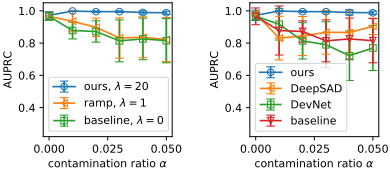
Image classification. We use the MNIST dataset 5 and the Fashion-MNIST 6 dataset to evaluate anomaly detection on image data. Both image datasets contain ten classes and we use the standard one-v.s.-all setting to perform anomaly detection experiments. The anomalies are detected according to the reconstruction error computed from the output of a convolutional autoencoder. Model details are in the appendix.
Traing/test split. Table 1 summarizes the training/test data split for each dataset. The setup of FashionMNIST is the same as that of MNIST. The size numbers for MNIST (and FashionMNIST) are the approximate numbers since the original dataset is not divided equally for each class. The number of anomaly contamination in the training set and the number of labeled anomalies for training will be specified when we present the corresponding experimental results.
6.2 DetectionMetrics
Both anomaly recall rate (#recalled anomalies/#total anomalies) and the associated precision (#recalled anomalies/# recalled samples) are critical for evaluating anomaly detectors. To compare models trained with different setups and approaches in a threshold-independent way, we evaluate the performance of an anomaly detection model based on the area under the precision-recall curve (AUPRC), which approximates the average precision weighted by the associated recall. Metrics such as precision rate, recall rate, and F1 score (the harmonic mean of precision and recall) are not ideal since they depend on the choice of thresholds. Receiver operating characteristic (ROC) concerns mostly about samples that are determined as anomalies, which is less informative than AUPRC for anomaly detection tasks.
4 https://archive.ics.uci.edu/ml/datasets/human+activity+ recognition+using+smartphones
5 http://yann.lecun.com/exdb/mnist/
6 https://github.com/zalandoresearch/fashion-mnist
| Dataset | labeled | baseline | DeepSAD | DevNet | Ours |
|---|---|---|---|---|---|
| ECG | 20 | 0.867 ±0.006 | 0.884 ±0.087 | 0.893 ±0.009 | 0.980 ±0.005 |
| 50 | 0.860 ±0.011 | 0.886 ±0.062 | 0.925 ±0.009 | 0.994 | |
| 20 | 0.817 | 0.330 | 0.802 | ±0.002 | |
| HAR | ±0.003 0.819 | ±0.002 0.329 | ±0.013 0.818 | 0.969 ±0.026 0.995 ±0.003 | |
| 50 | ±0.001 | ±0.007 | |||
| ±0.005 |
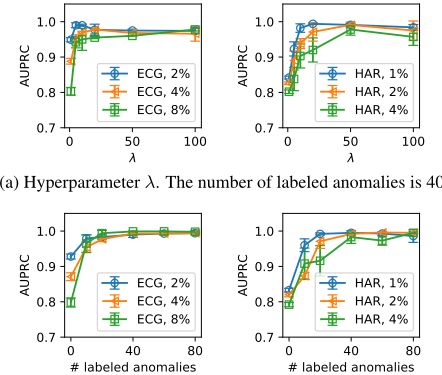
Figure 2: Sensitivity of AUPRC to the hyperparameter λ and the number of labeled anomalies. The line and the error bar indicate the mean and standard deviations from 10 random seeds, respectively. The percentiles indicate the contamination ratios for each setup.
6.3 Algorithms in Comparison
We compare our approach with the baseline approach, DeepSAD, and DevNet. The details and hyperparameter settings are the same in the previous synthetic experiments. The baseline approach trains on contaminated training datasets without using additionally labeled anomalies. The hyperparameters of DevNet are selected according to the recommended value in the original papers. We add the amplification factor λ to DeepSAD and keep it the same as our approach.
| MNIST | FashionMNIST | ||||||||
|---|---|---|---|---|---|---|---|---|---|
| class | baseline | DeepSAD | DevNet | Ours | class | baseline | DeepSAD | DevNet | Ours |
| 0 | 0.982±0.000 | 0.824±0.000 | 0.983±0.001 | 0.992±0.005 | T-shirt | 0.960±0.001 | 0.887±0.001 | 0.960±0.002 | 0.973±0.003 |
| 1 | 1.000±0.000 | 0.985±0.006 | 1.000±0.000 | 0.996±0.001 | Trouser | 0.993±0.001 | 0.941±0.010 | 0.993±0.000 | 0.990±0.001 |
| 2 | 0.957±0.003 | 0.865±0.001 | 0.960±0.002 | 0.981±0.014 | Pullover | 0.943±0.002 | 0.872±0.037 | 0.945±0.002 | 0.986±0.001 |
| 3 | 0.971±0.001 | 0.883±0.000 | 0.974±0.001 | 0.975±0.005 | Dress | 0.966±0.001 | 0.917±0.002 | 0.968±0.001 | 0.982±0.002 |
| 4 | 0.979±0.001 | 0.928±0.000 | 0.979±0.001 | 0.995±0.001 | Coat | 0.957±0.002 | 0.837±0.000 | 0.959±0.002 | 0.977±0.001 |
| 5 | 0.976±0.001 | 0.919±0.000 | 0.976±0.001 | 0.983±0.009 | Sandal | 0.920±0.002 | 0.978±0.000 | 0.923±0.003 | 0.991±0.000 |
| 6 | 0.980±0.002 | 0.888±0.002 | 0.982±0.001 | 0.986±0.020 | Shirt | 0.943±0.002 | 0.898±0.025 | 0.944±0.002 | 0.963±0.005 |
| 7 | 0.986±0.000 | 0.937±0.000 | 0.986±0.001 | 0.996±0.001 | Sneaker | 0.986±0.001 | 0.966±0.002 | 0.987±0.002 | 0.990±0.001 |
| 8 | 0.955±0.003 | 0.870±0.000 | 0.959±0.003 | 0.942±0.036 | Bag | 0.923±0.002 | 0.879±0.019 | 0.924±0.001 | 0.988±0.002 |
| 9 | 0.980±0.001 | 0.924±0.000 | 0.981±0.001 | 0.989±0.001 | AnkleBoot | 0.973±0.001 | 0.897±0.000 | 0.974±0.001 | 0.990±0.003 |
6.4 Results and Discussions
We run experiments for the five datasets and record the associated AUPRCs. For each configuration, we repeat the experiment 10 times with 10 different random seeds.
Synthetic data. We vary the contamination ratio α from 0 to 5% and compare different anomaly detectors. Figure 1 shows the AUPRCs in each setup. The curve for λ = 0 on the left panel shows that data contamination indeed causes a quadratic-like AUPRC decay. While our approach with λ = 20 reduces the performance degradation, the ramp loss [Jehl et al., 2019] fails, which indicates the importance of setting a large λ. The right panel shows that our approach outperforms other recently proposed anomaly detectors.
Time-series. Table 2 shows the AUPRCs (means and standard deviations) on the time-series datasets. We contaminate ECG and HAR with 100 and 200 anomalies, respectively. For both datasets, we evaluate the detection performance with 20 labeled anomalies and 50 labeled anomalies. Our approach not only significantly improves the unsupervised baseline approach, but also outperforms other approaches. Moreover, the gradient attenuation issue is significant as the performance of DeepSAD is not very stable (better than the baseline on the synthetic dataset and the ECG 5000 dataset but much worse than the baseline in HAR).
Image data. Table 3 shows the AUPRCs (means and standard deviations) for the MNIST and Fashion-MNIST experiments. For all experiment configurations, we contaminate the training dataset with 500 randomly sampled anomalies and use another 100 randomly sampled anomalies for labeling. Our approach achieves the best performance in most of the experiments. DevNet is better than ours in a few configurations, while DeepsAD is always worse than ours. This again shows that the gradient attenuation due to the extra multiplication is harmful to anomaly detection tasks.
6.5 Sensitivity Analysis
The performance of our approach depends on the hyperparameter λ and the number of labeled anomalies. Both quantities are critical for practical applications. A desirable anomaly detector is expected to attain high AUPRCs from a large interval of λ without using too many labeled anomalies. The exact effective range of λ and the number of labeled anomalies depend on the specific dataset.
We use the two time-series datasets to investigate the practical effectiveness of our approach. We repeat each experiment using 10 random seeds. The normal training dataset is the same as before. The ECG 5000 dataset is contaminated with 2, 4, 8% contamination ratios. The ratio for the HAR dataset is 1, 2, 4%. We evaluate the AUPRCs by varying λ and the number of additionally labeled anomalies.
Figure 2 shows the mean and standard deviations (indicated in the height of the error bar) of the AUPRCs. The effective interval of λ to produces a high AUPRC is wide in general. When the number of labeled anomalies is sufficient to cover the contamination (i.e., configurations with smaller contamination ratios), a larger λ is always not worse than a smaller one. When the number of labeled anomalies is insufficient, the AUPRC first increases and then decreases while λ increases. Meanwhile, as the number of labeled anomalies inject knowledge about contamination, a large number of labeled anomalies always improve AUPRC despite that a relatively small one suffices. This validates the data efficiency.
7 Discussion and Conclusion
We developed a theoretic framework to explain the performance degradation of deep anomaly detectors due to training data contamination. We showed that the gradient-based training induced a kernel machine, which indicated a memorybased detection mechanism in deep detectors. We further showed that, given enough memory capacity, the detection performance degraded at a quadratic rate with respect to the contamination ratio. To mitigate the degradation without cleaning the training dataset, we proposed a contradicting training approach that leveraged the information of an additional small dataset of labeled anomalies.
The effectiveness of an anomaly detector relies on both the training data quality and the structure of the neural network. Our work is based on the assumption that a good neural network is available. To detect difficult unknown anomaly, techniques such as domain adaptation [Dong et al., 2020] should be considered. We focus on improving anomaly detection in the presence of contamination of the dataset. Our empirical results showed that effectiveness of our approach on various public datasets. Besides the public dataset, we have also validated our approach for real-world telecommunication signaling data, which is reported in [Wu et al., 2021].
@inproceedings{ijcai2022p322,
  title     = {Understanding and Mitigating Data Contamination in Deep Anomaly Detection: A Kernel-based Approach},
  author    = {Wu, Shuang and Zhao, Jingyu and Tian, Guangjian},
  booktitle = {Proceedings of the Thirty-First International Joint Conference on
               Artificial Intelligence, {IJCAI-22}},
  publisher = {International Joint Conferences on Artificial Intelligence Organization},
  editor    = {Luc De Raedt},
  pages     = {2319--2325},
  year      = {2022},
  month     = {7},
  note      = {Main Track},
  doi       = {10.24963/ijcai.2022/322},
  url       = {https://doi.org/10.24963/ijcai.2022/322},
}
TY - CPAPER TI - Understanding and Mitigating Data Contamination in Deep Anomaly Detection: A Kernel-based Approach AU - Wu, Shuang AU - Zhao, Jingyu AU - Tian, Guangjian T2 - Proceedings of the Thirty-First International Joint Conference on Artificial Intelligence, IJCAI-22 PB - International Joint Conferences on Artificial Intelligence Organization PY - 2022 SP - 2319 EP - 2325 DO - 10.24963/ijcai.2022/322 UR - https://doi.org/10.24963/ijcai.2022/322 ER -Copied
Machine-readable versions of this paper, for tools and AI agents:





