
Inverse Problems for Gradual Semantics
Proceedings of the Thirty-First International Joint Conference on Artificial Intelligence. Main Track. Pages 2719-2725.
https://doi.org/10.24963/ijcai.2022/377
Keywords
- Knowledge Representation and Reasoning: Argumentation
- Agent-based and Multi-agent Systems: Agreement Technologies: Argumentation
Abstract
Gradual semantics with abstract argumentation provide each argument with a score reflecting its acceptability. Many different gradual semantics have been proposed in the literature, each following different principles and producing different argument rankings. A sub-class of such semantics, the so-called weighted semantics, takes, in addition to the graph structure, an initial set of weights over the arguments as input, with these weights affecting the resultant argument ranking. In this work, we consider the inverse problem over such weighted semantics. That is, given an argumentation framework and a desired argument ranking, we ask whether there exist initial weights such that a particular semantics produces the given ranking. The contribution of this paper are: (1) an algorithm to answer this problem, (2) a characterisation of the properties that a gradual semantics must satisfy for the algorithm to operate, and (3) an empirical evaluation of the proposed algorithm.
- [Amgoud and Ben-Naim, 2013] Leila Amgoud and Jonathan Ben-Naim. Ranking-Based Semantics for Argumentation Frameworks. In Proc. Scalable Uncer- tainty Management, pages 134-147, 2013.
- [Amgoud et al., 2016] Leila Amgoud, Jonathan Ben-Naim, Dragan Doder, and Srdjan Vesic. Ranking Arguments With Compensation-Based Semantics. In KR 2016, pages 12-21, 2016.
- [Amgoud et al., 2017] Leila Amgoud, Jonathan Ben-Naim, Dragan Doder, and Srdjan Vesic. Acceptability Semantics for Weighted Argumentation Frameworks. In IJCAI, pages 56-62, 2017. IJCAI
- [Amgoud et al., 2022] Leila Amgoud, Dragan Doder, and Srdjan Vesic. Evaluation of argument strength in attack graphs: Foundations and semantics. Artificial Intelligence, 302:103607, 2022.
- [Baroni et al., 2011] Pietro Baroni, Martin Caminada, and Massimiliano Giacomin. An introduction to argumenta- tion semantics. Knowledge Eng. Review, 26(4):365-410, 2011.
- [Bonzon et al., 2016] Elise Bonzon, Jérôme Delobelle, Sébastien Konieczny, and Nicolas Maudet. A Compar- ative Study of Ranking-Based Semantics for Abstract Argumentation. In Proc. AAAI, pages 914-920, 2016.
- [Brent, 2013] Richard P Brent. Algorithms for minimization without derivatives. Courier Corporation, 2013.
- [Caminada et al., 2012] Martin W. A. Caminada, Wal- ter Alexandre Carnielli, and Paul E. Dunne. Semi-stable semantics. J. Log. Comput., 22(5):1207-1254, 2012.
- [Coste-Marquis et al., 2012] Sylvie Coste-Marquis, Sébastien Konieczny, Pierre Marquis, and Mohand Akli Ouali. Weighted Attacks in Argumentation Frameworks. In KR 2012, 2012.
- [da Costa Pereira et al., 2011] Célia da Costa Pereira, An- drea Tettamanzi, and Serena Villata. Changing one's mind: Erase or rewind? In IJCAI, pages 164-171, 2011.
- [Dekker, 1969] TJ Dekker. Finding a zero by means of suc- cessive linear interpolation, constructive aspects of the fundamental theorem of algebra (B. Dejon and P. Henrici, eds.), 1969. [Delobelle, 2017] Jérôme Delobelle. Ranking-based Seman- tics for Abstract Argumentation. PhD thesis, Université d'Artois, 2017.
- [Dung, 1995] Phan Minh Dung. On the Acceptability of Ar- guments and its Fundamental Role in Nonmonotonic Rea- soning, Logic Programming and n-Person Games. Artif. Intell., 77(2):321-358, 1995.
- [Dunne et al., 2011] Paul E. Dunne, Anthony Hunter, Pe- ter McBurney, Simon Parsons, and Michael Wooldridge. Weighted argument systems: Basic definitions, algo- rithms, and complexity results. Artif. Intell., 175(2):457- 486, 2011.
- [Dunne et al., 2015] Paul E. Dunne, Wolfgang Dvorák, Thomas Linsbichler, and Stefan Woltran. Characteristics of multiple viewpoints in abstract argumentation. Artif. Intell., 228:153-178, 2015.
- [Gabbay and Rodrigues, 2015] Dov M. Gabbay and Odi- naldo Rodrigues. Equilibrium states in numerical argu- mentation networks. Logica Universalis, 9(4):411-473, 2015.
- [Hunter and Thimm, 2017] Anthony Hunter and Matthias Thimm. Probabilistic reasoning with abstract argumen- tation frameworks. J. Artif. Intell. Res., 59:565-611, 2017.
- [Li et al., 2011] Hengfei Li, Nir Oren, and Timothy J. Nor- man. Probabilistic argumentation frameworks. In TAFA, volume 7132 of Lecture Notes in Computer Science, pages 1-16, 2011.
- [Mahesar et al., 2018] Quratul-ain Mahesar, Nir Oren, and Wamberto W. Vasconcelos. Computing preferences in ab- stract argumentation. In Proc. PRIMA, pages 387-402, 2018.
- [Mossakowski and Neuhaus, 2016] Till Mossakowski and Fabian Neuhaus. Bipolar Weighted Argumentation Graphs. CoRR, abs/1611.08572, 2016.
- [Mossakowski and Neuhaus, 2018] Till Mossakowski and Fabian Neuhaus. Modular Semantics and Characteris- tics for Bipolar Weighted Argumentation Graphs. CoRR, abs/1807.06685, 2018.
- [Polberg and Hunter, 2018] Sylwia Polberg and Anthony Hunter. Empirical evaluation of abstract argumentation: Supporting the need for bipolar and probabilistic ap- proaches. International Journal of Approximate Reason- ing, 93:487-543, 2018.
- [Rago et al., 2016] Antonio Rago, Francesca Toni, Marco Aurisicchio, and Pietro Baroni. Discontinuity-Free De- cision Support with Quantitative Argumentation Debates. In KR 2016, pages 63-73, 2016.
- [Tang et al., 2016] Yuqing Tang, Nir Oren, and Katia Sycara. Markov argumentation random fields. In Proceedings of AAAI Conference on Artificial Intelligence, 2016.
- [Verbeke and Cools, 1995] Johan Verbeke and Ronald Cools. The newton-raphson method. International Journal of Mathematical Education in Science and Technology, 26(2):177-193, 1995.
- [Wu et al., 2016] Jiachao Wu, Hengfei Li, Nir Oren, and Timothy J. Norman. Gödel fuzzy argumentation frame- works. In COMMA, volume 287 of Frontiers in Artificial Intelligence and Applications, pages 447-458. IOS Press, 2016.
- [Yun and Vesic, 2021] Bruno Yun and Srdjan Vesic. Grad- ual semantics for weighted bipolar setafs. In ECSQARU 2021, volume 12897 of Lecture Notes in Computer Sci- ence, pages 201-214. Springer, 2021.
- [Yun et al., 2020] Bruno Yun, Srdjan Vesic, and Madalina Croitoru. Ranking-Based Semantics for Sets of Attacking Arguments. In AAAI 2020, pages 3033-3040, 2020.
References were extracted automatically from the PDF and may contain errors.
Full text extracted automatically from the PDF; figures, tables and equations may differ. The PDF is the version of record.
1 Introduction
Abstract argumentation semantics aim to identify the justification status of arguments by considering interactions between arguments. Such semantics typically operate over a directed graph, with nodes representing the (abstract) arguments, and directed edges denoting the interactions between them, e.g., attacks or supports among others. Standard argumentation semantics [Baroni et al., 2011; Dung, 1995; Caminada et al., 2012] identify sets of arguments which are considered justified (as well as unjustified and undecided). In contrast, ranking-based semantics seek to assign a ranking (or ordering) over arguments, with higher ranked arguments being considered more justified (or "less attacked") than lower ranked arguments. Such rankings are - in most rankingbased semantics - determined by assigning numerical values (called acceptability degrees) to all arguments, with the ranking on arguments being computed based on the numerical ordering. Those ranking-based semantics are called gradual semantics. Note that not all ranking-based semantics follow this numerical approach. For instance, the ranking on arguments obtained from the burden-based or the discussion-based semantics [Amgoud and Ben-Naim, 2013], are computed using the lexicographical order on vectors of argument scores.
∗Contact Author
While some ranking-based semantics [Amgoud and BenNaim, 2013; Bonzon et al., 2016; Delobelle, 2017; Amgoud et al., 2016] only consider the structure of a standard Dung's argumentation framework, others take in one or more additional features, such as a set of initial weights for each argument [da Costa Pereira et al., 2011; Amgoud et al., 2022]; weights for attacks between arguments [Coste-Marquis et al., 2012; Yun and Vesic, 2021]; a support relation [Mossakowski and Neuhaus, 2018; Mossakowski and Neuhaus, 2016; Rago et al., 2016]; or even set attacks [Yun et al., 2020]. In most gradual semantics, the final acceptability degree of an argument then depends on a range of parameters. Here, we focus on gradual semantics which take into account the structure of the graph, the initial weights of arguments, and the peculiarities of the semantics being used. Of course, the proposed approach could easily be generalised to other settings.
Rather than describing how an initial set of argument weights map to a ranking on arguments via some semantics, we instead consider the inverse problem. That is, given an abstract argumentation framework and a desired ranking on arguments, we seek to identify what initial weights should be assigned to arguments so as to obtain the desired argument ranking. We provide an algorithm for undertaking this task for a set of well-known gradual semantics which satisfy some basic properties, and evaluate the algorithm's performance.
While we do not discuss the applications of our results, we note that potential areas in which they can be used include persuasion [Polberg and Hunter, 2018] and preference elicitation [Mahesar et al., 2018].
The remainder of this paper is structured as follows. In Section 2, we give the needed background to understand our approach. In Section 3, we describe our algorithm. Section 4 highlights the properties of the semantics over which the algorithm operates. Our empirical evaluation is detailed in Section 5, and we discuss potential applications of this work as well as avenues for future research in Section 6.
2 Background
We begin this section by providing a brief overview of abstract argumentation, as well as several gradual semantics.
Following this, we introduce the bisection method, a simple technique for finding the roots of an equation which lies at the heart of our approach.
2.1 Argumentation
We situate our approach in the context of abstract argumentation. Arguments are thus atomic entities which interact with each other via an attack relationship. Such systems are encoded as directed graphs (c.f., [Dung, 1995]). Since our departure point here involves assigning each argument an initial weight, we instead consider weighted argumentation frameworks (WAFs) [Dunne et al., 2011; Amgoud et al., 2017].
Definition 1 (WAF) A weighted argumentation framework (WAF) is a triple F = ⟨A,D,w⟩, where A is a finite set of arguments, D ⊆ A × A is a binary attack relation, and w : A → [0, 1] is a weighting function assigning an initial weight to each argument.
The set of attackers of an argument a ∈ A is denoted as Att(a) = {b ∈ A | (b, a) ∈ D}.
A ranking-based semantics allows us to move from a WAF to a ranking over arguments. While myriad semantics have been proposed, we consider the gradual semantics described in [Amgoud et al., 2022] due to this work's recency and the popularity of the semantics described therein. We note in advance that some of these semantics do not work with our approach, but we will use these to help explain the properties of those semantics to which our approach applies. Furthermore, while [Bonzon et al., 2016] describes 13 ranking-based semantics, only these gradual semantics allow for an initial weight to be assigned to an argument.
Definition 2 (Gradual Semantics) A gradual semantics σ is a function that associates to each weighted argumentation graph F = ⟨A,D,w⟩, a scoring function σF : A → [0, 1] that provides an acceptability degree to each argument. In this paper, we consider the gradual semantics σx, for x ∈ {TB, IS,MB, CB,HC}, defined as follows.
- Trust-based semantics σTB [da Costa Pereira et al., 2011] are defined so that the acceptability degree of an argument a ∈ A is σF TB (a) = TB∞(a), where TBi(a) = 12 · TBi-1(a) + 12 · min(w(a), 1 - max b∈Att(a) TBi-1(b)) and for all b ∈ A, TB0(b) = w(b).
- The iterative-schema semantics σIS [Gabbay and Rodrigues, 2015] is defined such that the acceptability degree of an argument a ∈ A is σF IS (a) = IS∞(a), where ISi(a) = (1 - ISi-1(a)) · min( 1 2 , 1- max b∈Att(a) ISi-1(b)) + ISi-1(a) · max( 12 , 1 - max b∈Att(a) ISi-1(b)) and for all b ∈ A, IS0(b) = w(b).
- The weighted max-based semantics σMB [Amgoud et al., 2022] is defined such that the acceptability degree of an argument a ∈ A is σFMB (a) = MB∞(a), where MBi(a) = w(a) 1+ max b∈Att(a) MBi-1(b) and for all b ∈ A,MB0(b) = w(b) .
- The weighted card-based semantics σCB [Amgoud et al., 2022] is defined such that the acceptability degree of an argument a ∈ A is σF CB (a) = CB∞(a) where CBi(a) = w(a) 1+|Att∗ (a)|+ ∑ b∈Att∗(a) CBi-1(b) |Att∗(a)| , for all b ∈ A, CB0(b) = w(b), and Att∗ (a) = {b ∈ Att(a) | w(b) > 0} if Att∗ (a) ̸= ∅ and w(a) otherwise.
- The weighted h-categorizer semantics σHC[Amgoud et al., 2022] is defined such that the acceptability degree of an argument a ∈ A is σFHC (a) = HC∞(a) where HCi(a) = w(a) 1+ ∑ b∈Att(a) HCi-1(b) and for all b ∈ A,HC0(b) = w(b) .
| a0 | a1 | a2 | a3 | Argument ranking | |
|---|---|---|---|---|---|
| σF TB | 0.43 | 0.39 | 0.50 | 0.30 | a3 ≺ a1 ≺ a0 ≺ a2 |
| σF IS | 1.00 | 0.50 | 0.00 | 1.00 | a2 ≺ a1 ≺ a0 ≃ a3 |
| σFMB | 0.43 | 0.30 | 0.58 | 0.30 | a1 ≃ a3 ≺ a0 ≺ a2 |
| σFHC | 0.43 | 0.30 | 0.38 | 0.30 | a1 ≃ a3 ≺ a2 ≺ a0 |
| σF CB | 0.43 | 0.18 | 0.17 | 0.30 | a2 ≺ a1 ≺ a3 ≺ a0 |
With the exception of σIS, the ranking on arguments is obtained from the acceptability degree assigned to them. For σIS, the semantics returns those arguments whose acceptability degree is set to 1. As usual, for every a, b ∈ A, we write a ≻ b iff a ⪰ b and b ̸⪰ a, a ⪯ b iff a ̸≻ b, a ≺ b iff a ̸⪰ b, and a ≃ b iff a ⪯ b and a ⪰ b.
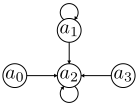
Example 1 Let F = ⟨A,D,w⟩ be a WAF, where A = {a0, a1, a2, a3},D = {(a0, a2), (a1, a1), (a1, a2), (a2, a2), (a3, a2)}, w(a0) = 0.43, w(a1) = 0.39, w(a2) = 0.92, and w(a3) = 0.3. The WAF is represented in Figure 1 and the acceptability degrees for the gradual semantics of Definition 2 are shown in Table 1.
We note that the semantics described above are able to operate on cyclic graphs. Semantics such as DF-Quad [Rago et al., 2016], while popular, are designed to operate on acyclic graphs only, and we therefore ignore them in this work.
2.2 The BisectionMethod
The algorithm we describe in Section 3 requires us to find the roots of a continuous function. While many techniques for doing so exist [Dekker, 1969; Brent, 2013; Verbeke and Cools, 1995], the bisection method is easily understood and numerically stable, and is therefore used in our experiments, though more advanced methods could also be used.
Algorithm 1 The bisection method.
function BISECT(f, α, β, ϵ) µ ← α+β 2 if |f(µ)| < ϵ then return µ if f(µ) > 0 then return BISECT(f, µ, β, ϵ) else return BISECT(f, α, µ, ϵ) end functionAlgorithm 1 details the bisection method. As input, the method takes in a function f, a tolerance ϵ, and upper and lower bound values (α and β respectively), such that f(β) < 0 < f(α). A single iteration of the algorithm identifies the midpoint µ = (α + β)/2. If f(µ) > 0, α is set to µ; if f(µ) < 0, β is set to µ, tightening the upper and lower bounds. The process then repeats until the absolute value of the image of the midpoint is sufficiently small, i.e., |f((α + β)/2)| < ϵ. Note that one can choose to also stop when the distance between α and β is small. The number of iterations required to achieve an error ϵ is bounded by ⌈log2((| α - β |)/ϵ)⌉. Note that for the bisection method to work correctly and return a unique root, the function f must be continuous and monotonic in the interval [α, β].
3 The Inverse Problem
Our aim in this work is to identify a set of initial weights to obtain some desired final ranking on arguments. More formally, we take as input: (1) an unweighted argumentation framework ⟨A,D⟩, (2) a gradual semantics σ, and (3) a desired preference relation ⪰⊂ A × A. Our aim is to find a weighting function w such that in the resultant WAF F = ⟨A, D, w⟩, for all a, b ∈ A, σF (a) ≥ σF (b) iff a ⪰ b.
In Sections 3.2 and 3.3, we describe a two phase algorithm to identify an appropriate weighting function. In phase 1, we identify an achievable acceptability degree for an argument, taking into account the desired ranking on arguments. In phase 2, we undertake a search - using the bisection method - for the initial weights necessary to achieve this desired acceptability degree. We begin however by considering several special cases of the inverse problem.
3.1 Special Cases
We begin by considering the trust-based semantics. If w(a) < 0.5 for all a ∈ A, then σF TB (a) = w(a), making the inverse problem trivial to solve in this case. While such a solution satisfies the inverse problem, it is at odds with the intuition behind trust based semantics as described in [da Costa Pereira et al., 2011]. In cases where, for all a ∈ A, w(a) ≥ 0.5, the presence of cycles can mean that no solution exists for the inverse problem under the σTB semantics. As an example of this, consider the standard 3-cycle WAF: ⟨{a, b, c}, {(a, b), (b, c), (c, a)},w⟩. If w(a),w(b),w(c) ≥ 0.5, the acceptability degrees of all arguments will be 0.5.
Turning to the σIS semantics, we observe that it was designed to have acceptability degrees converge to either 1, 0.5, or 0. This means that the inverse problem is not always applicable to this semantics as it can only accommodate three levels of acceptability. Moreover, there are rankings which cannot be achieved, e.g. consider the simple WAF: ⟨{a, b}, {(a, b)},w⟩, it is not possible to get a ≺ b as σF IS (a) = 1 and σF IS (b) = 0, for any weighting w.
Finally, consider a fully connected graph. We can easily prove the following proposition, which makes the solving the inverse problem on such graphs trivial.
Proposition 1 For a fully connected WAF F = ⟨A,D,w⟩, semantics σ ∈ {σMB, σCB, σHC} and any arguments a, b ∈ A, σF (a) ≥ σF (b) iff w(a) ≥ w(b).
Given these special cases, in the remainder of the paper we consider only σMB, σCB and σHC. We can trivially solve the inverse problem for fully connected graphs as all the semantics will converge quickly, even in the presence of a significant number of arguments and edges.
3.2 Phase 1: Computing Acceptability Degrees
We partition the set of arguments A into a sequence of nonempty sets of arguments [Ar0, . . . ,Arn] such that for any a, b ∈ Ari, 0 ≤ i ≤ n, a ≃ b, and for any a ∈ Ari, b ∈ Arj where 0 ≤ i < j ≤ n, a ≻ b. Now consider an argument a ∈ Ar0. For each semantics, we can reason as follows.
- σMB: Assume that a is attacked by an argument with acceptability degree 1. If w(a) = 1, its acceptability degree can be at most 0.5.
- σCB: Assume that a is attacked by n other arguments with degree 1. Then its acceptability degree can be at most 1/(2 + n). If a is the most attacked argument in Ar0, then all other arguments in Ar0 will have an acceptability degree equal to or greater than this value.
- σHC: Assume that a is attacked by n other arguments with degree 1. Then its acceptability degree can be at most 1/(1 + n). If a is the most attacked argument in Ar0, then all other arguments will have an acceptability degree equal or greater to this value.
We refer to the aforementioned values as the minimal upper bounds for the arguments in Ar0, as this is the lowest value we are guaranteed to be able to achieve (with the corresponding semantics) if the arguments in Ar0 have an initial weight of 1. Similarly, the maximal upper bound for arguments in Ar0 is 1, achievable if all attackers of arguments in Ar0 have an acceptability degree of 0. The idea is to make sure that all the arguments from Ar0 have acceptability degree in the interval [mup, 1], where mup is the minimal upper bound corresponding to the semantics in question, e.g. all the arguments fromAr0 are within [ 1 1+n , 1] for σHC.
Now, consider Ar1. If the maximal upper bound of the acceptability degree of these arguments is lower than the minimal upper bound for the arguments in Ar0, then we will comply with our desired ranking on arguments. To achieve this, we set the initial weights of arguments in Ar1 to (just below) the minimal upper bound of Ar0. We can repeat this, computing initial weights, and concomitant maximal upper bounds for Ari by considering the minimal upper bounds of Ari-1. Algorithm 2 describes this process. Note that a small constant ζ is added to the denominator in all cases to ensure that the minimal upper bound is still reduced for the special case where all arguments in some Ari are unattacked.
function COMPUTEBOUNDS([], , ) return {} end function function COMPUTEBOUNDS([Ar0, . . . , Arn], max, σ) switch σ do case σMB: min ← max/(1 + max + ζ) case σHC : min ← max/(1 + max a∈Ar0 |Att(a)| + ζ ) case σCB: min ← max/(2 + max a∈Ar0 |Att(a)| + ζ) return {(Ar0, min)}∪ COMPUTEBOUNDS([Ar1, . . . , Arn],min, σ) end function function COMPUTEBOUNDS([Ar0, . . . , Arn], σ) return COMPUTEBOUNDS([Ar0, . . . , Arn], 1, σ) end function3.3 Phase 2: Finding the Initial Weights
Having identified appropriate minimum upper bounds for all Ar0 to Arn, we now turn our attention to finding initial weights for each argument in these sets so as to have that argument's acceptability degree equal to the corresponding set's minimum upper bound. By doing this, we obtain our desired ranking on arguments.
Our approach to achieving this involves picking an argument and modifying its initial weight (using the bisection method), causing it to approach its minimum upper bound value. We then pick another argument and repeat this process, until all arguments reach their desired values. There are several choices we must consider, and optimisations possible, when instantiating this approach. The most obvious choices we face revolve around selecting an argument for modification, and the decision of how much to modify the selected argument by. Myriad strategies for argument selection are possible, and in this work we consider 5 simple strategies:
- S1 : Select more preferred arguments for modification first. The rationale here is that such arguments have higher acceptability degrees, and fixing their values will cause fewer perturbations in the remainder of the process.
- S2 : Select less preferred arguments for modification first. Such arguments, with their small degree, would have little influence on the network.
- S3 : Select arguments further from their target degree first. By selecting arguments with the largest error first, we may perturb the network less.
- S4 : Select arguments nearest their target degree first. These, due to needing only minor perturbations, would have minimal effect on the rest of the argumentation system.
- S5 : Pick arguments at random. This is the baseline strategy.
Observe that additional strategies can be used, e.g. picking arguments with most, or fewest attackers, or which attack most or fewest arguments, first. We leave consideration of such strategies to future work.
The bisection method is only guaranteed to work for a function with a single variable, and selecting an appropriate strategy is therefore critical to our algorithm's success. As discussed in Section 5, some of these strategies work much better than others, but we are unable to provide an analytical proof of correctness for any of the strategies.
With regards to how much we should modify a selected argument, we could do so until it is within some tolerance ϵ of its acceptability degree, or until a certain number of iterations of the bisection method have been carried out. The rationale behind the second approach is that it allows us to respond to changes in acceptability degrees of other arguments due to our modifications more rapidly than if we modify only a single argument at a time.
If d is the desired acceptability degree for an argument a, then we can use the bisection method to find a new initial weight wa for a such that |σF (a) - d| ≤ ϵ where σF (a) is the acceptability degree of a in the WAF where the weight of a is now wa. To apply the bisection method we need to also identify an initial upper and lower bound. While we can use the values 1 and 0 for this, we can also identify tighter bounds, leading to a small improvement in performance. First, consider the lower bound α passed to the bisection method. Since our denominator is at least 1, we can set α to the minimal upper bound. For β, assume we wish to achieve a minimal upper bound of m(a) for argument a, which has n attackers. Now consider σMB, and assume that the strongest attacker has acceptability degree 1. We have that m(a) = w(a)/(2 + ζ) and so can set β to min{(2 + ζ) · m(a), 1}. Using this idea, for σHC, we can set β to min{m(a) · (1 + n + ζ), 1}, and for σCB to min{(2 + n + ζ) · m(a), 1}.
From a practical point of view, observe that the target acceptability degree computed in Phase 1 may be very small. The stopping condition of our bisection method should therefore use a relative error |(α+β)/2-m(a)|/m(a) < ϵ rather than an absolute error. Since we evaluate acceptability degrees as part of the bisection method, we can also terminate our algorithm early if the acceptability degrees returned in the evaluation match our desired ranking, even if they have not yet converged to the desired minimum upper bound.
4 Properties
We now examine properties of our approach and the underlying semantics, identifying necessary conditions over the latter which are needed for the former to work. Given the iterative nature of the underlying semantics, proving that some of these properties hold is difficult, and in Section 5, we carry out an empirical evaluation which strongly suggests that the σMB, σHC and σCB semantics respect these properties. Properties which we are able to demonstrate are identified as propositions, with associated proofs in the supplementary material, while those we are unable to analytically demonstrate are labelled as conjectures.
The first property we consider involves the weights obtained in Phase 1 (Section 3.2). We need to demonstrate that the computed weights are achievable. While we can easily demonstrate that the computed weight is achievable in isolation, doing so for the entire system is more difficult.
Conjecture 1 (Weighting Validity) For any unweighted argumentation graph ⟨A,D⟩ and σ ∈ {σMB, σHC, σCB}, there is a weighting function w such that for all 0 ≤ i ≤ n, for all a ∈ Ari, σF (a) is equal to its minimum upper bound (as computed by Algorithm 2), where F = ⟨A, D, w⟩.
In Phase 2, for the bisection method to operate, we must demonstrate that our semantics is continuous (otherwise we may be unable to converge to a solution); and that these changes are (strongly) monotonic (as otherwise we may have any number of solutions). Thus, our solution satisfies uniqueness (though uniqueness does not imply monotonicity).
Property 1 (Uniqueness) Given two WAFs F = ⟨A,D,w⟩,F ′ = ⟨A,D,w′ ⟩ and some a ∈ A such that w(a) ̸= w′ (a) and for all b ̸= a ∈ A, w(b) = w′ (b). It holds that σF (a) ̸= σF ′ (a), for σ ∈ {σMB, σCB, σHC}.
Property 2 (Continuity) A gradual semantics σ satisfies continuity iff for any WAF F = ⟨{a1, a2, . . . , an},D,w⟩, XF = (σF (a1), σF (a2), . . . , σF (an)), we can find F ′ = ⟨{a1, a2, . . . , an},D,w′ ⟩ (with unbounded weights) such that there is at least one a ∈ A s.t. w(a) ̸= w′ (a) and |XF ′ - XF | < δ for any positive δ. We say that σ satisfies bounded continuity iff it satisfies continuity and the initial weights for F ′ are restricted to [0, 1].
Property 3 (StrongMonotonicity) A gradual semantics σ satisfies strong monotonicity iff for any two WAFs F = ⟨A,D,w⟩,F ′ = ⟨A,D,w′ ⟩ for which there is some a ∈ A such that w(a) = w′ (a) + δ, δ > 0 and for all b ∈ A \ {a}, w(b) = w′ (b), it holds that σF (a) > σF ′ (a).
This in turn yields the following proposition.
Proposition 2 A gradual semantics σ which does not satisfy strong monotonicity or bounded continuity could have multiple, or no solutions to the inverse problem. In other words, both are necessary conditions for a unique solution for the inverse problem to exist.
We conjecture that σMB, σHC and σCB meet these conditions. We are unable to demonstrate strong monotonicity and bounded continuity though we show uniqueness and continuity for them in our supplementary material). The empirical evaluation suggests our approach operates successfully.
Proposition 3 The gradual semantics σ satisfies continuity and uniqueness, for σ ∈ {σMB, σHC, σCB} .
Conjecture 2 The gradual semantics σ satisfies strong monotonicity and bounded continuity for σ ∈ {σMB, σHC, σCB} .
5 Evaluation
We evaluated each of the strategies discussed in Section 3.3 over directed scale-free, small world (Erdos-Renyi), and complete graphs of different sizes (number of arguments) 1 . As part of our evaluation, we ran 10, 100 and 2000 iterations of the bisection method for each argument before using a strategy to pick the next desired argument. Table 2 describes the remaining parameters used in our evaluation.
1 Source code for our algorithm and evaluation can be found on GitHub at https://github.com/jhudsy/numerical inverse.
| ζ Graph Size Runs per graph size Erdos-Renyi probability Maximum relative error Bisection method iterations Bisection method ϵ Maximum bisection method calls | 1 10, 20, . . . , 150 15 0.1,0.3,0.5,0.7 0.001 10,100,2000 0.001 1000 |
We created a simple target preference ordering for our experiments, randomly placing each argument within the graph into one of 5 levels of preference. This meant that in all cases, at least some arguments had equal desired preference levels.
Our experiments evaluated the runtime of the different strategies, the number of times the bisection method was invoked, and the number of times the total iterations required exceeded the permitted maximum number of iterations. Given the number of dimensions across which our evaluation took place, we present only a subset of our results here; full results can be found in the supplementary material.
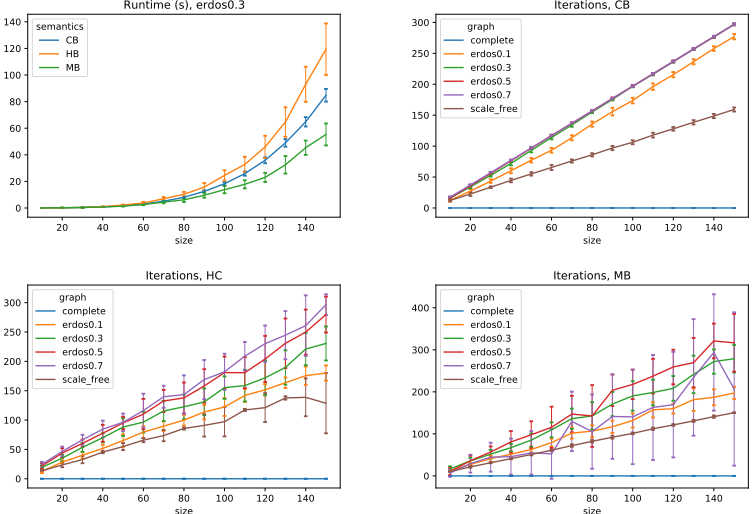
Our main criterion for evaluation revolves around the number of times the bisection method was called by our approach. As shown in Figure 2, which is representative of the results for most graph topologies, our runtime grows in a super-linear manner, due - as shown in [Amgoud et al., 2022] - to the increased time taken to evaluate a semantics on larger graphs. The number of bisection method iterations is shown in Figure 2 for our different semantics and graph types when selecting the next argument based on largest relative error. This value grows linearly (with a gradient between 1 and 2 depending on topology and semantics) for all semantics considered (R2 > 0.99 for all cases). Arguments are thus only recomputed at most twice before our approach converges. These results not only demonstrate the feasibility of our approach for large argumentation graphs, but also highlight the effectiveness of this specific argument selection strategy. We also note that there is little variance in our results for CB. We believe that this is due to the extra |Att| term in the semantics; this term overwhelms the term which depends on other arguments' final degrees, making the result more dependent on the topology of the graph than in the case of the other semantics.
Due to space,we omit several detailed results. In summary, (a) from all argument selection strategies, only selecting arguments from largest to smallest relative error resulted in always finding a solution to the inverse problem; (b) Allowing for partial convergence (via fewer iterations per argument before moving to the next one) decreased performance, often failing to find a solution; (c) Optimising α and β bounds (c.f. Section 3.3) had almost no influence on runtime. This unsurprising due to the speed of bisection method convergence.
Note that in the absence of equivalent arguments with the same acceptability degree, one could allow for early termination without getting to the target acceptability degrees, but that was not investigated in the current paper.
size size
Figure 2: Runtime (in seconds) and number of iterations for the different semantics and graph types
6 Conclusion &Discussion
We considered the inverse problem for a WAF. We demonstrated that a solution to this inverse problem exists for at least one family of semantics, and that a solution does not exist for at least some semantics. We then described an algorithm to solve this problem, and empirically evaluated its performance. Our results show the viability of our approach. When selecting arguments for initial weight perturbation based on relative error, each argument is typically perturbed at most twice (depending on semantics and graph topology).
Our approach was able to find weightings over all evaluated graphs and semantics, suggesting that HC, CB and MB meet all the requirements described in Section 4. Some of our results rely on empirical analysis, and providing analytical proofs for these is a critical avenue of future work.
We note in passing that our approach assumes that our argument ranking is total. Extending our scheme to admit partial rankings is - in a sense - trivial, but would result in a combinatorial explosion as we would need to consider multiple possible argument rankings as inputs.
To our knowledge no work has explicitly considered the inverse problem applied to gradual semantics as described in this paper, but several works have examined related concepts under different guises. The work of [Dunne et al., 2015] is perhaps closest to ours. They consider the case where one is given a set of extensions and a semantics, and need to decide whether there exists an argumentation framework that induces the given set of extensions. Unlike our work, they situate their approach in standard abstract argumentation semantics. Work on the epistemic approach to probabilistic argumentation [Hunter and Thimm, 2017] describes properties which probabilistic argumentation semantics should satisfy. Selecting some of these properties constrains the probabilities which arguments can have. Similarly, in fuzzy argumentation [Wu et al., 2016] calculates legal ranges of fuzzy degrees for arguments based on initial weights and the semantics underpinning the fuzzy argumentation system. Finally, argumentation dynamics examines what arguments or attacks should be introduced to strengthen or weaken an argument, somewhat analogous to our changing of initial argument weight.
There has been some work on sensitivity analysis within argumentation [Tang et al., 2016]. This work considers whether (small) changes in argument weights will affect the conclusions that can be drawn from an argumentation framework. The results reported on in this paper are a first step towards our long-term goal to provide a formal analysis of sensitivity to initial weights in MB, CB and HC style semantics.
The conditions specified in Prop. 2 are necessary for our algorithm to operate. As mentioned above, we are still investigating whether these conditions are also sufficient, or whether additional properties need to be identified. Once this is done, we will be able to categorise other weighted semantics unrelated to those discussed in the current work (e.g., the constellation-based probabilistic semantics [Li et al., 2011]) and consider whether our approach can be applied to them.
While we believe analytical solutions exist for the inverse problem for some semantics, one advantage of the numerical approach proposed in this work is that it is more generally applicable to a wide range of semantics. The current work therefore describes an easily applied approach to solving the inverse problem in argumentation.
@inproceedings{ijcai2022p377,
  title     = {Inverse Problems for Gradual Semantics},
  author    = {Oren, Nir and Yun, Bruno and Vesic, Srdjan and Baptista, Murilo},
  booktitle = {Proceedings of the Thirty-First International Joint Conference on
               Artificial Intelligence, {IJCAI-22}},
  publisher = {International Joint Conferences on Artificial Intelligence Organization},
  editor    = {Luc De Raedt},
  pages     = {2719--2725},
  year      = {2022},
  month     = {7},
  note      = {Main Track},
  doi       = {10.24963/ijcai.2022/377},
  url       = {https://doi.org/10.24963/ijcai.2022/377},
}
TY - CPAPER TI - Inverse Problems for Gradual Semantics AU - Oren, Nir AU - Yun, Bruno AU - Vesic, Srdjan AU - Baptista, Murilo T2 - Proceedings of the Thirty-First International Joint Conference on Artificial Intelligence, IJCAI-22 PB - International Joint Conferences on Artificial Intelligence Organization PY - 2022 SP - 2719 EP - 2725 DO - 10.24963/ijcai.2022/377 UR - https://doi.org/10.24963/ijcai.2022/377 ER -Copied
Machine-readable versions of this paper, for tools and AI agents:





