
Logit Mixing Training for More Reliable and Accurate Prediction
Proceedings of the Thirty-First International Joint Conference on Artificial Intelligence. Main Track. Pages 2812-2819.
https://doi.org/10.24963/ijcai.2022/390
Keywords
- Machine Learning: Robustness
- Machine Learning: Classification
Abstract
When a person solves the multi-choice problem, she considers not only what is the answer but also what is not the answer. Knowing what choice is not the answer and utilizing the relationships between choices, she can improve the prediction accuracy. Inspired by this human reasoning process, we propose a new training strategy to fully utilize inter-class relationships, namely LogitMix. Our strategy is combined with recent data augmentation techniques, e.g., Mixup, Manifold Mixup, CutMix, and PuzzleMix. Then, we suggest using a mixed logit, i.e., a mixture of two logits, as an auxiliary training objective. Since the logit can preserve both positive and negative inter-class relationships, it can impose a network to learn the probability of wrong answers correctly. Our extensive experimental results on the image- and language-based tasks demonstrate that LogitMix achieves state-of-the-art performance among recent data augmentation techniques regarding calibration error and prediction accuracy.
- 4 Proof-of-Concept Study 4.1 Toy Example We conducted a 2D classification task using the two-class spiral dataset [
- [Verma et al., 2019] to reveal the impact of LogitMix. To show the decision boundary and hidden rep- resentation of each method, we visualize the predictions in References [
- [Devlin et al., 2018] Jacob Devlin, Ming-Wei Chang, Ken- ton Lee, and Kristina Toutanova. Bert: Pre-training of deep bidirectional transformers for language understanding. arXiv preprint arXiv:1810.04805, 2018.
- [Goodfellow et al., 2015] Ian Goodfellow, Jonathon Shlens, and Christian Szegedy. Explaining and harnessing adver- sarial examples. In ICLR, 2015.
- [Guo et al., 2017] Chuan Guo, Geoff Pleiss, Yu Sun, and Kil- ian Q Weinberger. On calibration of modern neural net- works. In International Conference on Machine Learning, pages 1321-1330. PMLR, 2017.
- [He et al., 2016] Kaiming He, Xiangyu Zhang, Shaoqing Ren, and Jian Sun. Deep residual learning for image recog- nition. In CVPR, pages 770-778, 2016.
- [Heo et al., 2019] Byeongho Heo, Jeesoo Kim, Sangdoo Yun, Hyojin Park, Nojun Kwak, and Jin Young Choi. A com- prehensive overhaul of feature distillation. In ICCV, pages 1921-1930, 2019.
- [Hinton et al., 2014] Geoffrey Hinton, Oriol Vinyals, and Jeff Dean. Distilling the Knowledge in a Neural Network. In NIPS 2014 Deep Learning Workshop, 2014.
- [Kim et al., 2020] Jang-Hyun Kim, Wonho Choo, and Hyun Oh Song. Puzzle mix: Exploiting saliency and local statistics for optimal mixup. In ICML, 2020.
- [Krizhevsky and Hinton, 2009] A. Krizhevsky and G. Hinton. Learning multiple layers of features from tiny images. Mas- ter's thesis, Department of Computer Science, University of Toronto, 2009.
- [Lakshminarayanan et al., 2017] Balaji Lakshminarayanan, Alexander Pritzel, and Charles Blundell. Simple and scal- able predictive uncertainty estimation using deep ensem- bles. In NeurIPS, pages 6402-6413, 2017.
- [Li and Maki, 2018] Vladimir Li and Atsuto Maki. Feature contraction: New convnet regularization in image classifi- cation. In BMVC, page 213, 2018.
- [Ma et al., 2018] Ningning Ma, Xiangyu Zhang, Hai-Tao Zheng, and Jian Sun. Shufflenet v2: Practical guidelines for efficient cnn architecture design. In ECCV, pages 116-131, 2018.
- [MacKay, 1992] David JC MacKay. A practical bayesian framework for backpropagation networks. Neural compu- tation, 4(3):448-472, 1992.
- [Mikolov et al., 2013] Tomas Mikolov, Ilya Sutskever, Kai Chen, Greg S Corrado, and Jeff Dean. Distributed repre- sentations of words and phrases and their compositionality. In NeurIPS, pages 3111-3119, 2013.
- [Müller et al., 2019] Rafael Müller, Simon Kornblith, and Ge- offrey Hinton. When does label smoothing help? arXiv preprint arXiv:1906.02629, 2019.
- [Naeini et al., 2015] Mahdi Pakdaman Naeini, Gregory Cooper, and Milos Hauskrecht. Obtaining well calibrated probabilities using bayesian binning. In AAAI Conference on Artificial Intelligence, 2015.
- [Pereyra et al., 2017] Gabriel Pereyra, George Tucker, Jan Chorowski, Lukasz Kaiser, and Geoffrey E. Hinton. Reg- ularizing neural networks by penalizing confident output distributions. In ICLR, 2017.
- [Russakovsky et al., 2015] Olga Russakovsky, Jia Deng, Hao Su, Jonathan Krause, Sanjeev Satheesh, Sean Ma, Zhiheng Huang, Andrej Karpathy, Aditya Khosla, Michael Bern- stein, Alexander C. Berg, and Li Fei-Fei. ImageNet Large Scale Visual Recognition Challenge. IJCV, 115(3):211- 252, 2015.
- [Sandler et al., 2018] Mark Sandler, Andrew Howard, Men- glong Zhu, Andrey Zhmoginov, and Liang-Chieh Chen. Mobilenetv2: Inverted residuals and linear bottlenecks. In CVPR, pages 4510-4520, 2018.
- [Seo et al., 2019] Seonguk Seo, Paul Hongsuck Seo, and Bo- hyung Han. Learning for single-shot confidence calibration in deep neural networks through stochastic inferences. In CVPR, pages 9030-9038, 2019.
- [Simonyan and Zisserman, 2015] Karen Simonyan and An- drew Zisserman. Very deep convolutional networks for large-scale image recognition. In ICLR, 2015.
- [Sun et al., 2020] Lichao Sun, Congying Xia, Wenpeng Yin, Tingting Liang, Philip S Yu, and Lifang He. Mixup- transformer: Dynamic data augmentation for nlp tasks. arXiv preprint arXiv:2010.02394, 2020.
- [Szegedy et al., 2016] Christian Szegedy, Vincent Van- houcke, Sergey Ioffe, Jon Shlens, and Zbigniew Wojna. Rethinking the inception architecture for computer vision. In CVPR, pages 2818-2826, 2016.
- [Thulasidasan et al., 2019] Sunil Thulasidasan, Gopinath Chennupati, Jeff Bilmes, Tanmoy Bhattacharya, and Sarah Michalak. On mixup training: Improved calibration and predictive uncertainty for deep neural networks. In NeurIPS, 2019.
- [Verma et al., 2019] Vikas Verma, Alex Lamb, Christopher Beckham, Amir Najafi, Ioannis Mitliagkas, David Lopez- Paz, and Yoshua Bengio. Manifold mixup: Better repre- sentations by interpolating hidden states. In ICML, pages 6438-6447. PMLR, 2019.
- [Wang et al., 2018] Alex Wang, Amanpreet Singh, Julian Michael, Felix Hill, Omer Levy, and Samuel R. Bowman. GLUE: A multi-task benchmark and analysis platform for natural language understanding. arXiv preprint 1804.07461, 2018.
- [Xie et al., 2017] Saining Xie, Ross Girshick, Piotr Dollár, Zhuowen Tu, and Kaiming He. Aggregated residual trans- formations for deep neural networks. In CVPR, pages 1492-1500, 2017.
- [Yun et al., 2019] Sangdoo Yun, Dongyoon Han, Seong Joon Oh, Sanghyuk Chun, Junsuk Choe, and Youngjoon Yoo. Cutmix: Regularization strategy to train strong classifiers with localizable features. In ICCV, 2019.
- [Zhang et al., 2018] Hongyi Zhang, Moustapha Cisse, Yann N. Dauphin, and David Lopez-Paz. mixup: Beyond empirical risk minimization. In ICLR, 2018.
References were extracted automatically from the PDF and may contain errors.
Full text extracted automatically from the PDF; figures, tables and equations may differ. The PDF is the version of record.
1 Introduction
Humans can improve predictions by knowing how likely nontarget classes are misclassified into a target class. For example, suppose that we have an image of computer with apple logo and should identify an object out of three choices, e.g., computer, apple and orange. Here, we can exploit the fact that apple and orange have positive correlations and computer and orange have no correlation. Since computer with apple logo is equally and highly probable for being both computer and apple, we can utilize the probability of orange being an answer; it is a small, non-zero value because orange is similar to apple. Then, both the new information about orange and the sum of all probabilities being 1 substantially affect the overall decision; the probability of apple being an answer can be less probable than that of computer. Consequently, we can correctly predict computer as the final answer. This example shows that understanding inter-class relationships can be particularly beneficial when handling more challenging and unusual decision tasks.
∗ indicates an equal contribution.
† is a corresponding author.
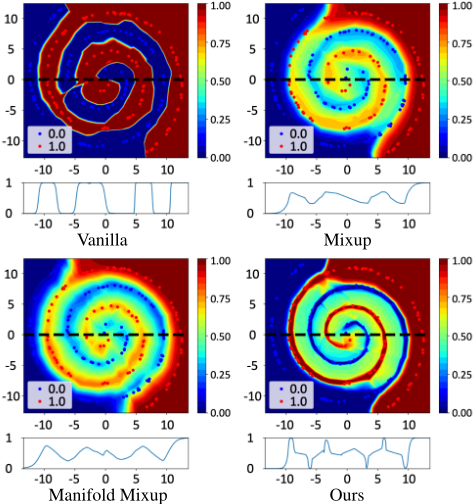
Unlike humans, conventional deep neural networks (DNNs) are poor at understanding class relationships. Since the onehot label induces zero probability for non-target class labels, DNNs learn to de-correlate the relationship between the target class and the other classes [Li and Maki, 2018]. Even worse, when the model overfits to estimate a target class, its prediction tends to be over-confident [Guo et al., 2017], which is particularly vulnerable to high-risk systems, e.g., medical diagnosis and autonomous driving systems.
Inspired by the human reasoning process, we propose a new training strategy using inter-class relationships for holistic recognition. Specifically, we exploit logits for designing an additional learning signal and develop our training strategy in conjunction with mixing-based data augmentation [Verma et al., 2019; Yun et al., 2019; Zhang et al., 2018; Kim et al., 2020]. Given the baseline mixing-based method, we randomly choose two training examples. The data is generated by linearly combining two examples, and the logit is also derived by the same linear combination of two logits (i.e., two logits are the logit of each example). While the existing method imposes the model to map the mixed data to the mixed label, we additionally introduce two supervision and a joint training strategy. In other words, the model should jointly learn to map both 1) from the mixed data to the mixed logit and 2) from the original training samples to the labels.
We name it LogitMix. Specifically, the mixed logit is utilized as weak supervision for considering inter-class relationships (e.g., how likely the wrong classes are the answer). Simultaneously, the original training data is used as the strong supervision for learning class-only information (e.g., relying only on how likely the correct class is the answer). While mixing-based methods also enjoy the effect of learning twoclass relationships, they are limited in two aspects. Firstly, the participation of only two-class relationships can be insufficient to resolve ambiguity in multi-choice problems. Secondly, their mixed labels are the result after activation (i.e., softmax), thereby losing negative relationships and precision. LogitMix can effectively learn inter-class relationships (i.e., logit reveals all-class relationships) with high precision (i.e., logit provides negative and positive values with high dynamic range). Moreover, since LogitMix faithfully learns the original training data, we can extract meaningful logits for weak supervision. Then, logits can supervise the model to learn accurate confidence of training data. As a result, our logit mixing strategy can induce a well-calibrated and highly accurate model, as shown in Figure 1. Here, the vanilla model can predict 0 and 1 accurately, but has sharp decision boundaries, causing a poorly calibrated prediction. While existing studies, such as Mixup or Manifold Mixup, induce smooth boundaries but sacrifice confidence in training data, LogitMix enjoys the benefit from both sides, showing the improved boundaries without losing the prediction accuracy on training samples.
In summary, LogitMix is a powerful training strategy for reflecting both positive and negative inter-class relationships in model training. Based on the extensive experiments on three popular image benchmark datasets, LogitMix outperforms state-of-the-art data mixing training techniques, such as Mixup [Zhang et al., 2018], CutMix [Yun et al., 2019], and PuzzleMix [Kim et al., 2020], in terms of prediction accuracy and calibration error. Also, we adopt LogitMix using the famous pre-trained language model, i.e., BERT [Devlin et al., 2018], to solve eight popular NLP tasks on the GLUE benchmark datasets. The experimental results confirm that LogitMix on BERT can show better prediction accuracy than the existing mixing-based method on BERT.
2 RelatedWork
Mixing-based augmentation. Mixup [Zhang et al., 2018] trains the model using the data generated by the convex combination of two random training samples and their labels. Despite its simplicity, Mixup training achieves robustness toward adversarial examples [Zhang et al., 2018] and improves calibration [Thulasidasan et al., 2019]. Manifold Mixup [Verma et al., 2019] uses two intermediate representations at layer k as examples. To achieve better performance in spatial examples, [Yun et al., 2019] introduce a region-based augmentation strategy. By randomly creating a binary mask, it generates the mixed example by adding the masked image and the inversely masked other images. Unlike CutMix, PuzzleMix [Kim et al., 2020] recently suggests a saliency-aware mixing strategy to mitigate the misguiding examples during training.
Although various mixing-based techniques have been actively studied, their success is mostly limited to computer vision tasks. Most recently, the idea of Mixup has been applied to the pre-trained language model, namely MixupTransformer [Sun et al., 2020], which demonstrates the potential of mixing-based techniques on language-based tasks. Note that our method can utilize any mixing-based approaches as the baselines and further improve their performances by exploiting the mixed logit as the additional weak supervision in both computer vision and natural language processing tasks.
Logit regularization. [Szegedy et al., 2016] propose label smoothing that modifies a one-hot label to a mixture of the one-hot label and uniform distribution by dividing a weight factor. [Pereyra et al., 2017] point out the limitation of label smoothing that allocates the same probability across all classes regardless of their relationships. Then, they propose a confidence regularizer by penalizing low entropy predictions. As a pioneering work, [Hinton et al., 2014] propose knowledge distillation, which gives insight into how logits have useful information on the model and data distribution. Motivated by these observations, we exploit the logit to develop a mixingbased training strategy by preserving inter-class correlations.
Confidence calibration. [Naeini et al., 2015] diagnoses the problem of the confidence calibration of modern networks and proposes the expected calibration error (ECE) as a measurement of calibration. [Guo et al., 2017] addresses that the modern network is poorly calibrated and suggests a simple post-processing calibration method to soften the prediction with temperature scaling. Various Bayesian approaches [MacKay, 1992] are commonly used for estimating the uncertainty of the prediction. Nevertheless, these methods are computationally inefficient as they require some modifications to the training procedure. [Lakshminarayanan et al., 2017] approximate the Bayesian method by using an ensemble of networks. [Seo et al., 2019] propose a well-calibrated prediction scheme without multiple stochastic inferences. This method is related to label smoothing [Szegedy et al., 2016; M¨uller et al., 2019] and confidence penalty [Pereyra et al., 2017] as it makes the network output smooth prediction. [Thulasidasan et al., 2019] have empirically shown that the network trained with Mixup provides better-calibrated results.
3 ProposedModel
3.1 Mixing-Based Augmentation Techniques
Recently, mixing-based data augmentation techniques [Verma et al., 2019; Yun et al., 2019; Zhang et al., 2018] have achieved highly accurate prediction performance. They generate the input data by a linear combination of two randomly selected training datasets. Likewise, the label is generated by the same linear combination of the two corresponding labels. In this way, they effectively improve prediction accuracy and prevent undesirable behaviors such as memorization and sensitivity to adversarial examples at the same time. Furthermore, recent work [Thulasidasan et al., 2019] reports that Mixup training encourages that the output of DNNs, i.e., the estimated label distribution, can serve as a better indicator of the actual likelihood of a correct prediction. The mixing-based training strategies generate an augmented sample as follows:
where (x1, y1) and (x2, y2) denote two random training samples. M ∈ {0, 1}W×H denotes a binary mask indicating where to drop out and fill in from two images, and ⊙ is an element-wise multiplication. Z is a soft mask with a value within [0, 1], when λ = ∑i Zi and Π0 (or Π1) represents the transport matrix. Here, each element Πij encodes the ratio of the transport from location i to j (i.e. i and j for the block index). Beta(·, ·) implies a Beta distribution, and α ∈ (0,∞) is the parameter to control the shape of the Beta distribution. Using the mixed input and the mixed label, the model is trained to minimize the following loss function.
where H is the cross-entropy function. ˜ ymix is the predicted label vector by the model, e.g. ˜ ymix = softmax(f (xmix)), where f denotes the model. That is, f(xmix) indicates logit, the model output for the mixed input xmix before the softmax activation function.
Whereas the original label y is encoded as a one-hot vector, the mixed label ymix allows two non-zero entries in the label distribution. Here, the model learns two-class relationships encoded in the mixed labels, which empirically yield the label smoothing effect. Lately, [Thulasidasan et al., 2019] show that the label smoothing effect is a crucial factor for achieving accurate predictive uncertainty. Mixing-based techniques can also be regarded as a robust data augmentation scheme. [Thulasidasan et al., 2019] also show that data augmentation alone without mixed labels can improve the prediction accuracy.
3.2 LogitMix
To utilize inter-class relationships (i.e., all-class relationships), LogitMix aims to achieve both high prediction accuracy and reliable prediction confidence. Specifically, we devise the mixed data augmentation trick like [Yun et al., 2019; Zhang et al., 2018] to explicitly consider the inter-class relationships. Unlike existing techniques, we additionally suggest two loss terms: 1) the estimated logit for the mixed data should match the target mixed logit, and 2) the estimated label distribution for each sample should match the one-hot label. In the first loss term, we assigned weak supervision for the logit of mixed data as the mixture of two logits. We refer to it as weak supervision as the mixed logit is not oracle supervision. Since the mixed data is generated by any existing mixing-based technique, we use it as the baseline model and thus incorporate Lmix into our final loss function. Formally, the objective of LogitMix is formulated by the sum of three losses:
To derive Lsim, namely the similarity loss, we generate a mixed logit by linearly combining two logits f(x1) and f(x2) for two random samples x1 and x2. Then, the mixed logit should be matched to the logit f(xmix) of the mixed sample xmix. It is motivated by previous studies [Mikolov et al., 2013] that linear interpolation is an effective way of combining factors. Besides, various studies report linear interpolation between the hidden representations results in the meaningful region of embeddings [Verma et al., 2019]. Therefore, we utilize a simple linear mixture of two logits as weak supervision.
Why LogitMix helps? The idea of utilizing logit as a learning signal is used to develop Lsim. This similarity loss enforces the network to map the mixed input to the mixed logit. Then, a natural question can be raised as to why logit should be used, not a probability (i.e., a post-softmax value). Here, we argue that the post-softmax values generally lose the rich information encoding class relationships. This argument can be demonstrated by the following example. Focusing on the N-ary classification task, we denote two mixed inputs as x1mix and x2mix , respectively, and their logits as l1 = [1.5, 0.5, . . .] and l2 = [0.5,-0.5, . . .], respectively. Although the two logit vectors are clearly different, the first two elements of their post-softmax results are the same as [0.73, 0.27, . . .]. When adopting the post-softmax values as our signals, the two different mixed data results in the same class relationships. However, x2mix in its logit exhibits a negative relationship between class 1 and class 2, which is observable from neither x1mix nor the post-softmax of x2mix ; this unusual information can be valuable information to train the model [Heo et al., 2019].
Based on this example analysis, we can easily find the disadvantages of the post-softmax values in learning inter-class relationships. Since the softmax reduces the dynamic range ([+∞,-∞] → [0, 1]) of the class activation significantly, valuable information such as negative correlations and precision can be abandoned. On the other hand, the logit can encode both positive and negative all-class relationships with a high dynamic range. Thanks to this desirable property, Lsim is more effective than Lmix in learning class relationships. Lmix and Lsim also induce different types of learning signals. Therefore, the two-loss terms can be used simultaneously and enjoy performance gains from others.
4 Proof-of-Concept Study
4.1 Toy Example
We conducted a 2D classification task using the two-class spiral dataset [Verma et al., 2019] to reveal the impact of LogitMix. To show the decision boundary and hidden representation of each method, we visualize the predictions in different colors; two-class samples are noted as either red or blue color-coded points. Then, we compare LogitMix with the other mixing augmentation methods. Because it is non-trivial to apply region-based methods such as CutMix and PuzzleMix (a point does not have spatial information), we compared LogitMix with vanilla, Mixup [Zhang et al., 2018], and Manifold Mixup [Verma et al., 2019], as shown in Fig. 1.
Specifically, vanilla training results in irregular boundaries and the predictions for the out-of-distribution samples are overconfident; the predictions for the out-of-distribution samples exhibit as high confidence as in-distribution samples. Also, the sharp transition around the decision boundaries indicates the vulnerability of adversarial attacks [Goodfellow et al., 2015]. In the case of Mixup, we observe a gradual transition in the inter-class area having an intensity of 0.3 to 0.7 around the decision boundaries; however, a part of those observations originates from lower-confidence on training samples. Manifold Mixup has more precise decision boundaries than the two previous cases, especially on the transition. However, overall confidence tends to be lower than others. One possible reason is under-fitting since its complicated training prevents sufficient convergence for the conventional learning procedure [Thulasidasan et al., 2019]. In contrast, LogitMix improves high-confident samples (i.e. high confidence on training samples) and shows the gradual transition over inter-class regions as a supportive clue of a well-calibrated confidence estimation model.
4.2 Combination of Losses
Existing mixing-based techniques only use Lmix; they utilize the original training samples depending on sampling results from Beta(·, ·) but do not learn the original training data simultaneously. Meanwhile, LogitMix utilizes both Lcls and Lsim on top of Lmix. Here, to understand the role of each loss term and its synergy with Lmix, we investigate various combinations of losses and report their classification accuracy with ResNet50 on the CIFAR100 dataset, which consists of 50,000 images with 100 classes. More training details can be found in Section 5.
Table 1 demonstrates the result of various combinations of losses; LogitMixm indicates that Mixup is chosen as our baseline mixing strategy. In this study, we have three important observations. Firstly, our similarity loss (Lsim) always increases the accuracy. Specifically, both the vanilla model and Mixup are improved by adding Lsim. Without Lsim, the accuracy of LogitMix, i.e., Lmix +Lcls, is significantly degraded; the accuracy decreases by -1.51%p.
We also observe that removing Lmix significantly decreases the accuracy (-1.48%p). It is because the logit can be noisy at the early stage of the training without Lmix, therefore, the effect of Lsim can be degraded.
Another interesting observation is that combining Lcls on existing Mixup loss also improves the baseline Mixup. Since Lcls provides more accurate feedback for training data and Lmix serves as a regularization term, their joint training can enjoy the synergy, achieving 0.26%p of gains over the original Mixup. However, we observe that training with Lmix + Lcls is less stable (i.e. high variance) than all other combinations.
Finally, LogitMix utilizes all three losses and records the best accuracy among all combinations, also a low variance. Specifically, LogitMixm achieves 1.77%p of the improvement over Mixup. Mixup shows a 1.5%p gain over the vanilla model; overall, our model is 3.27%p higher than the vanilla model. In this study, we confirm that each component of LogitMix is useful and effective, but combining all components best synergizes the model training.
| Name | Loss | Accuracy(%) |
|---|---|---|
| Vanilla | Lcls | 78.32 ± 0.07 |
| Mixup | Lmix | 79.82 ± 0.08 |
| LogitMixm | Lcls +Lsim +Lmix | 81.59 ± 0.09 |
| (-) Mixup | Lcls + Lsim | 80.11 ± 0.09 |
| (-) Cross entropy | Lmix + Lsim | 80.51 ± 0.08 |
| (-) Similarity loss | Lmix + Lcls | 80.08 ± 0.49 |
5 Experiments
In this section, we evaluate LogitMix compared to competitors in various tasks. We stress that LogitMix can be combined with any mixing-based data augmentation techniques [Verma et al., 2019; Yun et al., 2019; Zhang et al., 2018; Kim et al., 2020] and enjoy their performance gains. We first assess the ability to improve prediction accuracy and confidence calibration. The performance gain in both aspects implies that the trained model better predicts the true posterior distribution; thus it better reveals the inter-class correlations of the data distribution. To show the effectiveness of LogitMix on various tasks, we tackle two problems; image classification and natural language processing (NLP) tasks. Additionally, we examine the robustness of the model trained with LogitMix. This result can quantify how LogitMix is successful in learning the vicinity of boundaries. We also conduct an ablation study by changing α for the empirical understanding of LogitMix.
Model architecture. For image classification tasks, we select five CNN architectures as backbone networks: three of them are conventional CNNs (i.e., VGGNet [Simonyan and Zisserman, 2015], ResNet [He et al., 2016], and ResNeXt [Xie et al., 2017]), and the others are light-weight CNNs (i.e., MobileNetV2 [Sandler et al., 2018] and ShuffleNet [Ma et al., 2018]). For the NLP tasks, we choose two baselines, BERTBASE and BERTLARGE [Devlin et al., 2018] because the Mixup-Transformer [Sun et al., 2020] demonstrated the effectiveness of Mixup on these pre-trained models. Inspired by their success, we use the same backbone models for building and evaluating LogitMix.
Datasets. We validate the effectiveness of LogitMix on three benchmark image datasets and eight natural language datasets. The image datasets include CIFAR100 [Krizhevsky and Hinton, 2009] (32×32 RGB images in 100 classes), TinyImageNet
| Dataset | Network | Metric | Vanilla | Mixup | LogitMixm | CutMix | LogitMixc | PuzzleMix | LogitMixp |
|---|---|---|---|---|---|---|---|---|---|
| CIFAR100 | Acc | 74.30 | 75.02 | 76.22 (+1.20) | 75.34 | 76.10 (+0.76) | 75.92 | 76.38 (+0.46) | |
| VGG16 | ECE | 0.176 | 0.060 | 0.035 (-0.025) | 0.051 | 0.062 (+0.011) | 0.121 | 0.100 (-0.021) | |
| OE | 0.154 | 0.035 | 0.025 (-0.010) | 0.022 | 0.008 (-0.014) | 0.011 | 0.049 (+0.038) | ||
| Acc | 78.32 | 79.82 | 81.59 (+1.77) | 80.57 | 81.02 (+0.45) | 82.57 | 83.76 (+1.19) | ||
| ResNet50 | ECE | 0.087 | 0.040 | 0.014 (-0.026) | 0.078 | 0.073 (-0.005) | 0.092 | 0.215 (+0.123) | |
| OE | 0.073 | 0.028 | 0.003 (-0.025) | 0.064 | 0.060 (-0.004) | 0.015 | 0.000 (-0.015) | ||
| ResNeXt50 | Acc | 79.18 | 81.10 | 81.63 (+0.53) | 81.16 | 81.46 (+0.30) | 81.40 | 82.13 (+0.73) | |
| ECE | 0.069 | 0.042 | 0.021 (-0.021) | 0.059 | 0.032 (-0.027) | 0.092 | 0.220 (+0.128) | ||
| OE | 0.057 | 0.001 | 0.000 (-0.001) | 0.047 | 0.023 (-0.024) | 0.017 | 0.001 (-0.016) | ||
| MobileNetV2 | Acc | 69.69 | 69.98 | 73.90 (+3.92) | 68.82 | 69.91 (+1.09) | 75.77 | 75.99 (+0.22) | |
| ECE | 0.061 | 0.091 | 0.048 (-0.043) | 0.050 | 0.049 (-0.001) | 0.097 | 0.100 (+0.003) | ||
| OE | 0.042 | 0.000 | 0.000 (0.000) | 0.000 | 0.000 (0.000) | 0.022 | 0.009 (-0.013) | ||
| ShuffleNetV2 | Acc | 72.17 | 74.17 | 75.53 (+1.36) | 73.60 | 73.73 (+0.13) | 76.18 | 76.75 (+0.57) | |
| ECE | 0.079 | 0.060 | 0.042 (-0.018) | 0.016 | 0.023 (+0.007) | 0.126 | 0.094 (-0.032) | ||
| OE | 0.060 | 0.000 | 0.000 (-0.000) | 0.002 | 0.000 (-0.002) | 0.014 | 0.001 (-0.013) | ||
| TinyImageNet | Acc | 66.6 | 68.34 | 70.71 (+2.37) | 69.08 | 69.87 (+0.79) | 69.71 | 70.15 (+0.44) | |
| ResNet50 | ECE | 0.098 | 0.032 | 0.030 (-0.002) | 0.029 | 0.034 (+0.005) | 0.121 | 0.131 (+0.010) | |
| OE | 0.076 | 0.022 | 0.010 (-0.012) | 0.015 | 0.005 (-0.010) | 0.012 | 0.012 (0.000) | ||
| Acc | 57.62 | 59.55 | 62.12 (+2.57) | 53.54 | 57.66 (+4.12) | 64.08 | 65.30 (+1.22) | ||
| MobileNetV2 | ECE | 0.073 | 0.091 | 0.032 (-0.059) | 0.094 | 0.082 (-0.012) | 0.112 | 0.104 (-0.008) | |
| OE | 0.045 | 0.019 | 0.000 (-0.019) | 0.000 | 0.000 (0.000) | 0.034 | 0.016 (-0.018) | ||
| ILSVRC2015 | Acc | 76.13 | 77.37 | 78.38 (+1.01) | 78.43 | 78.51 (+0.08) | 75.63 | 77.47 (+1.84) | |
| ResNet50 | ECE | 0.370 | 0.041 | 0.028 (-0.013) | 0.028 | 0.020 (-0.008) | 0.120 | 0.117 (-0.003) | |
| OE | 0.030 | 0.003 | 0.001 (-0.002) | 0.029 | 0.029 (0.000) | 0.053 | 0.056 (+0.003) |
(64×64 RGB images in 100 classes) and ILSVRC2015 [Russakovsky et al., 2015] (256×256 RGB images in 1000 classes). Additionally, the General Language Understanding Evaluation (GLUE) benchmark [Wang et al., 2018].
Implementation details. All CNN networks are trained by SGD optimization with momentum of 0.9. Except for the PuzzleMix [Kim et al., 2020] and LogitMixp, we follow the same training schedule as CutMix [Yun et al., 2019] for CIFAR100, TinyImageNet and ILSVRC datasets. Since light-weight models have a different training practice, we follow the procedure described in their original papers. In the language-based tasks, we use a pre-trained language model, i.e. BERT [Devlin et al., 2018]. As Mixup-Transformer [Sun et al., 2020] finetunes BERT using a Mixup training strategy for downstream tasks, we also follow the same practice using the same hyperparameters as [Sun et al., 2020]. When finetuning BERTBASE (or BERTLARGE), the batch size is 8, the learning rate is 2e - 5, the max sequence length is 128, and the number of the training epochs is 3 for all eight tasks. We use a beta distribution with α = 3.0 for λ. To train the models on all the datasets except for ILSVRC2015, we use a single Titan XP GPU with 12 GB memory. For ILSVRC2015, we utilize four V100 GPU.
Metrics for confidence calibration. For the quantitative analysis of the confidence calibration, we used two popular metrics, the expected calibration error (ECE) [Naeini et al., 2015] and the overconfidence error (OE) [Thulasidasan et al., 2019]. Note that the two measures are calculated on validation datasets. Specifically, the ECE represents an average difference between true confidence and predicted confidence. If it is zero, it means the network is perfectly calibrated. The OE is similar to ECE, but it only measures the confidence difference when it is over-confident. Over-confidence is a critical factor in high-risk systems. Thus, the OE is a good indicator to assess system reliability for high-risk applications.
5.1 Image Classification Tasks
We showed that our method improved classification accuracy (i.e. high confidence on training samples) and helped to learn the gradual transition of the probability between the two classes (i.e., appropriate confidence on samples from offthe-data distribution) with a toy example. In this section, we evaluate the proposed method on image classification tasks for handling more realistic application scenarios.
Table 2 reports the experimental results using various CNN networks and image benchmark datasets. In general, we achieve better accuracy and confidence calibration after combining LogitMix. In particular, our gain in prediction accuracy is substantial where the gap between the baseline and the baseline combined with LogitMix is as large as the gap between the vanilla and the other competitors. Besides, our method enjoys the advantage of the baseline and effectively improves the baseline performances.
When LogitMixp is used to train ResNet50 or ResNeXt50 on CIFAR100, we observe large gains in the prediction accuracy but substantial errors in ECE. Despite the trade-off between the prediction accuracy and the calibration error, LogitMixp achieves nearly 0 in OE, indicating that our training strategy is a safe and reliable solution for practical applications. On ILSVRC2015, LogitMix consistently achieves meaningful gains over the baseline mixing-based methods; finding the best ratio of the three-loss terms (currently, they are equally weighted) would further improve the performance. Without weight tuning, nevertheless, LogitMixc still achieves state-of-the-art performances on ILSVRC2015 evaluations. Considering that achieving the improvement over the state-ofthe-art performances is particularly challenging, our gains on PuzzleMix (CIFAR100 and TinyImageNet) or CutMix (ILSVRC2015) are sufficiently meaningful. As a result, LogitMix surpasses the performance of existing methods in most experimental conditions.
| Model | MNLI-mm | QQP | QNLI | SST-2 | CoLA | STS-B | MRPC | RTE | Average |
|---|---|---|---|---|---|---|---|---|---|
| BERTBASE [Devlin et al., 2018] | 84.73 | 91.25 | 91.43 | 93.12 | 57.82 | 89.43 | 87.75 | 68.95 | 83.06 |
| Mixup on BERTBASE [Sun et al., 2020] | 84.29 | 91.15 | 91.36 | 93.12 | 58.82 | 89.44 | 87.50 | 67.87 | 82.94 |
| LogitMix on BERTBASE | 84.73 | 91.25 | 91.58 | 93.12 | 58.85 | 89.45 | 87.50 | 70.04 | 83.32 |
| (0.00) | (0.00) | (+0.15) | (0.00) | (+0.03) | (+0.01) | (-0.25) | (+1.09) | (+0.26) | |
| BERTLARGE [Devlin et al., 2018] | 85.99 | 90.20 | 92.20 | 92.89 | 60.88 | 89.9 | 87.75 | 73.29 | 84.14 |
| Mixup on BERTLARGE [Sun et al., 2020] | 86.02 | 90.09 | 92.42 | 92.66 | 61.86 | 90.02 | 88.24 | 73.29 | 84.33 |
| LogitMix on BERTLARGE | 86.10 | 90.95 | 92.60 | 93.58 | 63.89 | 89.98 | 89.22 | 74.37 | 85.09 |
| (+0.08) | (+0.75) | (+0.18) | (+0.69) | (+2.03) | (-0.04) | (+0.98) | (+1.08) | (+0.76) |
| VWCI [Seo et al., 2019] | Mixup [Zhang et al., 2018] | LogitMixm (Ours) | |
|---|---|---|---|
| Acc | 73.87 (+0.09) | 75.02 (+0.72) | 76.22 (+1.92) |
| ECE | 0.098 (-0.089) | 0.057 (-0.116) | 0.035 (-0.141) |
One interesting remark can be made via the experiment with a compact model such as MobileNetV2. Generally speaking, Mixup-like approaches act as an augmentation method, which populates training examples to prevent over-fitting. However, if it injects examples far from the training distribution (e.g., missing the salient object in mixed data), such augmentation can induce under-fitting. Under-fitting normally does not degrade the performance of high-capacity networks, but it can hurt the performance of low-capacity networks. When CutMix is used for training MobileNetV2 on TinyImageNet, we observe severe performance degradation. We interpret that their mixed data rather provides misguiding learning signals and thus induces under-fitting. Unlike CutMix, PuzzleMix largely outperforms Mixup and CutMix on MobileNetV2 because PuzzleMix carefully considers the saliency when mixing the data, mitigating the misleading mixed data.
When LogitMix is combined with CutMix, LogitMixc, the effect of under-fitting is substantially reduced, filling the degradation gap introduced by CutMix. From this result, we argue that our method provides a reasonable interpretation for understanding the example far from training distribution. LogitMix helps the model to understand the hidden relationships with weak supervision, and it can create synergy when combined with the existing mixing-based technique. For the same reason, LogitMixp shows clear improvements over PuzzleMix. This observation is coherent with our motivation that the inter-class correlation (i.e. mixed logit) with sufficient class information (i.e. label) helps to improve both the accuracy and the estimate of predictive confidence.
5.2 Natural Language Processing Tasks
Table 3 summarizes the performances of the vanilla model (baseline BERT), Mixup (Mixup-Transformer), and LogitMix under eight different NLP tasks. In this experiment, we only focus on evaluating the prediction performances because not all metrics handle the accuracy (i.e., Matthew's correlation for CoLA and Spearman correlations for STS-B). Besides, CutMix and PuzzleMix are excluded as the competitors because it is non-trivial to create mixing data for text by following their region-based mixing principle.
In this experiment, we observe that Mixup on BERT achieves -0.12 %p and +0.18 %p of average differences over BERTBASE and BERTLARGE, respectively. Adopting LogitMix on the baseline BERT, we mostly achieve performance gains over not only the baseline BERT but also Mixup on BERT. Overall, LogitMix on BERT further promotes the performances of baseline models on eight NLP tasks, approximately 0.26%p and 0.95%p of average gains over BERTBASE and BERTLARGE, respectively, and 0.37%p and 0.76%p of average gains over Mixup on BERTBASE and Mixup on BERTLARGE, respectively.
One interesting remark is that the performance gains of LogitMix on BERTLARGE are more pronounced than those of LogitMix on BERTBASE. This is an encouraging result because improving the complex model is more challenging and truly improves state-of-the-art performances. Since LogitMix provides a useful learning signal, we speculate that the large model could benefit more. These experimental results demonstrate that LogitMix is a powerful training strategy and it can easily be used for various tasks.
5.3 Confidence Calibration
We focus on evaluating our calibration performances. As our method calibrates the prediction with a single inference, we exclude Bayesian approaches [MacKay, 1992] or stochastic approaches with multiple inferences [Lakshminarayanan et al., 2017] for comparisons. Instead, we identify Mixup and variance-weighted confidence-integrated Loss (VWCI) [Seo et al., 2019] as a single inference-based competitor. In order to match the same recipe in the results reported by VWCI, we compare the methods for CIFAR100 using VGG16 (Table 4). The result of VWCI is obtained from the paper, and both the accuracy and ECE with the gains over the baseline model (in parentheses) are summarized because the reported performance from VWCI is slightly different from our results. Compared with the others, LogitMix achieves the highest accuracy and the lowest calibration error; comparing with performance gains, our result is also the best among the three.
| Method | Metric | α = 0.2 | α = 0.4 | α = 0.6 | α = 1.0 | α = 2.0 | α = 3.0 | α = 4.0 |
|---|---|---|---|---|---|---|---|---|
| Mixup | Acc ECE | 79.30 0.020 | 79.32 0.040 | 79.28 0.400 | 79.07 0.056 | 78.15 0.080 | 77.92 0.099 | 76.81 0.120 |
| OE | 0.012 | 0.008 | 0.001 | 0.000 | 0.000 | 0.000 | 0.000 | |
| LogitMixm (-) Lcls | Acc | 80.21 | 79.74 | 79.49 | 79.66 | 79.98 | 79.76 | 80.21 |
| ECE | 0.026 | 0.024 | 0.087 | 0.071 | 0.101 | 0.110 | 0.101 | |
| OE | 0.018 | 0.002 | 0.000 | 0.000 | 0.000 | 0.000 | 0.000 | |
| LogitMixm | Acc | 80.47 | 81.10 | 80.72 | 80.34 | 81.23 | 81.59 | 81.31 |
| ECE | 0.039 | 0.025 | 0.019 | 0.013 | 0.013 | 0.014 | 0.014 | |
| OE | 0.029 | 0.014 | 0.011 | 0.005 | 0.003 | 0.002 | 0.002 |
5.4 Searching for the Loss Weights
We search for the best weight to some extent. Currently, wmix and wcls are set to 1 for reducing the searching cost. Then, the best weight for Lsim is determined as one of {0.1, 0.5, 1.0, 2.0} by testing them on CIFAR100. As a result, we set wsim to 1 for LogitMixm, 0.1 for LogitMixc and 0.5 for LogitMixp to perform the best. Then, the same weights were used regardless of the datasets. The different weights may be caused by different regularization effects per mixing-based augmentation. Although the weights might not be optimal for each dataset, LogitMix consistently improves the baselines.
5.5 The Effect of Alpha
In all mixing-based approaches, the mixing rate is controlled by α. In particular, using a large α value degrades the accuracy largely in Mixup [Thulasidasan et al., 2019; Zhang et al., 2018]. With the large α, the training sample is likely to be mixed in half (e.g., near boundaries), far from the training distribution. Using large α also leads the network to rarely observe the original sample. Then, it raises a natural question: is a large α also bad for LogitMix?
To analyze the effect of the α, the performance of the network (i.e., accuracy and ECE) is investigated by changing α using ResNet50 on CIFAR100 as reported in Table 5. As expected, the accuracy starts to drop with high α in Mixup. Meanwhile, the accuracy generally increases as the α value increases in our method. Here, we discard the effect of Lcls from LogitMix and observe that LogitMix without Lcls shows a similar tendency. This implies that our similarity loss can provide a meaningful interpretation by implicit supervision. LogitMix can successfully handle half-mixing samples (i.e. samples created with a large α value). This phenomenon is coherent with the advantage of LogitMix on the low-capacity network (e.g. MobileNetV2 on TinyImageNet); weak supervision provides a reasonable interpretation for understanding the out-ofdistribution samples, and it is effective to handle under-fitting as well. Nevertheless, extreme α values are also harmful to LogitMix because they prevent the original training samples (i.e. in-distribution samples) from participating in model training. Based on this experimental result, we conclude α = 3 as the default value.
Regarding the confidence calibration, ECE is degraded, and OE decreases as α increases. This means that ECE increases due to being under-confident; the network is overly regularized with out-of-the-distribution samples. This is consistent with the tendency for accuracy. Unlike Mixup, LogitMix generally achieves good calibration results, less sensitive to α.
6 Conclusion
This study is motivated by the human reasoning capability that improves the prediction by better understanding the wrong choices. Based on this analogy, we proposed LogitMix, a novel joint training strategy that utilizes the mixed logit for considering the class relationships and the original training data for class-only information.
Based on extensive evaluations using various network architectures on both image and language classification tasks, empirical analysis, and ablation study, we have demonstrated various useful properties of LogitMix; 1) creating performance synergy with any mixing-based techniques, and thus achieving state-of-the-art performances, 2) applicable to various backbones, datasets, and tasks, 3) improving the decision boundaries without losing the confidence accuracy on training data, and 4) being insensitive to α.
Acknowledgements
This research was partially supported by the Basic Science Research Program through NRF funded by the MSIP (NRF2022R1A2C3011154), IITP grant funded by the Korea government(MSIT) and KEIT grant funded by the Korea government(MOTIE) (No. 2022-0-00680), and Korea Medical Device Development Fund grant funded by the Korea government (Project Number: 202011D06).
@inproceedings{ijcai2022p390,
  title     = {Logit Mixing Training for More Reliable and Accurate Prediction},
  author    = {Bang, Duhyeon and Baek, Kyungjune and Kim, Jiwoo and Jeon, Yunho and Kim, Jin-Hwa and Kim, Jiwon and Lee, Jongwuk and Shim, Hyunjung},
  booktitle = {Proceedings of the Thirty-First International Joint Conference on
               Artificial Intelligence, {IJCAI-22}},
  publisher = {International Joint Conferences on Artificial Intelligence Organization},
  editor    = {Luc De Raedt},
  pages     = {2812--2819},
  year      = {2022},
  month     = {7},
  note      = {Main Track},
  doi       = {10.24963/ijcai.2022/390},
  url       = {https://doi.org/10.24963/ijcai.2022/390},
}
TY - CPAPER TI - Logit Mixing Training for More Reliable and Accurate Prediction AU - Bang, Duhyeon AU - Baek, Kyungjune AU - Kim, Jiwoo AU - Jeon, Yunho AU - Kim, Jin-Hwa AU - Kim, Jiwon AU - Lee, Jongwuk AU - Shim, Hyunjung T2 - Proceedings of the Thirty-First International Joint Conference on Artificial Intelligence, IJCAI-22 PB - International Joint Conferences on Artificial Intelligence Organization PY - 2022 SP - 2812 EP - 2819 DO - 10.24963/ijcai.2022/390 UR - https://doi.org/10.24963/ijcai.2022/390 ER -Copied
Machine-readable versions of this paper, for tools and AI agents:





