
Heterogeneous Ensemble Knowledge Transfer for Training Large Models in Federated Learning
Proceedings of the Thirty-First International Joint Conference on Artificial Intelligence. Main Track. Pages 2881-2887.
https://doi.org/10.24963/ijcai.2022/399
Keywords
- Knowledge Representation and Reasoning: Applications
- Machine Learning: Ensemble Methods
Abstract
Federated learning (FL) enables edge-devices to collaboratively learn a model without disclosing their private data to a central aggregating server. Most existing FL algorithms require models of identical architecture to be deployed across the clients and server, making it infeasible to train large models due to clients' limited system resources. In this work, we propose a novel ensemble knowledge transfer method named Fed-ET in which small models (different in architecture) are trained on clients, and used to train a larger model at the server. Unlike in conventional ensemble learning, in FL the ensemble can be trained on clients' highly heterogeneous data. Cognizant of this property, Fed-ET uses a weighted consensus distillation scheme with diversity regularization that efficiently extracts reliable consensus from the ensemble while improving generalization by exploiting the diversity within the ensemble. We show the generalization bound for the ensemble of weighted models trained on heterogeneous datasets that supports the intuition of Fed-ET. Our experiments on image and language tasks show that Fed-ET significantly outperforms other state-of-the-art FL algorithms with fewer communicated parameters, and is also robust against high data-heterogeneity.
- [Allen-Zhu and Li, 2021] Zeyuan Allen-Zhu and Yuanzhi Li. Towards understanding ensemble, knowledge distil- lation and self-distillation in deep learning. arXiv preprint arXiv:2012.09816, July 2021.
- [Bhargava et al., 2021] Prajjwal Bhargava, Aleksandr Drozd, and Anna Rogers. Generalization in nli: Ways (not) to go beyond simple heuristics. arXiv preprint arXiv:2110.01518, 2021.
- [Bonawitz et al., 2019] Keith Bonawitz, Hubert Eichner, Wolfgang Grieskamp, Dzmitry Huba, Alex Ingerman, Vladimir Ivanov, Chloe Kiddon, Jakub Konecny, Stefano Mazzocchi, H. Brendan McMahan, Timon Van Overveldt, David Petrou, Daniel Ramage, and Jason Roselander. Towards Federated Learning at Scale: System Design. SysML, April 2019.
- [Camacho-Gómez et al., 2021] Carlos Camacho-Gómez, Sancho Salcedo-Sanz, and David Camacho. A Review on Ensemble Methods and their Applications to Optimization Problems, pages 25-45. Springer Singapore, Singapore, 2021.
- [Cheng et al., 2021] Sijie Cheng, Jingwen Wu, Yanghua Xiao, Yang Liu, and Yang Liu. Fedgems: Federated learn- ing of larger server models via selective knowledge fusion. arXiv preprint arXiv:2110.11027, December 2021.
- [Cho et al., 2021] Yae Jee Cho, Jianyu Wang, Tarun Chiru- volu, and Gauri Joshi. Personalized federated learning for heterogeneous clients with clustered knowledge transfer. arXiv preprint arXiv:2109.08119, 2021.
- [He et al., 2016] Kaiming He, Xiangyu Zhang, Shaoqing Ren, and Jian Sun. Deep residual learning for image recog- nition. In Proceedings of the IEEE conference on computer vision and pattern recognition, pages 770-778, 2016.
- [He et al., 2020] Chaoyang He, Murali Annavaram, and Salman Avestimehr. Group knowledge transfer: Federated learning of large cnns at the edge. In Advances in Neural Information Processing Systems, 2020.
- [Hinton et al., 2015] Geoffrey Hinton, Oriol Vinyals, and Jeff Dean. Distilling the knowledge in a neural network. arXiv preprint arXiv:1503.02531, March 2015.
- [Hong et al., 2021] Zhang-Wei Hong, Prabhat Nagarajan, and Guilherme Maeda. Periodic intra-ensemble knowl- edge distillation for reinforcement learning. In Euro- pean Conference on Machine Learning and Principles and Practice of Knowledge Discovery in Databases, 2021.
- [Hsu et al., 2019] Tzu-Ming Harry Hsu, Hang Qi, and Matthew Brown. Measuring the effects of non-identical data distribution for federated visual classification. In International Workshop on Federated Learning for User Privacy and Data Confidentiality in Conjunction with NeurIPS 2019 (FL-NeurIPS'19), December 2019.
- [Itahara et al., 2021] Sohei Itahara, Takayuki Nishio, Yusuke Koda, Masahiro Morikura, and Koji Yamamoto. Distillation-based semi-supervised federated learning for communication-efficient collaborative training with non-iid private data. arXiv preprint arXiv:2008.06180, 2021.
- [Kairouz et al., 2019] Peter Kairouz, H. Brendan McMahan, Brendan Avent, and Aurelien Bellet et. al. Advances and open problems in federated learning. arXiv preprint arXiv:1912.04977, 2019.
- [Karimireddy et al., 2020] Sai Praneeth Karimireddy, Satyen Kale, Mehryar Mohri, Sashank J Reddi, Sebas- tian U Stich, and Ananda Theertha Suresh. SCAFFOLD: Stochastic controlled averaging for on-device federated learning. In Proceedings of the International Conference on Machine Learning (ICML), 2020.
- [Lan et al., 2018] X. Lan, X. Zhu, and S. Gong. Knowledge distillation by on-the-fly native ensemble. In Proceedings of the 32nd International Conference on Neural Informa- tion Processing Systems., pages 7528-7538, 2018.
- [Li et al., 2021] Qinbin Li, Bingsheng He, and Dawn Song. Model-contrastive federated learning. In IEEE Conf. on Computer Vision and Pattern Recognition (CVPR), 2021.
- [Lin et al., 2020] Tao Lin, Lingjing Kong, Sebastian U. Stich, and Martin Jaggi. Ensemble distillation for robust model fusion in federated learning. In Advances in Neural Information Processing Systems, 2020.
- [McMahan et al., 2017] H. Brendan McMahan, Ei- der Moore, Daniel Ramage, Seth Hampson, and Blaise Agøura y Arcas. Communication-Efficient Learning of Deep Networks from Decentralized Data. International Conference on Artificial Intelligenece and Statistics (AISTATS), April 2017.
- [Ozkara et al., 2021] Kaan Ozkara, Navjot Singh, Deepesh Data, and Suhas Diggavi. Quped: Quantized personaliza- tion via distillation with applications to federated learning. In Advances in Neural Information Processing Systems, volume 34, pages 3622-3634, 2021.
- [Park and Kwak, 2020] SeongUk Park and Nojun Kwak. Feature-level ensemble knowledge distillation for aggre- gating knowledge from multiple networks. In European Conference on Artificial Intelligence (ECAI), 2020.
- [Sahu et al., 2020] Anit Kumar Sahu, Tian Li, Maziar San- jabi, Manzil Zaheer, Ameet Talwalkar, and Virginia Smith. Federated optimization for heterogeneous networks. In Proceedings of the 3rd MLSys Conference, January 2020.
- [Simonyan and Zisserman, 2014] Karen Simonyan and An- drew Zisserman. Very deep convolutional networks for large-scale image recognition. CoRR, abs/1409.1556, 2014.
- [Tran et al., 2020] Linh Tran, Bastiaan S. Veeling, and Kevin Roth et. al. Hydra: Preserving ensemble diversity for model distillation. In ICML Workshop on Uncertainty and Robustness in Deep Learning, 2020.
- [Wang et al., 2021] Jianyu Wang, Zachary Charles, Zheng Xu, Gauri Joshi, H Brendan McMahan, Maruan Al- Shedivat, Galen Andrew, Salman Avestimehr, Katharine Daly, Deepesh Data, et al. A field guide to federated opti- mization. arXiv preprint arXiv:2107.06917, 2021.
References were extracted automatically from the PDF and may contain errors.
Full text extracted automatically from the PDF; figures, tables and equations may differ. The PDF is the version of record.
1 Introduction
Moving both data collection and model training to the edge, federated learning (FL) has gained much spotlight since it was introduced [McMahan et al., 2017]. In FL, a number of edge-devices (clients), like cell-phones or IoT devices, collaboratively train machine learning models without explicitly disclosing their local data. Instead of communicating their data, the clients locally train their models, and send model updates periodically to the aggregating server. The two distinctive challenges in FL are that clients can have i) limited system resources, and ii) heterogeneous local datasets [Kairouz et al., 2019; Bonawitz et al., 2019].
∗Work done while at Microsoft Research. Corresponding author email: {yaejeec@andrew.cmu.edu}.
Many recent work in FL [Wang et al., 2021] overlook the clients' resource constraints, using large homogeneous models on the clients and server. In practice, the clients do not have enough bandwidth or computing power to train large state-of-the-art (SOTA) models, and therefore, are restricted to train smaller and computationally lighter models. Moreover, a naive aggregation of the clients' models can hinder the convergence of the model due to high data-heterogeneity across the clients [Sahu et al., 2020; Cho et al., 2021; Ozkara et al., 2021]. Based on these constraints, the global model trained on clients can fail to work well in practice.
A more realistic approach to learn from the resourceconstrained clients in FL is by allowing different models to be deployed across clients depending on their system resources, all while training a larger model for the server. This presents a new challenge where clients return models not only trained on heterogeneous data, but also with different architecture (amongst themselves and the server). Hence, we raise the question: How can we utilize an ensemble of different models trained on heterogeneous datasets to train a larger model at the server? We draw insight from ensemble knowledge transfer [Hinton et al., 2015; Allen-Zhu and Li, 2021] to investigate this problem in our work in the FL context.
Previous studies on ensemble knowledge transfer [Lan et al., 2018; Hong et al., 2021; Tran et al., 2020; Park and Kwak, 2020], propose methods to transfer knowledge from a bag of experts to a target model, where the ensemble models are trained on similar datasets. These datasets are commonly generated from methods data augmentation or simple data shuffling. In FL, however, the models are trained on heterogeneous data distributions, where some models may show higher inference confidence than others, depending on the data sample used for knowledge transfer. Knowing which model is an expert than the others for each data sample is imperative for effective ensemble transfer in FL - especially when there are no hard labels for the data samples.
In this work, we propose a novel ensemble knowledge transfer algorithm for FL named Fed-ET which trains a large model at the server via training small and heterogeneous models at the resource-constrained and data heterogeneous clients. Inspired by the successful usage of knowledge transfer via unlabeled public data [Hinton et al., 2015; Allen-Zhu and Li, 2021], Fed-ET leverages unlabeled data to perform a bi-directional ensemble knowledge transfer between the server and client models. Unlike previous work in FL with knowledge distillation or with sole focus on tackling data-heterogeneity (see Table 1), Fed-ET allows client modelheterogeneity while training a larger model at the server, and can be used for any classification tasks. Moreover, FedET does not impose any overhead to the clients nor assumes that the clients have access to additional data other than its private data. In Fed-ET clients simply perform local training as in standard FL while all the other computations are done by the server. Our main contributions are:
| Method | Client Model Heterogeneity | Public Data | Client Access to Public Data | Server Model Size | Possible Tasks |
|---|---|---|---|---|---|
| FedAvg [McMahan et al., 2017] FedProx [Sahu et al., 2020] SCAFFOLD [Karimireddy et al., 2020] MOON [Li et al., 2021] FedDF [Lin et al., 2020] DS-FL [Itahara et al., 2021] FedGKT [He et al., 2020] FedGEMS [Cheng et al., 2021] Fed-ET (ours) | No No No No Yes Yes Yes Yes Yes | N/A N/A N/A Unlabeled Unlabeled Unlabeled N/A Labeled Unlabeled | N/A N/A N/A Required Not Required Required N/A Required Not Required | = Client Model = Client Model = Client Model = Client Model = Client Model = Client Model > Client Model > Client Model >Client Model | Any Any Any Only Image Any Any Only Image Any Any |
- We propose Fed-ET, the first ensemble transfer algorithm for FL (to the best of our knowledge) using unlabeled data that enables training a large server model with smaller models at the clients, for any classification task.
- We consider the data-heterogeneity in FL by proposing a weighted consensus distillation approach with diversity regularization in Fed-ET that effectively filters out experts, showing the corresponding generalization bounds.
- We show Fed-ET's efficacy with image and language classification tasks where Fed-ET achieves higher test accuracy, with more robustness against data-heterogeneity and fewer communication rounds, than other FL algorithms.
2 Background and RelatedWork
Ensemble Knowledge Transfer. Knowledge transfer from an ensemble of trained models to a target model has been studied in various areas of machine learning. In [Lan et al., 2018], ensemble knowledge distillation for online learning is proposed where the teacher ensembles are trained on-thefly to simultaneously train the teachers along with the target model. In [Hong et al., 2021], ensemble reinforcement learning is investigated where an ensemble of policies share knowledge through distillation. In [Tran et al., 2020], ensembles trained on shuffled data are used to transfer knowledge to a target model, and ways to utilize the diversity across these models to improve knowledge transfer are investigated.
The previous work mentioned above, however, is not directly applicable to FL because i) the local models are trained on heterogeneous data, and ii) FL is an iterative process with only a fraction of clients participating in every communication round. Since the server sends its knowledge back to a new set of clients every round in FL, an ensemble knowledge transfer scheme should have a well defined feedback loop from the target model to the ensemble of models. As such, our proposed Fed-ET induces a data-aware weighted consensus from the ensemble of models, with a feedback loop to transfer the server model's knowledge to the client models.
FL with Knowledge Distillation. Several studies investigated combining FL with knowledge distillation to allow different models across clients, or to improve the server model. In [Itahara et al., 2021], an entropy-reduction aggregation method of the clients' logits is proposed, lowering the variance of the clients' outputs. In [He et al., 2020], FedGKT is proposed specifically for image classification, using knowledge distillation across CNNs with small CNNs at the clients and a larger CNN at the server. In [Li et al., 2021], MOON is also proposed for image tasks, where contrastive loss is used across models of identical architecture from the server and clients to improve the server model. In [Lin et al., 2020], FedDF is proposed to aggregate heterogeneous models through knowledge distillation with unlabeled public data, but it does not take data-heterogeneity into account and the server model is restricted to the clients' models.
The aforementioned work in FL with knowledge distillation are limited to specific scenarios such as when we have labels in the public dataset, target only image tasks, or have low data-heterogeneity across the clients. Our proposed FedET is not limited to these scenarios while still being able to outperform the baselines in Table 1 as shown in our experiments. We use a weighted consensus-based distillation scheme, where clients with higher inference confidence contribute more to the consensus compared to less confident clients. We also take use of a diversity regularization term, where clients that do not follow the consensus can still transfer useful representations to the server model.
3 Federated Ensemble Transfer: Fed-ET
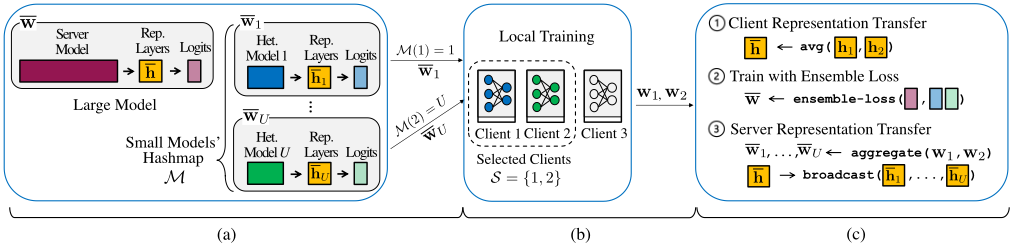
We propose Fed-ET, an ensemble knowledge transfer framework that trains a large server model with small and heterogeneous models trained on clients, using an unlabeled public dataset 1 . Concisely, Fed-ET consists of the three consecutive steps: i) clients' local training and representation transfer, ii)
1 Applicable datasets are accessible by the server through data generators (e.g., GAN), open-sourced repositories, or data markets.
weighted consensus distillation with diversity regularization, and iii) server representation transfer (see Figure 1).
3.1 Preliminaries
We consider a cross-device FL setup with a N-class classification task where K clients are connected to a server. Each client k ∈ [K] has its local training dataset Bk and each data sample ξ is a pair (x, y) with input x ∈ Rd and label y ∈ [1,N]. Each client has its local objective Fk(w) = 1 |Bk | ∑ξ∈Bk f(w, ξ) with f(w, ξ) being the composite loss function. Having a large w with identical architecture across all resource-constrained clients, as done in the standard FL framework, can be infeasible. Moreover, the local minimums w∗ k , k ∈ [1, K] minimizing Fk(w) can be different from each other due to data-heterogeneity. Fed-ET tackles these obstacles by training a large server model with data-aware ensemble transfer from the smaller models trained on clients.
Formally, we consider U small and heterogeneous models at the server with M = {1 : w1, ...,U : wU} where M is the hashmap with the keys 1, ...,U as model ids, the values M[i] = wi ∈ Rni as the models, and ni as the number of parameters for i ∈ [U]. All of the small models in M have a representation layer hi ∈ Ru , i ∈ [U], which includes the classification layer, connected to the end of their different model architectures u ≪ ni, i ∈ [U]. Each client is designated its model to use fromM depending on its resource capability. With slight abuse of notation, we denote the model id chosen by client k as M(k) ∈ [1, U], and the local model for that client k ∈ [K] as wk = wM(k) =M[M(k)] which has its respective representation layer defined as hk.
The server has its large model defined as w ∈ Rn also with its representation layer defined as h ∈ Ru . The large server model is assumed to be much larger than the small server models in M, i.e., n ≫ ni, i ∈ [U]. As shown in the following sections, the representation layers h and hk, k ∈ [K] are shared bidirectionally between clients and server to transfer the representations learned from their respective training. Only the server has access to an unlabeled public dataset denoted as P. The local models wk, k ∈ [K], and large server model w output soft-decisions (logits) over the pre-defined number of classes N, which is a probability vector over the N classes. We refer to the soft-decision of model wk over any input data x in either the private or public dataset as s(wk, x) : RnM(k) × (Bk ∪ P) → ∆N, where ∆N stands for the probability simplex over N.
3.2 Ensemble Transfer with Federated Learning
Step 1: Client Local Training & Representation Trans-
fer. For each communication round t, the server gets the set of m < K clients, denoted as S (t,0) , by selecting them in proportion to their dataset size. The upper-subscript (t, r) denotes for t-th communication round and r-th local iteration. Note that S (t,0) is independent of the local iteration index. For each client k ∈ S (t,0) , the most recent version of its designated model w(t,0) k = w(t,0) M(k) = M[M(k)] is sent from the server to the client. The clients perform local mini-batch stochastic-gradient descent (SGD) steps on their local model w(t,0) k with their private dataset Bk, k ∈ [K]. Accordingly, the clients k ∈ S (t,0) perform τ local updates so that for every communication round their local models are updated as:
where ηt is the learning rate and 1b ∑ξ∈ξ(t,r) k ∇f(w(t,r) k , ξ) is the stochastic gradient over mini-batch ξ (t,r) k of size b randomly sampled from Bk. After the clients k ∈ S (t,0) finish their local updates, the models w(t,τ) k , k ∈ S (t,0) are sent to the server. Each client has different representation layers h(t,τ) k in their respective models w(t,τ) k , k ∈ S (t,0) . The server receives these models from the clients and updates its large model's representation layer with the ensemble models as h(t,0) = 1m ∑k∈S (t,0) h(t,τ) k . This pre-conditions the large server model with the clients' representations for Step 2 where we train the large server model with the ensemble loss.
Step 2: Ensemble Loss by Weighted Consensus with Diversity Regularization. Next, the large server model is trained via a weighted consensus based knowledge distillation scheme from the small models received from the clients. A key characteristic of the ensemble is that each model may be trained on data samples from different data distributions. Hence, some clients can be more confident than others on each of the public data samples. However, all clients may still have useful representations to transfer to the server, even when they are not very confident about that particular data sample. Hence Fed-ET proposes a weighted consensus distillation scheme with diversity regularization, where the large server model is trained on the consensus knowledge from the ensemble of models while regularized by the clients that do not follow the consensus.
Weighted Consensus. First we derive a reliable consensus over the ensemble of models by evaluating the variance within the logit vectors s(w(t,τ) k , x), x ∈ P for each client k ∈ S (t,0) . We denote this variance as σ2 s (w(t,τ ) k , x) ..= Var(s(w(t,τ ) k , x)), which is the variance taken over the N total probability values for the N-multi-class classification task. Higher σ2 s (w(t,τ ) k , x) indicates a more confident client k about how well it models data sample x, and viceversa [Camacho-G´omez et al., 2021]. Hence, we weigh the logits from the clients with high σ2 s (w(t,τ ) k , x) more heavily compared to low-variance logit clients. Formally, we set a confidence based weighted average over the logits for each data sample x ∈ P denoted as:
where the weights are defined as:
The resulting weighted consensus logit s(t,τ) (x) efficiently derives the consensus out of the ensemble of models trained
<
l
a
t
e
x
i
s
h
1
_
b
6
4
=
"
K
o
7
T
r
Z
c
A
O
n
D
8
P
j
v
W
2
R
I
w
>
B
/
V
L
S
N
F
p
f
X
H
k
0
3
Y
Q
q
m
g
y
U
u
M
5
9
G
z
J
d
+
E
C
<
l
a
t
e
x
i
s
h
1
_
b
6
4
=
"
A
U
F
r
B
Y
u
E
H
q
X
w
C
Q
N
z
>
c
V
D
L
S
J
3
2
v
K
d
k
G
p
W
+
o
M
0
y
P
Z
7
8
T
j
f
O
9
R
I
m
/
5
g
n
<
l
a
t
e
x
i
s
h
1
_
b
6
4
=
"
3
o
K
0
c
v
n
M
p
J
N
m
8
+
9
E
X
A
I
>
B
V
S
U
r
q
/
g
T
W
L
F
Q
Z
2
5
w
H
R
f
j
P
D
z
7
u
C
G
y
O
Y
k
d
<
l
a
t
e
x
i
s
h
1
_
b
6
4
=
"
C
R
G
K
2
X
T
y
N
E
I
g
9
f
A
o
>
H
c
V
7
M
w
F
q
5
B
J
Y
S
j
Q
k
D
L
Z
3
W
m
O
z
8
U
n
v
0
+
d
/
P
p
u
r
<
l
a
t
e
x
i
s
h
1
_
b
6
4
=
"
H
D
E
A
R
B
v
G
w
q
u
+
S
3
>
C
c
V
9
T
M
K
X
y
/
Q
Y
F
o
J
p
N
d
r
2
Z
g
7
j
8
0
n
k
O
5
L
m
P
I
z
f
U
W
<
l
a
t
e
x
i
s
h
1
_
b
6
4
=
"
T
F
v
7
q
P
M
p
m
A
+
n
C
>
H
c
V
B
S
8
w
E
3
9
O
/
g
X
o
J
D
K
j
L
N
0
Q
k
U
r
d
W
y
u
Z
2
f
G
z
I
R
Y
5
<
l
a
t
e
x
i
s
h
1
_
b
6
4
=
"
X
g
E
M
A
H
5
J
C
Y
/
y
U
n
N
F
B
T
O
3
8
>
c
V
D
L
S
W
r
K
m
u
p
R
Z
d
k
j
I
2
7
9
f
+
0
v
Q
P
w
q
z
o
G
<
l
a
t
e
x
i
s
h
1
_
b
6
4
=
"
T
m
B
G
q
S
8
X
Y
K
M
W
F
Z
0
L
r
d
w
>
A
+
c
V
D
N
2
p
f
U
u
o
Q
y
g
E
3
7
k
/
I
R
z
J
O
P
H
C
j
n
v
9
5
<
l
a
t
e
x
i
s
h
1
_
b
6
4
=
"
q
r
5
g
W
f
S
8
z
Z
w
C
B
k
+
G
/
F
d
>
A
X
c
V
N
H
y
p
7
R
T
v
n
o
M
2
D
3
L
J
u
0
j
I
Y
U
Q
P
K
E
O
m
9
<
l
a
t
e
x
i
s
h
1
_
b
6
4
=
"
C
R
G
K
2
X
T
y
N
E
I
g
9
f
A
o
>
H
c
V
7
M
w
F
q
5
B
J
Y
S
j
Q
k
D
L
Z
3
W
m
O
z
8
U
n
v
0
+
d
/
P
p
u
r
<
l
a
t
e
x
i
s
h
1
_
b
6
4
=
"
H
D
E
A
R
B
v
G
w
q
u
+
S
3
>
C
c
V
9
T
M
K
X
y
/
Q
Y
F
o
J
p
N
d
r
2
Z
g
7
j
8
0
n
k
O
5
L
m
P
I
z
f
U
W
<
l
a
t
e
x
i
s
h
1
_
b
6
4
=
"
o
D
m
c
q
g
F
/
S
n
d
3
J
9
>
A
B
H
V
L
N
2
p
r
f
0
7
I
v
Q
k
R
T
u
K
M
G
Z
C
P
X
y
U
+
W
z
j
E
8
O
Y
w
5
<
l
a
t
e
x
i
s
h
1
_
b
6
4
=
"
c
H
f
0
j
p
d
X
R
/
T
7
u
W
M
U
E
Y
I
>
A
B
8
3
V
D
L
S
g
F
2
r
Z
k
w
q
o
G
5
Q
m
K
9
+
n
N
z
J
y
O
P
C
v
<
l
a
t
e
x
i
s
h
1
_
b
6
4
=
"
K
E
n
D
W
/
k
8
U
2
j
5
f
c
H
z
T
F
g
0
>
A
B
3
V
L
S
M
p
r
Z
d
u
w
q
o
G
7
Q
m
Y
9
+
X
N
J
y
O
R
P
C
v
I
<
l
a
t
e
x
i
s
h
1
_
b
6
4
=
"
K
o
7
T
r
Z
c
A
O
n
D
8
P
j
v
W
2
R
I
w
>
B
/
V
L
S
N
F
p
f
X
H
k
0
3
Y
Q
q
m
g
y
U
u
M
5
9
G
z
J
d
+
E
C
<
l
a
t
e
x
i
s
h
1
_
b
6
4
=
"
C
R
G
K
2
X
T
y
N
E
I
g
9
f
A
o
>
H
c
V
7
M
w
F
q
5
B
J
Y
S
j
Q
k
D
L
Z
3
W
m
O
z
8
U
n
v
0
+
d
/
P
p
u
r
<
l
a
t
e
x
i
s
h
1
_
b
6
4
=
"
A
U
F
r
B
Y
u
E
H
q
X
w
C
Q
N
z
>
c
V
D
L
S
J
3
2
v
K
d
k
G
p
W
+
o
M
0
y
P
Z
7
8
T
j
f
O
9
R
I
m
/
5
g
n
<
l
a
t
e
x
i
s
h
1
_
b
6
4
=
"
A
U
F
r
B
Y
u
E
H
q
X
w
C
Q
N
z
>
c
V
D
L
S
J
3
2
v
K
d
k
G
p
W
+
o
M
0
y
P
Z
7
8
T
j
f
O
9
R
I
m
/
5
g
n
<
l
a
t
e
x
i
s
h
1
_
b
6
4
=
"
H
D
E
A
R
B
v
G
w
q
u
+
S
3
>
C
c
V
9
T
M
K
X
y
/
Q
Y
F
o
J
p
N
d
r
2
Z
g
7
j
8
0
n
k
O
5
L
m
P
I
z
f
U
W
<
l
a
t
e
x
i
s
h
1
_
b
6
4
=
"
0
8
G
J
y
c
C
D
U
I
Y
B
d
O
v
5
9
R
N
o
F
g
>
A
3
V
L
S
W
u
r
Q
K
n
P
q
p
Z
T
E
M
k
z
j
/
w
7
m
2
H
+
X
f
<
l
a
t
e
x
i
s
h
1
_
b
6
4
=
"
7
B
d
D
T
w
5
V
j
A
C
F
O
c
g
R
U
Q
I
>
8
3
L
S
N
W
u
r
Y
K
y
n
P
q
p
Z
E
M
k
z
G
/
o
J
m
2
H
v
9
+
X
0
f
<
l
a
t
e
x
i
s
h
1
_
b
6
4
=
"
X
g
E
M
A
H
5
J
C
Y
/
y
U
n
N
F
B
T
O
3
8
>
c
V
D
L
S
W
r
K
m
u
p
R
Z
d
k
j
I
2
7
9
f
+
0
v
Q
P
w
q
z
o
G
<
l
a
t
e
x
i
s
h
1
_
b
6
4
=
"
c
H
f
0
j
p
d
X
R
/
T
7
u
W
M
U
E
Y
I
>
A
B
8
3
V
D
L
S
g
F
2
r
Z
k
w
q
o
G
5
Q
m
K
9
+
n
N
z
J
y
O
P
C
v
<
l
a
t
e
x
i
s
h
1
_
b
6
4
=
"
T
F
v
7
q
P
M
p
m
A
+
n
C
>
H
c
V
B
S
8
w
E
3
9
O
/
g
X
o
J
D
K
j
L
N
0
Q
k
U
r
d
W
y
u
Z
2
f
G
z
I
R
Y
5
<
l
a
t
e
x
i
s
h
1
_
b
6
4
=
"
K
E
n
D
W
/
k
8
U
2
j
5
f
c
H
z
T
F
g
0
>
A
B
3
V
L
S
M
p
r
Z
d
u
w
q
o
G
7
Q
m
Y
9
+
X
N
J
y
O
R
P
C
v
I
on heterogeneous datasets due to filtering out the following two main adversaries: i) the non-experts with low intravariance within each logit, and ii) overly-confident but erroneous outliers by utilizing the power of ensemble where multiple experts contribute to the consensus.
For each data sample x we get the most probable label from s(t,τ) (x) as:
The pair (x, y(t,τ) s (x)), x ∈ P is the consensus-derived data sample from the unlabeled public dataset P, which is then used to train the server model with the cross-entropy loss l((x, y(t,τ) s (x)),w(t,0) ). The cross-entropy loss term used in the final ensemble loss for training the server model is:
Diversity Regularization. While the confidence based weighted consensus can derive a more reliable consensus from the ensemble, the diversity across the participating models is less represented. Meaningful representation information of what clients learned from their private data should be included, even when certain clients have low-confidence and may have different logits from the consensus. Encouraging diversity across models can improve the generalization performance of ensemble learning [Tran et al., 2020; Park and Kwak, 2020]. Hence, we gather the logits from the clients that do not coincide with the consensus, formally,
S (t,0)
div (x) = {l : y(t,τ)
s (x) ̸= argmax
label∈[0,N-1]s(w(t,τ )
and formulate a regularization term:
l
, x)
∩ l ∈ S (t,0) } (6)
where the weights are
Accordingly, the diversity regularization term for the final ensemble loss is where KL(·, ·) is the KL-divergence loss between two logits:
Final Ensemble Loss. Finally, combining the weighted consensus based cross-entropy loss in (5) with the diversity regularization in (9), the server model is updated, in every communication round t, by minimizing the following objective function:
To minimize the ensemble loss in (10), instead of going through the entire dataset P, the server model takes τs minibatch SGD 2 steps by sampling a mini-batch ξ (t,r′ ) P , r′ ∈ [0, τs - 1] of bs data samples from P uniformly at random without replacement. Then, for every communication round t the server performs:
Note that neither the weighted ensemble term nor the diversity regularization term dominates the ensemble loss in (10) with a reasonable λ (see Table 4) and further because each term comes from a different set of clients. The former term is from the majority of the clients following the consensus, while the latter term is from the other clients that do not coincide with that consensus. Due to data-heterogeneity, these two different sets of clients likely change every round making it difficult for a single term to dominate the ensemble loss during training.
2 Herein, SGD is depicted without loss of generality for other optimization algorithms.
Algorithm 1 Federated Ensemble Transfer: Fed-ET
- 1: Initialize: Hashmap of Heterogeneous Models: M = {1 : w(0,0) 1 , ...,U : w(0,0) U }; Designated Model Ids for each client k ∈ [K]: M(k) ∈ [1,U]; Selected set of m < K clients: S (0,0)
- 2: Output: w(T,0)
- 3: For t = 0, ..., T - 1 communication rounds do:
- 5: Receive w(t,0) k =w(t,0) M(k) =M[M(k)] from server
- 4: Clients k ∈ S (t,0) in parallel do:
- 6: Update w(t,τ) k with (1) and send it to server
- 7: Server do:
- 8: Receive all updated local model w(t,τ) k , k ∈ S (t,0) .
- 9: Transfer client representation h(t,0) = 1m ∑S (t,0)h(t,τ) k
- 10: Update w(t,τs) with (11) and updateMwith (12)
- 12: Get S (t+1,0) by sampling in proportion to dataset sizes
- 11: Transfer server representation h(t,τs) models inM
Step 3: Server's RepresentationTransfer. Finally, we update the server's small models in M by aggregating the received clients' models with identical architecture by simple averaging. Concretely, with S (t,0) i ..= {k : k ∈ S (t,0) ∩ M(k) = i}, i ∈ [U], we updateMas
After this update, the updated h(t,τs) from the server model w(t,τs) is transferred to all the models inM.
The algorithmof Fed-ET. In the preceding paragraphs, we have shown three essential components of Fed-ET for federated ensemble transfer with heterogeneous models trained on heterogeneous data distributions. The complete algorithm of Fed-ET can be obtained by using these components in tandem as described in Algorithm 1. Note that FedET is easily extendable to allow clients to define their own model architectures depending on their computing resources.
3.3 Generalization Bound for Ensemble Transfer
In Fed-ET, an ensemble of small models trained on heterogeneous data distributions is used to train a large server model for its target test data distribution. We show the generalization properties of a weighted ensemble of models trained on heterogeneous datasets in respect to the server's target distribution, supporting the weighted consensus distillation process of Fed-ET. We consider hypotheses h : X → Y, with input space x ∈ X, label space y ∈ Y, and hypotheses space H. The loss function l(h(x), y) measures the classification performance of h for a single data point (x, y). We define the expected loss over all data points for an arbitrary data distribution D′ as LD′ (h) = E(x,y)∼D′ [l(h(x), y)] for h ∈ H and assume that L(h) is convex with range [0, 1]. We now present the generalization bound for the server's target distribution with respect to an ensemble of weighted models trained on heterogeneous datasets below in Theorem 1.
Theorem 1. With K clients and a server for FL, we have D as the server's target test data distribution, and Dk, ̂Dk as the true and empirical data distribution, respectively, for client k ∈ [K]. We define hk = argminh LDk (h) and ̂hk = argminL̂Dk (h). Then, we have for the weighted ensemble of models ∑Ki=1 αiĥDi for K clients with arbitrary weights αi, i ∈ [K], ∑Ki=1 αi = 1, with probability at least 1 - δ over the choice of samples, the bound:
where νi = infh LDi (h)+LD(h) and d(Di, D) measures the distribution discrepancy between two distributions.
In Theorem 1, the first, second, and third terms in the upper bound show that the generalization performance of the ensemble transfer worsens by the following qualities of each clients: i) bad local model quality on its own training data, ii) small training dataset size, and iii) large discrepancy between its data distribution Di, i ∈ [K] and server's target data distribution D. Fed-ET aims in giving lower weights to the clients that demonstrate i) and iii) by weighted consensus distillation where the confidence levels and multiple inferences of the clients contribute to the consensus, so that erroneous outliers can be filtered out. The effect of ii) is also considered in Fed-ET by sampling clients in proportion to their dataset sizes.
4 Experiments
For all experiments, partial client participation is considered where 10 clients are sampled from the 100 clients for image tasks and the 106 clients for the language task.
Datasets. For image datasets, the training dataset is partitioned data heterogeneously amongst a total of 100 clients using the Dirichlet distribution DirK(α) [Hsu et al., 2019]. The public dataset is generated by applying a different data transformation to the data samples (non-overlapping with either the training or test dataset) to further differentiate it with the training dataset. For the language task, we use sentiment classification with Sent140 (Twitter) dataset. For the training dataset, users with more than 100 data samples are treated as the FL clients, leading to a total of 106 clients. For all datasets, non-overlapping users' data samples are used.
Models. For image tasks, we set a CNN, ResNet8, and ResNet18 [He et al., 2016] for the small server models, and a VGG19 [Simonyan and Zisserman, 2014] for the large server model. For language tasks, a Tiny-BERT [Bhargava et al., 2021] and a LSTM classifier are set for the small server models, and a Mini-BERT [Bhargava et al., 2021] is set for the large server model. For the representation layers we use a small MLP with dimension 128 which is a small increase in the model size. The small server models inMare designated (prior to training) to the clients uniformly at random.
| α = 0.1 (Higher Data-Het.) | α = 0.5 (Lower Data-Het.) | N/A | ||||||||
|---|---|---|---|---|---|---|---|---|---|---|
| Method | CIFAR10 | CIFAR100 | CIFAR10 | CIFAR100 | Sent140 | |||||
| FedAvg | 71.19 | (±0.27) | 30.21 | (±0.32) | 74.82 | (±0.23) | 33.12 | (±0.13) | 71.51 | (±0.45) |
| Model FedProx | 72.45 | (±0.13) | 31.51 | (±0.11) | 75.24 | (±0.19) | 33.63 | (±0.08) | 71.32 | (±0.31) |
| Homogeneous Scaffold | 75.12 | (±0.20) | 30.61 | (±0.57) | 78.69 | (±0.15) | 34.91 | (±0.61) | 73.28 | (±0.35) |
| MOON | 75.68 | (±0.51) | 33.72 | (±0.89) | 81.17 | (±0.41) | 42.15 | (±0.72) | N/A | |
| Model FedDF | 73.81 | (±0.42) | 31.87 | (±0.46) | 76.55 | (±0.32) | 37.87 | (±0.31) | 72.19 | (±0.43) |
| Heterogeneous DS-FL | 65.27 | (±0.53) | 29.12 | (±0.51) | 68.44 | (±0.47) | 33.56 | (±0.55) | 63.12 | (±0.71) |
| Fed-ET (ours) | 78.66 | 35.78 | 81.13 | 41.58 | 75.78 | |||||
Fed-ET (ours) 78.66 (±0.31) 35.78 (±0.45) 81.13 (±0.28) 41.58 (±0.36) 75.78 (±0.39)
| CIFAR10 | CIFAR100 | Sent140 | |
|---|---|---|---|
| Method | Cacc(70%) | Cacc(30%) | Cacc(70%) |
| FedAvg | 72×109 | 87×109 | 25×109 |
| FedProx | 70×109 | 86×109 | 22×109 |
| Scaffold | 68×109 | 79×109 | 19×109 |
| MOON | 75×109 | 90×109 | N/A |
| Fed-ET (ours) |
Fed-ET (ours) 26×109 31×109 9×10⁹
Table 3: Communication cost to achieve the target test accuracy x (Cacc(x)) for α = 0.1.
Baselines. We consider two types of baselines: i) model homogeneous (FedAvg, FedProx, Scaffold, MOON) and ii) model heterogeneous (FedDF, DS-FL). FedGKT assumes full client participation, thus a direct comparison with Fed-ET is not possible. For model homogeneous, we use the large server model for evaluation. For model heterogeneous we use the small server models for the client models and the large server model for the server model (if a separate server model is required).
Effectiveness of Fed-ET. In Table 2, we show the best achieved test accuracy of Fed-ET and the baselines for different degrees of data-heterogeneity. Fed-ET achieves higher test accuracy for CIFAR10 with high data-heterogeneity (α = 0.1) and Sent140 compared to both the model homogeneous and model heterogeneous baselines. Specifically, for α = 0.1, MOON achieves 75% and 33% for CIFAR10 and CIFAR100 respectively at the cost of communicating directly the large VGG19 while Fed-ET achieves higher accuracy of 78% and 35% respectively while using smaller models than VGG19 for the clients. For lower data-heterogeneity (α = 0.5), MOON slightly out-performs Fed-ET by around 1% but at the cost of training larger models at the clients.
Communication Efficiency. The communication efficiency of Fed-ET is shown in Table 3. We compare the communication cost Cacc(x), the total number of model parameters communicated between the server and clients during training to achieve test accuracy x. The baselines in Table 3 require model-homogeneity, and hence communicate the large server model, while Fed-ET communicates the smaller models in M for each round. Fed-ET is able to achieve the target test accuracy with approximately 3× less Sent140 72.11 (±0.28) 74.37 (±0.42) 75.78 (±0.39)
| Diversity Parameter (λ) | |||
|---|---|---|---|
| Datasets | 0 | 0.05 | 0.5 |
| CIFAR10 | 76.55 (±0.25) | 78.66 (±0.31) | 75.29 (±0.31) |
| CIFAR100 | 31.71 (±0.43) | 35.78 (±0.45) | 30.18 (±0.55) |
| Sent140 | 72.11 | 74.37 | 75.78 |
Table 4: Effect of diversity regularization in Fed-ET on test accuracy with different values of λ for α = 0.1.
number of communicated parameters compared to those of the baselines. Fed-ET enables efficient training with smaller models at the clients, while achieving comparable performance to when large models are used at the clients.
Effect of the Diversity Parameter λ. In Table 4, we show the performance of Fed-ET with different values of λ, which modulates the diversity regularization term in (10). With λ = 0, Fed-ET only uses the weighted consensus to train the large server model without leveraging the diversity across the clients' models. A larger λ indicates larger regularization loss to include more diversity across the clients' models. For image tasks the best performance is achieved with λ = 0.05, indicating that diversity indeed helps in improving generalization of the server model when moderately applied to the training. For the language task, a larger λ = 0.5 achieves the best performance, demonstrating that depending on the task, more inclusion of the diversity across the models in the ensemble can increase the generalization performance.
5 Conclusion
Motivated by the rigid constraint of deploying identical model architectures across the clients/server in many FL algorithms, we propose Fed-ET, an ensemble knowledge transfer framework to train large server models with smaller models trained on clients. Without additional overhead at the clients, Fed-ET transfers knowledge to the target model with a dataaware weighted consensus distillation from an ensemble of models trained on heterogeneous data. Fed-ET achieves high test accuracy with significantly lower communication overhead and robustness against data-heterogeneity. Relevant future steps are evaluating different deploying strategies of heterogeneous models to the clients and extending Fed-ET to a general ensemble knowledge transfer framework.
@inproceedings{ijcai2022p399,
  title     = {Heterogeneous Ensemble Knowledge Transfer for Training Large Models in Federated Learning},
  author    = {Cho, Yae Jee and Manoel, Andre and Joshi, Gauri and Sim, Robert and Dimitriadis, Dimitrios},
  booktitle = {Proceedings of the Thirty-First International Joint Conference on
               Artificial Intelligence, {IJCAI-22}},
  publisher = {International Joint Conferences on Artificial Intelligence Organization},
  editor    = {Luc De Raedt},
  pages     = {2881--2887},
  year      = {2022},
  month     = {7},
  note      = {Main Track},
  doi       = {10.24963/ijcai.2022/399},
  url       = {https://doi.org/10.24963/ijcai.2022/399},
}
TY - CPAPER TI - Heterogeneous Ensemble Knowledge Transfer for Training Large Models in Federated Learning AU - Cho, Yae Jee AU - Manoel, Andre AU - Joshi, Gauri AU - Sim, Robert AU - Dimitriadis, Dimitrios T2 - Proceedings of the Thirty-First International Joint Conference on Artificial Intelligence, IJCAI-22 PB - International Joint Conferences on Artificial Intelligence Organization PY - 2022 SP - 2881 EP - 2887 DO - 10.24963/ijcai.2022/399 UR - https://doi.org/10.24963/ijcai.2022/399 ER -Copied
Machine-readable versions of this paper, for tools and AI agents:





