
Reinforcement Learning with Option Machines
Proceedings of the Thirty-First International Joint Conference on Artificial Intelligence. Main Track. Pages 2909-2915.
https://doi.org/10.24963/ijcai.2022/403
Keywords
- Machine Learning: Reinforcement Learning
- Planning and Scheduling: Planning with Incomplete Information
- Machine Learning: Deep Reinforcement Learning
Abstract
Reinforcement learning (RL) is a powerful framework for learning complex behaviors, but lacks adoption in many settings due to sample size requirements. We introduce a framework for increasing sample efficiency of RL algorithms. Our approach focuses on optimizing environment rewards with high-level instructions. These are modeled as a high-level controller over temporally extended actions known as options. These options can be looped, interleaved and partially ordered with a rich language for high-level instructions. Crucially, the instructions may be underspecified in the sense that following them does not guarantee high reward in the environment. We present an algorithm for control with these so-called option machines (OMs), discuss option selection for the partially ordered case and describe an algorithm for learning with OMs. We compare our approach in zero-shot, single- and multi-task settings in an environment with fully specified and underspecified instructions. We find that OMs perform significantly better than or comparable to the state-of-art in all environments and learning settings.
- [Andreas et al., 2017] J. Andreas, D. Klein, and S. Levine. Modular multitask reinforcement learning with policy sketches. In ICML, pages 166-175. PMLR, 2017.
- [Bengio et al., 2009] Y. Bengio, J. Louradour, R. Collobert, and J. Weston. Curriculum learning. In ICML, volume 26, pages 41-48, 2009.
- [Brafman et al., 2018] R. Brafman, G. De Giacomo, and F. Patrizi. Ltlf/ldlf non-markovian rewards. In AAAI, vol- ume 32. AAAI, 2018.
- [Camacho et al., 2019] A. Camacho, R. Icarte, T. Klassen, R. Valenzano, and S. McIlraith. Ltl and beyond: Formal languages for reward function specification in reinforce- ment learning. In IJCAI, pages 6065-6073, 2019. IJCAI
- [den Hengst et al., 2020] F. den Hengst, E.M. Grua, A. El Hassouni, and M. Hoogendoorn. Reinforcement learning for personalization: A systematic literature review. Data Science, 3(2):107-147, 2020.
- [den Hengst et al., 2022] F. den Hengst, V. Franc ¸ois-Lavet, M. Hoogendoorn, and F. van Harmelen. Planning for po- tential: efficient safe reinforcement learning. Machine Learning, pages 1-20, 2022.
- [Dietterich, 2000] T.G. Dietterich. Hierarchical reinforce- ment learning with the maxq value function decomposi- tion. JAIR, 13:227-303, 2000.
- [Dulac-Arnold et al., 2019] G. Dulac-Arnold, D. Mankowitz, and T. Hester. Challenges of real-world reinforcement learning. arXiv:1904.12901, 2019.
- [Fu and Topcu, 2014] J. Fu and U. Topcu. Probably approx- imately correct mdp learning and control with temporal logic constraints. In Robotics: Science and Systems, num- ber 10, 2014.
- [Grounds and Kudenko, 2005] M. Grounds and D. Kudenko. Combining reinforcement learning with symbolic plan- ning. In AAMAS, pages 75-86. Springer, 2005.
- [Grzes and Kudenko, 2008] M. Grzes and D. Kudenko. Plan-based reward shaping for reinforcement learning. In IntelliSys, volume 2, pages 10-22. IEEE, 2008.
- [Illanes et al., 2020] L. Illanes, X. Yan, R. Icarte, and S. McIlraith. Symbolic plans as high-level instructions for reinforcement learning. In ICAPS, volume 30, pages 540- 550, 2020.
- [Konda and Tsitsiklis, 2000] V. Konda and J. Tsitsiklis. Actor-critic algorithms. In NIPS, pages 1008-1014, 2000.
- [Leonetti et al., 2012] M. Leonetti, L. Iocchi, and F. Pa- trizi. Automatic generation and learning of finite-state controllers. In AIMSA, pages 135-144. Springer, 2012.
- [Leonetti et al., 2016] M. Leonetti, L. Iocchi, and P. Stone. A synthesis of automated planning and reinforcement learn- ing for efficient, robust decision-making. Artificial Intelli- gence, 241:103-130, 2016.
- [Li et al., 2017] X. Li, C. Vasile, and C. Belta. Reinforce- ment learning with temporal logic rewards. In IROS, pages 3834-3839. IEEE/RSJ, 2017.
- [Lyu et al., 2019] D. Lyu, F. Yang, B. Liu, and S. Gustafson. Sdrl: interpretable and data-efficient deep reinforcement learning leveraging symbolic planning. In AAAI, vol- ume 33, pages 2970-2977, 2019.
- [Mealy, 1955] G.H. Mealy. A method for synthesizing se- quential circuits. The Bell System Technical Journal, 34(5):1045-1079, 1955.
- [Michaud and Colange, 2018] T. Michaud and M. Colange. Reactive synthesis from ltl specification with spot. In 7th Workshop on Synthesis, SYNT@ CAV, 2018.
- [Ng et al., 1999] A.Y. Ng, D. Harada, and S. Russell. Pol- icy invariance under reward transformations: Theory and application to reward shaping. In ICML, pages 278-287, 1999.
- [Parr and Russell, 1998] R. Parr and S. Russell. Reinforce- ment learning with rhierarchies of machines. NIPS, pages 1043-1049, 1998.
- [Ryan, 2002] M. Ryan. Using abstract models of behaviours to automatically generate reinforcement learning hierar- chies. In ICML, volume 2, pages 522-529, 2002.
- [Sadigh et al., 2014] D. Sadigh, E.S. Kim, S. Coogan, S.S. Sastry, and S. Seshia. A learning based approach to control synthesis of markov decision processes for linear tempo- ral logic specifications. In CDC, pages 1091-1096. IEEE, 2014.
- [Singh, 1992] S. Singh. Transfer of learning by composing solutions of elemental sequential tasks. Machine Learning, 8(3):323-339, 1992.
- [Sutton and Barto, 2018] R.S. Sutton and A. Barto. Rein- forcement learning: An introduction. MIT press, 2018.
- [Sutton et al., 1999] R.S. Sutton, D. Precup, and S. Singh. Between mdps and semi-mdps: A framework for tempo- ral abstraction in reinforcement learning. Artificial Intelli- gence, 112(1-2):181-211, 1999.
- [Toro Icarte et al., 2018a] R. Toro Icarte, T. Klassen, R. Valenzano, and S. McIlraith. Teaching multiple tasks to an rl agent using ltl. In AAMAS, pages 452-461, 2018.
- [Toro Icarte et al., 2018b] R. Toro Icarte, T. Klassen, R. Valenzano, and S. McIlraith. Using reward machines for high-level task specification and decomposition in reinforcement learning. In ICML, volume 35, pages 2107-2116. PMLR, 2018.
- [Williams, 1992] R.J. Williams. Simple statistical gradient- following algorithms for connectionist reinforcement learning. Machine Learning, 8(3):229-256, 1992.
- [Yang et al., 2018] F. Yang, D. Lyu, B. Liu, and S. Gustafson. Peorl: integrating symbolic planning and hierarchical reinforcement learning for robust decision-making. In IJCAI, pages 4860-4866, 2018. IJCAI
References were extracted automatically from the PDF and may contain errors.
Full text extracted automatically from the PDF; figures, tables and equations may differ. The PDF is the version of record.
1 Introduction
Reinforcement Learning (RL) is a powerful framework for learning complex behaviors. Sample effiency, however, remains an open challenge in RL and prevents adoption in many real-world settings [Dulac-Arnold et al., 2019; den Hengst et al., 2020]. Sample efficiency is often improved with knowledge of a good solution, e.g. with demonstrations, increasingly complex tasks [Bengio et al., 2009], intermediate rewards [Ng et al., 1999] and by decomposing the task into subtasks that are easier to learn [Dietterich, 2000].
Recently, approaches have become popular for making RL more sample efficient with high-level symbolic knowledge. These methods combine the clear semantics, verifiability and well-understood compositional and computational characteristics of symbolic methods at a high level of abstraction with the power and flexibility of RL at large, low-level action and state spaces [Yang et al., 2018; Toro Icarte et al., 2018b; Toro Icarte et al., 2018a; Camacho et al., 2019; Lyu et al., 2019; Illanes et al., 2020; den Hengst et al., 2022]. These works demonstrate that symbolic instructions form a compelling complement to RL. A drawback of existing methods, however, is that they require the instructions to fully define the task at hand. Specifically, these assume that high rewards are always obtained if the instructions are followed. Such rich instructions, however, may be hard to attain in practice. Firstly, knowledge of a good solution may be tacit. Secondly, the solution space may be so large that only partial instructions are feasible, e.g. chess opening and closing strategies. Finally, the quality of a solution may not be known a priori, e.g. when it depends on the agents' capabilities or user preferences.
∗Contact Author
We therefore target a setting in which an agent is to optimize an environment reward with the help of underspecified instructions. These instructions define a solution at a high level of abstraction and, crucially, do not define the task at hand completely: following these instructions does not guarantee a high environment reward. Such instructions are abundant in a vast range of domains, including driving directions and clinical guidelines. In this paper, we propose and evaluate a framework for sample-efficient RL with underspecified instructions.
The framework consists of a high-level controller over a set of temporally extended actions known as options [Sutton et al., 1999] and uses a formalism that allows for looping, interleaving and partial ordering of such options. The policies for these options are trained to optimize an environment return and can be reused both within a single task and across tasks. We compare our approach with the state of the art on an environment with instructions that fully specify the task and an environment in which the instructions are underspecified.
In summary, the contributions of this paper are:
- the first approach to increase sample efficiency of an RL agent with high-level and underspecified instructions;
- methods for specification, control and learning for options with rich initiation and termination conditions;
- intuitive instruction semantics that allow reuse of options both within a single task and across multiple tasks;
- state of the art performance in a single-task setting and significant outperformance of the state of the art in zero-
shot and multi-task settings across environments with fully specified and underspecified instructions.
After comparing our approach to related work and introducing preliminaries, we introduce our framework in Section 4. We detail how instructions are formalized and used for control, then present a learning algorithm in Section 5, an experimental evaluation in Section 6 and a discussion in Section 7.
2 RelatedWork
The literature on improving RL sample efficiency is vast and contains many task- or domain-specific approaches. We limit the discussion here to generic methods for expressing and supplying knowledge to the learner.
2.1 Hierarchical RL
Our work uses the expressive formalism of finite state transducers (FSTs) to specify initiation and termination conditions of temporally extended actions and can hence be seen an extension of the options framework [Sutton et al., 1999], see Section 3.1. Our framework specifically proposes the use of a, to the best of our knowledge, novel kind of option with nonMarkovian initiation and termination conditions, see Section 4.3. In the context of hierarchical RL, both sequential [Singh, 1992] and subroutine-based [Dietterich, 2000] formalisms have been used to define options. Unlike our proposed approach, these formalisms do not allow for interleaving, looping or partial ordering of options.
2.2 Classical Planning and RL
High-level control with classical planning and primitive control with RL goes back to Ryan [2002] who proposed to use plans obtained from high-level teleo-operators mapping states to suitable behaviors. Another early example used STRIPS planning and was extended with reward shaping [Grounds and Kudenko, 2005; Grzes and Kudenko, 2008]. More recently, Yang et al. [2018] and Lyu et al. [2019] proposed to use an action language from which subtasks are derived. Solutions to these are combined to solve new tasks and are optimized using intrinsic rewards. Illanes et al. [2020] introduced the problem of 'taskable RL' and propose a solution based on decomposition. Unfortunately, these works all require a planning goal that specifies the task completely and requires a planning model whereas our approach is robust against underspecified instructions and relies on instructions formalized as an FST which can be specified as e.g. LTL constraints.
2.3 Automata, Temporal Logics and RL
The first to recognize that automata can drastically improve RL sample efficiency were Parr and Russell [1998]. They proposed a 'hierarchy of abstract machines' to constrain the agent action space. This work was extended by iteratively refining the automata with data [Leonetti et al., 2012; Leonetti et al., 2016]. These automata operate on primitive actions and have no abstraction over actions.
Another line of work proposes to specify tasks in temporal logic formulas. These formulas are then converted into a reward function with the aim for the agent is to learn how to satisfy the formula [Sadigh et al., 2014; Fu and Topcu, 2014;
Li et al., 2017; Brafman et al., 2018; den Hengst et al., 2022]. These works require the full task to be specified whereas we target optimizing an unknown environment reward function using possibly underspecified instructions.
Some works consider decomposition of tasks specified in a temporal logic formula with the option framework. Andreas et al.[2017] introduced an approach for learning modular behaviors over sequences of subtasks. This approach optimizes an environment reward but does not support looping or interleaving subtasks and requires learning when to switch to a new subtask. Toro Icarte et al. [2018a] similarly learn a policy per subtask, but infer subtasks from an LTL formula using LTL progression. The same authors propose to learn a policy per state of an automaton representation of the formula [Toro Icarte et al., 2018b; Camacho et al., 2019]. These approaches specify temporally extended behaviors implicitly, i.e. there is no transparency at the meta-controller level, whereas we use explicitly named options. Reuse of options is therefore limited and their approach may not be applicable to certain zero-shot settings. On top of this, many policies may need to be learned, as the size of the automaton may grow exponentially in the size of the formula. Most importantly, these approaches also require that the entire task is specified upfront, whereas we target optimizing an unknown environment reward with possibly underspecified instructions.
3 Preliminaries
3.1 Reinforcement Learning
The RL framework can be used to maximize the amount of collected rewards in an environment by selecting an action at each time step [Sutton and Barto, 2018]. Such problems are formalized as a Markov Decision Problem (MDP) M : ⟨S,A, T,R, γ, S0⟩ with a set of environment states S = {s1 , . . . , sn }, a set of agent actions A = {a1 , . . . , am}, a probabilistic transition function T : S ×A → P(S) function R : S × A × S → [Rmin, Rmax] with Rmin, Rmax ∈ R, a discount factor γ ∈ [0, 1) to balance current and future rewards and S0 a distribution of initial states at time step t = 0. At each time step t, the agent observes an environment state st and performs some action at ∼ π ∈ Π : S → P(A) and collects reward rt = R(st, at, st+1). An optimal policy π∗ yields the highest obtainable discounted cumulative rewards. For complex tasks it may be difficult to discover any positive rewards. The agent can be given progressively more complex tasks known as curriculum learning [Bengio et al., 2009].
Actor-Critic Methods
Actor-critic (AC) methods optimize a set of weights θ on which the policy is conditioned: a ∼ π(s, ·; θ) [Williams, 1992; Konda and Tsitsiklis, 2000]. This actor is itself optimized with an estimated state-value ˆ vπ(s;w), conditioned on a second set of weights w referred to as the critic. Both sets of weights can then be optimized with the following update rules for given step sizes αθ , αw > 0 and a given interaction with the environment (st, at, rt, st+1) and resulting return g = ∑∞j=t γ j-tR(sj, aj, sj+1) at time t:

recipe may be underspecified and not guarantee a tasty result as baking requires more knowledge than just the recipes.
We now introduce OMs formally from the perspective of a curriculum of tasks. An OM curriculum is defined as a tuple C : ⟨S, A, T, γ, R, P, Φ, L⟩ where S, A, T, γ are defined as usual in RL, see Section 3.1. Tasks R are formalized as a set of environment reward functions, P a probability distribution over tasks R and instructions Φ as a set of FSTs. Each φi ∈ Φ corresponds to a particular task Ri and has some Σi of environment events as its input alphabet. We assume that a function for detecting these events L : S → ⋃Φ Σi is available. The main loop can be found in Algorithm 1 and contains components for control and learning.
4.1 Instructions as an OptionMachine
Our approach uses high-level instructions for a given task. In particular, instructions define traces of high-level behaviors based on high-level descriptions of environment states. This allows for the intuitive formalization of e.g. a recipe.
Example 1. (cont.) A recipe 'mix ingredients until smooth, fill pie plate and bake in oven at 180◦C until golden. Apply a home-made topping or use a topping from the pantry to finalize the pie.' See Figure 1 for an example OM.
High-level descriptions of states consist of events that the agent can detect in the environment. These are formalized a set of atomic propositions AP I , to which some truth value in Σ : 2AP I can be assigned. Σ corresponds to the input alphabet for the FST associated with the current task. We assume that some function L : S → Σ for detecting these events in states is available, e.g. as a handcrafted or pretrained component. We return to our running example before we look at how events are used for high-level control.
Example 1. (cont.) Events {smooth, pie-plate-filled, golden} can be identified from pixel-level states.
High-level Behaviors are actions that take multiple time steps and can be reused across tasks. These are formalized as options and denoted with a set of atomic propositions AP O , to which some truth values in Ω : 2AP O can be assigned. At each time step, the permissible options in an OM are determined by this FST output. The current FST state qt and detected events L(st) trigger some FST transition δ(qt, L(st)) which produces a new FST state qt+1 and an output ωt ∈ Ω ∪ ϵ. The 'true' propositions in ωt are interpreted as the set of permissible options at that particular time step and are denoted Ot ⊆ AP O . An OM consists of policies associated with options, a FST that specifies which options are
Options
The option framework introduces an abstraction over the space of actions [Sutton et al., 1999]. The agent selects a 'primitive' action a ∈ A or 'multi-step' action at each time step. These options are formalized as a tuple ⟨I, π, β⟩ where I : S → {0, 1} a function indicating in which states the option can be initiated, π a policy that controls the agent when the option is active and β : S → {0, 1} a termination function that determines when the option becomes inactive. If the options are trained with an actor-critic method then each option o can have its own actor θo and critic wo. We denote the sets of all actors and critics for all options as Θ and W.
3.2 Finite State Transducers
Transducers are a generalization of finite state machines for control and define a mapping between two different types of information. We focus on deterministic FSTs whose output is determined by its current state and input, known in literature as a Mealy machine. We define a FST as a tuple φ : ⟨Σ,Ω,Q, I, F, δ⟩ where Σ is a finite input alphabet, Ω a finite output alphabet, Q a finite set of states, I ⊆ Q the set of initial states, F ⊆ Q the set of terminal or final states, δ : Q × (Σ ∪ {ϵ}) → Q × (Ω ∪ {ϵ}) a transition functions where ϵ the empty string [Mealy, 1955]. A FST can be specified in a temporal logic such as LTL and then converted to a FST with out-of-the-box tools [Michaud and Colange, 2018].
4 The OptionMachine Framework
In this section we introduce a framework for using underspecified instructions in RL. Specifications for Option Machines (OMs) can be underspecified in two ways. Firstly, the instructions specify what to do at a high level of abstraction rather than at the level of primitive actions. Secondly, a policy following the instructions in OMs is not assumed to always get high environment rewards. This contrasts with most related works, in which following the instructions is equated to high environment rewards. OMs, in contrast, use the environment reward as the canonical definition of the task and leverage instructions for reuse of obtained knowledge, improved exploration and better reward attribution.
Example 1. A recipe gives instructions for a particular type of pie. While each type of pie is a separate task, recipes refer to common steps such as mixing ingredients, pouring, baking etc. Solutions for these steps can be reused across recipes. A
permissible and a mechanism to select from these. We discuss selection mechanisms in the next section. If no options are explicitly defined, then this is represented by the empty string Ot = {ϵ}. We treat this is a particular output for which the agent uses a dedicated fallback option.
Example 1. (cont.) Figure 1 shows that mix is the only permissible option until the event smooth is detected. From this point onward, the option fill is permissible until the event pie-plate-filled becomes true etc. When the event golden has been detected, the two options make-topping and pantry-topping become permissible simultaneously.
4.2 Control with OptionMachines
Control in the OM framework assumes a given task Ri with corresponding FST φi and has a two-level structure, see Algorithm 2. At the upper, meta-controller level, a suitable option is selected using φi. The policy for this option is then executed at the lower level and generates a primitive action at ∈ A to be executed by the agent. In particular, an option is selected based on the FST output. This output defines one or multiple permissible options Ot. For now, we simply assume these policies to exist and leave the details on how these are optimized from interactions with the environment to Section 5.
Example 1. (cont.) It may not be clear to a recipe author whether their audience has the right actuators to create a topping. Further, it may not be known whether e.g. pantry toppings are available.
We compare three approaches to select an option from Ot. The first approach assumes a total ordering over all options AP O which fixes the selected option as the highest-ranked permissible option in Ot. This 'fixed' approach does not incorporate learning in the upper level of control but it comes with the benefit of stability of agent behavior. The other two approaches do incorporate learning in the upper level of decision-making and both use option-specific state-value estimates ˆ v(s; wo). The first of these simply selects an option o from the permissible options Ot greedily:
The greedy approach, however, may result in frequent switches between options, e.g. when estimates are inaccurate during early phases of learning or when all permissible options yield a similar return. To mitigate this, we introduce a 'sticky' mechanism that defaults to selecting the previous option ot-1 if it is permissible and greedily otherwise:
4.3 Reusable Policies and Non-Markovian Options
Policies in the OM framework have names AP O and can therefore easily be reused within a task or across tasks. For example, the policy for mixing ingredients can be used for mixing both the dough and the filling in a single cake recipe.
Algorithm 1 Main loop
Input: curriculumC : ⟨S,A, T, γ,R, P,Φ,L⟩, parameterizations π(·; s, θ) and ˆ v(s; w) Parameters: learning steps N, batch size D Output: set of actors Θ and set of critics W 1: i ← 0, D← ∅, Θ← ∅, W← ∅ 2: ∀o ∈ AP O ∪ ϵ, add random weights θo to Θ, wo to W. 3: while i < N do 4: while |D| <D do 5: sample (R ∈ R, φ ∈ Φ) ∼ P . 6: d ← rollout for task R and instructions φ. {Alg. 2} 7: D←D∪ d. 8: end while 9: update parameters Θ,Wwith D. {Alg. 3} 10: i ← i + 1. 11: end while 12: returnΘ,W.
Algorithm 2 Control with an Option Machine
Input: finite-state transducer φ, actors Θ, critics W,
labelling L : S → Σ
Parameters: shaping reward ρ ≥ 0
Output: episode d
- 1: initialize o, d ← ∅, q ← q0 ∈ φ, observe s.
- 2: while q and s are not terminal do
- 3: (q′ ,O) ←δ(q,L(s)).
- 4: o ← select fromO. {Equation 3 or 4}
- 5: perform action a ∼ π(·|s, θo).
- 6: observe r and s′ .
- 7: append (s, o, q, a, r, s′ ) to d.
- 8: s ← s′ , q ← q′ .
- 9: end while
- 10: return d.
Additionally, multiple recipes may require mixing dough. Named options enable reuse of policies in e.g. a zero-shot setting where an unseen task can be solved by combining previously encountered options.
The initiation and termination condition of options in our framework are defined by the FST and based on the history of observed events L(s0),L(s1), . . . ,L(st). These conditions are therefore non-Markovian. This enables powerful yet intuitive control, including looping and interleaving of options.
5 Learning with OptionMachines
In this section we look at the problem of learning optimal policies for options from environment interactions generated by a sequence of these options. A key challenge here is to attribute rewards to the appropriate option. If an option was in control at a particular point in time, should future rewards be attributed to this option or not? First, however, we detail how instructions in OMs can be used to guide the agent with shaping rewards.
Shaping rewards are small positive (or negative) intermediate rewards for actions or states that are promising (or to be
Algorithm 3 Learning with Option Machines
Input: actors Θ, critics W, episodes D
Parameters: learning rates αθ,w , shaping reward ρ, discount
factor γ
Output: updated actors Θ and critics W
1: for all d ∈ D do 2: d′ ← reverse episode d. 3: q′ ← q ∈ d′ [0]. 4: o′ ← o ∈ d′ [0]. {option to train} 5: ge ← 0. {environment return} 6: gs ← 0. {shaping return} 7: for all (s, o, q, a, r, s′ ) ∈ d′ do 8: if q ̸= q′ then 9: o′ ← o. {update option to train} 10: gs ← ρ. {add shaping rewards} 11: else 12: gs ← γgs. {discount shaping return} 13: end if 14: ge ← γge + r. {update environment return} 15: g ← ge + gs. {total return} 16: θo′ +← αθ (∇logπ(a|s, θo′ ))(g - ˆ v(s, wo′ )). 17: wo′ +← αw(∇ˆ v(s, wo′ ))(g - ˆ v(s, wo′ )). 18: end for 19: end for 20: returnΘ,Wavoided). These can be defined based on prior knowledge of a good solution. For example, a small positive reward can be given for solving a subtask such as successfully baking a pie crust. The usage of the FST formalism gives a very natural way to delineate subtasks using FST states. In particular, if the FST transitions from some state q to another state q′ ̸= q, a preset shaping reward ρ can be applied to inform the agent that it is progressing according to the instructions. Shaping rewards can be defined naturally in our approach.
We now turn to the problem of attributing rewards to options and propose a method to address it using FST state information. We first consider the simple case where a single option o was active while visiting a FST state q. In this case, a transition from q to another state q′ ̸= q must have been caused by the actions sampled according to that options' policy θo. Hence, future rewards should be used to update that options' policy. The case of multiple options executing before a transition to a new state, however, poses a problem. Reaching the event that triggers this transition requires different policies for the used options. Hence, these interactions should not be used to update both options policies naively. We propose to use all interactions for updating only the policy of the last option executing in a FST state instead.
Example 1. (cont.) In Figure 1, a single option will execute while visiting states {q0, q1, q2}. During visits to q3 both make-topping and pantry-topping may execute (although not at the same time) until the topping-applied event is observed. If pantry-topping last executes before the event topping-applied is observed then this option's policy will be updated during learning.
| Option Machines | |||||
|---|---|---|---|---|---|
| Env. | Setting | Sketch | Fixed | Greedy | Sticky |
| maze | isolation holdout | 0.09 0.49 | 0.60 0.54 | N/A | N/A |
| craft | isolation | 0.03 | 0.90 | 0.74 | 0.73 |
| holdout | 0.05 | 0.86 | 0.13 | 0.22 | |
Algorithm 3 lists a learning algorithm that implements these ideas on reward shaping and reward attribution. First, the final automaton state and active option are extracted and both the discounted cumulative environment return ge and shaping return gs are initialized (lines 1-6). In lines 8-12, the last executing option o in a particular FST state q is set as the target option o′ to optimize and the shaping rewards are calculated. These are added to the total reward (lines 14-15) and used to update the actor and critic parameters (lines 1617). The learning algorithm thus leverages FST state information in two ways: firstly, shaping rewards can be supplied to promote exploration and reinforce subtask completion and secondly, interactions are mapped to a single option to ensure that the parameters of the appropriate option are updated.
6 Experiments
In this section, we provide an empirical evaluation of OMs in an environment with both fully specified and underspecified instructions. We evaluate OMs in single-task, multi-task and two zero-shot settings to answer the research questions:
- Do the instructions improve sample efficiency?
- What are effects of named options and reward shaping?
- Which option selection method to use?
We include versions of OMs for each of the option selection mechanisms described in Section 4.2: OM-fixed selects based on an arbitrarily fixed order, OM-greedy selects according to Equation 3 and OM-sticky according to Equation 4.
6.1 Baselines
We compare option machines to three state-of-the-art approaches. Firstly, we include the 'sketch'-based approach proposed by Andreas et al.[2017]. This approach targets the multi-task setting, uses a sequence of subtasks rather than the richer representation proposed here and learns option termination conditions. Secondly, we compare to reward machines (RM) by Icarte et al. [2018b] which assume that the instructions specify the task fully and require that the training and evaluation subtasks use the same events. This is not the case for the tasks included here and we therefore do not include RM in the zero-shot setting. For all algorithms, we use AC as the base learner and we include a vanilla AC baseline per task in the single-task setting, denoted 'RL'.
6.2 Experimental Setup
Two benchmark environments by [Andreas et al., 2017] are used to evaluate the approach. In the 'craft' environment, Episode ×106
Episode ×106
Episode ×106
Episode ×106
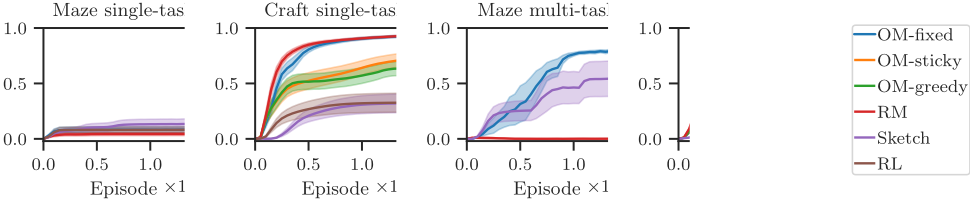
Figure 2: Total environment rewards per episode in the single- and multi-task setting on two environments.
items can be obtained by collecting resources such as wood and iron and combining them at workshop locations. Instructions may specify multiple permissible options simultaneously or may fully specify tasks. In the 'maze' environment, the agent must navigate a series of rooms with doors. An event detector describes whether the agent is in a door or not. Critically, it does not differentiate doors leading to the desired room from other doors. As a result, instructions are underspecified. Furthermore, instructions only permit one option at a time. We therefore do not include OM-greedy and OM-sticky in this environment.
An existing curriculum learning setup was used for multitask learning [Andreas et al., 2017]. Initially, only tasks associated with two options are presented. Once the mean reward on these reaches a threshold of 0.8, this limit is incremented. Tasks within this limit are sampled inversely proportional to the obtained reward. Results were selected with a grid search over hyperparameters. Shaping reward hyperparameters ρ = 0 and ρ = 0.1 were selected for the maze and craft environment respectively. We report averages over five random seeds. A detailed description of the environments, tasks, hyperparameters etc. can be found in the Appendix.
6.3 Results
Single-task Results
The two leftmost graphs in Figure 2 show the single-task results on all tasks consisting of more than two options. The maze environment proves too challenging. The reason is its inherent exploration problem which cannot be mitigated by the instructions. Following these does not guarantee solving the task and hence shaping rewards do not help. In the craft environment, shaping is useful: the RM and OM-fixed approaches significantly outperform all others. The usage of named options has negligible effects as RM and OM-fixed perform similarly. Finally, we see a slight advantage of using the sticky option selection over its greedy counterpart.
Multi-task Results
The two rightmost graphs in Figure 2 show that the instructions improve sample efficiency as our approach significantly outperforms all baselines. In the maze environment, this can all be attributed to the usage of named options since there are no shaping rewards with ρ = 0. Also, note that RMs fail to perform in the multi-task setting because they use the instructions as the full specification of the task. In the craft environment, the instructions do fully specify the task and shaping rewards increase sample efficiency. A comparison between OM-fixed and RM indicates that the usage of named options increases sample efficiency significantly. Again, we see that OM-fixed outperforms the other OM variants and that using sticky option selection provides a slight benefit.
Zero-shot Results
We evaluate applicable approaches in two zero-shot settings. In the first setting, policies for all options are trained in isolation and then evaluated on tasks composed of these options. We include all tasks here. In the second setting, policies are trained on a set of training tasks and then evaluated on two unseen, held out, tasks. For OM-based approaches, we execute Algorithm 2 in both settings. Table 1 shows that all of the OM versions significantly outperform the baseline in both environments. OM-fixed outperforms all OM versions. The difference here is striking in the holdout case.
The holdout setting is challenging since policies are optimized in the context of tasks other than the evaluation task. As a result, a policy associated with some option o is positively reinforced if it completes a subtask associated with a later option o′ . If this subtask is not part of the evaluation task, completing it may harm performance. It could take time and affect later subtasks if these are not commutative. OM-fixed is less susceptible to this failure mode then the other variants, as it uses the same delineation across all episodes. This does not show in the 'isolation' training setting where the greedy and sticky variants perform significantly better than their counterparts trained in the holdout setting.
7 Discussion
We proposed a framework for sample efficient RL with underspecified instructions. These are represented with powerful and intuitive FSTs as a natural way to define shaping rewards and use named options for the reuse of learned behaviors. Experimental evaluations show state of the art performance in a single-task setting and significant outperformance of the state of the art in zero-shot and multi-task settings across environments with fully specified and with underspecified instructions. We have found indications that shaping rewards should not be used when instructions do not cover the task at hand completely but that named options provide a significant benefit. Finally, results indicate that named options significantly increase performance in the multi-task and zero-shot settings.
Future work includes the development of a calculus of instructions for RL with FST operations and the study of ways to derive OMs from interactions to communicate learned strategies with other agents and humans.
@inproceedings{ijcai2022p403,
  title     = {Reinforcement Learning with Option Machines},
  author    = {den Hengst, Floris and François-Lavet, Vincent and Hoogendoorn, Mark and van Harmelen, Frank},
  booktitle = {Proceedings of the Thirty-First International Joint Conference on
               Artificial Intelligence, {IJCAI-22}},
  publisher = {International Joint Conferences on Artificial Intelligence Organization},
  editor    = {Luc De Raedt},
  pages     = {2909--2915},
  year      = {2022},
  month     = {7},
  note      = {Main Track},
  doi       = {10.24963/ijcai.2022/403},
  url       = {https://doi.org/10.24963/ijcai.2022/403},
}
TY - CPAPER TI - Reinforcement Learning with Option Machines AU - den Hengst, Floris AU - François-Lavet, Vincent AU - Hoogendoorn, Mark AU - van Harmelen, Frank T2 - Proceedings of the Thirty-First International Joint Conference on Artificial Intelligence, IJCAI-22 PB - International Joint Conferences on Artificial Intelligence Organization PY - 2022 SP - 2909 EP - 2915 DO - 10.24963/ijcai.2022/403 UR - https://doi.org/10.24963/ijcai.2022/403 ER -Copied
Machine-readable versions of this paper, for tools and AI agents:





