
On the Channel Pruning using Graph Convolution Network for Convolutional Neural Network Acceleration
Proceedings of the Thirty-First International Joint Conference on Artificial Intelligence. Main Track. Pages 3107-3113.
https://doi.org/10.24963/ijcai.2022/431
Keywords
- Machine Learning: Learning Sparse Models
- Machine Learning: Learning Graphical Models
- Machine Learning: Classification
- Machine Learning: Deep Reinforcement Learning
Abstract
Network pruning is considered efficient for sparsification and acceleration of Convolutional Neural Network (CNN) based models that can be adopted in re-source-constrained environments. Inspired by two popular pruning criteria, i.e. magnitude and similarity, this paper proposes a novel structural pruning method based on Graph Convolution Network (GCN) to further promote compression performance. The channel features are firstly extracted by Global Average Pooling (GAP) from a batch of samples, and a graph model for each layer is generated based on the similarity of features. A set of agents for individual CNN layers are implemented by GCN and utilized to synthesize comprehensive channel information and determine the pruning scheme for the overall CNN model. The training process of each agent is carried out using Reinforcement Learning (RL) to ensure their convergence and adaptability to various network architectures. The proposed solution is assessed based on a range of image classification datasets i.e., CIFAR and Tiny-ImageNet. The numerical results indicate that the proposed pruning method outperforms the pure magnitude-based or similarity-based pruning solutions and other SOTA methods (e.g., HRank and SCP). For example, the proposed method can prune VGG16 by removing 93% of the model parameters without any accuracy reduction in the CIFAR10 dataset.
- [Hao Li, 2017] Asim Kadav Hao Li, Igor Durdanovic, Hanan Samet, Hans Peter Graf. Pruning Filters for Efficient ConvNets. In International Conference on Learning Representations, Toulon, France, April 24 -26, 2017.
- [Hu et al., 2016] Hengyuan Hu, Rui Peng, Yu-Wing Tai, et al. Network trimming: A data-driven neuron pruning approach towards efficient deep architectures. arXiv preprint arXiv:1607.03250, 2016.
- [Liu et al., 2017] Zhuang Liu, Jianguo Li, Zhiqiang Shen, et al. Learning efficient convolutional networks through network slimming. In International Conference on Computer Vision, 2736-2744, 2017.
- [Lei et al., 2017] Wang Lei, Huawei Chen and Yixuan Wu. Compressing Deep Convolutional Networks Using K- means Based on Weights Distribution. In International Conference on Intelligent Information Processing, Article 10, Bangkok, Thailand, 2017.
- [Ding et al., 2019] Xiaohan Ding, Guiguang Ding, Yuchen Guo, et al. Centripetal SGD for Pruning Very Deep Convolutional Networks With Complicated Structure. In Conference on Computer Vision and Pattern Recognition, 4938-4948, 15-20 June 2019.
- [Wang et al., 2021] Zi Wang, Chengcheng Li and Xiangyang Wang. Convolutional neural network pruning with structural redundancy reduction. In Conference on Computer Vision and Pattern Recognition, 14913-14922, 2021.
- [Li et al., 2020] Hang Li, Chen Ma, Wei Xu, et al. Feature statistics guided efficient filter pruning. arXiv preprint arXiv:2005.12193, 2020. IJCAI
- [He et al., 2018] Yang He, Guoliang Kang, Xuanyi Dong, et al. Soft Filter Pruning for Accelerating Deep Convolutional Neural Networks. In International Joint Conference on Artificial Intelligence, Stockholm, Sweden, July 13-19 2018. IJCAI
- [Lee et al., 2021] Jaeho Lee, Sejun Park, Sangwoo Mo, et al. Layer-adaptive Sparsity for the Magnitude-based Pruning. In International Conference on Learning Representations, Vienna, Austria, May 04 2021.
- [Zhao et al., 2019] Chenglong Zhao, Bingbing Ni, Jian Zhang, et al. Variational Convolutional Neural Network Pruning. In Conference on Computer Vision and Pattern Recognition, 2775-2784, 15-20 June 2019.
- [He et al., 2019] Yang He, Ping Liu, Ziwei Wang, et al. Filter Pruning via Geometric Median for Deep Convolutional Neural Networks Acceleration. In Conference on Computer Vision and Pattern Recognition, 4335-4344, 15-20 June 2019.
- [Suau et al., 2018] Xavier Suau, Luca Zappella, Vinay Palakkode, et al. Principal filter analysis for guided network compression. arXiv preprint arXiv:1807.10585, 2018.
- [Lemaire et al., 2019] Carl Lemaire, Andrew Achkar and Pierre-Marc Jodoin. Structured pruning of neural networks with budget-aware regularization. In Conference on Computer Vision and Pattern Recognition, 9108-9116, 2019.
- [He et al., 2018] Yihui He, Ji Lin, Zhijian Liu, et al. Amc: Automl for model compression and acceleration on mobile devices. In European Conference on Computer Vision, 784-800, 2018.
- [Lin et al., 2019] Shaohui Lin, Rongrong Ji, Chenqian Yan, et al. Towards optimal structured cnn pruning via generative adversarial learning. In Conference on Computer Vision and Pattern Recognition, 2790-2799, 2019.
- [Wu et al., 2018] Zuxuan Wu, Tushar Nagarajan, Abhishek Kumar, et al. Blockdrop: Dynamic inference paths in residual networks. In Conference on Computer Vision and Pattern Recognition, 8817-8826, 2018.
- [Liu et al., 2020] Yabo Liu, Yi Liu and Cheng Yang. Modulation recognition with graph convolutional network. IEEE Wireless Communications Letters, 9:624- 627, 2020.
- [Zhuang and Ma, 2018] Chenyi Zhuang and Qiang Ma. Dual graph convolutional networks for graph-based semi- supervised classification. In Proceedings of the 2018 World Wide Web Conference, 499-508, 2018.
- [Bruna et al., 2013] Joan Bruna, Wojciech Zaremba, Arthur Szlam, et al. Spectral networks and locally connected networks on graphs. arXiv preprint arXiv:1312.6203, 2013.
- [Chen and Zhao, 2019] S. Chen and Q. Zhao. Shallowing Deep Networks: Layer-Wise Pruning Based on Feature Representations. IEEE Transactions on Pattern Analysis and Machine Intelligence, 41:3048-3056, 2019.
- [Ding et al., 2021] Xiaohan Ding, Tianxiang Hao, Jianchao Tan, et al. Lossless CNN Channel Pruning via Decoupling Remembering and Forgetting. In International Conference on Computer Vision, March 10, 2021.
- [Chen et al., 2021] Tianyi Chen, Bo Ji, Tianyu Ding, et al. Only Train Once: A One-Shot Neural Network Training And Pruning Framework. arXiv preprint arXiv:2107.07467, 2021.
- [Krizhevsky and Hinton, 2009] Alex Krizhevsky and Geoffrey Hinton. Learning multiple layers of features from tiny images. Handbook of Systemic Autoimmune Diseases, 2009.
- [Deng et al., 2009] Jia Deng, Wei Dong, Richard Socher, et al. Imagenet: A large-scale hierarchical image database. In Conference on Computer Vision and Pattern Recognition, 248-255, 2009.
- [Simonyan and Zisserman, 2014] Karen Simonyan and Andrew Zisserman. Very deep convolutional networks for large-scale image recognition. arXiv preprint arXiv:1409.1556, 2014.
- [He et al., 2016] Kaiming He, Xiangyu Zhang, Shaoqing Ren, et al. Deep residual learning for image recognition. In Conference on Computer Vision and Pattern Recognition, 770-778, 2016.
- [Wang et al., 2021] Zidu Wang, Xuexin Liu, Long Huang, et al. Model Pruning Based on Quantified Similarity of Feature Maps. arXiv preprint arXiv:2105.06052, 2021.
- [He et al., 2020] Yang He, Yuhang Ding, Ping Liu, et al. Learning Filter Pruning Criteria for Deep Convolutional Neural Networks Acceleration. In Conference on Computer Vision and Pattern Recognition, 2006-2015, 13-19 June 2020.
- [Lin et al., 2020] Mingbao Lin, Rongrong Ji, Yan Wang, et al. HRank: Filter Pruning Using High-Rank Feature Map. In Conference on Computer Vision and Pattern Recognition, 1526-1535, 13-19 June 2020.
- [Kang and Han, 2020] Minsoo Kang and Bohyung Han. Operation-aware soft channel pruning using differentiable masks. In International Conference on Machine Learning, 5122-5131, 2020.
References were extracted automatically from the PDF and may contain errors.
Full text extracted automatically from the PDF; figures, tables and equations may differ. The PDF is the version of record.
1 Introduction
In recent years, the Convolutional Neural Networks (CNNs) have been widely adopted in many application domains, e.g., computer vision. However, the requirements of substantial storage space and computing power make such models difficult to be deployed in computing and storage constrained platforms. Model compression is one of the feasible solutions to address this challenge through designing compact and efficient models whilst maintaining the accuracy as much as possible. Pruning based on a specific criterion is an effective way to compress the model, and the most commonly used criteria are magnitude and similarity. The magnitude-based methods prefer to prune the components with smaller magnitude in the network. For example, some studies evaluated the channel's importance by the magnitude of weights [Hao Li, 2017], feature maps [Hu et al., 2016], or BN layers [Liu et al., 2017]. The similarity-based methods consider the approximate component as redundancy and a collection of clusteringbased pruning methods [Lei et al., 2017] [Ding et al., 2019] have been developed. These studies have confirmed the effectiveness of both criteria for guaranteeing the model pruning performance. However, most of the existing studies adopt them independently and their integration may potentially lead to the improvement of pruning performance. Wang et al. [Wang et al., 2021] exploited the graph models based on similarity to evaluate layer redundancy but used the magnitude criterion to prune channels. Li et al. [Li et al., 2020] adopted two pruning processes that are carried out successively based on the variance and similarity of feature maps.
Inspired by the previous work, this paper attempts to construct a graph model at each layer and perform channel-wise pruning via the Graph Convolutional Network (GCN). The idea behind this method is that considering the channels as nodes, a graph model can be used to express the characteristic of channels through node features and the similarity between channels through connections of edges. Additionally, GCNs can aggregate the information from one node and its neighbors, i.e. combining the magnitude and similarity criteria for comprehensive channel evaluation.
To build the graph model, the distribution of Global Average Pooling (GAP) is used as the node feature, and the edge connections between nodes can be further determined based on the KL-divergence. Based on the graph, reinforcement learning (RL) is used to train an agent containing GCN and obtain the pruning scheme. The agent can repeat the "try-andlearn" process guided by the proposed objective function for multiple iterations to achieve the balance between pruned parameters and accuracy reduction. The benefit of the proposed pruning solution is confirmed through experiments based on the benchmark datasets for comparison with a range of models. The main technical contributions made in this work are summarized as follows.
(1) Adaptability to multiple models and layers. GAP ignores the position information of the feature map, which ensures the format invariance of our method in convolutional layers or full-link layers. Also, the flexibility of GCN's input dimensions allows the proposed method to prune multiple layers simultaneously so that we can deal with residual connections conveniently.
(2) Automatically learning of criteria to determine sparsity and pruned channels. Our method is guided by an objective function where a balance ratio is selected to obtain the tradeoff between the overall compression rate and performance reduction. For each layer, GCN can learn the optimal criterion under the supervision of RL without any additional assigned parameters.
(3) Outstanding model compression capability. Our proposed method can achieve better performance on multiple datasets and networks compared with the previous magnitude-based, similarity-based, and other SOTA algorithms.
2 Related Work
Magnitude-based pruning methods aim to remove the components with smaller magnitude in the network. The norm of convolution kernel is the most commonly used indicator, e.g., L1norm [Hao Li, 2017] and L2 norm [He et al., 2018] [Lee et al., 2021]. Existing studies also used BN layers or feature maps to evaluate channel importance. For example, Liu et al. [Liu et al., 2017] and Zhao et al. [Zhao et al., 2019] adopted the scaling coefficient of the BN layer for evaluation. Hu et al.[Hu et al., 2016] and Li et al[Li et al., 2020] evaluated the channel importance by sparsity and standard deviation of feature maps respectively.
Similarity-based pruning methods explore the network redundancy from approximate parts. Lei et al.[Lei et al., 2017] adopted K-means to obtain the clustering centers, by which all the convolutional kernels can be quantitatively represented. However, He et al.[He et al., 2019] argued that kernels closer to the clustering center have greater redundancy. Ding et al.[Ding et al., 2019] performed controllable and differentiable clustering by their proposed C-SGD method. The kernels are guided by loss function to be similar or identical during the training process and each cluster can only maintain one kernel and remove the rest after training.
Redundancy evaluation determines the target sparsity for each layer in the pruning process. A set of studies exploited the calculation of sparsity, e.g., PCA [Suau et al., 2018], graph theory [Wang et al., 2021]. However, most studies [Lemaire et al., 2019] attach masks to the weight matrix and add corresponding regularization terms to the loss function, hoping some weights can be compressed to zero automatically. The sparsity and pruned channels can also be determined simultaneously by the agent, but additional optimizing methods, e.g., RL [He et al., 2018], GAN[Lin et al., 2019] and gradient [Wu et al., 2018], are required for agent training.
Graph Convolutional Network is an effective tool for graph structural data modeling that has been widely used for pattern recognition [Liu et al., 2020] and semi-supervised classification[Zhuang and Ma, 2018]. GCNs can be classified as time-domain GCN and spectral-domain GCN according to the convolution domain. The former is an extension of CNN that aggregates node information by directly summing up neighborhood features; and the latter [Bruna et al., 2013] performs the approximate convolution operations through Laplacian transformation and can be often formulated as a firstorder approximation.
3 Pruning Method
3.1 Preliminaries
For a CNN with 𝑁𝑁 layers, let 𝑐𝑐𝑖𝑖 denote the channel number of 𝑖𝑖th layer. Then the convolution kernel with size 𝑤𝑤 × ℎ can be represented as 𝑓𝑓𝑖𝑖 ∈ R𝑐𝑐𝑖𝑖×𝑐𝑐𝑖𝑖-భ×𝑤𝑤×ℎ , and the feature map with size 𝑊𝑊𝑖𝑖 ×𝐻𝐻𝑖𝑖 can be denoted as 𝑋𝑋𝑖𝑖 ∈ R𝑐𝑐𝑖𝑖×𝑊𝑊𝑖𝑖×𝐻𝐻𝑖𝑖 . Regarding fully connected layers in CNN as convolutional layers with 1 × 1 kernel, the inference process can be expressed as
where ∗ is the convolution operation, 𝜎𝜎(∙) is the nonlinear activation function, generally 𝑅𝑅𝑅𝑅𝑅𝑅𝑅𝑅(∙), BN layers are omitted here for simplicity. Let 𝐹𝐹 = {𝑓𝑓𝑖𝑖} denote the set of all parameters, 𝐼𝐼 and 𝑙𝑙 denote the input image and output label respectively, a CNN can be abbreviated as 𝑙𝑙 = 𝛷𝛷𝐹𝐹(𝐼𝐼).
Conducting channel-wise pruning for the CNN is equivalent to selecting channel indicator vector 𝑚𝑚𝑖𝑖 ∈ {0,1}𝑐𝑐𝑖𝑖 for each layer and replacing the inference process as
where ⊙ represents the Hadamard product on the channel dimension. Let 𝑀𝑀 = {𝑚𝑚𝑖𝑖} represent the set of 𝑚𝑚𝑖𝑖. The pruned CNN can be written as 𝑙𝑙 = 𝛷𝛷𝐹𝐹,𝑀𝑀(𝐼𝐼).
The GCN is defined on the graph structure. A graph 𝐺𝐺 =< 𝑉𝑉, 𝐸𝐸 > is composed of a node-set 𝑉𝑉 = {𝑣𝑣𝑗𝑗} with capacity 𝛼𝛼 and an edge set 𝐸𝐸 = {𝑒𝑒 = (𝑣𝑣𝑗𝑗భ, 𝑣𝑣𝑗𝑗మ)|𝑣𝑣𝑗𝑗భ, 𝑣𝑣𝑗𝑗మ ∈ 𝑉𝑉}. For a GCN with 𝐵𝐵 layers, denoting the 𝑐𝑐𝑖𝑖-dimension node features of 𝑖𝑖th layer as 𝑇𝑇𝑖𝑖 ∈ 𝑅𝑅𝛼𝛼×𝑐𝑐𝑖𝑖, the inference process can be expressed as
Figure 1 overviews the proposed pruning framework.
where 𝐴𝐴̂ is adjacency matrix with self-ring, 𝐷𝐷� is degree matrix of 𝐴𝐴̂, 𝑘𝑘𝑖𝑖 ∈ 𝑅𝑅𝑐𝑐𝑖𝑖+భ×𝑐𝑐𝑖𝑖 is trainable parameters. Let 𝐾𝐾 = {𝑘𝑘𝑖𝑖} represent all parameters, 𝑚𝑚 and 𝑃𝑃 denote output and input features, a GCN can be written as 𝑚𝑚 = 𝛹𝛹𝐾𝐾(𝐺𝐺, 𝑃𝑃).
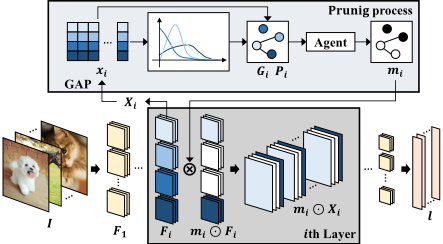
In our framework, the channel features 𝑃𝑃 with each layer of CNN 𝛷𝛷 are firstly exacted and a graph 𝐺𝐺 is constructed, and then the pruning scheme 𝑚𝑚 from a specialized GCN 𝛹𝛹 can be obtained.
3.2 Construction of Graph
Here, the construction method of 𝐺𝐺 and the training method of 𝛹𝛹 is briefly introduced as follows. In 𝑖𝑖th layer, assembling all channels to a node-set 𝑉𝑉𝑖𝑖 , the graph model can be constructed based on node (channel) features. Due to the capability of channel importance evaluation [Chen and Zhao, 2019] and format consistency among different layers, the distribution of GAP values is considered as the channel feature.
Let 𝜉𝜉 = {𝐼𝐼𝑘𝑘 } represent an image set with capacity 𝑛𝑛. When feeding 𝑘𝑘th sample 𝐼𝐼𝑘𝑘 to the network, we get GAP value 𝑥𝑥𝑖𝑖𝑖𝑖 𝑘𝑘 from 𝑖𝑖 th layer and 𝑗𝑗 th channel. As 𝐼𝐼𝑘𝑘 traverses 𝜉𝜉 , 𝑥𝑥𝑖𝑖𝑖𝑖 𝑘𝑘 also forms a set χ𝑖𝑖𝑖𝑖 = {𝑥𝑥𝑖𝑖𝑖𝑖 𝑘𝑘 }. To alleviate the difference between layers, χ𝑖𝑖𝑖𝑖 is further standardized to χ𝑖𝑖𝑖𝑖 ′ = {𝑥𝑥𝑖𝑖𝑖𝑖 ′𝑘𝑘 } by 𝑠𝑠𝑠𝑠𝑠𝑠(χ𝑖𝑖𝑖𝑖). Since activation functions 𝑅𝑅𝑅𝑅𝑅𝑅𝑅𝑅(∙) and the standardization process guarantee a bounded range for most of 𝑥𝑥𝑖𝑖𝑖𝑖 𝑘𝑘′ , the data distribution of χ𝑖𝑖𝑖𝑖 ′ can be represented by an s-dimension vector 𝑝𝑝𝑖𝑖𝑖𝑖. For the sampling interval [0, 𝑢𝑢], the 𝑟𝑟th component of 𝑝𝑝𝑖𝑖𝑖𝑖 is
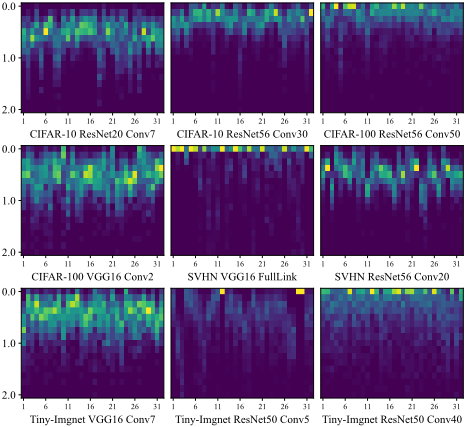
Corresponding to 𝑉𝑉𝑖𝑖, the channel features for 𝑖𝑖th layer is defined as 𝑃𝑃𝑖𝑖 = {𝑝𝑝𝑖𝑖𝑖𝑖} that not only reflects the magnitude of feature maps but also ensures the consistency among similar channels. Figure 2 shows 𝑃𝑃𝑖𝑖 of different networks and datasets.
Edge set 𝐸𝐸𝑖𝑖 can be determined by 𝑃𝑃𝑖𝑖. Since 𝑝𝑝𝑖𝑖𝑖𝑖 represents data distribution, we use KL divergence to measure channel distance. With a certain threshold 𝜃𝜃, 𝐸𝐸𝑖𝑖 can be written as 𝐸𝐸𝑖𝑖 = {(𝑣𝑣𝑖𝑖𝑗𝑗భ , 𝑣𝑣𝑖𝑖𝑗𝑗మ)|𝐷𝐷𝐾𝐾𝐾𝐾�𝑝𝑝𝑖𝑖𝑗𝑗భ�𝑝𝑝𝑖𝑖𝑗𝑗మ� < 𝜃𝜃, 𝑣𝑣𝑗𝑗భ , 𝑣𝑣𝑗𝑗మ ∈ 𝑉𝑉𝑖𝑖}. The selection of 𝜃𝜃 will be further discussed in Section 4.
3.3 Objective Function
The identification of an appropriate pruning scheme 𝑀𝑀 for the pre-trained network 𝛷𝛷𝐹𝐹 can be formulated as a minimum optimization problem. Similar to previous studies, the objective function is defined as
where 𝑅𝑅𝑝𝑝𝑝𝑝𝑝𝑝𝑝𝑝 is the performance degradation after pruning, 𝑅𝑅𝑝𝑝𝑝𝑝𝑝𝑝𝑝𝑝 is the proportion of pruned parameters, and 𝛾𝛾 represents the balance ratio. The FLOPs constraint is not selected here because its pruning effect is similar to that of 𝑅𝑅𝑝𝑝𝑝𝑝𝑝𝑝𝑝𝑝.
To avoid huge computational consumption, a batch of samples 𝑆𝑆 is selected from the training dataset to evaluate performance degradation. Let 𝐿𝐿(𝑆𝑆, 𝛷𝛷) denote the loss function, 𝑅𝑅𝑝𝑝𝑝𝑝𝑝𝑝𝑝𝑝 can be expressed as
where the third power is used to enhance the sensitivity of model performance.
On the other hand, let 𝑃𝑃𝑃𝑃𝑃𝑃𝑃𝑃(𝛷𝛷) denote the number of nonzero parameters, 𝑅𝑅𝑝𝑝𝑝𝑝𝑝𝑝𝑝𝑝 can be expressed as
With the correlation of layers, a greedy strategy is conducted to obtain 𝑀𝑀, in which we train GCN and prune for each layer sequentially. Therefore, the optimization objective for 𝑖𝑖th layer is min
where 𝛹𝛹𝑖𝑖 is the abbreviated form of GCN 𝛹𝛹𝐾𝐾𝑖𝑖 , 𝑀𝑀𝑖𝑖-ଵ = {𝑚𝑚ଵ,𝑚𝑚ଶ …𝑚𝑚𝑖𝑖-ଵ} is the pruning scheme of the former 𝑖𝑖 - 1 layers.
3.4 Training Method for GCN
Given the optimization objective in 3.3, the training method of 𝛹𝛹𝑖𝑖 can be determined for 𝑖𝑖th layer. Since Γ is differentiable, taking 𝑚𝑚�𝑖𝑖 = 𝛹𝛹𝑖𝑖(𝐺𝐺𝑖𝑖, 𝑃𝑃𝑖𝑖) as pruning scheme, and optimize both 𝛹𝛹𝑖𝑖 and 𝛷𝛷 by BP algorithm is a possible way. However, the previous studies (e.g., [Ding et al., 2021]) have revealed that continuous 𝑚𝑚�𝑖𝑖 can hardly converge to binary 𝑚𝑚𝑖𝑖 even with the constraint term in loss function.
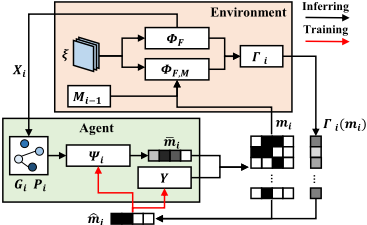
To avoid the converge problem, this work optimizes an agent containing GCN by RL (In detail, Policy Gradient) and obtain binary 𝑚𝑚𝑖𝑖 from sampling. As shown in Figure 3, the environment of the agent is defined as 𝐺𝐺𝑖𝑖 and 𝑃𝑃𝑖𝑖, which are extracted from a random batch of image 𝜉𝜉. The output of GCN 𝑚𝑚�𝑖𝑖 ∈ (0,1)𝑐𝑐𝑖𝑖 represents the distribution of the agent's actions i.e. pruning schemes. Training of the agent is a repeated process of "try-and-learn". In each iteration, multiple 𝑚𝑚𝑖𝑖 are sampled according to 𝑚𝑚�𝑖𝑖, and those who make 𝛤𝛤𝑖𝑖 minimum is regarded as the label 𝑚𝑚�𝑖𝑖 . With a loss function CrossEntropy, 𝛹𝛹𝑖𝑖 can be optimized by the BP algorithm.
To reduce the uncertainty caused by random selection of image batch 𝜉𝜉 and ensure convergence, we also introduce a memory mechanism to the agent. The agent not only samples
𝑚𝑚𝑖𝑖 from current 𝑚𝑚�𝑖𝑖, but also takes the former τ iterations' 𝑚𝑚�𝑖𝑖 as possible attempts. The memory library of 𝑚𝑚�𝑖𝑖is denoted as 𝑌𝑌 in Figure 3.
3.5 Pruning Method for ResNet
For networks containing residual connections, e.g., ResNet or DenseNet, the connections establish channel relevance between different layers, which brings considerable difficulties for model pruning in a layer-by-layer fashion.
To decouple the relevance, we divide all layers into different groups, as suggested in [Chen et al., 2021], so that layers in different groups are irrelevant and each group can be pruned separately. This requires no additional operations on the network while maintaining the potential pruning capability. The grouping scheme for the model pruning is illustrated in Figure 4.
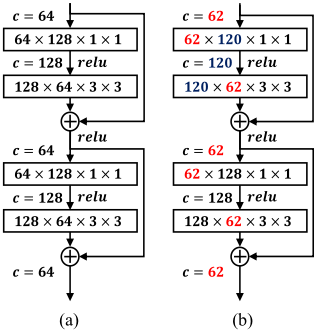
In Figure 4, inner layers (blue) of the residual block are grouped separately, and layers containing residual connections (red) are grouped according to channel association. Once the pruned channels for the group with multiple layers are determined and their features are combined, the same process of pruning for individual layers can be performed similarly.
4 Experiment and Result
4.1 Datasets
The CIFAR [Krizhevsky and Hinton, 2009] is a widely used dataset consisting of CIFAR-10 and CIFAR-100, which have 10 and 100 classes respectively. Both of them contain 50000 training images and 10000 test images with a resolution of 32×32, and all the images are uniformly distributed across each class. The Tiny-ImageNet is a sub dataset of ImageNet [Deng et al., 2009], which contains 200 classes and 64×64 colored images. Each class has 500 training images, 50 validation images, and 50 test images.
During the model training, the images are randomly flipped horizontal and cropped with padding to avoid overfitting. The numbers of padding pixels for CIFAR and TinyImageNet are set as is 4 and 8, respectively. In this work, no further effort on data augmentation is required.
4.2 Networks
The VGG [Simonyan and Zisserman, 2014] and ResNet [He et al., 2016] are the two popular benchmarks for model compression experiments and are adopted in this work. Here, the VGG-16 and ResNet-20, 50 and 56 are selected as the representative of the VGG family and the ResNet family. Due to the scale differences between datasets, models are adjusted accordingly to avoid excessive redundancy. For example, the channel number of full-link layers in VGG-16 is 4096 when training on Tiny-ImageNet, while that of CIFAR is 512.
4.3 Implementation Details
Models are well trained to their best performance before the layer-by-layer pruning is conducted. For each layer, we select u = 3, s = 12 to build a graph and design GCN 𝛹𝛹 with the structure s - 16 -32 - 16 - 1. When training 𝛹𝛹, 30 possible 𝑚𝑚 will be evaluated for each iteration, where 20 are discretized from 𝑚𝑚� and 10 are from prior iterations. After evaluation, 𝑚𝑚� is regarded as the label for 5 times reinforcement training. Among all iterations, 𝛹𝛹 is trained with decreasing learning rate from 0.1 to 0.001 until convergence or reaching maximum iteration 300. Once the pruning scheme of the layer is determined by 𝛹𝛹, corresponding channels will be pruned following a fine-tuning process of 30 epochs.
4.4 Performance Validation
Table 1 shows the performance of the proposed solution on a range of networks and datasets.
On the CIFAR-10 dataset, the pruning results show that even for small networks such as ResNet20, our method can achieve 0.7× compression of both FLOPs and parameters without accuracy reduction. Moreover, compared with the ResNet20 baseline, the pruned ResNet56 achieves higher accuracy with a smaller scale, which further indicates the effectiveness of our approach.
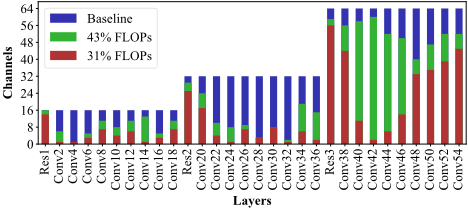
Figure 5 shows the pruning scheme of ResNet56 with different compression rates. It can be observed that the groups with residual connection (Res1-3) consisting of multiple layers are sensitive to pruning, and hence a few channels are removed even for 22% FLOPs compression. However, the layers in residual blocks (Conv2-54) are of low importance and hence are assigned with high sparsity to achieve overall network compression. The result of different layer sparsity shows that our method can efficiently carry out the automatic layer evaluation.
| Network | Accuracy (%) | FLOPs (M) | Parameters (M) |
|---|---|---|---|
| ResNet20 (92.25) | 92.22 | 28.66 (69.53%) | 0.20 (72.58%) |
| 91.58 | 20.38 (49.46%) | 0.17 (61.49%) | |
| CIFAR-10 ResNet56 (93.72) | 93.85 | 65.57 (51.69%) | 0.56 (64.99%) |
| 92.75 | 28.89 (22.78%) | 0.25 (29.50%) | |
| VGG16 (93.1) | 93.27 | 134.22 (42.71%) | 2.21 (14.50%) |
| 93.08 | 84.62 (26.93%) | 1.06 (6.94%) | |
| ResNet20 (68.38) | 68.95 | 35.18 (85.36%) | 0.25 (91.84%) |
| 66.14 | 16.54 (40.13%) | 0.14 (50.58%) | |
| CIFAR-100 ResNet56 (72.86) | 72.86 | 64.98 (51.23%) | 0.52 (60.76%) |
| 72.22 | 60.60 (47.78%) | 0.51 (60.17%) | |
| VGG16 (72.00) | 72.00 | 136.47 (43.42%) | 2.98(19.51%) |
| 71.64 | 99.82 (31.76%) | 1.76(11.54%) | |
| ResNet50 (59.66) | 59.26 | 277.16 (82.52%) | 14.63 (61.16%) |
| 57.67 | 117.98 (35.13%) | 10.03 (41.92%) | |
| VGG16 | 59.04 | 791.79 (62.12%) | 12.37 (35.95%) |
| (60.08) | 58.53 | 610.20 (47.87%) | 10.07 (29.26%) |
Being designed for the ImageNet dataset, VGG16 has amazing redundancy on CIFAR-10. Our proposed method can keep the accuracy almost unchanged with nearly 93% of parameters being removed. However, VGG's network structure is not as efficient as that of ResNet, so when compressed to a scale close to ResNet56 baseline, VGG16 cannot achieve similar accuracy.
On the CIFAR-100 dataset, the redundancy of each model declines in varying degrees. ResNet20 has a serious loss of accuracy when pruning 60% FLOPs. And ResNet56, while still able to retain accuracy with 50% FLOPs removal, is no longer able to accommodate greater compression. VGG16
has been least affected, our method still can retain accuracy by removing 88% parameters.
On the Tiny-ImageNet dataset, our method can maintain accuracy in slight pruning, but cannot conduct significant model compression. For example, we can compress ResNet50 with the removal of 39% parameters and only 0.4% accuracy reduction. But model degradation is inevitable when pruning over 64% FLOPs and 58% parameters.
4.5 Performance Comparison
The proposed solution is further extensively assessed through comparison with a range of existing solutions, including the magnitude-based methods (L1[Hao Li, 2017], SFP[He et al., 2018]), similarity-based methods (FPvG[He et al., 2019], QSFM[Wang et al., 2021]), agent-based methods (AMC [He et al., 2018], LFP [He et al., 2020]) and other SOTA methods (HRank [Lin et al., 2020], SCP [Kang and Han, 2020]) (the unnamed methods are denoted as the paper title abbreviations). In detail, L1 and SFP take L1norm and L2norm of filters as the importance index. The FPvG uses filter clustering methods to find out redundant channels, while QSFM evaluates similarity and prunes channel for each feature map pair. AMC and LFP train agents to automatically prune CNNs, where RL is also regarded as the training method. The HRank evaluates the channel importance by the rank of feature maps.
The pruning performance results of all algorithms on the VGG16 and ResNet56 on CIFAR-10 are shown in Table 2 and Table 3, respectively.
| Method | Accuracy (%) | FLOPs (M) | Parameters (M) |
|---|---|---|---|
| QSFM | 93.39→91.6 (-1.79) | 235.08 (74.80%) | 11.44 (75.00%) |
| SCP | 93.69→93.23 (-0.46) | 152.42 (48.50%) | 7.86 (51.53%) |
| L1 | 93.25→93.4 (0.15) | 206.00 (65.55%) | 5.40 (35.41%) |
| FPE | 93.03→92.49 (-0.54) | 177.27 (56.41%) | 3.30 (21.64%) |
| HRank | 93.96→93.52 (-0.44) | 145.61 (46.33%) | 2.51 (16.46%) |
| Ours | 93.2→93.53 (0.33) | 134.22 (42.71%) | 2.21 (14.49%) |
| HRank | 93.96→91.23 (-2.73) | 73.70 (23.45%) | 1.78 (11.67%) |
| Ours | 93.2→93.08 (-0.12) | 84.62 (26.93%) | 1.06 (6.94%) |
Table 2 presents that our proposed approach achieves the lowest accuracy drop compared to other approaches in a wide range of compression ratios. When pruning VGG16 on CIFAR-10, QSFM, SCP, and FPE stop compressing with the removal of 30%-50% FLOPs, since the model begins to show unacceptable accuracy degradation. The HRank, L1 and our proposed solution demonstrate better performance and the proposed solution can even increase the model accuracy at certain pruning scenarios (reduction of around 60% FLOPs). Only a few methods attempt to significantly compress the model. The HRank and CUP can implement pruning schemes to remove 76.55% FLOPs. And Ours, although achieving a slightly less compression of FLOPs, have much better performance on retaining the accuracy and compression of parameters.
| Method | Accuracy (%) | FLOPs (M) | Parameters (M) |
|---|---|---|---|
| L1 | 93.04→93.06 (+0.02) | 91.87 (72.43%) | 0.73 (85.87%) |
| HRank | 93.26→93.52 (+0.26) | 89.66 (70.69%) | 0.71 (83.51%) |
| QSFM | 93.21→91.98 (-1.23) | 73.56 (58.00%) | 0.59 (69.10%) |
| Ours | 93.72→93.85 (+0.13) | 65.56 (51.68%) | 0.55 (64.27%) |
| AMC | 92.80→91.90 (-0.90) | 63.42 (50.00%) | - |
| HRank | 93.26→93.17 (-0.09) | 63.38 (49.97%) | 0.49 (56.97%) |
| SCP | 93.69→93.23 (-0.46) | 61.52 (48.50%) | 0.44 (51.53%) |
| SFP | 93.59→93.35 (-0.24) | 60.12 (47.40%) | - |
| FPvG | 93.59→92.93 (-0.66) | 60.12 (47.40%) | - |
| LFP | 93.59→93.34 (-0.25) | 59.74 (47.10%) | - |
| Ours | 93.72→93.72 (+0.00) | 58.29 (45.95%) | 0.36 (42.07%) |
| Ours | 93.72→92.75 (-0.97) | 28.89 (22.77%) | 0.25 (29.21%) |
Table 3 shows that pruning ResNet56 on the CIFAR-10 dataset is a more challenging task. L1 and HRank can still increase model performance with light pruning, but for further compression, nearly all the methods suffer from accuracy reduction with the removal of 50% FLOPs. In comparison, our proposed solution can achieve the same accuracy as the baseline with only 45.95% FLOPs and 42.07% parameters, indicating a SOTA performance.
4.6 Ablation Study
The selection of threshold 𝜽𝜽 is an important factor for establishing the graph model. In this work, we select 𝜃𝜃 as 0.25 to achieve a sparse connection in each graph.
For validation, we further assign 𝜃𝜃 as 0 and 0.5 to represent the cases where the threshold is too small or too large. Experiments with VGG16 on CIFAR-100 show that inappropriate selection of 𝜃𝜃 leads to performance degradation. For example, with a certain compression ratio (57% FLOPs and 28% Paras) and selected thresholds above, only 71.4% and 71.3% accuracy can be maintained, which is significantly lower than the pruning result in Table 1(72% accuracy with 43% FLOPs and 20% Paras). That is because when 𝜃𝜃 is too small, our proposed method degenerates to a pure magnitude-based pruning method that cannot model a similar relationship between channels. In addition, when 𝜃𝜃 is too large, node features are homogenized due to excessive edge connections, which also degrades the performance.
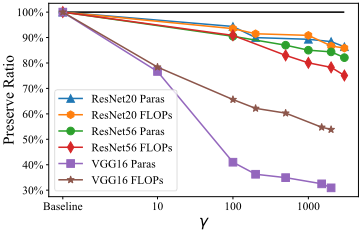
The selection of 𝜸𝜸 balances the performance degradation and pruning ratio, which influences the pruned model size. Figure 6 shows when 𝛾𝛾 changes from 0(baseline) to 3000, the preserve ratio of multiple models on the CIFAR-10 dataset.
Figure 6 indicates that the size of the pruned model is not only affected by the selection of 𝛾𝛾, but also by the redundancy of the model itself. For example, we can assign 𝛾𝛾 as 100 to compress 60% FLOPs of VGG16, but it is difficult to compress ResNet20. The objective function's sensitivity to model performance has automatically selected an appropriate compression ratio for each model. Therefore, to achieve a slight model compression, 𝛾𝛾 should be controlled within a small range, while for a large compression ratio, multiple rounds of pruning with suitable 𝛾𝛾 are needed.
5 Conclusion
This paper presented a novel GCN-based model pruning solution for efficient pruning of CNNs based on the outstanding performance of magnitude and similarity-based pruning methods. The proposed approach is implemented by combining the adjacent GAP distribution through GCN to identify the pruning scheme and RL is adopted as the training method. Extensive experiments based on VGG16 and ResNet demonstrated the effectiveness of our approach that can outperform the pure magnitude or similarity-based solutions and a set of other SOTA solutions. For future work, we will further validate the proposed method through deployment in different application domains.
@inproceedings{ijcai2022p431,
  title     = {On the Channel Pruning using Graph Convolution Network for Convolutional Neural Network Acceleration},
  author    = {Jiang, Di and Cao, Yuan and Yang, Qiang},
  booktitle = {Proceedings of the Thirty-First International Joint Conference on
               Artificial Intelligence, {IJCAI-22}},
  publisher = {International Joint Conferences on Artificial Intelligence Organization},
  editor    = {Luc De Raedt},
  pages     = {3107--3113},
  year      = {2022},
  month     = {7},
  note      = {Main Track},
  doi       = {10.24963/ijcai.2022/431},
  url       = {https://doi.org/10.24963/ijcai.2022/431},
}
TY - CPAPER TI - On the Channel Pruning using Graph Convolution Network for Convolutional Neural Network Acceleration AU - Jiang, Di AU - Cao, Yuan AU - Yang, Qiang T2 - Proceedings of the Thirty-First International Joint Conference on Artificial Intelligence, IJCAI-22 PB - International Joint Conferences on Artificial Intelligence Organization PY - 2022 SP - 3107 EP - 3113 DO - 10.24963/ijcai.2022/431 UR - https://doi.org/10.24963/ijcai.2022/431 ER -Copied
Machine-readable versions of this paper, for tools and AI agents:





