
Neural PCA for Flow-Based Representation Learning
Proceedings of the Thirty-First International Joint Conference on Artificial Intelligence. Main Track. Pages 3229-3235.
https://doi.org/10.24963/ijcai.2022/448
Keywords
- Machine Learning: Representation learning
- Computer Vision: Neural generative models, auto encoders, GANs
Abstract
Of particular interest is to discover useful representations solely from observations in an unsupervised generative manner. However, the question of whether existing normalizing flows provide effective representations for downstream tasks remains mostly unanswered despite their strong ability for sample generation and density estimation. This paper investigates this problem for such a family of generative models that admits exact invertibility. We propose Neural Principal Component Analysis (Neural-PCA) that operates in full dimensionality while capturing principal components in descending order. Without exploiting any label information, the principal components recovered store the most informative elements in their leading dimensions and leave the negligible in the trailing ones, allowing for clear performance improvements of 5%-10% in downstream tasks. Such improvements are empirically found consistent irrespective of the number of latent trailing dimensions dropped. Our work suggests that necessary inductive bias be introduced into generative modeling when representation quality is of interest.
- [Belghazi et al., 2018] Mohamed Ishmael Belghazi, Aris- tide Baratin, Sai Rajeswar, Sherjil Ozair, Yoshua Ben- gio, Aaron Courville, and R Devon Hjelm. Mine: mutual information neural estimation. arXiv preprint arXiv:1801.04062, 2018.
- [Bengio et al., 2013] Yoshua Bengio, Aaron Courville, and Pascal Vincent. Representation learning: A review and new perspectives. IEEE transactions on pattern analysis and machine intelligence, 35(8):1798-1828, 2013.
- [Chapelle et al., 2009] Olivier Chapelle, Bernhard Scholkopf, and Alexander Zien. Semi-supervised learning (chapelle, o. et al., eds.; 2006)[book reviews]. IEEE Transactions on Neural Networks, 20(3):542-542, 2009.
- [Chen et al., 2018] Ricky TQ Chen, Yulia Rubanova, Jesse Bettencourt, and David K Duvenaud. Neural ordinary dif- ferential equations. In Advances in neural information pro- cessing systems, pages 6571-6583, 2018.
- [Chen et al., 2019] Ricky T. Q. Chen, Jens Behrmann, David K Duvenaud, and Joern-Henrik Jacobsen. Residual flows for invertible generative modeling. In H. Wallach, H. Larochelle, A. Beygelzimer, F. d'Alché-Buc, E. Fox, and R. Garnett, editors, Advances in Neural Information Processing Systems 32, pages 9916-9926.
- [Dempster et al., 1977] Arthur P Dempster, Nan M Laird, and Donald B Rubin. Maximum likelihood from incom- plete data via the em algorithm. Journal of the Royal Sta- tistical Society: Series B (Methodological), 39(1):1-22, 1977.
- [Dinh et al., 2014] Laurent Dinh, David Krueger, and Yoshua Bengio. Nice: Non-linear independent compo- nents estimation. arXiv preprint arXiv:1410.8516, 2014.
- [Dinh et al., 2016] Laurent Dinh, Jascha Sohl-Dickstein, and Samy Bengio. Density estimation using real nvp. Interna- tional Conference on Learning Representations, 2016.
- [Durkan et al., 2019] Conor Durkan, Artur Bekasov, Iain Murray, and George Papamakarios. Neural spline flows. In Advances in Neural Information Processing Systems, pages 7509-7520, 2019.
- [Fefferman et al., 2016] Charles Fefferman, Sanjoy Mitter, and Hariharan Narayanan. Testing the manifold hypoth- esis. Journal of the American Mathematical Society, 29(4):983-1049, 2016.
- [Grathwohl et al., 2018] Will Grathwohl, Ricky TQ Chen, Jesse Bettencourt, Ilya Sutskever, and David Duvenaud. Ffjord: Free-form continuous dynamics for scalable re- versible generative models. In International Conference on Learning Representations, 2018.
- [Hjelm et al., 2018] R Devon Hjelm, Alex Fedorov, Samuel Lavoie-Marchildon, Karan Grewal, Phil Bachman, Adam Trischler, and Yoshua Bengio. Learning deep representa- tions by mutual information estimation and maximization. arXiv preprint arXiv:1808.06670, 2018.
- [Kingma and Dhariwal, 2018] Durk P Kingma and Prafulla Dhariwal. Glow: Generative flow with invertible 1x1 con- volutions. In Advances in Neural Information Processing Systems, pages 10215-10224, 2018.
- [Kobyzev et al., 2020] Ivan Kobyzev, Simon Prince, and Marcus Brubaker. Normalizing flows: An introduction and review of current methods. IEEE Transactions on Pattern Analysis and Machine Intelligence, page 1-1, 2020.
- [Meng et al., 2020] Chenlin Meng, Yang Song, Jiaming Song, and Stefano Ermon. Gaussianization flows. In Inter- national Conference on Artificial Intelligence and Statis- tics, 2020.
- [Narayanan and Mitter, 2010] Hariharan Narayanan and Sanjoy Mitter. Sample complexity of testing the manifold hypothesis. In Proceedings of the 23rd International Conference on Neural Information Processing Systems- Volume 2, pages 1786-1794, 2010.
- [Papamakarios et al., 2019] George Papamakarios, Eric Nal- isnick, Danilo Jimenez Rezende, Shakir Mohamed, and Balaji Lakshminarayanan. Normalizing flows for probabilistic modeling and inference. arXiv preprint arXiv:1912.02762, 2019.
- [Poole et al., 2019] Ben Poole, Sherjil Ozair, Aaron Van Den Oord, Alex Alemi, and George Tucker. On variational bounds of mutual information. In International Confer- ence on Machine Learning, pages 5171-5180. PMLR, 2019.
- [Rezende and Mohamed, 2015] Danilo Jimenez Rezende and Shakir Mohamed. Variational inference with nor- malizing flows. International Conference on Machine Learning, 2015.
- [Theis et al., 2015] Lucas Theis, Aäron van den Oord, and Matthias Bethge. A note on the evaluation of generative models. arXiv preprint arXiv:1511.01844, 2015.
- [Tsai et al., 2020] Yao-Hung Hubert Tsai, Han Zhao, Makoto Yamada, Louis-Philippe Morency, and Ruslan Salakhutdinov. Neural methods for point-wise depen- dency estimation. arXiv preprint arXiv:2006.05553, 2020.
- [Uria et al., 2013] Benigno Uria, Iain Murray, and Hugo Larochelle. Rnade: the real-valued neural autoregressive density-estimator. In Proceedings of the 26th International Conference on Neural Information Processing Systems- Volume 2, pages 2175-2183, 2013.
References were extracted automatically from the PDF and may contain errors.
Full text extracted automatically from the PDF; figures, tables and equations may differ. The PDF is the version of record.
1 Introduction
One of the core objectives of generative models is to deliver the promise of learning useful representations of observations in an unsupervised manner (without exploiting any label information) [Bengio et al., 2013]. The usefulness of a representation is often measured by the representation's quality for generic downstream tasks that are discriminative in nature [Chapelle et al., 2009][Dempster et al., 1977], e.g. classification tasks, and informative in describing the observations [Hjelm et al., 2018].
This paper investigates the usefulness of representations given by Normalizing Flows (NF) [Rezende and Mohamed, 2015][Dinh et al., 2014][Dinh et al., 2016][Kingma and Dhariwal, 2018][Chen et al., 2019], a family of likelihoodbased models that admits exact invertibility and inference.
∗ Shen Li is sponsored by Google PhD fellowship 2021.
We empirically find that state-of-the-art NFs yield poor representations in terms of discriminativeness and informativeness. We attribute it to a mathematical fact that an NF preserves dimensionality throughout the transform such that invertibility is guaranteed. This, apparently, violates the manifold hypothesis that data resides in a lower dimensional manifold embedded in a full Euclidean space [Fefferman et al., 2016]. Consequently, dimensionality preservation leads to redundant representations, which undermines representations desired as shown in our empirical studies.
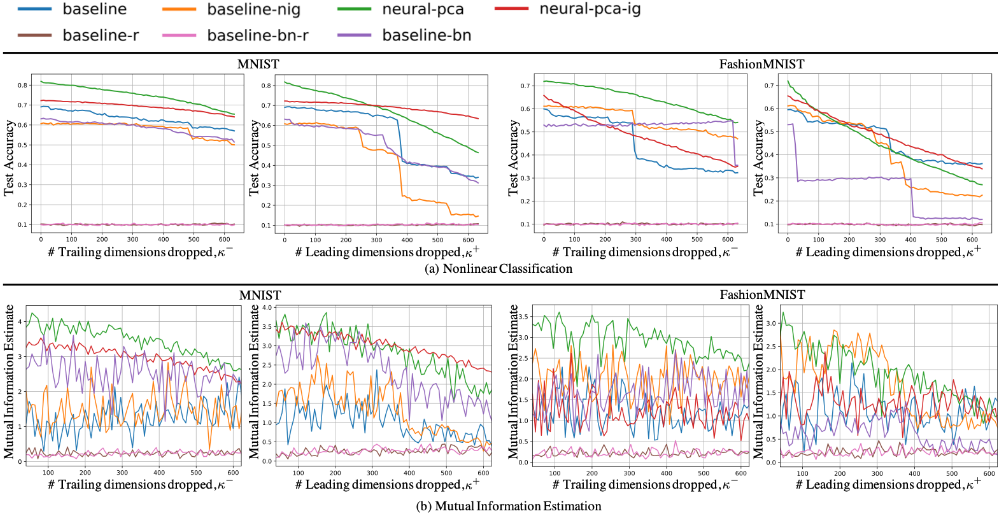
To alleviate the conflict with the manifold hypothesis, we propose Neural-PCA, a flow model that operates in a fulldimensional space while capturing principal components in descending order. Without exploiting any label information, the principal components recovered in an unsupervised way store the most informative elements in leading dimensions, allowing for clear improvements in downstream tasks (e.g. classification and mutual information estimation). Empirically, we find that such improvements are consistent irrespective of the number of trailing dimensions of latent codes dropped, which acts as evidence of the manifold hypothesis. At the same time, dropping leading dimensions results in significant decline in classification accuracy and mutual information estimation, which indicates that leading dimensions capture the most dominant variations of data whereas trailing dimensions store less informative ones. Neural-PCA on one hand preserves exact invertibility, while respecting the manifold hypothesis for interpretability and better representations for downstream tasks on the other.
Specifically, a Neural-PCA can be constructed by appending the proposed PCA block to any regular normalizing flow, continuous or discrete. A PCA block is a bijection that allows for an easy inverse and an efficient evaluation of its Jacobian determinant. We further show that, to encourage principal component learning, a non-isotropic base density is a desirable choice along with Neural-PCA. Moreover, in terms of sample generation and inference, we propose an efficient approach for learning orthogonal statistics in SO(n) so that Neural-PCA can be properly evaluated and inversed. Experimental results suggest that Neural-PCA captures principal components in an unsupervised yet generative manner, improving performance in downstream tasks while maintaining the ability for generating visually authentic images and for density estimation.
2 Background
A Normalizing Flow is an invertible transformation from a complex distribution to a simple probability distribution, or vice versa. Formally, let z ∈ Z ⊆ Rn be a random latent variable with a known and tractable probability density (known as base density). In the context of generative models, a normalizing flow defines an invertible differentiable function f such that x = f(z). By using the change of variable formula [Papamakarios et al., 2019], the probability density function (pdf) of x is given by
where g is the inverse of f . The density pX(x) is called a pushforward of the base density pZ(z) by the function f . This movement from base density to a complex density is the generative direction. Its inverse g acts in the opposite direction called normalizing direction, which pushes a complex irregular data distribution towards a simpler or more "normal" form. We refer readers to [Kobyzev et al., 2020] for a complete review of normalizing flows.
Throughout the entire treatment of this paper, we define a normalizing flow in the normalizing direction: for any bijection g, x denotes its input and z denotes the output, i.e. z = g(x). Here, x and z can be, for example, 4D tensors for image data or 2D tensors for tabular data.
3 Neural PCA
Manifold hypothesis [Narayanan and Mitter, 2010] is a commonly-held assumption that data are extremely concentrated on a low-dimensional manifold embedded in the ambient space with a few noisy ones residing off the manifold in various directions. The manifold is often twisted and coupled, manifesting a complex landscape. Besides merely modeling the data distribution, we expect an NF to capture major data variances into the subspace Z spanned by leading dimensions and leave data noise in the trailing dimensions. This inspires us to derive an operator that expands/contracts and rotates the manifold in a variance-dependent (PCA-like) manner. Experiments suggest that the proposed module will affect all the preceding transforms in terms of back-propagation, thereby leading to the desired representations. The training algorithm of Neural-PCA is summarized in Algorithm 1.
3.1 PCA Block
Our proposed method, Neural-PCA, can be constructed by appending a PCA block to any regular normalizing flow h (defined in the normalizing direction). A PCA block consists of a batch normalization layer (BatchNorm) [Dinh et al., 2016] and a PCA layer, which defines two invertible transforms: Φ and Ψ, respectively.
Formally, Φ is defined as: x Φ -→ z := α x-˜µ √ ˜σ2+ϵ + β where ˜µ and ˜σ are the estimated batch mean and variance, α is a rescaling factor and β is an offset. Both can be learned endto-end. However, in an endeavor to perform principal component analysis, we fix β = 0 to enforce zero mean.
Algorithm 1 Training algorithm of Neural-PCA
Input: Batched training data {X(1) , ...,X(M) }; Baseline flow hθ; PCA-block Φα ◦ Ψ; learnable parameters Θ := {θ, α}.
Output: The optimal Θ∗ ; the BatchNorm statistics ¯µ, ¯σ; and ˜ V .
1: for all epoch do 2: for all m in 1, ..., M do 3: Z (m) , log | det(Jh)| ← h(X(m) ); 4: Z (m) , log | det(JΦ)| ← Φ(Z (m) ); ▷ BN Layer 5: U (m) , Σ(m) , V (m)T ← SVD(Z (m) ); 6: Z (m) ← Z (m)V (m) ; ▷ PCA Layer 7: J ← log p(Z (m) ) + log | det(Jg)|; 8: Θ ← Θ - η∇ΘJ ; ▷ η is the learning rate 9: ¯µ← 0, ¯σ ← 0, V ←O; 10: for all m in 1, ...,M do ▷ Computing training statistics 11: Z (m) , log | det(Jh)| ←h(X(m) ); 12: Z (m) , log | det(JΦ)| ←Φ(Z (m) ); 13: U (m) ,Σ(m) , V (m)T ← SVD(Z (m) ); 14: ¯µ← ¯µ+mean(Z (m) ), ¯σ ← ¯σ +Var(Z (m) ); 15: V ← V +V (m) ; 16: ¯µ← ¯µ/M; ¯σ ← ¯σ/M; V ← V /M; 17: ˜ V ← arg minV ∈SO(n) ∥V - V ∥F ; ▷ Mean rotationAfter BatchNorm, we have normalized batched data X as input for the PCA layer Ψ. Here, X is a matrix of shape (B,C), where B is the batch size. Each row of X represents one sample of dimensionality C. Then, the PCA layer performs full SVD on X: X = UΣV T , yielding a C-by-C orthogonal rotation matrix V . In the forward pass, the PCA layer acts as a rotation of the data X by post-multiplying V such that the 1st column (dimension) contains the largest variance, followed by the 2nd, etc. Finally, the PCA layer outputs the resultant matrix Z = XV of shape (B, C). In aggregate, Neural-PCA in the normalizing direction can be constructed by composition: g := Ψ ◦ Φ ◦ h.
3.2 Choices of Base Density
The optimization objective of Neural-PCA is in the same spirit of a regular NF, i.e. maxΘE[log pΘ(x)] (hereinafter w.l.o.g. we consider one sample log-likelihood and drop E[·] to avoid notation clusters). A closed form objective can be derived by applying the change-of-variable formula (1). Oftentimes, prior works choose an isotropic Gaussian (IG, e.g. normal distribution) as the base density for simplicity. In contrast, we show that this choice discourages the ordering of principal components. Instead, we assign different Gaussian variances to different dimensions. This induces a nonisotropic Gaussian as base density. Without loss of generality, each dimension i is assigned with a Gaussian variance σi, for i = 1, ..., n with the relation σ1 ≥ σ2 ≥ · · · ≥ σn > 0 (equality holds when IG is employed). Then, the optimization objective (denoted by J (Θ; σ1, ..., σn)) can be written as
where z = gΘ(x) and Θ is the learnable parameters of g. Note that σi's are predefined hyperparameters and that the optimization is performed over Θ only. Then, the objective can be simplified as
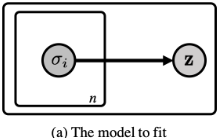
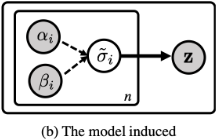
Alternative to such a hard assignment of Gaussian variance σi's, a hierarchical model shown in Figure 1(b) can relax the statistical dependency. In experiments, we find that using the model illustrated in Figure 1(a) yields sufficiently good performance. The satisfactory performance can be explained by Theorem 1, which reveals its relation to the hierarchical Bayesian generative model with ˜σi's as random variables obeying uniform distributions, i.e. ˜σi ∼ U[αi, βi].
Theorem 1. Maximizing J(Θ; σ1, ..., σn) with respect to Θ is equivalent to maximizing a lower bound of the loglikelihood of a hierarchical Bayesian generative model with ˜σi's as random variables obeying uniform distributions U[αi, βi], where αi and βi are subject to σ2 i = αiβi, 0 < αi < βi ≤ 1 for all i's; that is,
Remark 1. Suppose all the uniform distributions have equal variance, which indicates that βi -αi = τ (τ is a constant), for all i's. Note that σi = √αiβi. Then these two equations yield that σi = √α2 i + ταi, and further that αi is an increasing function of σi for σi > 0 and so is βi. This implies that the predefined hyperparameters σi's with the ordering σ1 ≥ σ2 ≥ · · · ≥ σn > 0 lead to the maximization of the log-likelihood lower bound of the hierarchical Bayesian generative models with ˜σi's locating at a non-decreasing sequence of intervals [αi, βi], separately for all i's. As shown in Figure 1, the sub-figure (a) illustrates the graphical model to fit practically and (b) demonstrates the model that (a) induces by maximizing its log-likelihood lowerbound.
Remark 2. Theorem 1 suggests that J(Θ; σ1, ..., σn) is a lower bound of log-likelihood of the hierarchical Bayesian model induced (see Figure 1(b)) when βi ≤ 1. In experiments, to achieve this theoretical bound, we enforce all σi's within the open interval (0, 1) evenly spaced in descending order. Since data intrinsic dimension is inaccessible and cannot be known a priori in most cases, such an "even-spacing" assignment is a reasonable choice for principal component learning.
Remark 3. Evaluating the log-determinant term in Eq. (3) is prohibitively expensive. We propose an efficient training procedure of Neural-PCA, which requires a gradient-stopping trick. The specific treatment is relegated to Appendix B.
3.3 LearningMean Rotation as Training Statistics
In terms of sampling and inference, a regular normalizing flow with BatchNorm layers utilizes exponential moving averages of mean and variance as training statistics when the forward or inverse operation proceeds in the test mode. However, such a moving-averaging strategy cannot be directly applied to the PCA layer in Neural-PCA, since all V 's are in the special orthogonal group SO(n) and arithmetic averaging is not closed in SO(n).
Theorem 2. For a finite positive integer M < ∞, the mean rotation M(V (1) , ..., V (M) ) of V (1) , ..., V (M) ∈ SO(n) is the orthogonal projection of the arithmetic mean of all rotation matrices V = ∑Mm=1 V (m) /M in the linear space Rn onto the special orthogonal group SO(n).
Fortunately, according to Theorem 2, we can leverage the relation between the mean rotation and the usual arithmetic mean, which allows for learning training statistics in a PCA block (including the mean and variance of BatchNorm and the rotation matrix of PCA layer):
In the last training epoch, we freeze all learnable parameters Θ of Neural-PCA, and perform an extra pass over the training data to obtain arithmetic means of statistics in BatchNorm (i.e. ¯µ and ¯σ) and the arithmetic mean of V (m) for all m = 1, ...,M, where M is the total number of batches in the last training epoch. The arithmetic means of the statistics, ¯µ and ¯σ, are used in place of the exponential moving averaged ones for the BatchNorm layer. As for the PCA layer, by virtue of Theorem 2, we solve an additional optimization problem which finds a matrix ˜ V that is closest to the arithmetic mean V in the SO(n) group: ˜ V = argminV∈SO(n)∥V - V ∥F , where V = ∑i V (i) /M and ˜ V denotes the mean rotation M(V (1) , · · · , V (M) ). We show that this optimization problem has a closed form solution: ˜ V = QP T with the proof relegated to Appendix D. Here, Q and P are left- and rightsingular vectors of V . Note that now the rotation matrix ˜ V does not depend on any test batch statistics when Neural-PCA is evaluated in the test mode. Hence, the PCA layer's forward (or inverse) operation can proceed by post-multiplying ˜ V (or ˜ V T ) with zero log-determinant of Jacobian matrix. See Algorithm 1 for the entire training procedure.
3.4 Measuring the Usefulness of Representations
Given a flow-based representation z = g(x) ∈ Rn , we consider its corrupted representations with the leading or trailing
κ dimensions removed, denoted by z↓κ+ and z↓κ-, respectively, for κ = 0, ..., n - 1. Note that z↓0+ = z↓0- = z := z↓0 which denotes the original representation z with zero dimensions removed. Since Neural-PCA aligns dimensions in descending order, removing trailing dimensions amounts to retaining leading principal components. We are interested in the usefulness of corrupted representations in terms of discriminativeness and informativeness, which can be measured by the following downstream metrics:
Nonlinear classification accuracy. For each κ, we train a classifier using z↓κ+ or z↓κ- of the training split of a dataset, choose the best model using the validation split and finally evaluate classification accuracy using the test split. For evaluation in nonlinear classification, we implement an MLP with one hidden layer (200 units) in the following network architecture: (n - κ) -200-ReLU-Dropout(0.2) -nC, where (n - κ) is the number of remaining dimensions and nC is the number of classes of a dataset in question. Note that such a narrow architecture (with 200 units) limits the expressiveness of the classifier in order to better show the class separability of the learned representations.
Linear classification accuracy. In similar fashion, for evaluation in linear classification, the classifier is replaced by a support vector machine (SVM) with linear kernel.
Mutual information estimate. Mutual information (MI) measures the statistical dependencies between two random variables. Going a step further, recent work [Tsai et al., 2020] proposed neural methods for point-wise dependency (PD) estimation, characterizing the instance-level dependency between a pair of events taken by random variables. Unlike prior methods [Belghazi et al., 2018][Poole et al., 2019], this fine-grained characterization is suitable for deterministic normalizing flows (when an instance x is given, z↓κ+ or z↓κis completely determined, but not the other way around for κ ̸= 0). To estimate MI between x and zκ (κ ̸= 0), we employ the density-ratio fitting method [Tsai et al., 2020], of which the objective is given by
Here, we instantiate the density-ratio estimator as the innerproduct in the embedding space followed by softplus activation to ensure positiveness, i.e. ˆ rφ(x, z↓κ) := 1 + softplus(⟨ϕ(f(x)), ϕ(z↓κ)⟩), where f : Rn ↦→ Rn-κ is a feature map, and ϕ : Rn-κ ↦→ Rde is a nonlinear mapping with de the dimensionality of the embedding space. Both f and ϕ are parameterized by neural networks. Then, mutual information can be evaluated by taking the expectation of the estimated log-density-ratio: I(X;Z↓κ) ≈ EPX,Z↓κ [log ˆ rφ(x, z↓κ)]. Mathematically, higher MI, I(X;Z↓κ), implies lower conditional entropy H(X|Z↓κ), suggesting that partial latent representation (corrupted) can be used to infer the original data x.
4 RelatedWork
Finding a good rotation matrix for ICA or PCA has been explored in literature. [Meng et al., 2020] proposed a trainable rotation layer, whereby the rotation matrix is parameterized with multiple trainable Householder reflections. Specifically, an n × n orthogonal matrix R is represented as a product of n Householder reflections: R = H1H2 · · ·Hn, where Hi = I -2vivT i /∥vi∥22 for any vector vi ∈ Rn , i = 1, ..., n. However, full parameterization of a rotation matrix costs O(n2 ) space, which precludes its application for high dimensional data. A potential remedy is to utilize patch-based parameterization of rotation matrices [Meng et al., 2020]. This amounts to learning rotation in each subspace separately, as the resulting rotation matrix is block-diagonal as a whole. This significantly reduces the number of parameters overall. However, we empirically show that the trainable rotation layer is agnostic to intrinsic data variations and thus fails to learn discriminative representations. In contrast, our mean rotation learning method is parameter-free and variation-aware, which provides useful representations for downstream tasks.
| Model Name | #Extra Params | BatchNorm | PCA Layer | Base |
|---|---|---|---|---|
| Baseline | 0 | - | - | IG |
| Baseline-NIG | 0 | - | - | NIG |
| Baseline-BN | O(n) | ✓ | - | NIG |
| Baseline-R | O(n2 ) | - | - | NIG |
| Baseline-BN-R | O(n2 ) | ✓ | - | NIG |
| Neural-PCA-IG | O(n) | ✓ | ✓ | IG |
| Neural-PCA | O(n) | ✓ | ✓ | NIG |
5 Experiments
5.1 Implementation Details
To demonstrate the efficacy of Neural-PCA in terms of its contributing components, throughout experiments, we consider several model variants shown in Table ?? for comparison. A baseline model (Baseline) is a regular normalizing flow with an isotropic Gaussian N(0, I) as its base density. "Baseline-NIG" is a baseline model that uses a non-isotropic Gaussian as base density. This is to show the efficacy of the PCA block of Neural-PCA. "Baseline-BN" is a baseline model with a BatchNorm layer at the end. This is to show the necessity of PCA layer in a PCA block. "Baseline-R" is a baseline model with a trainable rotation layer. "Neural-PCAIG" is the same as Neural-PCA except for the choice of an isotropic Gaussian N(0, I) as base density. We show in experiments that to learn useful representations, the PCA block and non-isotropy of base density are two essential building blocks complementary to one another.
5.2 Evaluation on Toy Datasets
For intuitive understanding, we conduct experiments on a two-dimensional toy dataset, Two-Spiral. As shown in Figure 2, each of the two colors represents one class. However, this label information is not given during training, as the goal is to show improvements on downstream tasks with latent codes that are learned in an unsupervised manner.
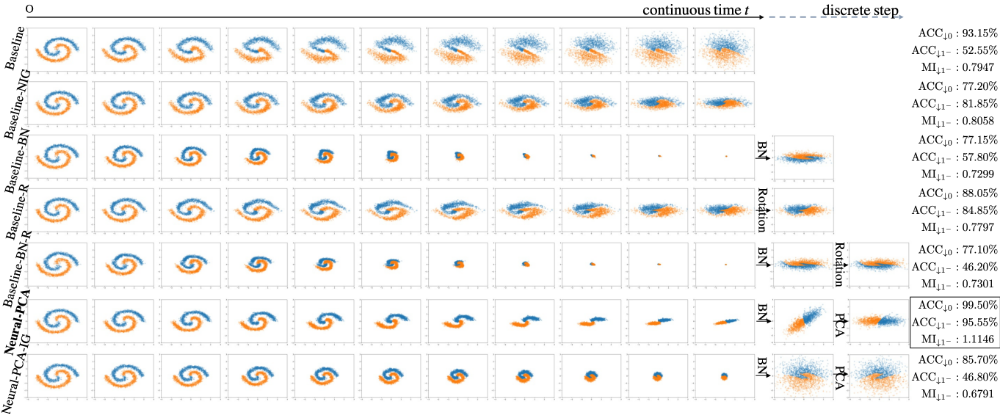
We use the state-of-the-art flow, FFJORD [Grathwohl et al., 2018], as the baseline flow for modeling distribution of tabular data. FFJORD is a continuous flow that allows unrestricted architectures as compared to Neural ODE [Chen et al., 2018]. For an instantiation of Neural-PCA, a PCA block is appended to a baseline flow. To encourage the latent ordering, a non-isotropic Gaussian density N(0, diag(1, 0.1)) is used as the base density. The batch size for training is set to 100 for all models. For Neural-PCA, the proposed projection method (cf. Section 3.3) is utilized to aggregate all rotation matrices computed from different batches. After training, models are evaluated on a linear classification task using the learned representations of 2000 test points. To measure linear separability, we use SVM with linear kernel as the binary classifier.
Ideally, as a diffeomorphism, a well-fitted flow model should unroll a spiral into a finite line segment lying in the latent space. The length of the spiral should be proportional to the largest variance and the thickness to the least. Further, to encourage axis-aligned representations, a non-isotropic Gaussian density with a diagonal covariance matrix is chosen as the base density. The ordering of the diagonals encodes our prior belief and encourages the desired unrolling behavior. This hypothesis verifies our choices for the base density, a non-isotropic Gaussian N(0, diag(1, 0.1)). As shown in Figure 2, Neural-PCA is capable of unrolling the spiral, whereas other models contract or expand the spiral, disrespecting its intrinsic manifold. Intriguingly, this unrolling behavior results in far clearer linear separability in the latent space (99.50% accuracy). Also noting that, for NeuralPCA after PCA layer, the horizontal dimension contains the largest variation and the vertical has the least, we observe that the classification boundary is almost perpendicular to the first major axis. This suggests that these two classes can still be well-separated even after dimensionality reduction (projecting points to the horizontal axis achieves 95.55% accuracy). The other methods apparently fail to do so. This visually reveals why Neural-PCA outperforms the others in learning better representations of data. In mutual information estimation, Neural-PCA also attains a higher MI estimate than other model variants. Detailed comparison and analyses can be found in Appendix E.
5.3 Evaluation on High-Dimensional Datasets
To demonstrate the effectiveness of Neural-PCA on highdimensional data, we conduct evaluations on image datasets: MNIST and FashionMNIST, which both give 1024(= 32 × 32 × 1)-dimensional spaces. Note that the original spatial sizes of MNIST and FashionMNIST data are (28 × 28 × 1). Preprocessing includes padding zeros on boundaries for such data. Dequantization is also performed by adding uniform noise to the images [Uria et al., 2013][Theis et al., 2015].
We choose the state-of-the-art flow, RQ-NSF(C) [Durkan et al., 2019], as the baseline flow for modeling image data. RQ-NSF(C) is an analytically invertible model based on monotonic rational-quadratic splines that improves the flexibility of coupling transforms. Similarly as in toy data, to encourage the ordering, we set σi's evenly from 1.0 down to 0.005, respectively for i = 1, · · · , n. All models are trained for 100,000 iterations with Adam optimizer. The batch size is set to 1800. Learning rates are annealed from 5 × 10⁻⁴ down to zero following a cosine learning policy. Similarly in the Two-Spiral setting, mean rotations are calculated using the projection method proposed in Section 3.3.
Nonlinear Classification. As shown in Figure 3(a), Neural-PCA outperforms all the other model variants by large margins when zero dimensions are removed as well as when a large fraction of trailing dimensions are removed (624 > 1024/2). Removing leading dimensions, on the other hand, gives rise to rapid decline in test accuracy of NeuralPCA, which suggests that the principal components recovered in our proposed unsupervised manner manifests strong discriminativeness of the data. We observe that Baseline-R and Baseline-BN-R learn poor representations for classification with test accuracy ∼ 10%; as the number of categories is 10 for all datasets, these two models amount to random guess.
Linear Classification by SVM. For linear classification, we use SVM with linear kernel in place of the MLP as in nonlinear classification. Similar behaviors can be observed (cf. Appendix): substantial accuracy improvements of ≳ 10% on MNIST and FashionMNIST when zero dimensions are removed. The improvements remain clear even after removing a large proportion of trailing dimensions.
Mutual Information Estimation. In terms of mutual information estimation, similar and consistent behaviors of Neural-PCA as in classification metrics can be observed, as suggested in Figure 3(b).
5.4 Comparison with Post-PCAmodels.
This section demonstrates the necessity of training flow with PCA-Block end-to-end jointly. As in the toy data setting, we consider post-PCA models based on baseline features learned by Baseline, Baseline-NIG, Baseline-BN, BaselineBN-R and Neural-PCA-IG. Our results suggest that the representations learned by these models have already been axisaligned, and therefore post-PCA on them would not result in non-trivial rotation further. Comparison results and detailed analysis can be found in Appendix F.
5.5 Miscellaneous
Other interesting properties of Neural-PCA, including generation quality, density estimation, mean rotation analysis and latent interpolation, are relegated to Appendix G, H and I, respectively. The implementation details for experiments can be found in Appendix J. Code is publicly available at https://github.com/MathsShen/Neural-PCA.
6 Conclusions
We have proposed Neural-PCA that operates in full dimensionality while capturing principal components in descending order. Consequently, the principal components recovered store the most informative elements in leading dimensions and leave the negligible in trailing ones, allowing for considerable improvements in downstream tasks. Echoing the manifold hypothesis, such improvements are empirically found consistent irrespective of the number of trailing dimensions dropped. Our work suggests that necessary inductive biases be introduced into generative modelling when representation quality is of interest.
Acknowledgements
We thank all anonymous reviewers for constructive suggestions on the manuscript of this paper. This work is in memoriam of Shen Li's Grandmother, Baoling Hong (1939-2021).
@inproceedings{ijcai2022p448,
  title     = {Neural PCA for Flow-Based Representation Learning},
  author    = {Li, Shen and Hooi, Bryan},
  booktitle = {Proceedings of the Thirty-First International Joint Conference on
               Artificial Intelligence, {IJCAI-22}},
  publisher = {International Joint Conferences on Artificial Intelligence Organization},
  editor    = {Luc De Raedt},
  pages     = {3229--3235},
  year      = {2022},
  month     = {7},
  note      = {Main Track},
  doi       = {10.24963/ijcai.2022/448},
  url       = {https://doi.org/10.24963/ijcai.2022/448},
}
TY - CPAPER TI - Neural PCA for Flow-Based Representation Learning AU - Li, Shen AU - Hooi, Bryan T2 - Proceedings of the Thirty-First International Joint Conference on Artificial Intelligence, IJCAI-22 PB - International Joint Conferences on Artificial Intelligence Organization PY - 2022 SP - 3229 EP - 3235 DO - 10.24963/ijcai.2022/448 UR - https://doi.org/10.24963/ijcai.2022/448 ER -Copied
Machine-readable versions of this paper, for tools and AI agents:





