
The Dichotomous Affiliate Stable Matching Problem: Approval-Based Matching with Applicant-Employer Relations
Proceedings of the Thirty-First International Joint Conference on Artificial Intelligence. Main Track. Pages 356-362.
https://doi.org/10.24963/ijcai.2022/51
Keywords
- Agent-based and Multi-agent Systems: Economic Paradigms, Auctions and Market-Based Systems
- Agent-based and Multi-agent Systems: Mechanism Design
Abstract
While the stable marriage problem and its variants model a vast range of matching markets, they fail to capture complex agent relationships, such as the affiliation of applicants and employers in an interview marketplace. To model this problem, the existing literature on matching with externalities permits agents to provide complete and total rankings over matchings based off of both their own and their affiliates' matches. This complete ordering restriction is unrealistic, and further the model may have an empty core. To address this, we introduce the Dichotomous Affiliate Stable Matching (DASM) Problem, where agents' preferences indicate dichotomous acceptance or rejection of another agent in the marketplace, both for themselves and their affiliates. We also assume the agent's preferences over entire matchings are determined by a general weighted valuation function of their (and their affiliates') matches. Our results are threefold: (1) we use a human study to show that real-world matching rankings follow our assumed valuation function; (2) we prove that there always exists a stable solution by providing an efficient, easily-implementable algorithm that finds such a solution; and (3) we experimentally validate the efficiency of our algorithm versus a linear-programming-based approach.
- [Ashlagi and Roth, 2021] Itai Ashlagi and Alvin E Roth. Kidney exchange: an operations perspective. Management Science, 2021.
- [Aziz, 2020] Haris Aziz. Strategyproof multi-item exchange under single-minded dichotomous preferences. AAMAS, 2020.
- [Baccara et al., 2012] Mariagiovanna Baccara, Ays ¸e İmrohoroglu, Alistair J Wilson, and Leeat Yariv. A field study on matching with network externalities. AER, 2012.
- [Bando, 2012] Keisuke Bando. Many-to-one matching mar- kets with externalities among firms. Journal of Mathemat- ical Economics, 2012.
- [Bando, 2014] Keisuke Bando. A modified deferred accep- tance algorithm for many-to-one matching markets with externalities among firms. Journal of Mathematical Eco- nomics, 2014.
- [Bogomolnaia and Moulin, 2004] Anna Bogomolnaia and Hervé Moulin. Random matching under dichotomous preferences. Econometrica, 2004.
- [Brânzei et al., 2013] Simina Brânzei, Tomasz Michalak, Talal Rahwan, Kate Larson, and Nicholas R Jennings. Matchings with externalities and attitudes. In AAMAS, 2013.
- [Cooper and Manlove, 2020] Frances Cooper and David Manlove. Algorithms for New Types of Fair Stable Match- ings. In SEA, 2020.
- [Dickerson et al., 2019] John Dickerson, Karthik Sankarara- man, Kanthi Sarpatwar, Aravind Srinivasan, Kung-Lu Wu, and Pan Xu. Online resource allocation with matching constraints. In AAMAS, 2019.
- [Dooley and Dickerson, 2020] Samuel Dooley and John P Dickerson. The affiliate matching problem: On labor mar- kets where firms are also interested in the placement of previous workers. arXiv preprint arXiv:2009.11867, 2020.
- [Echenique and Yenmez, 2007] Federico Echenique and M Bumin Yenmez. A solution to matching with prefer- ences over colleagues. GEB, 2007.
- [Feder, 1995] Tomás Feder. Stable networks and product graphs, volume 555. AMS, 1995.
- [Gale and Shapley, 1962] David Gale and Lloyd S Shapley. College admissions and the stability of marriage. The American Mathematical Monthly, 1962.
- [Gupta et al., 2019] Sushmita Gupta, Sanjukta Roy, Saket Saurabh, and Meirav Zehavi. Balanced stable marriage: How close is close enough? In WADS. Springer, 2019.
- [Hafalir, 2008] Isa E Hafalir. Stability of marriage with ex- ternalities. IJGT, 2008.
- [Jones and Teytelboym, 2018] Will Jones and Alexander Teytelboym. The local refugee match: Aligning refugees' preferences with the capacities and priorities of localities. Journal of Refugee Studies, 2018.
- [Kamiyama, 2020] Naoyuki Kamiyama. On stable match- ings with pairwise preferences and matroid constraints. In AAMAS, 2020.
- [Kawase and Iwasaki, 2020] Yasushi Kawase and Atsushi Iwasaki. Approximately stable matchings with general constraints. In AAMAS, 2020.
- [Kurokawa et al., 2018] David Kurokawa, Ariel D Procac- cia, and Nisarg Shah. Leximin allocations in the real world. ACM TEAC, 2018.
- [Li et al., 2014] Jian Li, Yicheng Liu, Lingxiao Huang, and Pingzhong Tang. Egalitarian pairwise kidney exchange: fast algorithms via linear programming and parametric flow. In AAMAS, 2014.
- [Manlove, 2013] David Manlove. Algorithmics of matching under preferences. World Scientific, 2013.
- [McDermid and Irving, 2014] Eric McDermid and Robert W Irving. Sex-equal stable matchings: Complexity and exact algorithms. Algorithmica, 2014.
- [Mumcu and Saglam, 2010] Ays ¸e Mumcu and Ismail Saglam. Stable one-to-one matchings with externalities. Mathematical Social Sciences, 2010.
- [Ortega, 2020] Josué Ortega. Multi-unit assignment under dichotomous preferences. Mathematical Social Sciences, 2020.
- [Perrault et al., 2016] Andrew Perrault, Joanna Drummond, and Fahiem Bacchus. Strategy-proofness in the stable matching problem with couples. In AAMAS, 2016.
- [Pycia, 2012] Marek Pycia. Stability and preference align- ment in matching and coalition formation. Econometrica, 2012.
- [Rastegari et al., 2016] Baharak Rastegari, Paul Goldberg, and David F. Manlove. Preference elicitation in match- ing markets via interviews: A study of offline benchmarks (extended abstract). In AAMAS, 2016.
- [Roth, 2002] Alvin E Roth. The economist as engineer: Game theory, experimentation, and computation as tools for design economics. Econometrica, 2002.
- [Roth, 2018] Alvin E Roth. Marketplaces, markets, and mar- ket design. AER, 2018.
- [Sandholm and Boutilier, 2006] Tuomas Sandholm and Craig Boutilier. Preference elicitation in combinatorial auctions. Combinatorial Auctions, 2006.
- [Sasaki and Toda, 1996] Hiroo Sasaki and Manabu Toda. Two-sided matching problems with externalities. J. Econ. Theory, 1996.
- [Sethuraman et al., 2006] Jay Sethuraman, Chung-Piaw Teo, and Liwen Qian. Many-to-one stable matching: geometry and fairness. Math. Oper. Res., 2006.
- [Shen et al., 2020] Weiran Shen, Pingzhong Tang, Xun Wang, Yadong Xu, and Xiwang Yang. Learning to design coupons in online advertising markets. In AAMAS, 2020.
- [Tziavelis et al., 2019] Nikolaos Tziavelis, Ioannis Gian- nakopoulos, Katerina Doka, Nectarios Koziris, and Pana- giotis Karras. Equitable stable matchings in quadratic time. In NeurIPS, 2019.
- [Tziavelis et al., 2020] Nikolaos Tziavelis, Ioannis Gian- nakopoulos, Rune Quist Johansen, Katerina Doka, Nec- tarios Koziris, and Panagiotis Karras. Fair procedures for fair stable marriage outcomes. In AAAI, 2020.
References were extracted automatically from the PDF and may contain errors.
Full text extracted automatically from the PDF; figures, tables and equations may differ. The PDF is the version of record.
1 Introduction
In many markets, two classes of participants seek to be paired with each other. For example, in labor markets, workers are paired with firms [Perrault et al., 2016]; in online advertising, eyeballs are paired with advertisements [Shen et al., 2020; Dickerson et al., 2019]; and, in morally-laden settings such as refugee resettlement and organ donation, refugees are paired with new housing locations [Jones and Teytelboym, 2018] and donors are paired with needy recipients [Ashlagi and Roth, 2021; Li et al., 2014], respectively. The field of market design purports to provide analytically-sound and empirically-validated approaches to the design and fielding of such matching markets, and necessarily joins fields such as economics and computer science [Roth, 2002; Roth, 2018].
The seminal work of Gale and Shapley [1962] characterized the stable marriage problem, where both sides of a market-workers and firms, refugees and settlement locations, etc.-express preferences over the other side, and the goal is to find a robust matching that does not unravel in the face of agents' selfish behavior. Myriad generalizations were proposed in the following decades; see Manlove [2013] for an overview of the history and variants of these problems. Largely, these models assume that agents' preferences only consider the direct impact of an outcome on that agent.
One extension of stable marriage is matching with externalities wherein agents on each side of a two-sided market have preferences over their own match and the matches of others. These models often incorporate many more realistic and complex assumptions which makes for a richer and harder to analyze matching setting [Pycia, 2012; Echenique and Yenmez, 2007; Baccara et al., 2012]. Sasaki and Toda [1996] first introduced matching with externalities, where agents' decisions to deviate from a proposed match depended on reasonable assumptions for the reaction of other agents to the deviation. Hafalir [2008] and Mumcu and Saglam [2010] expand upon this stability notion for one-toone matchings with further restrictions on agent behavior; while Bando [2012; 2014] extends the analysis to many-toone matchings where firms consider other firms' externalities.
Much work in the matching with externalities literature focuses on the appropriateness of various stability definitions. Much analysis then centers on the complexity and hardness of the proposed matching algorithms. For instance, Brˆanzei [2013] models agent values in matching with externalities as arbitrary functions and creates a valuation as a sum over the agent's values over all matches. In our work, an agent values a match as either acceptable or unacceptable (dichotomously), and we do a (weighted) sum over all relevant matches for the agent to get their valuation. While there is existing work on the complexities of these matchings, eliciting general preferences over a complex market can be intractable, both with respect to human ability and computational/communication complexity [Rastegari et al., 2016; Sandholm and Boutilier, 2006]. One commonly imposed assumption is that of dichotomous preferences [Bogomolnaia and Moulin, 2004], which coarsely places alternatives into acceptable or unacceptable bins.
This work is inspired by Dooley and Dickerson [2020], which explores matching with externalities in academic faculty hiring; however, in our work, we analyze the marketplace with dichotomous preferences. Our main motivation is the academic faculty interview marketplace, where we match interview slots for universities and graduating students, and universities care about their graduating students' matches. Other motivations include playdate matching, study abroad, student project allocation, and the dog breeding market.
We note that the only simplification we introduce to the Dooley and Dickerson model is that of binary preferences. This assumption is prevalent in various matching settings like resource allocation [Ortega, 2020] and more specifically in the allocation of unused classrooms in a school setting [Kurokawa et al., 2018] and barter exchange [Aziz, 2020]. With this additional assumption, we are able to provide positive and constructive principled approaches to clearing (dichotomous) affiliate matching markets.
Our contributions. We view our contributions as follows.
- We introduce the Dichotomous Affiliate Stable Matching (DASM) Problem, which characterizes the affiliate matching problem under dichotomous preferences to better accommodate realistic preference elicitation constraints, along with a valuation function for agents to rank matches based off their preferences, parameterized by an employer's relative valuation of its affiliates' and its own matches (§2);
- We run a human survey to provide support for the model design choices, showing that real people in some situations may, indeed, adhere to our valuation function under different parameters (§3);
- We propose an efficient algorithm to solve the DASM Problem (§4), i.e., yield a stable matching; and
- We perform experimental validation of our algorithmic approach to verify its correctness and scalability (§5).
2 Model Definition
We now present our matching model. This model represents hiring interview markets where applicants have previous affiliations with employers and preferences are encoded as binary values that denote interest or disinterest (i.e., dichotomous preferences [Bogomolnaia and Moulin, 2004]). We describe the model in the most general many-to-many setting. We formalize the model, including defining valuation functions (§2.1), stability, and other useful concepts (§2.2).
2.1 The Dichotomous Affiliate Stable Matching Problem
In the Dichotomous Affiliate Stable Matching (DASM) Problem, we are given sets A of n applicants and E of m employers. For every a ∈ A (resp. e ∈ E), we are given a complete preference function pra : E → {0, 1} (resp. pree : A → {0, 1}, the notational difference will be clear later). If u and v are on opposite sides, then we say u is interested in or likes v if pru(v) = 1 (or pruu (v) = 1 if u ∈ E), otherwise u is disinterested in v. The many-tomany matching scenario specifies that u might be matched with as many as q(u) agents on the other side of the market, where q(u) is the capacity of u. A valid matching is a function µ : A ∪ E → 2A∪E such that for any a ∈ A (resp.
e ∈ E): µ(a) ⊆ E (resp. µ(e) ⊆ A), |µ(a)| ≤ q(a) (resp. |µ(e)| ≤ q(e)), and e ∈ µ(a) if and only if a ∈ µ(e).
One defining aspect of this market is the notion of affiliates which represent previous relationships between agents. Let aff : E → 2A return an employer's set of affiliate. For instance, in Figure 1, a1 is e1's affiliate, and a2 and a3 are both e2's affiliates. Then aff(e1) = {a1}, aff(e2) = {a2, a3}, and aff(e3) = ∅. Note that aff over all e ∈ E forms a disjoint cover of A, so each applicant is the affiliate of exactly one employer. In this model, e cares about its affiliates' matches. To express this, for any a ∈ aff(e), e has preferences prae : E → {0, 1}. To account for these preferences, e's valuation of matchings is over tuples of its own and its affiliates' matches. While these valuations may be general, we will examine a natural and flexible additive valuation method.
Definition 1. For any e ∈ E and a ∈ A, we define the weighted valuation function over a match µ for a given weight λ ∈ [0, 1] as:
And we say e or a prefers µ to µ′ (µ ≻e µ′ or µ ≻a µ′ ) if and only if vale(µ) > vale(µ′ ) or vala(µ) > vala(µ′ ).
This function does not necessarily create a total order over matchings, as an agent may have the same valuation for two distinct matchings. Then it does not prefer one matching to another. In the employer version, λ parameterizes how employers weigh the value of their affiliates' matches with respect to their own matches. It may be agreed upon by employers or set by a centralized system in order to avoid potential abuse of this parameter. If λ = 1, then an employer cares about each affiliate match as much as each of its own matches. If λ = 0, employers do not care about their affiliates' matches. If λ = ϵ for small ϵ > 0, employers care about their matches first and use affiliates' matches as tiebreakers.
To understand the role of λ, consider again our example in Figure 1 and let λ = 1. Then e2's valuations of µ and µ′ are: vale2 (µ) = 3 (since it likes one of its matches and both of its affiliates' matches) and vale2 (µ′ ) = 2 (since it likes both of its matches). Therefore µ ≻e2 µ′ . If λ = ϵ, then e2's valuations of the matchings are: vale2 (µ) = 1 + 2ϵ and vale2 (µ′ ) = 2. This means µ ≺e2 µ′ . As we discuss later, this illustrates how λ can affect which matchings are stable.
2.2 Blocking Tuples and Stability
Next, we define the notion of stability in the DASM Problem. As in the standard stable marriage problem [Gale and Shapley, 1962] and its many variants, our notion of stability relies on the (non)existence of blocking tuples. The blocking tuple-traditionally, blocking pair-is designed to identify a set of unmatched individuals who might cheat in order to match with each other. We formalize cheating as follows:
Definition 2. Consider an instance of the DASM Problem with matching µ. An agent a ∈ A ∪ E cheats if they break a match with some agent a′ ∈ µ(a).

Like in the standard stable marriage problem, we would like to ensure that no two agents 1 a ∈ A and e ∈ E will agree to cheat on their assigned match to (possibly) match with each other assuming no other agents cheat. In stable marriage, the only way (up to) two agents will cheat, and thus cause instability, is if they prefer each other to their matches.
In our setting, stability is not as simple. Let a ∈ A and e ∈ E be two agents who consider cheating on matches e′ ∈ µ(a) and a′ ∈ µ(e) respectively. Once e′ and a′ lose their matches with a and e, they could naturally consider filling that empty space in their capacities by matching with each other (this is not cheating). In stable marriage, we do not need to model e′ 's and a′ 's reaction because this does not impact e's and a's decisions to cheat. In the DASM Problem, however, e's preference profile is more complicated. For instance, if a′ ∈ aff(e), and e wants a′ to be matched with e′ , e might decide to cheat on a′ so that a′ will fill its new empty capacity by matching with e′ . Note that this still does not require a′ or e′ to cheat, since they are only forming matches instead of breaking them.
To this end, we define our notion of the blocking tuple to capture not only the cheating between two agents, but also the responses of those whose matches have been broken.
Definition 3. Consider an instance of the DASM Problem with matching µ and some tuple T = (a1, . . . , ak) where ai ∈ A ∪ E for all i ∈ [k]. Construct µ′ with the following process:
- Allow up to two agents in T to cheat on one match each. If exactly two agents cheat, they then match with each other. Otherwise, the sole cheater may match assuming this new match does not violate any capacities.
- All other agents in T are then allowed to form new matches up to their capacity.
Then T is a blocking tuple if: (1) all cheating agents strictly prefer µ′ to µ, and (2) for any other agent a ∈ T that forms a match with a′ ∈ T , a strictly prefers µ′ to µ′ \ {(a, a′ )}. An instance of the DASM Problem is stable if and only if it contains no blocking tuples.
In stable marriage, this becomes the same standard notion of cheating, and therefore this is a natural extension of the stable marriage blocking pair. In Definition 3, a cheating agent would only cheat if they know other agents could respond in a way such that the resulting matching is preferable to the original matching. After cheating occurs, non-cheating agents will respond with a match if they would prefer to have that match in the final matching. Thus, non-cheating agents are not performing calculated activity; they are simply reacting.
1 In future work, this could be generalized to coalitions, or larger sets of agents.
Interestingly, we only need to consider certain blocking tuples of size at most six to determine instability. See Proposition 2 and the full version of our paper for reasoning and a proof. These properties are captured by the potential blocking tuple, a tuple of size at most six with the appropriate agents such that, given the right preference profiles, they could be blocking tuples. To accommodate the sextuplet notation, we introduce the "empty agent", γ, and a set E = {γ}, which represents the absence of an agent. Formally, γ is an agent in the system with no side or affiliation and zero capacity. Additionally, given a matching µ, we must notate the agents who have remaining capacity. Let N A µ = {a ∈ A : |µ(a)| < q(a)} and N E µ = {e ∈ E : |µ(e)| < q(e)}.
Definition 4. Consider an instance of the DASM Problem with matching µ. A tuple T = (a, a′ , a′′ , e, e′ , e′′ ) is a potential blocking tuple for µ if all the following hold:
We now clarify the purpose of each condition respectively:
- a must be an applicant.
- e must be an employer that is not matched with a (else they cannot form a blocking tuple).
- a′ is e's old match that is broken. If e simply has additional capacity, then a′ ∈ E is an empty agent.
- e′ is a's old match that is broken. If a simply has additional capacity, then e′ ∈ E is an empty agent.
- a′′ is e′ 's new match. It must have unmatched capacity, or (if e′ and a′ decide to match) is instead a′ itself. It could be an empty agent if e′ does not rematch (and must be if e′ is an empty agent). Additionally, we must ensure it was not previously matched to e′ .
- e′′ is a′ 's new match. It must have unmatched capacity, or (if e′ and a′ decide to match) is instead e′ itself. It could be an empty agent if a′ does not rematch (and must be if a′ is an empty agent). Additionally, we must ensure it was not previously matched to a′ .
- If e′ matches with a′ (where a′ = a′′ /∈ E), then a′ must match with e′ (where e′ = e′′ /∈ E).
Consider Figure 1 and tuple (a3, a2, a2, e2, e1, e1). Some agents are duplicated in this tuple; this is okay. This potential blocking tuple describes the following changes: (1) a3 breaks its match with e1, (2) e2 breaks its match with a2, (3) a3 and e2 match together, and (4) a2 and e1 match together. Note that the last part occurs because a2 and e1 appear twice in the tuple. If we rewrite the tuple as (a3, a2, a′2 , e2, e1, e′1 ) to distinguish duplicate instances, then a′2 indicates that e1 matches with a2 and e′1 indicates a2 matches with e1.
Definition 4's matching constraints ensure that broken and formed matches in this process make sense (e.g., no two agents will be matched to each other twice). When we consider a blocking tuple, we must compare the matching to the alternative matching that occurs after swapping as described.
Definition 5. Consider an instance of the DASM Problem with matching µ and a potential blocking tuple T = (a, a′ , a′′ , e, e′ , e′′ ). Let µ′ be defined by starting at µ, breaking the matches (a, e′ ) and (a′ , e), adding match (a, e), and adding matches (a′ , e′′ ) and (a′′ , e′ ) if and only if those variables are not in E respectively. Then µ′ is the swapped matching of µ with respect to T .
In Figure 1, µ′ is the swapped matching of µ with respect to (a3, a2, a2, e2, e1, e1). Note that it is a valid matching.
Proposition 1. If µ is a matching and µ′ is the swapped matching of µ with respect to some potential blocking tuple T , then µ′ is a matching.
See our full paper for a proof. Now we show that the set of potential blocking tuples are sufficient consideration to show that an instance of the DASM Problem is unstable.
Proposition 2. Consider an instance of the DASM Problem with matching µ. Then µ is unstable if and only if there exists a potential blocking tuple T = (a, a′ , a′′ , e, e′ , e′′ ) with respective swapped matching µ′ for µ such that:
- µ ≺a µ′
- µ ≺e µ′
- If a′ /∈ E, then µ′ \ {(a′ , e′′ )} ≺a′ µ′
- If e′ /∈ E, then µ′ \ {(a′′ , e′ )} ≺e′ µ′
- If a′′ /∈ E, then µ′ \ {(a′′ , e′ )} ≺a′′ µ′
- If e′′ /∈ E, then µ′ \ {(a′ , e′′ )} ≺e′′ µ′
See our full paper for a proof. In the rest of the paper, we assume all blocking tuples take this form. The first two conditions ensure that a and e prefer the new match µ′ to µ. The next four state that in the context of µ′ , all of a′ , e′ , a′′ , and e′′ must actively desire the new match. In these conditions, we only care if a′ , a′′ , e′ , and e′′ are not in E (i.e., they exist).
Consider again Figure 1 when λ = 1. Recall that T = (a3, a2, a2, e2, e1, e1) is a potential blocking tuple for µ and µ′ is the swapped matching of µ with respect to T . When λ = 1, we already showed that e2 prefers µ′ to µ. Additionally, since a3 doesn't like its match in µ but likes its match in µ′ , it also prefers µ′ . Once a3 and e2 have broken their matches with a2 and e1 respectively, a2 and e1 have an active interest in matching. This implies that T satisfies all constraints in Proposition 2 and is a blocking tuple. When λ = ϵ, since e2 does not prefer µ′ to µ, this is not a blocking tuple.
| λ = 1 | ||||||||
|---|---|---|---|---|---|---|---|---|
| Scenario | 1 | 2 | 3 | 4 | 5 | 6 | 7 | 8 |
| Random | 10% | 5% | 5% | 3% | 100% | 10% | 10% | 3% |
| Observed Unprimed | 41% | 31% | 30% | 56% | 100% | 42% | 25% | 30% |
| Observed Primed | 41% | 44% | 35% | 55% | 100% | 51% | 22% | 45% |
| Scenario | 1 | 2 | λ = ϵ 3 | 4 | 5 | 6 | 7 | 8 |
| Random | 3% | 1% | 1% | 3% | 20% | 3% | 3% | 1% |
| Observed Unprimed | 14% | 15% | 18% | 56% | 30% | 17% | 16% | 17% |
| Observed Primed | 18% | 34% | 20% | 55% | 37% | 28% | 10% | 34% |
3 Evidence from a Human Experiment
This survey evaluates the applicability of our valuation function proposed for the DASM Problem. More details of methods and results can be found in the full version of our paper.
In the survey, participants were asked to identify as a university in a DASM Problem instance with an affiliated graduating student. Across multiple problem instances, the survey presented the user with binary preferences over relevant matches and five possible matchings. It then asked the users to rank the matchings. For each question, we found the preference profiles that emerge from our weighted valuation function when λ ∈ {ϵ, 1} and then computed: (1) the chance of randomly selecting the profiles, and (2) empirical adherence to the profiles. These results are depicted in Table 1.
Our results show that participants' ranking adherence to each valuation function is statistically significant, though not consistent. For a deeper quantitative analysis, see our full paper. More qualitatively, participants expressed differing philosophies. Some participants were very direct with their strategies, even stating: "My needs first, then Ryan's", where Ryan is the example affiliate. We see that our two valuation function versions align with this general strategy. On the other end of the spectrum, there were participants who were uncomfortable with the ability to express a preference over their affiliate's match. One participant said, "If Ryan doesn't get matched with my school, why would I care what others he matched with? Is it any of my business?" This indicates that there are clearly different strategies, but also different philosophical approaches to the affiliate matching problem.
4 DASM Solved in Quadratic Time
We now introduce a quadratic (in the number of agents) algorithm, SmartPriorityMatch, to solve the DASM Problem. Inputs are assumed to be a A of applicants and E of employers, where each agent reports all appropriate approval lists (i.e., binary vectors). Let n = |A| and m = |E|. All proofs and pseudocode can be found in the full version of this paper.
Theorem 1. SmartPriorityMatch solves the DASM Problem in O(nm) time for any λ ∈ [0, 1].
SmartPriorityMatch puts a "priority level" on each applicant-employer pair. For instance, a pair (a, e) ∈ A×E where a ∈ aff(e) and each agent is maximally interested in the match (pree (a) = prae (e) = pra(e) = 1) is a "highest" priority edge. For each priority level, we construct bipartite graphs with partitions A and E where edges correspond to pairs of that priority level. The edge sets for the different priority levels (from highest to lowest priority) are as follows:
- G0- Edges between an e ∈ E and a ∈ aff(e) if they have maximum interest for the match: pree (a) = 1, prae (e) = 1, and pra(e) = 1.
- G1- Edges between an e ∈ E and a ∈ A \ aff(e) if they are interested in each other: pree (a) = 1 and pra(e) = 1.
- G2- Edges between an e ∈ E and a ∈ aff(e) if they are interested in each other for their own match: pree (a) = 1 and pra(e) = 1.
- G3- Edges between an e ∈ E and a ∈ aff(e) if e is interested in itself for a and a is interested in e: prae (e) = 1 and pra(e) = 1.
Next, we would like to run simple maximal b-matchings (i.e., many-to-many matchings) on these graphs in this order, decreasing the quotas as matches are made. Unfortunately, this method cannot ensure stability. Call this algorithm PriorityMatch. While this does not provide us with the desired results, it will set a strong foundation for SmartPriorityMatch.
Lemma 1. There exists a DASM Problem instance where PriorityMatch may not find a stable matching.
Intuitively, PriorityMatch's fault is that it is not sufficiently forward-looking. For instance, an employer e that can match with one of two of its affiliates a1 and a2 in G0 cannot greedily distinguish between the two. Therefore it could arbitrarily match with a1, and a2 could match with another employer e′ in G1. If e likes the match (e′ , a1) and not (e′ , a2), then it should have matched with a2 and let a1 match with e′ . This creates a blocking tuple (e, e′ , e′ , a2, a1, a1). This problem only arises when an employer might match with its affiliates who have the opportunity to match with other employers later on, which only happens on G0. However, we find that PriorityMatch could find a stable matching for these examples given a smart enough way to find the maximal b-matchings.
Lemma 2. PriorityMatch solves the DASM Problem with parameter λ ∈ [0, 1] in O(nm) time if it can ensure that for any potential blocking tuple T = (a, a′ , a′′ , e, e′ , e′′ ) such that a, a′ ∈ aff(e) and a prefers the swapped matching of µ with respect to T , then:
To achieve this, our maximal b-matchings must depend on lower-priority graphs. Instead of running the matchings in order, we will use reserved matchings, defined as follows.
Definition 6. Consider a graph G = (V,E, q, S, r), where V, E, and q are the standard b-matching parameters, S ⊆ 2V is the set of affiliations, and r : S → N is a reservation function such that r(S) ≤ |S| for all S ∈ S. A reserved maximal b-matching µ is a b-matching that is maximal under the additional constraint that for each S ∈ S, there are at least r(S) elements in S that have not met their capacity: |{s ∈ S : |µ(s)| < q(s)}| ≥ r(S).
Consider an affiliation with 10 vertices, each with 100 capacity. The affiliation might have a reservation of 9 (of a max possible 10). We could match each vertex in the affiliation 99 times and one vertex 100 times. Only one vertex has reached its capacity, thus satisfying the reservation. We defer to our full paper for a simple greedy solution to this problem.
Our algorithm starts with a reserved matching on G1, where reservations ensure we can still find a maximal matching on G0 afterwards. Since each a ∈ A may only be adjacent to aff -1 (a) in G0, G0 is a set of disjoint stars with centers e ∈ E. This allows e to match to any subset S ⊆ N0(e) of size exactly |S| = min(|N0(e)|, q0(e)), where N0(e) is the neighborhood around e in G0 and q0(e) is the capacity of e in G0 (which is just its starting capacity). To ensure e can do this after a reserved maximal b-matching in G1, we must reduce the quota of e in G1 to q1 = q0(e)-min(|N0(e)|, q0(e)) and ensure that at least min(|N0(e)|, q0(e)) of its neighbors in N0(e) have at least one capacity remaining via a reservation on N0(e). Therefore, when we run the reserved maximal b-matching on G1, we use affiliations S1 = {N0(e), e ∈ E} with reservations r(N0(e)) = min(|N0(e)|, q0(e)).
We now describe our algorithm. First, run a reserved maximal b-matching on G1. Next, run the standard PriorityMatch process on G0, G2, and G3. For more details, see the full version of our paper. The four resulting matchings are disjoint, and we can show that SmartPriorityMatch is in fact an intelligent implementation of PriorityMatch.
Lemma 3. SmartPriorityMatch's output will always be equivalent to that of PriorityMatch with a specific maximal matching function.
Finally, we can show that SmartPriorityMatch satisfies the conditions posed in Lemma 2. This concludes Theorem 1. We briefly note that this algorithm solves the problem for any weight λ ∈ [0, 1], 2 however the algorithm itself does not depend on λ. Thus, there must exist a matching that is stable for all λ. We conjecture that increasing the value of λ simply makes stability more difficult to achieve (i.e., for 1 ≥ λ > λ′ ≥ 0, a stable solution for λ is also stable for λ′ ).
5 Scalability Experiments
This section provides experimental validation for the polynomial-time scalability of SmartPriorityMatch, as analyzed in Theorem 1. To the best of our knowledge, our model is new, so there is no direct benchmark from the literature. Because of this, following the path of others (e.g., recently Cooper and Manlove [2020]), we instead model our problem as an integer linear program (ILP) and compare against that baseline. As in Cooper and Manlove [2020] and other works, we also use that ILP as a "safety check" to ensure that our algorithmic approach and a general mathematicalprogramming-based solution method align in their results. The formulation of the ILP and its proof can be found in our full paper. It translates the set of potential blocking tuples (i.e., our blocking tuple search space) into ILP constraints. Since there are O(n3 · m3 ) potential blocking tuples on n applicants and m employers, the ILP has O(n3 ·m3 ) constraints.
To confirm the efficiency of SmartPriorityMatch, we compare it to the baseline ILP described in the full version of our paper. We use similar runtime experiments used by Tziavelis et al. [2019] adapted to the DASM setting. We have four parameters: (1) m, the number of employers, (2) n/m, the number of affiliates per employer, (3) q, the capacity for each applicant, and (4) t ∈ (0, 1), a threshold parameter. This means that the number of applicants is n, and we let employer capacity be q · n/m. We use Tziavelis et al. [2019]'s Uniform data, where we find a uniform random total ranking for each agent and we use the threshold parameter such that an agent with ranking r is approved if r > t · n. In other words, for each agent, we assign a preference of 1 to the top 100t% of its uniformly randomly ranked preferences. In Figure 2, we run 50 trials for each setting and take the average runtime.
2 We additionally note that with a slight modification to edge priority, our algorithm could work for λ ∈ [0,∞).
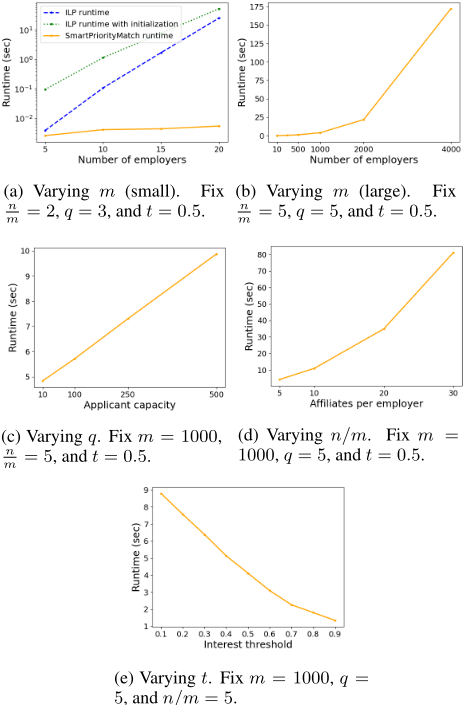
We then vary m from 5 to 20 and compare the performances of SmartPriorityMatch and the ILP (Figure 2a) with n/m = 2, q = 3, and t = 0.5 fixed. Since the ILP requires O(n3 ·m3 ) constraints, its runtime is very large for even small n. Due to our system's space constraints, we were only able to go up to n = 20. We plotted the performance of the ILP with and without the time to initialize the ILP. We see that SmartPriorityMatch exhibits much better performance, particularly when we include the time to initialize the ILP itself.
Next we plot SmartPriorityMatch's performance on larger sets, varying parameters one at a time. With m from 10 to 4000 (Figure 2b), we further support its scalability over the ILP. Varying q from 5 to 500 (Figure 2c), we see SmartPriorityMatch is dependent on capacity, but in practical ranges, it has less of an impact than varying m. With n/m from 5 to 30 (Figure 2d), we see that increasing n/m has a significant impact on runtime. Finally, varying t from 0.10 to 0.90, smaller thresholds appear to increase the runtime (i.e., when agents have a lower bar for expressing interest in other agents).
6 Conclusions &Future Research
We propose a new model, the DASM Problem, that characterizes Dooley and Dickerson [2020]'s affiliate matching problem under dichotomous preferences. Dichotomous, or approval-based, preferences are often more realistic for preference elicitation and their application to this model allows for stronger theoretical results. To rank matchings, we use a weighted function that computes agent matching valuations based off their and their affiliates' preferences. In a human survey, we support the real-world value use of the valuation function with different weights. We then develop (and prove) a quadratic time algorithm to solve the DASM Problem, experimentally validating its efficiency against a baseline ILP.
This work could be extended by considering more general valuation functions, particularly by giving employers more freedom over the relative value of their and their affiliates' matches. We may draw intuition from recent "same-class" preference extensions to the stable marriage problem such as the work of Kamiyama [2020] or from stable matching work with constraints [Kawase and Iwasaki, 2020]. Similarly, we should consider concerns of fairness (other than stability). Fair stable matching has a long history [Feder, 1995; McDermid and Irving, 2014], with hardness results [Gupta et al., 2019] for various forms of matching (e.g., with incomplete preferences [Cooper and Manlove, 2020] or other fairness constraints such as median-ranked assignment [Sethuraman et al., 2006], equitable matching [Tziavelis et al., 2019], procedural fairness [Tziavelis et al., 2020], etc.), many of which could be applied to the DASM setting.
Acknowledgements
We thank Haris Aziz and Duncan McElfresh for comments on earlier versions of this work. This research was supported in part by NSF CAREER Award IIS-1846237, NSF D-ISN Award #2039862, NSF Award CCF-1852352, NIH R01 Award NLM-013039-01, NIST MSE Award #20126334, DARPA GARD #HR00112020007, DoD WHS Award #HQ003420F0035, NSF BIGDATA Grant #1546108, NSF SPX Grant #1822738, NSF CCF grant #2114269, ARCS Endowment Award, and Ann G. Wylie Fellowship.
@inproceedings{ijcai2022p51,
  title     = {The Dichotomous Affiliate Stable Matching Problem: Approval-Based Matching with Applicant-Employer Relations},
  author    = {Knittel, Marina and Dooley, Samuel and Dickerson, John},
  booktitle = {Proceedings of the Thirty-First International Joint Conference on
               Artificial Intelligence, {IJCAI-22}},
  publisher = {International Joint Conferences on Artificial Intelligence Organization},
  editor    = {Luc De Raedt},
  pages     = {356--362},
  year      = {2022},
  month     = {7},
  note      = {Main Track},
  doi       = {10.24963/ijcai.2022/51},
  url       = {https://doi.org/10.24963/ijcai.2022/51},
}
TY - CPAPER TI - The Dichotomous Affiliate Stable Matching Problem: Approval-Based Matching with Applicant-Employer Relations AU - Knittel, Marina AU - Dooley, Samuel AU - Dickerson, John T2 - Proceedings of the Thirty-First International Joint Conference on Artificial Intelligence, IJCAI-22 PB - International Joint Conferences on Artificial Intelligence Organization PY - 2022 SP - 356 EP - 362 DO - 10.24963/ijcai.2022/51 UR - https://doi.org/10.24963/ijcai.2022/51 ER -Copied
Machine-readable versions of this paper, for tools and AI agents:





