
Interpretable AMR-Based Question Decomposition for Multi-hop Question Answering
Proceedings of the Thirty-First International Joint Conference on Artificial Intelligence. Main Track. Pages 4093-4099.
https://doi.org/10.24963/ijcai.2022/568
Keywords
- Natural Language Processing: Interpretability and Analysis of Models for NLP
- Natural Language Processing: Language Generation
- AI Ethics, Trust, Fairness: Explainability and Interpretability
- Natural Language Processing: Question Answering
- Data Mining: Mining Graphs
Abstract
Effective multi-hop question answering (QA) requires reasoning over multiple scattered paragraphs and providing explanations for answers. Most existing approaches cannot provide an interpretable reasoning process to illustrate how these models arrive at an answer. In this paper, we propose a Question Decomposition method based on Abstract Meaning Representation (QDAMR) for multi-hop QA, which achieves interpretable reasoning by decomposing a multi-hop question into simpler subquestions and answering them in order. Since annotating the decomposition is expensive, we first delegate the complexity of understanding the multi-hop question to an AMR parser. We then achieve decomposition of a multi-hop question via segmentation of the corresponding AMR graph based on the required reasoning type. Finally, we generate sub-questions using an AMR-to-Text generation model and answer them with an off-the-shelf QA model. Experimental results on HotpotQA demonstrate that our approach is competitive for interpretable reasoning and that the sub-questions generated by QDAMR are well-formed, outperforming existing question-decomposition-based multihop QA approaches.
- [Bevilacqua et al., 2021] Michele Bevilacqua, Rexhina Blloshmi, and Roberto Navigli. One spring to rule them both: Symmetric amr semantic parsing and generation without a complex pipeline. In Proceedings of the Thirty-Fifth AAAI Conference on Artificial Intelligence, 2021.
- [Cai and Lam, 2020] Deng Cai and Wai Lam. Amr pars- ing via graph-sequence iterative inference. arXiv preprint arXiv:2004.05572, 2020.
- [Chen et al., 2020] Wenhu Chen, Hanwen Zha, Zhiyu Chen, Wen- han Xiong, Hong Wang, and William Wang. Hybridqa: A dataset of multi-hop question answering over tabular and textual data. arXiv preprint arXiv:2004.07347, 2020.
- [De Cao et al., 2018] Nicola De Cao, Wilker Aziz, and Ivan Titov. Question answering by reasoning across documents with graph convolutional networks. arXiv preprint arXiv:1808.09920, 2018.
- [Fang et al., 2019] Yuwei Fang, Siqi Sun, Zhe Gan, Rohit Pil- lai, Shuohang Wang, and Jingjing Liu. Hierarchical graph network for multi-hop question answering. arXiv preprint arXiv:1911.03631, 2019.
- [Faruqui and Das, 2018] Manaal Faruqui and Dipanjan Das. Iden- tifying well-formed natural language questions. arXiv preprint arXiv:1808.09419, 2018.
- [Hoang et al., 2021] Thanh Lam Hoang, Gabriele Picco, Yufang Hou, Young-Suk Lee, Lam Nguyen, Dzung Phan, Vanessa López, and Ramon Fernandez Astudillo. Ensembling graph pre- dictions for amr parsing. Advances in Neural Information Pro- cessing Systems, 34, 2021.
- [Kapanipathi et al., 2021] Pavan Kapanipathi, Ibrahim Abde- laziz, Srinivas Ravishankar, Salim Roukos, Alexander Gray, Ramón Fernandez Astudillo, Maria Chang, Cristina Cornelio, Saswati Dana, Achille Fokoue-Nkoutche, et al. Leveraging abstract meaning representation for knowledge base question answering. In Findings of the Association for Computational Linguistics: ACL-IJCNLP 2021, pages 3884-3894, 2021.
- [Lewis et al., 2019] Mike Lewis, Yinhan Liu, Naman Goyal, Mar- jan Ghazvininejad, Abdelrahman Mohamed, Omer Levy, Ves Stoyanov, and Luke Zettlemoyer. Bart: Denoising sequence- to-sequence pre-training for natural language generation, trans- lation, and comprehension. arXiv preprint arXiv:1910.13461, 2019.
- [Liao et al., 2018] Kexin Liao, Logan Lebanoff, and Fei Liu. Ab- stract meaning representation for multi-document summariza- tion. arXiv preprint arXiv:1806.05655, 2018.
- [Min et al., 2019] Sewon Min, Victor Zhong, Luke Zettlemoyer, and Hannaneh Hajishirzi. Multi-hop reading comprehension through question decomposition and rescoring. arXiv preprint arXiv:1906.02916, 2019.
- [Mitra and Baral, 2016] Arindam Mitra and Chitta Baral. Ad- dressing a question answering challenge by combining statisti- cal methods with inductive rule learning and reasoning. In Dale Schuurmans and Michael P. Wellman, editors, Proceedings of the Thirtieth AAAI Conference on Artificial Intelligence, pages 2779- 2785, 2016.
- [Pan et al., 2020] Liangming Pan, Wenhu Chen, Wenhan Xiong, Min-Yen Kan, and William Yang Wang. Unsupervised multi- hop question answering by question generation. arXiv preprint arXiv:2010.12623, 2020.
- [Perez et al., 2020] Ethan Perez, Patrick S. H. Lewis, Wen-tau Yih, Kyunghyun Cho, and Douwe Kiela. Unsupervised question de- composition for question answering. In EMNLP, pages 8864- 8880, 2020.
- [Qiu et al., 2019] Lin Qiu, Yunxuan Xiao, Yanru Qu, Hao Zhou, Lei Li, Weinan Zhang, and Yong Yu. Dynamically fused graph network for multi-hop reasoning. In Proceedings of the 57th An- nual Meeting of the Association for Computational Linguistics, pages 6140-6150, 2019.
- [Radford et al., 2019] Alec Radford, Jeffrey Wu, Rewon Child, David Luan, Dario Amodei, Ilya Sutskever, et al. Language models are unsupervised multitask learners. OpenAI blog, 1(8):9, 2019.
- [Raffel et al., 2019] Colin Raffel, Noam Shazeer, Adam Roberts, Katherine Lee, Sharan Narang, Michael Matena, Yanqi Zhou, Wei Li, and Peter J Liu. Exploring the limits of transfer learning with a unified text-to-text transformer. arXiv preprint arXiv:1910.10683, 2019.
- [Rajpurkar et al., 2016] Pranav Rajpurkar, Jian Zhang, Konstantin Lopyrev, and Percy Liang. Squad: 100,000+ questions for ma- chine comprehension of text. arXiv preprint arXiv:1606.05250, 2016.
- [Rakshit and Flanigan, 2021] Geetanjali Rakshit and Jeffrey Flani- gan. Asq: Automatically generating question-answer pairs using amrs. arXiv preprint arXiv:2105.10023, 2021.
- [Ribeiro et al., 2020] Leonardo FR Ribeiro, Martin Schmitt, Hin- rich Schütze, and Iryna Gurevych. Investigating pretrained language models for graph-to-text generation. arXiv preprint arXiv:2007.08426, 2020.
- [Ribeiro et al., 2021] Leonardo FR Ribeiro, Yue Zhang, and Iryna Gurevych. Structural adapters in pretrained language models for amr-to-text generation. arXiv preprint arXiv:2103.09120, 2021.
- [Tu et al., 2020] Ming Tu, Kevin Huang, Guangtao Wang, Jing Huang, Xiaodong He, and Bowen Zhou. Select, answer and ex- plain: Interpretable multi-hop reading comprehension over mul- tiple documents. In The Thirty-Fourth AAAI Conference on Arti- ficial Intelligence, pages 9073-9080, 2020.
- [Xu et al., 2021] Weiwen Xu, Huihui Zhang, Deng Cai, and Wai Lam. Dynamic semantic graph construction and reasoning for explainable multi-hop science question answering. arXiv preprint arXiv:2105.11776, 2021.
- [Yang et al., 2018a] Zhilin Yang, Peng Qi, Saizheng Zhang, Yoshua Bengio, William Cohen, Ruslan Salakhutdinov, and Christo- pher D. Manning. HotpotQA: A dataset for diverse, explainable multi-hop question answering. In ACL, pages 2369-2380, 2018.
- [Yang et al., 2018b] Zhilin Yang, Peng Qi, Saizheng Zhang, Yoshua Bengio, William W. Cohen, Ruslan Salakhutdinov, and Christopher D. Manning. Hotpotqa: A dataset for diverse, ex- plainable multi-hop question answering. In EMNLP, pages 2369- 2380, 2018.
- [Zhu et al., 2021] Yunchang Zhu, Liang Pang, Yanyan Lan, Huawei Shen, and Xueqi Cheng. Adaptive information seeking for open- domain question answering. arXiv preprint arXiv:2109.06747, 2021.
References were extracted automatically from the PDF and may contain errors.
Full text extracted automatically from the PDF; figures, tables and equations may differ. The PDF is the version of record.
1 Introduction
Multi-hop question answering (QA) has long been a grand challenge in Artificial Intelligence [Chen et al., 2020; Yang et al., 2018b]. General solutions could benefit from interpretability, i.e., providing evidence for the answer by mimicking human reasoning in answering a multi-hop question. Such evidence is usually embodied in key information scattered in multiple paragraphs of the text. To endow a multi-hop QA model with better interpretability, it is desired to capture clues from the given questions and subsequently extract correct pieces of evidence based on these clues.
Currently, most multi-hop QA approaches achieve posthoc-interpretable reasoning by constructing an auxiliary model to provide explanations for an existing QA model, e.g., [Qiu et al., 2019; Tu et al., 2020; Fang et al., 2019] perform interpretable multi-hop reasoning using a supportingevidence prediction model. As a result, methods of this type usually cannot employ a context-specific reasoning process for answering multi-hop questions; this disconnect between reasoning and explanation lessens the extent to which humans can understand the behaviour of the machine reasoning models and therefore how these models might be improved. In contrast, methods based on intrinsically interpretable reasoning may better help humans to understand and trust the mechanism of a QA system using multi-hop reasoning, because they construct a self-explanation system and incorporate interpretability directly into that system.
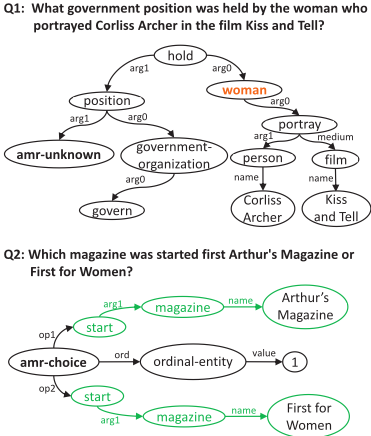
Divide-and-conquer is a promising strategy for intrinsic interpretability, in which complex multi-hop questions are decomposed into simpler sub-questions that can be answered by an off-the-shelf QA model. The simplified sub-questions may help humans to understand the logic of complex multihop questions better, and also to diagnose where QA models fail. Since annotations for decomposition are expensive and time-consuming, existing studies have trained a question decomposition (QD) model using a combination of hand-crafted labelled examples and a rule-based algorithm, or have trained a pseudo decomposition model to extract spans of text as subquestions [Min et al., 2019; Perez et al., 2020]. However, the resulting sub-questions are often ungrammatical, may not even be explicit questions, or require additional language processing, leading to errors in downstream prediction tasks.
In a multi-hop question, predicate-argument structure plays a key role in understanding its meaning. Utilizing predicateargument structures to help understand natural language questions has become a common approach [Rakshit and Flanigan, 2021]. In the explicit graph structure of AMR, the predicate-argument structure appears in the form of nodes. Recently, AMR parsers have made great progress in reducing the complexity of understanding natural language questions by improving their semantic graph representations [Ribeiro et al., 2020], benefiting downstream tasks such as summarization [Liao et al., 2018] and question answering [Xu et al., 2021]. Furthermore, AMR-to-Text generation models have been developed in recent years that produce well-formed text by encoding the AMR graph as an input to pretrained language models [Bevilacqua et al., 2021; Ribeiro et al., 2021].
Motivated by this, we propose to perform question decomposition based on AMR for multi-hop QA. Our method is designed for four goals: i) delegating the complexity of understanding multi-hop questions to AMR parsing; as shown in Figure 1 we understand multi-hop questions better by identifying the intermediate unknown variable or longest identical path; ii) segmenting the AMR graph according to the required type of reasoning; iii) generating sub-questions by AMR-to-Text generation and sorting them into a logical order, e.g., based on primary and secondary unknowns; iv) answering sub-questions and providing an interpretable reasoning process that can form a basis for explanation.
The contributions of this paper are summarised as follows:
- We transform the task of decomposition of the multi-hop question into the task of segmentation of the corresponding AMR graph.
- We propose two different AMR graph segmentation methods for multi-hop QD according to the reasoning type required: 1) unknowns-based and 2) path-based graph segmentation.
- We propose a pipeline-based modular method that integrates multiple modules, i.e., AMR parsing, AMR graph segmentation and AMR-To-Text generation, for multihop QD and multi-hop QA, which may help humans to better understand the reasoning behaviors of an interpretable multi-hop QA model.
2 RelatedWork
Intrinsic Interpretability. Intrinsically interpretable QA models incorporate interpretability directly into the structure of QA systems, making them self-explanatory. Recent studies have used divide-and-conquer, simplifying multi-hop questions to achieve self-explainable reasoning. DecompRC [Min et al., 2019] decomposes complex questions into several subquestions and uses a scoring model to jointly select the final answer and the most appropriate decomposition. OUNS [Pan et al., 2020] creates a pseudo-decomposition model with unsupervised seq2seq learning to map a hard question to many simple questions, and builds a recomposition model that combines answers of those simple questions to obtain the final answer. Unlike the above methods, QDAMR decomposes a multi-hop question based on the high-level semantic relations between the concepts in its AMR parse graph, and answers sub-questions in a logical, and potentially explanatory, order.
Post-hoc Interpretability. Post-hoc-interpretable QA models provide explanations for multi-hop reasoning by creating second (supporting evidence) models, which fall into two categories. In one, the supporting evidence prediction model is constructed independently: AISO [Zhu et al., 2021] defines three types of retrieval operations to find the missing evidence at each reasoning step. In the other category a multi-task model achieves answer prediction and supporting evidence prediction simultaneously. HGN [Fang et al., 2019], EntityGCN [De Cao et al., 2018] and DFGN [Qiu et al., 2019] fuse multi-granularity information in a graph, and then apply a multi-task prediction model over the graph to achieve both answer and evidence prediction.
AMR for Multi-hop QA. AMR parsers have made great progress in recent years as a source of explicit graph structure for conducting symbolic reasoning [Mitra and Baral, 2016]. AMR-SG [Xu et al., 2021] constructs an AMR semantic graph from valid evidence items, and reasons over it to obtain interpretability. NSQA [Kapanipathi et al., 2021] proposes a Neuro-Symbolic QA system based on AMR that forms logical queries and applies a neuro-symbolic reasoner to predict the final answer. Unlike the above forms of symbolic reasoning, we use AMR to convert the multi-hop question to symbolic form in support of question decomposition and identification of intermediate unknowns.
3 Method
3.1 Overview
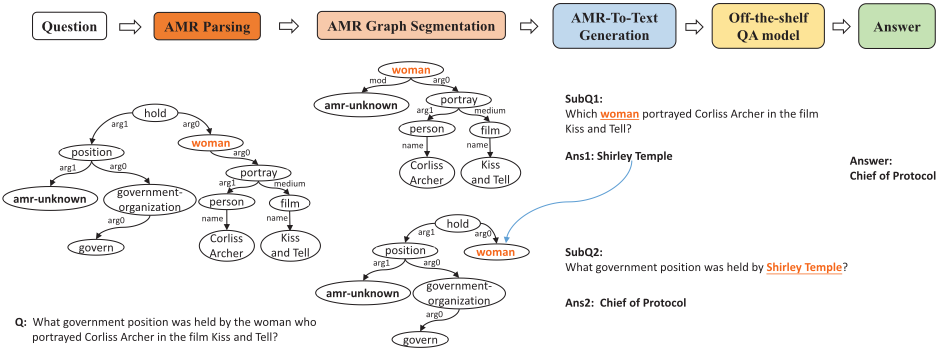
In this section, we describe interpretable question decomposition based on AMR, for multi-hop QA. As illustrated in Figure 2, the pipeline of our proposed QA system consists of four modules: i) AMR Parsing: utilizes AMR parsers to transform the multi-hop questions into an AMR graph; ii) AMR graph segmentation: segments the AMR graph into simpler AMR sub-graphs according to the reasoning type of the question; iii) Sub-question generation: applies AMR-to-Text generation model to sub-graphs to generate sub-questions; iv) Single-hop QA model: answers sub-questions with off-theshelf QA models.
3.2 AMR Parsing
Multi-hop QA requires multiple steps of reasoning over multiple scattered paragraphs to arrive at an answer. In order to help humans understand how these models make decisions, it is useful to capture intermediate unknown variables in the multi-hop question. To do this, we delegate the complexity of understanding the multi-hop question to an AMR graph. As shown in Figure 2, we parse a multi-hop question Q into an AMR graph, where nodes represent concepts and edges represent relations in between. An amr-unknown node denotes a primary unknown concept that represents the answer to the given question Q. In the example of Figure 2, amrunknown is an AMR position which represents the type of the answer. Furthermore, the AMR graph annotations on Q can also help identify intermediate unknown variables needed for multi-hop reasoning, e.g., woman is a secondary unknown.
We exploit transfer learning, using a pretrained model based on BART [Lewis et al., 2019] for AMR parsing to a linearized AMR graph [Bevilacqua et al., 2021]. Its advantage is that it overcomes the data sparsity issue in seq2seq-based methods. Since the linearized graph output is fully graphisomorphic, we encode the question into a graph without losing adjacency information.
3.3 AMRGraph Segmentation
The key challenge of question decomposition is that it is difficult to obtain annotations for the decomposition. We therefore propose to transform decomposition of the multi-hop question into a corresponding AMR graph segmentation operation. The advantage of AMR graph segmentation is that it can be done without linguistic expertise and without training. Multi-hop questions can be divided into the following categories according to the reasoning type: bridging, intersection and comparison. Thus, we propose two graph segmentation methods across the three reasoning types, i.e., unknownbased and path-based AMR graph segmentation, which we describe in the following subsection.
Unknowns-based Graph segmentation. Bridging questions require asking for the answer to an entity that is not explicitly mentioned. Therefore, the key to answering the question is how to identify the secondary unknown entity. According to [Rakshit and Flanigan, 2021], each predicate-argument relationship at the sentence level can be expressed as a questionanswer pair. Motivated by this, we propose using unknownsbased graph segmentation for bridging questions. We first extract all predicate nodes, then take subject nodes connected to the predicate nodes as candidate unknowns, and finally segment the AMR graph based on subject nodes. This is done by line 1-5 in Algorithm 1. In the example of Figure 2, portray is the predicate node and woman is the corresponding subject node which is the secondary unknown in the question Q.
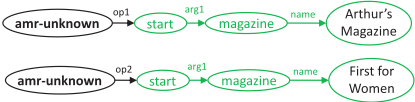
Path-based Graph segmentation. Intersection questions and comparison questions share the commonality that they both have two parallel conditions or entities. Intersection questions require asking for an entity that satisfies multiple conditions ("Are both Coldplay and Pierre Bouvier from the same country?"), and comparison questions require comparing a property of two entities ("Who is older, Annie Morton or Terry Richardson?"). Thus, we propose a path-based method to capture these parallel conditions or entities by retrieving the longest identical paths in the AMR. Specifically, we take the linearized AMR graph as a sequence of symbols, made up of concepts and relations, and then view the longest identical sequences as identifying parallel conditions or entities (line 7 in Algorithm 1). We demonstrate this longest path retrieval on question Q2 in Figure 1. The following is the longest identical path; fields prefixed with a colon represent the relationship between concepts, e.g., :arg and :name.
Finally, we generate sub-graphs by disconnecting the path instances in turn, as shown in Figure 3.
3.4 Sub-question Generation
After graph segmentation, we apply an AMR-to-Text generator with the same architecture as the AMR parser to generate sub-questions from AMR sub-graphs [Bevilacqua et al., 2021]. This model first transforms the graph into a sequence of symbols using a linearization technique, and then feeds it
Algorithm 1 : Question Decomposition Based on AMR
- Input: Multi-hop Question Q Output: Bridging/Intersection question: q1, q2; Comparison question: q1, q2, q3 1: Linearized AMR Graph G :=AMR Parsing(Q) 2: Qtype := getReasoningType(G) 3: if Qtype is bridging then 4: secUnkNode := getSecondaryUnknows(Q, G) 5: G1, G2 := unkBasedSegmentation(G, secUnkNode) 6: else 7: longestPath := getLongestIdenticalPath(G) 8: G1, G2 := pathBasedSegmentation(G, longestPath) 9: end if 10: q1 :=AMR-to-Text Generation(G1) 11: q2 :=AMR-to-Text Generation(G2) 12: if Qtype is bridging then 13: qAns 1 := off-the-shelf QA(q1) 14: G′2 := replace(G2, qAns 1 , secUnkNode) 15: q2 :=AMR-to-Text Generation(G′2) 16: else if Qtype is intesection then 17: Continue 18: else 19: op := findOperation(Q) 20: qAns 1 , qAns 2 := off-the-shelf QA(q1, q2) 21: q3 := constructOpQuestion(op, qAns 1 , qAns 2 ) 22: end if 23: if Qtype is bridging or intersection then 24: return q1, q2 25: else 26: return q1, q2, q3 27: end if
into the pretrained language model BART to obtain the subquestion. Similar to AMR parsing, the full graph-isomorphic linearization technique encodes the graph into a sequence of symbols without losing adjacency information. This helps make the generated text fluent. Especially, for comparison questions, we apply a single discrete operation [Min et al., 2019] over the answers of sub-questions to generate the third sub-question (line 21 in Algorithm).
3.5 Single-hop Question Answering
To achieve interpretable reasoning, we first determine the order of sub-questions before answering them, because the answer to one sub-question may be part of another, e.g., the answer to question Q1 Shirley Temple is equivalent to woman in AMR graph of Figure 2. Thus, we use different strategies to answer sub-questions for different reasoning types. For bridging questions, we first predict answers to sub-questions with secondary unknowns, then substitute the answer for the secondary unknowns in the primary sub-question, and finally take the answer of this primary sub-question as the final answer. For intersection questions, we do not need to identify the order of sub-questions because sub-questions are parallel, and the final answer is the intersection of answers of subquestions. Similarly, the final answer of the comparison question is the result of applying some discrete operation over the answers of sub-questions [Min et al., 2019].
Given ordered sub-questions, we train a single-hop QA on SQUAD [Rajpurkar et al., 2016] and on the new single-hop QA dataset. The dataset consists of single-hop QA pairs constructed by [Pan et al., 2020] on HotpotQA. Once trained, we use the resulting single-hop QA system as the off-the-shelf QA model and no longer fine-tune the model on multi-hop questions. In addition, we compute a forward pass on each sentence with sub-questions, if the sentence contains the answer of sub-questions, we take it as supporting evidence. In the end, sub-question-evidence pairs are used to support the interpretability of the single-hop QA model.
4 Experiments
We empirically evaluate our QDAMR against state-of-the-art QD-based QA models on the HotpotQA [Yang et al., 2018a].
4.1 Data and Setup
Dataset. We evaluate our model under the distractor setting of HotpotQA, which consists of questions and a collection of 10 paragraphs. Each question is originally annotated with either of two reasoning types: bridging and comparison. For the sake of fine-grained type annotations, all our methods further separate out a third type of question, intersection, from the bridging type, based on specific AMR concepts.
In addition, following [Pan et al., 2020], we construct new single-hop QA pairs from HotpotQA using the following procedures: i) for bridging questions, we first find an entity a that links the gold-standard evidence, then use the pretrained transformer model T5 [Raffel et al., 2019] to generate a question Q with a as the answer from the gold-standard evidence, and finally take (Q, a) as a new QA pair; ii) for intersection and comparison questions, we first find potential comparison entities e1/e2 from the gold-standard evidence, then generate a question Q1/Q2 that contains a specific entity e1/e2, and finally take (Q1, e1) and (Q2, e2) as a new QA pair.
Baselines. We compare our method with other QD-based QA on HotpotQA. For a fair comparison, we use the BERT-based QA from [Min et al., 2019] as the off-the-shelf QA.
- DecompRC [Min et al., 2019] trains a pointer model to identify split points in a question; these are subsequently used to compose sub-questions for each reasoning type.
- OUNS [Perez et al., 2020] creates a noisy pseudodecomposition for each multi-hop question, and then trains a decomposition model with unsupervised seq2seq learning to improve the pseudo-decomposition.
- QDAMR: QDAMRT5 denotes the T5-based transformer model used for AMR parsing and AMR-to-Text generation; QDAMRSP denotes that we use Spring-based transformer model for AMR parsing and AMR-to-Text generation; QDAMRSP RoBERTa denotes a finetuned RoBERTa-based QAmodel that is used as the off-the-shelf QAmodel.
| Decomp Method | AnnotaQDAMR | AnnotaDRC | ||
|---|---|---|---|---|
| EM | F1 | EM | F1 | |
| DecomRC | 54.82 | 68.23 | 55.12 | 69.99 |
| OUNS | 58.74 | 73.40 | 58.74 | 73.40 |
| QDAMRT5 | 62.24 | 77.19 | 60.07 | 75.34 |
| QDAMRSP | 64.57 | 78.44 | 63.13 | 77.61 |
| QDAMRSP RoBERTa | 67.13 | 81.17 | 66.83 | 80.12 |
| Decomp Method | GPT2 ↓ NLL | %Well- ↑ formed | Edit ↓ Dist | Length ↓ Ratio |
|---|---|---|---|---|
| DecompRC | 6.04 | 32.6 | 7.08 | 1.22 |
| OUNS | 5.56 | 60.9 | 5.96 | 1.08 |
| QDAMR | 5.37 | 68.2 | 5.19 | 1.06 |
Setup. Each of the tested methods separates the questions by type in a different manner. For both fairness and comprehensiveness in comparisons, we conduct two sets of experiments, each using either the DecompRC and QDAMR strategies with each tested system. Specifically, DecompRC uses the different question decomposition methods per reasoning type to answer the multi-hop question, and then uses a decomposition scorer to select the best answer as the final result. The reasoning type that yields the best result is returned as the reasoning type of the multi-hop question. While, our QDAMR first identifies the reasoning type of the question (see line 2 in Algorithm 1), and then uses the corresponding AMR-based decomposition method to answer the question.
Performance Metrics. Exact Match (EM) and partial match (F1) between the prediction and the ground truth answer are used as performance metrics [Yang et al., 2018a].
| AMR Parsing | AMR-to-Text Generation | EM | F1 |
|---|---|---|---|
| CAIL | T5 | 58.89 | 74.34 |
| T5 | T5 | 62.24 | 77.19 |
| Graphere | T5 | 63.36 | 77.83 |
| Spring | Spring | 67.13 | 81.17 |
4.2 Main Results
Table 1 shows how the question decomposition method affects performance using the two question-type identification methods. Under the same setting, using a BERT-based QA model, our QDAMR models yield substantial improvements, where QDAMRSP respectively improves EM/F1 by 9.75/10.21 and 5.83/5.04 in AnnotaQDAMR , and by 8.01/7.62 and 4.39/4.21 in AnnotaDRC , compared to DecompRC and OUNS. This demonstrates the effectiveness of our model's use of AMR to decompose multi-hop questions. Moreover, the performance under the AnnotaQDAMR setting consistently outperforms that under the AnnotaDRC setting, validating improved effectiveness identifying reasoning type over the DecomRC baseline. By fine-tuning RoBERTa on generated single-hop QA pairs and SQUAD, our model shows further improvements on EM/F1 with 2.56/2.73 in AnnotaQDAMR and 3.7/2.59 in AnnotaDRC , compared to the QDAMRSP , and a substantial improvement over both the DecompRC and OUNS baselines. In the following ablation studies section, we analyse the quality of the sub-questions and sources of performance gain.
4.3 Quality of Sub-questions
We evaluate the quality of sub-questions from two perspectives: fluency and wellformedness. We measure fluency using the GPT-2 [Radford et al., 2019] negative loglikelihood (NLL). For wellformedness, we use three metrics from OUNS: i) the proportion of well-formed sub-questions [Faruqui and Das, 2018]; ii) the token Levenstein (edit) distance between the multi-hop question and its generated subquestions; and iii) the ratio between the length of the multihop question and the length of the sub-question.
As shown in Table 2, QDAMR outperforms DecompRC and OUNS on these four metrics; QDAMR achieves the best result on GPT-2 NLL score with 5.37 (lower is better). For the proportion of well-formed questions, QDAMR achieves the best score with 68.2, indicating that sub-questions generated by our model are more grammatical. The lowest Levenstein edit distance score indicates that the sentence structure of our generated sub-questions is more similar to that of the original multi-hop question.
4.4 Ablation Studies
Next, we verify the effectiveness of two modules, AMR paring and AMR-to-Text generation, in our proposed framework and analyse the performance of different decomposition methods across three reasoning types.
Effectiveness of AMR Parsing and AMR-to-Text Generation. Since we delegate the complexity of understanding multi-hop questions to the process of turning it into an AMR graph, and the generation of a well-formed sub-question to the process of AMR-based text synthesis, it is necessary to select a good combination of AMR parsing and AMR-toText generation. To this end, we use four AMR parsers (CAIL [Cai and Lam, 2020], Graphere [Hoang et al., 2021], T5 and SPRING [Bevilacqua et al., 2021]) to generate the AMR graph from a multi-hop question, and we generate subquestions from AMR sub-graphs using two AMR-to-Text generation methods (T5 and SPRING) because CAIL and Graphere do not support AMR-to-Text generation. In Table 3, we observe that sub-questions generated by the integration of the Spring-based AMR parsing and Spring-based AMR-toText generation subsystems achieve the best EM/F1 scores. This indicates the value of the Spring architecture in which full graph isomorphism allows for encoding and decoding without losing adjacency information, resulting in high fluency of generated sub-questions.
| Comparison Question: Who is older, Annie Morton or Terry Richardson? | Answer: Terry Richardson | ||
|---|---|---|---|
| Methods | DecompRC | OUNS | QDAMR |
| subQ1 Ans1 subQ2 Ans2 subQ3 Final Ans | Who is older? (Annie Morton) Who is Annie Morton or Terry Richardson? (Annie Morton) Which is smaller (Ans1)(Ans2)? Annie Morton | Who is Annie Morton? (American model) When was Terry Richardson born? (26 July 1999) - 26 July 1999 | How old is Terry Richardson? (August 14, 1965) What was Annie Moore's age? (October 8, 1970) Which is smaller (Ans1)(Ans2)? Terry Richardson |
| Intersection Question: Are both Coldplay and Pierre Bouvier from the same country? Answer: No | |||
|---|---|---|---|
| Methods | DecompRC | OUNS | QDAMR |
| subQ1 Ans1 subQ2 Ans2 operation Final Ans | Are both coldplay? (British rock band) Are pierre bouvier from the same country? (Canadian) Intersection(Ans1,Ans2) No | Where are Coldplay and Coldplay from? (British) What country is Pierre Bouvier from? (Canadian) - British | Fromwhat country is ColdPlay? (British) Where is Pierre Bouvier from? (Canadian) Intersection(Ans1,Ans2) No |
| Decomp Method | bridge | intersec | comparison | |||
|---|---|---|---|---|---|---|
| EM | F1 | EM | F1 | EM | F1 | |
| DecomRC | 55.24 | 71.53 | 54.55 | 69.29 | 52.81 | 63.44 |
| OUNS | 66.41 | 80.84 | 66.93 | 81.07 | 65.62 | 79.43 |
| QDAMR | 69.45 | 82.35 | 66.98 | 81.15 | 66.02 | 80.24 |
Decomposition Performance across Reasoning Types. We compare the performance of the three decomposition methods across reasoning types. As shown in Table 5, QDAMR outperforms other methods on all three tested reasoning types. We observe that the EM/F1 scores of our QDAMR on bridging questions (69.45/82.35) are improved by 3.04/1.51 and 14.21/10.82 compared with OUNS and DecompRC, respectively, indicating that unknowns-based decomposition can successfully identify the primary and secondary unknowns of the multi-hop question to generate well-formed sub-questions. For intersection and comparison questions, QDAMR still has a significant margin over DecompRC and slightly outperforms OUNS. This suggests that explicit pathbased decomposition may hold advantages over the implicit pointer-based decomposition of DecompRC. The examples in Table 4 illustrate how decomposition in QDAMR works across reasoning types that require additional combination operations (intersection and comparison). We also observe that sub-questions generated by QDAMR are more consistently well-formed. In addition, our proposed pipelinebased modular method is a self-explanatory system, which directly incorporates interpretability into the structure of its QA pipeline; the following are the interpretable reasoning processes applied for each of the reasoning types, Bridging, Intersection and Comparison:
- B : Q→SubQ1→Ans1→SubQ2→Ans
- I : Q→(SubQ1, SubQ2)→intersec(Ans1, Ans2)→Ans
- C : Q→(SubQ1, SubQ2)→(Ans1, Ans2)→SubQ3→Ans.
5 Conclusion and FutureWork
We have demonstrated use of question decomposition based on the AMR semantic representation for multi-hop QA, using an intrinsically interpretable framework to incorporate interpretability directly into the system structure. The complex task of multi-hop question interpretation is delegated to AMR parsers. These parsers produce AMR Graphs to which two segmentation methods are applied, i.e., unknown-based and path-based graph segmentation, to achieve question decomposition. To generate a well-formed sub-question, we perform both AMR parsing and AMR-to-Text generation with the same architecture, which uses a fully graph-isomorphic linearization technique to complete the transformation from graph to a sequence of symbols without losing adjacency information. This provides a good foundation for generating well-formed sub-questions using the AMR-to-Text generation model. Experimental results demonstrate that our QDAMR system outperforms baseline question decomposition methods, both in performance of multi-hop QA and in the quality of generated sub-questions. Since our proposed graph segmentation methods are based on predicate-argument relations and parallel conditions/entities respectively, they could in principle be generalized to an unknown number of hops by identifying multiple predicate nodes or capturing multiple parallel conditions/entities. While, as noted, an aim of the QDAMR design is to provide inherent interpretability, the effectiveness with which its outputs serve as explanations for human users remains to be evaluated in future work.
Acknowledgments
This work was supported by a grant from the New Zealand Tertiary Education Commission and by the Strong AI Lab at the University of Auckland. The first author is supported by a PhD scholarship from the China Scholarship Council.
@inproceedings{ijcai2022p568,
  title     = {Interpretable AMR-Based Question Decomposition for Multi-hop Question Answering},
  author    = {Deng, Zhenyun and Zhu, Yonghua and Chen, Yang and Witbrock, Michael and Riddle, Patricia},
  booktitle = {Proceedings of the Thirty-First International Joint Conference on
               Artificial Intelligence, {IJCAI-22}},
  publisher = {International Joint Conferences on Artificial Intelligence Organization},
  editor    = {Luc De Raedt},
  pages     = {4093--4099},
  year      = {2022},
  month     = {7},
  note      = {Main Track},
  doi       = {10.24963/ijcai.2022/568},
  url       = {https://doi.org/10.24963/ijcai.2022/568},
}
TY - CPAPER TI - Interpretable AMR-Based Question Decomposition for Multi-hop Question Answering AU - Deng, Zhenyun AU - Zhu, Yonghua AU - Chen, Yang AU - Witbrock, Michael AU - Riddle, Patricia T2 - Proceedings of the Thirty-First International Joint Conference on Artificial Intelligence, IJCAI-22 PB - International Joint Conferences on Artificial Intelligence Organization PY - 2022 SP - 4093 EP - 4099 DO - 10.24963/ijcai.2022/568 UR - https://doi.org/10.24963/ijcai.2022/568 ER -Copied
Machine-readable versions of this paper, for tools and AI agents:





