
Logically Consistent Adversarial Attacks for Soft Theorem Provers
Proceedings of the Thirty-First International Joint Conference on Artificial Intelligence. Main Track. Pages 4129-4135.
https://doi.org/10.24963/ijcai.2022/573
Keywords
- Natural Language Processing: Language Models
- Natural Language Processing: Text Classification
- Machine Learning: Neuro-Symbolic Methods
- Machine Learning: Adversarial Machine Learning
- Natural Language Processing: Question Answering
Abstract
Recent efforts within the AI community have yielded impressive results towards “soft theorem proving” over natural language sentences using language models. We propose a novel, generative adversarial framework for probing and improving these models’ reasoning capabilities. Adversarial attacks in this domain suffer from the logical inconsistency problem, whereby perturbations to the input may alter the label. Our Logically consistent AdVersarial Attacker, LAVA, addresses this by combining a structured generative process with a symbolic solver, guaranteeing logical consistency. Our framework successfully generates adversarial attacks and identifies global weaknesses common across multiple target models. Our analyses reveal naive heuristics and vulnerabilities in these models’ reasoning capabilities, exposing an incomplete grasp of logical deduction under logic programs. Finally, in addition to effective probing of these models, we show that training on the generated samples improves the target model’s performance.
- [Chen et al., 2017] P. Chen, H. Zhang, Y. Sharma, J. Yi, and C. Hsieh. ZOO: zeroth order optimization based black-box attacks to deep neural networks without training substitute models. In ACM, 2017.
- [Clark et al., 2020] P. Clark, O. Tafjord, and K. Richardson. Transformers as soft reasoners over language. In IJCAI, 2020. IJCAI
- [Ebrahimi et al., 2018] J. Ebrahimi, A. Rao, D. Lowd, and D. Dou. Hotflip: White-box adversarial examples for text classification. In ACL, 2018.
- [Gao et al., 2018] J. Gao, J. Lanchantin, M. Soffa, and Y. Qi. Black-box generation of adversarial text sequences to evade deep learning classifiers. In IEEE, 2018.
- [Gontier et al., 2020] N. Gontier, K. Sinha, S. Reddy, and C. Pal. Measuring systematic generalization in neural proof generation with transformers. In NeurIPS, 2020.
- [Guo et al., 2021] C. Guo, A. Sablayrolles, H. Jégou, and D. Kiela. Gradient-based adversarial attacks against text transformers. In EMNLP, 2021.
- [Helwe et al., 2021] C. Helwe, C/ Clavel, and F. Suchanek. Reasoning with transformer-based models: Deep learning, but shallow reasoning. In AKBC, 2021.
- [Jin et al., 2020] D. Jin, Z. Jin, J. T. Zhou, and P. Szolovits. Is BERT really robust? A strong baseline for natural lan- guage attack on text classification and entailment. In AAAI, 2020.
- [Jordan et al., 1999] M. Jordan, Z. Ghahramani, T. Jaakkola, and L. Saul. An introduction to variational methods for graphical models. Mach. Learn., 37(2):183-233, 1999.
- [Kassner and Schütze, 2020] N. Kassner and H. Schütze. Negated and misprimed probes for pretrained language models: Birds can talk, but cannot fly. In ACL, 2020.
- [Li et al., 2020] L. Li, R. Ma, Q. Guo, X. Xue, and X. Qiu. BERT-ATTACK: adversarial attack against BERT using BERT. In EMNLP, 2020.
- [Lin, 2004] C. Lin. ROUGE: A package for automatic evalu- ation of summaries. In Text Summarization Branches Out, 2004.
- [Liu et al., 2019] Y. Liu, M. Ott, N. Goyal, J. Du, M. Joshi, D. Chen, O. Levy, M. Lewis, L. Zettlemoyer, and V. Stoy- anov. RoBERTa: A Robustly Optimized BERT Pretraining Approach. arXiv e-prints, page arXiv:1907.11692, 2019.
- [McCoy et al., 2019] Tom McCoy, Ellie Pavlick, and Tal Linzen. Right for the wrong reasons: Diagnosing syntactic heuristics in natural language inference. In ACL, 2019.
- [Misra et al., 2020] K. Misra, A. Ettinger, and J. Rayz. Ex- ploring bert's sensitivity to lexical cues using tests from semantic priming. In EMNLP, 2020.
- [Mnih and Gregor, 2014] A. Mnih and K. Gregor. Neural variational inference and learning in belief networks. In ICML, 2014.
- [Mozes et al., 2021] M. Mozes, M. Bartolo, P. Stenetorp, B. Kleinberg, and L. Griffin. Contrasting human & machine-generated word-level adv. examples for text clas- sification. In EMNLP, 2021.
- [Petroni et al., 2019] F. Petroni, T. Rocktäschel, S. Riedel, P. Lewis, A. Bakhtin, Y. Wu, and A. H. Miller. Language models as knowledge bases? In EMNLP-IJCNLP, 2019.
- [Raedt et al., 2007] L. De Raedt, A. Kimmig, and H. Toivo- nen. Problog: A probabilistic prolog and its application in link discovery. In IJCAI, 2007.
- [Ren et al., 2020] Y. Ren, J. Lin, S. Tang, J. Zhou, S. Yang, Y. Qi, and X. Ren. Generating natural language adversar- ial examples on a large scale with generative models. In ECAI, 2020.
- [Saha et al., 2020] S. Saha, S. Ghosh, S. Srivastava, and M. Bansal. Prover: Proof generation for interpretable rea- soning over rules. In EMNLP, 2020.
- [Sanh et al., 2019] V. Sanh, L. Debut, J. Chaumond, and T. Wolf. DistilBERT, a distilled version of BERT: smaller, faster, cheaper and lighter. arXiv e-prints, page arXiv:1910.01108, 2019.
- [Simoncini and Spanakis, 2021] W. Simoncini and G. Spanakis. Seqattack: On adversarial attacks for named entity recognition. In EMNLP, 2021.
- [Szegedy et al., 2014] C. Szegedy, W. Zaremba, I. Sutskever, J. Bruna, D. Erhan, I. Goodfellow, and R. Fergus. Intrigu- ing properties of neural networks. In ICLR, 2014.
- [Talmor et al., 2020] A. Talmor, O. Tafjord, P. Clark, Y. Goldberg, and J. Berant. Leap-of-thought: Teaching pre-trained models to systematically reason over implicit knowledge. In NeurIPS, 2020.
- [Vaswani et al., 2017] A. Vaswani, N. Shazeer, N. Parmar, J. Uszkoreit, L. Jones, A. Gomez, L. Kaiser, and I. Polo- sukhin. Attention is all you need. In NeurIPS, 2017.
- [Williams et al., 2018] A. Williams, N. Nangia, and S. Bow- man. A broad-coverage challenge corpus for sentence un- derstanding through inference. In NAACL-HLT, 2018.
- [Williams, 1992] R. Williams. Simple statistical gradient- following algorithms for connectionist reinforcement learning. Mach. Learn., 8, 1992.
- [Yu et al., 2020] W. Yu, Z. Jiang, Y. Dong, and J. Feng. Re- clor: A reading comprehension dataset requiring logical reasoning. In ICLR, 2020.
- [Zeng et al., 2021] G. Zeng, F. Qi, Q. Zhou, T. Zhang, B. Hou, Y. Zang, Z. Liu, and M. Sun. Openattack: An open-source textual adversarial attack toolkit. In IJCAI, 2021.
- [Zhu et al., 2020] Y. Zhu, Y. Zhou, and M. Xia. Generating Semantically Valid Adversarial Questions for TableQA. arXiv e-prints, page arXiv:2005.12696, 2020.
References were extracted automatically from the PDF and may contain errors.
Full text extracted automatically from the PDF; figures, tables and equations may differ. The PDF is the version of record.
1 Introduction
Recent research highlights that language models are surprisingly adept at memorising and recalling factual information when trained on internet-scale corpora [Petroni et al., 2019]. Less clear, though, is their ability to deduce new conclusions by manipulating and combining this stored knowledge. The NLP community explore this via the publication of natural language benchmarks requiring logical reasoning [Yu et al., 2020]. While neural models are increasingly improving on these tasks, their reasoning capabilities can prove brittle and shallow upon closer examination [Helwe et al., 2021].
Existing studies seemingly demonstrate that language models can act as "soft theorem-provers" (STPs) over natural language sentences. [Clark et al., 2020] demonstrate that Transformers [Vaswani et al., 2017] can learn to predict whether a natural language query is logically entailed by a collection of natural language facts and rules, as illustrated in Fig. 1. Their results appear impressive, showing near-perfect performance on the original task, demonstrating robustness to syntactic and lexical variations and generalization beyond the training set. Despite this, an important question remains: have these systems learned the desired reasoning processes, or are they dependent on shallow heuristics and shortcuts?
Adversarial machine learning [Szegedy et al., 2014] offers a natural inroad into this question. It is widely used within NLP to probe model robustness and defend against adversarial attacks [Ebrahimi et al., 2018; Li et al., 2020]. A successful attack minimally perturbs an input such that: 1) its semantics is preserved, and 2) the model alters its prediction. The first challenge is usually addressed by assuming that "small" perturbations will not meaningfully impact semantics. However, previous works focus on lexical semantics while we are interested in logical semantics. The assumption that "small" perturbations will not impact logical semantics is unduly strong as logical entailment is sensitive to any perturbations, causing standard methods to generate inconsistent attacks by inadvertently flipping the label. Considering Fig. 1, existing methods may perturb "Mark is smart" to "Mark is intelligent", but this attack is inconsistent for Q1 as it is no longer entailed after the perturbation. To solve this logical inconsistency problem, our contributions are as follows:
- We propose logically consistent attacks, whereby the perturbed sample's label faithfully reflects its new entailment, and show that standard methods produce logically inconsistent attacks.
- We propose LAVA (Logically consistent AdVersarial Attacker): a black-box, generative adversarial framework to select, apply and verify adversarial attacks on STPs. We demonstrate that the vanilla version significantly outperforms standard methods, and can be further improved via a simple best-of-k decoding enhancement.
- LAVA exposes naive heuristics and global weaknesses common across multiple STPs, such as a flawed usage of quantified rules. Training on the adversarial samples improves the target model's performance.
Our implementation is available at https://github.com/ alexgaskell10/LAVA.
2 Background: Soft Theorem-Proving
[Clark et al., 2020] examine neural systems' capacities to conduct automated reasoning using language and introduce the RuleTakers dataset to this end. They demonstrate that Transformers can act as "soft theorem provers" over natural language by solving a logical deduction task. Their objective is to determine whether a natural language claim, the query, is "entailed" by a set of rules and facts, the context.
To generate the dataset, the authors first synthesise stratified logic programs, amounting to sets of rules and facts. Facts are atomic sentences and rules are implications that have, as a body, conjunctions of atoms and, as the head, atoms. The authors also consider more general versions of rules and facts, where atoms may be negated. All rules can be propositional or (implicitly) universally quantified. Then, rules and facts are converted to natural language representations using templates (see Fig. 1 for an example).
To generate labels for queries in the dataset, the authors use the closed world assumption and an interpretation of negation as negation-as-failure (NAF), adapting the standard semantics for stratified logic programs to allow a symbolic solver to label whether a query is entailed by a context. We use |= to represent this entailment. We illustrate NAF in Fig. 1, Q3., as Sarah cannot be shown to be happy so she is smart.
The dataset is subdivided on a [0..5] range according to the number of deductive steps required (proof depth), approximating sample difficulty. Proof depth is closely related to proof length, the number of context sentences in the proof.
3 Logically Consistent Adversarial Attacks
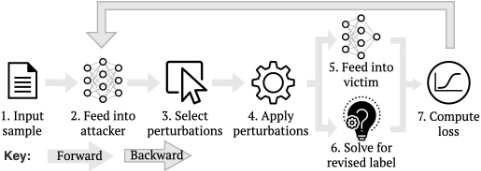
We introduce LAVA as a framework for generating logically consistent adversarial attacks. In §3.1 we define our problem statement and introduce the attacker and victim, and derive our objective and gradients in §3.2. LAVA's overall flow is illustrated in Fig. 2. The sample is first fed into the attacker which predicts the perturbations to apply, relating to stages 2 and 3 from Fig. 2 and §3.4. The perturbed sample is fed into the victim (stage 5). Logical consistency is ensured by recomputing the label for the perturbed sample, relating to step 6 in Fig. 2 and §3.5, and this is used to compute the attacker's learning signal (stage 7 in Fig. 2).
3.1 ProblemDefinition
STP aims to predict if a context, c, entails, y, a query, q:
where 1 is the indicator function and pθV is a probability distribution over the entailment label. We refer to the STP, parameterized with θV (a Transformer), as the victim, as this is the model we are attacking. We probe the victim using adversarial attacks, perturbing the query, q′ , and/or context, c′ , so as to fool the victim into predicting the opposite label, ˆ y = 1-y = 1-1(c′ |= q′ ). We train an attacker, parameterized by θA, to generate victim-fooling perturbations, (q′i , c′i ), conditioned on the original sample. We represent this as the distribution pθA (q′i , c′i | q, c), abbreviated to pθA (q′ , c′ ). The objective now is to sample (denoted ∼) perturbations from the attacker's distribution to maximize the log likelihood of fooling the victim:
Note that we only train the attacker's parameters and the victim is solely used for querying its probabilities (without gradient access), making this a black-box adversarial attack method suitable with any text-based binary classifier.
3.2 Deriving the Objective Function
We now introduce the perturbations, q′ and c′ , as latent variables. We seek to maximize the (log) probability of incorrect victim answers, J = log pθV (ˆ y | q, c). Marginalizing over the perturbations, we obtain
where perturbations are sampled from the attacker's joint distribution, as outlined in Eq. 1. Following [Mnih and Gregor, 2014], we derive a lower bound using Jensen's inequality, which says that for any convex function g(x), E[g(x)] ≥ g(E[x]) [Jordan et al., 1999]:
Expanding the expectation gives our final optimisation problem, L:
From Eq. 3 we obtain an expression for the attacker's gradients. We subtract a baseline b to reduce the variance of the learning signal without affecting its expectation:
Figure 3: A randomly sampled successful attack, S. The perturbations applied to the original O are coloured green, red and blue corresponding to QuesFlip, SentElim and EquivSub strategies respectively.
Eq. 4 relates to the backward pass component of Fig. 2. As in [Mnih and Gregor, 2014], the baseline is an exponentiallydecaying moving average of log pθV (ˆ y | q′ , c′ ).
3.3 Attack Strategies
Generating textual adversarial attacks is challenging as there is no universal definition for measuring semantic distances between texts, making it difficult to quantify the distributional shift introduced during attacks. Controlling which perturbations preserve the sample's label is another challenge. These are often addressed by assuming locality, namely that several word/sub-word/character perturbations are unlikely to materially impact the text's semantics [Zhu et al., 2020]. This assumption is invalid for logical entailment as this is sensitive even to local perturbations - the logical inconsistency problem. As for text generation in general, ensuring that outputs are fluent and coherent is also a consideration.
We address these challenges using a structured generative process, specifically by constraining LAVA to select from a set of perturbations. These perturbations were chosen to exploit the logical semantics underlying the data, probing the victim's robustness to logical transformations such as negation. These are implemented using deterministic rules which we refer to as templates. The use of these perturbations ensures the attacks are linguistically aligned with the original data distribution, while also guaranteeing grammaticality and fluency. The remainder of this section outlines the perturbations candidates (stage 4 in Fig. 2), summarised in Table 1. These are annotated on a successful LAVA attack in Fig. 3.
Question flipping (QuesFlip) Predict whether to negate the question. [Kassner and Sch¨utze, 2020] motivate this by showing that neural models struggle with negation. To illustrate the use of templates, the sentence "The entity is attribute" may be mapped into: "The entity is not attribute".
Sentence elimination (SentElim) Predict whether to retain each context sentence in the perturbed output.
Equivalence substitution (EquivSub) Predict whether each context fact should be substituted with a logically equivalent propositional rule where the fact is the rule head and the body consists of other (randomly sampled) context facts.
| Perturb. | Before | After |
|---|---|---|
| QuesFlip: SentElim: EquivSub: | q, {a, b, a → c} q, {a, b, a → c} q, {a, b, a → c} | ¬q, {a, b, a → c} q, {✁a, b,✘ ✘✘ a → c}) q, {✁a, b, a → c, b → a} |
3.4 Attacker Architecture
The attack model outputs a categorical distribution with 2N c + 1 parameters, N c for EquivSub and SentElim and one for QuesFlip, where N c is the number of context sentences. An attack is created by sampling perturbations and applying them to the input whilst recomputing the associated label. The perturbed output is fed into the victim.
The attacker's architecture is similar to [Saha et al., 2020], differing mainly through our three output heads, g1 , g2 and g3 , for the attack strategies in §3.3. The input, x = [CLS] q [SEP] c [SEP], with ids x, is fed into a Transformer encoder, EA, giving hidden states H = EA(x). We denote the sequence of tokens and hidden states corresponding to sentence j as cj and Hj respectively with c0 := q. The representation, hj, is formed using mean pooling as hj = mean pool(Hj). This is fed into the output heads, gi , to obtain the categorical parameter, µij :
W1,W2, b1, b2 are learnable weights and σ(z) = 1/(1 + e-z ). The question representation, h0, is only fed into the QuesFlip head, g3 , while other representations, h1, . . . , hN c , are fed into the SentElim and EquivSub heads, g1 and g2 .
The attacker is trained using a REINFORCE-style objective [Williams, 1992], with the victim's loss as the learning signal. Crucially, the logically consistent label is used to compute the loss and attacker's gradients; else the attacker may learn to produce inconsistent attacks. This relates to stage 6 in Fig. 2 and §3.5.
3.5 Logically Consistent Attacks
To address the logical consistency challenge outlined in §3.3, we must solve for the perturbed sample's entailment relationship (c′ |= q′ in Eq. 3). While the entailment label is predictable under the EquivSub and QuesFlip perturbations (the former preserves and the latter flips the label), the impact of applying SentElim is unpredictable. Our solution is the solver module which uses a symbolic solver to recompute the label for the perturbed sample, denoted the modified label. LAVA uses ProbLog [Raedt et al., 2007] as the solver but could be easily adapted to use an alternative if desired. We apply the perturbations to the natural language sentences as well as the underlying logic programs which were used to generate them. The perturbed logic program is then fed into the solver module to compute the modified label. This occasionally (< 2%)
fails due to negative cycles in the perturbed sample, in which case we denote the attack as unsuccessful.
4 Experiments
To our knowledge, LAVA is the first to use logically consistent attacks. Here, we first introduce baselines and metrics (§4.1 - 4.2). Next, we validate LAVA's effectiveness by showing that it successfully generates attacks (§4.3) which transfer across victims and address the victims' weaknesses when trained upon (§4.4). All results are for the RuleTakers test set (20,192 samples), using the validation set for early stopping.
4.1 Benchmarks
HotFlip (HF) This is a white-box attack method which uses the victims' gradients to estimate the loss of substituting words/characters in the input text, selecting the highestimpact perturbation [Ebrahimi et al., 2018]. For comparability, we use the black-box OpenAttack variant [Zeng et al., 2021], substituting words with synonyms and replacing gradient-guided perturbation search with brute force.
TextFooler (TF) This is a black-box method which generates attacks by substituting input words with synonyms and ranking them by impact, verifying that the substitutions maintain grammaticality and semantic similarity [Jin et al., 2020]. We use the OpenAttack [Zeng et al., 2021] implementation.
As mentioned in §3.5, perturbing the input can compromise a sample's logical consistency, resulting in invalid attacks. We thus integrate the solver module into the above HF and TF, modifying the logic programs and computing a label for the perturbed sample, as in §3.5. We report the logical consistency-adjusted attack success rates below.
Random Selector (RS) This sets µij = 0.5 from Eq. 5. This ablates LAVA's learned component and makes its perturbations independent of the input, providing a comparison against an attacker that selects perturbations randomly.
Unigram Selector (US) This is a heuristic version of RS. Perturbation probability is biased towards sentences with greater word overlap with the question, replacing Eq. 5 with
ROUGE-1 [Lin, 2004] computes the unigram overlap score between context sentence cj and the query, c0. ¯ r is the mean unigram score over the training data, giving the same expected categorical parameters as under RS.
4.2 Metrics
Attack success rate (ASR) This represents the attacker's performance: ASR = # successful attacks / # attacks.
F1 sentence overlap score (F1) This is a measure of the distance between perturbed and original examples in terms of sentence overlap. Higher scores reflect more overlap and while a low F1 is bad ("adversarial" implies minimal perturbations), we do not seek to maximise F1 as this can overly constrain the attacker and restrict attacks' diversity (thus, a higher value for F1 is not necessarily preferable).
Prior studies [Simoncini and Spanakis, 2021; Li et al., 2020] report grammaticality and fluency, but these are unnecessary here due to our template-based generative process.
| Name | ASR (%) ↑ | F1 (%) |
|---|---|---|
| TF RS US HF Rl- Rl- | 10.1 | 88.9 |
| Baselines | 10.4 | 66.9 |
| 12.1 | 65.3 | |
| 21.5 | 94.5 | |
| SentElim | 10.0 | 74.3 |
| Abls. EquivSub | 10.9 | 80.3 |
| Rl- QuesFlip | 25.1 | 68.4 |
| Rl (main) | 28.6 | 67.6 |
| Ours Rb | 30.1 | 67.8 |
| Rd | 52.5 | 68.6 |
4.3 Attacker Performance
Before training our attacker, we train the victims until convergence on the RuleTakers dataset. Unless specified, the victim's core uses ROBERTA-large, Rl, [Liu et al., 2019] and we provide ROBERTA-base, Rb, and Distil-ROBERTAbase, Rd, [Sanh et al., 2019] for comparison. The attacker is trained for five epochs with a batch size of 8 on a single 11Gb NVIDIA GeForce RTX 2080 GPU. The learning rate was set to 5e-6 , with 1e-5 and 2.5e-6 also tested. We provide configuration files in the accompanying code for reproducibility.
ASR Table 2 gives the attackers' results. We report the four benchmarks from §4.1 and model ablations. For HF and TF, we report the adjusted results, described in §4.1, to ensure logical consistency. The unadjusted ASRs are 81% and 84% (not shown in the table) respectively, vs 22% and 10% after adjusting. Recall that the unadjusted figures contain many logically-inconsistent attacks, hence we only discuss the adjusted ASR. This demonstrates that naively perturbing the context will likely flip the entailment relationship, hence integrating the solver within the generative process is desirable. This result corroborates recent findings that adversarial methods often generate invalid examples [Mozes et al., 2021]. Using an independent t-test, our method significantly outperforms all baselines. The F1 metric is discussed in §4.5.
Best-of-k Decoding The results in Table 2 use one-sample decoding: the attacker generates one attack for each sample.
| Method | Victim | Trf. ASR (%) ↑ | Atk. ASR (%) |
|---|---|---|---|
| Ours | Rl → Rb | 84.4 | 28.6 28.6 |
| Rl → Rd | 82.1 | ||
| Rb → Rd | 81.8 | 30.1 | |
| Rb → Rl | 80.2 | 30.1 | |
| TF | Rl →Rb | 64.6 | 10.1 |
| HF Rl →Rb | 55.1 | 21.5 |
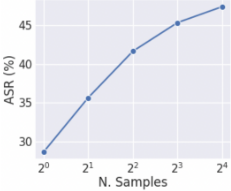
Alternatively, we can use best-of-k decoding by taking N k adversarial samples and retaining the one which most successfully fools the victim. Fig. 4 shows the benefits of bestof-k decoding, yielding an ASR of 47% when N k = 16.
The Rl victim performs near-perfectly on the original task with 99.3% accuracy (reported in Table 4, discussed in §4.6). Given this, it is interesting that the attacker fools the victim with 29% and 49% ASR when N k = 1 and 16 respectively. This reveals weaknesses in the victim's reasoning capabilities which the attacker learns to exploit.
Ablations Here we ablate each perturbation strategy from §3.3 and compare this against the performance when using all three (Rl (main) in Table 2). Using a t-test, all ablations significantly reduce the attacker's ASR (p < 3e-15 ). Equipping the attacker with a greater range of perturbations helps it to identify weaknesses in the victim's reasoning capabilities.
4.4 Transferability
In general, when a model is used to generate attacks, a concern is that the attacker can overfit to a single victim. This can be formalized using transferability [Chen et al., 2017], defined as the proportion of the successful attacks generated against victim x, denoted Vx, that also successfully fool a different victim y, denoted Vy, shown in Table 3. In Table 3, the top row says that 84% of the successful attacks against Rl also succeed against Rb. Our methods' attacks are more transferable than the baselines, implying that LAVA identifies global rather than local vulnerabilities.
4.5 ASR vs Number of Perturbations
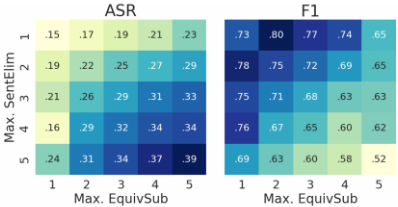
The results according to the two metrics, ASR and F1, cannot be taken in isolation, since they encapsulate an important trade-off between the ease of fooling the victim and the number of applied perturbations. In our early experiments we observed that the attacker could easily achieve a high ASR by perturbing most of the context sentences. This shifts the original and perturbed samples' distributions, making it trivial to fool the victim but hard to attribute its failure to poor reasoning versus out-of-distribution generalization. Addressing this, we introduce hyper-parameters capping the number of SentElim and EquivSub perturbations the attacker can apply. Fig. 5 shows the trade-off between ASR and F1: increasing this threshold leads to more successful attacks but also makes the original and perturbed samples less similar. Note that these parameters specify the maximum number of perturbations; the attacker can apply fewer. Interestingly, our main model (with the caps set at 3) uses 2.3 EquivSub perturbations on average. As EquivSub adds a reasoning step, thus in principle making the sample more difficult, we expected the attacker to use EquivSub as frequently as permitted.
| Victim | DSet | Before | After ↑ | ∆ (%) ↑ |
|---|---|---|---|---|
| Rl | DA | 71.4 | 96.9 | 35.7 |
| DO | 99.3 | 99.7 | 0.4 | |
| Rb | DA | 69.9 | 94.9 | 35.8 |
| DO | 97.9 | 98.6 | 0.7 | |
| Rd | DA | 47.5 | 85.4 | 79.7 |
| DO | 75.7 | 89.1 | 17.7 |
The results reported elsewhere in this study assume the SentElim and EqivSub caps are set at 3, the level we consider to optimally trade-off ASR and F1. In Table 2 the F1 scores of HF and TF are near 1, reflecting the local nature of these methods' attacks which limits their diversity. This metric does not capture the fact that logically equivalent sentences can be realised linguistically distinctly, thus requiring a high F1 score can overly constrain the attacker.
4.6 Adversarial Training
The previous sections demonstrated that an attacker can learn to exploit weaknesses in the victim's reasoning capabilities. Here, we investigate whether training the victim on the successful attacks helps address these blind spots. To test this, we initially train a victim to convergence on the original dataset DO and train an attacker against this victim. The attacker is evaluated on DO , generating an augmented dataset of adversarial samples, DA. We then resume training the victim on the combined dataset DC = DO ⋃ DA.
The results in Table 4 show that training on DC improves the victims' performance on DO and DA. Using an independent t-test, all differences are significant with p < 1e-7 . While there is limited headroom for improvement on DO using Rl and Rb as victims, the weaker distilled model, Rd, sees a sizable 17.5% improvement. These show that data augmentation via logically consistent adversarial examples is a promising strategy for enhancing STPs.
5 Analysis of Attacks
Qualitative We have identified several blind spots in the victim's reasoning capabilities by qualitatively analysing the successful attacks. Fig. 3 displays an example of one such vulnerability, whereby the victim is often fooled if the query literal appears within the body of a rule, i.e. "If Fiona is round and Dave is big then ...". This can be exploited by the attacker's EquivSub perturbation. Another common failure type is when the attacker eliminates a leaf fact on samples containing deeper proofs. This operation flips the label while the victim's prediction is unchanged. This suggests the victim performs backward-chaining from the query, but its search is shallow and terminates before the proof tree is complete.
More generally, the victim appears brittle when using quantified rules. It struggles to correctly bind variables on either side of an implication, e.g. "if someone is happy then they like John" versus "if someone is happy then Anne likes John". Similarly, many failures occur on conjunctive implications containing both variables and facts. Using the example "if Anne likes John and someone is happy then they like Beth", someone and they refer to a common variable but could be misconstrued as relating to Anne or John. However, none of the attacker's perturbations can create quantified rules so it cannot exploit these vulnerabilities.
These observations yield intriguing insights into STPs' reasoning processes and suggest avenues for improving the STPs and attackers. The first and second failure modes imply that short-cuts are used, although we believe they play a minor role else the victim would prove more brittle. The failures involving quantified rules suggest a coarse word-sense disambiguation mechanism which is not scaling to more complex rules. It also suggests an incomplete understanding of the properties of variables within logic programs.
Quantitative Breaking down the attacker's ASR by proof length, we see that the ASR is 0%, 19%, 30% and 47% for proofs of length 0, 1, 2 and ≥3 respectively. Predictably, as samples get harder the victim is more easily fooled. Note that for proofs of length zero (20% of samples) the attacker's ASR is zero. By definition, proofs of length zero have no context sentences unifying with the query (it does not "match" any facts or rule heads), rendering attacks ineffective as the attacker cannot synthesise a fact/rule to link the query and the context.
6 RelatedWork
Transformers as Soft Theorem Provers Our study is closely related to the RuleTakers line of work [Clark et al., 2020]. These posit that Transformers can act as "soft theorem provers" over natural language sentences, analogous to symbolic theorem provers for formally represented theories. These studies exhibit impressive model capabilities, such as near-perfect entailment prediction, an ability to generate reasoning proofs [Saha et al., 2020], generalizing beyond the training set and reasoning over implicit and explicit knowledge [Talmor et al., 2020]. Our work stands apart by identifying weaknesses in these approaches using adversarial attacks.
Other studies have noted the shortcomings of Transformers on reasoning problems. Vulnerability to deeper Horn Rule reasoning [Gontier et al., 2020], word-order permutations [McCoy et al., 2019], mis-priming [Misra et al., 2020] and shallow heuristics [Williams et al., 2018] have all been observed (see [Helwe et al., 2021] for more examples). Our study is distinct from these as we train a generative adversary end-to-end to discover these weaknesses.
Adversarial Attacks These have seen recent attention by the NLP community as a method for probing model robustness and creating more challenging datasets. Borrowing the taxonomy in [Simoncini and Spanakis, 2021], these can be grouped according to: 1) specificity - are the attacks targeted at a label? 2) Knowledge of the victim - white-box attacks assume all information about the victim is known, whereas black-box attacks assume only its probabilities are known. 3) Granularity - are characters, tokens or phrases perturbed? We add a fourth data generation process criterion - is it solely a human, a hybrid human-in-the-loop or a solely model-based procedure? Using this taxonomy, our model is an unspecified, black-box, phrase-level, model-based attack procedure.
Several methods have recently emerged at character-level [Ebrahimi et al., 2018; Gao et al., 2018] and word-level [Li et al., 2020; Jin et al., 2020]. These generally rely on inserting/removing characters or substituting words with synonyms or tokens with similar embeddings. These methods implicitly assume that the locality of attacks preserves the original passage's semantics. This assumption has proven invalid [Mozes et al., 2021], particularly for logical reasoning we posit as entailment is sensitive to token-level perturbations.
LAVA was inspired by a recent movement towards training generative models for adversarial attacks. Ours is closely related to SAGE [Zhu et al., 2020], a Wasserstein AutoEncoder trained to attack TableQA systems. A particular challenge in this domain is controlling the semantic shift introduced by attacks [Mozes et al., 2021] - logical consistency can be viewed as a special case of semantic shift. Other generative strategies have been successfully employed, such as using GANs [Ren et al., 2020] or integrating victim gradients [Guo et al., 2021].
7 Conclusions and FutureWork
We use adversarial examples to probe the robustness of STPs. To this end, we propose LAVA, a black-box attack framework which learns to exploit vulnerabilities in the victim's reasoning capabilities. We define the logical inconsistency problem, namely that a given sample's logical entailment relationship may be sensitive to even small perturbations, and we address this via a structured generative process in conjunction with a integrated symbolic solver. LAVA outperforms standard methods in terms of attack success rate and transferability and training the victim on the adversarial samples improves performance. Our analyses reveal weaknesses and crude heuristics in the victim's reasoning processes, exposing a flawed grasp of the semantics of logic programs. Future work may seek to equip the attacker with the ability to synthesise rules as we expect this would expose a wider range of vulnerabilities. Going forward, we envisage that LAVA could play a useful role in future STP development as a framework for identifying and debugging their vulnerabilities.
Acknowledgments
This work was supported by UKRI [grant number EP/S0233356/1], in the CDT in Safe and Trusted AI. We thank Alex Spies for his insightful comments and feedback.
@inproceedings{ijcai2022p573,
  title     = {Logically Consistent Adversarial Attacks for Soft Theorem Provers},
  author    = {Gaskell, Alexander and Miao, Yishu and Toni, Francesca and Specia, Lucia},
  booktitle = {Proceedings of the Thirty-First International Joint Conference on
               Artificial Intelligence, {IJCAI-22}},
  publisher = {International Joint Conferences on Artificial Intelligence Organization},
  editor    = {Luc De Raedt},
  pages     = {4129--4135},
  year      = {2022},
  month     = {7},
  note      = {Main Track},
  doi       = {10.24963/ijcai.2022/573},
  url       = {https://doi.org/10.24963/ijcai.2022/573},
}
TY - CPAPER TI - Logically Consistent Adversarial Attacks for Soft Theorem Provers AU - Gaskell, Alexander AU - Miao, Yishu AU - Toni, Francesca AU - Specia, Lucia T2 - Proceedings of the Thirty-First International Joint Conference on Artificial Intelligence, IJCAI-22 PB - International Joint Conferences on Artificial Intelligence Organization PY - 2022 SP - 4129 EP - 4135 DO - 10.24963/ijcai.2022/573 UR - https://doi.org/10.24963/ijcai.2022/573 ER -Copied
Machine-readable versions of this paper, for tools and AI agents:





