
On Tracking Dialogue State by Inheriting Slot Values in Mentioned Slot Pools
Proceedings of the Thirty-First International Joint Conference on Artificial Intelligence. Main Track. Pages 4375-4382.
https://doi.org/10.24963/ijcai.2022/607
Keywords
- Natural Language Processing: Dialogue and Interactive Systems
- Natural Language Processing: Natural Language Semantics
Abstract
Dialogue state tracking (DST) is a component of the task oriented dialogue system. It is responsible for extracting and managing slots, where each slot represents a part of the information to accomplish a task, and slot value is updated recurrently in each dialogue turn. However, many DST models cannot update slot values appropriately. These models may repeatedly inherit wrong slot values extracted in previous turns, resulting in the fail of the entire DST task. They cannot update indirectly mentioned slots well, either. This study designed a model with a mentioned slot pool (MSP) to tackle the update problem. The MSP is a slot specific memory that records all mentioned slot values that may be inherited, and our model updates slot values according to the MSP and the dialogue context. Our model rejects inheriting the previous slot value when it predicates the value is wrong. Then, it extracts the slot value from the current dialogue context. As the contextual information accumulates, the new value is more likely to be correct. It also can track the indirectly mentioned slot by picking a value from the MSP. Experimental results showed our model reached state of the art DST performance on MultiWOZ datasets.
- [Chao and Lane, 2019] Guan-Lin Chao and Ian Lane. BERT-DST: Scalable end-to-end dialogue state track- ing with bidirectional encoder representations from transformer. In INTERSPEECH, 2019.
- [Devlin et al., 2019] Jacob Devlin, Ming-Wei Chang, Ken- ton Lee, and Kristina Toutanova. BERT: Pre-training of deep bidirectional transformers for language understand- ing. In Proceedings of the 2019 Conference of the North American Chapter of the Association for Computational Linguistics: Human Language Technologies, Volume 1 (Long and Short Papers), pages 4171-4186, June 2019.
- [Eric et al., 2020] Mihail Eric, Rahul Goel, Shachi Paul, Ab- hishek Sethi, Sanchit Agarwal, Shuyang Gao, Adarsh Ku- mar, Anuj Goyal, Peter Ku, and Dilek Hakkani-Tur. Mul- tiWOZ 2.1: A consolidated multi-domain dialogue dataset with state corrections and state tracking baselines. In Pro- ceedings of the 12th Language Resources and Evaluation Conference, pages 422-428, May 2020.
- [Feng et al., 2021] Yue Feng, Yang Wang, and Hang Li. A sequence-to-sequence approach to dialogue state tracking. In Proceedings of the 59th Annual Meeting of the Associ- ation for Computational Linguistics and the 11th Interna- tional Joint Conference on Natural Language Processing (Volume 1: Long Papers), pages 1714-1725, August 2021.
- [Gao et al., 2019] Shuyang Gao, Abhishek Sethi, Sanchit Agarwal, Tagyoung Chung, and Dilek Hakkani-Tur. Di- alog state tracking: A neural reading comprehension ap- proach. In Proceedings of the 20th Annual SIGdial Meet- ing on Discourse and Dialogue, pages 264-273, Septem- ber 2019.
- [Heck et al., 2020] Michael Heck, Carel van Niekerk, Nu- rul Lubis, Christian Geishauser, Hsien-Chin Lin, Marco Moresi, and Milica Gasic. Trippy: A triple copy strategy for value independent neural dialog state tracking. In Pro- ceedings of the 21th Annual Meeting of the Special Inter- est Group on Discourse and Dialogue, pages 35-44, July 2020.
- [Hosseini-Asl et al., 2020] Ehsan Hosseini-Asl, Bryan Mc- Cann, Chien-Sheng Wu, Semih Yavuz, and Richard Socher. A simple language model for task-oriented dia- logue. In H. Larochelle, M. Ranzato, R. Hadsell, M. F. Balcan, and H. Lin, editors, Advances in Neural Informa- tion Processing Systems, volume 33, pages 20179-20191, 2020.
- [Kim et al., 2018] Jin-Hwa Kim, Jaehyun Jun, and Byoung- Tak Zhang. Bilinear attention networks. In Proceedings of the 32nd International Conference on Neural Information Processing Systems, NIPS'18, page 1571-1581, 2018.
- [Kim et al., 2020] Sungdong Kim, Sohee Yang, Gyuwan Kim, and Sang-Woo Lee. Efficient dialogue state track- ing by selectively overwriting memory. In Proceedings of the 58th Annual Meeting of the Association for Computa- tional Linguistics, pages 567-582, July 2020.
- [Kingma and Ba, 2015] Diederik P Kingma and Jimmy Ba. Adam: A method for stochastic optimization. Interna- tional Conference on Learning Representations, 2015.
- [Lee et al., 2019] Hwaran Lee, Jinsik Lee, and Tae-Yoon Kim. SUMBT: Slot-utterance matching for universal and scalable belief tracking. In Proceedings of the 57th Annual Meeting of the Association for Computational Linguistics, pages 5478-5483, July 2019.
- [Li et al., 2021] Shiyang Li, Semih Yavuz, Kazuma Hashimoto, Jia Li, Tong Niu, Nazneen Rajani, Xifeng Yan, Yingbo Zhou, and Caiming Xiong. Coco: Control- lable counterfactuals for evaluating dialogue state trackers. International Conference on Learning Representations, 2021.
- [Liu et al., 2021] Pengfei Liu, Weizhe Yuan, Jinlan Fu, Zhengbao Jiang, Hiroaki Hayashi, and Graham Neubig. Pre-train, prompt, and predict: A systematic survey of prompting methods in natural language processing. arXiv preprint arXiv:2107.13586, 2021.
- [Manotumruksa et al., 2021] Jarana Manotumruksa, Jeff Dalton, Edgar Meij, and Emine Yilmaz. Improving dialogue state tracking with turn-based loss function and sequential data augmentation. In Findings of the Association for Computational Linguistics: EMNLP 2021, pages 1674-1683, November 2021.
- [Mehri et al., 2020] S. Mehri, M. Eric, and D. Hakkani- Tur. Dialoglue: A natural language understanding benchmark for task-oriented dialogue. arXiv preprint arXiv:2009.13570, 2020.
- [Ni et al., 2021] Jinjie Ni, Tom Young, Vlad Pandelea, Fuzhao Xue, Vinay Adiga, and Erik Cambria. Recent ad- vances in deep learning-based dialogue systems. arXiv preprint arXiv:2105.04387, 2021.
- [Nouri and Hosseini-Asl, 2018] Elnaz Nouri and Ehsan Hosseini-Asl. Toward scalable neural dialogue state tracking. In NeurIPS 2018, 2nd Conversational AI workshop, 2018.
- [Song et al., 2021] Xiaohui Song, Liangjun Zang, and Songlin Hu. Data augmentation for copy-mechanism in dialogue state tracking. In International Conference on Computational Science, pages 736-749. Springer, 2021.
- [Summerville et al., 2020] Adam Summerville, Jordan Hashemi, James Ryan, and William Ferguson. How to tame your data: Data augmentation for dialog state tracking. In Proceedings of the 2nd Workshop on Natural Language Processing for Conversational AI, pages 32-37, July 2020.
- [Tian et al., 2021] Xin Tian, Liankai Huang, Yingzhan Lin, Siqi Bao, Huang He, Yunyi Yang, Hua Wu, Fan Wang, and Shuqi Sun. Amendable generation for dialogue state tracking. In Proceedings of the 3rd Workshop on Natural Language Processing for Conversational AI, pages 80-92, November 2021.
- [Townsend et al., 2001] David J Townsend, Thomas G Bever, Thomas G Bever, et al. Sentence comprehension: The integration of habits and rules. MIT Press, 2001.
- [Wen et al., 2017] Tsung-Hsien Wen, David Vandyke, Nikola Mrkšić, Milica Gašić, Lina M. Rojas-Barahona, Pei-Hao Su, Stefan Ultes, and Steve Young. A network- based end-to-end trainable task-oriented dialogue system. In Proceedings of the 15th Conference of the European Chapter of the Association for Computational Linguistics: Volume 1, Long Papers, pages 438-449, April 2017.
- [Wu et al., 2016] Yonghui Wu, Mike Schuster, Zhifeng Chen, Quoc V Le, Mohammad Norouzi, Wolfgang Macherey, Maxim Krikun, Yuan Cao, Qin Gao, Klaus Macherey, et al. Google's neural machine translation sys- tem: Bridging the gap between human and machine trans- lation. arXiv preprint arXiv:1609.08144, 2016.
- [Wu et al., 2019] Chien-Sheng Wu, Andrea Madotto, Ehsan Hosseini-Asl, Caiming Xiong, Richard Socher, and Pas- cale Fung. Transferable multi-domain state generator for task-oriented dialogue systems. In Proceedings of the 57th Annual Meeting of the Association for Computational Lin- guistics (Volume 1: Long Papers), 2019.
- [Zang et al., 2020] Xiaoxue Zang, Abhinav Rastogi, Srini- vas Sunkara, Raghav Gupta, Jianguo Zhang, and Jindong Chen. MultiWOZ 2.2 : A dialogue dataset with additional annotation corrections and state tracking baselines. In Pro- ceedings of the 2nd Workshop on Natural Language Pro- cessing for Conversational AI, pages 109-117, July 2020.
- [Zhang et al., 2020] Jianguo Zhang, Kazuma Hashimoto, Chien-Sheng Wu, Yao Wang, Philip Yu, Richard Socher, and Caiming Xiong. Find or classify? dual strategy for slot-value predictions on multi-domain dialog state track- ing. In Proceedings of the Ninth Joint Conference on Lex- ical and Computational Semantics, pages 154-167, De- cember 2020.
- [Zhao et al., 2021] Jeffrey Zhao, Mahdis Mahdieh, Ye Zhang, Yuan Cao, and Yonghui Wu. Effective sequence-to-sequence dialogue state tracking. In Pro- ceedings of the 2021 Conference on Empirical Methods in Natural Language Processing, pages 7486-7493, November 2021.
- [Zhou and Small, 2019] Li Zhou and Kevin Small. Multi- domain dialogue state tracking as dynamic knowledge graph enhanced question answering. In NeurIPS Work- shop on Conversational AI, 2019.
References were extracted automatically from the PDF and may contain errors.
Full text extracted automatically from the PDF; figures, tables and equations may differ. The PDF is the version of record.
1 Introduction
The task-oriented dialogue system is a type of system that aims to collect information according to a multi-turn dialogue between a user and an agent to accomplish a task. Dialogue state tracking (DST) is a module of the system that is responsible for extracting values from utterances to fill slots and maintaining slots over the continuation of the dialogue, where each slot represents an essential part of the information and turn-specific values of all slots comprise the dialogue state [Heck et al., 2020; Ni et al., 2021].
Figure 1 describes a sample DST process. As each slot is typically mentioned only once in the entire dialogue, the dialogue state is updated recurrently. Therefore, the dialogue state update strategy plays a critical role in the DST task.
∗Corresponding author
| Dialogue Utterance | Predicted Dialogue State |
|---|---|
| Agent: None User: I need to take a train out of Cambridge after 19:00 please. | train:{departure: Cambridge} |
| Agent: How about the TR1006 ? It leaves at 19:00. User: I need to travel on Tuesday to London king's cross. | train:{ departure: Cambridge, destination: London king's cross, day: Tuesday} |
| Agent: TR4125 leaves Cambridge for London on Tuesday at 19:00. Would you like me to book it for you? User: Yes, please for six people. | train:{departure: Cambridge, destination: London king's cross, day: Tuesday, leaveAt: 19:00, people:5} |
| Agent: The booking was successful. Do you need anything else? User: Yes, I'm looking for a restaurant. I believe it's called Curry Prince. | train:{departure: Cambridge, destination: London king's cross, day: Tuesday, leaveAt: 19:00, people:5}, restaurant: {name: Curry Prince} |
| Agent: I have found the restaurant; would you like for me to book a table for you? User: Yes, I would like it the same day at 14:00, for six persons as well. | train:{departure: Cambridge, destination: London king's cross, day: Tuesday, leaveAt: 19:00, people:5}, restaurant: {name: Curry Prince, time: 14:00, people: 6, day: Tuesday} |
However, we found this topic is not detailly investigated. Many previous studies adopted a na¨ıve update strategy that directly inherits the previous value when a slot is not mentioned in the current turn [Chao and Lane, 2019]. Once a model extracts a wrong slot value, the wrong value may be repeatedly inherited in the following dialogue, resulting in the fail of the entire DST task, e.g., the train-people slot in the sample [Manotumruksa et al., 2021; Zhao et al., 2021]. Furthermore, a slot may be mentioned indirectly in a complex DST task as the value is referred from another slot rather than explicitly mentioned in current turn utterances [Zhou and Small, 2019; Heck et al., 2020], e.g., the value of restaurantday slot in the sample is from the train-day slot. An intelligent model needs to reject inheriting wrong values from previous turns and correctly track values for indirectly mentioned slots. Psychological studies have shown that humans can constantly monitor and update wrong interpretations during language processing. For example, when listening to the first a few words of a sentence, the listener will build a plausible interpretation. If this interpretation is inconsistent with later words, the brain will re-analyze the sentence and adopt a new interpretation that is consistent with all the input [Townsend et al., 2001]. Here, we adopt a similar strategy that allows models to update slot values based on subsequent input.
This study designed a model with an additional mentioned slot pool (MSP) module to tackle the dialogue state update problem more elaborately. MSP is a slot-specific memory including all slot values that are possible to be inherited. For each slot, our model will determine whether to inherit the previous value or extract the value from utterances according to dialogue context and the MSP. This design enables the model not to inherit the previous slot value when it predicates the value is wrong. Then, the model re-extracts the slot value from current dialogue context. As contextual information accumulates with dialogue progresses, the new value extraction process is more likely to find the right value and correct previous mistakes. For example, the last turn of the sample DST contains the utterance "six persons as well." This contextual information helps the model realize that the values of trainpeople and restaurant-people slots should be the same. As the value of the restaurant-people slot is six, the wrong trainpeople value may be corrected in the new value extraction process. Meanwhile, our model can track indirectly mentioned slot values by picking a value in MSP because all relevant slot values are integrated into it.
We investigated the performance of our model on three representative DST datasets. The result showed that our model achieved state-of-the-art (SOTA) performance among DST models which were not trained by external datasets. Further analysis also indicated that our design is more efficient than other dialogue state update methods. We used the abbreviation MSP to denote both the pool and our model in the following content.
2 RelatedWork
Recently, fine-tuning large pretrained neural network language model (PNNLM) gradually becomes the de facto standard paradigm to tackle DST tasks [Devlin et al., 2019]. For example, Mehri et al. [2020] fine-tuned BERT [Devlin et al., 2019] to track dialogue state. This type of studies demonstrated that DST performance could be significantly improved by simply using larger PNNLM. The potential of the prompt technique also inspired researchers to fulfill the DST task by giving model slot descriptions [Zang et al., 2020; Liu et al., 2021]. Some studies demonstrated the efficiency of conducting data augmentation. Song et al. [2021] and Summerville et al. [2020] augmented data by copying utterances and replacing the slot value label. Li et al. [2021] used the pretrained utterance generator and counterfactual goal generator to create novel user utterances.
Meanwhile, another series of studies try to improve DST performance by designing a more effective model structure.
Traditional DST models formulate slot filling as a classification task, requiring a predefined ontology containing all possible classification values [Nouri and Hosseini-Asl, 2018]. However, these models suffer from generalization issues. To solve this issue, Wu et al. [2019] adopted an encoder-decoder framework to formulate the DST as a machine translation task, and Gao et al. [2019] formulated DST as a span finding task. Both methods are widely adopted in subsequent studies, e.g., [Tian et al., 2021; Zhou and Small, 2019]. Previous studies also realized that the slot value might be mentioned indirectly. Heck et al. [2020], Kim et al. [2020], and Zhou et al. [2019] proposed a triple copy strategy, a selective overwrite method, and a knowledge evolving graph to deal with the indirect mention problem, respectively. Manotumruksa et al. [2021] noticed the wrong slot value is mistakenly inherited, and they tackle this problem by amplifying the loss weight of DST on early turns. Although these studies have tried to solve the mistakenly inherit problem and the indirectly mention problem independently, none of them try to solve two problems at once, while we achieved this goal by introducing the model equipped with a MSP.
3 Methodology
3.1 Preliminaries
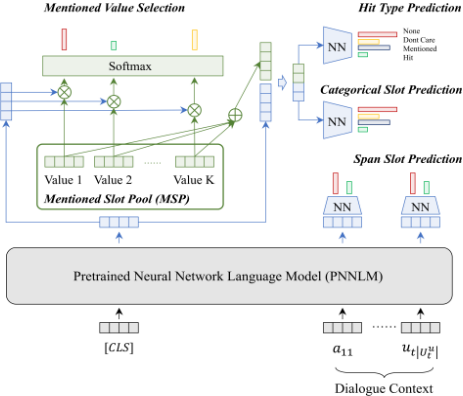
Figure 2 depicts the structure of our model. We represent a dialogue as X = {U a 1 ,U u 1 , . . . ,U a T , U u T }, where T is the total turn number, U a t and U u t are utterances of agent and user in turn t, respectively. U a t and U u t consist of two lists of word tokens ati and utj, respectively. Dialogue context Ct = {U a 1 ,U u 1 , . . . ,U a t ,U u t } indicates observable dialogue utterances at turn t. Following the setting of previous work [Heck et al., 2020], we add a classification token [CLS] in front of Ct, and feed this extended dialogue context into a PNNLM. We use Rt = [rCLS t , r1 t , . . . , r|Ct| t ] to denote the output of PNNLM, where ri t ∈ Rn corresponds to a token in Ct and n represents the output dimension of the PNNLM.
The goal of DST is to exactly predict the dialogue state yt according to Ct. yt is a set of slot-value tuples.
We useMs,t = [M 1 s,t , ...,M K s,t ] to denote the MSP, where K is the maximum size of MSP. M i s,t indicates the predicted values of slot s or relevant slots s′ at turn t-1. The definition of relevant slots is described later. ms,t ∈ RK×n and mis,t indicate the representation of Ms,t and M i s,t , respectively. The low-rank bilinear model is utilized to generate a fused MSP representation [Kim et al., 2018],
where rslot ∈ Rn are representations of a given slot, and W fused s ∈ Rn×n is a learnable parameter.
3.2 Hit Type Prediction
Each slot is equipped with a hit type prediction layer. At each turn t, the hit type prediction layer maps representations of MSP and dialogue context to one of the four classes in {none, dontcare, mentioned, hit},
where none indicates the slot is not mentioned until turn t, dontcare indicates the user does not care about the value of slot s, mentioned indicates slot value is from an item in MSP, and hit indicates slot value needs to be updated according to Ct. If a slot is already mentioned and the predicted slot hit type is hit, it indicates our model predicts the previous slot value is wrong, and the model will update the slot value via the hit value prediction module.
3.3 Mentioned Value Selection
As described in equation 3, we utilized a bilinear model to select the most appropriate slot value in MSP according to the representation of Ct when our model assigns mentioned as hit type. The value with biggest pmention s,t will be selected.
3.4 Hit Value Prediction
Our model extracts a slot value from Ct when the model assigns hit as hit type. In this study, we refer to slots whose possible value number are small as categorical slots, e.g., whether a hotel has free internet, and slots whose possible value numbers are large, unenumerable, or may change over time as span slots, e.g., restaurant name in a booking task. The value of a categorical slot is predicted via a classification method. A slot-specific prediction layer takes rCLS t and mfused s,t as input and generate the probabilities of each slot value,
where Vs denotes the ontology of a categorical slot. We predict the value of a span slot by finding a token span within Ct. Our model determines the token span by predicting its start token index and end token index. A slot-specific span prediction layer takes Rt as input and projects it as:
The index with the biggest probability will be assigned as the classify value, start index, or end index. The span will be assigned as none if the start index is larger than the end index.
3.5 Optimization
The loss function for the hit type prediction, mentioned value selection, and hit value prediction of a single dialogue are defined as follows:
where ytype s,t , ymention s,t , yhit s,t , ystart s,t , yend s,t are one-hot encoded labels of a slot hit type, mentioned slot, categorical slot, and the start index and the end index of a span slot, respectively. The joint loss function of dialogue is a weighted sum of Ltype, Lmention, and Lhit, as shown in equation 11, where α, β, γ are weight hyperparameters.
4 Experiments
4.1 Experiment Settings
Dataset
We conducted experiments on three annotated DST datasets, i.e., MultiWOZ 2.1, MultiWOZ 2.2, and WOZ 2.0, respectively [Eric et al., 2020; Zang et al., 2020; Wen et al., 2017]. We preprocessed datasets following [Heck et al., 2020]. We mainly focus on analyzing the results of MultiWOZ 2.1 and 2.2 because they are by far the most challenging open-source datasets in DST task. MultiWOZ 2.1 and 2.2 are comprised of over 10,000 multi-domain dialogues over a large ontology. There are five domains (train, restaurant, hotel, taxi, attraction), with 30 domain-slot pairs appearing in all data portions. We also report experimental results on the WOZ 2.0 to add additional evidence, although the it is smaller than the MultiWOZ dataset in both ontology and the number of examples.
Range of Mentioned Slot Pools
For a slot s at turn t, the MSP is comprised of the value of slot s and values of (at most) other three relevant slots s′ at turn t-1. The none slot value is not included. We define the s′ is a relevant slot of s if s may inherit the value of slot s′ . Of note, a slot only inherit the value from a small fraction of other slots. For example, the taxi-destination slot cannot inherit the value from the restaurant-food slot and taxi-departure slot because the restaurant-food is not a place, and the destination cannot be the same as the departure. We designed a custom dictionary in this study to define the range of relevant slots. The MSP will be padded if its actual size is less than four. We used the masking method to avoid the model selecting the padded value. The MSP will be truncated if its actual size is larger than four. Only the latest four updated slot values will be reserved. If the actual size of MSP is zero and our model assigns the slot hit type as mentioned, the slot value will be assigned as none.
Evaluation Metric
We mainly evaluated DST models using the Joint Goal Accuracy (JGA) metric. Turn-specific JGA is one if and only if all slot-value pairs are correctly predicted, otherwise zero. The general JGA score is averaged across all turns in the test set.
Although JGA is the most widely used metric in the DST task, it is not comprehensive enough because the label distribution in the DST dataset is highly imbalanced. We adopted precision, recall, and F1 to investigate model performance more detailly. As slot filling is not a binary classification task, we define precision = TP (TP+FP) , recall = TP (TP+FN+PLFP) , and F1 is the harmonic mean of recall and precision. TP (true positive) indicates the number of cases that the slot value is not none, and the model successfully predicts the value. FP (false positive) indicates that the slot value is none, but the model predicts not none. FN (false negative) indicates that the slot value is not none, but the model predicts none. PLFP (positive label false prediction) indicates that the slot value is not none and the model predicts a wrong positive value.
Implemention Details
We used the pre-trained BERT transformer as the PNNLM backbone [Devlin et al., 2019], which was also adopted in most previous DST studies. The base version of BERT was trained on lower-uncased English text. It has 12 hidden layers with 768 units and 12 self-attention heads. The large version has 24 hidden layers with 1024 units and 16 self-attention heads, and it was trained on cased English text. The base and large versions of BERT have about 110 million and 345 million parameters, respectively. Unless specified, we used the base version of BERT as the pre-trained backbone and reported corresponding performance.
The maximum input sequence length was set to 512 tokens after tokenization. The weights α, β, and γ were 0.6, 0.2, and 0.2, respectively. We adopted embeddings released from WordPiece as value representations and slot representations (mis,t , rslot) [Wu et al., 2016]. The word embeddings were locked during the training process. If the slot and the value need to be represented by multi-tokens, we used the mean of the corresponding token embeddings as the representation.
For optimization, we used Adam optimizer [Kingma and Ba, 2015]. The initial learning rate was set to 1e-5, and the total epoch number was set to 20. We conducted training with a warmup proportion of 10% and let the learning rate decay linearly after the warmup phase. Early stopping was employed based on the JGA of the development set. All the reported performance JGA were the mean of five independent experiments. We released the source code of this paper at https://github.com/ZJLAB-AMMI/msp.
Baseline Models
We compared our proposed model with a variety of recent DST baselines.
- TRADE [Wu et al., 2019] encodes the whole dialogue context using bidirectional Gated Recurrent Units (GRU) and generates the value for every slot using the GRU-based copy mechanism.
- SUMBT [Lee et al., 2019] learns the relations between domain-slot-types and slot-values appearing in utterances through attention mechanisms based on contextual semantic vectors.
- DS-DST [Zhang et al., 2020] is an ontology-based DST model that requires an ontology with all possible values for each domain-slot pair.
- Trippy [Heck et al., 2020] uses the triple copy mechanism to track the dialogue state.
- Seq2Seq-DU [Feng et al., 2021] employs two encoders to encode the utterances and the descriptions of schemas and a decoder to generate pointers to represent the state of dialogue.
- AG-DST [Tian et al., 2021] generates a dialogue based on the current turn and the previous dialogue state and a two-pass process.
As our model is fine-tuned on the target dataset, we did not include models trained by augmented or external corpus as baselines to make the comparison fairly, e.g. [Mehri et al., 2020; Li et al., 2021]. The performance of baselines was cited from corresponding papers or [Zhao et al., 2021].
4.2 Experimental Results
DST Performance
Table 1 describes the DST performance of our MSP models and baselines in MultiWOZ 2.1, MultiWOZ 2.2, and WOZ 2.0 datasets, respectively. The domain-specific JGAs of two MultiWOZ datasets are described in Table 2. The MSPB indicated the model used base version of BERT as the backbone, while the MSP-L indicated the model used the large version of BERT. The AG-DST-S and AG-DST-T indicates the two models used single PNNLM and two PNNLMs as backbones, respectively. The doamin-specific JGA indicated our MSP model obtained better performance in taxi, resaurant, and attraction task because of the update of MultiWOZ dataset.
As the size of PNNLM significantly influences the performance of models in almost all natural language processing tasks, it is necessary to figure out whether the performance improvement of a model is from its structure design or its PNNLM scale. Therefore, we also described the number of parameters in PNNLM. The result showed that our MSPB model achieved better performance than baselines when their PNNLM sizes were similar. Specifically, the MSP-B model improved SOTA JGA of MultiWOZ 2.1 from 55.3% to 56.2% (compared to Trippy) and MultiWOZ 2.2 from 51.7% to 54.2% (compared to DS-DST). It also achieved comparable performance (JGA: 91.2%) compared to DS-DST and SUMBT in WOZ 2.0, though slightly worse than Trippy (JGA: 92.7%).
| # of | MultiWOZ | WOZ | ||
|---|---|---|---|---|
| Model | Para. | 2.1 | 2.2 | 2.0 |
| TRADE | / | 45.6% | 45.4% | / |
| SUMBT | 110M | 49.2% | 49.7% | 91.0% |
| DS-DST | 110M | 51.2% | 51.7% | 91.2% |
| Trippy | 110M | 55.3% | 50.7% | 92.7% |
| MSP-B | 110M | 56.2% | 54.2% | 91.2% |
| Seq2Seq-DU | 220M | 56.1% | 54.4% | / |
| AG-DST-S | 340M | / | 56.2% | / |
| AG-DST-A | 680M | / | 57.1% | / |
| MSP-L | 345M | 57.2% | 57.7% | / |
| Model | MultiWOZ 2.1 | MultiWOZ 2.2 |
|---|---|---|
| Taxi | 96.2% | 97.5% |
| Restaurant | 88.4% | 88.8% |
| Hotel | 85.0% | 82.2% |
| Attraction | 89.1% | 89.3% |
| Train | 89.5% | 87.6% |
Our MSP model is also more efficient than baselines because it achieved comparable or better performance with significantly fewer parameters and without utilizing the slot description information. Specifically, the MSP-B model obtained 56.2% and 54.2% JGA in two MultiWOZ datasets via only about 110 million parameters (one uncased-base BERT). The Seq2Seq-DU achieved similar performance via about 220 million parameters (two uncased-base BERTs) and the schema descriptions (JGA: 56.1% and 54.4% in two MultiWOZ datasets). Similarly, the MSP-L model achieved significantly better performance than AG-DST (JGA: 57.7% vs. 56.2% in MultiWOZ 2.2) when using PNNLMs with a similar number of parameters. The AG-DST model is slightly worse than our MSP model. Even it uses two times more parameters (JGA: 57.7% vs. 57.1% in MultiWOZ 2.2 dataset). Meanwhile, our MSP-L model achieved 57.2% JGA in MultiWOZ 2.1 dataset. As far as we know, our MSP model reached a new SOTA in the MultiWOZ dataset among models not trained by external or augmented datasets.
Update Strategy Comparison
We conducted experiments on our strategies and three common strategies to investigate whether our MSP-based dialogue update strategy is better. The three strategies are:
| Model | MultiWOZ 2.1 | MultiWOZ 2.2 |
|---|---|---|
| Pure context | 53.7% | 52.3% |
| Changed state | 54.9% | 53.2% |
| Full state | 55.5% | 53.6% |
| MSP | 56.2% | 54.2% |
- Pure context strategy. This strategy does not use the previous dialogue state and tracking the dialogue state purely relies on dialogue context. It is widely used in end-to-end models, e.g., [Hosseini-Asl et al., 2020].
- Changed state strategy. This strategy utilizes the entire dialogue context to track slots changed in the latest turn. If a slot is not mentioned in the latest turn, it inherits the value recorded in the previous dialogue state. Heck et al. [2020] and Zhang et al. [2020] used this strategy.
- Full state strategy. This strategy converts previous dialogue state into a string, and utilizes the dialogue context and dialogue state string to track entire dialogue state. We adopted the design of AG-DST to implement this strategy [Tian et al., 2021].
Table 3 describes the result of the dialogue state update strategy comparison, where all other experimental settings are the same. It is not surprising that the performance of the changed state strategy is better than the pure context strategy (JGA: 54.9% vs. 53.7% in MultiWOZ 2.1 and 53.2% vs. 52.3% in MultiWOZ 2.2) as dialogue state is a compact representation of the dialogue history. Moreover, our strategy achieved about 2% and 1% improvement compared to changed state strategy and full state strategy as it achieved JGA as 56.2% and 54.2% in MultiWOZ 2.1 and 2.2 datasets, respectively. These results demonstrated that our MSP-based dialogue state update strategy is more effective in DST tasks.
Ablation Study
We conducted ablation studies to investigate the performance of our model in five different structures.
- Span-short context. All slots are predicted via the spanbased method, and the model tracks the dialogue state purely based on the latest 128 tokens in the dialogue context.
- Long context. The model tracks dialogue state based on the latest 512 tokens.
- Categorical slots. The categorical slot is predicted via the classification-based method in this structure.
- MSP-self. Adding the MSP module into the model. Only the previous value of the target slot is included in the MSP.
- MSP-full. Our design. Previous values of the target slot and relevant slots are included in the MSP.
Table 4 describes the result of the ablation study. The model with a long context reached significantly better performance than the model with a short context, demonstrating that DST models benefit from longer contextual information.
| Model | MultiWOZ 2.1 | MultiWOZ 2.2 |
|---|---|---|
| Span-short context | 46.4% | 47.9% |
| +Long context | 52.8% | 52.0% |
| +Categorical slots | 54.6% | 53.3% |
| +MSP-self | 56.0% | 53.9% |
| +MSP-full | 56.2% | 54.2% |
Applying the classification-based method to track categorical slots also improves DST performance. These findings accord with findings of previous studies [Tian et al., 2021; Zhou and Small, 2019].
The DST model obtained about 2%-3% performance improvement by equipping the MSP module. The MSP-full model obtained faint performance improvement compared to the MSP-self model (JGA: 56.2% vs. 56.0%, 54.2% vs. 53.9% in two MultiWOZ datasets, respectively). On the one hand, these results showed the effectiveness of updating the dialogue state via our MSP-based strategy. On the other hand, it indicates that integrating the value of another slot into the MSP is helpful, though the performance gain is not significant. The ablation study demonstrated that the MSP module could be used as an additional model component to improve the DST performance.
Inherit Analysis
The previous three subsections have demonstrated the effectiveness of our model. In this subsection, we will further investigate the correctness of our assumption. That is, whether the MSP module improves DST performance by rejecting inheriting wrong slot values and tracking the indirectly mentioned slots.
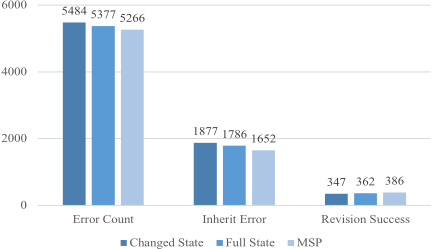
Figure 3 describes inappropriate inherit analysis result of the MSP, changed state, and full state based models on an experiment conducted in the MultiWOZ 2.2 dataset. Error count means the number of wrong slot value prediction cases. Inherit error means the error is caused by inappropriate inheriting. We defined inheriting the wrong previous slot value or failing to track indirectly mentioned slots as inappropriate inheriting. Revision success indicates the model rejects inheriting a wrong value and revising it into a correct value. The MSP model achieved better performance as it mistakenly predicted 5,266 slots, 218 times less than the changed state model. Meanwhile, the inappropriate inherit count of MSP is also less than the changed state model about 200 times. The MSP model successfully corrected the previous mistake 386 times, about 10% more than the changed state model. These results indicate that performance improvement of the MSP model is likely partially from rejecting inherited wrong previous values. Result of full state model also derived the similar conclusion.
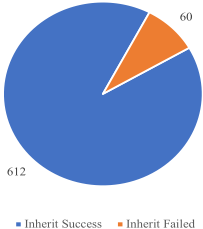
Figure 4 describes the result of indirect mentioned slot inherit analysis on the same experiment. It indicates the MSP model tracked indirectly mentioned slots 612 times, occupying about 91% of indirectly mentioned cases, while we cannot investigate this ability of other models for their black box properity. Although we did not found appropriate baselines to proof the superiority of MSP model in inheriting indirectly mentioned slots, its superiority could be verified indirectly. Of note, the MSP-full model achieved slightly better performance than the MSP-self model. The only difference between the two models is that the MSP-full model contains information of indirectly mentioned slots, while the MSP-self model does not. Therefore, we can reasonably infer that the performance improvement of the MSP-full model is from the incorporation of indirectlymentioned slots. It likely improves the model's ability to handle indirectly mentioned slots, resulting in the JGA improvement.
Error Analysis
At last, we investigated weaknesses of our model. Table 5 describes the slot-specific error distribution of a MultiWOZ 2.2 dataset experiment. We only showed ten slots whose F1 values are less than 90% to save space. These slots are the main performance bottleneck of DST tasks. It is not surprising that most slots are span slots because finding an exact correct token span in a dialogue with hunderends of tokens is difficult. We found the model idenfity wrong slot values mainly because of FP predictions and FN predictions, which is not surprising as well. However, the error distribution revealed that the performance of many slots lagged because of the high PLFP rate. More than half of the mistakes are PLFP in taxi-destination and taxi-departure slot, and over 30% of mistakes are PLFP in the train-leaveat slot. Previous studies have noticed this phenomenon, but they did not analyze it [Tian et al., 2021].
| Slot | Slot Type | Accuracy | Precision | Recall | F1 | TP | TN | FP | FN | PLFP |
|---|---|---|---|---|---|---|---|---|---|---|
| taxi-leaveat | span | 98.9% | 81.6% | 92.6% | 86.8% | 3.6% | 95.4% | 0.3% | 0.5% | 0.3% |
| taxi-destination | span | 98.1% | 82.1% | 92.5% | 87.0% | 6.4% | 91.7% | 0.5% | 0.4% | 1.0% |
| taxi-depature | span | 97.9% | 79.1% | 93.0% | 85.5% | 6.1% | 91.8% | 0.5% | 0.4% | 1.2% |
| taxi-arriveby | span | 99.1% | 84.4% | 87.1% | 85.7% | 2.7% | 96.5% | 0.4% | 0.3% | 0.2% |
| restaurant-name | span | 94.8% | 84.9% | 92.0% | 88.3% | 19.8% | 75.0% | 1.7% | 2.9% | 0.6% |
| hotel-name | span | 95.8% | 87.9% | 90.7% | 89.3% | 17.7% | 78.1% | 1.8% | 1.9% | 0.5% |
| hotel-parking | categorical | 95.4% | 82.4% | 87.4% | 84.8% | 12.9% | 82.5% | 1.9% | 2.5% | 0.2% |
| hotel-type | categorical | 95.4% | 82.4% | 87.4% | 84.8% | 12.9% | 82.5% | 1.9% | 2.5% | 0.2% |
| attraction-name | span | 93.1% | 72.0% | 75.2% | 73.6% | 9.6% | 83.6% | 3.2% | 2.9% | 0.8% |
| train-leaveat | span | 97.1% | 82.9% | 97.0% | 89.4% | 12.4% | 84.6% | 0.4% | 1.5% | 1.0% |
We detailly investigated the high PLFP rate problem in this study. It seems that most PLFP mistakes occur in cases that require the model to identify the correct value in several candidate values. For example, when a user says, "I need a train leaving after 19:45." and the agent replies, "There is a train leaving at 21:00.", there are two candidate values for the train-leaveat slot, i.e., "19:45", and "21:00". We found our model may predict "19:45", rather than the correct "21:00". This result reflected that our model understands shallow semantic information because it extracted a time token span rather than a meaningless one. However, it still cannot understand the deep semantic information because its prediction was wrong.
5 Conclusion
This study proposed a model with a MSP to improve DST performance. The experimental results indicate our model reached new SOTA in DST tasks in MultiWOZ 2.1 and 2.2 datasets. Further experiments demonstrated the MSP can be used as an addidtional component to improve the DST performance, and the MSP-based dialogue state update strategy is more effective than other common update strategies. Meanwhile, we quantitatively analyzed that our design indeed helps the model reject wrong values and track indirectly mentioned slots. However, our model still performs poorly in understanding deep semantic information. In the future study, we will integrate external grammar knowledge to improve the model's understanding ability in complex dialogue context.
Acknowledgements
This research was supported by the National Key Research and Development Program of China (No. 2021ZD0204105), Exploratory Research Project of Zhejiang Lab (No. 2022RC0AN01), and Open Research Projects of Zhejiang Lab (No. 2019KD0AD01/012).
@inproceedings{ijcai2022p607,
  title     = {On Tracking Dialogue State by Inheriting Slot Values in Mentioned Slot Pools},
  author    = {Sun, Zhoujian and Huang, Zhengxing and Ding, Nai},
  booktitle = {Proceedings of the Thirty-First International Joint Conference on
               Artificial Intelligence, {IJCAI-22}},
  publisher = {International Joint Conferences on Artificial Intelligence Organization},
  editor    = {Luc De Raedt},
  pages     = {4375--4382},
  year      = {2022},
  month     = {7},
  note      = {Main Track},
  doi       = {10.24963/ijcai.2022/607},
  url       = {https://doi.org/10.24963/ijcai.2022/607},
}
TY - CPAPER TI - On Tracking Dialogue State by Inheriting Slot Values in Mentioned Slot Pools AU - Sun, Zhoujian AU - Huang, Zhengxing AU - Ding, Nai T2 - Proceedings of the Thirty-First International Joint Conference on Artificial Intelligence, IJCAI-22 PB - International Joint Conferences on Artificial Intelligence Organization PY - 2022 SP - 4375 EP - 4382 DO - 10.24963/ijcai.2022/607 UR - https://doi.org/10.24963/ijcai.2022/607 ER -Copied
Machine-readable versions of this paper, for tools and AI agents:





