
S2SNet: A Pretrained Neural Network for Superconductivity Discovery
Proceedings of the Thirty-First International Joint Conference on Artificial Intelligence. AI for Good. Pages 5101-5107.
https://doi.org/10.24963/ijcai.2022/708
Keywords
- Multidisciplinary Topics and Applications: Physical Science
Abstract
Superconductivity allows electrical current to flow without any energy loss, and thus making solids superconducting is a grand goal of physics, material science, and electrical engineering. More than 16 Nobel Laureates have been awarded for their contribution in superconductivity research. Superconductors are valuable for sustainable development goals (SDGs), such as climate change mitigation, affordable and clean energy, industry, innovation and infrastructure, and so on. However, a unified physics theory explaining all superconductivity mechanism is still unknown. It is believed that superconductivity is microscopically due to not only molecular compositions but also the geometric crystal structure. Hence a new dataset, S2S, containing both crystal structures and superconducting critical temperature, is built upon SuperCon and Material Project. Based on this new dataset, we propose a novel model, S2SNet, which utilizes the attention mechanism for superconductivity prediction. To overcome the shortage of data, S2SNet is pre-trained on the whole Material Project dataset with Masked-Language Modeling (MLM). S2SNet makes a new state-of-the-art, with out-of-sample accuracy of 92% and Area Under Curve (AUC) of 0.92. To the best of our knowledge, S2SNet is the first work to predict superconductivity with only information of crystal structures. This work is beneficial to superconductivity discovery and further SDGs. The code and datasets are available at https://github.com/supercond/S2SNet
- [Bahdanau et al., 2015] Dzmitry Bahdanau, Kyunghyun Cho, and Yoshua Bengio. Neural machine translation by jointly learning to align and translate. In Yoshua Bengio and Yann LeCun, editors, 3rd International Conference on Learning Representations, ICLR 2015, San Diego, CA, USA, May 7-9, 2015, Conference Track Proceedings, 2015.
- [Baldow et al., 2017] Christoph Baldow, Sebastian Salentin, Michael Schroeder, Ingo Roeder, and Ingmar Glauche. Magpie: Simplifying access and execution of computa- tional models in the life sciences. PLoS computational biology, 13(12):e1005898, 2017.
- [Bardeen et al., 1957] John Bardeen, Leon N Cooper, and J Robert Schrieffer. Microscopic theory of superconduc- tivity. Physical Review, 106(1):162, 1957.
- [Bergerhoff et al., 1987] G Bergerhoff, ID Brown, F Allen, et al. Crystallographic databases. International Union of Crystallography, Chester, 360:77-95, 1987.
- [Chen et al., 2019] Chi Chen, Weike Ye, Yunxing Zuo, Chen Zheng, and Shyue Ping Ong. Graph networks as a univer- sal machine learning framework for molecules and crys- tals. Chemistry of Materials, 31(9):3564-3572, 2019.
- [Devlin et al., 2019] Jacob Devlin, Ming-Wei Chang, Ken- ton Lee, and Kristina Toutanova. BERT: pre-training of deep bidirectional transformers for language understand- ing. In Jill Burstein, Christy Doran, and Thamar Solorio, editors, Proceedings of the 2019 Conference of the North American Chapter of the Association for Computational Linguistics: Human Language Technologies, NAACL-HLT 2019, Minneapolis, MN, USA, June 2-7, 2019, Volume 1 (Long and Short Papers), pages 4171-4186. Association for Computational Linguistics, 2019.
- [Dosovitskiy et al., 2020] Alexey Dosovitskiy, Lucas Beyer, Alexander Kolesnikov, Dirk Weissenborn, Xiaohua Zhai, Thomas Unterthiner, Mostafa Dehghani, Matthias Min- derer, Georg Heigold, Sylvain Gelly, et al. An image is worth 16x16 words: Transformers for image recognition at scale. arXiv preprint arXiv:2010.11929, 2020.
- [Hamidieh, 2018] Kam Hamidieh. A data-driven statistical model for predicting the critical temperature of a super- conductor. Computational Materials Science, 154:346- 354, 2018.
- [Han et al., 2021] Xu Han, Zhengyan Zhang, Ning Ding, Yuxian Gu, Xiao Liu, Yuqi Huo, Jiezhong Qiu, Liang Zhang, Wentao Han, Minlie Huang, et al. Pre-trained mod- els: Past, present and future. arXiv e-prints, pages arXiv- 2106, 2021.
- [Hinton and Roweis, 2002] Geoffrey Hinton and Sam T Roweis. Stochastic neighbor embedding. In NIPS, vol- ume 15, pages 833-840. Citeseer, 2002.
- [Hirschberg and Manning, 2015] Julia Hirschberg and Christopher D Manning. Advances in natural language processing. Science, 349(6245):261-266, 2015.
- [Jain et al., 2013] Anubhav Jain, Shyue Ping Ong, Geoffroy Hautier, Wei Chen, William Davidson Richards, Stephen Dacek, Shreyas Cholia, Dan Gunter, David Skinner, Ger- brand Ceder, and Kristin a. Persson. The Materials Project: A materials genome approach to accelerating materials in- novation. APL Materials, 1(1):011002, 2013.
- [Kirklin et al., 2015] Scott Kirklin, James E. Saal, Bryce Meredig, Alex Thompson, Jeff W. Doak, Muratahan Aykol, Stephan Rühl, and Chris Wolverton. The open quantum materials database (oqmd): Assessing the accu- racy of dft formation energies. npj Computational Mate- rials, 1, December 2015. Publisher Copyright: c 2015 Shanghai Institute of Ceramics, Chinese Academy of Sci- ences/Macmillan Publishers Limited.
- [Kwaśniewska et al., 2017] Alicja Kwaśniewska, Jacek Rumiński, and Paul Rad. Deep features class activation map for thermal face detection and tracking. In 2017 10Th international conference on human system interactions (HSI), pages 41-47. IEEE, 2017.
- [Le-Khac et al., 2020] Phuc H Le-Khac, Graham Healy, and Alan F Smeaton. Contrastive representation learning: A framework and review. IEEE Access, 2020.
- [Mercado et al., 2021] Rocío Mercado, Tobias Rastemo, Ed- vard Lindelöf, Günter Klambauer, Ola Engkvist, Hong- ming Chen, and Esben Jannik Bjerrum. Graph networks for molecular design. Machine Learning: Science and Technology, 2(2):025023, 2021.
- [Miryala, 2021] Muralidhar Miryala. Expert opinion: Rele- vance of high-tc superconductors for sdg goals. In High-Tc Superconducting Technology, pages 1-16.
- [Park and Wolverton, 2020] Cheol Woo Park and Chris Wolverton. Developing an improved crystal graph con- volutional neural network framework for accelerated ma- terials discovery. Physical Review Materials, 4(6):063801, 2020.
- [Schmidt et al., 2019] Jonathan Schmidt, Mário RG Mar- ques, Silvana Botti, and Miguel AL Marques. Recent ad- vances and applications of machine learning in solid-state materials science. npj Computational Materials, 5(1):1- 36, 2019.
- [Stanev et al., 2018] Valentin Stanev, Corey Oses, A Gilad Kusne, Efrain Rodriguez, Johnpierre Paglione, Stefano Curtarolo, and Ichiro Takeuchi. Machine learning mod- eling of superconducting critical temperature. npj Compu- tational Materials, 4(1):1-14, 2018.
- [Villars and Phillips, 1988] Pierre Villars and James Charles Phillips. Quantum structural diagrams and high-t c super- conductivity. Physical Review B, 37(4):2345, 1988.
- [Vinyals et al., 2015] Oriol Vinyals, Samy Bengio, and Man- junath Kudlur. Order Matters: Sequence to sequence for sets. arXiv e-prints, page arXiv:1511.06391, November 2015.
- [Xie and Grossman, 2018] Tian Xie and Jeffrey C Gross- man. Crystal graph convolutional neural networks for an accurate and interpretable prediction of material proper- ties. Physical review letters, 120(14):145301, 2018.
- [Yang et al., 2021] Qiong Yang, Hongchao Ji, Hongmei Lu, and Zhimin Zhang. Prediction of liquid chromato- graphic retention time with graph neural networks to as- sist in small molecule identification. Analytical Chemistry, 93(4):2200-2206, 2021.
- [Zhang et al., 2021] Xiao-Chen Zhang, Cheng-Kun Wu, Zhi-Jiang Yang, Zhen-Xing Wu, Jia-Cai Yi, Chang-Yu Hsieh, Ting-Jun Hou, and Dong-Sheng Cao. Mg-bert: leveraging unsupervised atomic representation learning for molecular property prediction. Briefings in Bioinfor- matics, 2021.
- [Zhou et al., 2018] Quan Zhou, Peizhe Tang, Shenxiu Liu, Jinbo Pan, Qimin Yan, and Shou-Cheng Zhang. Learning atoms for materials discovery. Proceedings of the National Academy of Sciences, 115(28):E6411-E6417, 2018.
References were extracted automatically from the PDF and may contain errors.
Full text extracted automatically from the PDF; figures, tables and equations may differ. The PDF is the version of record.
1 Introduction
Superconductors are crucial for sustainable everyday applications and attractive for the United Nations' sustainable development goals (SDGs) [Miryala, 2021]. Superconductors have zero resistance, which allows perfect current transmission without losses. With superconducting cables, a continuous supply of power can be obtained for a timely availability of irrigation water in remote areas, which is a key to sustainability in performing agriculture. Then hunger can be effectively alleviated since it is partly caused by the lack of sustainability in performing agriculture. Affordable and clean energy can also be obtained because DC energy from places where power is plentiful, like solar plants in Africa (365 sunny days) can be delivered worldwide without losses. Zero resistance means "no heat-generation and no energyloss", which is the key contribution in the climate action. For good health and well-being, superconducting magnets, which can produce magnetic field of high-quality, high-intensity, are well used as high-field magnets in magnetic resonance imaging, nuclear magnetic resonance, water purification, magnetic drug delivery, and so on.
∗Equal contribution.
†Corresponding author: rux@zju.edu.cn
Superconductivity has been a hot topic along many fields for its great significance to human beings and SDGs. However, the theory of superconductivity is still a puzzle till now. Benefiting from massive publicly available datasets in the area of material science, many machine learning methods have been applied to predicting material properties, generating structures, and so on [Schmidt et al., 2019]. It also sheds a light to modeling superconductors with machine learning methods. Much of the recent interest in superconductivity modelling has focused on critical temperature regression using measured properties of the material [Stanev et al., 2018; Hamidieh, 2018], which is computationally expensive since feature engineering is required.
In AI for physical science, a lot of efforts have been made to model molecules with Graph Neural Networks (GNN) [Yang et al., 2021; Mercado et al., 2021] since the molecules are graphs naturally. However, quite few methods have been proposed for crystal modelling [Chen et al., 2019; Park and Wolverton, 2020; Xie and Grossman, 2018]. Due to the different annotations among different datasets, the current supervised learning models can only be trained on small datasets, while other unlabeled data are not fully utilized.
Recently, attention mechanism is widely used in Natural Language Processing (NLP) [Bahdanau et al., 2015] and Computer Vision (CV) [Dosovitskiy et al., 2020] to model the interaction of contexts. The pre-training task, MaskedLanguage Modeling (MLM) task, in both NLP and CV, has shown great potential to get model better and more robust with astounding experimental results [Devlin et al., 2019; Bahdanau et al., 2015]. Besides, with pre-training tasks, the unlabeled data can be utilized properly.
According to BCS theory, superconductivity can be microscopically explained as the interaction between electrons and lattice vibrations (phonons) [Bardeen et al., 1957]. Therefore, we propose a machine learning model for the way from Structure to Superconductivity (S2SNet), in which only crystal structures are required, to model the interaction in order to predict potential superconducting. Attention mechanism is applied to crystal structures. S2SNet is pre-trained on a large amount of unlabeled data to learn the interaction between different atoms in lattice.
Through S2SNet, we try to model the potential interaction between lattice dynamics and cooper pairs to predict the potential superconductor properties of material. It is experimentally verified that S2SNet outperforms other existing models. To the best of our knowledge, S2SNet is the first work showing that it is possible to predict the superconductivity of materials via their crystal structures.
The main contributions of our work can be summarized as follows:
- We propose a novel neural network to discover potential superconductivity of materials given only information of crystal structures for the first time.
- A new dataset S2S containing both crystal structure and superconductivity critical temperature is built for the first time. It provides a benchmark for future machine learning based superconductor discovery.
- To provide insight and guide the superconductivity research for physicists, we present a list of potential superconductors for future experimental validation.
2 RelatedWork
Superconductivity Prediction. Previous machine learning methods focus on predicting the superconductivity through the measured properties of materials, while these properties are obtained through complex and expensive feature engineering. The averaged valence-electron numbers, orbital radii differences, and metallic electronegativity differences were three critical features used in [Villars and Phillips, 1988]. Materials Agnostic Platform for Informatics and Exploration (Magpie) and AFLOW were used for feature engineering in [Stanev et al., 2018; Hamidieh, 2018].
Crystal Modeling. Quite few methods are proposed for crystal modeling. By connecting the atoms within a distance threshold, crystals were modeled as a graph with atoms as nodes in CGCNN [Park and Wolverton, 2020; Xie and Grossman, 2018]. External environmental conditions are taken into consideration by taking it as an additional nodes and connecting it with all the other nodes in MEGNet [Chen et al., 2019].
Unsupervised Learning. Various approaches have been proposed to make full use of the unlabeled data, most of which pre-train a model with the unlabeled dataset and finetune it on specific labeled dataset [Han et al., 2021]. Contrastive learning is commonly used for pre-training in CV [Le-Khac et al., 2020]. As pre-training tasks in NLP, diverse techniques such as mask language model (MLM), replaced token detection (RTD), and so on are often employed
(a) Schematic illustration of S2SNet
(b) Schematic illustration of attention mechanism
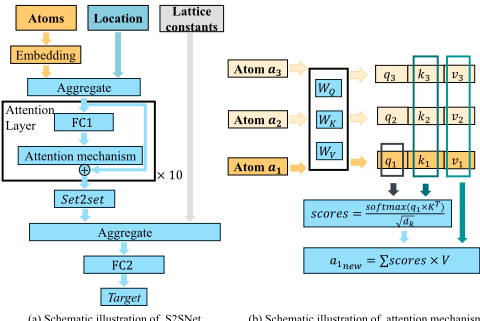
Figure 1: Illustration of S2SNet and attention mechanism. (a) Overall illustration of S2SNet. The Attention Module are performed for 10 times. FC1 and FC2 are two fully connected hidden layers. FC2 outputs the target ˆ yt. (b) Illustration of the Attention mechanism. The computation of representation of Atom a1 is presented. Best view in color.
[Hirschberg and Manning, 2015]. Following the pre-training model Bert, Zhang et. al. proposed "MG-Bert" for molecule modelling with unsupervised learning [Zhang et al., 2021].
3 Methodology
Attention mechanism is proposed in the filed of NLP and widely used in CV recently [Hirschberg and Manning, 2015; Dosovitskiy et al., 2020]. It is applied to the crystals in this study.
3.1 S2SNet
Fig. 1 shows the overall illustration of S2SNet and the attention mechanism. In this paper, it is defined that a crystal c ∈ C consists of atoms A = {a1, a2, · · · , an}, the location of atoms P = {p1, p2, · · · , pn}, and the lattice parameters U = {u1, u2, u3}, i.e. c = {A, P,U}. n, a, p and U denote the number of atoms in a unit cell, the atomic number, the actual 3-D location of an atom in the crystal, and the physical dimension of a unit cell respectively. The overall workflow of S2SNet can be described as followings:
- Atoms A are embedded into 512-dim vectors through the Embedding layer. Expanded distance with Gaussian basis centered at 512 points linearly placed between 0 and 5.12 ˚A is applied to the location P of atoms in the crystal [Chen et al., 2019]. Specifically, the Euclidean distances P ′ between atoms and the center of crystal i.e. the mean coordinates of all atoms, are calculated. Then Gaussian basis are performed as Eq. 1, where P ′0 are 512 distances from 0 to 5.12 ˚A and σ = 2 [Chen et al., 2019].
- The embedding of atoms A′ are atom-wise aggregated with the distance ˆ P as Eq. 2, where Wα is a matrix to
get the position ˆ P into the same dimension as A′ and model the interaction between different positions.
- Attentionmechanism is performed on each atom respectively with its neighborhood atoms. Thus the embedding of atom contains all the information of itself and neighbors. neighbor(a′′ ) is defined as the atoms within the Euclidean distance, ρ, from a′′ . In this paper, ρ equals to 2 ˚A according to [Chen et al., 2019].
- To aggregate the embedding of all atoms in crystal, the Set2Set [Vinyals et al., 2015] is performed on the set A′′′ .
- Lattice parameters are aggregated to get the final representation of crystal as Eq. 5, where Wθ is a matrix to get the lattice parameters U into the same dimension as b.
- Through the FC2 layer, target can be obtained and loss function is binary cross entropy as Eq. 6, where yt is the ground truth of whether it is a superconductor and ˆ yt is the prediction of S2SNet.
In Fig. 1(b), an example of the attention mechanism is illustrated. Suppose that the neighbors of atom a1 are a2 and a3. To get the representation of atom a1, a1 and its neighbors, a2 and a3, are firstly multiplied with WQ, WK and WV respectively. Three different groups of {q, k, v} are obtained. q1 from a1 is multiplied with k1, k2, k3 from all the atoms to get the score as Eq. 7, where dk is the dimension of k. Finally, the representation of atom a1 can be obtained as the weighted sum of V from all the atoms as Eq. 8, where N is the number of a1's neighbors plus one. Representations of other atoms ai ∈ A can also be obtained like this.
| Dataset | |U| | Max (|A|) | |V | |
| S2S | 1,685 | 248 | 95 |
| pre-train | 69,239 | 444 | 95 |
3.2 MLMPre-training Task
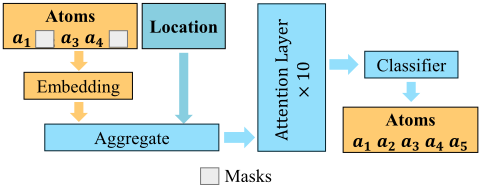
MLM pre-training task is a self-supervised learning method to model the interaction between atoms via classification as Fig. 2. In this task, 15% (at least 2) of the atoms in a crystal are masked, and the model are trained to predict the class of masked atoms. Therefore no extra labels except the structure of the crystal are required. Since there are 95 elements in S2S dataset, this pre-training is a 95-classification task. The objective of this pre-training can be defined as Eq. 9, where N and 95 denote the number of masked atoms and the number of element classes respectively. yi,j is the ground truth and ˆ yi,j is the prediction of S2SNet for "atom i is the element j", 0 for False and 1 for True.
After convergence of training, the Embedding, Aggregate, and Attention layers are cloned. Finally, S2SNet is then finetuned on S2S dataset with the pre-trained layers frozen.
4 Experiments
To verify S2SNet, a dataset of superconductors is constructed, on which extensive experiments are conducted. Compared with other models, the experiments demonstrate that S2SNet effectively captures the crystal structural information for superconductivity prediction.
4.1 Setup
S2S Dataset. We collect a total of 69,239 crystal structures from Material Project database [Jain et al., 2013], each of which contains lattice structure, formation energy, and band gap of crystals. 33,810 superconductors and their critical temperatures are obtained from SuperCon∗ , which stores the critical temperature of substances. In addition, this paper also obtains structural information of part of materials from databases such as OQMD [Kirklin et al., 2015], and ICSD [Bergerhoff et al., 1987]. The information in the databases above are used to construct S2S dataset with 1,685 crystals, which includes 421 currently known crystal superconductors and other 1,264 materials without known superconductivity sampled fromMaterial Project database. Each entry includes the name of the substance, its crystal structure(atoms, location of atoms and lattice parameters), and whether it is a superconductor. This statistics of S2S dataset and pre-training dataset are shown in Table 1.
∗ https://supercon.nims.go.jp/en/
| Method | pre-train | without pre-train | ||
|---|---|---|---|---|
| ACC(%) | AUC(%) | ACC(%) | AUC(%) | |
| MEGNet | 80.30 | 79.10 | 78.37 | 75.43 |
| Statistic | - | - | 83.33 | 78.52 |
| CGCNN | 82.42 | 86.40 | 79.69 | 82.45 |
| S2SNet(ours) | 91.28 | 91.18 | 89.53 | 90.24 |
Compared Approaches. We mainly compare our proposal with several superconductivity prediction methods, MEGNet [Chen et al., 2019], Statistic [Stanev et al., 2018], and CGCNN [Xie and Grossman, 2018]. MEGNet uses graph networks to model molecules and crystals universally for property prediction. Statistic achieves a pleasant result on predicting superconductor which calculates 145 properties of materials with MAGPIE [Baldow et al., 2017] and put these features into a random forest for training. CGCNN is specifically designed for accurate and interpretable prediction of crystal material properties where convolutional neural networks are performed on crystal graph.
Evaluation Metrics. We mainly employ Accuracy (ACC) and Area Under Curve (AUC) for superconductor prediction. In addition, we also use visualization and interpretability analysis to verify our S2SNet.
4.2 Experimental Results and Discussion
Comparison on S2S Dataset. All these models are trained and tested directly on S2S dataset. To bridge the shortage of data, MEGNet and CGCNN are pre-trained with the task of predicting formation energy following the paper [Chen et al., 2019] and S2SNet is pre-trained with the MLM task both on the Material Project database. 80% of S2S dataset are randomly selected to train the models and the left 20% are used to test the models. All the models are evaluated in the same way. Adam optimizer is used in S2SNet and the settings of other models follow their papers.
The experimental results are shown in Table 2. S2SNet consistently outperforms the other competitors both on accuracy (ACC) and Area Under Curve (AUC). For example, S2SNet gets about 6% improvements on ACC than Statistic and about 7% improvements on AUC than CGCNN without pre-training and almost 11%/14% improvements than MEGNet on ACC/AUC. With the pre-training task, all these three models, MEGNet, CGCNN and S2SNet are improved significantly. Since S2SNet is pre-trained on the unsupervised MLM task, it can be pre-trained on other much bigger dataset without any labels. However, MEGNet and CGCNN must be trained on the dataset with specific labels such as formation energy and so on. This also means that S2SNet can be further improved with larger dataset in the future work.
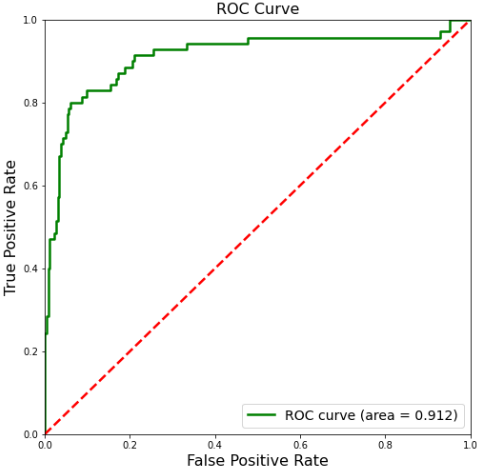
Fig. 3 shows the receiver operating characteristic (ROC) curve for the superconductor classifier. The overall test accuracy is 91.28%, and the area under curve for the receiver operation conditions is 0.9118.
4.3 Ablation Study
Ablation studies are also conducted to verify our S2SNet. Table 3 shows the experimental results of S2SNet with different number of attention layers on S2S dataset. Experiments demonstrate that more layers lead to better AUC. For both efficiency and accuracy, the number of attention layers in our S2SNet is 10.
| # attention layers | 5 | 10 | 15 |
| ACC(%) | 89.83 | 91.28 | 92.31 |
|---|---|---|---|
| AUC(%) | 89.38 | 91.18 | 92.27 |
| Method | pre-train | without pre-train | ||
|---|---|---|---|---|
| w | w/o | w | w/o | |
| ACC(%) | 91.28 | 90.41 | 89.53 | 87.79 |
| AUC(%) | 91.18 | 89.22 | 90.24 | 86.20 |
Further experiments are conducted to verify that the lattice parameters are helpful in S2SNet. Table 4 shows results of 10 attention layer S2SNet without the input of lattice parameters. With lattice parameters, models perform much better no matter pre-trained or not.
4.4 Interpretability on S2SNet
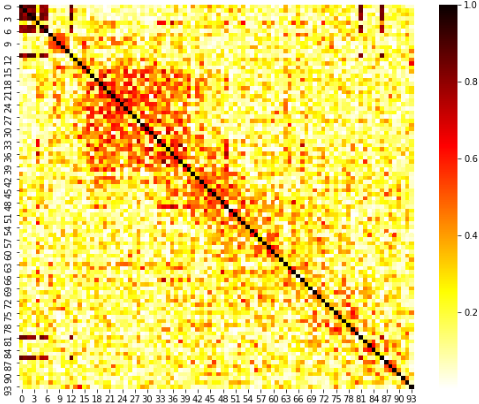
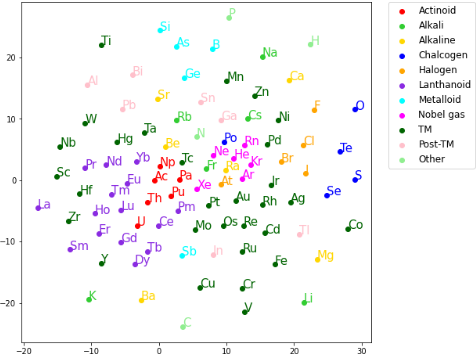
According to [Zhou et al., 2018], the interpretability and reproducibility of known chemical common knowledge for machine learning models in material science is critical. To this end, the embeddings of all the element are extracted from S2SNet. The Pearson correlation coefficient between different elements are calculated as Eq. 10, where m is the dimension of elemetal embedding vector. As is shown in Fig. 4, the Pearson correlation coefficient between elemental embedding vectors follow the trend of the periodic table of elements. For example, the chalcogen, halogen, lanthanoid, transition metals, metalloid, and actinoid show highest similarities within their groups. For better observation on the elemental embedding vectors, t-SNE[Hinton and Roweis, 2002] is used to map the high-dimension embedding vectors into 2-dimension space in Fig. 5. Elements with similar properties are close to each other, such as the Actinoid, the Chalcogen, the Halogen and so on. All the visualizations show that S2SNet learns the common intuition in chemistry.
4.5 Potential SuperconductingMaterials
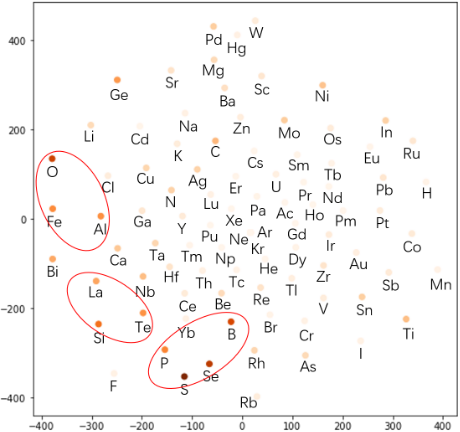
In order to provide more insight to the field of superconducting materials research, all the materials we have are fed into S2SNet to predict whether they are superconductors or not. Frequency of elements in materials that our model determines to be superconductors is shown in Fig. A1 in Appendix A. Orange and blue ones denote the number of atoms and the number of materials that contain corresponding atom respectively. Si, S, B, La, Fe, Se, Ge, P, Al, N, O, Bi, C, Ca, Te, Ti and Ni appear in more than 300 superconductors which, in our opinion, are supposed to be crucial elements for superconductor. And the known superconducting elements Nb, Pb, and so on are also identified as the crucial elements in S2SNet. To verify that whether our model has learned these knowledge, we make the embedding layer learnable and train the overall model with the superconductivity prediction. Atomic embeddings are visualized by t-sne in Fig. 6. The atoms with high frequency are grouped together.
We get 5468 potential superconductors out of the 69239 materials, and the element combination of part of representative potential superconductors are list in Table A1 in Appendix A. The existing Iron-based, Cuprate, Hydrogen-based and Metal superconductors are identified with high score by our model. Some potential superconductors with similar structures are also predicted. Besides, the other potential superconductors with extremely high score are also given for further experimental synthesis verification. The results are reasonable, since Graphene and SiC, which are not in the training set, are predicted to be superconductors. The prediction accuracis for Iron-based, Cuprate, Hydrogen-based superconductors are 97.64%, 92.00% and 96.89% respectively. It is worth mentioning that all the 21 Iron-based superconductors are correctly predicted.
4.6 Why Are They Superconductors
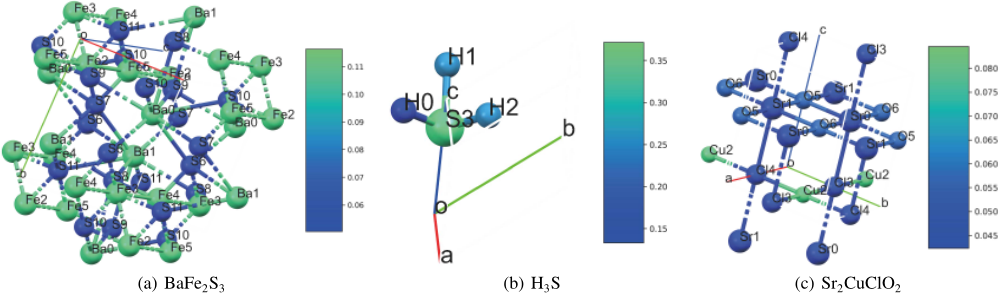
Class Activation Map (CAM) is used to explore how superconductivity comes [Kwa´sniewska et al., 2017]. CAM is a technique commonly used in CV for interpretability, i. e., highlighting the parts of a picture where the model identifies it as a specific class. Herein, we highlight the atoms in crystals that are critical for superconductivity with CAM. The experimental findings are consistent with the previously proposed theories. We take the BaFe 2 S 3 , H 3 S, and Sr 2 CuClO 2 for example. The contribution of atoms in each crystal to superconductivity is shown in Fig. 7 and the color denotes the contribution. BaFe 2 S 3 in Fig. 7(a) represents the Ironbased superconductors and the Fe is more crucial for superconductivity. H 3 S represents the Hydrogen-based superconductors. Fig. 7(b) shows that both H and S are important for superconductivity and the three hydrogen atoms are of different importance. The hydrogen atoms that are closer to the S is more crucial which is consistent to previous experimental results that with higher pressure, the atoms in a crystal are closer, which can cause the superconductivity. Sr 2 CuClO 2 represents the superconductors based on Cuprate. Fig. 7(c) demonstrate that Cu and O are crucial atoms.
5 Conclusion
A new dataset, S2S, is built as a benchmark for future machine learning based superconductivity discovery. Based on S2S, a novel pre-trained neural network, S2Snet, is built for superconductivity prediction solely from their crystal structures. S2SNet leverages attention mechanism to model the interaction of atoms in the crystal cells. With the pre-training task, MLM, massive unlabeled data can be properly utilized for S2SNet to learn better representation of atoms under interactions. Indeed S2SNet outperforms other methods significantly no matter with or without pre-training. Furthermore, it is straightforward to extend S2SNet to predict other properties of crystals as well. We expect that S2S dataset and S2SNet could inspire the machine learning community to make more impact on AI for science and SDGs. Finally, the current dataset is still relatively small. Enriching S2S dataset will be our future work.
@inproceedings{ijcai2022p708,
  title     = {S2SNet: A Pretrained Neural Network for Superconductivity Discovery},
  author    = {Liu, Ke and Yang, Kaifan and Zhang, Jiahong and Xu, Renjun},
  booktitle = {Proceedings of the Thirty-First International Joint Conference on
               Artificial Intelligence, {IJCAI-22}},
  publisher = {International Joint Conferences on Artificial Intelligence Organization},
  editor    = {Luc De Raedt},
  pages     = {5101--5107},
  year      = {2022},
  month     = {7},
  note      = {AI for Good},
  doi       = {10.24963/ijcai.2022/708},
  url       = {https://doi.org/10.24963/ijcai.2022/708},
}
TY - CPAPER TI - S2SNet: A Pretrained Neural Network for Superconductivity Discovery AU - Liu, Ke AU - Yang, Kaifan AU - Zhang, Jiahong AU - Xu, Renjun T2 - Proceedings of the Thirty-First International Joint Conference on Artificial Intelligence, IJCAI-22 PB - International Joint Conferences on Artificial Intelligence Organization PY - 2022 SP - 5101 EP - 5107 DO - 10.24963/ijcai.2022/708 UR - https://doi.org/10.24963/ijcai.2022/708 ER -Copied
Machine-readable versions of this paper, for tools and AI agents:





