
A Reliability-aware Distributed Framework to Schedule Residential Charging of Electric Vehicles
Proceedings of the Thirty-First International Joint Conference on Artificial Intelligence. AI for Good. Pages 5115-5121.
https://doi.org/10.24963/ijcai.2022/710
Keywords
- AI Ethics, Trust, Fairness: Societal Impact of AI
- Planning and Scheduling: Scheduling
- Constraint Satisfaction and Optimization: Constraint Optimization
- Planning and Scheduling: Distributed; Multi-agent Planning
- Agent-based and Multi-agent Systems: Coordination and Cooperation
Abstract
Residential consumers have become active participants in the power distribution network after being equipped with residential EV charging provisions. This creates a challenge for the network operator tasked with dispatching electric power to the residential consumers through the existing distribution network infrastructure in a reliable manner. In this paper, we address the problem of scheduling residential EV charging for multiple consumers while maintaining network reliability. An additional challenge is the restricted exchange of information: where the consumers do not have access to network information and the network operator does not have access to consumer load parameters. We propose a distributed framework which generates an optimal EV charging schedule for individual residential consumers based on their preferences and iteratively updates it until the network reliability constraints set by the operator are satisfied. We validate the proposed approach for different EV adoption levels in a synthetically created digital twin of an actual power distribution network. The results demonstrate that the new approach can achieve a higher level of network reliability compared to the case where residential consumers charge EVs based solely on their individual preferences, thus providing a solution for the existing grid to keep up with increased adoption rates without significant investments in increasing grid capacity.
- [ANSI, 2020] American National Standards Institute ANSI. ANSI C84.1-2020: Electric Power Systems Volt- age Ratings (60 Hz). https://blog.ansi.org/2020/10/ ansi-c84-1-2020-electric-voltage-ratings-60, 2020. Ac- cessed: 2022-02-13. Link
- [Billinton and Li, 1994] Roy Billinton and Wenyuan Li. Ba- sic Concepts of Power System Reliability Evaluation, pages 9-31. Springer US, Boston, MA, 1994.
- [Blonsky et al., 2021] Michael Blonsky, Prateek Mu- nankarmi, and Sivasathya Pradha Balamurugan. Incor- porating Residential Smart Electric Vehicle Charging in Home Energy Management Systems. In 2021 IEEE Green Technologies Conference (GreenTech), pages 187-194, 2021.
- [Bolognani and Dörfler, 2015] Saverio Bolognani and Flo- rian Dörfler. Fast Power System Analysis via Implicit Linearization of the Power Flow Manifold. In 53rd An- nual Allerton Conference on Communication, Control, and Computing (Allerton), pages 402-409, Sep 2015.
- [Boyd et al., 2011] Stephen Boyd, Neal Parikh, Eric Chu, Borja Peleato, and Jonathan Eckstein. Distributed Opti- mization and Statistical Learning via the Alternating Di- rection Method of Multipliers. Found. Trends Mach. Learn., 3(1):1-122, Jan 2011.
- [Cao et al., 2012] Yijia Cao, Shengwei Tang, Canbing Li, Peng Zhang, Yi Tan, Zhikun Zhang, and Junxiong Li. An Optimized EV Charging Model Considering TOU Price and SOC Curve. IEEE Transactions on Smart Grid, 3(1):388-393, 2012.
- [Cao et al., 2022] Yongsheng Cao, Hao Wang, Demin Li, and Guanglin Zhang. Smart Online Charging Algorithm for Electric Vehicles via Customized Actor-Critic Learn- ing. IEEE Internet of Things Journal, 9(1):684-694, 2022.
- [Dall'Anese et al., 2014] Emiliano Dall'Anese, Sairaj V. Dhople, Brian B. Johnson, and Georgios B. Giannakis. Decentralized optimal dispatch of photovoltaic inverters in residential distribution systems. IEEE Transactions on En- ergy Conversion, 29(4):957-967, 2014.
- [Dominion Energy, 2021] Dominion Energy. Off-Peak Plan -Time of Use Rate. https://www.dominionenergy.com/ virginia/rates-and-tariffs/off-peak-plan, Jan 2021. Ac- cessed: 2022-02-13. Link
- [Farkas et al., 2011] Csaba Farkas, Kristóf I. Szabó, and László Prikler. Impact Assessment of Electric Vehicle Charging on a LV Distribution System. In Proceedings of the 2011 3rd International Youth Conference on Ener- getics (IYCE), pages 1-8, 2011.
- [Gonc ¸alves et al., 2018] Ivo Gonc ¸alves, Álvaro Gomes, and Carlos Henggeier Antunes. Optimizing Residential En- ergy Resources with an Improved Multi-Objective Ge- netic Algorithm Based on Greedy Mutations. In Proceed- ings of the Genetic and Evolutionary Computation Confer- ence, GECCO '18, page 1246-1253, New York, NY, USA, 2018. Association for Computing Machinery. Heidari et al., 2015]
- Saeed Heidari, Mahmud Fotuhi- Firuzabad, and Shahram Kazemi. Power Distribution Network Expansion Planning Considering Distribution Automation. IEEE Transactions on Power Systems, 30(3):1261-1269, 2015.
- [Kersting, 2012] William H. Kersting. Distribution System Modeling and Analysis. CRC Press, Abingdon, Jan 2012.
- [Khonji et al., 2018] Majid Khonji, Sid Chi-Kin Chau, and Khaled Elbassioni. Approximation Scheduling Algo- rithms for Electric Vehicle Charging with Discrete Charg- ing Options. In Proceedings of the Ninth International Conference on Future Energy Systems, e-Energy '18, page 579-585, New York, NY, USA, 2018. Association for Computing Machinery.
- [Lee and Choi, 2020] Sangyoon Lee and Dae-Hyun Choi. Energy Management of Smart Home with Home Appli- ances, Energy Storage System and Electric Vehicle: A Hi- erarchical Deep Reinforcement Learning Approach. Sen- sors (Basel, Switzerland), 20(7):2157, Apr 2020.
- [Liu et al., 2015] Mingming Liu, Paul McNamara, Robert Shorten, and Seán McLoone. Residential Electrical Ve- hicle Charging Strategies: The Good, The Bad and The Ugly. Journal of Modern Power Systems and Clean En- ergy, 3(2):190-202, Jun 2015.
- [Meyur et al., 2020] Rounak Meyur, Madhav Marathe, Anil Vullikanti, Samarth Swarup, Henning Mortveit, Virgilio Centeno, and Arun Phadke. Creating Realistic Power Dis- tribution Networks using Interdependent Road Infrastruc- ture. In IEEE Big Data Conference, Dec 2020.
- [Putrus et al., 2009] Ghanim. A. Putrus, Pasist Suwanap- ingkarl, David Johnston, Edward C. Bentley, and Mahin- sasa Narayana. Impact of Electric Vehicles on Power Dis- tribution Networks. In 2009 IEEE Vehicle Power and Propulsion Conference, pages 827-831, 2009.
- [Shao et al., 2009] Shengnan Shao, Manisa Pipattanasom- porn, and Saifur Rahman. Challenges of PHEV Pene- tration to the Residential Distribution Network. In 2009 IEEE Power & Energy Society General Meeting, pages 1- 8, 2009.
- [Shuvo and Yilmaz, 2021] Salman Sadiq Shuvo and Yasin Yilmaz. CIBECS: Consumer Input Based Electric Vehicle Charge Scheduling for a Residential Home. In 2021 North American Power Symposium (NAPS), pages 1-6, 2021.
- [Tang et al., 2016] Wanrong Tang, Suzhi Bi, and Ying Jun Zhang. Online Charging Scheduling Algorithms of Elec- tric Vehicles in Smart Grid: An Overview. IEEE Commu- nications Magazine, 54(12):76-83, 2016.
- [Thorve et al., 2018] Swapna Thorve, Samarth Swarup, Achla Marathe, Youngyun Chungbaek, Eric K. Nordberg, and Madhav V. Marathe. Simulating Residential Energy Demand in Urban and Rural Areas. In 2018 Winter Simu- lation Conference (WSC), pages 548-559, 2018.
- [Wei et al., 2021] Sankaran Wei, Weiand Ramakrishnan, Zachary A. Needell, and Jessika E. Trancik. Personal Vehicle Electrification and Charging Solutions for High- Energy Days. Nature Energy, 6(1):105-114, Jan 2021.
- [Wi et al., 2013] Young-Min Wi, Jong-Uk Lee, and Sung- Kwan Joo. Electric Vehicle Charging Method for Smart Homes/buildings with a Photovoltaic System. IEEE Trans- actions on Consumer Electronics, 59(2):323-328, 2013.
- [Zhao et al., 2018] Yue Zhao, Yan Chen, and Brian Keel. Optimal Scheduling of Home Energy Management Sys- tem With Plug-In Electric Vehicles Using Model Predic- tive Control. In Dynamic Systems and Control Conference, Sept 2018.
References were extracted automatically from the PDF and may contain errors.
Full text extracted automatically from the PDF; figures, tables and equations may differ. The PDF is the version of record.
1 Introduction
Studies have shown that home-charging units are pivotal infrastructure for promoting EV adoption [Wei et al., 2021]. As EV adoption increases over the next few years, the power drawn from the grid will increase and may cause disturbances in the distribution power network. It is quite possible that the network operation may undergo modifications in order to accommodate these unconventional loads in the future without affecting the reliability of the grid.
∗Contact Author
From the standpoint of power engineering, a reliable power grid is one which has adequate generation to support the consumer load demand and can be operated without violating standard power engineering constraints [Billinton and Li, 1994]. In this paper, we consider an operational problem and therefore are not concerned about the aspect of adequate generation. Thus, we use the term reliable distribution network to mean a network that can satisfy the loads without violating the node voltages and line flow (edge flow) capacities. While flows above line rating causes overheating of conductors and subsequent physical damage, node voltages represent the quality of power delivered at the node. Undervoltage and overvoltage at residence nodes lead to eventual failure of household appliances. Relevant basic concepts of power distribution networks can be found in [Kersting, 2012].
Traditionally, the distribution network is designed to sustain the peak load demand of consumers [Heidari et al., 2015]. The predictable growths in consumer peak demands and energy consumption enables the network operator to plan and operate the network reliably. However, adoption of EVs in residential communities leads to a significant deviation in the predictability of consumer loads [Shao et al., 2009]. Residential EV charging constitutes a significant percentage of net household demand leading to large power consumed from the grid. The problem is more dominant when residential consumers opt to charge EVs according to their personal convenience [Putrus et al., 2009]. The excess load consumed by the EV charging units adversely affects distribution grid by causing transformer overloading or high voltage drop at feeder ends [Farkas et al., 2011]. As a result, it is desirable to develop a framework which aids residential consumers with their goal of scheduling EV charging based on their individual preferences, and simultaneously taking into account the grid reliability requirements of the network operator.
Contributions. The contributions of the paper are summarized here: (i) A novel 'reliability-aware distributed EV charging scheduling framework' is proposed. It uses information such as the hourly electricity rate, household energy demand profiles & their preferences as inputs for consumers, and power engineering constraints of distribution network as inputs for operator to aid residential EV adopters in scheduling their EV charging units in an optimal manner without affecting the reliability of the power grid. (ii) The distributed framework uses ADMM based iterative methodology which guarantees an optimal solution for our problem. Each iteration involves solving a mixed integer quadratic program (MIQP) for each residential consumer and a quadratic program (QP) for the operator. The optimal solutions are exchanged and used in succeeding iterations until a consensus is reached. This minimum exchange of information between the consumers/residences/households and the network operator can be executed using present smart grid infrastructure and avoids sharing of private and proprietary data. (iii) We use digital duplicates of residential consumer load demand profile and power distribution networks resembling the actual physical counterparts for our case studies. This facilitates conducting real-world test scenarios to explore the impact of using the proposed framework while considering multiple levels of EV adoption. Our experiment results demonstrate that the proposed distributed framework helps maintain network reliability compared to the case where EV adopters charge their vehicles based on their personal (individualized) preferences.
2 RelatedWork
Several works have been presented in the literature for scheduling EV charging. In general, optimization techniques are a popular choice for solving the problem of scheduling EV charging at household level [Cao et al., 2012; Zhao et al., 2018; Lee and Choi, 2020; Blonsky et al., 2021; Wi et al., 2013; Tang et al., 2016; Gonc¸alves et al., 2018; Khonji et al., 2018]. Recently, machine learning (ML) techniques such as neural networks [Shuvo and Yilmaz, 2021] and reinforcement learning frameworks [Cao et al., 2022] have been proposed to study the problem of scheduling EV charging loads in smart homes.
Most of these works implement a centralized approach to schedule EV charging. A centralized optimization algorithm/framework evaluates the optimal power consumption patterns which are beneficial to only one of the entities - consumers or network operators [Liu et al., 2015]. This approach may not be realistic since details of the individual consumer load is usually not accessible to the network operator. At the same time, the network topology and parameters are unknown to the consumers. Under such circumstances, a decentralized/distributed framework is useful since it can help network operators and consumers communicate essential information that can respect both - network reliability and consumer preferences. The current smart grid infrastructure supports the development of such a framework due to the availability of two-way communication.
Dall'Anese et al. [2014] use an alternating direction method of multipliers (ADMM) based approach to evaluate inverter set points at different locations in a network while maintaining network reliability. The results show that this method provides superior convergence guarantees in comparison with other methods while dealing with mixed integer linear programs (MILP). In this work, we propose a distributed optimization framework based on the ADMM method for scheduling EV charging in a power distribution network. Our framework satisfies two goals - maintaining grid reliability while respecting consumer preferences.
3 ProblemFormulation
In this paper, we are interested in power consumption trajectory over a finite horizon time window of T intervals from time instant k = 0 to k = T. We define an interval t as the duration between time instants k = t - 1 and k = t. Table 1 summarizes the index variables and sets used in the paper.
| Symbol | Description |
|---|---|
| T | Number of intervals in time window |
| N | Number of non-substation nodes in network |
| i | Index of node in network |
| t | Index of time interval |
| k | Index of time instant |
| α, β | Limits of squared voltage magnitude |
| V | Set of all nodes in network |
| H | Set of all residence nodes in network |
| N | Set of all non-substation nodes in network |
3.1 Distribution NetworkModel
The power distribution network is a tree comprising of N +1 nodes collected in the set V := N∪{0},N := {1, 2, · · · ,N}. The tree is rooted at substation node {0} and consists of primary and secondary distribution lines collected in the edge set. The set N includes residences, local transformers and auxiliary nodes required to connect the transformers and residences [Meyur et al., 2020; Kersting, 2012; Bolognani and D¨orfler, 2015]. Here, we are interested in the variables associated with the set of residence nodes H ⊂ N. The power consumption and squared voltage magnitude at node i and time t are denoted respectively by pti and vt i . We respectively stack these variables for i ∈ N to corresponding vectors pt and vt for every time interval t. The non-linear relation between power injections and squared voltages in the network can be simplified to linear expression using the Linearized Distribution Flow (LDF) model [Bolognani and D¨orfler, 2015].
Here, 1 is a vector of all 1's. The matrix R is a function of network topology and edge parameters which is only accessible by the network operator. The primary objective of the operator is to maintain the network reliability where the node voltages are within acceptable ANSI C.84 Range A limits [ANSI, 2020]. In most practical distribution networks, these limits are 0.95 pu and 1.05 pu. The operator ensures that the power consumption at different nodes in the network satisfy (1) where α, β denote the squared voltage limits.
3.2 Residence LoadModels
This section describes load demand of a residence node i ∈ H. The aggregate power consumption for the time interval t is given by pti ∈ R. This load comprises of an uncontrollable base load demand denoted by pti,0 and the controllable counterpart. In this paper, we use the synthetically generated residential load demand data described in [Thorve et al., 2018]
for the uncontrollable base load demand. We consider residence owned EV charging stations as the only controllable load which is denoted by pti,EV . The power consumption at node i and over time interval t can be expressed as
3.3 EVChargingModel.
We assume that the EV charging unit is responsible to charge only a single EV owned by the customer. Let the charge capacity of the EV be Qi,EV and the power rating of the EV charging unit be Pi,EV. The state of charge (SOC) evolves over the time interval t from st-1 i,EV to sti,EV following (3b). Further, the constraint (3c) limits the SOC to suitable lower and upper bounds. The scheduling problem aims to find out the optimal time intervals when the EV can be charged while maintaining a secure power grid. Let zt i,EV ∈ {0, 1} be a binary variable which takes the value 1 if the EV is charged at time interval t and 0 otherwise.
Further, the EV is available for charging only at particular time intervals denoted by the closed interval Ti,EV := [ti,start, ti,end]. Let the initial SOC be si,init and it is expected that by the end of the interval, the SOC needs to be at least si,final. Note that we consider a very simple case where the EV is available to be charged within a single continuous time interval Ti,EV in the time window of T intervals. We also assume that the EV is not used in this interval.
In realistic scenarios, these intervals of charging are discontinuous and usage of EV would result in different SOC at different time intervals.
3.4 Optimization Problem
Each residence aims to compute the optimal power usage trajectory of its EV charging unit over a finite horizon time window of length T denoted by {pti,EV}Tt=1 . Given the hourly rate of electricity ct for each time interval in the time window, the optimization problem for each residence involves minimizing the total cost of consumption given the EV constraints (3). This results in the MILP (4).
At the same time, the network operator needs to ensure node voltages are within acceptable limits to maintain a reliable system. Additionally the operator might aim to optimize other aspects such as minimize losses or reduce voltage deviation [Dall'Anese et al., 2014]. This can be expressed by C (pt ) which is a function of power usage of all residences at interval t. In this paper, we do not consider any particular objective of the network operator and treat C (pt ) = 0.
The above equation (Eq 5) defines the Reliability-aware EV Charge Scheduling (REVS) problem which satisfies consumer preferences as well as ensures network reliability.
4 ProposedMethodology
The REVS problem in (5) is an MILP with binary variables arising from the on/off status of the EV charging unit. This problem can be solved from a central location (such as the operator) if the load information of residences are known. However, this is not always the case due to privacy concern associated with sharing personal data of consumers. Similarly, the network topology and parameters are considered proprietary information and cannot be shared with the consumers. However, limited information exchange such as total power consumption can be done without violating privacy concerns using the current smart grid infrastructure. In this section, we propose an iterative method based on the ADMM technique to reach the optimal solution for the REVS problem.
To this end, we separate the problem for the network operator and individual residences. Each residence i aims to compute the optimal power usage trajectory {pti }Tt=1 over the time window given the EV charging constraints. The network operator computes consumption trajectories {˜ pti } for all nodes (in the vector form ˜pt ) such that the network reliability constraints are satisfied. Additionally, we add constraint (6f) to force these trajectories to match each other. Therefore, we get (6) as the alternate version of the REVS problem.
Now, we use the conventional ADMM steps to iteratively update the optimization variables for the operator and residences. Let ˜ P[l] := {˜pt [l]}Tt=1 denote the optimal trajectories for all nodes computed by the operator for iteration l.
| Symbol | Description |
|---|---|
| vt i pti ˜ pti pti,0 pti,EV zt i,EV ski,EV γ t i vt pt ˜pt | Voltage at node i for interval t Power consumed at node i for interval t Power consumption computed by operator Power consumed by fixed load Power consumed by EV charging unit On/Off status of EV charging unit SOC of EV at time instant k Dual variable corresponding to (6f) Vector of vt i for all nodes i ∈ N Vector of pti for all nodes i ∈ N Vector of ˜ pti for all nodes i ∈ N |
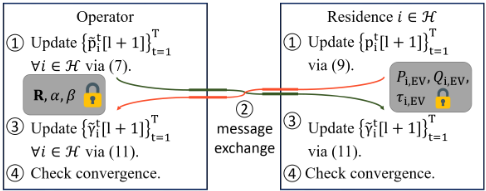
Similarly, let Pi[l] := {pti [l]}Tt=1 denote the optimal power usage trajectory computed by residence i. We abuse the notation {Pi[l]} to denote the optimal trajectories {pti [l]}Tt=1 computed by all residences i ∈ H individually. The two steps of iteration are listed below. Note that the first step is carried out simultaneously for all residences and network operator. Fig. 1 illustrates the proposed message passing based distributed framework.
S1a. At the operator side, we update the operator estimated power consumption ˜ pti for all residences using (7).
where the function F( ˜ P[l], {Pi[l]}) is defined as
S1b. For residence i, we update using (9).
where the function Fi (˜ pti [l], pti [l]) is defined as
- S2. At the operator and residence sides, the dual variable is updated.
The resulting decentralized procedure involves a two-way message exchange of the iterates {˜pt [l]}Tt=1 and {pt [l]}Tt=1 between the network operator and residential consumers. At an iteration l > 0, the network operator updates the power trajectories based on (7) whose objective includes a regularization term F( ˜ P[l], {Pi[l]}). This term enforces consensus with the power usage trajectories computed at the residences. The constraints ensure the reliability aspects of the network. Note that (7) is a QP because of the quadratic regularization term. The operator relays to each residential consumer i a copy of the iterate value {˜ pti [l + 1]}Tt=1 . At the same time, the consumer optimal trajectories are updated using (9) and copy of the iterate value {pti [l +1]}Tt=1 is sent to the operator. We note that (9) is a MIQP because of the quadratic regularization term ensuring consensus with the operator objective and binary constraints for the EV charging unit. Thus, the REVS problem which was originally an MILP is converted to a QP for the operator and MIQPs for individual residences using the proposed ADMM based framework. Once the updated local iterates are exchanged, the operator and residences update the local dual variables using (11).
The centralized approach to solve the MILP guarantees convergence to the global optimum solution. However, the concern of sharing private consumer information with the network operator hinders the approach. The proposed ADMM based distributed framework avoids sharing of private and proprietary information and only uses exchange of power consumption data. The approach converts the problem into a QP for the operator and MIQPs for each residence. However, the size of each problem is significantly smaller than the original MILP. The convergence of the algorithm to the optimal solution of (5) is formally stated next.
Proposition 1. The iterates {˜pt [l]}Tt=1 and {pt [l]}Tt=1 produced by [S1] - [S2] are convergent, for any κ > 0. Further,
where ptopt denotes the optimal power usage trajectory.
ADMM has been proved to converge to the optimal solution for convex problems and for specific non-convex problems involving binary constraints [Boyd et al., 2011]. Therefore, we can guarantee that the proposed framework converges to the optimal solution in the exact sense.
5 Experiments
The experiments are conducted in order to study the effects of EV adoptions at different levels (30%, 60%, 90%). We compare effects of two optimization scenarios (individual vs. distributed) on EV scheduling behavior in different communities. Under the individual optimization scenario, customers charge their EVs based on individual preferences without considering the impact on network reliability. The optimal schedule is obtained by solving (4) for each EV adopter. With distributed optimization, the customers coordinate with the network operator to achieve an EV charging schedule where their personal preferences are accommodated as well as the network reliability is maintained. The optimal schedule is obtained by iteratively solving Equations (7), (9), and (11) until convergence.
Particularly, we aim to compare the reliability of the network when these two methods are used to schedule residential EV charging for varied levels of EV adoption. Note that network reliability is the ability to operate with edge power flows within the line capacities and node voltage within the bandwidth (0.95-1.05 p.u) [ANSI, 2020]. Hence, these two measures - node voltage and edge power flow are used to quantify the impact of network reliability at different levels (30%, 60%, 90%) of EV adoptions in multiple communities in the distribution network.
A small area of Montgomery county in Virginia is considered as the region of interest for our study. Household level synthetic hourly electricity consumption profiles are used. These timeseries are created using several population surveys, statistical models, and physics based models of household devices and validated using real data [Thorve et al., 2018]. The data also has household level demographics and spatial attributes. Synthetically generated distribution networks created using electrical engineering concepts and resembling actual networks are used for the purpose of our analysis [Meyur et al., 2020]. Hourly electricity rate (in $/kWhr) is known to the residential customers (Table 3). Time of use (TOU) hourly electricity rate provided by the off-peak plan of a utility company serving the particular geographical region [Dominion Energy, 2021] are used.
Assumptions. All EVs have a uniform charge capacity of 20kWhr and are available to be charged between 4:00p.m. and 5:00a.m. The initial state of charge is assumed to be 20% and the EVs are required to be charged to at least 90%. Households are randomly selected as EV adopters in the network. All adopters have necessary provisions to charge their EVs at their residential premises. We consider a uniform power rating of 4.8kW for all residential EV chargers.
6 Results
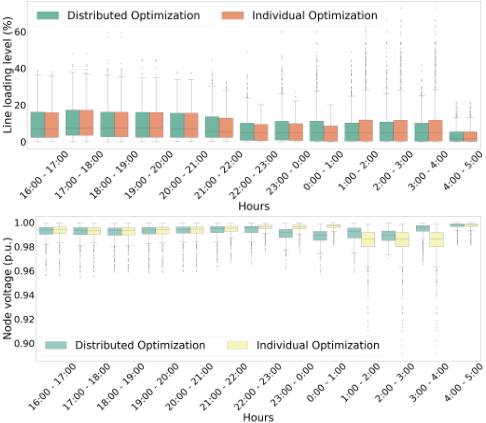
Figure 3 describes edge power flow as a percentage of line capacities and node voltages in 'Com-A' community in the network when EV adoption has reached 90%. Figure 3 (top) shows that the edge flow (line rating capacity) levels in the network are well within limits even when 90% of residences have adopted EV. However, the same cannot be observed for node voltages in the network. Figure 3 (bottom) shows that the node voltages at several residences are outside the acceptable limits of 0.95-1.05 p.u. We notice that maximum number of node voltage violations occur in the period where the hourly electricity rate (in $/kWhr) is minimum.
| Time interval (HH:MM) | 00:00- | 05:00- | 15:00- | 18:00- |
|---|---|---|---|---|
| -05:00 | -15:00 | -18:00 | -00:00 | |
| Cost ($/kWhr) | 0.07866 | 0.09511 | 0.21436 | 0.09511 |
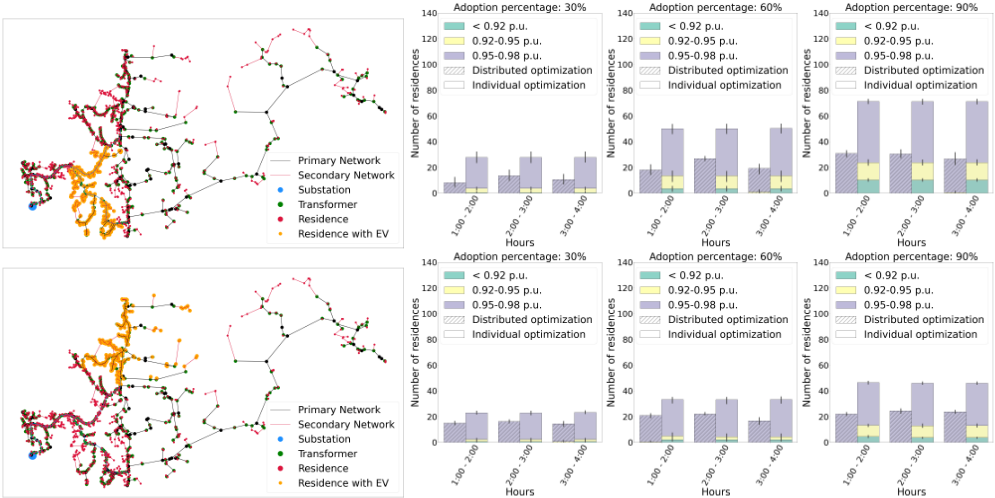
We further explore effects of node voltage violation, at different adoption levels in two communities ('Com-A', 'ComB') of residences in the network. Figure 2 shows the selected communities in the network and node voltage violation at different adoption levels. The results are obtained after performing optimizations under two scenarios : individual and distributed. We focus our attention only on the time intervals where the hourly electricity rate (in $/kWhr) is minimum (i.e. time windows of maximum node violations). The node voltage violation is divided into 3 ranges : less than 0.92 p.u., between 0.92-0.95 p.u. and between 0.95-0.98 p.u. Though the last voltage range is not considered as voltage violation by the practised ANSI standard [ANSI, 2020], it can be considered as a sign of reduced network reliability.
The clustered bar chart shows significantly higher number of residences with voltage violation under individual optimization scenario as compared to the distributed optimization scenario. The number of residences with voltage less than 0.95 p.u. is close to zero at all considered time intervals. The observations are similar for both communities in the network. This shows that, if the proposed distributed framework is used to schedule EV charging units, the network operator is able to dispatch the power without compromising on system reliability.
Figure 2 shows that under the individual optimization approach the number of residences with undervoltage during the cheap electricity hours increases with an increase in the level of adoption. However, this trend is not consistent in the distributed optimization approach. This is because the later approach also ensures system reliability along with consuming electricity during cheap hourly rates. The distributed framework does this by allocating small amount of EV charging during time intervals where the hourly electricity rates are relatively higher.
We also notice that the number of residences experiencing undervoltage issues for the same level of adoption differs significantly when we consider different communities for EV adoption. These differences can be attributed to location and energy usage of adopter households in the network and the resulting voltages at different nodes. The error bars on the bar chart (Figure 2) show variation in number of residences violating node voltage in each category for multiple random group of EV adopters.
7 Conclusion
In this paper we propose an ADMM method based distributed framework for scheduling EV charging for consumers at residential premises while maintaining reliability of the network. We observe that individual consumer loads, spatial layout of the network, and electricity pricing all affect network reliability. We provide a set of results on a small distribution network in Montgomery county of Virginia, USA for EV adoption at different levels in multiple residential communities. We inspect the network reliability with two measures : node voltage and edge flows (line rating/line loading). Results show that the proposed distributed approach for scheduling residential EV charging enables the network operator to maintain system reliability by respecting line limits and having fewer undervoltage households and almost no households with node violation even for higher levels of EV adoption as opposed to an individual approach.
Acknowledgements
This work is partially supported by University of Virginia Strategic Investment Fund award number SIF160, 3Cavaliers grant and NSF grants: EAGER 161070 & CINES 160369.
@inproceedings{ijcai2022p710,
  title     = {A Reliability-aware Distributed Framework to Schedule Residential Charging of Electric Vehicles},
  author    = {Meyur, Rounak and Thorve, Swapna and Marathe, Madhav and Vullikanti, Anil and Swarup, Samarth and Mortveit, Henning},
  booktitle = {Proceedings of the Thirty-First International Joint Conference on
               Artificial Intelligence, {IJCAI-22}},
  publisher = {International Joint Conferences on Artificial Intelligence Organization},
  editor    = {Luc De Raedt},
  pages     = {5115--5121},
  year      = {2022},
  month     = {7},
  note      = {AI for Good},
  doi       = {10.24963/ijcai.2022/710},
  url       = {https://doi.org/10.24963/ijcai.2022/710},
}
TY - CPAPER TI - A Reliability-aware Distributed Framework to Schedule Residential Charging of Electric Vehicles AU - Meyur, Rounak AU - Thorve, Swapna AU - Marathe, Madhav AU - Vullikanti, Anil AU - Swarup, Samarth AU - Mortveit, Henning T2 - Proceedings of the Thirty-First International Joint Conference on Artificial Intelligence, IJCAI-22 PB - International Joint Conferences on Artificial Intelligence Organization PY - 2022 SP - 5115 EP - 5121 DO - 10.24963/ijcai.2022/710 UR - https://doi.org/10.24963/ijcai.2022/710 ER -Copied
Machine-readable versions of this paper, for tools and AI agents:





