
CounterGeDi: A Controllable Approach to Generate Polite, Detoxified and Emotional Counterspeech
Proceedings of the Thirty-First International Joint Conference on Artificial Intelligence. AI for Good. Pages 5157-5163.
https://doi.org/10.24963/ijcai.2022/716
Keywords
- Multidisciplinary Topics and Applications: Social Sciences
- Natural Language Processing: Dialogue and Interactive Systems
- Natural Language Processing: Language Generation
Abstract
Recently, many studies have tried to create generation models to assist counter speakers by providing counterspeech suggestions for combating the explosive proliferation of online hate. However, since these suggestions are from a vanilla generation model, they might not include the appropriate properties required to counter a particular hate speech instance. In this paper, we propose CounterGeDi - an ensemble of generative discriminators (GeDi) to guide the generation of a DialoGPT model toward more polite, detoxified, and emotionally laden counterspeech. We generate counterspeech using three datasets and observe significant improvement across different attribute scores. The politeness and detoxification scores increased by around 15% and 6% respectively, while the emotion in the counterspeech increased by at least 10% across all the datasets. We also experiment with triple-attribute control and observe significant improvement over single attribute results when combining complementing attributes, e.g., politeness, joyfulness and detoxification. In all these experiments, the relevancy of the generated text does not deteriorate due to the application of these controls.
- [Bartlett and Krasodomski-Jones, 2015] Jamie Bartlett and Alex Krasodomski-Jones. Counter-speech examining content that challenges extremism online. DEMOS, October, 2015.
- [Bender et al., 2021] Emily M. Bender, Timnit Gebru, Angelina McMillan-Major, and Shmargaret Shmitchell. On the dangers of stochastic parrots: Can language models be too big? In FAccT, 2021.
- [Benesch et al., 2016] Susan Benesch, Derek Ruths, Kelly P Dil- lon, Haji Mohammad Saleem, and Lucas Wright. Considerations for successful counterspeech. A report for Public Safety Canada under the Kanishka Project. Accessed November, 25:2020, 2016.
- [Chung et al., 2019] Yi-Ling Chung, Elizaveta Kuzmenko, Serra Sinem Tekiroglu, and Marco Guerini. Conan-counter narratives through nichesourcing: a multilingual dataset of responses to fight online hate speech. In ACL, 2019.
- [Clark et al., 2019] Leigh Clark, Nadia Pantidi, Orla Cooney, Philip Doyle, Diego Garaialde, Justin Edwards, Brendan Spillane, Emer Gilmartin, Christine Murad, Cosmin Munteanu, Vincent Wade, and Benjamin R. Cowan. What Makes a Good Conversation? Challenges in Designing Truly Conversational Agents. ACM, 2019.
- [Dathathri et al., 2019] Sumanth Dathathri, Andrea Madotto, Jan- ice Lan, Jane Hung, Eric Frank, Piero Molino, Jason Yosinski, and Rosanne Liu. Plug and play language models: A simple ap- proach to controlled text generation. In ICLP, 2019.
- [de los Riscos and D'Haro, 2021] Agustín Manuel de los Riscos and Luis Fernando D'Haro. ToxicBot: A Conversational Agent to Fight Online Hate Speech. 2021.
- [Fanton et al., 2021] Margherita Fanton, Helena Bonaldi, Serra Sinem Tekiroglu, and Marco Guerini. Human-in-the- loop for data collection: a multi-target counter narrative dataset to fight online hate speech. In NAACL, 2021.
- [Frenett and Dow, 2015] Ross Frenett and Moli Dow. One to one online interventions: A pilot cve methodology. Institute for Strategic Dialogue, 2015.
- [Fumagalli, 2020] Corrado Fumagalli. Counterspeech and or- dinary citizens: How? when? Political Theory, page 0090591720984724, 2020.
- [Holtzman et al., 2020] Ari Holtzman, Jan Buys, Li Du, Maxwell Forbes, and Yejin Choi. The curious case of neural text degener- ation. In ICLP, 2020.
- [Krause et al., 2020] Ben Krause, Akhilesh Deepak Gotmare, Bryan McCann, Nitish Shirish Keskar, Shafiq Joty, Richard Socher, and Nazneen Fatema Rajani. Gedi: Generative discriminator guided sequence generation. arXiv preprint arXiv:2009.06367, 2020.
- [Liu et al., 2021] Alisa Liu, Maarten Sap, Ximing Lu, Swabha Swayamdipta, Chandra Bhagavatula, Noah A. Smith, and Yejin Choi. DExperts: Decoding-time controlled text generation with experts and anti-experts. In ACL-IJCNLP, 2021.
- [Madaan et al., 2020] Aman Madaan, Amrith Setlur, Tanmay Parekh, Barnabás Póczos, Graham Neubig, Yiming Yang, Ruslan Salakhutdinov, Alan W Black, and Shrimai Prabhumoye. Polite- ness transfer: A tag and generate approach. In ACL, 2020.
- [Mathew et al., 2019] Binny Mathew, Punyajoy Saha, Hardik Tharad, Subham Rajgaria, Prajwal Singhania, Suman Kalyan Maity, Pawan Goyal, and Animesh Mukherjee. Thou shalt not hate: Countering online hate speech. In ICWSM, 2019.
- [Mathew et al., 2021] Binny Mathew, Punyajoy Saha, Seid Muhie Yimam, Chris Biemann, Pawan Goyal, and Animesh Mukherjee. Hatexplain: A benchmark dataset for explainable hate speech de- tection. In AAAI, 2021.
- [Prabhumoye et al., 2020] Shrimai Prabhumoye, Alan W Black, and Ruslan Salakhutdinov. Exploring controllable text genera- tion techniques. arXiv preprint arXiv:2005.01822, 2020.
- [Prendinger and Ishizuka, 2005] Helmut Prendinger and Mitsuru Ishizuka. The empathic companion: A character-based interface that addresses users' affective states. App. AI, 2005.
- [Qian et al., 2019] Jing Qian, Anna Bethke, Yinyin Liu, Elizabeth Belding, and William Yang Wang. A benchmark dataset for learning to intervene in online hate speech. In EMNLP-IJCNLP, 2019.
- [Sai et al., 2020] Ananya B Sai, Akash Kumar Mohankumar, and Mitesh M Khapra. A survey of evaluation metrics used for nlg systems. arXiv preprint arXiv:2008.12009, 2020.
- [Saravia et al., 2018] Elvis Saravia, Hsien-Chi Toby Liu, Yen-Hao Huang, Junlin Wu, and Yi-Shin Chen. Carer: Contextualized affect representations for emotion recognition. In EMNLP, 2018.
- [Sennrich et al., 2016] Rico Sennrich, Barry Haddow, and Alexan- dra Birch. Controlling politeness in neural machine translation via side constraints. In NAACL 2016, 2016.
- [Tekiroglu et al., 2020] Serra Sinem Tekiroglu, Yi-Ling Chung, and Marco Guerini. Generating counter narratives against online hate speech: Data and strategies. In ACL, 2020.
- [Vidgen et al., 2019] Bertie Vidgen, Helen Margetts, and Alex Har- ris. How much online abuse is there. Alan Turing Institute, 2019.
- [Wang and Wan, 2018] Ke Wang and Xiaojun Wan. Sentigan: Gen- erating sentimental texts via mixture adversarial networks. In IJ- CAI, 2018. IJCAI
- [Warstadt and Bowman, 2019] Alex Warstadt and Samuel R Bow- man. Linguistic analysis of pretrained sentence encoders with acceptability judgments. arXiv preprint arXiv:1901.03438, 2019.
- [Zhang et al., 2020] Yizhe Zhang, Siqi Sun, Michel Galley, Yen- Chun Chen, Chris Brockett, Xiang Gao, Jianfeng Gao, Jingjing Liu, and William B Dolan. Dialogpt: Large-scale generative pre- training for conversational response generation. In ACL: System Demonstrations, 2020.
- [Zhu and Bhat, 2021] Wanzheng Zhu and Suma Bhat. Generate, prune, select: A pipeline for counterspeech generation against online hate speech. arXiv preprint arXiv:2106.01625, 2021.
References were extracted automatically from the PDF and may contain errors.
Full text extracted automatically from the PDF; figures, tables and equations may differ. The PDF is the version of record.
1 Introduction
One of the most effective strategies to combat the rising online hate speech is counterspeech. It is a direct response to hateful or harmful speech that seeks to undermine it. Several organisations like Facebook 1 have laid out guidelines for general public on how to counter hateful speech online. While these guidelines might be effective, writing a proper counterspeech is quite challenging [Fumagalli, 2020]. Recently, many non-profit organisations have taken up the task of countering online hate 2 . This nichesourcing of counterspeech can be effective but might be a mentally taxing task for the NGO operators given the amount of hate generated each day [Vidgen et al., 2019]. To assist these operators, the scientific community have come up with different human-in-the-loop methods to collect counterspeech data [Fanton et al., 2021] as well as build models to generate counterspeech suggestions [Zhu and Bhat, 2021].
1 https://counterspeech.fb.com/en/
2 https://wecounterhate.com/
Such generation models aim to reduce the human intervention by helping the counter speakers with suggestions 3 , which they can further post-edit as per requirements. While these recent transformer based generation models can produce relevant outputs, they often fail to produce diverse output [Holtzman et al., 2020]. Further, we cannot control the generated output for any attribute from the vanilla generation model. However, as pointed out by different authors [Bartlett and Krasodomski-Jones, 2015], counterspeech can vary based on the hate speech instance, demography of the hate and counter speakers [Mathew et al., 2019] etc. Hence, the generation models without any control might produce suggestions that are not suitable for a particular instance. To counter effectively, the counter speakers should have the control over the generated content so that they can steer the counterspeech toward a desired property or a mixture of different properties. Such a generation model will allow the counter speaker to use different strategies to counter hate [Benesch et al., 2016]. In this paper, we propose six different GEDI 4 models and use them in single and multiple attribute setting to guide the generation of a vanilla counterspeech generation model for English language. We observe that -
- The single attribute GEDI models improve the controlled attribute significantly for all the attributes. Specifically, there is 15% increase in politeness and 6% increase in detoxification.
- Among the GEDI with emotional attributes, joy has the highest attribute scores with an improvement of 15%, 17% and 88% in Gab [Qian et al., 2019], Reddit [Qian et al., 2019], and CONAN [Chung et al., 2019] datasets respectively.
- While combining multiple attributes - politeness, detoxification and joyfulness (one of the emotional attribute) for controlling the generation, we observe a further increase in scores compared to the single attribute setup.
- We are able to maintain the relevancy of the generated
3 We view the counterspeech generating task as delicate task which requires human supervision.
4 Generative discirimintators.
output measured using BLEU-2 score while there is a slight drop in performance in terms of fluency which comes as a cost for the additional control.
- Finally, human judges also marked higher presence of the attributes in the attribute controlled setups compared to the baselines.
We show examples of emotion controlled counter speech corresponding to a hate speech in Table 1. Please refer to Appendix 5 for more examples on single and multi attribute controlled counterspeech. The code is added here 6 .
| Hate speech | Anyone who isn't a re***ded pickle has privilege, I sup- pose. |
| Counterspeech (no control) | The R word is highly offensive, Spread the word to end the word! |
| Counterspeech (sad) | in the words of my favorite friend this post sounds like such hate speech. it makes you sound uneducated. how sad. do not use internet powers to silence your anger with some- thing so simple or even reasonable! |
| Counterspeech (joy) | we all believe in open mindedness, whether your side of the fence is greater or lesser. we hope you have fun! mwahaha peace out and cool weather. keep hydrated npcs. |
2 RelatedWorks
With regard to countering hatred, we focus on two research aspects relevant to the present work (i) counterspeech datasets and models for counterspeech generation (ii) controlling methods for generation models particularly in NLP.
Counterspeech generation strategies: An effective strategy to mitigate hate speech is counterspeech as it does not violate freedom of expression [Benesch et al., 2016]. While the idea of countering some hateful messages is not new, the research community has recently started taking a massive interest in understanding counterspeech practices and its effectiveness while mitigating hate speech [Mathew et al., 2019]. Recently, Tekiro˘glu et al. proposed novel techniques to generate counterspeech using a GPT-2 model with postfacto editing by experts or annotator groups. One of the recent generation methods uses a three stage pipeline - Generate, Prune and Select (GPS) to generate diverse and relevant counterspeech output [Zhu and Bhat, 2021]. The primary challenge in counterspeech generation research is understanding if the counterspeech produced is effective. One study[Bartlett and Krasodomski-Jones, 2015] found that effectiveness of the counterspeech further depends on the tone of the counterspeech. In specific, sentimental or casual tone received 83% more responses [Frenett and Dow, 2015]. In addition to that, Mathew et al. found that different communities find different types of counterspeech effective. In this work, we present a novel approach to guide the counterspeech toward one or more desired properties. This is done by building a controllable generation pipeline based on GEDI.
5 https://tinyurl.com/bdcmk9nm
6 https://github.com/hate-alert/CounterGEDI
Controllable text generation: Controllable text generation is the task of generating natural sentences whose attributes can be controlled. The previous approaches rely on reinforcement learning or training conditional generative models [Prabhumoye et al., 2020]. One of the earliest line of work focused on controlling a desired attribute by side constraints [Sennrich et al., 2016] and back propagating gradients [Dathathri et al., 2019]. One of the variations - DEXPERTS [Liu et al., 2021] uses language models for both positive and negative classes. While the other variation - GEDI [Krause et al., 2020] uses class conditioned language models for positive and negative classes. The final output tokens in both these methods are generated based on an equation which utilises the contrast between the positive and the negative class.
We, in this work, use this GEDI model and apply it to the domain of counterspeech generation. We train different GEDI models to control attributes like politeness, emotions and detoxification of counterspeech.
3 Models
DialoGPT: We used a variant of the GPT model - DialoGPT [Zhang et al., 2020] which was trained on a large corpus consisting of English Reddit dialogues. The corpus consist of 147 million instances of dialogues, collected over a period of 12 years. Unlike GPT-2, this model should generate better dialouge like responses to any given prompt. In this model, along with ground truth response T = x1, ..., xn we also have a dialogue utterance history S. The model aims at maximising p(T|S) = p(x1|S) ∏ni=2 p(xi|S, ..., xi-1). For our experiment, we used DialoGPTm - a 24 layer, 345 million weight parameters transformer model 7 and finetune over a particular dataset having hate and counterspeech pairs.
Generate Prune Select (GPS): One of the recent counterspeech generation model is Generate, Prune, Select (GPS) - a three stage pipelined approach [Zhu and Bhat, 2021]. At first, the generation part generates a large number of diverse response candidates using a generative model based on RNN based autoencoder. Second, the pruning part prunes the ungrammatical candidates from the candidate pool. This is done using a classifier trained on linguistic acceptability classifier. Finally, the response-selection part selects appropriate responses based on the hate speech instance. We use the similarity based method USE-LARGE-SIM [Zhu and Bhat, 2021]. GEDI: For controlling generated counterspeech, we use a recent method Generative Discriminators (GEDI) [Krause et al., 2020], where the authors present a decoding time algorithm to control the output from the generation model. GEDI assumes we have class conditioned language model (CC-LM) with a desired control code c and an undesired control code ¯ c. For our case, we fix the control code c as 'true' and ¯ c as 'false'. For each dataset, the attribute mentioned in the +ve column in Table 3 is considered as desired, while -ve column is used as undesired attribute.
The authors use the contrast between Pθ(x1:t|c) and Pθ (x1:t|¯ c) to guide sampling from an LM that gives PLM(x1:T ). The probability that the next token xt belongs to desired class is calculated using this contrast.
7 https://huggingface.co/microsoft/DialoGPT-medium
For controlled generation, the authors propose a simple method to guide the model toward the target class which is represented using the heuristic equation 1 where ω is controllable parameter. In order to control multiple attributes, we extend the heuristic as represented in equation 2 where ωi is a controllable parameter to bias the generation toward class ci for GEDI trained on the ith attribute.
4 Datasets
Counterspeech datasets: In order to evaluate our approach we use three public datasets which contain hate speech and its corresponding counterspeech. The details of these datasets are noted in Table 2. Reddit and Gab datasets contain 5, 257 and 14, 614 hate speech instances respectively [Qian et al., 2019]. We use the English part of the CONAN dataset [Chung et al., 2019] which contains 408 hate speech instances. The counterspeech in Gab and Reddit datasets were written by AMT workers, whereas for CONAN the counterspeech was written by expert NGO operators.
We further made hate speech and counterspeech pairs from these datasets such that each hate speech was associated with one counterspeech. Finally, we ended up with 3,864, 14,223, 41,580 datapoints for CONAN, Reddit and Gab respectively. We split each dataset randomly into train, validation, test set with 80% for training, 10% each for validation and testing.
| Dataset | Source-H | Source-C | Hate instances | Total pairs |
|---|---|---|---|---|
| CONAN | synthetic | expert | 408 | 3,864 |
| crowd | 5,257 | 14,223 | ||
| Gab | gab | crowd | 14,614 | 41,580 |
Attribute datasets: We control several attributes in the generated counterspeech. We selected these attributes following the recommended strategies for counterspeech [Benesch et al., 2016] and properties of responses in human conversation [Clark et al., 2019].
Politeness: One of the properties of counterspeech as suggested by [Benesch et al., 2016] is empathy. As a first step in that direction we tried to make the generated counterspeech more polite. We used the dataset of 1.39 million posts released by [Madaan et al., 2020] labelled into nine politeness classes (P1-P9). As recommended by the authors, we considered P9 as the polite part and others (P1-P8) as non-polite.
Detoxification: [Benesch et al., 2016] also noted several strategies which are discouraged while writing counterspeech. One of these discouraged strategies are hostile or aggressive behaviour. To detox any hostile counterspeech generated by the generation model, we use the a popular Kaggle dataset 8 which contains text samples having 'toxic' and 'nontoxic' labels. We stratified-split the released training dataset randomly into 90% training and 10% validation sets. The test set is already released separately with the dataset. We trained a GEDI model considering toxic as the positive label and nontoxic as the negative label. While generating using GEDI, we guide the generation toward the negative class (non-toxic). Emotion: Another important aspect of conversation is communicating different emotions. A study [Prendinger and Ishizuka, 2005] found that systems expressing emotions are more capable of providing user satisfaction. In case of counterspeech, emotions might enhance the effect of the generated counterspeech [Benesch et al., 2016]. For example, 'sadness' as an emotion can be added when the counter speakers affiliate themselves with the target group. Similarly, 'joy' can used to convey positivity in the counterspeech.
In order to control the emotion while generating a counterspeech, we used a large dataset [Saravia et al., 2018] of 416,809 datapoints comprising posts having seven emotions - 'sadness', 'joy', 'fear', 'anger', 'surprise', and 'love'. For this paper, we did not consider - 'love' and 'surprise' emotions as these had less than 10% posts in the dataset. We stratified-split each dataset randomly into training, validation, and test set with 80% for training, and 10% for both validation and testing. We consider each emotion as a separate attribute and trained a GEDI model for that emotion by considering it as positive label and other emotions as negative labels. For our experiments, we primarily focus on guiding the models toward the positive class.
A summary statistic of the attribute dataset for each of the task considered is noted in Table 3.
| Dataset | +ve | -ve | Tr (%+ve) | V (%+ve) | Te (%+ve) |
|---|---|---|---|---|---|
| Polite | p | n-p | 1.12M (20%) | 137k (20%) | 137k (20%) |
| Toxic | t | n-t | 143k (10%) | 16k (10%) | 153k (4%) |
| Emotion | j | o | 333k (34%) | 42k (34%) | 42k (34%) |
| f | o | 333k (11%) | 42k (11%) | 42k (11%) | |
| s | o | 333k (29%) | 42k (29%) | 42k (29%) | |
| a | o | 333k (14%) | 42k (14%) | 42k (14%) |
5 Experimental Setup
Counterspeech generation models: The DialoGPTm model for each counterspeech model has six initial layers fixed due to resource constraints. The model were trained till 10 epochs with batch size as 8. We saved the final model at the epoch having the best language modelling loss for the validation dataset. We used a maximum length of 256 tokens for the DialoGPTmmodel 9 . The learning rate is fixed at 5e-6 .
GEDI models: We train the GPT-2 model as the GEDI models based on the training setting specified in the original paper [Krause et al., 2020]. For each model we fix the batch size at 8 and train the models for 5 epochs. The λ weight in the loss equation is fixed at 0.8 to maximise generation quality for the GEDI model. We used a maximum length of 128 tokens for the GPT-2 model. The learning rate is fixed at 2e-5 for training the model following the recommendations by [Krause et al., 2020].
8 https://www.kaggle.com/c/jigsaw-toxic-commentclassification-challenge/data
9 1% datapoints have more than 256 tokens.
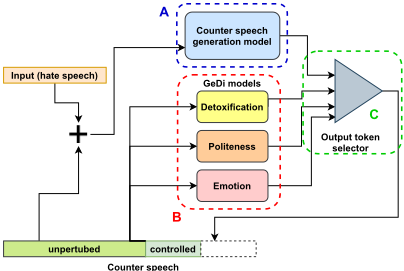
Final pipeline: Our final pipeline comprises three parts as shown in Figure 1. The part A represents the vanilla counterspeech generation model trained on one of the three counterspeech datasets. Similar to an auto-regressive setup, it takes in the hate speech with the currently generated counterspeech (empty at the initial step) and produces next token probablities for the production of the next token. The part B consists of the single or multiple GEDI models. Each GEDI model controls an attribute out of the total six. It takes as input the currently generated counterspeech and produces token probabilities based on the desired attribute. We initially allow the counterspeech generation models to generate 10 tokens without any control to provide the initial prompt to the GEDI model. Finally, part C selects the next token based on the token probabilities from different models, i.e., the counterspeech generation model and the GEDI models following equation 2. For each GEDI model, we primarily control the weight (ω) as mentioned in equation 1, while other parameters are kept same as the paper [Krause et al., 2020]. For single attribute, we fix the weight at 1 to give equal importance to the counterspeech generation as well as the control attributes. For two attribute control, we set weights at 0.5 for both the attributes. For three attributes control, which comprises detoxification, politeness and an emotion, we set 0.3 for politeness & detoxification each and 0.4 for the emotion. We also use nucleus sampling as a decoding strategy [Holtzman et al., 2020]. Please check Appendix 5 for more details.
6 Evaluation
We consider several metrics to evaluate our whole pipeline of controlled counterspeech generation. The generation metrics measure the generation capability of the DialoGPTm and GEDI models. The classification metrics are mainly to evaluate the GEDI model on the attribute datasets. Finally, we measure the amount of control in the generated counterspeech using external classifiers which we refer to as controller metrics. We generate 5 samples for every hate speech instance with DialoGPTm. The GPS framework automatically selects the best response based on the heuristic, hence we keep one sample for every hate speech instance.
Generation metrics: To measure the generation quality, we use different standard metrics. We use BLEU-2 10 and METEOR [Sai et al., 2020] to measure how similar the generated counterspeech are to the ground truth counterspeech. We also measure if the generation model generates a diverse and novel counterspeech using metrics from previous research [Wang and Wan, 2018]. To measure fluency, we use a classifier of linguistic acceptability trained on the COLA dataset [Warstadt and Bowman, 2019]
GEDI metrics: For classification, we report accuracy, macro F1-score, and AUROC score for each GEDI model's performance on a test dataset of a particular attribute. We also report the generation performance using the perplexity [Zhang et al., 2020].
Controller metrics: In order to evaluate the ability of the GEDI controller to control the attribute, we used third-party classifiers for each attribute. For politeness, we trained a bertbase-uncased model for politeness level detection on a scale of 0 to 7 11 . For measuring emotion in the generated text, we used the Ekman version of the GoEmotions models 12 . For each post, it returns a confidence score between 0-1 for anger, disgust, fear, joy, sadness, surprise + neutral. We report the confidence score for a particular emotion as a measure of that emotion in a given post. Finally, to measure toxicity we used the HateXplain model [Mathew et al., 2021] trained on two classes - toxic and non-toxic 13 . We report the confidence between 0-1 for the non-toxic class.
7 Results
Generation results: We compare DialoGPTm model with the GPS in Table 4. We find BLEU-2 scores are better for the GPS model while the METEOR scores are better for DialoGPT model for all three datasets. DialoGPTm is also better in terms of novelty and diversity for all the three datasets. The fluency metric COLA is better for GPS for all the three datasets, since it straightforwardly prunes grammatically incorrect samples. Since DialoGPTm presents a competitive performance compared to the state-of-the-art model, we therefore use DialoGPTm for the rest of the experiments. GEDI metrics: As reported in Table 5, we find that F1-score and AUCROC scores for politeness and all the four emotions are above 0.9. This highlights that even with 0.2 as the weight for the discriminator we are able to get good scores on classification. The perplexity scores for all the test datasets are also around 3.514 . GEDI model for toxicity has lower scores than the other attribute tasks. The F1-score for toxicity detection is ∼ 0.6 and AUCROC is ∼ 0.83. The perplexity is also higher at around 4.5 for the toxicity dataset. This highlights the difficulty of the task of detecting toxicity.
10 converted to a scale of 0-100 from 0-1
11 https://github.com/AlafateABULIMITI/politeness-detection
12 https://huggingface.co/monologg/bert-base-cased-goemotionsekman
13 https://huggingface.co/Hate-speech-CNERG/bert-baseuncased-hatexplain-rationale-two
| Model | B2 (↑) | COLA (↑) | M (↑) | N (↑) | D (↑) |
| CONAN | |||||
|---|---|---|---|---|---|
| GPS | 41.5 | 0.82 | 0.14 | 0.18 | 0.60 |
| DialoGPTm | 12.7 | 0.78 | 0.18 | 0.84 | 0.80 |
| GPS | 14.1 | 0.82 | 0.11 | 0.30 | 0.47 |
| DialoGPTm | 6.9 | 0.75 | 0.17 | 0.82 | 0.74 |
| Gab | |||||
| GPS | 13.9 | 0.82 | 0.12 | 0.15 | 0.41 |
| DialoGPTm | 7.7 | 0.80 | 0.17 | 0.80 | 0.72 |
| Dataset | Positive | F1 (↑) | Acc (↑) | AUC(↑) | Perplexity (↓) |
|---|---|---|---|---|---|
| Toxicity | toxic | 0.60 | 0.85 | 0.84 | 4.428 |
| Politeness | polite | 0.93 | 0.96 | 0.93 | 3.476 |
| Emotion | joy | 0.96 | 0.96 | 0.97 | 3.546 |
| Emotion | sadness | 0.98 | 0.98 | 0.99 | 3.543 |
| Emotion | fear | 0.94 | 0.97 | 0.98 | 3.774 |
| Emotion | anger | 0.96 | 0.98 | 0.99 | 3.560 |
Single-attribute control: In Table 6, we report the amount of different attributes present in the generated counterspeech for each dataset and for each model. When we compare GPS and DialoGPTm, we find that except anger emotion, all other scores are significantly higher for DialoGPTm. Second, using control for a particular attribute significantly improves the presence of that attribute (p-value <0.001). For instance, in Table 6, the politeness score increases from 3.91 to 4.54, from 5.24 to 6.05 and 5.14 to 6.11 for CONAN, Reddit and Gab respectively when the DialoGPTm model is controlled for politeness. This is true for all attributes barring the 'anger' emotion. Politeness and detoxification score increased by 15-18% and 6-8% respectively across all the datasets. For the emotion attributes, 'joy' has the highest scores among all for both controlled and uncontrolled attribute. We see an overall increase in 'joy' of around 17% for Gab, 14% for Reddit and 88% for CONAN. Counter responses in CONAN datasets are mostly devoid of any emotions hence bringing a change in them is much easier than the Reddit/Gab datasets which are higher in terms of the joy attribute. We reach closer to GPS baseline for anger emotion while controlling anger emotion and increase the score by 54%, 55% and 16% for Reddit, Gab and CONAN, respectively. While the increase for other emotions - 'sadness' and 'fear' increased significantly, the overall scores for them remain low.
14 For reference, perplexity for pretraining GPT-2 comes around 10 after 10K steps (https://tinyurl.com/3vwrvscd).
| Model | D (↑) | P (↑) | J (↑) | A (↑) | S (↑) | F (↑) |
|---|---|---|---|---|---|---|
| CONAN | ||||||
| GPS | 0.68 | 2.01 | 0.16 | 0.12 | 0.03 | 0.01 |
| DialoGPTm | 0.64 | 3.91 | 0.18 | 0.09 | 0.04 | 0.01 |
| DialoGPTm-c | 0.68 | 4.54 | 0.34 | 0.11 | 0.08 | 0.05 |
| GPS | 0.82 | 1.62 | 0.23 | 0.32 | 0.04 | 0.01 |
| DialoGPTm | 0.82 | 5.24 | 0.63 | 0.17 | 0.06 | 0.00 |
| DialoGPTm-c | 0.87 | 6.05 | 0.72 | 0.27 | 0.10 | 0.02 |
| Gab | ||||||
| GPS | 0.79 | 1.46 | 0.22 | 0.28 | 0.04 | 0.01 |
| DialoGPTm | 0.81 | 5.14 | 0.66 | 0.17 | 0.05 | 0.00 |
| DialoGPTm-c | 0.85 | 6.11 | 0.77 | 0.26 | 0.10 | 0.02 |
| Scores | Detox | Polite | Joy | Anger | Sadness | Fear |
|---|---|---|---|---|---|---|
| CONAN | ||||||
| BLEU-2 | 13.8 | 12.1 | 12.2 | 11.6 | 12.0 | 12.8 |
| COLA | 0.83 | 0.72 | 0.72 | 0.74 | 0.76 | 0.72 |
| BLEU-2 | 8.1 | 7.8 | 7.7 | 7.8 | 7.5 | 7.3 |
| COLA | 0.72 | 0.77 | 0.70 | 0.72 | 0.81 | 0.70 |
| Gab | ||||||
| BLEU-2 | 8.7 | 8.3 | 8.5 | 8.3 | 8.2 | 8.3 |
| COLA | 0.85 | 0.82 | 0.76 | 0.76 | 0.80 | 0.78 |
Multi-attribute control: We also generate counterspeech with the DialoGPTm with mutli-attribute control. We keep politeness, detoxification and one of the emotion 15 as control attributes. This gives us four variations for each dataset. We then measure the individual attribute scores for each of these three attribute and report the results in Table 8. For detoxification scores, the setup - joy+polite+detox outperforms other setups across all the experiment. This setup even outperforms the single-attribute detoxification setup by 8%, 2% and 2% for CONAN, Reddit and Gab, respectively. For politeness score, the best performance occurs for joy + polite + detox setup for CONAN and Reddit dataset, while the setup - fear + polite + detox performs better in case of the Gab dataset. Compared to single attribute setup for politeness, the politeness scores drop across all the multi-attribute setups. Among the emotions, the attribute score for 'joy' in a multi-attribute setting outperforms the single attribute setting by 44%, 13% and 10% for CONAN, Reddit and Gab. For 'anger', the scores in multi-attribute setting decrease around 25-30% when compared to the single attribute setting. For other attributes like 'sadness' and 'fear', the multi-attribute results are below 0.1, similar to the single attribute results. Please also see Appendix 5 for ablation studies.
15 One among 'joy', 'anger', 'fear' and 'sad'.
Quality of controlled generation: In the previous section, we observed that we were able to control attributes in generated outputs in single and multi-attribute setups. While this is encouraging, it is important to understand if the controlled text are losing the central theme of remaining a counterspeech and are still fluent. For the former, we measure the BLEU-2 metric and for the latter we use the COLA metric.
According to Table 7, we find that relevance of the output (measured using BLEU-2) does not change much across different attributes for the single attribute setups. For some of the attributes like detoxification, the BLEU-2 scores even outperform the DialoGPTm model (without control) for all the datasets as noted in column B2 in Table 4. For Reddit and Gab, there is a further improvement of 1-2 points in the BLEU-2 metric for other attributes also as compared to the vanilla DialogGPTm model (in column B2 in Table 4). This shows that the controls do not affect the overall relevance of the generated counterspeech. In fact, the relevance improves in many cases. In terms of fluency, we see a slight drop which comes as a cost for controlling different attributes except few cases (comparing column COLA in Table 4 and Table 7). This might be due to the fact that GEDI model is not geared toward maintaining the fluency of the models. The observation holds for the multi attribute setup as well (comparing columns B2 and COLA in Table 4 and Table 8).
Overall, we observe that it is possible to control the attributes in the generated outputs using the single attributes. Our experiments with multi-attributes further reveals that there are certain complementing attributes for e.g joy + polite + detox which can be used to further increase the single-attributes setups. For other setups, the attribute scores drops below the single attribute setups. Another promising observation is that the control of attribute does not harm the relevance of the generated output as they still remain close to the ground truth. Since GEDI is not geared toward improving the fluency, we see a slight drop in the fluency of the generated outputs. An interesting research direction would be to look into improving attribute and fluency scores while using multi-attribute setups. We have added examples of single and multi-attribute setup in the Appendix 5 .
Human evaluation: In order to understand, if the improvement in the attribute scores across (while controlling different attributes) would be visible to the moderators, we perform a human evaluation on the generated counterspeech. In this experiment, an annotator is shown three sentences - one generated from the GPS pipeline, another generated using DialoGPTm model and finally, one generated using the DialoGPTm model where some attribute x was getting controlled. We hide the type of model from which the post was generated and further shuffle the posts to remove any ordering bias. Next, the annotator was asked to mark the amount of the attribute x in the given three posts on a scale of 0-5 where 0 presents the absence of the attribute while 5 corresponds to the highest presence of that attribute. Five annotators participated in the annotation with each post getting marked by two annotators. The annotators annotated 20 randomly selected triplets per dataset for each attribute. We do not include the detoxification attribute for these experiments as there is very little difference in detoxification scores when comparing the baseline and the controlled setups. For more details about the annotations, please refer to the Appendix 5 .
| Attributes | Detox(↑) | Polite(↑) | Emotion(↑) | B2(↑) | COLA(↑) |
|---|---|---|---|---|---|
| CONAN | |||||
| Joy(J)+P+D | 0.74 | 4.13 | 0.49 (J) | 13.4 | 0.79 |
| Anger(A)+P+D | 0.67 | 3.06 | 0.08 (A) | 12.6 | 0.68 |
| Sad(S)+P+D | 0.70 | 3.56 | 0.07 (S) | 13.2 | 0.74 |
| Fear(F)+P+D | 0.70 | 4.00 | 0.06 (F) | 13.6 | 0.75 |
| Joy+P+D | 0.89 | 5.79 | 0.82 (J) | 8.3 | 0.81 |
| Anger+P+D | 0.85 | 4.24 | 0.19 (A) | 8.3 | 0.72 |
| Sad+P+D | 0.87 | 3.56 | 0.09 (S) | 8.2 | 0.79 |
| Fear+P+D | 0.87 | 4.00 | 0.01 (F) | 7.8 | 0.79 |
| Gab | |||||
| Joy+P+D | 0.87 | 5.68 | 0.85 (J) | 8.8 | 0.85 |
| Anger+P+D | 0.83 | 4.11 | 0.19 (A) | 8.5 | 0.75 |
| Sad+P+D | 0.85 | 4.70 | 0.09 (S) | 8.8 | 0.84 |
| Fear+P+D | 0.86 | 5.82 | 0.01 (F) | 8.8 | 0.83 |
| Model | Polite (↑) | Joy (↑) | Anger (↑) | Sad (↑) | Fear (↑) |
|---|---|---|---|---|---|
| CONAN | |||||
| GPS DGPTm DGPTm-c | 0.50 0.59 2.00 | 1.30 2.50 1.00 | 2.50 3.00 4.00 | 1.00 0.75 1.00 | 0.00 0.75 2.00 |
| GPS DGPTm DGPTm-c | 1.83 2.66 3.50 | 0.93 2.50 3.33 | 1.50 1.50 2.00 | 0.33 0.66 2.00 | 0.36 1.33 1.25 |
| Gab | |||||
| GPS DGPTm DGPTm-c | 1.56 2.17 3.21 | 1.28 2.50 2.92 | 0.81 1.66 1.90 | 0.4 1.11 2.03 | 0.17 0.89 1.00 |
We observe an improvement in most of the attribute scores for the controlled model over the two baselines. Three cases where the improvement is not present is while controlling 'joy' and 'sad' for the CONAN dataset and controlling 'fear' for Reddit dataset. While controlling attribute 'sad', we only see an improvement relative to the base DialoGPTm model. The summary of this experiment is presented in the Table 9.
8 Conclusion
Our research aims to add controllable parameters to counterspeech generation setup which can help the moderators to tune the counterspeech toward a particular strategy. Our controllable GEDI models for six different attribute shows significant improvement in the attribute scores over the baselines. We also try to control the generation using multi-attribute and find that the attribute scores can increase further if suitable attributes are mixed together.
Ethical Statement
Hate speech is a complex phenomenon. While the language generation methods are better than before, it is still very far from generating coherent and meaningful replies [Bender et al., 2021]. Hence, we advocate against deployment of fully automatic pipelines for countering hate speech [de los Riscos and D'Haro, 2021]. Based on the current progress, in this pipeline, an active participation of the counter speakers is required to generate relevant counterspeech. This automation, in turn, has the potential to reduce the mental toll of the counter speakers, at least partially.
@inproceedings{ijcai2022p716,
  title     = {CounterGeDi: A Controllable Approach to Generate Polite, Detoxified and Emotional Counterspeech},
  author    = {Saha, Punyajoy and Singh, Kanishk and Kumar, Adarsh and Mathew, Binny and Mukherjee, Animesh},
  booktitle = {Proceedings of the Thirty-First International Joint Conference on
               Artificial Intelligence, {IJCAI-22}},
  publisher = {International Joint Conferences on Artificial Intelligence Organization},
  editor    = {Luc De Raedt},
  pages     = {5157--5163},
  year      = {2022},
  month     = {7},
  note      = {AI for Good},
  doi       = {10.24963/ijcai.2022/716},
  url       = {https://doi.org/10.24963/ijcai.2022/716},
}
TY - CPAPER TI - CounterGeDi: A Controllable Approach to Generate Polite, Detoxified and Emotional Counterspeech AU - Saha, Punyajoy AU - Singh, Kanishk AU - Kumar, Adarsh AU - Mathew, Binny AU - Mukherjee, Animesh T2 - Proceedings of the Thirty-First International Joint Conference on Artificial Intelligence, IJCAI-22 PB - International Joint Conferences on Artificial Intelligence Organization PY - 2022 SP - 5157 EP - 5163 DO - 10.24963/ijcai.2022/716 UR - https://doi.org/10.24963/ijcai.2022/716 ER -Copied
Machine-readable versions of this paper, for tools and AI agents:





