
Vision-and-Language Pretrained Models: A Survey
Proceedings of the Thirty-First International Joint Conference on Artificial Intelligence. Survey Track. Pages 5530-5537.
https://doi.org/10.24963/ijcai.2022/773
Keywords
- Survey Track: Multidisciplinary Topics and Applications
- Survey Track: Natural Language Processing
- Survey Track: Computer Vision
Abstract
Pretrained models have produced great success in both Computer Vision (CV) and Natural Language Processing (NLP). This progress leads to learning joint representations of vision and language pretraining by feeding visual and linguistic contents into a multi-layer transformer, Visual-Language Pretrained Models (VLPMs). In this paper, we present an overview of the major advances achieved in VLPMs for producing joint representations of vision and language. As the preliminaries, we briefly describe the general task definition and genetic architecture of VLPMs. We first discuss the language and vision data encoding methods and then present the mainstream VLPM structure as the core content. We further summarise several essential pretraining and fine-tuning strategies. Finally, we highlight three future directions for both CV and NLP researchers to provide insightful guidance.
- [Bugliarello et al., 2021] Emanuele Bugliarello, Ryan Cot- terell, Naoaki Okazaki, and Desmond Elliott. Multi- modal pretraining unmasked: A meta-analysis and a uni- fied framework of vision-and-language berts. Transactions of the Association for Computational Linguistics, 9:978- 994, 2021.
- [Chen et al., 2020] Yen-Chun Chen, Linjie Li, Licheng Yu, Ahmed El Kholy, Faisal Ahmed, Zhe Gan, Yu Cheng, and Jingjing Liu. Uniter: Universal image-text representa- tion learning. In European conference on computer vision, pages 104-120. Springer, 2020.
- [Chiou et al., 2021] Meng-Jiun Chiou, Roger Zimmermann, and Jiashi Feng. Visual relationship detection with visual- linguistic knowledge from multimodal representations. IEEE Access, 9:50441-50451, 2021.
- [Devlin et al., 2019] Jacob Devlin, Ming-Wei Chang, Ken- ton Lee, and Kristina Toutanova. Bert: Pre-training of deep bidirectional transformers for language understand- ing. In Proceedings of the 2019 Conference of the North American Chapter of the Association for Computational Linguistics: Human Language Technologies, Volume 1 (Long and Short Papers), pages 4171-4186, 2019.
- [Dosovitskiy et al., 2020] Alexey Dosovitskiy, Lucas Beyer, Alexander Kolesnikov, Dirk Weissenborn, Xiaohua Zhai, Thomas Unterthiner, Mostafa Dehghani, Matthias Min- derer, Georg Heigold, Sylvain Gelly, et al. An image is worth 16x16 words: Transformers for image recognition at scale. In International Conference on Learning Repre- sentations, 2020.
- [Fei et al., 2021] Hongliang Fei, Tan Yu, and Ping Li. Cross- lingual cross-modal pretraining for multimodal retrieval. In Proceedings of the 2021 Conference of the North Amer- ican Chapter of the Association for Computational Lin- guistics: Human Language Technologies, 2021.
- [Gan et al., 2020] Zhe Gan, Yen-Chun Chen, Linjie Li, Chen Zhu, Yu Cheng, and Jingjing Liu. Large-scale adversarial training for vision-and-language representation learning. In NeurIPS, 2020.
- [Gao et al., 2020] Dehong Gao, Linbo Jin, Ben Chen, Minghui Qiu, Peng Li, Yi Wei, Yi Hu, and Hao Wang. Fashionbert: Text and image matching with adaptive loss for cross-modal retrieval. In Proceedings of the 43rd Inter- national ACM SIGIR Conference on Research and Devel- opment in Information Retrieval, pages 2251-2260, 2020.
- [Hao et al., 2020] Weituo Hao, Chunyuan Li, Xiujun Li, Lawrence Carin, and Jianfeng Gao. Towards learning a generic agent for vision-and-language navigation via pre- training. In Proceedings of the IEEE/CVF Conference on Computer Vision and Pattern Recognition, pages 13137- 13146, 2020.
- [Hong et al., 2021] Yicong Hong, Qi Wu, Yuankai Qi, Cris- tian Rodriguez-Opazo, and Stephen Gould. Vln bert: A recurrent vision-and-language bert for navigation. In Pro- ceedings of the IEEE/CVF Conference on Computer Vision and Pattern Recognition, pages 1643-1653, 2021.
- [Hu et al., 2021] Xiaowei Hu, Xi Yin, Kevin Lin, Lei Zhang, Jianfeng Gao, Lijuan Wang, and Zicheng Liu. Vivo: Vi- sual vocabulary pre-training for novel object captioning. Proceedings of the AAAI Conference on Artificial Intelli- gence, 35(2):1575-1583, May 2021.
- [Huang et al., 2020] Zhicheng Huang, Zhaoyang Zeng, Bei Liu, Dongmei Fu, and Jianlong Fu. Pixel-bert: Aligning image pixels with text by deep multi-modal transformers. arXiv preprint arXiv:2004.00849, 2020.
- [Huang et al., 2021] Zhicheng Huang, Zhaoyang Zeng, Yu- pan Huang, Bei Liu, Dongmei Fu, and Jianlong Fu. See- ing out of the box: End-to-end pre-training for vision- language representation learning. In Proceedings of the IEEE/CVF Conference on Computer Vision and Pattern Recognition, pages 12976-12985, 2021.
- [Jia et al., 2021] Chao Jia, Yinfei Yang, Ye Xia, Yi-Ting Chen, Zarana Parekh, Hieu Pham, Quoc V Le, Yunhsuan Sung, Zhen Li, and Tom Duerig. Scaling up visual and vision-language representation learning with noisy text su- pervision. arXiv preprint arXiv:2102.05918, 2021.
- [Kim et al., 2021] Wonjae Kim, Bokyung Son, and Ildoo Kim. Vilt: Vision-and-language transformer with- out convolution or region supervision. arXiv preprint arXiv:2102.03334, 2021.
- [Li et al., 2019] Liunian Harold Li, Mark Yatskar, Da Yin, Cho-Jui Hsieh, and Kai-Wei Chang. Visualbert: Asimple and performant baseline for vision and language. arXiv preprint arXiv:1908.03557, 2019.
- [Li et al., 2020a] Gen Li, Nan Duan, Yuejian Fang, Ming Gong, and Daxin Jiang. Unicoder-vl: A universal encoder for vision and language by cross-modal pre-training. In Proceedings of the AAAI Conference on Artificial Intelli- gence, volume 34, pages 11336-11344, 2020.
- [Li et al., 2020b] Xiujun Li, Xi Yin, Chunyuan Li, Pengchuan Zhang, Xiaowei Hu, Lei Zhang, Lijuan Wang, Houdong Hu, Li Dong, Furu Wei, et al. Oscar: Object-semantics aligned pre-training for vision-language tasks. In European Conference on Computer Vision, pages 121-137. Springer, 2020.
- [Li et al., 2021a] Wei Li, Can Gao, Guocheng Niu, Xinyan Xiao, Hao Liu, Jiachen Liu, Hua Wu, and Haifeng Wang. Unimo: Towards unified-modal understanding and gener- ation via cross-modal contrastive learning. In Proceedings of the 59th Annual Meeting of the Association for Compu- tational Linguistics and the 11th International Joint Con- ference on Natural Language Processing (Volume 1: Long Papers), pages 2592-2607, 2021.
- [Li et al., 2021b] Yehao Li, Yingwei Pan, Ting Yao, Jing- wen Chen, and Tao Mei. Scheduled sampling in vision- language pretraining with decoupled encoder-decoder net- work. In Proceedings of the AAAI Conference on Artificial Intelligence, volume 35, pages 8518-8526, 2021.
- [Lu et al., 2019] Jiasen Lu, Dhruv Batra, Devi Parikh, and Stefan Lee. Vilbert: Pretraining task-agnostic visiolin- guistic representations for vision-and-language tasks. Ad- vances in NeurIPS, 32:13-23, 2019.
- [Lu et al., 2020] Jiasen Lu, Vedanuj Goswami, Marcus Rohrbach, Devi Parikh, and Stefan Lee. 12-in-1: Multi- task vision and language representation learning. In Pro- ceedings of the IEEE/CVF Conference on Computer Vision and Pattern Recognition, pages 10437-10446, 2020.
- [Majumdar et al., 2020] Arjun Majumdar, Ayush Shrivas- tava, Stefan Lee, Peter Anderson, Devi Parikh, and Dhruv Batra. Improving vision-and-language navigation with image-text pairs from the web. In European Conference on Computer Vision, pages 259-274. Springer, 2020.
- [Mogadala et al., 2021] Aditya Mogadala, Marimuthu Kalimuthu, and Dietrich Klakow. Trends in integration of vision and language research: A survey of tasks, datasets, and methods. Journal of Artificial Intelligence Research, 71:1183-1317, 2021.
- [Murahari et al., 2020] Vishvak Murahari, Dhruv Batra, Devi Parikh, and Abhishek Das. Large-scale pretraining for visual dialog: A simple state-of-the-art baseline. In Eu- ropean Conference on Computer Vision, pages 336-352. Springer, 2020.
- [Ni et al., 2021] Minheng Ni, Haoyang Huang, Lin Su, Ed- ward Cui, Taroon Bharti, Lijuan Wang, Dongdong Zhang, and Nan Duan. M3p: Learning universal representations via multitask multilingual multimodal pre-training. In Pro- ceedings of the IEEE/CVF Conference on Computer Vision and Pattern Recognition, pages 3977-3986, 2021.
- [Radford et al., 2021] Alec Radford, Jong Wook Kim, Chris Hallacy, Aditya Ramesh, Gabriel Goh, Sandhini Agar- wal, Girish Sastry, Amanda Askell, Pamela Mishkin, Jack Clark, et al. Learning transferable visual mod- els from natural language supervision. arXiv preprint arXiv:2103.00020, 2021.
- [Singh et al., 2021] Amanpreet Singh, Ronghang Hu, Vedanuj Goswami, Guillaume Couairon, Wojciech Galuba, Marcus Rohrbach, and Douwe Kiela. Flava: A foundational language and vision alignment model. arXiv preprint arXiv:2112.04482, 2021.
- [Su et al., 2019] Weijie Su, Xizhou Zhu, Yue Cao, Bin Li, Lewei Lu, Furu Wei, and Jifeng Dai. Vl-bert: Pre-training of generic visual-linguistic representations. In Interna- tional Conference on Learning Representations, 2019.
- [Sun et al., 2021] Siqi Sun, Yen-Chun Chen, Linjie Li, Shuohang Wang, Yuwei Fang, and Jingjing Liu. Light- ningdot: Pre-training visual-semantic embeddings for real-time image-text retrieval. In Proceedings of the 2021 Conference of the North American Chapter of the Asso- ciation for Computational Linguistics: Human Language Technologies, pages 982-997, 2021.
- [Tan and Bansal, 2019] Hao Tan and Mohit Bansal. Lxmert: Learning cross-modality encoder representations from transformers. In Proceedings of the 2019 Conference on Empirical Methods in Natural Language Processing and the 9th International Joint Conference on Natural Lan- guage Processing (EMNLP-IJCNLP), pages 5100-5111, 2019.
- [Wang et al., 2020] Yue Wang, Shafiq Joty, Michael Lyu, Ir- win King, Caiming Xiong, and Steven CH Hoi. Vd-bert: A unified vision and dialog transformer with bert. In Pro- ceedings of the 2020 Conference on Empirical Methods in Natural Language Processing (EMNLP), pages 3325- 3338, 2020.
- [Wang et al., 2021a] Wenhui Wang, Hangbo Bao, Li Dong, and Furu Wei. Vlmo: Unified vision-language pre- training with mixture-of-modality-experts. arXiv preprint arXiv:2111.02358, 2021.
- [Wang et al., 2021b] Zirui Wang, Jiahui Yu, Adams Wei Yu, Zihang Dai, Yulia Tsvetkov, and Yuan Cao. Simvlm: Sim- ple visual language model pretraining with weak supervi- sion. arXiv preprint arXiv:2108.10904, 2021.
- [Wen et al., 2021] Keyu Wen, Jin Xia, Yuanyuan Huang, Linyang Li, Jiayan Xu, and Jie Shao. Cookie: Con- trastive cross-modal knowledge sharing pre-training for vision-language representation. In Proceedings of the IEEE/CVF International Conference on Computer Vision, pages 2208-2217, 2021.
- [Xia et al., 2021] Qiaolin Xia, Haoyang Huang, Nan Duan, Dongdong Zhang, Lei Ji, Zhifang Sui, Edward Cui, Taroon Bharti, and Ming Zhou. Xgpt: Cross-modal generative pre-training for image captioning. In CCF International Conference on Natural Language Processing and Chinese Computing, pages 786-797. Springer, 2021.
- [Yang et al., 2021] Zhengyuan Yang, Yijuan Lu, Jianfeng Wang, Xi Yin, Dinei Florencio, Lijuan Wang, Cha Zhang, Lei Zhang, and Jiebo Luo. Tap: Text-aware pre-training for text-vqa and text-caption. In Proceedings of the IEEE/CVF Conference on Computer Vision and Pattern Recognition, pages 8751-8761, 2021.
- [Yu et al., 2021] Fei Yu, Jiji Tang, Weichong Yin, Yu Sun, Hao Tian, Hua Wu, and Haifeng Wang. Ernie-vil: Knowl- edge enhanced vision-language representations through scene graphs. In Proceedings of the AAAI Conference on Artificial Intelligence, volume 35, pages 3208-3216, 2021.
- [Zhang et al., 2021] Pengchuan Zhang, Xiujun Li, Xiaowei Hu, Jianwei Yang, Lei Zhang, Lijuan Wang, Yejin Choi, and Jianfeng Gao. Vinvl: Revisiting visual representa- tions in vision-language models. In Proceedings of the IEEE/CVF Conference on Computer Vision and Pattern Recognition, pages 5579-5588, 2021.
- [Zhou et al., 2020] Luowei Zhou, Hamid Palangi, Lei Zhang, Houdong Hu, Jason Corso, and Jianfeng Gao. Uni- fied vision-language pre-training for image captioning and vqa. In Proceedings of the AAAI Conference on Artificial Intelligence, volume 34, pages 13041-13049, 2020.
- [Zhuge et al., 2021] Mingchen Zhuge, Dehong Gao, Deng- Ping Fan, Linbo Jin, Ben Chen, Haoming Zhou, Minghui Qiu, and Ling Shao. Kaleido-bert: Vision-language pre-training on fashion domain. In Proceedings of the IEEE/CVF Conference on Computer Vision and Pattern Recognition, pages 12647-12657, 2021.
References were extracted automatically from the PDF and may contain errors.
Full text extracted automatically from the PDF; figures, tables and equations may differ. The PDF is the version of record.
1 Introduction
In both Computer Vision (CV) and Natural Language Processing (NLP) communities, pretrained models have made significant progress. While CV researchers use VGG and ResNet using ImageNet to predict the categorical label of a given image, BERT [Devlin et al., 2019] has been used and revolutionised many NLP tasks, such as natural language inference, and reading comprehension. Motivated by this, many cross-modal Vision-Language Pretrained Models (VLPMs) have been designed [Lu et al., 2019; Su et al., 2019; Chen et al., 2020; Li et al., 2020b]. This pretrain-thentransfer learning approach to vision-language tasks naturally follows its widespread use in both CV and NLP. It has become the de facto standard due to the ease of use and solid representational power of large, publicly available models trained on large-scaled data sources.
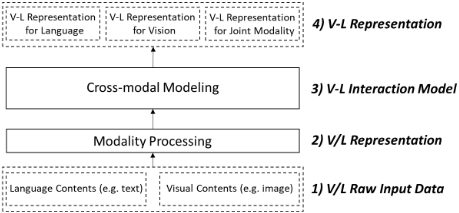
In this paper, we present an overview of the rise and major advances achieved in the topic of VLPMs. Figure 1 illustrates a generic architecture of VLPMs. It involves the design of four main components: 1) V/L (Vision and Language) Raw Input Data defines the representative raw data streams from language and visual contents respectively, such as a single or multiple sentence(s) and one or a set of image(s). 2) V/L Representation processes the raw data input into the desired format of modality representations that can be used for 3) V-L (Vision-Language) Interaction Model, which then enforces the cross-modal modeling between the two modalities. For instance, a common design is that the textual sentence is first tokenized and converted into the Bert-formatted input embedding while the image is processed into a set of spatialaware RoI (Region of Interest) features. Those two modality representations are then concatenated and fed into the transformer encoder layers in which the cross-modal interaction is modeled via the multi-head self-attention mechanism. 4) V-L Representation defines the possible cross-modal representations, which can be a V-L representation for the single modality (i.e., Language or Vision) and/or the V-L representation of joint modalities (i.e., Language and Vision). With the well-designed task supervision and learning guidelines from the pretraining, the V-L representation finally learns to represent the generic cross-modal semantics, which would be transferred to help with the downstream V-L tasks via finetuning. This generic architecture applies to most of the existing VLPMs. The designs are various for each component, their pretraining strategies and transfer applications.
∗Corresponding author: hqyang@ieee.org. Work done when Siqu and Feiqi were interned at IDEA.
Existing surveys in this area have only partially reviewed some related tasks [Mogadala et al., 2021] or focused mainly on systematical analysis [Bugliarello et al., 2021]. To the best of our knowledge, this is the first work that presents a comprehensive review of VLPMs. Our paper aims to provide both CV and NLP researchers insightful guidance for visual and language cross-modal learning via pretraining.
2 Input Data Encoding
2.1 Language Encoding
Most VLPMs represent the language input by taking a single textual sentence, which directly aligns with the image (visual modality) since their pretraining process mainly relies on pairwise image-text corpus [Li et al., 2019; Tan and Bansal, 2019; Lu et al., 2019; Li et al., 2020a; Chen et al., 2020; Yu et al., 2021; Li et al., 2020b]. Some VLPMs use multiple sentences for representing the language input, especially with visual dialogue and multi-lingual settings [Wang et al., 2020; Ni et al., 2021; Fei et al., 2021]. Some special VLPMs apply visual input in the form of text and encode it as a part of the language input [Li et al., 2020b; Yang et al., 2021]. For instance, OSCAR appends a set of object class tags detected from an image to the textual sentence as a language input to learn object-aligned V-L representation [Li et al., 2020b]. This early-fusion strategy of vision to language (V2L) at the raw input level serves as an anchor point to ease the crossmodal alignment learning.
To process the language input into a suitable language representation for cross-modal modeling, almost all VLPMs directly adapt the Bert-formatted input representation [Devlin et al., 2019], which sums up three types of learnable embeddings for each token in the textual sequence: 1) token embedding, 2) position embedding, and 3) segment embedding. The token embedding mostly follows the original Bert and encodes the textual sequence in the general form of "[CLS]w1w2...wi[SEP]" or with some minor modifications, where wi represents the ith tokenized (sub-)word based on the WordPiece vocabulary and [CLS]/[SEP] are special tokens indicating the starting and ending of this sequence. Some models introduce additional special tokens to better align with specific data or pretraining tasks [Wang et al., 2020; Zhou et al., 2020; Xia et al., 2021], such as the [EOT] tokens for separating each dialogue turns [Wang et al., 2020]. The position embedding is used exactly the same as in the original Bert, but the segment embedding is adjusted to be modality embedding in order to differentiate the two modalities or to further distinguish the multiple data streams within the language modality when multiple sentences are used, e.g., the segment tokens A/B/C used in VL-Bert [Su et al., 2019]. As a special case, the visual feature (See Sec.2.2) can also be included into the language representation as the fourth type of embedding, which can be regarded as an early-fusion strategy of vision to language (V2L) at the representation level [Su et al., 2019; Chiou et al., 2021]. With the Bert input representation format, it allows the VLPMs to enable initialising input embedding from Bert and directly adopt transformer encoder or its variants for the further cross-modal interaction modeling with a multi-head self-attention mechanism.
Intra-modality Processing. In particular, some VLPMs apply additional intra-modality processing with selfattention-based transformer blocks to the aforementioned Bert-formatted language embeddings for further encoding the intra-modal contextual information, in order to better balance with the already high-level visual feature produced by the deep CNN-based extractor from the vision modality (see Sec. 2.2) and enable a robust single-modal representation of language [Lu et al., 2019; Tan and Bansal, 2019; Li et al., 2021b; Yang et al., 2021; Majumdar et al., 2020]. Instead, the resultant transformer output representation would be used as input for the V-L interaction model.
2.2 Vision Encoding
With the processing of language input, the visual input for VLPMs is normally a single image that directly aligns with the paired text input [Li et al., 2019; Tan and Bansal, 2019; Lu et al., 2019; Li et al., 2020a; Chen et al., 2020; Yu et al., 2021; Li et al., 2020b], or a set of image(s) that are semantically correlated with each other [Majumdar et al., 2020; Hao et al., 2020]. For instance, the pretraining data for Vision-Language Navigation(VLN) is formed by a textual instruction with a group of panorama images along the navigation trajectory path [Majumdar et al., 2020].
Similar to the language representation, most studies encode visual input into the Bert-style sequential representation, which consists of the aforementioned three major embeddings. The segment embedding is created the same as that in language representation, but the token embedding and position embedding are modified to visual feature and spatial position embedding for capturing the visual semantics. Specifically, the visual feature is extracted using the CNNbased feature extractors, the most common way in the CV domain. For this, the granularity of representation, i.e., the grouping of image pixels into the sequential visual tokens, decides the alignment level of cross-modal modeling in the image content: 1) RoI-based VLPMs typically apply a pretrained Faster R-CNN object detector with a CNN backbone and extract the visual features of the detected object regions for the visual tokens [Lu et al., 2019; Tan and Bansal, 2019; Wang et al., 2020; Chen et al., 2020; Li et al., 2020a; Zhou et al., 2020] This is under the assumption that most image-text pairwise data is supposed to have its text describe the salient object (regions) in the corresponding image. Comparatively, some VLPMs simply split the whole image into continuous 2) patches [Gao et al., 2020; Wang et al., 2021b; Wen et al., 2021; Huang et al., 2021] or even more finegrained 3) pixels [Huang et al., 2020] as visual tokens for CNN-based feature extraction and refine the visual representation end-to-end, leading to significant speed improvement. More recent studies even propose the shallow, convolutionfree embedding that utilizes simple linear projection to encode visual tokens at the patches/pixels level as in ViT [Dosovitskiy et al., 2020] for a further efficiency gain [Wang et al., 2021a; Singh et al., 2021; Kim et al., 2021]. Besides, there are also VLPMs encoding each integral 4) image as a visual token by taking the pooling layer result from a CNN model (e.g., EfficientNet) [Hao et al., 2020].
Unlike the textual tokens with sequential positional relation, visual tokens entail spatial positional relation instead, varying based on different granularity, which can be encoded by spatial position embedding. RoI-based VLPMs commonly adopt the coordinate-based position embedding[Lu et al., 2019; Li et al., 2020a; Zhou et al., 2020; Chen et al., 2020], such as the 5-dimensional vector representing the normalized coordinates of the RoI bounding boxes and the fraction of image area. Comparatively, pixel/patch-based VLPMs represent the pixel location using the 2D-aware vector for the row/column number [Huang et al., 2021]. PREVALENT [Hao et al., 2020] for Vision-Language Navigation (VLN) is the only image-based VLPM that specifies the spatial position embedding, which uses the elevation and heading angle relative to the agent to represent the positional relations among panorama images. The spatial position embedding is normally combined with the visual feature with or without segment embedding via one or two FC layers followed by Layer Normalization to form the visual representation.
Intra-modality Processing. Since the transformer block used for additional intra-modality processing in language (See Sec.2.1) is a global operator whereas the CNN-based visual feature extractor is a local operator, it may lead to a different feature distribution between the two modalities [Wen et al., 2021]. Thus, some VLPMs also apply self-attentionbased transformer blocks to the initial Bert-style sequential visual representation to align with the language intramodality processing [Tan and Bansal, 2019; Hao et al., 2020; Sun et al., 2021; Wen et al., 2021]. Using transformers for intra-modality processing enables a modality-customized encoding with the freedom of selecting a different number of blocks for each modality. In practice, the language modality normally uses more transformer blocks than the vision modality for a better balance [Tan and Bansal, 2019; Lu et al., 2019; Hao et al., 2020]. Besides, several models adopt non-Transformer processing, e.g., AoANet [Xia et al., 2021] and Visual Dictionary mapping [Huang et al., 2021].
3 V-L InteractionModel (V-LIM)
There are two types of mainstream VLPM model structures: (1) Single-stream (1-stream) [Li et al., 2019; Chen et al., 2020; Li et al., 2020b], which directly fuse the initial language/visual representation by using the joint crossmodal encoder at the initial stage, and (2) Double-stream (2-stream) [Tan and Bansal, 2019; Lu et al., 2019; Murahari et al., 2020], which separately apply the intra-modality processing to two modalities along with a shared cross-modal encoder. However, this way of classification is mainly based on the perspective of intra-modality data-handling. In this section, we briefly review the model structure and the major output of VLPMs by focusing on their V-L interaction models (V-LIM) instead, which can be: 1) Self-attention-based, 2) Co-attention-based or 3) VSE-based V-LIM.
1) Self-attention-based V-LIM. Most single-stream [Li et al., 2019; Li et al., 2020a; Su et al., 2019; Huang et al., 2020; Gao et al., 2020; Chen et al., 2020; Li et al., 2020b] and some of the double-stream VLPMs [Huang et al., 2021] are considered as a self-attention-based V-LIMs since they directly apply single-stream self-attention module to the modality representations for cross-modal modeling. They simply concatenate the language and visual representation (as introduced in Sec.2.1 and Sec.2.2) to produce an integrated sequence representation so that a self-attention stream in the following transformer blocks can enforce the dense interaction modeling for both intra-modal (V-V&L-L) and cross-modal (V-L). Following the transformer, the output representation of the global-level special token, such as [CLS], in the multi-modal sequence would be taken as the holistic joint V-L representation for both pretraining and transfer learning. The output representation in the language or vision sequence could represent the contextualized V-L semantics and thus can be used as the V/L representation for Language or Vision.
2) Co-attention-based V-LIM. Comparatively, VLPMs with co-attention-based V-LIM decouple the intra- and crossmodal modeling processes. They keep two separate streams of transformer blocks for each modality that are entangled only at the specific cross-attention sub-layer(s). These sublayers enforce exchange of the key and value in self-attention module between the two modality streams. In this way, they limit the cross-modal modeling only to those co-attention sub-layers while leaving the rest of the sub-layers independent to focus on intra-modality processing and modeling. This single-modality focus makes them align well with the definition of double-stream VLPMs [Tan and Bansal, 2019; Lu et al., 2019; Murahari et al., 2020; Majumdar et al., 2020; Hao et al., 2020; Yu et al., 2021]. As a result, the V/L representation for Language or Vision can be taken from the output representation of the two separate modality streams whereas the V-L representation for joint modality is derived by taking the global token representation from either modality sequence (or their aggregation).
Encoder-decoder VLPMs. There are some VLPMs that apply a transformer-based encoder-decoder structure to empower the V-L generation ability. They can be categorized into either single-stream [Zhou et al., 2020; Wang et al., 2020; Wang et al., 2021b; Li et al., 2021a] or doublestream [Xia et al., 2021; Li et al., 2021b]. Regarding the V-LIM, few of them adopt unified encoder-decoder structure with self-attention-based V-LIM [Zhou et al., 2020; Wang et al., 2020; Li et al., 2021a]. Others try to emphasize the different peculiarities of the understanding/generation disciplines and instead use the conventional decoupled encoderdecoder structure [Wang et al., 2021b; Xia et al., 2021; Li et al., 2021b]. Their V-LIM can be either self- or coattention-based or even their combination, depending on how the attention modules in encoder/decoder are utilized for handling the multi-modalities. In general, these encoder-decoder VLPMs derive the V-L representation via the cross-modal encoder in a similar way to those self-attention-based VLPMs.
3) VSE-based V-LIM. More recently, there is another emerging mainstream of VLPMs that simply utilizes the dual-encoder structured model with VisualSemantic-Embedding(VSE)-based cross-modal contrastive learning [Radford et al., 2021; Jia et al., 2021; Sun et al., 2021; Wen et al., 2021]. They tend to have a special focus on large-scale cross-modal retrieval with high demand for efficiency. They utilize the intra-modality processing to derive the vision and language representation (as described in Sec.2.1 and Sec.2.2) between which the similaritybased cross-modal alignment would be modeled in the shared VSE space at the global level. This dual-encoder structure eradicates the fusion-style attention-based V-LIMs that are computation-costly and time-consuming. At the same time, it enables independent V/L representation encoding of both modalities, making the pre-computation possible for more efficient retrieval. The resultant V/L representation for language and vision can be independently derived by the learned modality encoders whereas their fused representation can represent the V-L representation for joint modality.
4 Pretraining
In this section, we review the pretraining regarding the datasets, tasks and objective designs.
4.1 Datasets
Conceptual Captions (CC, roughly 3M) and SBU Captions (SBU, around 1M) of enormous size and diversified nature are the most commonly used webly collected datasets for VLPM pretraining [Lu et al., 2019; Zhou et al., 2020; Li et al., 2021b; Li et al., 2020a; Fei et al., 2021]. It is found that a larger sized corpus leads to better performance in downstream transfer tasks [Lu et al., 2019; Wen et al., 2021; Jia et al., 2021]. Some simple Dual-encoder VLPMs [Radford et al., 2021; Jia et al., 2021] collect even larger scaled corpus from the web, such as WIT (400M) [Radford et al., 2021] and ALIGN(1.8B) [Jia et al., 2021].
Another combination that leads to better domain adaptation is the out-of-domain+in-domain datasets, where they define the web-based CC/SBU as out-of-domain and the MS-COCO (COCO)/Visual Genome (VG) as the in-domain datasets because most downstream tasks are built on them [Chen et al., 2020; Yu et al., 2021; Sun et al., 2021; Kim et al., 2021; Wang et al., 2021a; Li et al., 2021a]. The in-domain datasets can also be the task-specific datasets that specifically come from the commonly evaluated downstream tasks (e.g., GQA/VQA2.0) [Lu et al., 2020; Xia et al., 2021; Zhang et al., 2021; Li et al., 2020b; Wen et al., 2021].
Some VLPMs target specialized tasks/domains such as Visual Dialogue (VD) and pretrain on only the domain/taskspecific dataset due to their reduced suitability to the aforementioned text-image datasets regarding domain nature or dataset format [Gao et al., 2020; Zhuge et al., 2021; Wang et al., 2020; Hao et al., 2020]. There are also efforts of jointly pretraining with single-modal tasks on auxiliary single-modality data source, i.e., non-paired image or text collection, for reinforcing single-modal representations [Su et al., 2019; Li et al., 2021a; Fei et al., 2021; Ni et al., 2021; Singh et al., 2021].
4.2 Tasks and Objectives
There are three most commonly used cross-modal pretraining tasks 1 : 1) Cross-modal Masked Language Modeling (CMLM) extends the Masked Language Modeling (MLM) from Bert pretraining [Devlin et al., 2019] to multi-modal setting for learning the contextualized V-L representation, utilizing the bi-directional attention-based V-LIM. This is proved to be helpful for transferring the pretrained language model Bert into multi-modal setting [Wang et al., 2020] and thus makes it one of the most essential VLPM pretraining tasks [Su et al., 2019; Huang et al., 2020; Chen et al., 2020]. The task goal is to predict the masked tokens in text sequence based on the observation of their surrounding context, including both the unmasked textual tokens and all the visual tokens, by minimising the negative log-likelihood (NLL) loss. While most VLPMs mask out WordPiece sub-tokens as in Bert, some achieve better transfer performance via masking over semantically integral token groups such as complete word [Kim et al., 2021; Gao et al., 2020] or segment [Yu et al., 2021; Li et al., 2021a; Li et al., 2020b].
1 Task/objective names may vary slightly in different papers.
2) Cross-modal Masked Region Modeling (CMRM) is a vision-supervised counterpart of CMLM, initially proposed by RoI-based VLPMs. It randomly masks out tokens in the visual sequence instead [Chen et al., 2020; Tan and Bansal, 2019; Lu et al., 2019; Li et al., 2020a; Su et al., 2019]. Thus far, there exist three variant objectives: a) Region Label Classification (CMRMC) predicts the object class of each masked region via minimizing the cross-entropy (CE) loss calculated based on the one-hot encoded object class from the object detector as ground-truth and the normalized distribution of the VLPM prediction over the possible object classes. To mitigate the potential classification error of the object detector, b) Label Distribution Approximation (CMRMD) uses the probability distribution of the object class as a soft supervision by minimising the KL divergence loss between the object class distribution from the object detector and the normalized VLPM prediction distribution. Comparatively, c) Region Feature Regression (CMRMR) learns to regress the VLPM output of each masked region into its input feature derived from the object detector using the L2 loss. It is commonly applied together with CMRMC [Tan and Bansal, 2019; Ni et al., 2021; Li et al., 2021a] or CMRMD [Sun et al., 2021; Chen et al., 2020] for more robust visual content modeling and joint cross-modal learning. Especially, when the visual token is represented at patch level instead of RoI, CMRM can also be extended to masked patch modeling [Huang et al., 2021; Zhuge et al., 2021; Gao et al., 2020].
VLPMs with attention-based V-LIM commonly treat 3) Cross-modal Alignment (CA) as a binary classification problem, aiming to predict whether the input image-text pair is semantically matched or not based on the global V-L representation, by applying binary cross-entropy loss. The negative pairs can be sampled by randomly replacing either the image/text in the positive pair with another image/text from other data pairs in the corpus. On the other hand, dual-encoder based VLPMs with VSE-based V-LIM all regard CA as a ranking problem for finding the best match and apply the contrastive learning optimization objective [Radford et al., 2021; Sun et al., 2021; Jia et al., 2021; Wen et al., 2021]. They learn the decoupled V/L representation in the semantically shared VSE space. Most of them adopt in-batch negatives for convenience, which simply treats the text/image from the remaining pairs within the batch as negatives. In addition to the two global-level alignment CA objectives above, there are also several fine-grained alignment variants [Chen et al., 2020; Kim et al., 2021] that try to enforce the matching between the fine-grained components such as visual regions/patches and textual words of the imagetext pairs. One essential difference between the global-level and the fine-grained objectives is that the former introduces negative samples, which is found harmful for the fusionbased VLPMs with attention-based V-LIMs [Su et al., 2019]. Thus, some VLPMs [Li et al., 2021b; Singh et al., 2021; Wang et al., 2021a] introduce the single-modal encoders for its global-level CA while simultaneously keeping the fusionbased encoders for other tasks, to combine the advantages of the dual-encoder-based and fusion-based structures.
However, these three tasks cannot fulfil the goal of V-L generation tasks, such as Image Generation (IC) [Zhou et al., 2020; Xia et al., 2021; Li et al., 2021b; Wang et al., 2021b]. Thus, encoder-decoder-based VLPMs especially design the pretraining tasks to involve a decoding process. Those unified encoder-decoder VLPMs simply extend the bidirectional CMLM to seq2seq CMLM as an auxiliary pretraining task for text generation [Zhou et al., 2020; Li et al., 2021a; Wang et al., 2020]. Other VLPMs with decoupled encoderdecoder emphasize the inherently different peculiarities of the understanding and generation disciplines, where the former entails the unrestricted information passing across modalities whereas the latter only involves visual-to-textual information passing. They keep the bi-directional cross-modal modeling only to the encoder while generating the text via a separate decoder in an auto-regressive manner [Xia et al., 2021; Li et al., 2021b; Wang et al., 2021b].
From another perspective, applying downstream task such as the IC above for pretraining can be regarded as a kind of downstream-driven pretraining task [Tan and Bansal, 2019; Gao et al., 2020]. Some special pretraining tasks especially designed for the specific downstream task/domain can also be downstream-driven [Wang et al., 2020; Murahari et al., 2020; Hao et al., 2020; Yang et al., 2021], e.g., the Answer Prediction (AnP) for the Visual Dialogue(VD) task [Wang et al., 2020]. Besides, there are VLPMs that jointly pretrain on additional text and/or image collection with the single-modal tasks [Su et al., 2019; Wang et al., 2021a; Wen et al., 2021; Li et al., 2021a], including the single-modal multi-lingual settings [Ni et al., 2021; Fei et al., 2021].
5 Transfer Learning and Evaluation
In this section, we will introduce the downstream VisualLinguistic understanding (V-L Understanding), VisualLinguistic generation (V-L Generation) and single modal tasks that VLPMs mainly focus on.
V-L Understanding tasks refer to the tasks that require a model to capture both visual and linguistic semantics from the input and learn the correspondence between them. Most VLPMs apply a variety of V-L Understanding tasks for evaluation, while some just focus on a specific domain. Table 1 summarises the downstream tasks in V-L Understanding.
Visual Question Answering (VQA). Most works [Tan and Bansal, 2019; Lu et al., 2019; Zhou et al., 2020; Su et al., 2019; Gan et al., 2020; Wang et al., 2021a] formalize it as a classification problem to select an answer from a pool of common answers. However, SimVLM [Wang et al., 2021b] tries to decode open-ended answers in an auto-regressive manner to remove the limit posed by the fixed answer vocabulary.
Among these models, Self-attention-based VLPMs work better than Co-attention-based VLPMs, and SimVLM outperforms all other VLPMs on the VQA v2.0 dataset.
Cross Modal Retrieval (CMR). Some VLPMs [Li et al., 2020b; Gao et al., 2020] treat it as a binary classification task to predict whether each image-caption pair is matching, while others [Chen et al., 2020; Li et al., 2021b; Wen et al., 2021; Li et al., 2020a] solve it as a ranking problem to learn a similarity score to be maximized between positive pairs and minimized between negative pairs with a contrastive or CE loss.
Text Classification. Some VLPMs [Tan and Bansal, 2019; Gan et al., 2020; Lu et al., 2020; Huang et al., 2020; Chen et al., 2020] work on the Natural Language for Visual Reasoning (NLVR) task to perform binary classification based on special token representations, and some works [Gan et al., 2020; Lu et al., 2020; Chen et al., 2020; Li et al., 2021a; Huang et al., 2021; Kim et al., 2021] focus on the Visual Entailment (VE) problem to evaluate their methods.
Visual Commonsense Reasoning (VCR). The VCR task is usually divided into two sub-tasks to predict an answer and a rationale separately, and each sub-task is similar to answering a multiple-choice question out of four options. Therefore, most VLPMs [Li et al., 2019; Lu et al., 2019; Su et al., 2019] formulate each sub-task as a binary classification problem for each option, or a 4-way classification problem as done by Unicoder-VL [Li et al., 2020a].
Referring Expression Comprehension (REC). VLPMs for REC usually perform a binary classification on each image region for whether it is the target of the phrase and select the region with the highest score at inference stage [Lu et al., 2019; Su et al., 2019; Gan et al., 2020; Lu et al., 2020; Chen et al., 2020; Yu et al., 2021]. The VLPMs pretrained with in-domain datasets[Chen et al., 2020; Gan et al., 2020] generally work better on this task than those pretrained with only out-of-domain datasets.
Visual Relationship Detection (VRD). Only RVL-BERT focuses on this domain with two formulations [Chiou et al., 2021]. It can either be formulated as a ranking problem with the goal of ranking all possible subject-predicate-object triplets between any pair of object regions or as a binary classification problem to predict if a given subject-predicateobject triplet holds.
Visual Dialogue (VD). This problem can be formulated in a discriminative manner to select an answer from 100 candidates as done by VisDialBERT [Murahari et al., 2020] and VDBERT [Wang et al., 2020], or in a generative manner to auto-regressively decode the answer as done by VDBERT [Wang et al., 2020].
Visual Linguistic Navigation (VLN). Some VLPMs [Majumdar et al., 2020] try to solve this task in a discriminative setting by selecting the correct path among one positive path and several negative sample paths. In contrast, other VLPMs [Hong et al., 2021] try to solve it in a generative setting to make an action in between each state of the path by applying a reinforcement learning objective together with an imitation learning objective.
| Tasks | Papers |
|---|---|
| VQA | [Li et al., 2019], [Tan and Bansal, 2019], [Lu et al., 2019], [Zhou et al., 2020], [Su et al., 2019], [Gan et al., 2020], [Lu et al., 2020], [Huang et al., 2020], [Chen et al., 2020], [Li et al., 2020b], [Yu et al., 2021], [Li et al., 2021b], [Zhang et al., 2021], [Huang et al., 2021], [Zhuge et al., 2021], [Wang et al., 2021b], [Li et al., 2021a], [Wang et al., 2021a], [Kim et al., 2021], [Singh et al., 2021] |
| CMR | [Lu et al., 2019], [Li et al., 2020a], [Gan et al., 2020], [Lu et al., 2020], [Huang et al., 2020], [Gao et al., 2020], [Chen et al., 2020], [Li et al., 2020b], [Yu et al., 2021], [Li et al., 2021b], [Zhang et al., 2021], [Ni et al., 2021], [Sun et al., 2021], [Huang et al., 2021], [Li et al., 2021a], [Wen et al., 2021], [Fei et al., 2021], [Jia et al., 2021], [Wang et al., 2021a], [Kim et al., 2021], [Singh et al., 2021] |
| NLVR | [Li et al., 2019], [Tan and Bansal, 2019], [Gan et al., 2020], [Lu et al., 2020], [Huang et al., 2020], [Chen et al., 2020], [Li et al., 2020b], [Zhang et al., 2021], [Huang et al., 2021], [Wang et al., 2021b], [Wang et al., 2021a], [Kim et al., 2021] |
| VE | [Gan et al., 2020], [Lu et al., 2020], [Chen et al., 2020], [Li et al., 2021a], [Huang et al., 2021], [Wang et al., 2021b], [Kim et al., 2021], [Singh et al., 2021] |
| VCR | [Li et al., 2019], [Lu et al., 2019], [Li et al., 2020a], [Su et al., 2019], [Gan et al., 2020], [Chen et al., 2020], [Yu et al., 2021], [Li et al., 2021b] |
| REC | [Lu et al., 2019], [Su et al., 2019], [Gan et al., 2020], [Lu et al., 2020], [Chen et al., 2020], [Yu et al., 2021] |
| VRD | [Chiou et al., 2021] |
| VD | [Wang et al., 2020], [Murahari et al., 2020] |
| VLN | [Majumdar et al., 2020], [Hao et al., 2020], [Hong et al., 2021] |
V-L Generation tasks generate texts/images when the other modality is included in the input. Most generative VLPMs [Zhou et al., 2020; Xia et al., 2021; Li et al., 2020b; Zhang et al., 2021; Li et al., 2021a; Li et al., 2021b; Wang et al., 2021b; Hu et al., 2021] focus on Image Captioning (IC) task on COCO Captioning dataset by minimizing the NLL loss. Some of them [Li et al., 2020b; Zhang et al., 2021; Wang et al., 2021b; Hu et al., 2021] try the Nocaps task, which generates captions for images containing open domain novel objects. In addition, KaleidoBERT [Zhuge et al., 2021] extends this task to the fashion domain, and TAP [Yang et al., 2021] focuses on the TextCaps task (and the Text VQA task), which requires models to understand scene texts by applying CE loss at multiple decoding steps. VLPMs pretrained with extra in-domain datasets generally perform better except on the Nocaps. Similarly, multi-lingual VLPMs [Wang et al., 2021b] focus on the Multi-modal Machine Translation (MMT) task by minimizing the NLL loss.
Despite focusing on multi-modal pretraining, some VLPMs also investigate how their models can generalize to single modal tasks. SimVLM [Wang et al., 2021b] and ALIGN [Jia et al., 2021] perform the image classification task of predicting object categories, and KaleidoBERT [Zhuge et al., 2021] does it similarly to predict the category and subcategory of commercial products. Some VLPMs [Wang et al., 2021b; Li et al., 2021a] try to evaluate the natural language understanding capability of their models based on the GLUE benchmark tasks (or its subset). An improvement in linguistic tasks has been observed when pretrained with in-domain datasets, even with smaller pretraining data sizes.
6 Conclusion and Future Research Directions
This paper presents an overview of the recent advances in VLPMs for producing joint representations of visions and languages, images and text pairs. We mainly summarise vision and language input encoding methods and mainstream VLPMs. We also discuss several useful pretraining and finetuning tasks and strategies. We do hope that the paper will provide insightful guidance for both CV and NLP researchers who work on joint and cross-modal learning. To advance this, there are several promising future directions for VLPMs.
V-L Interaction Modeling. Although various VL interaction model extensions have been proposed in Section 3, there is still a significant challenge in aligning vision and language content. Most pretrained models focus on masking at the task level or input level, which does not directly align the features between image and text. Incorporating masking strategy at the embedding level has been shown to be effective [Zhuge et al., 2021]. It is promising to investigate how to explicitly align the embedding features between image and text so that it can learn fine-grain representations.
VLPM Pretraining Strategy. There still lacks systematic experiments and analysis on V-L-based multi-tasking synergy for VLPM pretraining. Few VLPMs explore multi-stage training [Li et al., 2019; Wang et al., 2020; Hong et al., 2021; Xia et al., 2021; Chen et al., 2020], and 12-in-1 [Lu et al., 2020] is the only one that tries to group the tasks of similar natures and test the performance boost from intra- and inter-group pretraining perspectives. It faces significant challenges to finding the answer in one step because it entails multiple factors such as selecting datasets (both multi-modal and single-modal), task design, task grouping, and order (multistage). Moreover, the effectiveness of the pretraining process may vary for different downstream targeted tasks. However, it is still worth exploring, step by step, how the V-L based multi-tasking can be implemented for VLPM pretraining that can generate the best transfer performance on the specific targeted domain/tasks, which will provide promising and valuable guidelines for the future development of VLPMs.
Training Evaluation. The trained VLPMs can be only evaluated during the downstream tasks. This may waste a lot of computation cost when the models are defective. It is worth exploring some metrics, such as perplexity, during the training procedure. Hence, we can guarantee the performance of the trained VLPMs in advance.
@inproceedings{ijcai2022p773,
  title     = {Vision-and-Language Pretrained Models: A Survey},
  author    = {Long, Siqu and Cao, Feiqi and Han, Soyeon Caren and Yang, Haiqin},
  booktitle = {Proceedings of the Thirty-First International Joint Conference on
               Artificial Intelligence, {IJCAI-22}},
  publisher = {International Joint Conferences on Artificial Intelligence Organization},
  editor    = {Luc De Raedt},
  pages     = {5530--5537},
  year      = {2022},
  month     = {7},
  note      = {Survey Track},
  doi       = {10.24963/ijcai.2022/773},
  url       = {https://doi.org/10.24963/ijcai.2022/773},
}
TY - CPAPER TI - Vision-and-Language Pretrained Models: A Survey AU - Long, Siqu AU - Cao, Feiqi AU - Han, Soyeon Caren AU - Yang, Haiqin T2 - Proceedings of the Thirty-First International Joint Conference on Artificial Intelligence, IJCAI-22 PB - International Joint Conferences on Artificial Intelligence Organization PY - 2022 SP - 5530 EP - 5537 DO - 10.24963/ijcai.2022/773 UR - https://doi.org/10.24963/ijcai.2022/773 ER -Copied
Machine-readable versions of this paper, for tools and AI agents:





