
Towards Contextually Sensitive Analysis of Memes: Meme Genealogy and Knowledge Base
Proceedings of the Thirty-First International Joint Conference on Artificial Intelligence. Doctoral Consortium. Pages 5871-5872.
https://doi.org/10.24963/ijcai.2022/838
Keywords
- Speech & Natural Language Processing (SNLP): General
- Knowledge Representation and Reasoning (KRR): General
- Computer Vision (CV): General
Abstract
As online communication grows, memes have continued to evolve and circulate as succinct multimodal forms of communication. However, computational approaches applied to meme-related tasks lack the same depth and contextual sensitivity of non-computational approaches and struggle to interpret intra-modal dynamics and referentiality. This research proposes to a ‘meme genealogy’ of key features and relationships between memes to inform a knowledge base constructed from meme-specific online sources and embed connotative meaning or contextual information in memes. The proposed methods provide a basis to train contextually sensitive computational models for analysing memes and applications in semi-automated meme annotation.
- [Barnes et al., 2021] Barnes, K., Riesenmy, T., Trinh, M.D., Lleshi, E., Balogh, N. & Molontay, R. (2021). Dank or not? Analyzing and predicting the popularity of memes on Reddit. Applied Network Science 6(21).
- [Beskow et al., 2020] Beskow, D.M., Jumar, S. & Carley, K.M. (2020). The evolution of political memes: Detecting and characterizing internet memes with multi-modal deep learning. Information Processing and Management 57(2).
- [Kiela et al., 2021] Kiela, D., Firooz, H., Mohan, A., Gos- wami, V., Fitzpatrick, CA., Bull, P., Lipstein, G. & Nelli, T. (2021). The Hateful Memes Challenge: Competition Report. In Proceedings of the NeurIPS 2020 Competition and Demonstration Track, PMLR, 344-360.
- [Kirk et al., 2021] Kirk, H., Jun, Y., Rauba, P., Wachtel, G., Li, R., Bai, X., Broestl, B., Doff-Sotta, M., Shtedritski, A., & Asano, Y.M. Memes in the Wild: Assessing the Gener- alizability of the Hateful Memes Challenge Dataset. In Proceedings of the 5th Workshop on Online Abuse and Harms, Association for Computational Linguistics, 26-35 (Online), August 2021.
- [Peirson and Tolunary, 2018] Peirson, A.L. & Tolunary, E.M., (2018). Dank Learning: Generating Memes Using Deep Neural Networks. ArXiv abs/1806.04510
- [Sadasivam et al., 2020] Sadasivam, A., Gunasekar, K., Davulcu, H., & Yang, Y. (2020). memeBot: Towards Au- tomatic Image Meme Generation. ArXiv, abs/2004.14571.
- [Sharma et al., 2020] Sharma, C., Bhageria, D., Scott, W., PYLK, S., Das, A., Chakraborty. T., Pulabaigari, V. & Gamback, B. SemEval-2020 Task 8: Memotion Analysis- The Visuo-Lingual Metaphor! In Proceedings of the 14th International Workshop on Semantic Evaluation, Interna- tional Committee for Computational Linguistics, 759-773, Barcelona, Spain (Online), December 2020.
- [Wang and Wen, 2015] Wang, W. and Wen, M. Can I haz Cheezburger? A Nonparanormal Approach to Combining Textual and Visual Information for Predicting and Gener- ating Popular Meme Descriptions. In Proceedings of the 2015 Conference of the North American Chapter for Com- putational Linguistics: Human Language Technolgoies, Association for Computational Linguistics, 355-365, Den- ver, Colorado, May-June 2015.
References were extracted automatically from the PDF and may contain errors.
Full text extracted automatically from the PDF; figures, tables and equations may differ. The PDF is the version of record.
1 Introduction
Memes are a unique social phenomenon which have grown in popularity as social media use increases. They represent a unique type of multimodal online content constructed from recycled images or catchphrases, referencing cultural icons or ideas, and invoking strategies such as humour and sarcasm to communicate simple or complex ideas. Many memes use image and text formats where the combination of each mode provides context for the other, and they are constructed by users continuously referencing and exploiting other meme content. Their reliance on contextual knowledge and referentiality makes them difficult to analyse using computational methods which lack human context.
2 Related Work
Current areas of interest in meme analysis are classification, AI meme generation and sentiment analysis. Meme classification refers to tasks which seek to distinguish memes from non-meme content or identify binary classes in memes - the most prominent recent example being the Facebook Hateful Meme Competition [Kiela et al., 2021]. The competition dataset required multimodal approaches as the interplay of text and image could change the final classification; the winning solutions proposed extracting features from visual streams and tagging these with external labels. Other studies proposed similar multimodal approaches with object detection, feature identification and classification of meme popularity [Beskow et al., 2020; Barnes et al., 2021]. However, Kirk et al. [2021] noted that models from the Hateful Meme competition performed poorly on 'wild' meme classification as models were trained on an artificial dataset.
Developments in AI meme generation proposed multimodal solutions and text-image alignment to match generated text to the correct template but demonstrated limited understanding of textual or visual codes in memes by confusing common linguistics structures of one meme template with another [Sadasivam et al., 2020; Peirson and Tolunary, 2018]. Wang and Wen [2015] proposed a non-paranormal approach to generating meme descriptions with an external knowledge module from reverse image search, demonstrating AI-generated memes that used puns.
Meme sentiment tasks are approached through natural language processing and aim to achieve fine-grained emotion classification. Multimodal approaches were again developed as part of the SemEval 2020 Task 8 analysis of the Memotion dataset, a prelabelled dataset with fine-grained emotions, outperforming unimodal approaches. However, performance was still overall poor on sentiment analysis task for all models [Sharma et al., 2020].
3 Research Objectives
This research will contribute computational approaches and techniques for meme analysis which are contextually sensitive and able to extract latent meaning with three objectives.
Classification of memes and extraction of features will be achieved as part of the proposed meme genealogy which differs from current research by identifying prominent features in memes through computer vision and natural language processing, to contribute a comprehensive mapping of meme relationships via their identified features.
The construction of a meme-specific ontology and knowledge base will collate contextual information from online sources, drawing on the most successful models in prior research which exploit external knowledge to augment models. The proposed knowledge base will use features inherent in memes and match them with contextual knowledge from online sources to ensure the connotations and references that have been constructed as memes are continually produced is captured.
The final object will use this knowledge base to tag memes with relevant semantic and contextual knowledge. Exploiting 'meme families' and entity relationships developed in the genealogy would allow for minimal annotation of only a few meme templates or features for future analysis, and can additionally be applied to analysing new, emerging memes based on their shared features to known memes.
4 Proposed Methodology
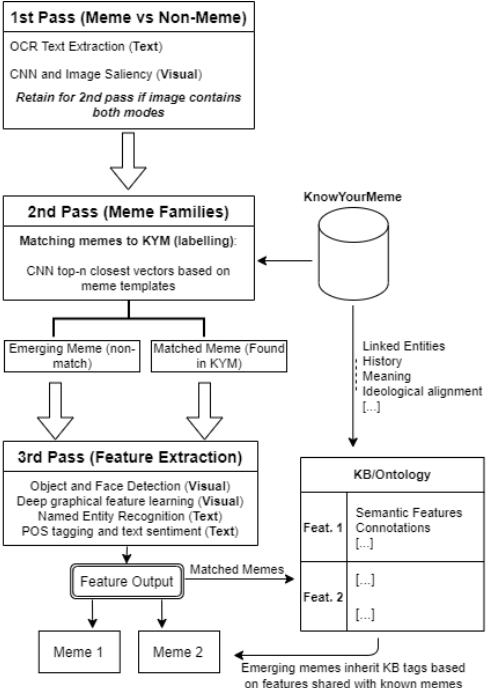
The proposed methodology draws on the achievements identified in current meme research: multimodal approaches; external knowledge; and fine-grained sentiment/discourse analysis applied to both the image and text as opposed to only text in previous studies. The latter will be solved using a semiotic framework to analyse visual/textual codes in memes but is expected to be achieved after the construction the knowledge base. The first stage explored is the construction of a meme genealogy and taxonomy, which will inform the development of a meme-specific knowledge base and ontology. Figure 1 illustrates the first stage and the incorporation of external knowledge:
5 Conclusion and Contributions
This research briefly outlines a proposed method towards contextually sensitive analysis of memes through a structured meme genealogy and knowledge base. It contributes a potential approach to accurate classification and sentiment analysis of memes by incorporating the rich history of referential meaning generated by users continuously creating memes, alongside methods to annotate memes with feature-inheritance. Currently, the first pass has been achieved and work is ongoing to extract features for the knowledge base.
@inproceedings{ijcai2022p838,
  title     = {Towards Contextually Sensitive Analysis of Memes: Meme Genealogy and Knowledge Base},
  author    = {Sherratt, Victoria},
  booktitle = {Proceedings of the Thirty-First International Joint Conference on
               Artificial Intelligence, {IJCAI-22}},
  publisher = {International Joint Conferences on Artificial Intelligence Organization},
  editor    = {Luc De Raedt},
  pages     = {5871--5872},
  year      = {2022},
  month     = {7},
  note      = {Doctoral Consortium},
  doi       = {10.24963/ijcai.2022/838},
  url       = {https://doi.org/10.24963/ijcai.2022/838},
}
TY - CPAPER TI - Towards Contextually Sensitive Analysis of Memes: Meme Genealogy and Knowledge Base AU - Sherratt, Victoria T2 - Proceedings of the Thirty-First International Joint Conference on Artificial Intelligence, IJCAI-22 PB - International Joint Conferences on Artificial Intelligence Organization PY - 2022 SP - 5871 EP - 5872 DO - 10.24963/ijcai.2022/838 UR - https://doi.org/10.24963/ijcai.2022/838 ER -Copied
Machine-readable versions of this paper, for tools and AI agents:





