
Displaying Justifications for Collective Decisions
Proceedings of the Thirty-First International Joint Conference on Artificial Intelligence. Demo Track. Pages 5892-5895.
https://doi.org/10.24963/ijcai.2022/847
Keywords
- Knowledge Representation and Reasoning: Automated Reasoning and Theorem Proving
- Agent-based and Multi-agent Systems: Computational Social Choice
Abstract
We present an online demonstration tool illustrating a general approach to computing justifications for accepting a given decision when confronted with the preferences of several agents. Such a justification consists of a set of axioms providing a normative basis for the decision, together with a step-by-step explanation of how those axioms determine the decision. Our open-source implementation may also prove useful for realising other kinds of projects in computational social choice, particularly those requiring access to a SAT solver.
- [Arrieta et al., 2020] Alejandro Barredo Arrieta, Natalia Díaz-Rodríguez, Javier Del Ser, Adrien Bennetot, Siham 2 It is also possible to use the tools of constraint programming [
- [Rossi et al., 2006] to the same effect, and in our initial work on the topic we followed this alternative route [Boixel and Endriss, 2020].
- Tabik, Alberto Barbado, Salvador García, Sergio Gil- López, Daniel Molina, Richard Benjamins, Raja Chatila, and Francisco Herrera. Explainable artificial intelligence (XAI): Concepts, taxonomies, opportunities and chal- lenges toward responsible AI. Information Fusion, 58:82- 115, 2020.
- [Arrow, 1963] Kenneth J. Arrow. Social Choice and Individ- ual Values. John Wiley and Sons, 2nd edition, 1963. First edition published in 1951.
- [Biere et al., 2009] Armin Biere, Marijn Heule, and Hans van Maaren, editors. Handbook of Satisfiability. IOS Press, 2009.
- [Boixel and Endriss, 2020] Arthur Boixel and Ulle Endriss. Automated justification of collective decisions via con- straint solving. In Proceedings of the 19th International Conference on Autonomous Agents and Multiagent Sys- tems (AAMAS-2020). IFAAMAS, 2020.
- [Boixel and de Haan, 2021] Arthur Boixel and Ronald de Haan. On the complexity of finding justifications for col- lective decisions. In Proceedings of the 35th AAAI Confer- ence on Artificial Intelligence (AAAI-2021). AAAI Press, 2021.
- [Boixel et al., 2022] Arthur Boixel, Ulle Endriss, and Ronald de Haan. A calculus for computing structured jus- tifications for election outcomes. In Proceedings of the 36th AAAI Conference on Artificial Intelligence (AAAI- 2022). AAAI Press, 2022.
- [Brams and Fishburn, 2002] Steven J. Brams and Peter C. Fishburn. Voting procedures. In Kenneth J. Arrow, Amartya K. Sen, and Kotaro Suzumura, editors, Handbook of Social Choice and Welfare, volume 1, chapter 4, pages 173-236. Elsevier, 2002.
- [Brandt et al., 2016] Felix Brandt, Vincent Conitzer, Ulle Endriss, Jérôme Lang, and Ariel D. Procaccia, editors. Handbook of Computational Social Choice. Cambridge University Press, 2016.
- [Cailloux and Endriss, 2016] Olivier Cailloux and Ulle En- driss. Arguing about voting rules. In Proceedings of the 15th International Conference on Autonomous Agents and Multiagent Systems (AAMAS-2016). IFAAMAS, 2016.
- [D'Agostino et al., 1999] Marcello D'Agostino, Dov M. Gabbay, Reiner Hähnle, and Joachim Posegga, editors. Handbook of Tableau Methods. Elsevier, 1999.
- [Gebser et al., 2012] Martin Gebser, Roland Kaminski, Ben- jamin Kaufmann, and Torsten Schaub. Answer Set Solving in Practice. Synthesis Lectures on Artificial Intelligence and Machine Learning. Morgan & Claypool Publishers, 2012.
- [Geist and Peters, 2017] Christian Geist and Dominik Pe- ters. Computer-aided methods for social choice theory. In Ulle Endriss, editor, Trends in Computational Social Choice, chapter 13, pages 249-267. AI Access, 2017.
- [Ignatiev et al., 2018] Alexey Ignatiev, Antonio Morgado, and João Marques-Silva. PySAT: A Python toolkit for prototyping with SAT oracles. In Proceedings of the 21st International Conference on Theory and Applications of Satisfiability Testing (SAT-2018). Springer, 2018.
- [Liffiton et al., 2016] Mark H. Liffiton, Alessandro Previti, Ammar Malik, and João Marques-Silva. Fast, flexible MUS enumeration. Constraints, 21(2):223-250, 2016.
- [Loustalot Knapp, 2022] Daniela Loustalot Knapp. Justifi- cation of matching outcomes. Master's thesis, ILLC, Uni- versity of Amsterdam, 2022.
- [Manlove, 2013] David Manlove. Algorithmics of Matching under Preferences. World Scientific, 2013.
- [Miller, 2019] Tim Miller. Explanation in artificial intelli- gence: Insights from the social sciences. Artificial intelli- gence, 267:1-38, 2019.
- [Nardi et al., 2022] Oliviero Nardi, Arthur Boixel, and Ulle Endriss. A graph-based algorithm for the automated justi- fication of collective decisions. In Proceedings of the 21st International Conference on Autonomous Agents and Mul- tiagent Systems (AAMAS-2022). IFAAMAS, 2022.
- [Procaccia, 2019] Ariel D. Procaccia. Axioms should ex- plain solutions. In Jean-Franc ¸ois Laslier, Hervé Moulin, M. Remzi Sanver, and William S. Zwicker, editors, The Future of Economic Design, pages 195-199. Springer, 2019.
- [Rossi et al., 2006] Francesca Rossi, Peter van Beek, and Toby Walsh, editors. Handbook of Constraint Program- ming. Elsevier, 2006.
- [Tang and Lin, 2009] Pingzhong Tang and Fangzhen Lin. Computer-aided proofs of Arrow's and other impossibil- ity theorems. Artificial Intelligence, 173(11):1041-1053, 2009.
- [Zwicker, 2016] William S. Zwicker. Introduction to voting theory. In Felix Brandt, Vincent Conitzer, Ulle Endriss, Jérôme Lang, and Ariel D. Procaccia, editors, Handbook of Computational Social Choice, chapter 2, pages 23-56. Cambridge University Press, 2016.
References were extracted automatically from the PDF and may contain errors.
Full text extracted automatically from the PDF; figures, tables and equations may differ. The PDF is the version of record.
1 Introduction
Suppose we have to select a "best" alternative from a given set of alternatives on the basis of the preferences expressed by several agents. We of course could delegate this decision to a computer program implementing one of the many voting rules that have been proposed in the literature [Brams and Fishburn, 2002]. But sometimes we expect more than simply being presented with the output returned by such a program. Sometimes we would like to see a meaningful justification for why a given choice really is the right one. Such a justification should appeal to basic normative principles we can agree with; and it should present the reasoning steps involved in showing that the suggested outcome really is entailed by those principles-in a manner that is easy to understand.
This point has been made by a number of authors in recent years [Cailloux and Endriss, 2016; Procaccia, 2019; Boixel and Endriss, 2020], and it ties in with broader concerns regarding the explainability of algorithmic decision making powered by AI [Miller, 2019; Arrieta et al., 2020].
Realising the ideal of (automatically) justifying collective decisions from first principles presents itself as a natural challenge for the field of computational social choice, given its concern with both the normative and the algorithmic aspects of collective decision making [Brandt et al., 2016]. Here we present an online tool we developed to showcase one particular approach addressing this challenge [Boixel and Endriss, 2020; Boixel et al., 2022; Nardi et al., 2022].
Roadmap. In Section 2 we introduce the problem of computing a justification for a given target outcome when presented with a profile of preferences and a corpus of axioms encoding normative principles of interest. Then, in Section 3 we present our demonstration tool and in Section 4 we briefly describe the AI techniques used to build it, before discussing possible directions for future developments in Section 5.
2 Justifying Collective Decisions
In this section we provide an informal account of the approach to finding axiomatic justifications for collective decisions we developed in a series of recent papers [Boixel and Endriss, 2020; Boixel et al., 2022; Nardi et al., 2022].
We are concerned with decision-making scenarios in which several agents each express their individual preferences by providing a ranking of the alternatives in a finite set X. We treat all agents the same, so when talking about such a profile of preferences we only keep track of how many agents support any given ranking. Making a collective decision amounts to selecting an outcome, a nonempty subset X⋆ ⊆ X. When X⋆ is a singleton, then we may think of that single element of X⋆ as the "best" alternative in X; otherwise, we may think of the elements of X⋆ as all being "tied for best".
Example 1. If you were to ask five sommeliers to rank three of the best known Italian wines-Amarone, Brunello, and Chianti-you might obtain the following preference profile:
#2 : Chianti ≻ Brunello ≻ Amarone
#1 : Brunello ≻ Amarone ≻ Chianti
#1 : Brunello ≻ Chianti ≻ Amarone
#1 : Amarone ≻ Chianti ≻ Brunello
That is, the first ranking is reported by two individuals, while the other rankings have just one supporter each.
Observe that the well-known Borda rule would declare a tie between Brunello and Chianti (with 5 points each), while the Copeland rule would select Chianti (winning all pairwise majority contests). So what is the right choice, and why? △ We might justify the outcome selected by a voting rule F by appealing to the axioms characterising F [Zwicker, 2016]. Examples include the Pareto Principle, saying that a dominated alternative should never be selected, and the Neutrality Principle, postulating symmetric treatment of the alternatives. But this is not the route we follow here. Instead, we want to justify outcomes by appealing to axioms directly.
So suppose we are given a profile R⋆, a target outcome X⋆, and a corpus A of axioms we may rely on. In its most basic form, a justification for X⋆ is simply a reference to a set AN ⊆ A, a so-called normative basis, such that every voting rule satisfying the axioms in AN will return X⋆ for R⋆. 1
Example 2. Let's return to our oenological case study. We can justify the outcome {Chianti} by reference to a normative basis consisting of just one axiom, the Condorcet Principle, which demands that any alternative beating all others in pairwise majority contests should be the only winner.
Can we also justify the tied outcome {Brunello, Chianti}? Yes, we can. As an expert in social choice theory would be able to confirm, the normative basis consisting of the aforementioned Neutrality and Pareto Principles together with the Reinforcement Principle does the job. The latter says: when one group of agents selects Y and another selects Y ′ , then their union should select Y ∩ Y ′ (unless that intersection would be empty). But what if you are no such expert? △
What is still missing from our notion of justification is the explanatory component. So let us refine our definition by requiring that AN must be paired with an explanation AE made up of a set of instances of the axioms in AN . Here an instance of an axiom is an application of that axiom to a specific situation (e.g., specific profiles and alternatives). AE must be such that every voting rule that satisfies it will return X⋆ for R⋆. In addition, we may require that AE can be presented in a structured form, as a step-by-step derivation.
Example 3. We can explain how Neutrality, Pareto, and Reinforcement force the selection of {Brunello, Chianti} as follows. First, consider this subprofile (let's call it R1):
#1 : Chianti ≻ Brunello ≻ Amarone
#1 : Brunello ≻ Chianti ≻ Amarone
By Pareto, Amarone cannot win in R1. By Neutrality, the other two alternatives either must both win or both lose. So the only possible outcome for R1 is {Brunello, Chianti}.
Now let us consider the rest of the group (subprofile R2):
#1 : Chianti ≻ Brunello ≻ Amarone
#1 : Brunello ≻ Amarone ≻ Chianti
#1 : Amarone ≻ Chianti ≻ Brunello
R2 is completely symmetric: if we rename Amarone to Brunello, Brunello to Chianti, and Chianti to Amarone we end up in the exact same profile. So the outcome must be invariant under this permutation as well, meaning that the full set {Amarone, Brunello, Chianti} is the only option.
Finally, when we join the two subprofiles, Reinforcement forces the desired outcome of {Brunello, Chianti}. △
While the general problem of computing justifications is highly intractable [Boixel and de Haan, 2021], for small-scale scenarios such as this, it is possible to automate the process.
3 The Online Demonstration Tool
We have developed an online demonstration tool that allows anyone to compute and explore axiomatic justifications for small-scale decision-making scenarios of their own design. In this section we describe the functionality of this tool and show how it can be applied to the example discussed earlier. The tool is available at the following address:
1 There is one further technical requirement: AN may not be trivial in the sense of there not existing even one voting rule that satisfies AN . An example for a trivial set of axioms is the set of those involved in Arrow's famous impossibility theorem [Arrow, 1963].
https://demo.illc.uva.nl/justify/
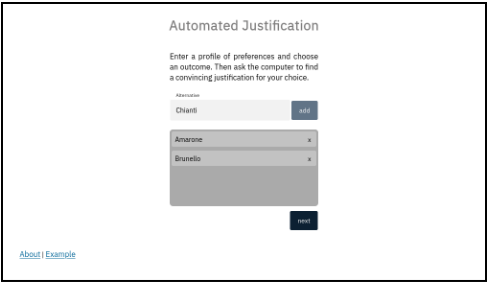
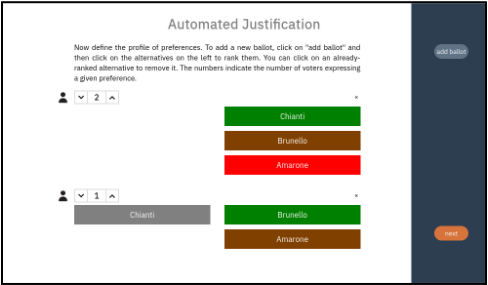
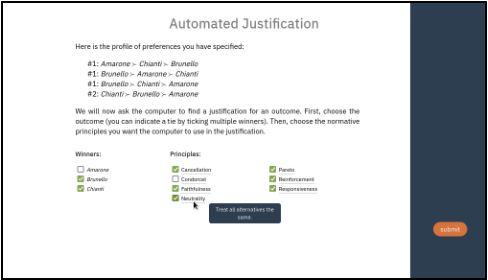
To build a profile, we first choose names for the alternatives involved in the decision-making scenario, and then define the preferences of the voters over those alternatives (see Figures 1 and 2). Next, we pick the outcome for which we want to find a justification, and finally we specify for each of the axioms available whether we would be happy for that axiom to feature in that justification (see Figure 3). Hovering over an axiom will reveal a short intuitive definition. Pressing the submit-button will launch the justification engine.
If no justification meeting our requirements exists, or if none can be found within the search depth or time limit in place, a message to this effect will be displayed. Otherwise, the justification found will be presented on the screen.
Such a justification consists in a step-by-step explanation for why the target outcome should win, similar to a mathematical proof. Indeed, a justification is internally represented as a proof tree, with each node being a step in the explanation. Most of the steps correspond to an application of an axiom instance that constrains the possible outcomes for either the profile we are interested in or some of its subprofiles. Other steps amount to simple case distinctions.
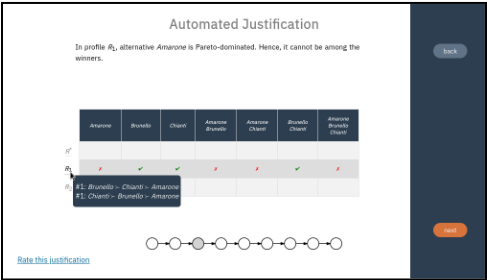
In our tool, we display one step at a time, describing each step in an intuitive way. Figure 4 shows an example, namely the application of the Pareto Principle to subprofile R1 to exclude Amarone from the set of winners (as also explained in Example 3). One can easily navigate back and forth between different steps in the explanation. On each page (corresponding to a step), we show a table that records, for every profile mentioned so far, the outcomes that are still available for it. This table is updated at every step, as more and more constraints imposed by the axiom instances over the available outcomes are made explicit. The justification is complete when the only remaining outcome for the profile specified by the user is the outcome she wanted to justify.
When a justification is displayed, the user has the option of rating both the degree to which it is easy to understand and the degree to which it is convincing. We hope the data collected in this manner will prove useful in informing future research on the topic of explainability is social choice.
4 Techniques
Building an application-such as our online demonstration tool-that can provide axiomatic justifications to its users requires the integration of a whole battery of AI techniques, ranging from computational social choice, to automated reasoning, to search. Here we provide a brief overview.
The starting point for the automation of the task of finding justifications is the fundamental insight that-for a fixed set of alternatives and an upper bound on the number of agentswe can rewrite any axiom of interest as a formula of propositional logic with variables of the form pR,x, encoding that in profile R alternative x should be part of the outcome. This makes it possible to use SAT solvers [Biere et al., 2009; Ignatiev et al., 2018] to reason about axioms. This insight has been used repeatedly in computational social choice to prove impossibility theorems [Tang and Lin, 2009; Geist and Peters, 2017]. But we can also use it to check whether a given set of axioms AN ⊆ A constitutes a valid normative basis for choosing X⋆ in profile R⋆. To do so, we simply need to check whether the encoding of AN is satisfiable but becomes unsatisfiable once we add a formula saying that the outcome should not be equal to X⋆. 2
Owing to the impressive efficiency of modern SAT solvers, these checks can be performed very quickly. The main bottleneck is the generation phase, as the encoding of an axiom will typically be huge. To address this challenge, we have developed a search algorithm that constructs the encoding of the set of formulas to be checked in an incremental fashion by exploring a graph on the set of all possible profiles induced by the axioms in the corpus A [Nardi et al., 2022].
Given an unsatisfiable set of formulas encoding AN together with the requirement that X⋆ must not be the outcome, any minimally unsatisfiable subset (MUS) of that set will contain all the information we need to identify a set of axiom instances involved in some explanation AE . So we can relegate this task to an MUS enumeration tool [Liffiton et al., 2016].
Finally, we have developed a method for turning such an MUS into a structured proof [Boixel et al., 2022], inspired by tableau-based calculi from the field of automated deduction [D'Agostino et al., 1999]. As there usually are many different such proofs, we used answer set programming [Gebser et al., 2012] as a means of selecting one that meets certain optimality criteria, such as being as short as possible.
We implemented our demonstration tool in Python, with an eye on reusability, particularly of the packages providing fundamental reasoning abilities. The code is available here:
https://github.com/comsoc-amsterdam/comsoc/
5 Future Directions
There are a number of directions in which to take this research agenda further. Examples include improving the performance of the justification algorithm, translating our tableau-based explanations into natural language, running experiments with users to improve our understanding of what kind of explanation they experience as most helpful, and extending our approach to other types of decision-making scenarios. Regarding the latter, recent work by Loustalot Knapp [2022] suggests that the general approach also has potential in the area of matching under preferences [Manlove, 2013].
@inproceedings{ijcai2022p847,
  title     = {Displaying Justifications for Collective Decisions},
  author    = {Boixel, Arthur and Endriss, Ulle and Nardi, Oliviero},
  booktitle = {Proceedings of the Thirty-First International Joint Conference on
               Artificial Intelligence, {IJCAI-22}},
  publisher = {International Joint Conferences on Artificial Intelligence Organization},
  editor    = {Luc De Raedt},
  pages     = {5892--5895},
  year      = {2022},
  month     = {7},
  note      = {Demo Track},
  doi       = {10.24963/ijcai.2022/847},
  url       = {https://doi.org/10.24963/ijcai.2022/847},
}
TY - CPAPER TI - Displaying Justifications for Collective Decisions AU - Boixel, Arthur AU - Endriss, Ulle AU - Nardi, Oliviero T2 - Proceedings of the Thirty-First International Joint Conference on Artificial Intelligence, IJCAI-22 PB - International Joint Conferences on Artificial Intelligence Organization PY - 2022 SP - 5892 EP - 5895 DO - 10.24963/ijcai.2022/847 UR - https://doi.org/10.24963/ijcai.2022/847 ER -Copied
Machine-readable versions of this paper, for tools and AI agents:





