
Answer Mining from a Pool of Images: Towards Retrieval-Based Visual Question Answering
Proceedings of the Thirty-Second International Joint Conference on Artificial Intelligence. Main Track. Pages 1312-1321.
https://doi.org/10.24963/ijcai.2023/146
Keywords
- Machine Learning: ML: Multi-modal learning
- Computer Vision: CV: Applications
- Computer Vision: CV: Vision and language
Abstract
We study visual question answering in a setting where the answer has to be mined from a pool of relevant and irrelevant images given as a context. For such a setting, a model must first retrieve relevant images from the pool and answer the question from these retrieved images. We refer to this problem as retrieval-based visual question answering (or RETVQA in short). The RETVQA is distinctively different and more challenging than the traditionally-studied Visual Question Answering (VQA), where a given question has to be answered with a single relevant image in context. Towards solving the RETVQA task, we propose a unified Multi Image BART (MI-BART) that takes a question and retrieved images using our relevance encoder for free-form fluent answer generation. Further, we introduce the largest dataset in this space, namely RETVQA, which has the following salient features: multi-image and retrieval requirement for VQA, metadata-independent questions over a pool of heterogeneous images, expecting a mix of classification-oriented and open-ended generative answers. Our proposed framework achieves an accuracy of 76.5% and a fluency of 79.3% on the proposed dataset, namely RETVQA and also outperforms state-of-the-art methods by 4.9% and 11.8% on the image segment of the publicly available WebQA dataset on the accuracy and fluency metrics, respectively.
- [Ahmad et al., 2019] Amin Ahmad, Noah Constant, Yinfei Yang, and Daniel Cer. Reqa: An evaluation for end-to- end answer retrieval models. In Proceedings of the 2nd Workshop on Machine Reading for Question Answering, pages 137-146, 2019.
- [Andreas et al., 2016] Jacob Andreas, Marcus Rohrbach, Trevor Darrell, and Dan Klein. Neural module networks. In CVPR, pages 39-48, 2016.
- [Antol et al., 2015] Stanislaw Antol, Aishwarya Agrawal, Ji- asen Lu, Margaret Mitchell, Dhruv Batra, C Lawrence Zit- nick, and Devi Parikh. Vqa: Visual question answering. In ICCV, pages 2425-2433, 2015.
- [Bansal et al., 2020] Ankan Bansal, Yuting Zhang, and Rama Chellappa. Visual question answering on image sets. In ECCV, pages 51-67, 2020.
- [Chang et al., 2022] Yingshan Chang, Mridu Narang, Hisami Suzuki, Guihong Cao, Jianfeng Gao, and Yonatan Bisk. Webqa: Multihop and multimodal qa. In CVPR, pages 16495-16504, 2022.
- [Chen et al., 2020] Yen-Chun Chen, Linjie Li, Licheng Yu, Ahmed El Kholy, Faisal Ahmed, Zhe Gan, Yu Cheng, and Jingjing Liu. Uniter: Universal image-text representation learning. In ECCV, pages 104-120, 2020.
- [Cho et al., 2021] Jaemin Cho, Jie Lei, Hao Tan, and Mohit Bansal. Unifying vision-and-language tasks via text gen- eration. In ICML, pages 1931-1942, 2021.
- [Devlin et al., 2019] Jacob Devlin, Ming-Wei Chang, Ken- ton Lee, and Kristina Toutanova. Bert: Pre-training of deep bidirectional transformers for language understand- ing. In NAACL-HLT, pages 4171-4186, 2019.
- [Fukui et al., 2016] Akira Fukui, Dong Huk Park, Daylen Yang, Anna Rohrbach, Trevor Darrell, and Marcus Rohrbach. Multimodal compact bilinear pooling for vi- sual question answering and visual grounding. In EMNLP, pages 457-468, 2016.
- [Gao et al., 2015] Haoyuan Gao, Junhua Mao, Jie Zhou, Zhi- heng Huang, Lei Wang, and Wei Xu. Are you talking to a machine? dataset and methods for multilingual image question. In NeurIPS, volume 28, pages 2296-2304, 2015.
- [Goyal et al., 2017] Yash Goyal, Tejas Khot, Douglas Summers-Stay, Dhruv Batra, and Devi Parikh. Making the V in VQA matter: Elevating the role of image under- standing in visual question answering. In CVPR, pages 6904-6913, 2017.
- [Guo et al., 2023] Dalu Guo, Chang Xu, and Dacheng Tao. Bilinear graph networks for visual question answering. IEEE Transactions on Neural Networks and Learning Sys- tems, 34(2):1023-1034, 2023.
- [Hsu et al., 2021] Chao-Chun Hsu, Eric Lind, Luca Sol- daini, and Alessandro Moschitti. Answer generation for retrieval-based question answering systems. In ACL/IJCNLP, pages 4276-4282, 2021.
- [Hu et al., 2017] Ronghang Hu, Jacob Andreas, Marcus Rohrbach, Trevor Darrell, and Kate Saenko. Learning to reason: End-to-end module networks for visual question answering. In ICCV, pages 804-813, 2017.
- [Johnson et al., 2017] Justin Johnson, Bharath Hariharan, Laurens Van Der Maaten, Li Fei-Fei, C Lawrence Zitnick, and Ross Girshick. Clevr: A diagnostic dataset for com- positional language and elementary visual reasoning. In CVPR, pages 2901-2910, 2017.
- [Kembhavi et al., 2017] Aniruddha Kembhavi, Minjoon Seo, Dustin Schwenk, Jonghyun Choi, Ali Farhadi, and Hannaneh Hajishirzi. Are you smarter than a sixth grader? textbook question answering for multimodal machine comprehension. In CVPR, pages 4999-5007, 2017.
- [Kim et al., 2021] Wonjae Kim, Bokyung Son, and Ildoo Kim. Vilt: Vision-and-language transformer without con- volution or region supervision. In ICML, pages 5583- 5594, 2021.
- [Kingma and Ba, 2015] Diederik P. Kingma and Jimmy Ba. Adam: A method for stochastic optimization. In ICLR, 2015.
- [Krishna et al., 2017] Ranjay Krishna, Yuke Zhu, Oliver Groth, Justin Johnson, Kenji Hata, Joshua Kravitz, Stephanie Chen, Yannis Kalantidis, Li-Jia Li, David A Shamma, et al. Visual genome: Connecting language and vision using crowdsourced dense image annotations. IJCV, 123(1):32-73, 2017.
- [Lei et al., 2018] Jie Lei, Licheng Yu, Mohit Bansal, and Tamara L Berg. Tvqa: Localized, compositional video question answering. In EMNLP, pages 1369-1379, 2018.
- [Lei et al., 2020] Jie Lei, Licheng Yu, Tamara Berg, and Mo- hit Bansal. Tvqa+: Spatio-temporal grounding for video question answering. In ACL, pages 8211-8225, 2020.
- [Li et al., 2019] Liunian Harold Li, Mark Yatskar, Da Yin, Cho-Jui Hsieh, and Kai-Wei Chang. Visualbert: A simple and performant baseline for vision and language. CoRR, 2019.
- [Li et al., 2020] Xiujun Li, Xi Yin, Chunyuan Li, Pengchuan Zhang, Xiaowei Hu, Lei Zhang, Lijuan Wang, Houdong Hu, Li Dong, Furu Wei, et al. Oscar: Object-semantics aligned pre-training for vision-language tasks. In ECCV, pages 121-137, 2020.
- [Lin et al., 2014] Tsung-Yi Lin, Michael Maire, Serge Be- longie, James Hays, Pietro Perona, Deva Ramanan, Piotr Dollár, and C Lawrence Zitnick. Microsoft coco: Com- mon objects in context. In ECCV, pages 740-755, 2014.
- [Lu et al., 2016] Jiasen Lu, Jianwei Yang, Dhruv Batra, and Devi Parikh. Hierarchical question-image co-attention for visual question answering. In NeurIPS, volume 29, pages 289-297, 2016.
- [Lu et al., 2020] Jiasen Lu, Vedanuj Goswami, Marcus Rohrbach, Devi Parikh, and Stefan Lee. 12-in-1: Multi- task vision and language representation learning. In CVPR, pages 10437-10446, 2020.
- [Malinowski et al., 2015] Mateusz Malinowski, Marcus Rohrbach, and Mario Fritz. Ask your neurons: A neural- based approach to answering questions about images. In ICCV, pages 1-9, 2015.
- [Marino et al., 2019] Kenneth Marino, Mohammad Raste- gari, Ali Farhadi, and Roozbeh Mottaghi. Ok-vqa: A visual question answering benchmark requiring external knowledge. In CVPR, pages 3195-3204, 2019.
- [Noh et al., 2016] Hyeonwoo Noh, Paul Hongsuck Seo, and Bohyung Han. Image question answering using convolu- tional neural network with dynamic parameter prediction. In CVPR, pages 30-38, 2016.
- [Paszke et al., 2019] Adam Paszke, Sam Gross, Francisco Massa, Adam Lerer, James Bradbury, Gregory Chanan, Trevor Killeen, Zeming Lin, Natalia Gimelshein, Luca Antiga, et al. Pytorch: An imperative style, high- performance deep learning library. In NeurIPS, volume 32, pages 8024-8035, 2019.
- [Rajpurkar et al., 2018] Pranav Rajpurkar, Robin Jia, and Percy Liang. Know what you don't know: Unanswerable questions for squad. In ACL, pages 784-789, 2018.
- [Ren et al., 2015a] Mengye Ren, Ryan Kiros, and Richard Zemel. Exploring models and data for image question an- swering. In NeurIPS, volume 28, pages 2953-2961, 2015.
- [Ren et al., 2015b] Shaoqing Ren, Kaiming He, Ross B. Gir- shick, and Jian Sun. Faster R-CNN: towards real-time ob- ject detection with region proposal networks. In NeurIPS, volume 28, pages 91-99, 2015.
- [Shah et al., 2019] Sanket Shah, Anand Mishra, Naganand Yadati, and Partha Pratim Talukdar. Kvqa: Knowledge- aware visual question answering. In AAAI, pages 8876- 8884, 2019.
- [Shih et al., 2016] Kevin J Shih, Saurabh Singh, and Derek Hoiem. Where to look: Focus regions for visual question answering. In CVPR, pages 4613-4621, 2016.
- [Singh et al., 2019] Amanpreet Singh, Vivek Natarajan, Meet Shah, Yu Jiang, Xinlei Chen, Dhruv Batra, Devi Parikh, and Marcus Rohrbach. Towards vqa models that can read. In CVPR, pages 8317-8326, 2019.
- [Singh et al., 2021] Hrituraj Singh, Anshul Nasery, Denil Mehta, Aishwarya Agarwal, Jatin Lamba, and Bal- aji Vasan Srinivasan. Mimoqa: Multimodal input multi- modal output question answering. In NAACL-HLT, pages 5317-5332, 2021.
- [Suhr et al., 2019] Alane Suhr, Stephanie Zhou, Ally Zhang, Iris Zhang, Huajun Bai, and Yoav Artzi. A corpus for rea- soning about natural language grounded in photographs. In ACL, pages 6418-6428, 2019.
- [Talmor et al., 2021] Alon Talmor, Ori Yoran, Amnon Catav, Dan Lahav, Yizhong Wang, Akari Asai, Gabriel Ilharco, Hannaneh Hajishirzi, and Jonathan Berant. Multimodalqa: complex question answering over text, tables and images. In ICLR (Poster), 2021.
- [Tan and Bansal, 2019] Hao Tan and Mohit Bansal. Lxmert: Learning cross-modality encoder representations from transformers. In EMNLP-IJCNLP, pages 5100-5111, 2019.
- [Tapaswi et al., 2016] Makarand Tapaswi, Yukun Zhu, Rainer Stiefelhagen, Antonio Torralba, Raquel Urtasun, and Sanja Fidler. Movieqa: Understanding stories in movies through question-answering. In CVPR, pages 4631-4640, 2016.
- [Tito et al., 2021] Rubèn Tito, Dimosthenis Karatzas, and Ernest Valveny. Document collection visual question an- swering. In ICDAR, pages 778-792, 2021.
- [Vaswani et al., 2017] Ashish Vaswani, Noam Shazeer, Niki Parmar, Jakob Uszkoreit, Llion Jones, Aidan N. Gomez, Lukasz Kaiser, and Illia Polosukhin. Attention is all you need. In NeurIPS, volume 30, pages 5998-6008, 2017.
- [Wang et al., 2022] Zirui Wang, Jiahui Yu, Adams Wei Yu, Zihang Dai, Yulia Tsvetkov, and Yuan Cao. Simvlm: Sim- ple visual language model pretraining with weak supervi- sion. In ICLR (Poster), 2022.
- [Wolf et al., 2020] Thomas Wolf, Lysandre Debut, Victor Sanh, Julien Chaumond, Clement Delangue, Anthony Moi, Pierric Cistac, Tim Rault, Rémi Louf, Morgan Fun- towicz, Joe Davison, et al. Transformers: State-of-the-art natural language processing. In EMNLP: System Demon- strations, pages 38-45, 2020.
- [Xiong et al., 2016] Caiming Xiong, Stephen Merity, and Richard Socher. Dynamic memory networks for visual and textual question answering. In ICML, pages 2397-2406, 2016.
- [Yang et al., 2016] Zichao Yang, Xiaodong He, Jianfeng Gao, Li Deng, and Alex Smola. Stacked attention net- works for image question answering. In CVPR, pages 21- 29, 2016.
- [Yuan et al., 2021] Weizhe Yuan, Graham Neubig, and Pengfei Liu. Bartscore: Evaluating generated text as text generation. In NeurIPS, volume 34, pages 27263-27277, 2021.
- [Zhou et al., 2020] Luowei Zhou, Hamid Palangi, Lei Zhang, Houdong Hu, Jason J. Corso, and Jianfeng Gao. Unified vision-language pre-training for image captioning and VQA. In AAAI, pages 13041-13049, 2020.
- [Zhu et al., 2016] Yuke Zhu, Oliver Groth, Michael Bern- stein, and Li Fei-Fei. Visual7w: Grounded question an- swering in images. In CVPR, pages 4995-5004, 2016.
References were extracted automatically from the PDF and may contain errors.
Full text extracted automatically from the PDF; figures, tables and equations may differ. The PDF is the version of record.
1 Introduction
Question Answering (QA) over textual as well as visual data has been an active area of research [Hsu et al., 2021; Guo et al., 2023]. In text-based QA, the research focus has recently shifted from highly-explored QA on a single paragraph such as SQuAD [Rajpurkar et al., 2018] to a setting where mining answers from a huge corpus of documents is a requirement [Ahmad et al., 2019; Hsu et al., 2021]. On the contrary, visual question answering (VQA) [Antol et al., 2015] literature has so far largely restricted itself to answering questions about a given relevant visual context (often a single image). However, this does not necessarily suffice to satisfy our information needs since the information may be spread across multiple images and may not be present in some images. For example, consider a natural language question 'Do the rose and sunflower share the same color?', answering such a question from a pool of images as visual context (refer Figure 1), requires a model to first retrieve relevant images and then perform visio-lingual reasoning on the retrieved images to arrive at a fluent free-form natural language answer. We refer to this problem as RETVQA or retrieval-based visual question answering. The RETVQA setting has potential applications in question answering on web images, e-commerce, environmental monitoring, and health care, among others, e.g., multiple images of a particular area can be analyzed to monitor environmental changes over time; multiple MRI or CT scans of a patient's brain need to be analyzed to detect abnormalities, such as tumors.
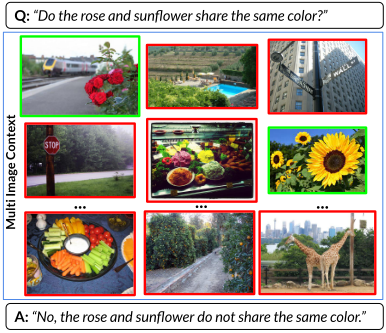
For RETVQA, the input is a pool of images with only a few images being relevant to the question. Close to our setting, there is some exciting progress in the recent literature [Talmor et al., 2021; Bansal et al., 2020; Singh et al., 2021; Chang et al., 2022]. However, these works assume one or more of the following constraints: "without requiring explicit retrieval", "having classification-type fixed-vocabulary answers", "assuming the availability of meta-data like WikiEntities, captions", "having a homogeneous yet limited number of images in the pool", and "having only a small set of questions that need multiple images". Such constraints in the existing datasets point towards a need for a large-scale benchmark to study RETVQA. To this end, we present a derived dataset prepared from Visual Genome [Krishna et al., 2017], leveraging its questions and annotations of images. We curate questions under different categories: (i) common attributes such as color, shape, and count, (ii) other object-attributes that include non-common attributes, e.g. length, material, and (iii) subject-object relationships, e.g., 'eats', 'left of'. Further, to facilitate benchmarking capabilities of the VQA models over open-ended answers, we curate questions under binary (yes/no) and open-ended answer categories. Note that the answers are free-form fluent in both the answer categories, e.g. 'No, rose and sunflower do not share the same color' (a binary answer); 'The color of rose and sunflower is red and yellow, respectively' (an open-ended generative answer). RETVQA dataset statistics and distribution across the question-answer categories are shown in Table 1 and Table 2, respectively.
| Measurement | Value |
|---|---|
| #Distinct questions | 418K |
| #Distinct precise answers | 16,205 |
| Train set questions | 334K (80%) |
| Val set questions | 41K (10%) |
| Test set questions | 41K (10%) |
| Avg question length (words) | 8.7 |
| Avg answer length (words) | 8.5 |
| #Distinct words in questions | 10,868 |
| #Distinct words in answers | 9,278 |
| #Avg relevant images per question | 2 |
| #Avg irrelevant images per question | 24.5 |
Further, to solve the RETVQA task, a model must first retrieve the relevant images for the question and then consume the retrieved images as the context to answer the question. Towards this end, we present a unified Multi Image BART that takes in the question along with the multi-image context retrieved using a relevance encoder to generate the free-form fluent natural-language answer. Our proposed framework, MI-BART, allows joint reasoning over multiple retrieved images along with the question to capture better semantics.
To summarize, our contributions are as follows: (i) We present RETVQA, a 20× larger dataset than the closest dataset [Chang et al., 2022] in this setting. RETVQA dataset is prepared by leveraging questions and image annotations from Visual Genome. It emphasizes on multi-image, metadata-independent questions over a pool of heterogenous collections of images, expecting a mix of classificationoriented and generative answers. We strongly believe that the proposed task, curated dataset and benchmarks presented in this paper will pave the way for further research. (ii) We present Multi Image BART (MI-BART) - a unified method that reasons jointly over the retrieved multi-image context along with the question to generate a free-form fluent answer for the question. (iii) We perform extensive experiments to evaluate the performance of our proposed framework on RETVQA and the image segment of WebQA. Our approach clearly outperforms baseline approaches on RETVQA dataset and achieves state-of-the-art performance on the image segment of WebQA. We make our data and implementation publicly available. 1
| Question Category | Binary | Open-ended | Total |
|---|---|---|---|
| Color | 50K | 50K | 100K |
| Shape | 49K | 50K | 99K |
| Count | 50K | 50K | 100K |
| Object-attributes | 80K | - | 80K |
| Relation-based | - | 38K | 38K |
| Total | 229K | 188K | 418K |
2 RelatedWork
Visual and Multi-modal QA. Visual Question Answering (VQA) aims at answering a natural language question in the context of a relevant image [Antol et al., 2015]. This area has seen significant progress partly due to the introduction of several challenging datasets [Malinowski et al., 2015; Ren et al., 2015a; Zhu et al., 2016; Antol et al., 2015; Goyal et al., 2017; Johnson et al., 2017; Krishna et al., 2017]. Most methods for VQA either use a multimodal fusion of language and image embeddings [Ren et al., 2015a; Gao et al., 2015; Noh et al., 2016; Kembhavi et al., 2017], attention-based multimodal fusion [Yang et al., 2016; Fukui et al., 2016; Shih et al., 2016; Lu et al., 2016; Xiong et al., 2016] or neural module networks [Andreas et al., 2016; Hu et al., 2017]. More recently, knowledge-based VQA [Shah et al., 2019; Marino et al., 2019] has gained attention where external knowledge is used for answering visual questions. Contrary to these exciting works in VQA literature, our problem setting is distinctively different as we need to mine the answer from a collection of relevant as well as irrelevant images.
Sharing a similar motivation as ours, the following tasks and accompanying datasets have been recently introduced in the literature: (i) MultimodalQA [Talmor et al., 2021], (ii) ISVQA [Bansal et al., 2020], and (iii) WebQA [Chang et al., 2022]. In MultimodalQA [Talmor et al., 2021], only a small part of the dataset (ImageListQ) is relevant to our setting; however, even on this subset, MultimodalQA assumes the availability of extra image metadata, i.e., table or WikiEntity linkage. Similarly, in ISVQA [Bansal et al., 2020], every question has a small set of homogeneous images as context. Since images are homogeneous, there is no need for explicit retrieval. Recently, WebQA [Chang et al., 2022] dataset has been proposed to target such practical QA scenarios, where a question has to be answered in the context of multimodal sources; however, the images in the dataset have associated captions. All of these settings have differences from RETVQA in either usage of additional context, constraints on images in the collection, answer schema, or classification instead of generation. In another recent work MIMOQA [Singh et al., 2021], only extractive question answering is performed. In terms of reasoning on more than one image, another related work is NLVR [Suhr et al., 2019]. However, it does not involve any retrieval and open-ended answer generation. Further, in terms of QA over multiple document images or video frames, related works are DocVQA [Tito et al., 2021] and VideoQA [Lei et al., 2018; Lei et al., 2020; Tapaswi et al., 2016]. DocVQA focuses on text-heavy document images, limiting visual reasoning, whereas the VideoQA task does not involve explicit retrieval and open-ended answer generation. Contrary to these works, our newly curated dataset is significantly larger, has no assumption of meta-data availability, and requires retrieval and reasoning over multiple images to arrive at an answer.
1 https://vl2g.github.io/projects/retvqa/
| Dataset | #Questions | Retrieval required | Heterogenous images | Multi-image reasoning | No Meta-data assumption | Answer type | %of questions that need multiple images |
|---|---|---|---|---|---|---|---|
| MultimodalQA [Talmor et al., 2021] | 2K | ✗ | ✗ | ✓ | ✗ (WikiEntities) | Classification | 6.1% |
| ISVQA [Bansal et al., 2020] | 141K | ✗ | ✗ | ✓ | ✓ | Classification | 33% |
| WebQA [Chang et al., 2022] | 18K | ✓ | ✓ | ✓ | ✗ (Captions) | Open-ended | 44% |
| RETVQA (Ours) | 327K | ✓ | ✓ | ✓ | ✓ | Open-ended | 100% |
Multi-modal modeling. Recently, multi-modal transformers such as VisualBERT [Li et al., 2019], VilBERT [Lu et al., 2020], VILT [Kim et al., 2021], LXMERT [Tan and Bansal, 2019], OSCAR [Li et al., 2020], UNITER [Chen et al., 2020] have shown strong results on the downstream vision and language tasks. However, these encoder-based models are more suited for classification-style VQA settings. Multimodal transformers like VLP [Zhou et al., 2020] and VLBart [Cho et al., 2021] are pre-trained with sequence-tosequence objectives and hence are more suitable for the current setting that requires the model to generate free-form natural language answers. We follow a similar approach by devising an encoder-decoder framework to jointly reason over multiple images along with the question.
3 RETVQA Dataset
Traditionally, VQA datasets [Antol et al., 2015; Goyal et al., 2017; Singh et al., 2019; Talmor et al., 2021] assume that the context provided is always relevant to the question. Recently, [Chang et al., 2022] proposed a benchmark where given a question and a pool of multimodal sources (containing both image and text snippets as context), only a few of these sources are relevant to the question. Similar to our problem setup, it requires first retrieving the relevant context and then using it to answer the question. However, after carefully observing the WebQA dataset, we found that most questions include rare entities like 'Maracana Stadium', 'Minnetonka Rhododendron', etc. Such questions make the retrieval task of the problem non-trivial without auxiliary information about these images. Methods proposed in [Chang et al., 2022] leverage metadata like image captions, which contain information like the name of the entity in the image. Further, a rule-based retrieval using word overlap of the question with the image caption for the retrieval task has an F1 score of 37, asserting our claim that retrieval is over-dependent on image metadata and not significantly on visual data. Further, the image-based subset of WebQA has a majority of samples (55.6%) with one relevant image per question, thereby, a single image VQA method may perform equally well given the relevant image is retrieved.
To overcome such limitations, we curate a dataset RETVQA from Visual Genome, where we emphasize multiimage, metadata-independent questions over a pool of heterogeneous images, expecting a mix of classification-oriented and open-ended generative answers. We leverage questionanswer and object annotations of Visual Genome to curate the dataset. We curate truly multi-image questions spanning over five different categories, namely, color, shape, count, objectattributes, and relation-based. For each question category, we curate binary-generative and open-ended generative answers. Dataset statistics are shown in Tables 1 and 2.
The questions in RETVQA are curated as follows. We start by extracting subjects and relations of the existing questionanswer pairs from Visual Genome; for example, consider these two question-answer pairs: q1 (over image I1): "What is the cow eating in the image?" where the answer is a1: "grass"; and, q2 (over image I2): "what is the sheep eating?" where the answer is a2: "grass". Given q1 and q2, we extract subjects ("cow" and "sheep"), relations ("eating (eat/eats)"), and then we frame combined questions using templates (over images I1 and I2) as follows. q3: "what else eats the same thing as cow does?" with answer a3: "sheep eats the same thing as cow". Another question could be q4: "Does cow and sheep eat the same thing?" where the answer is a4: "Yes, cow and sheep eat the same thing". Thus, we curate binarygenerative (like q4) and open-ended generative (like q3) types of answers. We further associate negative images for each of the curated questions using their object annotations as follows. A negative image is one where both the subject and object (used to generate the question) do not exist together in the image. This enforces that the answer has to be inferred only when all the relevant images are correctly retrieved and the negatives serve as sufficiently hard negatives.
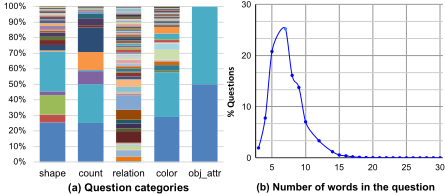
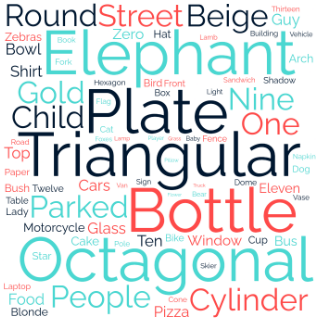
We use a random 80%-10%-10% train-validation-test split. All the questions in our dataset have at least two relevant images and 24.5 irrelevant images on average. A comparison with the other relevant datasets is shown in Table 3. Further, Figure 2 shows the distribution of unique answers across question types and question length distribution. Figure 3 shows the word cloud of top-80 frequent answers. We observe that most questions are in the 5-10 words range, and there is no noticeable bias towards the majority of answers in the dataset.
4 Retrieval QAMethodology
4.1 RETVQA ProblemFormulation
The RETVQA problem is defined as follows. Given a natural language question Q, a set of N heterogeneous images I = {I1, I2, . . . , IN}, the task is to generate an answer (A) for the question Q based on I where only a few images are relevant for the question. To answer the question Q using I, we need a method that retrieves the relevant images I r ⊆ I and then leverages the retrieved context I r . Accordingly, our labelled dataset consists of quadruplets (Q, I, I r , A).
4.2 RETVQA Framework
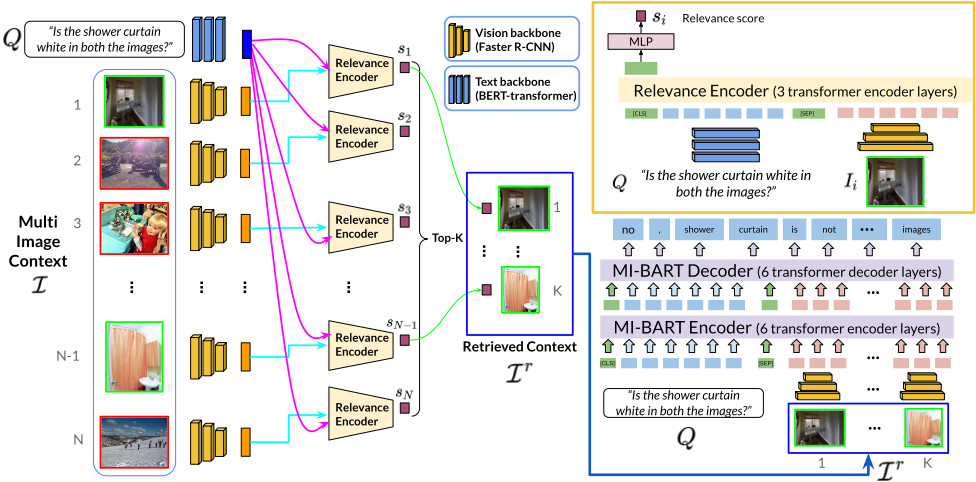
The proposed framework solution: (i) multi-modal relevance encoder for retrieval of relevant sources I r from I for the given question Q and (ii) a unified Multi Image BART (MIBART) to generate fluent free-form natural language answer for the question Q using the retrieved images I r as context.
Image representation. Inspired by recent vision-language pretraining literature [Li et al., 2019; Chen et al., 2020; Li et al., 2020], for every image Ii in I where i ∈ {1, 2, . . . ,N}, we first detect a fixed set of P objects using Faster R-CNN [Ren et al., 2015b] pretrained on Visual Genome [Krishna et al., 2017]. For every object p, where p ∈ {1, 2, . . . ,P}, we obtain 2048-dimensional regional feature oreg p and 4-dimensional bounding box co-ordinates obbox p . Thereby, each image Ii is represented by a set of P object proposals {(oreg , obbox )p}i. Following [Li et al., 2019], for every region p we project both 2048-dimensional regional representation and 4-dimensional bounding box coordinates into the d-dimensional space using a linear projection to obtain {op}i and then concatenate across all regions within the image to obtain image embedding oi as follows.
Question representation. We encode the textual question Q containing M words using a pretrained BERT [Devlin et al., 2019]. This results into a sequence q of M d-dimensional vectors, q = {qm} where m ∈ {1, 2, . . . ,M}. Note that if any additional metadata is available (e.g. captions in WebQA dataset), we augment it to the question.
4.3 Multimodal Relevance Encoder for Image Retrieval
Pretraining. Our multi-modal Relevance Encoder (RE) consists of three transformer encoder layers followed by a multi-layered perceptron (MLP) with a sigmoid unit over the final representation of the [CLS] token. We pretrain our relevance encoder on MS-COCO [Lin et al., 2014] using two unsupervised objectives, Image Text Matching (ITM) and Masked Language Modelling (MLM) similar to [Li et al., 2019].
Question-Image relevance learning. Each sample in our dataset contains a question Q and N images I1, I2, . . . , IN of which some have been labelled as positive and others negative. Further, for each image, we have P regions. We use each question-image pair (Q, Ii) to learn question-image relevance using our multi-modal Relevance Encoder (RE). Our pretrained multi-modal relevance encoder is fed with question-image pairs, along with two special tokens, [CLS] and [SEP]; in short, the input to our relevance encoder is [[CLS], {q1, q2, . . . , qm}, [SEP], {o1i, o2i, . . . , opi }]. Our encoder then allows the input M + P + 2 token sequence of question-image features to attend to each other and produces a sequence of contextualized embeddings. The d-dimensional contextualized embedding of [CLS] token is further fed to an MLP with a sigmoid unit to produce a relevance score (ˆ si) between 0 and 1 (Eq. 3), indicating whether the given question-image pair (Q, Ii) is relevant or not. We finetune our multi-modal relevance encoder parameters ϕ by minimizing binary cross-entropy loss LREL(ϕ) (Eq. 4).
Given a question Q and a set of N images I sampled from our dataset D, we obtain relevance scores S = {ˆ si}Ni=1 for each question-image pair (Q, {Ii}Ni=1 ) using our fine-tuned relevance encoder (Eq.5). To choose the final set of relevant images I r from the pool of images I, we rank all the images in the pool using S and choose top-K images as our relevant context I r for the given question Q (Eq. 6).
4.4 Multi Image BART for Question Answering
Given the question and the retrieved images I r , the goal of MI-BART is to generate an accurate yet fluent free-form natural language answer for the question. Towards this end, we propose an encoder-decoder architecture similar to SimVLM [Wang et al., 2022]. MI-BART encoder is a stack of six transformer layers [Vaswani et al., 2017], where each transformer layer comprises a self-attention layer, followed by a fully connected linear layer with a residual connection. Similarly, the MI-BART decoder is also a stack of six transformer layers [Vaswani et al., 2017], with an additional crossattention layer in each transformer layer. We concatenate question embedding q with image embeddings of each image Ik in I r with a special token [SEP] in between. Also, to distinguish the image features belonging to different images in the retrieved image set I r , we assign image order ids to image features from different images. Note that image order ids are not meant for assigning a sequence number to images in the retrieved set. Their sole purpose is to differentiate image features from different images. In short, the input to our MI-BART encoder is [[CLS], {q1, q2, . . . , qm}, [SEP], {o1, o2, . . . , op}1, [SEP], . . . , {o1, o2, . . . , op}k], where m ∈ {1, 2, . . . ,M}, p ∈ {1, 2, . . . , P} and k ∈ {1, 2 . . . ,K}. These inputs attend over each other through various self-attention layers of the MI-BART encoder and produce a sequence of contextualized embeddings z = {zj}, where j ∈ {1, 2, . . . ,M + (P × k) + k} (Eq. 7).
MI-BART decoder auto-regressively predicts the probability of the next token At in the answer A by attending to these encoder outputs z and previously generated answer tokens a<t through cross-attention and self-attention layers, respectively (Eq. 8). We train MI-BART decoder parameters θ by minimizing the generative loss LGEN(θ) for generating the target answer token conditioned on the question Q and retrieved image context I r (Eq. 9). During training, we leverage the ground truth relevant images as retrieved image context I r , while during inference, we obtain it from our relevance encoder.
To summarize, our proposed framework works as follows, given a question Q and a pool of N images I, we (i) obtain question-image relevance scores S for each question-image (Q, Ii) pair in (Q, I) using our multimodal relevance encoder, (ii) rank all images in the pool based on S, and choose top-K images as retrieved images context I r , and (iii) question Q along with the retrieved image context I r is fed to MI-BART which encodes the provided context and generates the free-form natural language answer A to the question Q.
| RETVQA | WebQA | |||||||||||
|---|---|---|---|---|---|---|---|---|---|---|---|---|
| Oracle Images | Retrieved Images | Oracle Images | Retrieved Images | |||||||||
| Method | Acc. | F | F×A | Acc. | F | F×A | Acc. | F | F×A | Acc. | F | F×A |
| Popularity-based Baselines | ||||||||||||
| Global popularity | 27.4 | 14.5 | 7.9 | 36.2 | 16.7 | 9.8 | 17.7 | 1.3 | 0.4 | 17.7 | 1.3 | 0.4 |
| Per-category popularity | 27.8 | 16.0 | 7.6 | 27.8 | 16.0 | 7.6 | 25.2 | 1.3 | 0.5 | 25.2 | 1.3 | 0.5 |
| Other Baseline Approaches | ||||||||||||
| Question only | 62.4 | 15.3 | 10.4 | 62.4 | 15.3 | 10.4 | 22.2 | 34.9 | 13.4 | 22.2 | 34.9 | 22.2 |
| Aggregate VQA | 69.2 | 17.1 | 13 | 66.6 | 16.2 | 11.9 | * | * | * | * | * | * |
| VLP [Zhou et al., 2020] | 65.1 | 70.2 | 58.8 | 65.1 | 70.2 | 58.8 | 45.7 | 42.2 | 25.9 | 44.2 | 38.9 | 24.1 |
| MI-BART (Ours) | ||||||||||||
| Image stitchMI-BART | 78.2 | 74.7 | 70.7 | 72.1 | 76.6 | 66.8 | 49.6 | 50.5 | 27.5 | 49.1 | 50.3 | 27.4 |
| MI-BART | 84.2 | 85.6 | 79.8 | 76.5 | 79.3 | 70.9 | 49.8 | 51.1 | 28.1 | 48.7 | 50.7 | 27.6 |
| Color | Shape | Count | Object-attributes | Relation-based | |||||||||||
|---|---|---|---|---|---|---|---|---|---|---|---|---|---|---|---|
| Method | Acc. | F | F×A | Acc. | F | F×A | Acc. | F | F×A | Acc. | F | F×A | Acc. | F | F×A |
| Popularity-based Baselines | |||||||||||||||
| Global popularity | 25.4 | 8.2 | 0.6 | 24.5 | 9.2 | 1.3 | 25.6 | 13.4 | 6.7 | 49.5 | 35.2 | 30.5 | 0.0 | 4.8 | 0.0 |
| Per-category popularity | 25.3 | 9.1 | 0.5 | 24.5 | 9.2 | 1.3 | 24.5 | 14.4 | 4.5 | 49.5 | 35.2 | 30.5 | 6.0 | 15.6 | 2.3 |
| Other Baseline Approaches | |||||||||||||||
| Question-only | 58.0 | 12.2 | 6.1 | 86.9 | 13.3 | 11.8 | 51.6 | 15.3 | 9.6 | 74.9 | 21.8 | 18.3 | 12.4 | 14.7 | 4.1 |
| Aggregate VQA | 60.1 | 12.4 | 6.7 | 91.3 | 14.4 | 13.5 | 54.6 | 15.6 | 10.3 | 75.4 | 21.9 | 18.6 | 32.2 | 20.8 | 11.9 |
| VLP [Zhou et al., 2020] | 62.0 | 67.3 | 52.8 | 84.0 | 81.0 | 75.7 | 50.8 | 70.0 | 50.8 | 76.8 | 78.2 | 74.8 | 36.8 | 33.8 | 18.5 |
| MI-BART (Ours) | |||||||||||||||
| Image stitchMI-BART | 71.8 | 76.8 | 63.7 | 96.2 | 94.4 | 91.1 | 62.7 | 80.1 | 62.6 | 81.6 | 87 | 81.4 | 52.0 | 39.5 | 26.4 |
| MI-BART | 72.1 | 75.7 | 63.9 | 92.4 | 90.3 | 87.7 | 66.0 | 80.0 | 66.0 | 78.5 | 83.4 | 78.4 | 69.5 | 50.4 | 43.1 |
4.5 Image-stitchMI-BART
Inspired by [Bansal et al., 2020], we consider stitching the retrieved images along the width into a single joint image and use single image VQA on this joint image. We use our proposed MI-BART for this baseline; however, we feed the stitched joint image instead of feeding K images. While the MI-BART combines information across images in the embedding space, the image-stitch MI-BART combines information across images in the input space.
5 Experiments and Results
We conduct our experiments on RETVQA as well as on WebQA. Since our task deals with the image set as a given context, we consider the image-only subset of the WebQA dataset. Following [Chang et al., 2022], we use accuracy (A), fluency (F), and F ×A, as metrics to evaluate the generated answers. Accuracy validates whether the correct answer is present in the generated answer, whereas fluency measures the quality of the answer paraphrase. Fluency is computed using a recently proposed natural language generation metric called BARTScore [Yuan et al., 2021]. Further, an F1 score is used for retrieving relevant images from a pool of images.
5.1 Baselines, Ablations and Implementation Details
Baselines. We compare our proposed method (MI-BART) and its variant image-stitch MI-BART with the following baselines: (i) Popularity-based Baselines: To check for prior biases associated with frequent answers globally or per question category, we use two popularity-based baselines. (a) Global popularity: the most frequent answer in the training set is always considered as the answer by the model, and (b) Per-category popularity: the most frequent answer for each question category is always considered the answer for questions in the corresponding question category. (ii) Aggregate VQA: RETVQA task involves VQA over multiple images. In the Aggregate VQA baseline, we use the traditional singleimage VQA method [Antol et al., 2015] for each image and aggregate the results. Given a question Q and its corresponding K retrieved images, I r from our relevance encoder, we feed each retrieved image along with the question Q to a single image VQA model to get a joint representation. We concatenate joint representations of all retrieved images into a single representation F and feed to a linear layer (MLP) to predict the final answer, i.e., A = MLP(F). Since traditional VQA methods follow a classification-style answer prediction approach, we use the 1000 most frequent answers as
| Binary | Open-ended | |||||
|---|---|---|---|---|---|---|
| Method | Acc. | F | F×A | Acc. | F | F×A |
| Popularity-based Baselines | ||||||
| Global popularity | 49.9 | 17.3 | 14.3 | 0.0 | 11.1 | 0.0 |
| Per-category popularity | 49.5 | 17.1 | 13.3 | 1.2 | 14.6 | 0.5 |
| Other Baseline Approaches | ||||||
| Question-only | 74.2 | 11.5 | 9.2 | 48 | 20 | 12 |
| Aggregate VQA | 75.6 | 11.5 | 9.5 | 55.5 | 22 | 14.9 |
| VLP [Zhou et al., 2020] | 73.2 | 80 | 72.5 | 55.1 | 58.2 | 42 |
| MI-BART (Ours) | ||||||
| Image stitch MI-BART | 80.4 | 88.3 | 80.3 | 69.4 | 70.2 | 57 |
| MI-BART | 78.7 | 85.6 | 78.7 | 73.7 | 71.7 | 61.5 |
Question: What else eats same thing as brown horse ?
| Retrieval | Acc. | F | F×A |
|---|---|---|---|
| Top-1 retrieved image | 59.8 | 61.1 | 48.8 |
| All retrieved images | 76.5 | 79.3 | 70.9 |
Table 7: MI-BART performance on RETVQA using different retrieval strategies.
classes in the softmax layer. To generate a fluent answer, we prepend the predicted answer to the question after removing the first word from the question. This baseline is not benchmarked on the WebQA dataset, as the dataset does not provide precise answer annotations for the trainset questions. (iii) VLP: As the RETVQA task requires the model to generate the text, encoder-only multimodal transformer models like ViLBERT [Lu et al., 2020], VisualBERT [Li et al., 2019], OSCAR [Li et al., 2020], ViLT [Kim et al., 2021] and UNITER [Chen et al., 2020] are not directly suitable. Hence, we use VLP [Zhou et al., 2020] which is a unified encoderdecoder multimodal transformer as our baseline. We finetune a pretrained VLP on our datasets for evaluation.
Ablations. We perform the following ablations to better understand the various components of our proposed model. (i) Question-only: To study the role of the images in generating accurate and fluent answers, we ignore the images and use questions only as input to our model. (ii) Single-image retrieval: To study the importance of reasoning over multiple images to generate an answer to the question, we use top-1 retrieved image as our only context instead of a multi-image context. (iii) Missing captions: To study the role of image metadata in the relevant source image retrieval and, thereby, the answer generation, we conduct experiments on WebQA without leveraging the image metadata (captions). In this ablation, we augment captions (available in WebQA) as part of the textual input in both the relevance encoder and MI-BART.
Implementation details. We have implemented our framework in PyTorch [Paszke et al., 2019] and Hugging Face's transformers [Wolf et al., 2020] library. Our relevance encoder has three transformer layers, each having eight attention heads. We pretrain our relevance encoder on MS- COCO [Lin et al., 2014] with a constant learning rate of 1e-4 using Adam optimizer [Kingma and Ba, 2015]. Using the same optimiser, we finetune the relevance encoder on both datasets with a constant learning rate of 2e-5. Our MI-BART has six standard transformer encoder layers and six standard transformer decoder layers [Vaswani et al., 2017]; we initialize our MI-BART with VLBart [Cho et al., 2021] pretrained weights to leverage the strong visual-textual learning of VLBart. We further finetune MI-BART on a multi-image QA task with a learning rate of 5e-5 using Adam optimizer with a linear warm-up of 10% of the total steps. Our relevance encoder and MI-BART were trained using 3 Nvidia RTX A6000 GPUs with a batch size of 96 and 256 while training and a batch size of 360 and 480 during testing, respectively.
| Retrieval | QA | |||
|---|---|---|---|---|
| Captions | P | R | F1 | F×A |
| w/ captions | 32.3 | 44.7 | 37.5 | 19.7 |
| w/o captions | 79.7 | 86.3 | 77.4 | 28.1 |
5.2 Results and Analysis
We conduct our experiments in two settings, namely, (i) Oracle images: Here, we use ground-truth relevant images for answer generation, and (ii) Retrieved images: Here, relevant images are retrieved using our relevance encoder. We show the results under both these settings in Table 4. We observe that the popularity-based methods perform poorly. This result is expected as popularity-based methods do not use any question or image context. Methods that involve either questions or images perform better than the popularity-based baselines. However, the question-only baseline has a F×A score of 10.4 on RETVQA, showing that image context is needed to generate accurate yet fluent answers. Transformer-based baseline VLP and image-stitch MI-BART reach a F×A score of 58.8 and 70.7 on our dataset, respectively, in the oracle setting, compared to 79.8 of our proposed MI-BART framework. Image-stitch MI-BART outperforms transformer-based VLP
by 12% on our dataset and 1.5% on the WebQA dataset, which shows that having a separate decoder in the proposed MI-BART baseline has better reasoning capabilities than a unified encoder-decoder like VLP. We further present the QA results over the retrieved images setting using our relevance encoder, which has an F1 score of 71 at the top-2. All the approaches involving image context outperform question-only baseline, emphasizing that RETVQA has a reasonable utility to develop and benchmark methods capable of jointly reasoning over multi-image context and the question.
Further, in Table 5, we show the QA results over various question categories, and in Table 6, we show the results over answer categories under the retrieved images setting. Our framework outperforms baselines, especially in questions with open-ended generative answers, which constitute nearly half of our dataset. As expected, open-ended generative questions are more challenging than binary ones. However, compared to the baselines, MI-BART provides better improvement for open-ended questions than binary ones by jointly reasoning over multi-image context. Results in Table 7 further emphasize our hypothesis of requiring multiple images to answer the given question. We show the missing caption ablation results on the image-subset of WebQA in Table 8; this result further affirms our claims that the performance of methods on the WebQA dataset depends on the image metadata like captions.
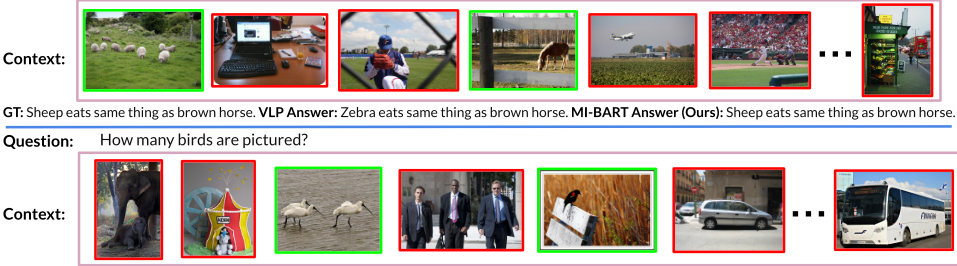
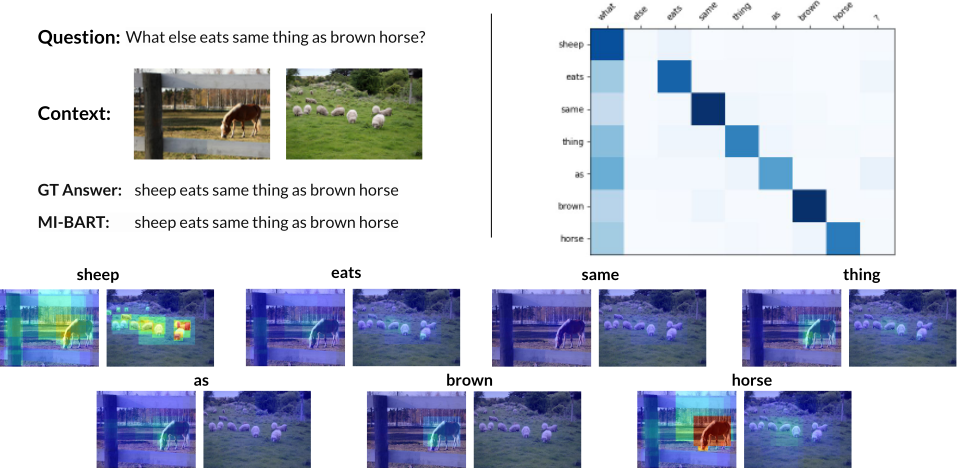
Qualitative analysis. We illustrate a selection of results using our proposed approach and one of the most competitive baselines viz. VLP in Figure 5. In both these results, our approach correctly answers the question in a large heterogeneous visual context. Further, to understand the importance of the multimodal input for question answering, we plot the multimodal attention map over the retrieved images and the question during the answer generation in Figure 6. The figure shows that our proposed MI-BART model attends to the relevant regions of both images while generating the main answer word 'sheep'. Further, we observe that it attends to brown horse regions of the first image along with the corresponding question parts while generating 'brown horse'. Thus, both images are needed and paid attention to when generating the right answer. We further conducted a detailed error analysis on 50 randomly chosen samples where our model failed to generate a correct answer. We categorize the errors into four major categories: (i) partial retrieval: images retrieved by relevance encoder are partially relevant (52%). (ii) Incorrect retrieval: images retrieved by the relevance encoder are entirely irrelevant (26%). (iii) Incorrect reasoning: model generating a partially incorrect answer despite all the retrieved images being relevant (40%).
6 Conclusion and Future Scope
In this paper, we introduced the RETVQA task. We proposed a unified Multi Image BART model to answer the question from the retrieved images using our relevance encoder. Our proposed framework shows promising improvements over the baselines. We have also performed several ablations to further understand the importance of various modules in the proposed framework. In the future, we would like to explore stronger retrieval models and QA on a large pool of images. We firmly believe RETVQA will pave the way for further research avenues in a broader theme of web image QA.
Acknowledgments
Abhirama is supported by the Prime Minister Research Fellowship (PMRF), Government of India. We thank Microsoft for supporting this work through the Microsoft Academic Partnership Grant (MAPG) 2021.
@inproceedings{ijcai2023p146,
  title     = {Answer Mining from a Pool of Images: Towards Retrieval-Based Visual Question Answering},
  author    = {Penamakuri, Abhirama Subramanyam and Gupta, Manish and Gupta, Mithun Das and Mishra, Anand},
  booktitle = {Proceedings of the Thirty-Second International Joint Conference on
               Artificial Intelligence, {IJCAI-23}},
  publisher = {International Joint Conferences on Artificial Intelligence Organization},
  editor    = {Edith Elkind},
  pages     = {1312--1321},
  year      = {2023},
  month     = {8},
  note      = {Main Track},
  doi       = {10.24963/ijcai.2023/146},
  url       = {https://doi.org/10.24963/ijcai.2023/146},
}
TY - CPAPER TI - Answer Mining from a Pool of Images: Towards Retrieval-Based Visual Question Answering AU - Penamakuri, Abhirama Subramanyam AU - Gupta, Manish AU - Gupta, Mithun Das AU - Mishra, Anand T2 - Proceedings of the Thirty-Second International Joint Conference on Artificial Intelligence, IJCAI-23 PB - International Joint Conferences on Artificial Intelligence Organization PY - 2023 SP - 1312 EP - 1321 DO - 10.24963/ijcai.2023/146 UR - https://doi.org/10.24963/ijcai.2023/146 ER -Copied
Machine-readable versions of this paper, for tools and AI agents:





