
CSGCL: Community-Strength-Enhanced Graph Contrastive Learning
Proceedings of the Thirty-Second International Joint Conference on Artificial Intelligence. Main Track. Pages 2059-2067.
https://doi.org/10.24963/ijcai.2023/229
Keywords
- Data Mining: DM: Mining graphs
- Machine Learning: ML: Self-supervised Learning
Abstract
Graph Contrastive Learning (GCL) is an effective way to learn generalized graph representations in a self-supervised manner, and has grown rapidly in recent years. However, the underlying community semantics has not been well explored by most previous GCL methods. Research that attempts to leverage communities in GCL regards them as having the same influence on the graph, leading to extra representation errors. To tackle this issue, we define ''community strength'' to measure the difference of influence among communities. Under this premise, we propose a Community-Strength-enhanced Graph Contrastive Learning (CSGCL) framework to preserve community strength throughout the learning process. Firstly, we present two novel graph augmentation methods, Communal Attribute Voting (CAV) and Communal Edge Dropping (CED), where the perturbations of node attributes and edges are guided by community strength. Secondly, we propose a dynamic ''Team-up'' contrastive learning scheme, where community strength is used to progressively fine-tune the contrastive objective. We report extensive experiment results on three downstream tasks: node classification, node clustering, and link prediction. CSGCL achieves state-of-the-art performance compared with other GCL methods, validating that community strength brings effectiveness and generality to graph representations. Our code is available at https://github.com/HanChen-HUST/CSGCL.
- [Ana and Jain, 2003] LN Fred Ana and Anil K Jain. Robust data clustering. In Proceedings of the IEEE Computer So- ciety Conference on Computer Vision and Pattern Recog- nition, pages 128-136, Madison, Wisconsin, June 2003. IEEE Computer Society.
- [Becker and Hinton, 1992] Suzanna Becker and Geoffrey E Hinton. Self-organizing neural network that discovers sur- faces in random-dot stereograms. Nature, 355(6356):161- 163, January 1992.
- [Chen et al., 2020] Ting Chen, Simon Kornblith, Moham- mad Norouzi, and Geoffrey Hinton. A simple framework for contrastive learning of visual representations. In Pro- ceedings of the 37th International Conference on Machine Learning, pages 1597-1607, Virtual Event, Vienna, Aus- tria, July 2020. PMLR.
- [Girvan and Newman, 2002] Michelle Girvan and Mark EJ Newman. Community structure in social and biological networks. Proceedings of the National Academy of Sci- ences, 99(12):7821-7826, June 2002.
- [Grover and Leskovec, 2016] Aditya Grover and Jure Leskovec. node2vec: Scalable feature learning for networks. In Proceedings of the 22nd ACM SIGKDD International Conference on Knowledge Discovery and Data Mining, pages 855-864, San Francisco, California, August 2016. Association for Computing Machinery.
- [Hassani and Khasahmadi, 2020] Kaveh Hassani and Amir Hosein Khasahmadi. Contrastive multi-view repre- sentation learning on graphs. In Proceedings of the 37th International Conference on Machine Learning, pages 4116-4126, Virtual Event, Vienna, Austria, July 2020.
- PMLR.
- [He et al., 2020] Xiangnan He, Kuan Deng, Xiang Wang, Yan Li, Yongdong Zhang, and Meng Wang. LightGCN: Simplifying and powering graph convolution network for recommendation. In Proceedings of the 43rd International ACM SIGIR Conference on Research and Development in Information Retrieval, pages 639-648, Xi'an, China, July 2020. Association for Computing Machinery.
- [Hjelm et al., 2019] R Devon Hjelm, Alex Fedorov, Samuel Lavoie-Marchildon, Karan Grewal, Phil Bachman, Adam Trischler, and Yoshua Bengio. Learning deep representa- tions by mutual information estimation and maximization. In Proceedings of the 7th International Conference on Learning Representations, New Orleans, Louisiana, May 2019.
- [Khambatti et al., 2002] Mujtaba Khambatti, Kyung Dong Ryu, and Partha Dasgupta. Peer-to-peer communities: formation and discovery. In Proceedings of the Four- teenth IASTED International Conference on Parallel & Distributed Computing & Systems, pages 161-166, Cam- bridge, Massachusetts, November 2002. ASTED/ACTA Press.
- [Kipf and Welling, 2016] Thomas N Kipf and Max Welling. Variational graph auto-encoders. CoRR, abs/1611.07308, 2016.
- [Kipf and Welling, 2017] Thomas N Kipf and Max Welling. Semi-supervised classification with graph convolutional networks. In Proceedings of the 5th International Confer- ence on Learning Representations, Toulon, France, April 2017.
- [Lee et al., 2022] Namkyeong Lee, Junseok Lee, and Chany- oung Park. Augmentation-free self-supervised learning on graphs. In Proceedings of the Thirty-Sixth AAAI Confer- ence on Artificial Intelligence, pages 7372-7380, Virtual Event, February 2022. AAAI Press.
- [Li et al., 2020] Zhao Li, Xin Shen, Yuhang Jiao, Xuming Pan, Pengcheng Zou, Xianling Meng, Chengwei Yao, and Jiajun Bu. Hierarchical bipartite graph neural networks: Towards large-scale e-commerce applications. In Proceed- ing of the 36th International Conference on Data Engi- neering (ICDE), pages 1677-1688, Dallas, Texas, April 2020. IEEE.
- [Li et al., 2022] Bolian Li, Baoyu Jing, and Hanghang Tong. Graph communal contrastive learning. In Proceedings of the 31st ACM Web Conference 2022, pages 1203-1213, Virtual Event, Lyon, France, April 2022. Association for Computing Machinery.
- [Liu et al., 2022] Yixin Liu, Ming Jin, Shirui Pan, Chuan Zhou, Yu Zheng, Feng Xia, and Philip Yu. Graph self- supervised learning: A survey. IEEE Transactions on Knowledge and Data Engineering, 2022.
- [MacQueen, 1967] J MacQueen. Classification and analy- sis of multivariate observations. In Proceedings of the 5th Berkeley Symposium on Mathematical Statistics and Prob- ability, pages 281-297, Berkeley, California, 1967. Uni- versity of California Press.
- [Newman and Girvan, 2004] Mark EJ Newman and Michelle Girvan. Finding and evaluating community structure in networks. Physical review E, 69(2):026113, February 2004.
- [Oord et al., 2018] Aaron van den Oord, Yazhe Li, and Oriol Vinyals. Representation learning with contrastive predic- tive coding. CoRR, abs/1807.03748, 2018.
- [Perozzi et al., 2014] Bryan Perozzi, Rami Al-Rfou, and Steven Skiena. DeepWalk: Online learning of social rep- resentations. In Proceedings of the 20th ACM SIGKDD In- ternational Conference on Knowledge Discovery and Data Mining, pages 701-710, New York, New York, August 2014. Association for Computing Machinery.
- [Rao et al., 2022] Jiahua Rao, Shuangjia Zheng, Sijie Mai, and Yuedong Yang. Communicative subgraph representa- tion learning for multi-relational inductive drug-gene in- teraction prediction. In Proceedings of the Thirty-First International Joint Conference on Artificial Intelligence, IJCAI-22, pages 3919-3925, Vienna, Austria, July 2022. International Joint Conferences on Artificial Intelligence Organization. IJCAI
- [Rong et al., 2020] Yu Rong, Wenbing Huang, Tingyang Xu, and Junzhou Huang. DropEdge: Towards deep graph con- volutional networks on node classification. In Proceedings of the 8th International Conference on Learning Represen- tations, Virtual Event, Addis Ababa, Ethiopia, April 2020.
- [Shchur et al., 2018] Oleksandr Shchur, Maximil- ian Mumme, Aleksandar Bojchevski, and Stephan Günnemann. Pitfalls of graph neural network evaluation. CoRR, abs/1811.05868, 2018.
- [Traag et al., 2019] Vincent A Traag, Ludo Waltman, and Nees Jan Van Eck. From Louvain to Leiden: guaranteeing well-connected communities. Scientific Reports, 9(1):1- 12, March 2019.
- [Van der Maaten and Hinton, 2008] Laurens Van der Maaten and Geoffrey Hinton. Visualizing data using t-SNE. Journal of Machine Learning Research, 9(86):2579-2605, November 2008.
- [Veličković et al., 2018] Petar Veličković, Guillem Cucurull, Arantxa Casanova, Adriana Romero, Pietro Lio, and Yoshua Bengio. Graph attention networks. In Proceed- ings of the 6th International Conference on Learning Rep- resentations, Vancouver, Canada, April 2018.
- [Veličković et al., 2019] Petar Veličković, William Fedus, William L Hamilton, Pietro Liò, Yoshua Bengio, and R Devon Hjelm. Deep graph infomax. In Proceedings of the 7th International Conference on Learning Representa- tions, New Orleans, Louisiana, May 2019.
- [Wang et al., 2017] Xiao Wang, Peng Cui, Jing Wang, Jian Pei, Wenwu Zhu, and Shiqiang Yang. Community preserv- ing network embedding. In Proceedings of the Thirty-First AAAI Conference on Artificial Intelligence, pages 203- 209, San Francisco, California, February 2017. AAAI Press.
- [Wei et al., 2022] Chunyu Wei, Jian Liang, Di Liu, and Fei Wang. Contrastive graph structure learning via informa- tion bottleneck for recommendation. In Proceedings of the 36th Conference on Neural Information Processing Systems, pages 20407-20420, New Orleans, Louisiana, November 2022.
- Curran Associates, Inc.
- [Wilcoxon, 1992] Frank Wilcoxon. Individual comparisons by ranking methods. Springer, 1992.
- [You et al., 2020] Yuning You, Tianlong Chen, Yongduo Sui, Ting Chen, Zhangyang Wang, and Yang Shen. Graph contrastive learning with augmentations. In Proceedings of the 34th Conference on Neural Information Process- ing Systems, pages 5812-5823, Virtual Event, Vancouver, Canada, December 2020.
- Curran Associates, Inc. [Zachary, 1977] Wayne W Zachary. An information flow model for conflict and fission in small groups. Journal of Anthropological Research, 33(4):452-473, Winter 1977.
- [Zhang et al., 2022] Rui Zhang, Bayu Distiawan Trisedya, Miao Li, Yong Jiang, and Jianzhong Qi. A benchmark and comprehensive survey on knowledge graph entity align- ment via representation learning. The VLDB Journal, 31(5):1143-1168, May 2022.
- [Zhao et al., 2021] Yunxiang Zhao, Jianzhong Qi, Qingwei Liu, and Rui Zhang. WGCN: Graph convolutional net- works with weighted structural features. In Proceedings of the 44th International ACM SIGIR Conference on Re- search and Development in Information Retrieval, pages 624-633, Virtual Event, Montreal, Canada, July 2021.
- [Zhou et al., 2009] Tao Zhou, Linyuan Lü, and Yi-Cheng Zhang. Predicting missing links via local information. The European Physical Journal B, 71(4):623-630, Octo- ber 2009.
- [Zhu et al., 2020] Yanqiao Zhu, Yichen Xu, Feng Yu, Qiang Liu, Shu Wu, and Liang Wang. Deep graph contrastive representation learning. In ICML Workshop on Graph Representation Learning and Beyond, Virtual Event, Vi- enna, Austria, July 2020. PMLR.
- [Zhu et al., 2021] Yanqiao Zhu, Yichen Xu, Feng Yu, Qiang Liu, Shu Wu, and Liang Wang. Graph contrastive learning with adaptive augmentation. In Proceedings of the 30th ACM Web Conference 2021, pages 2069-2080, Ljubljana, Slovenia, April 2021. Association for Computing Machin- ery. Zhu et al., 2022]
- Yun Zhu, Jianhao Guo, Fei Wu, and Sil- iang Tang. RoSA: A robust self-aligned framework for node-node graph contrastive learning. In Proceedings of the Thirty-First International Joint Conference on Arti- ficial Intelligence, IJCAI-22, pages 3795-3801, Vienna, Austria, July 2022. International Joint Conferences on Ar- tificial Intelligence Organization. IJCAI
References were extracted automatically from the PDF and may contain errors.
Full text extracted automatically from the PDF; figures, tables and equations may differ. The PDF is the version of record.
1 Introduction
Graph Representation Learning (GRL) is extensively used in knowledge graphs [Zhang et al., 2022], recommendation [He et al., 2020], e-commerce [Li et al., 2020], biological systems [Rao et al., 2022], etc. Unlike the label-dependent and noise-sensitive supervised GRL methods, Graph Contrastive Learning (GCL) [Becker and Hinton, 1992] extracts well-generalized representations between paired data views in a self-supervised manner. Many promising results from node-level GCL studies have been achieved [Veliˇckovi´c et al., 2019; Hassani and Khasahmadi, 2020; Zhu et al., 2021]. Despite their success, most of these studies hardly consider the community in GCL.
* Corresponding authors.
† Tsinghua University (www.ruizhang.info)
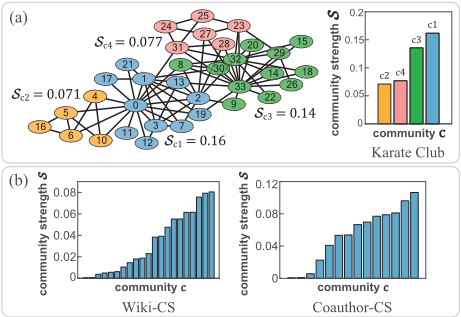
A community is a high-order structure of a graph, characterized by a denser connection among its members [Girvan and Newman, 2002]. This underlying structure is highly informative: for citation networks, communities indicate different academic fields; for co-purchase networks, communities indicate the common interests of a customer in multiple types of merchandise. Therefore, it is necessary to take into account communities in GCL. Recently, research like gCooL [Li et al., 2022] combines community detection with GCL. However, their work is built on an underlying hypothesis that different communities have the same influence on global semantics, which may lead to extra representation biases in GCL.
To tackle this issue, we hold that communities influence global semantics differently, which is vital for GCL. We define "community strength" to measure this influence of communities, and give a visualized example of community strength in Figure 1(a). Community strength, denoted as S, indicates how dense the connection of a community c is, and reflects the influence of c on the entire graph. A stricter definition can be found in Section 3.2. "Strong communities", with more densely connected edges, have a larger S (e.g. Sc1 and Sc3); "weak communities", more sparsely connected ones, have a smaller S (e.g. Sc2 and Sc4). As shown in Figure 1(b), the difference of community strength is one of the inherent features of real-world networks. Hence, community strength is of practical importance. We naturally ask: is there an effective way to leverage community strength information in GCL?
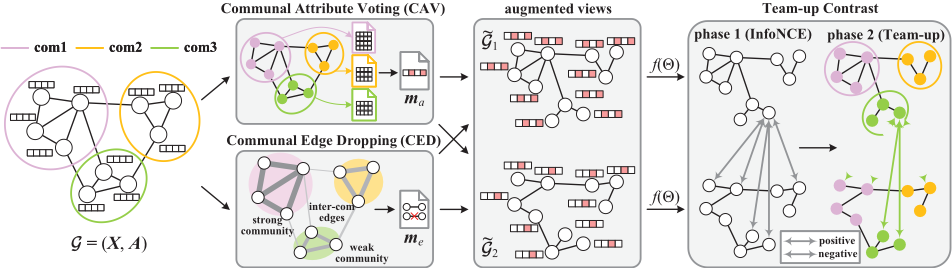
To answer this question, we propose a novel CommunityStrength-enhanced Graph Contrastive Learning (CSGCL) framework. It can capture and preserve community strength information throughout the learning process, from data augmentation to the training objective. Firstly, we put forward two novel graph augmentation approaches, Communal Attribute Voting (CAV) and Communal Edge Dropping (CED), which apply community strength respectively to every attribute and every edge to preserve the differences among communities. Secondly, we propose a dynamic "Team-up" contrastive scheme for CSGCL to progressively fine-tune the contrastive objective with community strength.
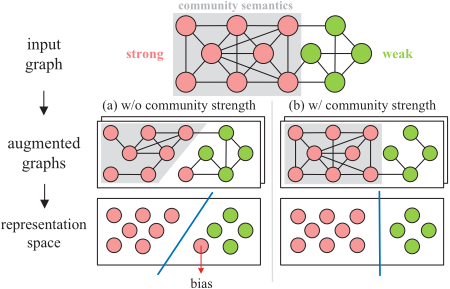
With the help of community strength, CSGCL can learn more discriminative representations, as in Figure 2. Without the consideration of community strength, every community is treated equally, which is not the case for real-world networks, so it leads to more representation biases. CSGCL takes into account community strength to handle these biases.
Our main contributions are as follows:
- We give a definition of community strength to evaluate the influence of a community. To the best of our knowledge, we are the first to manage to preserve community strength information in GCL.
- We propose two enhanced graph augmentation methods, CAV and CED, in which the perturbations of node attributes and edges are guided by community strength.
- A dynamic Team-up objective is devised, which directs the training process to preserve community strength.
- Extensive experiments on graph benchmark datasets show that CSGCL achieves state-of-the-art performance on up to three downstream tasks - node classification, node clustering, and link prediction.
2 RelatedWork
In this section, we give a brief review of traditional GRL methods, node-level GCL methods, and GCL with communities. Then, we compare CSGCL with these methods. For additional related work, see Appendix D.
2.1 Graph Representation Learning (GRL)
GRL extracts and compresses the semantic information and topological structure of a graph into low-dimensional representation vectors. Traditional methods [Perozzi et al., 2014; Grover and Leskovec, 2016] employ random walks to generate node sequences and embed them into the representation space using text encoding approaches. These methods only consider the co-occurrence of nodes. As improvements, CPNE [Wang et al., 2017] preserves community information by Non-negative Matrix Decomposition and, WGCN [Zhao et al., 2021] captures weighted structure features. An effective GRL paradigm is graph self-supervised learning [Kipf and Welling, 2016; Liu et al., 2022], which creates pretext tasks to leverage the information within data, helping the model to get rid of label dependency. However, they do not preserve community strength well in their representations.
2.2 Graph Contrastive Learning (GCL)
Shortly after the proposal of contrastive learning [Hjelm et al., 2019; Chen et al., 2020], it was introduced into the GRL field and became a new self-supervised hotspot. Most existing GCL methods [Zhu et al., 2020; Lee et al., 2022; Zhu et al., 2022; Wei et al., 2022] only focus on node-level relations. GraphCL [You et al., 2020] introduces augmentations of nodes or node pairs like DropEdge [Rong et al., 2020] and feature masking into GCL to increase the difference between two graph views. GCA [Zhu et al., 2021] further improves graph augmentation methods to adaptively capture the impact of different nodes. Outstanding as they are, they ignore the inherent community information in networks. Other works which consider the global information of graphs [Veliˇckovi´c et al., 2019; Hassani and Khasahmadi, 2020] also pay little attention to community semantics, which is discarded or undermined in node-level readout operations.
gCooL [Li et al., 2022] makes a good attempt to combine community information with GCL. It partitions communities on the representation graph and contrasts node-level and community-level representations across two different views, considering node pairs of the same community as positive samples. However, gCooL does not capture the difference between strong and weak communities. The differences between CSGCL and the aforementioned methods are that (1)
| Symbol | Description |
|---|---|
| G, ˜ G V E A, ˜A Y Z C Ec S | original & perturbed attributed graph node set of graph G edge set of graph G & perturbed node attribute matrix original & perturbed adjacency matrix labels of graph G matrix of graph G set of graph G set of a community c of strength Sc of every community c |
| M:j Mi,j d(·) T (·) 1[ex] | · | ∥ · ∥ ◦ | jth column of any matrix M element at row i and column j of any matrix M belonging to the kth view of any matrixM, k = 1, 2 degree of a node graph encoder with parameters Θ data augmentations indicator function, { 1, ex is true 0, ex is false size of a set Euclid norm |
| M(k) | |
| X, ˜X | original |
| classification representation | |
| community | |
| edge | |
| vector | |
| H | community indicator matrix |
| Mi: | ith row of any matrix M |
| f(·;Θ) | |
| Hadamard product |
CSGCL is a contrastive method taking advantage of community strength information; (2) CSGCL preserves community strength from data augmentation to model optimization.
3 Community-Strength-enhanced Graph Contrastive Learning
In this section, we illustrate and formulate the details of CSGCL. The overall architecture of CSGCL is shown in Figure 3. Notations used below are summarized in Table 1. For an intuitive workflow of CSGCL, we summarize our approaches in pseudo-codes in Appendix A.
3.1 Graph Contrastive Learning
An undirected attributed graph G = (V, E) is composed of a vertex set V and an edge set E. In a graph dataset, a graph with n nodes and d attributes is given as a node attribute matrix X ∈ Rn×d and a symmetric adjacency matrix A ∈ {0, 1}n×n , denoted as G = (X, A). For nodes u, v ∈ V, A(u,v) = 1 iff edge (u, v) ∈ E, otherwise A(u,v) = 0.
Graph Contrastive Learning aims to maximize the agreement of pairwise graph embeddings [Hjelm et al., 2019]. In general, A GCL framework is comprised of a GNN encoder, a projection head, and a contrastive loss. At the beginning of training, GCL generates two graph views ( ˜ G1, ˜ G2) by random perturbation to the input graph. Such perturbation is usually from multiple data augmentations T (G), e.g. DropEdge [Rong et al., 2020] and feature masking [Zhu et al., 2020]. Then, two views are both fed into a shared GNN encoder (like a two-layer GCN [Kipf and Welling, 2017]) to obtain node representations (but only the encoder is retained for various downstream predictions). Let Z = f ( ˜ G; Θ) be the projected embedding of ˜ G, where f is the graph encoder followed by a nonlinear projection layer. The embeddings of a certain node i in different views (Z(1) i: ,Z(2) i: ) are seen as positive pairs, and all other pairs (embeddings of different nodes in the same or different views) are seen as negative pairs.
GCL usually employs noise contrastive estimation (NCE) as the optimization objective. The most commonly used one is InfoNCE [Oord et al., 2018], which enhances the discrimination of representations by pulling similar (positive) ones together and pushing dissimilar (negative) ones away. The similarity between node pairs is calculated as
where sim(zi, zj) = (z⊤i zj)/ (∥zi∥∥zj∥) , and τ is the temperature of the similarity. Then InfoNCE is formulated as
3.2 Community-strength-enhancedAugmentations
In this section, we introduce the community-strengthenhanced augmentations: Communal Attribute Voting and Communal Edge Dropping.
Community strength. To begin with, communities in the graph are highlighted by unsupervised community detection methods. CSGCL utilizes existing community detectors so that our study can refocus attention on the communities in graph representations. We give more details of community detection methods suitable for CSGCL in Appendix D.
Let C be the set of all communities in graph G. Then, we have the definition below:
Definition 1. (Community strength S) For every community c of an undirected attributed graph G = (V, E), let |E| and |Ec| be the number of edges of the entire graph and inside that community respectively. Then, the community strength Sc of community c is formulated as follows:
which is composed of two terms: the proportion of edges inside community c, and the inter-community connection between c and other communities.
Community strength is based on modularity [Newman and Girvan, 2004], a measure of graph partition quality, which compares every community with its randomly connected counterpart, and calculates the difference in their number of edges. However, community strength is a metric of the local topological structure, while modularity is a quality metric of the entire graph. S > 0 for every community, because Sc ≤ 0 means c does not have any community characteristics.
Communal Attribute Voting (CAV). Based on the definition above, we propose CAV, a graph augmentation method based on attribute masking, which adopts community voting for attribute removal: attributes which are more influential in strong communities are better preserved, whereas less influential attributes are more likely to be voted out.
As the voting begins, a community penalty wa is assigned to every single attribute of X. Intuitively, wa reflects the odds to be removed for every attribute candidate:
where H ∈ {0, 1}n×|C| is an indicator matrix with Hi,c = 1[vi∈c] indicating to which community the ith node belongs, and ˜na(x) = (xmax - x)/(xmax - xmean) is a onedimensional normalization operation. Each node will score and vote for its redundant attributes, and the least-voted-for attributes will win a greater opportunity to be preserved.
Then, inspired by [Zhu et al., 2021], we adaptively adjust the attribute perturbation distribution using wa. Specifically, the voting results are a group of attribute masks ma independently sampled from two Bernoulli distributions:
where p(1) a and p(2) a are two hyperparameters controlling the sampling ranges. In this way, community strength is well preserved in the perturbed attribute matrices:
where ◦ is the Hadamard product.
Communal Edge Dropping (CED). The edge is the fundamental structural unit of graphs. Evolved from DropEdge [Rong et al., 2020], CED preserves community structures from perturbations guided by community strength.
The rationale for CED is that (1) intra-community edges are more important than inter-community edges, and (2) edges in strong communities are more important than those in weak communities. If there is a scoring function w(e) to calculate the weight we of each edge e ∈ Ec in the community c, it must meet the following condition:
where estrong is an intra-strong-community edge, eweak is an intra-weak-community edge with Sstrong > Sweak, and einter is an inter-community edge.
To this end, let e = (ui, uj), we formulate CED as:
where ˜ne(x) = (x - xmin)/(xmean - xmin) is a onedimensional normalization operation.
Remark 1. Theorem 1 indicates that CED is an ideal graph augmentation on edges: (1) strong communities have larger edge weights and vice versa; (2) inter-community edges have the smallest weights, which are much more likely to be dropped. Such design aims to retain real-world community properties in the perturbed graphs as much as possible.
Then, similar to CAV, the edge weight vector we is used to adjust the edge perturbation distribution:
where p(1) e and p(2) e function like p(1) a and p(2) a . In this way, community strength is well preserved in the perturbed adjacency matrices:
Up to now, two augmented graphs ( ˜ G (1) , ˜ G (2) ) have been generated by CSGCL to get embeddings.
3.3 Team-up Contrastive Learning Scheme
After obtaining the embeddings of two augmented graph views Z(1) = f( ˜ G (1) ; Θ), Z(2) = f( ˜ G (2) ;Θ), we find it necessary to teach our encoder the differences among communities, guided by a community-strength-enhanced objective.
GRL with communities is analogous to real-world social group activities. On such occasions, people tend to team up with those with whom they are familiar. A group of strangers need to communicate with one another to seek common interests before they coalesce [Khambatti et al., 2002]. Going back to the GRL scenario: at the beginning of training, nodes are unfamiliar with each other and crave for interaction with anyone within reach. As the training goes on, sufficient information exchange between nodes makes them understand their partners better. Driven by common interests, they tend to gather into groups - at this moment, the guidance of communities is indispensable for model optimization.
Inspired by this, we propose the dynamic Team-up contrastive learning scheme to learn communities more effectively. We divide CSGCL's learning process into two phases:
Individual contrast. In the first phase, themodel optimizes InfoNCE to learn initial similarities between each node individuals. The form of InfoNCE is shown in (2).
Team-up contrast. In the second phase, every similarity term s of InfoNCE is fine-tuned by community strength:
where
and Hi: is the community membership for the ith node. The latter term in (13) refers to the strength of "teams" (communities) to which the ith and jth nodes belong, and γ is a coefficient of community strength.
The final loss is a piecewise function combining the two phases above, with a dynamic change of the fine-tuned similarity ˜ s in (13):
in which γ(t) is a monotonically non-decreasing function that varies with training time t (in the units of 100 epochs). We simply consider a hard Sigmoid-shaped form for γ(t):
where t0 is the demarcation point of two phases. Thus we can unify two phases and formulate the final loss as (12)(14)(15): during the individual contrast (t ≤ t0, γ = 0), free communications are allowed between node individuals; during the Team-up contrast (t0 < t < t0 + γmax) when the nodelevel relationships are well-learned, γ rises gradually to direct the model to notice community strength; when teaming-up is complete (t ≥ t0 + γmax), we set γ ≡ γmax to prevent deviation from the contrastive objective.
4 Experiments
In this section, we describe our experiments that were conducted to evaluate our model and answer the questions below:
- Does GCL really benefit from our proposed methods? (Section 4.2).
- Is the boost to performance really given by community strength? (Section 4.3).
- How does the Team-up strength coefficient influence the performance on a certain graph? (Section 4.4).
Detailed experiment configurations can be found in Appendix C. Additional experiment results using different community detectors and metrics (micro- & macro-F1 and average precision) can be found in Appendix E.
4.1 Experiment Setup
Datasets. We use four benchmark graphs in different fields, including one directed graph: Wiki-CS; and three undirected graphs: Amazon-Computers (Computers), Amazon-Photo (Photo), and Coauthor-CS. We convert Wiki-CS to an undirected graph only during the community detection process by adding reverse edges. There is no other difference between Wiki-CS and undirected graphs for model training.
Baselines. We divide all baseline models into the following three categories:
- Traditional unsupervised models: Logistic regression (LogReg) & K-means [MacQueen, 1967] with raw features, DeepWalk [Perozzi et al., 2014] w/ or w/o the use of node attributes, node2vec [Grover and Leskovec, 2016], and CPNE [Wang et al., 2017];
- Supervised graph neural network models: GCN [Kipf and Welling, 2017] and GAT [Veliˇckovi´c et al., 2018];
- Renowned and up-to-date self-supervised GRL models: GAE & VGAE [Kipf and Welling, 2016], DGI [Veliˇckovi´c et al., 2019], MVGRL [Hassani and Khasahmadi, 2020], GRACE [Zhu et al., 2020], GCA [Zhu et al., 2021], AFGRL [Lee et al., 2022], and gCooL [Li et al., 2022].
For GCA and gCooL which have multiple model configurations, we select the best one for each dataset, marked as "- best" in the statistics.
Evaluation protocol. For node classification, we follow the evaluation protocol of [Zhu et al., 2021] which trains and tests an ℓ2-regularized logistic regression classifier with 10 random data splits (20 fixed splits for Wiki-CS). For node clustering, a K-means model [MacQueen, 1967] with fixed initial clusters is fit. For link prediction, the cosine similarity between every two nodes is calculated to evaluate the existence of a link. Each experiment is repeated 10 times to report the average performance along with the standard deviation.
Metrics. We use accuracy for node classification, normalized mutual information (NMI) [Ana and Jain, 2003] for node clustering, and area under the curve (AUC) [Zhou et al., 2009] for link prediction.
Implementation details. We choose Leiden [Traag et al., 2019] as the community detector for CSGCL, before which we pretested the community detection methods detailed in Appendix E.1. To ensure fairness, A simple two-layer GCN is employed to CSGCL as well as all other contrastive baselines. We use the Adam optimizer to optimize the model. Detailed environment configurations can be found in Appendix C.2.
| Method | Training data | Level | Wiki-CS | Computers | Photo | Coauthor-CS |
|---|---|---|---|---|---|---|
| Raw (LogReg) | X | - | 71.85±0.00 | 73.25±0.00 | 79.02±0.00 | 89.64±0.00 |
| DeepWalk (w/o X) | A | node | 73.84±0.16 | 85.77±0.58 | 89.06±0.43 | 84.71±0.35 |
| node2vec | A | node | 75.52±0.17 | 86.19±0.26 | 88.86±0.43 | 86.27±0.22 |
| DeepWalk (w/ X) | X,A | node | 77.21±0.03 | 86.28±0.07 | 90.05±0.08 | 87.70±0.04 |
| CPNE | A | community | 65.53±0.58 | 73.66±0.83 | 82.39±1.23 | OOM |
| GAE | X, A | node | 70.15±0.01 | 85.27±0.19 | 91.62±0.13 | 90.01±0.71 |
| VGAE | X, A | node | 75.63±0.19 | 86.37±0.21 | 92.20±0.11 | 92.11±0.09 |
| DGI | X, A | node | 75.35±0.14 | 83.95±0.47 | 91.61±0.22 | 92.15±0.63 |
| MVGRL | X, A | node | 77.52±0.08 | 87.52±0.11 | 91.74±0.07 | 92.11±0.12 |
| GRACE | X, A | node | 77.68±0.34 | 88.29±0.11 | 92.52±0.34 | 92.50±0.08 |
| GCA-best | X, A | node | 78.20±0.04 | 87.99±0.13 | 92.06±0.27 | 92.81±0.19 |
| AFGRL | X, A | node | 77.62±0.49 | 89.88±0.33 | 93.22±0.28 | 93.27±0.17 |
| gCooL-best | X,A | community | 78.20±0.09 | 88.67±0.10 | 92.84±0.20 | 92.75±0.01 |
| CSGCL (ours) | X,A | community | 78.60±0.13 | 90.17±0.17 | 93.32±0.21 | 93.55±0.12 |
| GCN | X, A, Y | - | 78.02±0.51 | 87.79±0.36 | 91.82±0.01 | 93.06±0.00 |
| GAT | X, A, Y | - | 77.62±0.69 | 88.64±0.63 | 92.16±0.47 | 91.49±0.30 |
| Method | Wiki-CS | Computers | Photo | Coauthor-CS |
|---|---|---|---|---|
| Raw (K-means) | 18.22±0.00 | 16.59±0.00 | 28.22±0.00 | 64.18±0.00 OOM |
| CPNE | 32.44±1.30 | 42.51±1.60 | 53.62±1.58 | |
| DGI | 31.00±0.02 | 31.80±0.02 | 37.60±0.03 | 74.70±0.01 |
| MVGRL | 26.30±1.00 | 24.40±0.00 | 34.40±4.00 | 74.00±1.00 |
| GRACE | 28.68±1.18 | 38.97±0.91 | 47.70±4.28 | 73.79±0.58 |
| GCA-best | 30.22±1.09 | 39.09±0.55 | 51.37±4.15 | 74.38±0.42 |
| gCooL-best | 30.92±1.12 | 42.70±0.96 | 58.50±2.98 | 71.42±1.16 |
| CSGCL (ours) | 32.80±1.50 | 45.09±0.95 | 58.79±2.17 | 78.29±1.24 |
| Method | Computers | Photo | Coauthor-CS |
|---|---|---|---|
| Raw | 54.58±0.00 | 60.21±0.00 | 93.69±0.00 |
| GRACE | 89.97±0.25 | 88.64±1.17 | 87.67±0.10 |
| GCA-best | 90.67±0.30 | 89.61±1.46 | 88.05±0.00 |
| gCooL-best | 90.45±0.86 | 90.83±2.05 | 88.91±0.04 |
| CSGCL (ours) | 94.95±1.70 | 91.63±1.37 | 96.45±0.15 |
| GCN | 87.89±0.90 | 88.20±0.08 | 92.71±0.63 |
| GAT | 87.60±2.23 | 89.32±2.06 | 92.80±0.75 |
4.2 Overall Performance
In this section, we discuss the overall performance of CSGCL. CSGCL is adapted to three downstream tasks: node classification and node clustering on all datasets (Table 2 and 3), and link prediction on three undirected datasets (Table 4). Some statistics are borrowed from either their original papers or [Zhu et al., 2021; Li et al., 2022]. Data components used by each method during training are shown in the "Training data" column of Table 2, including node attributes X, the adjacency matrix A, and labels Y. The representation level of each unsupervised method is listed in the "Level" column, including node-level and community-level. Bolded results in Tables 2-5 below represent the best results for each column.
We can see that CSGCL is superior to not only the traditional baselines but also the latest GCL models in all three downstream tasks. This is most noticeable in node clustering, where the NMI score of CSGCL is 1.7% higher on average than the next-best methods; for link prediction, CSGCL has a 7.5% increase of AUC on Coauthor-CS compared with other contrastive methods. CSGCL is also observed to be competitive against fully supervised models, especially on link prediction. Such achievements reveal the great generality of graph representations of CSGCL: community strength is beneficial to multiple downstream tasks on graphs.
Note that gCooL - another GCL method with communities - also achieves great performance on these tasks, which backs up the benefit of community semantics for GCL. However, gCooL does not capture the differences among communities. We conduct the one-tailed Wilcoxon signed-rank test [Wilcoxon, 1992] to further back up our improvement: taking node classification as an example, we have p = 9.77e4 < 0.05 on all datasets, indicating the acceptance of alternative hypothesis that CSGCL has significant improvements over the best model of gCooL.
| Variant | Wiki-CS | Computers | Photo | Coauthor-CS |
|---|---|---|---|---|
| CSGCL-CAV-CED-T | 77.68±0.34 | 88.29±0.11 | 92.52±0.34 | 92.50±0.08 |
| CSGCL-CED-T | 77.78±0.07 | 89.94±0.48 | 93.08±0.28 | 93.35±0.13 |
| CSGCL-CAV-T | 78.43±0.11 | 90.06±0.19 | 93.11±0.34 | 93.09±0.11 |
| CSGCL-T | 78.51±0.11 | 90.12±0.23 | 93.26±0.23 | 93.50±0.09 |
| CSGCL-S | 77.88±0.15 | 89.52±0.26 | 92.85±0.34 | 93.41±0.07 |
| CSGCL (Ours) | 78.60±0.13 | 90.17±0.17 | 93.32±0.21 | 93.55±0.12 |
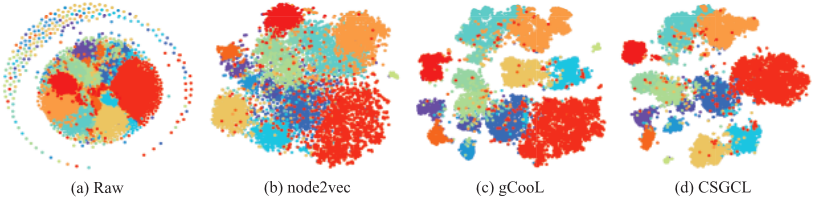
Furthermore, we visualize the graph representations of CSGCL as well as baselines by t-SNE [Van der Maaten and Hinton, 2008], a dimension reduction and visualization method. As shown in Figure 4, CSGCL learns the most discriminative graph representations among the competitive methods.
4.3 Ablation Studies
In this section, we describe the ablation studies on the key modules of CSGCL. "-CAV" and "-CED" refers to uniform attribute masking and edge dropping respectively, where the perturbation probabilities are set to the same for all attributes and edges. "-T" refers to the InfoNCE objective instead of Team-up. "-S" refers to the disregard of community strength, where every community shares the average strength S.
Table 5 verifies the effectiveness of CSGCL. The classification accuracy over all 4 datasets increases with either CAV or CED, and gains over 1% improvement on average with both. CSGCL with Team-up objective reaches the best classification performance, bringing significant improvements over CSGCL-T on three datasets with the results p = 1.37e-2, 2.78e-1, 3.71e-2, and 1.37e-2 of Wilcoxon signed-rank test in order. More importantly, the accuracy degrades without variations of community strength S. This verifies that the difference among community strength cannot be ignored.
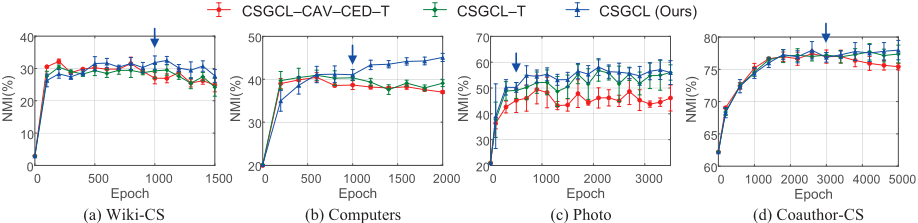
We also show that CSGCL has well preserved community semantics by carrying out community detection on the representations. Results are shown in Figure 5. The green curves (w/ CAV and CED) perform better than the red curves (w/ uniform attribute masking and edge dropping) after a period of training time, especially on Photo and CoauthorCS; CSGCL, the blue curves using the Team-up objective, performs the best among its counterparts, with the performance gaps widening in the Team-up phase, especially on Computers and Photo. This shows that our communitystrength-enhancement has better preserved community semantics throughout the learning process, which results in more accurate graph representations.
4.4 Parameter Analysis
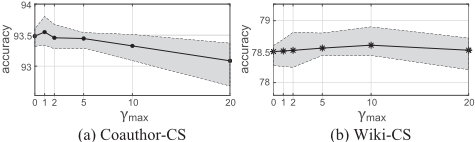
In this section, we describe the parameter analysis on the upper bound of the strength coefficient, γmax, which controls the overall influence of communities on a certain graph. All experiments below use the same training epochs and configurations. γmax is set as 0, 1, 2, 5, 10, and 20. We take Coauthor-CS and Wiki-CS as examples.
As the results in Figure 6, the accuracy of node classification is relatively stable when γmax changes in a certain range. So holistically, CSGCL is robust to the variation of γmax, but it is recommended to use the most appropriate one for each dataset to achieve better performance. The classification accuracy will decrease if γmax is too small (e.g. < 1 for Coauthor-CS), undermining the benefit of communities; however, it will also decrease if γmax is too large (e.g. > 5 for Coauthor-CS), derailing the model training.
5 Conclusion
In this paper, we present CSGCL, a novel contrastive framework enhanced by community strength throughout the learning process. Firstly, we manage to preserve differences among communities by the enhanced augmentations on attributes and edges, CAV and CED. Secondly, we put forward the dynamic Team-up contrastive scheme which regards GCL as a social group activity, guiding the optimization with community strength in a progressive manner. CSGCL achieves state-of-the-art performance on three downstream tasks: node classification, node clustering, and link prediction, indicating the effectiveness and generality of community-strengthenhanced representations.
Acknowledgments
This work is supported by National Natural Science Foundation of China under grants U1936108, U1836204, 62206102, and Science and Technology Support Program of Hubei Province under grant 2022BAA046.
Contribution Statement
The paper is co-first authored by Han Chen and Ziwen Zhao.
@inproceedings{ijcai2023p229,
  title     = {CSGCL: Community-Strength-Enhanced Graph Contrastive Learning},
  author    = {Chen, Han and Zhao, Ziwen and Li, Yuhua and Zou, Yixiong and Li, Ruixuan and Zhang, Rui},
  booktitle = {Proceedings of the Thirty-Second International Joint Conference on
               Artificial Intelligence, {IJCAI-23}},
  publisher = {International Joint Conferences on Artificial Intelligence Organization},
  editor    = {Edith Elkind},
  pages     = {2059--2067},
  year      = {2023},
  month     = {8},
  note      = {Main Track},
  doi       = {10.24963/ijcai.2023/229},
  url       = {https://doi.org/10.24963/ijcai.2023/229},
}
TY - CPAPER TI - CSGCL: Community-Strength-Enhanced Graph Contrastive Learning AU - Chen, Han AU - Zhao, Ziwen AU - Li, Yuhua AU - Zou, Yixiong AU - Li, Ruixuan AU - Zhang, Rui T2 - Proceedings of the Thirty-Second International Joint Conference on Artificial Intelligence, IJCAI-23 PB - International Joint Conferences on Artificial Intelligence Organization PY - 2023 SP - 2059 EP - 2067 DO - 10.24963/ijcai.2023/229 UR - https://doi.org/10.24963/ijcai.2023/229 ER -Copied
Machine-readable versions of this paper, for tools and AI agents:





