
Adaptive Path-Memory Network for Temporal Knowledge Graph Reasoning
Proceedings of the Thirty-Second International Joint Conference on Artificial Intelligence. Main Track. Pages 2086-2094.
https://doi.org/10.24963/ijcai.2023/232
Keywords
- Machine Learning: ML: Sequence and graph learning
- Knowledge Representation and Reasoning: KRR: Learning and reasoning
- Data Mining: DM: Knowledge graphs and knowledge base completion
Abstract
Temporal knowledge graph (TKG) reasoning aims to predict the future missing facts based on historical information and has gained increasing research interest recently. Lots of works have been made to model the historical structural and temporal characteristics for the reasoning task. Most existing works model the graph structure mainly depending on entity representation. However, the magnitude of TKG entities in real-world scenarios is considerable, and an increasing number of new entities will arise as time goes on. Therefore, we propose a novel architecture modeling with relation feature of TKG, namely aDAptivE path-MemOry Network (DaeMon), which adaptively models the temporal path information between query subject and each object candidate across history time. It models the historical information without depending on entity representation. Specifically, DaeMon uses path memory to record the temporal path information derived from path aggregation unit across timeline considering the memory passing strategy between adjacent timestamps. Extensive experiments conducted on four real-world TKG datasets demonstrate that our proposed model obtains substantial performance improvement and outperforms the state-of-the-art up to 4.8% absolute in MRR.
- [Bordes et al., 2013] Antoine Bordes, Nicolas Usunier, Alberto Garcia-Duran, Jason Weston, and Oksana Yakhnenko. Translating embeddings for modeling multi-relational data. Advances in neural information processing systems, 26, 2013.
- [Boschee et al., 2015] Elizabeth Boschee, Jennifer Lauten- schlager, Sean O'Brien, Steve Shellman, James Starz, and Michael Ward. ICEWS Coded Event Data, 2015.
- [Corso et al., 2020] Gabriele Corso, Luca Cavalleri, Do- minique Beaini, Pietro Liò, and Petar Veličković. Principal neighbourhood aggregation for graph nets. Advances in Neural Information Processing Systems, 33:13260-13271, 2020.
- [Dasgupta et al., 2018] Shib Sankar Dasgupta, Swayambhu Nath Ray, and Partha Talukdar. Hyte: Hyperplane-based temporally aware knowledge graph embedding. In Proceedings of the 2018 conference on empirical methods in natural language processing, pages 2001-2011, 2018.
- [Dettmers et al., 2017] T. Dettmers, P. Minervini, P. Stene- torp, and S. Riedel. Convolutional 2d knowledge graph embeddings. In 32nd AAAI Conference on Artificial Intel- ligence (AAAI-18), 2-7 February 2018, New Orleans, LA, USA, 2017.
- [Galárraga et al., 2013] Luis Antonio Galárraga, Christina Teflioudi, Katja Hose, and Fabian Suchanek. Amie: as- sociation rule mining under incomplete evidence in onto- logical knowledge bases. In Proceedings of the 22nd inter- national conference on World Wide Web, pages 413-422, 2013.
- [Garcia-Duran et al., 2018] Alberto Garcia-Duran, Sebasti- jan Dumančić, and Mathias Niepert. Learning sequence encoders for temporal knowledge graph completion. In Proceedings of the 2018 Conference on Empirical Meth- ods in Natural Language Processing, pages 4816-4821, 2018.
- [Goel et al., 2020] R. Goel, S. M. Kazemi, M. Brubaker, and P. Poupart. Diachronic embedding for temporal knowl- edge graph completion. In Proceedings of the AAAI con- ference on artificial intelligence, volume 34, pages 3988- 3995, 2020.
- [Han et al., 2020] Zhen Han, Peng Chen, Yunpu Ma, and Volker Tresp. Explainable subgraph reasoning for fore- casting on temporal knowledge graphs. In International Conference on Learning Representations, 2020.
- [Han et al., 2021] Zhen Han, Zifeng Ding, Yunpu Ma, Yu- jia Gu, and Volker Tresp. Learning neural ordinary equa- tions for forecasting future links on temporal knowledge graphs. In Proceedings of the 2021 Conference on Em- pirical Methods in Natural Language Processing, pages 8352-8364, 2021.
- [Jin et al., 2019] Woojeong Jin, Meng Qu, Xisen Jin, and Xi- ang Ren. Recurrent event network: Autoregressive struc- ture inference over temporal knowledge graphs. arXiv preprint arXiv:1904.05530, 2019.
- [Jin et al., 2020] Woojeong Jin, Meng Qu, Xisen Jin, and Xiang Ren. Recurrent event network: Autoregressive structure inference over temporal knowledge graphs. In EMNLP, 2020.
- [Kingma and Ba, 2014] Diederik P Kingma and Jimmy Ba. Adam: A method for stochastic optimization. arXiv preprint arXiv:1412.6980, 2014.
- [Lacroix et al., 2020] T. Lacroix, G. Obozinski, and N. Usunier. Tensor decompositions for temporal knowl- edge base completion. arXiv preprint arXiv:2004.04926, 2020.
- [Leblay and Chekol, 2018] J. Leblay and M. W. Chekol. De- riving validity time in knowledge graph. In Companion of the the Web Conference, pages 1771-1776, 2018.
- [Leetaru and Schrodt, 2013] Kalev Leetaru and Philip A Schrodt. Gdelt: Global data on events, location and tone, 1979-2012. In ISA annual convention, volume 2, pages 1-49. Citeseer, 2013.
- [Li et al., 2021] Zixuan Li, Xiaolong Jin, Wei Li, Saiping Guan, Jiafeng Guo, Huawei Shen, Yuanzhuo Wang, and Xueqi Cheng. Temporal knowledge graph reasoning based on evolutional representation learning. In Proceedings of the 44th International ACM SIGIR Conference on Re- search and Development in Information Retrieval, pages 408-417, 2021.
- [Li et al., 2022] Yizhi Li, Wei Fan, Chao Liu, Chenghua Lin, and Jiang Qian. TranSHER: Translating knowledge graph embedding with hyper-ellipsoidal restriction. In Proceed- ings of the 2022 Conference on Empirical Methods in Nat- ural Language Processing, pages 8517-8528, Abu Dhabi, United Arab Emirates, December 2022. Association for Computational Linguistics.
- [Mahdisoltani et al., 2014] F. Mahdisoltani, J. Biega, and F. Suchanek. Yago3: A knowledge base from multilin- gual wikipedias. In 7th biennial conference on innovative data systems research. CIDR Conference, 2014.
- [Ning et al., 2021] Zhiyuan Ning, Ziyue Qiao, Hao Dong, Yi Du, and Yuanchun Zhou. Lightcake: A lightweight framework for context-aware knowledge graph embed- ding. In Pacific-Asia Conference on Knowledge Discovery and Data Mining, 2021.
- [Qiao et al., 2020] Ziyue Qiao, Zhiyuan Ning, Yi Du, and Yuanchun Zhou. Context-enhanced entity and relation em- bedding for knowledge graph completion. arXiv preprint arXiv:2012.07011, 2020.
- [Sanchez-Gonzalez et al., 2020] Alvaro Sanchez-Gonzalez, Jonathan Godwin, Tobias Pfaff, Rex Ying, Jure Leskovec, and Peter Battaglia. Learning to simulate complex physics with graph networks. In International Conference on Ma- chine Learning, pages 8459-8468. PMLR, 2020.
- [Schlichtkrull et al., 2017] Michael Schlichtkrull, Thomas N Kipf, Peter Bloem, Rianne van den Berg, Ivan Titov, and Max Welling. Modeling relational data with graph con- volutional networks. arXiv preprint arXiv:1703.06103, 2017.
- [Shang et al., 2019] Chao Shang, Yun Tang, Jing Huang, Jinbo Bi, Xiaodong He, and Bowen Zhou. End-to- end structure-aware convolutional networks for knowledge base completion. In Proceedings of the AAAI Conference on Artificial Intelligence, volume 33, pages 3060-3067, 2019.
- [Sun et al., 2019] Z. Sun, Z. H. Deng, J. Y. Nie, and J. Tang. Rotate: Knowledge graph embedding by relational rota- tion in complex space. arXiv preprint arXiv:1902.10197, 2019.
- [Sun et al., 2021] Haohai Sun, Jialun Zhong, Yunpu Ma, Zhen Han, and Kun He. Timetraveler: Reinforcement learning for temporal knowledge graph forecasting. arXiv preprint arXiv:2109.04101, 2021.
- [Trivedi et al., 2017] Rakshit Trivedi, Hanjun Dai, Yichen Wang, and Le Song. Know-evolve: Deep temporal reason- ing for dynamic knowledge graphs. In international con- ference on machine learning, pages 3462-3471. PMLR, 2017.
- [Trouillon et al., 2016] T. Trouillon, J. Welbl, S. Riedel, Ric Gaussier, and G. Bouchard. Complex embeddings for sim- ple link prediction. JMLR.org, 2016.
- [Vashishth et al., 2019] Shikhar Vashishth, Soumya Sanyal, Vikram Nitin, and Partha Talukdar. Composition-based multi-relational graph convolutional networks. arXiv preprint arXiv:1911.03082, 2019.
- [Welling and Kipf, 2016] Max Welling and Thomas N Kipf. Semi-supervised classification with graph convolutional networks. In J. International Conference on Learning Rep- resentations (ICLR 2017), 2016.
- [Wu et al., 2020] Jiapeng Wu, Meng Cao, Jackie Chi Kit Cheung, and William L Hamilton. Temp: Temporal mes- sage passing for temporal knowledge graph completion. arXiv preprint arXiv:2010.03526, 2020.
- [Xu et al., 2020] Peng Xu, Jackie Chi Kit Cheung, and Yan- shuai Cao. On variational learning of controllable repre- sentations for text without supervision. In International Conference on Machine Learning, pages 10534-10543.
- PMLR, 2020.
- [Yang et al., 2014] Bishan Yang, Wen-tau Yih, Xiaodong He, Jianfeng Gao, and Li Deng. Embedding entities and relations for learning and inference in knowledge bases. arXiv preprint arXiv:1412.6575, 2014.
- [Ye et al., 2019] Rui Ye, Xin Li, Yujie Fang, Hongyu Zang, and Mingzhong Wang. A vectorized relational graph con- volutional network for multi-relational network alignment. In IJCAI, pages 4135-4141, 2019. IJCAI
- [Zhu et al., 2021a] Cunchao Zhu, Muhao Chen, Changjun Fan, Guangquan Cheng, and Yan Zhang. Learning from history: Modeling temporal knowledge graphs with se- quential copy-generation networks. In Proceedings of the AAAI Conference on Artificial Intelligence, volume 35, pages 4732-4740, 2021.
- [Zhu et al., 2021b] Zhaocheng Zhu, Zuobai Zhang, Louis- Pascal Xhonneux, and Jian Tang. Neural bellman-ford networks: A general graph neural network framework for link prediction. Advances in Neural Information Process- ing Systems, 34, 2021.
- [Zhu et al., 2022] Zhaocheng Zhu, Mikhail Galkin, Zuobai Zhang, and Jian Tang. Neural-symbolic models for logical queries on knowledge graphs. arXiv preprint arXiv:2205.10128, 2022.
References were extracted automatically from the PDF and may contain errors.
Full text extracted automatically from the PDF; figures, tables and equations may differ. The PDF is the version of record.
1 Introduction
Knowledge graphs (KGs) are multi-relational graphs that represent real-world facts and events. They are composed of nodes that represent entities and edges that represent the relationships between those entities. The edges are typically structured as triples in the form of (subject, relation, object), such as (Obama, visit, China). Temporal Knowledge Graphs (TKGs) are a special class of KGs that account for the temporal evolution of knowledge. Specifically, TKGs Albanese 澳大利亚总理 (下边这个精神老头)
* Corresponding author.
represent each fact as a quadruple that includes a timestamp, i.e., (subject, relation, object, timestamp), offering novel insights and perspectives on multi-relational data that varies over time. Recently, TKGs have been widely applied in a range of contexts, like policy-making, stock prediction, and dialogue systems. The task of TKG reasoning involves the inference of new facts from known ones, which can be performed under two primary settings: interpolation and extrapolation [Jin et al., 2020]. The interpolation setting seeks to fill in missing facts within a specified range of timestamps, while extrapolation attempts to predict future events based on historical knowledge [Jin et al., 2019; Trivedi et al., 2017]. This study focuses on the latter setting, specifically designing a model for the prediction of links at future timestamps.
In order to make full use of historical fact information [Sanchez-Gonzalez et al., 2020], various attempts have been made for TKG reasoning task to model the structural and temporal characteristics of TKGs. In these approaches, entities that appear throughout history are crucial components for modeling both structural and temporal characteristics: (a) For structural characteristics, the identification of the entities and their respective neighbor entities are essential, as most current models utilize structural information extracted from historical facts as the basis for TKG reasoning.
Modeling graph structures requires the use of entities (i.e., the nodes). For example, RE-NET [Jin et al., 2020] employs RGCN-based aggregator for message passing between adjacent entities, while CyGNet [Zhu et al., 2021a] introduces a copy-generation mechanism to track the distribution of historical neighbors for the query entity. (b) For temporal characteristics, entities serve as a crucial link in connecting subgraphs from different periods. Examples of this include a series of RNN-based methods that model the dynamic evolution of entities over time to describe temporal relationships [Li et al., 2021], as well as approaches such as xERTE [Han et al., 2020] and TITer [Sun et al., 2021] that use entities and their neighbor entities as bridges to weave individual subgraphs into an interlinked TKG therefore considering the temporal information. However, the magnitude of TKG entities in realworld scenarios is considerable. If all historical entities are incorporated into the model, the associated overhead would be substantial. In addition, as TKGs continue to evolve, an increasing number of new entities will arise over time. Reasoning on new entities that have not been trained in the absence of historical context also presents a complex problem.
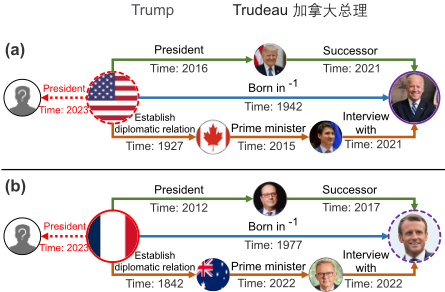
In this study, we will concentrate on the examination of temporal path as a means of utilizing historical event information in a novel and entity-independent manner. There exist numerous temporal paths following the timeline in TKGs, such as Establish Diplomatic Relation → Prime Minister → Interview With in Figure 1. By considering the whole temporal paths which exist between the query entity and any candidate entities, we are able to infer the potential relationships that may transpire between them in the future. For instance, Figure 1(a) shows a query (United States, President, ?, 2023) and the corresponding set of temporal paths between the query entity United States and a candidate entity Joe Biden, while Figure 1(b) shows another query (France, President, ?, 2023) and the corresponding set of temporal paths between the query entity France and a candidate entity Emmanuel Macron. Although the entities appearing in the history event information corresponding to these two different queries are not identical, the pattern of the same temporal paths between the query entity and the candidate entity will deduce the same conclusion. That is, the same set of temporal paths {Born In-1 , President → Successor, Establish Diplomatic Relation→Prime Minister → Interview With} between United States/France and Joe Biden/Emmanuel Macron will help get the same conclusion (United States/France, President, Joe Biden/Emmanuel Macron, 2023). It is noteworthy that the identity of the intermediate entities connected by temporal paths and whether they are new entities or pre-existing entities, has no impact on the ultimate prediction, thus rendering such a modeling approach completely entity-independent.
Therefore, we try to model all temporal paths between the query subject entity and candidate object entities and propose a novel architecture modeling with relation features over timeline. Specifically, it includes 3 components, namely, (1) PathMemory: to record the comprehensive paired representations/embeddings of all temporal paths between the query entity and any candidate entities. (2) PathAggregationUnit: to capture paired representations of paths from a subgraph of single timestamp. (3) Memory Passing Strategy: as time progresses, the representation of temporal paths in a subgraph from single timestamp is captured in a sequential manner, and is then utilized to update the stored representation of temporal paths in memory. Our main contributions are as follows:
- We propose an adaptive path-memory network for temporal extrapolated reasoning over TKGs, by collecting the path information related to specific queries, considering the structural information of subgraph and temporal characteristics among subgraph sequences.
- In order to avoid the limitations of entity-dependent model, we develop DaeMon based on the relation feature to adaptively capture the path information between entities without considering the entity representation, which is more flexible and efficient.
- Extensive experiments indicate that our proposed model substantially outperforms existing state-of-the-art results and achieves better performance (up to 4.8% absolute improvement in MRR) over commonly used benchmarks, meanwhile with substantial migration ability.
2 RelatedWork
2.1 Static KGReasoning
The development of knowledge graph embedding (KGE) methods, which aim to embed entities and relations into continuous vector spaces [Bordes et al., 2013; Sun et al., 2019; Li et al., 2022], has garnered significant interest in recent years. These methods can be classified into various categories, including translational models, semantic matching models, and deep neural network approaches utilizing feedforward or convolutional layers. Recent research has focused on the development of GNN-based models such as GCN [Welling and Kipf, 2016], R-GCN [Schlichtkrull et al., 2017], WGCN [Shang et al., 2019], VR-GCN [Ye et al., 2019], and CompGCN [Vashishth et al., 2019], which combine content and structural features in a graph and jointly embed nodes and relations in a relational graph [Ning et al., 2021; Qiao et al., 2020]. Additionally, path-based methods have been widely adopted for KG reasoning [Zhu et al., 2021b]. While these approaches have proven effective in static KGs ignoring the time information, they are unable to predict future events.
2.2 Temporal KGReasoning
The development of temporal KG reasoning models has garnered significant attention in recent years, particularly in regard to both interpolation and extrapolation scenarios. Interpolation models such as [Dasgupta et al., 2018] and [Wu et al., 2020] aim to infer missing relations within observed data, but are not equipped to predict future events beyond the designated time interval. In contrast, extrapolation models have been proposed to predict future events, such as Know-Evolve [Trivedi et al., 2017], which utilizes temporal point process to model continuous time domain facts but cannot capture long-term dependencies. The copy-generation mechanism employed by CyGNet [Zhu et al., 2021a] allows for the identification of high-frequency repetitive events.
<
l
a
t
e
x
i
s
h
1
_
b
6
4
=
"
Q
v
/
o
U
O
w
K
T
0
M
r
Y
7
F
9
G
q
p
j
A
>
B
n
c
V
N
S
8
E
J
3
L
P
W
y
2
m
Z
I
C
k
z
X
H
d
5
D
R
g
f
u
+
<
l
a
t
e
x
i
s
h
1
_
b
6
4
=
"
Q
v
/
o
U
O
w
K
T
0
M
r
Y
7
F
9
G
q
p
j
A
>
B
n
c
V
N
S
8
E
J
3
L
P
W
y
2
m
Z
I
C
k
z
X
H
d
5
D
R
g
f
u
+
<
l
a
t
e
x
i
s
h
1
_
b
6
4
=
"
Q
v
/
o
U
O
w
K
T
0
M
r
Y
7
F
9
G
q
p
j
A
>
B
n
c
V
N
S
8
E
J
3
L
P
W
y
2
m
Z
I
C
k
z
X
H
d
5
D
R
g
f
u
+
<
l
a
t
e
x
i
s
h
1
_
b
6
4
=
"
Q
v
/
o
U
O
w
K
T
0
M
r
Y
7
F
9
G
q
p
j
A
>
B
n
c
V
N
S
8
E
J
3
L
P
W
y
2
m
Z
I
C
k
z
X
H
d
5
D
R
g
f
u
+
<
l
a
t
e
x
i
s
h
1
_
b
6
4
=
"
L
Y
w
J
r
v
5
y
T
B
K
p
C
k
d
W
8
>
A
n
c
V
N
S
E
3
U
q
/
9
0
G
P
7
Q
o
2
m
Z
I
j
z
X
M
H
D
R
g
f
F
u
+
O
<
l
a
t
e
x
i
s
h
1
_
b
6
4
=
"
L
Y
w
J
r
v
5
y
T
B
K
p
C
k
d
W
8
>
A
n
c
V
N
S
E
3
U
q
/
9
0
G
P
7
Q
o
2
m
Z
I
j
z
X
M
H
D
R
g
f
F
u
+
O
<
l
a
t
e
x
i
s
h
1
_
b
6
4
=
"
L
Y
w
J
r
v
5
y
T
B
K
p
C
k
d
W
8
>
A
n
c
V
N
S
E
3
U
q
/
9
0
G
P
7
Q
o
2
m
Z
I
j
z
X
M
H
D
R
g
f
F
u
+
O
<
l
a
t
e
x
i
s
h
1
_
b
6
4
=
"
L
Y
w
J
r
v
5
y
T
B
K
p
C
k
d
W
8
>
A
n
c
V
N
S
E
3
U
q
/
9
0
G
P
7
Q
o
2
m
Z
I
j
z
X
M
H
D
R
g
f
F
u
+
O
<
l
a
t
e
x
i
s
h
1
_
b
6
4
=
"
B
y
3
E
9
U
j
K
L
Q
g
/
m
7
I
v
d
V
>
A
n
c
N
S
8
J
r
q
0
M
C
D
T
w
G
H
5
2
+
u
f
F
O
p
R
o
k
X
Z
P
Y
W
z
<
l
a
t
e
x
i
s
h
1
_
b
6
4
=
"
B
y
3
E
9
U
j
K
L
Q
g
/
m
7
I
v
d
V
>
A
n
c
N
S
8
J
r
q
0
M
C
D
T
w
G
H
5
2
+
u
f
F
O
p
R
o
k
X
Z
P
Y
W
z
<
l
a
t
e
x
i
s
h
1
_
b
6
4
=
"
B
y
3
E
9
U
j
K
L
Q
g
/
m
7
I
v
d
V
>
A
n
c
N
S
8
J
r
q
0
M
C
D
T
w
G
H
5
2
+
u
f
F
O
p
R
o
k
X
Z
P
Y
W
z
<
l
a
t
e
x
i
s
h
1
_
b
6
4
=
"
B
y
3
E
9
U
j
K
L
Q
g
/
m
7
I
v
d
V
>
A
n
c
N
S
8
J
r
q
0
M
C
D
T
w
G
H
5
2
+
u
f
F
O
p
R
o
k
X
Z
P
Y
W
z
<
l
a
t
e
x
i
s
h
1
_
b
6
4
=
"
j
I
w
/
2
K
o
Z
8
B
V
F
S
r
U
G
k
A
>
7
n
c
N
E
J
3
q
9
L
T
0
W
v
P
R
Y
Q
m
g
d
C
+
z
H
X
p
5
f
u
M
O
D
y
<
l
a
t
e
x
i
s
h
1
_
b
6
4
=
"
j
I
w
/
2
K
o
Z
8
B
V
F
S
r
U
G
k
A
>
7
n
c
N
E
J
3
q
9
L
T
0
W
v
P
R
Y
Q
m
g
d
C
+
z
H
X
p
5
f
u
M
O
D
y
<
l
a
t
e
x
i
s
h
1
_
b
6
4
=
"
j
I
w
/
2
K
o
Z
8
B
V
F
S
r
U
G
k
A
>
7
n
c
N
E
J
3
q
9
L
T
0
W
v
P
R
Y
Q
m
g
d
C
+
z
H
X
p
5
f
u
M
O
D
y
<
l
a
t
e
x
i
s
h
1
_
b
6
4
=
"
j
I
w
/
2
K
o
Z
8
B
V
F
S
r
U
G
k
A
>
7
n
c
N
E
J
3
q
9
L
T
0
W
v
P
R
Y
Q
m
g
d
C
+
z
H
X
p
5
f
u
M
O
D
y
xERTE [Han et al., 2020] offers understandable methods for their predictions yet have a limited scope of application. TANGO [Han et al., 2021] uses neural ordinary differential equations to represent and model TKGs. Other models, such as RE-NET [Jin et al., 2020] and RE-GCN [Li et al., 2021], utilize GNN or RNN architectures to capture temporal patterns. While progress has been made in the field, there remains a need for TKG reasoning models that are both flexible and efficient, able to handle long-term dependencies and scalable demand.
3 ProblemFormulation
A temporal knowledge graph G can be viewed as a multirelational, directed graph with time-stamped edges between entities. We can formalize a TKG as a sequence of knowledge graph snapshots ordered by timestamp, i.e., G = {G1,G2, ...,Gt, ...}. A fact in a subgraph Gt can be represented as a quadruple (s, r, o, t) or (st, rt, ot). It describes that a fact of relation type rt ∈ R occurs between subject entity st ∈ E and object entity ot ∈ E at timestamp t ∈ T , where E, R and T denote the finite sets of entities, relations, and timestamps, respectively. We need to state in advance is that we will use bold items to denote vector representations in later context.
The extrapolation reasoning task aims to predict the missing object entity o via answering query like (s, r, ?, tq) with historical known facts {(s, r, o, ti)|ti < tq} given, while the facts in the query time period tq is unknown. Specifically, we consider all entities in E as the candidates and rank them by the score function to predict missing object of the given query. Besides, for each fact in TKG G, we add inverse quadruple (o, r-1 , s, t) into Gt, correspondingly. Note that, when predicting the missing subject of a query (?, r, o, tq), we can convert it into (o, r-1 , ?, tq). Without loss of generality, we describe our model as predicting the missing object entity.
4 Methodology
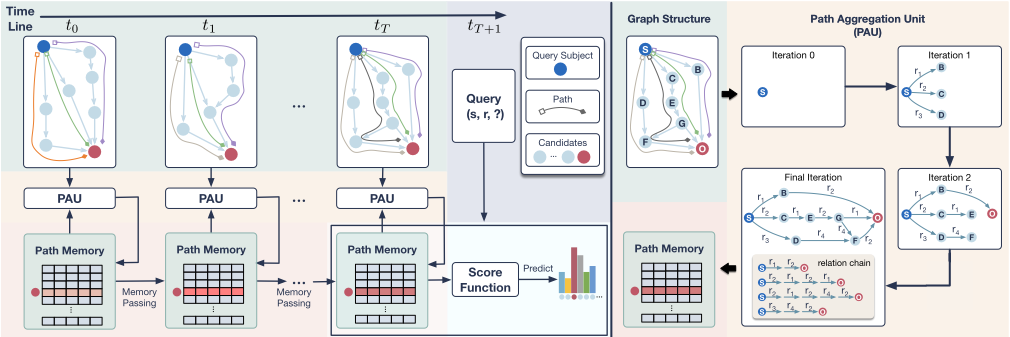
In this section, we introduce the proposed model, Adaptive Path-Memory Network (DaeMon), as illustrated in Figure 2.
We start with an overview and explain model architecture as well as its training and inference procedures in detail.
4.1 Model Overview
The main idea of DaeMon is to adaptively model the queryaware path information between query subject s and each object candidate oi ∈ E across history time with sequential subgraph while considering the query relation r. Since subgraphs of each timestamp are independent and unconnected, we hope to capture the connection information across time by updating the collected path information constantly. To record the path information across timestamps, we construct path memory to keep the status of current collected information temporarily. And then we use path aggregation unit to process and model comprehensive path information between s and oi ∈ E based on the memory status. Furthermore, we propose memory passing strategy to guide the memory status passing between adjacent times. Based on the final learned query-aware path information stored in memory, reasoning at the future timestamps can be made with a matching function. A high-level idea of modeling path information is to capture the relation chain pattern among the subgraph sequence.
4.2 PathMemory
To keep the connection information between query subject s and each object candidate oi ∈ E along the timeline, we construct query-aware memory unit to cache the obtained path information in the past and use it for subsequent processing, which can make the later processing refine the previous information continuously, considering the specific query (s, r, ?). We denote the status of memory as Mt(s,r)→E ∈ R|E|×d at timestamp t, where |E| is the cardinality of candidates set and d is the dimension of path embedding.
Specifically, given a query (s, r, ?), we take an object candidate oi as an example. The path information between s and oi we consider is the aggregation form of all paths that start with s and end with oi. Since our goal is to capture the path information across history timeline, we can finally obtain complete path information representation mT(s,r)→oi ∈
MT(s,r)→E stored in memory at the last history timestamp T .
Formally, we describe mt(s,r)→oi at timestamp t as follow:
where MPS(·) denotes the memory passing strategy, which is designed to inherit memory status of the previous timestamp and PAU(·) is path aggregation unit that aggregates paths information between query subject s and object candidate oi, which are introduced in the following section respectively; P t s→oi denotes the set of paths from s to oi at timestamp t and ⊕ denotes the paths aggregation operator. A path ptk ∈ P t s→oi is defined as follow when it contains relation chain edges as (e0 → e1 → · · · → et|pk | ):
where e(1,2,...,|ptk |) denotes the edge types in path ptk , wr(e∗) is the r-aware representation of edge e∗ and ⊗ denotes the operator of merging edges information in the path ptk .
4.3 Path Aggregation Unit
Path aggregation unit (PAU) is to process the representation of path information between a specific subject s and all candidates oi ∈ E, while considering the specific query relation type r. That means we only focus on features related to the query (s, r, ?).
We design a temporal path aggregation approach to constantly learn the history subgraphs structure over timeline. Since path feature in each subgraph is static without considering temporal feature, PAU learns path feature locally at each timestamp based on the memory status of previous adjacent timestamp and adaptively refines the memory with the development of time. Formally, given a query (s, r, ?), path information of P t s→E for all oi ∈ E will be learned by w-layers r-aware path aggregation neural network, based on previous memory status and topology of the subgraph at timestamp t. Memory status Mt(s,r)→E will be updated as aggregated path information, after finishing w layers aggregation iteration.
We can use Ht,l (s,r)→E ∈ R|E|×d to denote the l-th layer iterative path information status, and ht,l (s,r)→oi ∈ Ht,l (s,r)→E denotes the status of candidate oi at the l-th iteration, where l ∈ [0, w] and d is the dimension of path embedding. When l = 0, Ht,0 (s,r)→E denotes the initial status of iterations at timestamp t. For simplicity, we abbreviate Ht,l (s,r)→E , ht,l (s,r)→oi as Ht,l E , ht,l oi , respectively, and it is still representing path information for a specific query subject s and relation r rather than entity representation. Here we take ht,l oi as an example to describe the PAU iterative process at timestamp t as follow:
where AGG(·) and MSG(·) are the aggregation and message generation function, corresponding to the operator in Equation 2 and 3, respectively; wr denotes r-aware representation of edge type p; (z, p, oi) ∈ Gt is an edge in subgraph Gt that relation p occurs between an entity z and candidate entity oi.
Moreover, we initialize all relation type representation with a learnable parameter R ∈ R|R|×d in advance, and project query relation embedding r ∈ R to r-aware relation representation which is used in message generating. Formally, wr(z, p, oi) can be derived as Equation 5, thus considering awareness of query relation r.
For MSG function, we use vectorized approach of multiplication [Yang et al., 2014] as Equation 6, where operator ⊗ is defined as element-wise multiplication between h and w. The operation of multiplication can be interpreted as scaling ht,l-1 z by wr(z, p, oi) in our path information modeling.
And for AGG function, we adopt principal neighborhood aggregation (PNA) proposed in [Corso et al., 2020], since previous work has verified its effectiveness [Zhu et al., 2022]. After w-layers iteration of aggregation, the status of path memory mt(s,r)→oi ∈ Mt(s,r)→E is finally updated as ht,w oi ∈ Ht,w E w.r.t. the object candidate oi ∈ E.
As mentioned in Equation 1, Ht,0 E is initialized by memory passing strategy using last adjacent memory status Mt-1 (s,r)→E . Different from common GNN-based model and previous approach, for the first history subgraph (i.e. t = 0) which has no status of previous memory, we initialize query relation embedding r on entity oi before the first layer only if oi equals to query subject s, i.e. h0,0 s ← r, and a zero embedding otherwise. For the case where t > 0, memory passing strategy is involved to set the initial status Ht,0 E of PAU iteration.
4.4 Memory Passing Strategy
In order to capture the path information across time, we continue to refine the previously maintained path information. Considering the change of adjacent topology, a time-aware memory passing strategy is designed to guide how much previous obtained path memory information to keep and forget.
As mentioned at the end of Section 4.3, H0,0 E is initialized by query relation representation at the beginning of the time (t = 0). For t > 0, the initial status Ht,0 E should inherit previous memory status Mt-1 (s,r)→E , i.e. the final layer status Ht-1,w E , which has already collected the path information until timestamp t - 1. Therefore, we design a time-aware gated memory passing strategy, and the initial status Ht,0 E is determined by two parts, namely, the very beginning initial status H0,0 E and last learned memory status Mt-1 (s,r)→E at timestamp t - 1. Formally,
where ⊙ denotes the Hadamard product operation. The timeaware gate matrix Ut ∈ R|E|×d applies a non-linear transformation as:
where σ(·) denotes the sigmoid function and WGATE ∈ Rd×d is the parameter of time-aware gate weight matrix.
4.5 Learning and Inference
DaeMon models the query-aware path information across history time with the path memory. In contrast to most previous models, we focus on gathering the edge features of paths in the whole modeling process, without considering any node embedding. Thus, DaeMon has the transferability to migrate to other datasets for TKG prediction using pre-trained models, which will be presented in Section 5.2 in detail.
Score Function. Here we show how to apply the final learned memory status MT(s,r)→E to the TKG future reasoning. Given query subject s and query relation r at timestamp T + 1, we predict the conditional likelihood of the future object candidate oi ∈ E using mT(s,r)→oi ∈ MT(s,r)→E as:
where F(·) is a feed-forward neural network and σ(·) is the sigmoid function. As we have added inverse quadruple (o, r-1 , s, t) into the dataset in advance, without loss of generality, we can also predict subject si ∈ E given query relation r and query object o with the same model as:
Parameter Learning. Reasoning on a given query can be seen as a binary classification problem. We minimize the negative log-likelihood of positive and negative triplets as Equation 11. Negative samples are generated at each reasoning timestamp according to Partial Completeness Assumption [Gal´arraga et al., 2013]. That is we corrupt one of the entities in a positive triplet to create a negative sample from the reasoning future triplet set.
where n is hyperparameter of negative samples number per positive sample; (s, r, o) and (sj, r, oj) are the positive sample and j-th negative sample, respectively.
To encourage orthogonality in the learnable parameter R initialized at the beginning, according to [Xu et al., 2020], a regularization term is also added to the objective function as Equation 12, where I is the identity matrix, α is a hyperparameter and ∥ · ∥ denotes the L2-norm.
Therefore, the final loss of DaeMon can be denoted as:
5 Experiments
5.1 Experimental Setup
Datasets. Extensive experiments are conducted on four typical TKG datasets, namely, ICEWS18 [Jin et al., 2020], GDELT [Leetaru and Schrodt, 2013], WIKI [Leblay and Chekol, 2018], and YAGO [Mahdisoltani et al., 2014]. ICEWS18 is from the Integrated Crisis Early Warning System [Boschee et al., 2015] and GDELT [Jin et al., 2019] is from the Global Database of Events, Language, and Tone.
| Datasets | |E | | |R| | Ntrain | Nvalid | Ntest | Ntimestamp |
|---|---|---|---|---|---|---|
| ICEWS18 | 23,033 | 256 | 373,018 | 45,995 | 49545 | 304 |
| GDELT | 7,691 | 240 | 1,734,399 | 238,765 | 305,241 | 2976 |
| WIKI | 12,554 | 24 | 539,286 | 67,538 | 63,110 | 232 |
| YAGO | 10,623 | 10 | 161,540 | 19,523 | 20,026 | 189 |
WIKI [Leblay and Chekol, 2018] and YAGO [Mahdisoltani et al., 2014] are two knowledge base that contains facts with time information, and we use the subsets with a time granularity of years. The details of the datasets are provided in Table 1. We also adopt the same strategy of dataset split as introduced in [Jin et al., 2020] and split the dataset into train/valid/test by timestamps that (timestamps of the train) < (timestamps of the valid) < (timestamps of the test).
Evaluation Metrics. To evaluate the performance of the proposed model for TKG reasoning, we also choose the widely used task of link prediction on future timestamps. Mean Reciprocal Rank (MRR) and Hits@{1, 3, 10} are reported as the performance metrics to evaluate the proposed model's performance. Additionally, traditional filtered setting used in [Bordes et al., 2013] [Jin et al., 2020] [Zhu et al., 2021a] removes all valid quadruples that appear in the training, validation or test sets from the ranking list of corrupted facts, which is not appropriate for temporal reasoning tasks. Actually, only the facts occurring at the same time should be filtered. Thus, we use the time-aware filtered setting to calculate the results in a more reasonable way, which is consistent with the recent works [Sun et al., 2021][Han et al., 2021].
Baseline Methods. We compare our proposed model with three kinds of baselines: (1)KG Reasoning Models. Without considering the timestamps, DistMult[Yang et al., 2014], ComplEx [Trouillon et al., 2016], ConvE [Dettmers et al., 2017], and RotatE [Sun et al., 2019] are compared. (2)Interpolated TKG Reasoning models. We compare four interpolated TKG reasoning methods with proposed model, including TTransE [Leblay and Chekol, 2018], TADistMult [Garcia-Duran et al., 2018], DE-SimplE [Goel et al., 2020], and TNTComplEx [Lacroix et al., 2020]. (3)Extrapolated TKG Reasoning models. We choose state-of-theart extrapolated TKG reasoning methods, including TANGOTucker [Han et al., 2021], TANGO-DistMult [Han et al., 2021], CyGNet [Zhu et al., 2021a], RE-NET [Jin et al., 2020], RE-GCN [Li et al., 2021], TITer [Sun et al., 2021], and xERTE [Han et al., 2020].
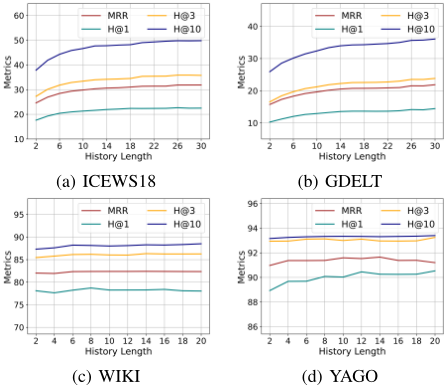
Implementation Details. For the Memory and PAU, the embedding dimension d is set to 64; the number of path aggregation layers w is set to 2; the activation function of aggregation is relu. Layer normalization and shortcut are conducted on the aggregation layers. For the Memory Passing, we perform grid search on the lengths of historical subgraph, and analysis it in detail presented in Figure 3. We present the overview results with the lengths 25, 15, 10, 10, corresponding to the dataset ICEWS18, GDELT, WIKI, and YAGO in Table 2. For the parameter learning, negative sample number is set to 64; the hyperparameter α in regularization term is set to 1. Adam [Kingma and Ba, 2014] is adopted for parameter learning with the learning rate of 5e -4, and the max epoch of training is set to 30. We also conduct the migration experiments which use the pre-trained model to predict the facts in other datasets, to present the transferability of our proposed model. All experiments are conducted with EPYC 7742 CPU, and 8 TESLA A100 GPUs. In addition, we also have released multi-device parallel version code to accelerate the training and inference. Codes and datasets are all available at https://github.com/hhdo/DaeMon.
| Model | ICEWS18 | GDELT | WIKI | YAGO | ||||||||||||
|---|---|---|---|---|---|---|---|---|---|---|---|---|---|---|---|---|
| MRR | H@1 | H@3 | H@10 | MRR | H@1 | H@3 | H@10 | MRR | H@1 | H@3 | H@10 | MRR | H@1 | H@3 | H@10 | |
| DistMult | 11.51 | 7.03 | 12.87 | 20.86 | 8.68 | 5.58 | 9.96 | 17.13 | 10.89 | 8.92 | 10.97 | 16.82 | 44.32 | 25.56 | 48.37 | 58.88 |
| ComplEx | 22.94 | 15.19 | 27.05 | 42.11 | 16.96 | 11.25 | 19.52 | 32.35 | 24.47 | 19.69 | 27.28 | 34.83 | 44.38 | 25.78 | 48.20 | 59.01 |
| ConvE | 24.51 | 16.23 | 29.25 | 44.51 | 16.55 | 11.02 | 18.88 | 31.60 | 14.52 | 11.44 | 16.36 | 22.36 | 42.16 | 23.27 | 46.15 | 60.76 |
| RotatE | 12.78 | 4.01 | 14.89 | 31.91 | 13.45 | 6.95 | 14.09 | 25.99 | 46.10 | 41.89 | 49.65 | 51.89 | 41.28 | 22.19 | 45.33 | 58.39 |
| TTransE | 8.31 | 1.92 | 8.56 | 21.89 | 5.50 | 0.47 | 4.94 | 15.25 | 29.27 | 21.67 | 34.43 | 42.39 | 31.19 | 18.12 | 40.91 | 51.21 |
| TA-DistMult | 16.75 | 8.61 | 18.41 | 33.59 | 12.00 | 5.76 | 12.94 | 23.54 | 44.53 | 39.92 | 48.73 | 51.71 | 54.92 | 48.15 | 59.61 | 66.71 |
| DE-SimplE | 19.30 | 11.53 | 21.86 | 34.80 | 19.70 | 12.22 | 21.39 | 33.70 | 45.43 | 42.60 | 47.71 | 49.55 | 54.91 | 51.64 | 57.30 | 60.17 |
| TNTComplEx | 21.23 | 13.28 | 24.02 | 36.91 | 19.53 | 12.41 | 20.75 | 33.42 | 45.03 | 40.04 | 49.31 | 52.03 | 57.98 | 52.92 | 61.33 | 66.69 |
| TANGO-Tucker | 28.68 | 19.35 | 32.17 | 47.04 | 19.42 | 12.34 | 20.70 | 33.16 | 50.43 | 48.52 | 51.47 | 53.58 | 57.83 | 53.05 | 60.78 | 65.85 |
| TANGO-DistMult | 26.65 | 17.92 | 30.08 | 44.09 | 19.20 | 12.17 | 20.40 | 32.78 | 51.15 | 49.66 | 52.16 | 53.35 | 62.70 | 59.18 | 60.31 | 67.90 |
| CyGNet | 24.93 | 15.90 | 28.28 | 42.61 | 18.48 | 11.52 | 19.57 | 31.98 | 33.89 | 29.06 | 36.10 | 41.86 | 52.07 | 45.36 | 56.12 | 63.77 |
| RE-NET | 28.81 | 19.05 | 32.44 | 47.51 | 19.62 | 12.42 | 21.00 | 34.01 | 49.66 | 46.88 | 51.19 | 53.48 | 58.02 | 53.06 | 61.08 | 66.29 |
| RE-GCN | 30.58 | 21.01 | 34.34 | 48.75 | 19.64 | 12.42 | 20.90 | 33.69 | 77.55 | 73.75 | 80.38 | 83.68 | 84.12 | 80.76 | 86.30 | 89.98 |
| TITer | 29.98 | 22.05 | 33.46 | 44.83 | 15.46 | 10.98 | 15.61 | 24.31 | 75.50 | 72.96 | 77.49 | 79.02 | 87.47 | 84.89 | 89.96 | 90.27 |
| xERTE | 29.31 | 21.03 | 33.40 | 45.60 | 18.09 | 12.30 | 20.06 | 30.34 | 71.14 | 68.05 | 76.11 | 79.01 84.19 | 80.09 | 88.02 | 89.78 | |
| DaeMon | 31.85 | 22.67 | 35.92 | 49.80 | 20.73 | 13.65 | 22.53 | 34.23 | 82.38 | 78.26 | 86.03 | 88.01 | 91.59 | 90.03 | 93.00 | 93.34 |
5.2 Experimental Results
The experiment results on TKG reasoning task are shown in Table 2 in terms of MRR and Hits@{1,3,10}. It can be seen that the results convincingly verify the effectiveness and DaeMon can consistently outperform all the baseline methods on the four TKG datasets. Especially on WIKI and YAGO, DaeMon achieves the most significant improvements of 4.8% and 4.1% absolute in MRR compared with stateof-the-art method, respectively. Specifically, DaeMon significantly outperforms all static models (those presented in the first block) and the temporal models for the interpolation setting (those presented in the second block) since DaeMon considers the time information of factors and models the subgraph sequence across timeline. It can thus capture the temporal pattern for the TKG reasoning tasks. For the temporal models under the extrapolation setting (those presented in the third block), there is no doubt that DaeMon also achieves better results because it can model the structure information and temporal pattern in a simultaneous manner, and DaeMon focuses on relation chain modeling which has more stable expression, considering the query-aware path information, using 3 key units to accurately do a more relevant search on the query over the timeline. In contrast to the previous model, node representation need not be considered, so for the TKG task, DaeMon can natively support model migration if the relation types are the same.
5.3 History Length Analysis
Time-across path information is updated and refined over the timeline using memory passing strategy, based on sequence of past subgraph. We adjust the values of historical sequence length to observe the performance change of DaeMon on 4 datasets. The results are shown in Figure 3.
In order to collect the path information across timeline, DaeMon strongly depends on the topology connectivity of the graph. Table 3 shows the density and interval of datasets. Since WIKI and YAGO have the long interval (1 year) between times, each subgraph of them contains more information. They can perform very stably in all history length settings, as illustrated in Figure 3(c,d). For the ICEWS18 and GDELT shown in Figure 3(a,b), their interval is much shorter than the former. Thus, they need longer histories to improve the accuracy. As shown in the results, when the history length reaches to cover all entities (i.e. length ≈ |E|/|Eavg|), MRR will no longer be significantly improved.
| Datasets | ICEWS18 | GDELT | WIKI | YAGO |
|---|---|---|---|---|
| |E | Interval |Eavg | | 23,033 24 hours 986.44 | 7,691 15 mins 393.18 | 12,554 1 year 2817.47 | 10,623 1 year 1190.72 |
| |E |/|Eavg | | 23.35 | 19.56 | 4.46 | 8.92 |
5.4 Ablation Study
We conduct ablation studies on ICEWS18 and GDELT to facilitate generalized conclusions. Particularly, we discuss the effect of each component with the following variants:
For memory passing strategy, as shown in the first three items of Table 4: (1) we conduct mean-pooling on the previous one memory status Mt-1 (s,r)→E , i.e. the final layer status that has already modeled the path information before current processing timestamp t, and directly pass to the current initial status Ht,0 E , which is denoted as MPS/PMMP. It can be observed that MPS/PMMP has a more significant impact on the final results, since it damages the path information that was collected before; (2) we drop out the passing step, and initialize each initial status Ht,0 E as the same of H0,0 E , finally calculate the mean of each updated layer status Ht,w E at each time, which is denoted as MPS/MMP. It also has undesirable results, since it ignores the sequence pattern information and process path Without considering continuity. (3) we replace the proposed gated passing strategy to Mean operator that calculates the mean of very beginning initial status H0,0 E and previous learned memory status Mt-1 (s,r)→E as the initial layer status Ht,0 E at timestamp t, which is denoted as MPS/IPMM. Intuitively, it belongs to a special case of the proposed strategy, and it is difficult to automatically adapt to the diversity of time series and path features.
For path aggregation unit, as shown in the fourth and fifth items of Table 4, we adopt two variants of MSG function to compare with our proposed approach. PAU/TransE and PAU/RotatE replace the operator in MSG function with vectorized version of summation and rotation operator [Bordes et al., 2013; Sun et al., 2019], respectively. It can be observed that results of them are all worse than what we used in DaeMon (i.e. multiplication operator), which proves the superiority of our method.
| Model | ICEWS18 | GDELT | ||||||
|---|---|---|---|---|---|---|---|---|
| MRR | H@1 | H@3 | H@10 | MRR | H@1 | H@3 | H@10 | |
| MPS/PMMP | 20.56 | 14.63 | 22.71 | 32.11 | 14.19 | 9.38 | 14.74 | 23.18 |
| MPS/MMP | 25.48 | 17.82 | 28.97 | 41.08 | 16.70 | 10.43 | 17.51 | 28.58 |
| MPS/IPMM | 29.85 | 20.82 | 34.03 | 47.02 | 19.98 | 12.85 | 22.01 | 33.35 |
| PAU/TransE | 30.28 | 20.81 | 34.06 | 49.10 | 20.11 | 13.19 | 21.75 | 33.48 |
| PAU/RotatE | 30.85 | 21.47 | 34.45 | 49.17 | 20.30 | 13.29 | 22.13 | 33.64 |
| DaeMon | 31.85 | 22.67 | 35.92 | 49.80 | 20.73 | 13.65 | 22.53 | 34.23 |
5.5 Case Study
In order to present the advantage of our proposed method that modeling with relation feature rather than entity (or node)
embedding, we conduct a case study that shows the migration ability of DaeMon.
We first choose a target dataset 'A' and another homologous dataset 'B', which means 'A' and 'B' have the same set of relation types. Second, we train the DaeMon with the training data of 'A' and test the performance with the testing data of 'A', and we can achieve the direct result of DaeMon on target dataset 'A'. Then, we train the DaeMon with the training data of 'B' and test the performance with the testing data of 'A', and we can get the migration result of DaeMon on target dataset 'A' using pre-trained model derived from dataset 'B'. Finally, we can evaluate the migration ability by the Migration Performance, which is calculated by the percentage ratio of the migration result divided by the direct result.
| Datasets | |E | | |R| | Ntrain | Nvalid | Ntest | Interval |
|---|---|---|---|---|---|---|
| YAGO | 10,623 | 10 | 161,540 | 19,523 | 20,026 | 1 year |
| YAGOs | 10,038 | 10 | 51,205 | 10,973 | 10,973 | 1 year |
More specifically, YAGO and YAGOs [Han et al., 2020] are homologous datasets (comparison shown in Table 5), and there is no intersection between the entity identifications of them. Therefore we use YAGO and YAGOs to be the target dataset in turn. Table 6 shows the results of the migration ability evaluation on datasets YAGOs and YAGO. We can observe that all the migration performance of the DaeMon is more than 90%. Even learning from a smaller dataset YAGOs and testing on a bigger dataset YAGO, the proposed model can achieve effective performance on each TKG reasoning evaluation metric. Thus, it can indicate that DaeMon can effectively capture the temporal path information and migrate the trained model to another homologous datasets.
| MRR | H@1 | H@3 | H@10 | |
|---|---|---|---|---|
| YAGOs | 53.65 | 47.68 | 59.20 | 61.09 |
| YAGO → YAGOs | 50.18 | 45.46 | 54.78 | 56.88 |
| Migration Performance | 93.53% | 95.34% | 92.53% | 93.11% |
| YAGO | 91.59 | 90.03 | 93.00 | 93.34 |
| YAGOs →YAGO | 88.72 | 84.73 | 92.80 | 93.14 |
| Migration Performance | 96.87% | 94.11% | 99.78% | 99.79% |
6 Conclusion
This paper proposed DaeMon for temporal knowledge graph reasoning, which models historical information in a novel and entity-independent manner. Based on modeling with relation features, DaeMon adaptively captures the temporal path information between query subject and object candidates across time by utilizing historical structural and temporal characteristics while considering the query feature. Extensive experiments on four benchmark datasets demonstrate the effectiveness of our method on temporal knowledge graph reasoning tasks and achieve new state-of-the-art results meanwhile with natively migration ability.
Acknowledgments
This research was supported by the Natural Science Foundation of China under Grant No. 61836013, the grants from the Strategic Priority Research Program of the Chinese Academy of Sciences XDB38030300, the Science and Technology Development Fund, Macau SAR (File no. SKLIOTSC-2021-2023 to Pengyang Wang), the Start-up Research Grant of University of Macau (File no. SRG2021-00017IOTSC to Pengyang Wang), the Informatization Plan of Chinese Academy of Sciences (CAS-WX2021SF-0101, CASWX2021SF-0111), and the Science and Technology Service Network Initiative, Chinese Academy of Sciences (No. KFJSTS-QYZD-2021-11-001).
Contribution Statement
In this work, Hao Dong and Zhiyuan Ning have an equal contribution, specifically, they led the project, provided theoretical support and were responsible for the overall model design, code implementation, experimental design and paper writing. Pengyang Wang, Ziyue Qiao, and Pengfei Wang provided guidance in solving complex problems and helped with paper writing. Yuanchun Zhou and Yanjie Fu provided valuable feedback on the paper drafts. All authors reviewed and approved the final manuscript.
@inproceedings{ijcai2023p232,
  title     = {Adaptive Path-Memory Network for Temporal Knowledge Graph Reasoning},
  author    = {Dong, Hao and Ning, Zhiyuan and Wang, Pengyang and Qiao, Ziyue and Wang, Pengfei and Zhou, Yuanchun and Fu, Yanjie},
  booktitle = {Proceedings of the Thirty-Second International Joint Conference on
               Artificial Intelligence, {IJCAI-23}},
  publisher = {International Joint Conferences on Artificial Intelligence Organization},
  editor    = {Edith Elkind},
  pages     = {2086--2094},
  year      = {2023},
  month     = {8},
  note      = {Main Track},
  doi       = {10.24963/ijcai.2023/232},
  url       = {https://doi.org/10.24963/ijcai.2023/232},
}
TY - CPAPER TI - Adaptive Path-Memory Network for Temporal Knowledge Graph Reasoning AU - Dong, Hao AU - Ning, Zhiyuan AU - Wang, Pengyang AU - Qiao, Ziyue AU - Wang, Pengfei AU - Zhou, Yuanchun AU - Fu, Yanjie T2 - Proceedings of the Thirty-Second International Joint Conference on Artificial Intelligence, IJCAI-23 PB - International Joint Conferences on Artificial Intelligence Organization PY - 2023 SP - 2086 EP - 2094 DO - 10.24963/ijcai.2023/232 UR - https://doi.org/10.24963/ijcai.2023/232 ER -Copied
Machine-readable versions of this paper, for tools and AI agents:





