
Diversity, Agreement, and Polarization in Elections
Proceedings of the Thirty-Second International Joint Conference on Artificial Intelligence. Main Track. Pages 2684-2692.
https://doi.org/10.24963/ijcai.2023/299
Keywords
- Game Theory and Economic Paradigms: GTEP: Computational social choice
Abstract
We consider the notions of agreement, diversity, and polarization in ordinal elections (that is, in elections where voters rank the candidates). While (computational) social choice offers good measures of agreement between the voters, such measures for the other two notions are lacking. We attempt to rectify this issue by designing appropriate measures, providing means of their (approximate) computation, and arguing that they, indeed, capture diversity and polarization well. In particular, we present "maps of preference orders" that highlight relations between the votes in a given election and which help in making arguments about their nature.
- [Alcalde-Unzu and Vorsatz, 2013] J. Alcalde-Unzu and M. Vorsatz. Measuring the cohesiveness of preferences: An axiomatic analysis. Social Choice and Welfare, 41(4):965-988, 2013.
- [Alcalde-Unzu and Vorsatz, 2016] J. Alcalde-Unzu and M. Vorsatz. Do we agree? Measuring the cohesiveness of preferences. Theory and Decision, 80(2):313-339, 2016.
- [Alcantud et al., 2013] J. C. R. Alcantud, R. de An- drés Calle, and J. M. Cascón. A unifying model to measure consensus solutions in a society. Mathematical and Com- puter Modelling, 57(7-8):1876-1883, 2013.
- [Arrighi et al., 2021] E. Arrighi, H. Fernau, D. Lokshtanov, M. de Oliveira Oliveira, and P. Wolf. Diversity in Kemeny rank aggregation: A parameterized approach. In Proceed- ings of IJCAI-2021, pages 10-16, 2021. IJCAI
- [Arya et al., 2001] V. Arya, N. Garg, R. Khandekar, A. Mey- erson, K. Munagala, and V. Pandit. Local search heuristic for k-median and facility location problems. In Proceed- ings of STOC-2001, pages 21-29, 2001.
- [Bartholdi et al., 1989] J. Bartholdi, III, C. Tovey, and M. Trick. Voting schemes for which it can be difficult to tell who won the election. Social Choice and Welfare, 6(2):157-165, 1989.
- [Berg, 1985] S. Berg. Paradox of voting under an urn model: The effect of homogeneity. Public Choice, 47(2):377-387, 1985.
- [Black, 1958] D. Black. The Theory of Committees and Elec- tions. Cambridge University Press, 1958.
- [Boehmer et al., 2021] N. Boehmer, R. Bredereck, P. Fal- iszewski, R. Niedermeier, and S. Szufa. Putting a compass on the map of elections. In Proceedings of IJCAI-2021, pages 59-65, 2021. IJCAI
- [Boehmer et al., 2022] N. Boehmer, P. Faliszewski, R. Nie- dermeier, S. Szufa, and T. W ąs. Understanding distance measures among elections. In Proceedings of IJCAI-2022, pages 102-108, 2022. IJCAI
- Bosch, 2006
- R. Bosch. Characterizations on Voting Rules and Consensus Measures. PhD thesis, Tilburg University, 2006.
- [Byrka et al., 2017] J. Byrka, T. W. Pensyl, B. Rybicki, A. Srinivasan, and K. Trinh. An improved approxima- tion for k-median and positive correlation in budgeted op- timization. ACM Transactions on Algorithms, 13(2):23:1- 23:31, 2017.
- [Can et al., 2015] B. Can, A. I. Ozkes, and T. Storcken. Mea- suring polarization in preferences. Mathematical Social Sciences, 78:76-79, 2015.
- [Can et al., 2017] B. Can, A. Ozkes, and T. Storcken. Gener- alized measures of polarization in preferences. Technical report, HAL, 2017.
- [Chamberlin and Courant, 1983] B. Chamberlin and P. Courant. Representative deliberations and representa- tive decisions: Proportional representation and the Borda rule. American Political Science Review, 77(3):718-733, 1983.
- [Cohen-Addad et al., 2022] V. Cohen-Addad, A. Gupta, L. Hu, H. Oh, and D. Saulpic. An improved local search algorithm for k-median. In Proceedings of SODA-2022, pages 1556-1612, 2022.
- [Cohen-Addad et al., 2023] V. Cohen-Addad, F. Grandoni, E. Lee, and C. Schwiegelshohn. Breaching the 2 LMP ap- proximation barrier for facility location with applications to k-median. In Proceedings of SODA-2023, pages 940- 986, 2023.
- [Conitzer, 2009] V. Conitzer. Eliciting single-peaked pref- erences using comparison queries. Journal of Artificial Intelligence Research, 35:161-191, 2009.
- [Cygan et al., 2015] M. Cygan, F. V. Fomin, Ł. Kowalik, D. Lokshtanov, D. Marx, M. Pilipczuk, M. Pilipczuk, and S. Saurabh. Parameterized Algorithms. Springer, 2015.
- [Dwork et al., 2001] C. Dwork, R. Kumar, M. Naor, and D. Sivakumar. Rank aggregation methods for the Web. In Proceedings of WWW-2001, pages 613-622, 2001.
- [Dynes and Tierney, 1994] R. Dynes and K. Tierney, editors. Disasters, Collective Behavior, and Social Organization. University of Delaware Press, 1994.
- [Endriss and Grandi, 2014] U. Endriss and U. Grandi. Bi- nary aggregation by selection of the most representative voters. In Proceedings of AAAI-2014, pages 668-674, 2014.
- [Erdélyi et al., 2015] G. Erdélyi, M. Fellows, J. Rothe, and L. Schend. Control complexity in Bucklin and fallback voting: An experimental analysis. Journal of Computer and System Sciences, 81(4):661-670, 2015.
- [Esteban and Ray, 1994] J.-M. Esteban and D. Ray. On the measurement of polarization. Econometrica, 62(4):819- 851, 1994.
- [Faliszewski et al., 2017] P. Faliszewski, P. Skowron, A. Slinko, and N. Talmon. Multiwinner voting: A new challenge for social choice theory. In U. Endriss, editor, Trends in Computational Social Choice. AI Access Foundation, 2017.
- [Faliszewski et al., 2019] P. Faliszewski, P. Skowron, A. Slinko, S. Szufa, and N. Talmon. How similar are two elections? In Proceedings of AAAI-2019, pages 1909-1916, 2019.
- [Faliszewski et al., 2023] P. Faliszewski, A. Kaczmarczyk, K. Sornat, S. Szufa, and T. W ąs. Diversity, agree- ment, and polarization in elections. Technical Report arXiv:2305.09780 [cs.GT], arXiv.org, May 2023.
- [Gowda et al., 2023] K. N. Gowda, T. W. Pensyl, A. Srini- vasan, and K. Trinh. Improved bi-point rounding algo- rithms and a golden barrier for k-median. In Proceedings of SODA-2023, pages 987-1011, 2023.
- [Hashemi and Endriss, 2014] V. Hashemi and U. Endriss. Measuring diversity of preferences in a group. In Proceed- ings of ECAI-2014, pages 423-428, 2014.
- [Hemaspaandra et al., 2005] E. Hemaspaandra, H. Spakowski, and J. Vogel. The complexity of Kemeny elections. Theoretical Computer Science, 349(3):382-391, 2005.
- [Huremović and Ozkes, 2022] K. Huremović and A. I. Ozkes. Polarization in networks: Identification- alienation framework. Journal of Mathematical Eco- nomics, 102:102732, 2022.
- [Karpov, 2017] A. Karpov. Preference diversity orderings. Group Decision and Negotiation, 26(4):753-774, 2017.
- [Keller et al., 2019] O. Keller, A. Hassidim, and N. Hazon. New approximations for coalitional manipulation in scor- ing rules. Journal of Artificial Intelligence Research, 64:109-145, 2019.
- [Kemeny, 1959] J. Kemeny. Mathematics without numbers. Daedalus, 88:577-591, 1959.
- [Kenyon-Mathieu and Schudy, 2007] C. Kenyon-Mathieu and W. Schudy. How to rank with few errors. In Proceedings of STOC-2007, pages 95-103, 2007.
- [Levin et al., 2021] S. A. Levin, H. V. Milner, and C. Perrings. The dynamics of political polariza- tion. Proceedings of the National Academy of Sciences, 118(50):e2116950118, 2021.
- [Mattei and Walsh, 2013] N. Mattei and T. Walsh. Preflib: A library for preferences. In Proceedings of ADT-2013, pages 259-270, 2013.
- [McCabe-Dansted and Slinko, 2006] J. McCabe-Dansted and A. Slinko. Exploratory analysis of similarities between social choice rules. Group Decision and Negotiation, 15:77-107, 2006.
- [Musco et al., 2018] C. Musco, C. Musco, and C. E. Tsourakakis. Minimizing polarization and disagreement in social networks. In Proceedings of WWW-2018, pages 369-378, 2018.
- [Procaccia et al., 2008] A. D. Procaccia, J. S. Rosenschein, and A. Zohar. On the complexity of achieving proportional representation. Social Choice and Welfare, 30(3):353- 362, 2008.
- [Skowron et al., 2015] P. Skowron, P. Faliszewski, and A. Slinko. Achieving fully proportional representation: Approximability result. Artificial Intelligence, 222:67- 103, 2015.
- [Szufa et al., 2020] S. Szufa, P. Faliszewski, P. Skowron, A. Slinko, and N. Talmon. Drawing a map of elections in the space of statistical cultures. In Proceedings of AAMAS- 2020, pages 1341-1349, 2020.
- [Tu and Neumann, 2022] S. Tu and S. Neumann. A viral marketing-based model for opinion dynamics in online so- cial networks. In Proceedings of WWW-2022, pages 1570- 1578, 2022.
- [Walsh, 2011] T. Walsh. Where are the hard manipulation problems. Journal of Artificial Intelligence Research, 42(1):1-29, 2011.
- [Walsh, 2015] T. Walsh. Generating single peaked votes. Technical Report arXiv:1503.02766 [cs.GT], arXiv.org, March 2015.
- [Williamson and Shmoys, 2011] D. P. Williamson and D. B. Shmoys. The Design of Approximation Algorithms. Cam- bridge University Press, 2011.
- [Zhu and Zhang, 2022] L. Zhu and Z. Zhang. A nearly-linear time algorithm for minimizing risk of conflict in social net- works. In Proceedings of KDD-2022, pages 2648-2656, 2022.
References were extracted automatically from the PDF and may contain errors.
Full text extracted automatically from the PDF; figures, tables and equations may differ. The PDF is the version of record.
1 Introduction
The notions of agreement, diversity, and polarization of a society with respect to some issue are intuitively quite clear. In case of agreement, most members of the society have very similar views regarding the issue, in case of diversity there is a whole spectrum of opinions, and in case of polarization there are two opposing camps with conflicting views and with few people taking middle-ground positions (more generally, if there are several camps, with clearly separated views, then we speak of fragmentation; see, for example, the collection of Dynes and Tierney [1994]). We study these three notions for the case of ordinal elections-that is, for elections where each voter has a preference order (his or her vote) ranking the candidates from the most to the least appealing one-and analyze ways of quantifying them. 1
Interestingly, even though agreement, diversity, and polarization seem rather fundamental concepts for understanding the state of a given society (see, for example, the papers in a special issue edited by Levin et al. [2021]), so far (computational) social choice mostly focused on the agreementdisagreement spectrum. Let us consider the following notion:
Given an election, the voters' agreement index for candidates a and b is the absolute value of the difference between the fraction of the voters who prefer a to b and the fraction of those with the opposite view. Hence, if all voters rank a over b (or, all voters rank b over a) then the agreement index for these candidates is equal to 1. On the other hand, if half of the voters report a ≻ b and half of them report b ≻ a, then the index is equal to 0. The agreement index of the whole election is the average over the agreement indices of all the candidate pairs.
1 More extensive analysis as well as all proofs are available in the full version of our paper [Faliszewski et al., 2023] and the code of our experiments is available at https://github.com/ Project-PRAGMA/diversity-agreement-polarization-IJCAI23.
For an election E, we denote its agreement index as A(E). Alcalde-Unzu and Vorsatz [2013] viewed this index as measuring voter cohesiveness-which is simply a different term for voter agreement-and provided its axiomatic characterization. Hashemi and Endriss [2014] focused on measuring diversity and provided axiomatic and experimental analyses of a number of election indices, including 1-A(E). 1-A(E) was also characterized axiomatically by Can et al. [2015], who saw it as measuring polarization; their point of view was that for each pair of candidates one can measure polarization independently. (In Section 2 we briefly discuss other election indices from the literature; generally, they are strongly interrelated with the agreement one).
Our view is that 1-A(E) is neither a measure of diversity nor of polarization, but of disagreement. Indeed, it has the same, highest possible, value on both the antagonism election (AN), where half of the voters report one preference order and the other half reports the opposite one, and on the uniformity election (UN), where each possible preference order occurs the same number of times. Indeed, both these elections arguably represent extreme cases of disagreement. Yet, the nature of this disagreement is very different. In the former, we see strong polarization, with the voters split into two opposing groups, and in the latter we see perfect diversity of opinion. The fundamental difference between these notions becomes clear in the text of Levin et al. [2021] which highlights "the loss of diversity that extreme polarization creates" as a central theme of the related special issue. Our main goal is to design election indices that distinguish these notions.
Our new indices are based on what we call the k-KEMENY problem. In the classic KEMENY RANKING problem (equivalent to 1-KEMENY), given an election we ask for a ranking whose sum of swap distances to the votes is the smallest (a swap distance between two rankings is the number of swaps of adjacent candidates needed to transform one ranking into the other). The k-KEMENY problem is defined analogously, but we ask for k rankings that minimize the sum of each vote's distance to the closest one (readers familiar with multiwinner elections [Faliszewski et al., 2017] may think of it as the Chamberlin-Courant rule [Chamberlin and Courant, 1983] for committees of rankings rather than candidates). We refer to this value as the k-Kemeny distance. Unfortunately, the k-KEMENY problem is intractable-just like KEMENY RANKING [Bartholdi et al., 1989; Hemaspaandra et al., 2005]-so we develop multiple ways (such as fast approximation algorithms) to circumvent this issue.
Our polarization index is a normalized difference between the 1-Kemeny and 2-Kemeny distances of an election, and our diversity index is a weighted sum of the k-Kemeny distances for k = 1, 2, 3, . . .. The intuition for the former is that if a society is completely polarized (that is, partitioned into two equal-sized groups with opposing preference orders), then 1Kemeny distance is the largest possible, but 2-Kemeny distance is zero. The intuition for the latter is that if a society is fully diverse (consists of all possible votes) then each kKemeny distance is non-negligible (we use weights for technical reasons). Since our agreement index can also be seen as a variant of the KEMENY RANKING problem, where we measure the distance to the majority relation, all these indices are based on similar principles.
To evaluate our indices, we use the "map of elections" framework of Szufa et al. [2020], Boehmer et al. [2021], and Boehmer et al. [2022], applied to a dataset of randomly generated elections. In particular, we find that our indices are correlated with the distances from several characteristic electionsand, hence, provide the map with a semantic meaning. Additionally, we develop a new form of a map that visualizes the relations between the votes of a single election (the original maps visualized relations between several elections from a given dataset). We use this approach to get an insight regarding the statistical cultures used to generate our dataset and to validate intuitions regarding the agreement, diversity, and polarization of its elections. In our experiments, we focused on elections with a relatively small number of candidates (8 candidates and 96 voters). While we believe that our main conclusions extend to all sizes of elections, it would be valuable to check this (however, this would require quite extensive computation that, currently, is beyond our reach).
2 Preliminaries
For every number k ∈ N, by [k] we understand the set {1, . . . , k}. For two sets A and B such that |A| = |B|, by Π(A, B) we mean the set of all bijections from A to B.
2.1 Elections
An election E = (C, V ) is a pair, where C is a set of candidates and V is a collection of voters whose preferences (or, votes) are represented as linear orders over C (we use the terms vote and voter interchangeably, depending on the context). For a vote v, we write a ≻v b (or, equivalently, v : a ≻ b) to indicate that v prefers candidate a over candidate b. We also extend this notation to more candidates. For example, for candidate set C = {a, b, c} by v : a ≻ b ≻ c we mean that v ranks a first, b second, and c third. For two candidates a and b from election E, by pE(a, b) we denote the fraction of voters in E that prefer a over b.
We will often speak of the following three characteristic elections, introduced by Boehmer et al. [2021] as "compass elections" (we assume candidate set C = {c1, . . . , cm} here; Boehmer et al. [2021] also considered the fourth election, i.e., stratification, but it will not play an important role for us):
Identity (ID). In an identity election all votes are identical. We view this election as being in perfect agreement.
Antagonism (AN). In an antagonism election, exactly half of the voters have one preference order (for example, c1 ≻ c2 ≻ · · · ≻ cm) and the other half has the reversed one (cm ≻ cm-1 ≻ · · · ≻ c1). We view this election as being perfectly polarized.
Uniformity (UN). A uniformity election contains the same number of copies of every possible preference order. We view this election as being perfectly diverse.
2.2 Kemeny Rankings and Swap Distance
For two votes u and v over a candidate set C, by swap(u, v) we mean their swap distance, that is, the minimal number of swaps of consecutive candidates required to transform u into v. This value is also known as Kendall's τ distance and is equal to the number of candidate pairs a, b ∈ C such that a ≻u b but b ≻v a. A Kemeny ranking of an election E = (C, V ) is a linear order over C that minimizes the sum of its swap distances to the votes from V [Kemeny, 1959]. It is well known that computing a Kemeny ranking is NP-hard [Bartholdi et al., 1989] and, more precisely, Θp2 - complete [Hemaspaandra et al., 2005].
For two elections, E = (C, V ) and F = (D, U), such that |C| = |D|, V = (v1, . . . , vn), and U = (u1, . . . , un), by dswap(E, F) we denote their isomorphic swap distance [Faliszewski et al., 2019], that is, the (minimal) sum of swap distances between the votes in both elections, given by optimal correspondences between their candidates and their voters. Formally:
where by π(vi) we denote vote vi with every candidate c ∈ C replaced by candidate π(c).
2.3 Maps of Elections
A map of elections is a collection of elections represented on a 2D plane as points, so that the Euclidean distances between the points reflect the similarity between the elections (the closer two points are, the more similar should their elections be). Maps of elections were introduced by Szufa et al. [2020] (together with an open-source Python library mapel, which we use and build on) and Boehmer et al. [2021], who used the distance based on position matrices of elections as a measure of similarity. We use the isomorphic swap distance instead. Indeed, Szufa et al. [2020] and Boehmer et al. [2021] admitted that isomorphic swap distance would be more accurate but avoided it because it is hard to compute (Boehmer et al. [2022] analyzed the consequences of using various distances). We are able to use the swap distance because we focus on small candidate sets. To present a set of elections as a map, we compute the distance between each two elections and then run the multidimensional scaling algorithm (MDS) to find an embedding of points on a plane that reflects the computed distances. For an example of a map, see Fig. 2 at the end of the paper; we describe its elections in Section 5.
2.4 Agreement and Other Election Indices
Election index is a function that given an election outputs a real number. The next index is among the most studied ones and captures voter agreement.
The agreement index takes values between 0 and 1, where 0 means perfect disagreement and 1 means perfect agreement. Indeed, we have A(ID) = 1 and A(UN) = A(AN) = 0.
There is also a number of other election indices in the literature. Somewhat disappointingly, they mostly fall into one or more of the following categories: (1) They are generalizations of the agreement index (or its linear transformation) [AlcaldeUnzu and Vorsatz, 2016; Can et al., 2017]; (2) They are highly correlated with the agreement index (at least on our datasets) [Hashemi and Endriss, 2014; Karpov, 2017; Alcantud et al., 2013]; (3) Their values come from a small set, limiting their expressiveness and robustness [Bosch, 2006; Hashemi and Endriss, 2014].
3 Diversity and Polarization Indices
In this section, we introduce our two new election indices, designed to measure the levels of diversity and polarization in elections. Both of them are defined on top of a generalization of the KEMENY RANKING problem (note that this generalization is quite different from that studied by Arrighi et al. [2021] under a related name).
Definition 2. k-Kemeny rankings of election E = (C, V ) are the elements of a set Λ = {λ1, . . . , λk} of k linear orders over C that minimize ∑v∈V mini∈[k] swap(v, λi).
The k-Kemeny distance, κk(E), is equal to this minimum.
We can think of finding k-Kemeny rankings as finding an optimal split of votes into k groups and minimizing the sum of each group's distance to its Kemeny ranking. Hence, 1Kemeny distance is simply the distance of the voters from the (standard) Kemeny ranking. We will later argue that κ1(E) is closely related to the agreement index.
We want our diversity index to be high for UN, but small for AN and ID. For identity, 1-Kemeny distance is equal to zero, but for both UN and AN, 1-Kemeny distance is equal to |V | · (|C| 2 )/2, which is the maximal possible value (as shown, for example, by Boehmer et al. [2022]). However, for k ≥ 2 we observe a sharp difference between k-Kemeny distances in these two elections. For AN, we get distance zero (it suffices to use the two opposing votes as the k-Kemeny rankings), and for UN we get non-negligible positive distances (as long as k is smaller than the number of possible votes). Motivated by this, we define the diversity index as a normalized sum of all k-Kemeny distances.
The sum in the definition is divided by the number of voters and the maximal possible distance (|C| 2 ) between two votes. As a result, the values of the index are more consistent across elections with different number of voters and candidates (for example, diversity of AN is always equal to 1/2). Apart from that, in the sum, each k-Kemeny distance is divided by k. This way, the values for large k have lesser impact on the total value, and it also improves scalability. However, we note that even with this division, diversity of UN seems to grow slightly faster than linearly with the growing number of candidates and there is a significant gap between the value for UN with all m! possible votes and even the most diverse election with significantly smaller number of voters. The currently defined diversity index works well on our datasets (see Section 6), but finding a more robust normalization is desirable (the obvious idea of dividing by the highest possible value of the sum is challenging to implement and does not prevent the vulnerability to changes in the voters count).
To construct the polarization index, we look at AN and take advantage of the sudden drop from the maximal possible value of the 1-Kemeny distance to zero for the 2-Kemeny distance. We view this drop as characteristic for polarized elections because they include two opposing, but coherent, factions. Consequently, we have the following definition (we divide by |V |· (C2 )/2 for normalization; the index takes values between 0, for the lowest polarization, and 1, for the highest).
For AN polarization is one, while for ID it is zero. For UN with 8 candidates, it is 0.232. This is intuitive as in UN every vote also has its reverse. However, we have experimentally checked that with a growing number of candidates the polarization of UN seems to approach zero (e.g., it is 0.13, 0.054, and 0.024 for, respectively, 20, 100, and 500 candidates).
We note that there is extensive literature on polarization measures in different settings, such us regarding distributions over continuous intervals [Esteban and Ray, 1994] or regarding opinions on networks [Musco et al., 2018; Huremovi´c and Ozkes, 2022; Tu and Neumann, 2022; Zhu and Zhang, 2022] (we only mention a few example references). On the technical level, this literature is quite different from our setting, but finding meta connections could be very inspiring.
Concluding our discussion of the election indices, we note a connection between the agreement index and the 1-Kemeny distance. Let µ be the majority relation of an election E = (C, V ), that is, a relation such that for candidates a, b ∈ C, a ⪰µ b if and only if pE(a, b) ≥ pE(b, a). If E does not have a Condorcet cycle, that is, there is no cycle within µ, then µ is identical to the Kemeny ranking. As noted by Can et al. [2015], the agreement index can be expressed as a linear transformation of the sum of the swap distances from all the votes to µ. Hence, if there is no Condorcet cycle, the agreement index is strictly linked to κ1(E) and all three of our indices are related.
4 Computation of k-Kemeny Distance
We define an optimization problem k-KEMENY in which the goal is to find the k-Kemeny distance of a given election (see Definition 2). In a decision variant of k-KEMENY, we check if the k-Kemeny distance is at most a given value. We note that k-KEMENY is NP-hard [Bartholdi et al., 1989], even for k = 1 and n = 4 [Dwork et al., 2001]. Hence, we seek polynomial-time approximation algorithms.
4.1 Approximation Algorithms
While there is a PTAS for 1-KEMENY [Kenyon-Mathieu and Schudy, 2007], it is not obvious how to approximate even 2-KEMENY. Yet, we observe that k-KEMENY is related to the classic facility location problem k-MEDIAN [Williamson and Shmoys, 2011]. In this problem we are given a set of clients X, a set of potential facility locations F, a natural number k, and a metric d defined over X ∪ F. The goal is to find a subset W = {f1, f2, . . . , fk} of facilities which minimizes the total connection cost of the clients, that is, ∑x∈X minf∈W d(x, f). We see that k-KEMENY is equivalent to k-MEDIAN in which the clients are the votes from the input election, the set of facilities is the set of all possible votes, and the metric is the swap distance. Hence, to approximate k-KEMENY we can use approximation algorithms designed for k-MEDIAN. The issue is that there are m! possible Kemeny rankings and the algorithms for k-MEDIAN run in polynomial time with respect to the number of facilities so they would need exponential time.
We tackle the above issue by reducing the search space from all possible rankings to those appearing in the input. We call this problem k-KEMENY AMONG VOTES and provide the following result. 2
Theorem 1. An α-approximate solution for k-KEMENY AMONG VOTES is a 2α-approximate solution for kKEMENY.
This allows us to use the rich literature on approximation algorithms for k-MEDIAN [Williamson and Shmoys, 2011]. For example, using the (currently best) 2.7-approximation algorithms for k-MEDIAN [Byrka et al., 2017; Cohen-Addad et al., 2023; Gowda et al., 2023] we get the following.
Corollary 1. There is a polynomial-time 5.4-approximation algorithm for k-KEMENY.
The algorithms of Byrka et al. [2017], Cohen-Addad et al. [2023] and Gowda et al. [2023] are based on a complex procedure for rounding a solution of a linear program, which is difficult to implement. Moreover, there are large constants hidden in the running time. Fortunately, there is a simple local search algorithm for k-MEDIAN which achieves (3 + 2/p)- approximation in time |F|p · poly(|F|, |X|), where p is the swap size (as a basic building block, the algorithm uses a swap operation which replaces p centers with p other ones, to locally minimize the connection cost) [Arya et al., 2001].
Corollary 2. There is a local search (6+4/p)-approximation algorithm for k-KEMENY, where p is the swap size.
2 We note that the special case of Theorem 1 for k = 1 and α = 1 was proved by Endriss and Grandi [2014].
We implemented the local search algorithm for p = 1 and used it in our experiments (see Section 6). We note that there is a recent result [Cohen-Addad et al., 2022] which shows that the same local search algorithm actually has an approximation ratio 2.83 + ϵ, but at the cost of an enormous swap size (hence also the running time)-for example, for approximation ratio below 3 one needs swap size larger than 1010000 .
In our experiments in Section 6, we also use a greedy algorithm, which solves k-KEMENY AMONG VOTES iteratively: Starting from an empty set of rankings, in each iteration, it adds a ranking (from those appearing among the votes) that decreases the k-Kemeny distance most. It is an open question if this algorithm achieves a bounded approximation ratio.
We also point out that using the PTAS for 1-KEMENY, we can obtain an approximation scheme in parameterized time for k-KEMENY (parameterized by the number of voters; note that an exact parameterized algorithm is unlikely as 1-KEMENY is already NP-hard for four voters [Dwork et al., 2001]). The idea is to guess the partition of the voters and solve 1-KEMENY for each group.
Theorem 2. For every ϵ > 0, there is a (1+ϵ)-approximation algorithm for k-KEMENY which runs in time FPT w.r.t. n.
All algorithms in this section, besides solving the decision problem, also output the sought k-Kemeny rankings.
4.2 Hardness of k-Kemeny Among Votes
The reader may wonder why we use k-MEDIAN algorithms instead of solving k-KEMENY AMONG VOTES directly. Unfortunately, even this restricted variant is intractable.
Theorem 3. k-KEMENY AMONG VOTES is NP-complete and W[2]-hard when parameterized by k.
Proof (sketch). We give a reduction from the MAX KCOVER problem (which is equivalent to the well-known Approval Chamberlin-Courant voting rule [Procaccia et al., 2008]). In MAX K-COVER we are given a set of elements X = {x1, x2, . . . , xN}, a family S = {S1, S2, . . . , SM} of nonempty, distinct subsets of X, and positive integers K ≤ M and T . The goal is to find K subsets from S which together cover at least T elements fromX.
We take an instance (X, S,K, T) of MAX K-COVER and construct an instance of k-KEMENY AMONG VOTES as follows. We create three pivot-candidates p1, p2, and p3. For every set S ∈ S, we create two set-candidates cS and dS obtaining, in total, m = 2M + 3 candidates. Next, we create the votes, each with the following vote structure:
where {c, d} means that the order of candidates c and d is not specified. Hence, when defining a vote we will only specify the voter's preference on the unspecified pairs of candidates.
For every set Sj ∈ S, we create L = N(M + 4) setvoters vj (we do not need to distinguish between these copies, hence we call any of them vj ) with the following specification over the vote structure:
For each two set-voters u and v, swap(u, v) ∈ {0, 2} and it equals 0 if and only if u and v come from the same set.
For every element xi ∈ X, we create an element-voter ei with the following specification over the vote structure:
Note that for each element-voter ei and set voter vj, swap(ei, vj) ≥ 3. In total we have n = N(M 2 + 4M + 1) voters. We define k = K and we ask if the k-Kemeny distance in k-KEMENY AMONG VOTES is at most D = 2L(M -K) + ∑j∈[M] |Sj| +4N -2T.
One direction follows by taking k set-voters corresponding to a solution for MAX K-COVER. The other one follows by observing that a solution to k-KEMENY AMONG VOTES may contain only set-voters (because there are N(M + 4) copies of each) and, hence, we can derive a corresponding solution for MAX K-COVER.
In order to achieve the theorem statement we notice that MAX K-COVER is W[2]-hard w.r.t. K [Cygan et al., 2015], 3 k = K, and the reduction runs in polynomial time.
In the full version of the paper, we show that using the same reduction as in the proof of Theorem 3, we can provide more fine-grained hardness results.
5 Statistical Cultures of Our Dataset
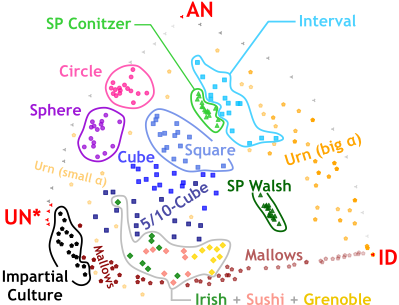
Before we move on to our main experiments, we describe and analyze our dataset. It consists of 292 elections with 8 candidates and 96 voters each, generated from several statistical cultures, that is, models of generating random elections. For example, under impartial culture (IC) each vote is drawn uniformly at random from all possible votes (thus, it closely resembles UN). We present our dataset as a map of elections in Fig. 2. In the full version of the paper we consider two additional datasets.
Below, we discuss each statistical culture used in our dataset and build an intuition on how our indices should evaluate elections generated from them. To this end, we form a new type of a map, which we call a map of preferences, where we look at relations between votes within a single election. In other words, a map of elections gives a bird's eye view of the space of elections, and a map of preferences is a microscope view of a single election.
5.1 Maps of Preferences
To generate a map of preferences for a given election, we first compute the (standard) swap distance between each pair of its votes. Then, based on these distances, we create a map in the same way as for maps of elections (that is, we use the multidimensional scaling algorithm). We obtain a collection of points in 2D, where each point corresponds to a vote in the election, and Euclidean distances between the points resemble the swap distances between the votes they represent.
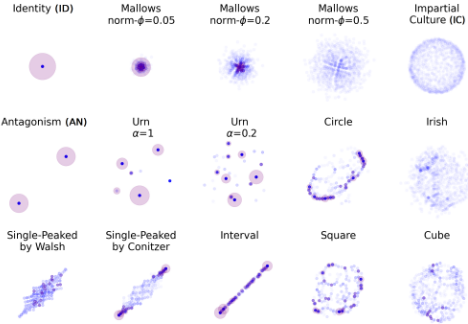
For each model, we generated a single election and created its map of preferences. The results are shown in Fig. 1. The elections have 1000 voters instead of 96, so that the pictures look similar each time we draw an election from the model.
3 Actually, the result comes from W[2]-hardness of the SET COVER problem and a folklore reduction to MAX K-COVER by setting T = N.
5.2 Model Definitions and Analysis
ID, AN, and IC
We first consider ID, AN, and IC elections (which, for the time being, covers for UN). ID and AN are shown as the first entries of the first two rows in Fig. 1. The former, with 1000 copies of the same vote, presented as a single point with a large purple disc, embodies perfect agreement. The latter, with 500 votes of one type and 500 its reverses, represents a very polarized society, which is well captured by the two faraway points with large discs on its map. Under IC, whose map is the last one in the first row, we see no clear structure except that, of course, there are many pairs of votes at high swap distance (they form the higher-density rim). Yet, for each such pair there are also many votes in between. Hence, it is close to being perfectly diverse.
We do not present UN in our maps because it requires at least m! votes. Indeed, from now on, we will consider an approximate variant of UN, i.e., UN∗ , generated by sampling votes from the scaled position matrix of UN.
Mallows Model
The Mallows model is parameterized by the central vote u and the dispersion parameter ϕ ∈ [0, 1]. Votes are generated independently and the probability of generating a vote v is proportional to ϕswap(u,v) . Instead of using the parameter ϕ directly, we follow Boehmer et al. [2021] and use its normalized variant, norm-ϕ ∈ [0, 1], which is internally converted to ϕ (see their work for details; with 8 candidates the conversion is nearly linear). For norm-ϕ = 1, the Mallows model is equivalent to IC, for norm-ϕ = 0 it is equivalent to ID, and for values in between we get a smooth transition between these extremes (or, between agreement and diversity, to use our high-level notions). We see this in the first row of Fig. 1.
Urn Model
In the Pólya-Eggenberger urn model [Berg, 1985; McCabeDansted and Slinko, 2006], we have a parameter of contagion α ∈ [0, ∞). We start with an urn containing one copy of each possible vote and we repeat the following process n times:
We draw a vote from the urn, its copy is included in the election, and the vote, together with α · m! copies, is returned to the urn. For α = 0 the model is equivalent to IC. The larger is the α value, the stronger is the correlation between the votes.
In Fig. 1, urn elections (shown in the middle of the second row) consist of very few distinct votes. For example, for α = 1 we only have seven votes, thus this election's map looks similarly to that for AN-few points with discs. Such elections, with several popular views but without a spectrum of opinions in between, are known as fragmented [Dynes and Tierney, 1994]. Hence, we expect their diversity to be small. As α decreases, urn elections become less fragmented.
We upper-bound the expected number of different votes in an urn election with m candidates, n voters (where n is significantly smaller than m!), and parameter α by ∑ni=1 1/(1+(i-1)α) (the first vote is always unique, the second one is drawn from the original m! votes from the urn with probability 1/(1+α), and so on; if we draw one of the original votes from the urn it still might be the same as one of the previous ones, but this happens with a small probability when n is significantly smaller than m!). For example, for n = 1000 and α equal to 1, our formula gives 7.48. In the literature, authors often use α = 1 [Erdélyi et al., 2015; Keller et al., 2019; Walsh, 2011], sometimes explicitly noting the strong correlations and modifying the model [Erdélyi et al., 2015]. However, smaller values of α are also used [Skowron et al., 2015; McCabe-Dansted and Slinko, 2006]. Since α = 1 gives very particular elections, it should be used consciously.
Single-Peaked Elections
Single-peaked elections [Black, 1958] capture scenarios where voters have a spectrum of opinions between two extremes (like choosing a preferred temperature in a room).
Definition 5 (Black [1958]). Let C be a set of candidates and let ▷ be an order over C, called the societal axis. A vote is single-peaked with respect to ▷ if for each t ∈ [|C|], its top t candidates form an interval w.r.t. ▷. An election is singlepeaked (w.r.t. ▷) if its votes are.
We use the Walsh [Walsh, 2015] and the Conitzer (random peak) models [Conitzer, 2009] of generating single-peaked elections. In the former, we fix the societal axis and choose votes single-peaked with respect to it uniformly at random (so we can look at it as IC over the single-peaked domain). In the Conitzer model we also first fix the axis, and then generate each vote as follows: We choose the top-ranked candidate uniformly at random and fill-in the following positions by choosing either the candidate directly to the left or directly to the right of the already selected ones on the axis, with probability 1/2 (at some point we run out of the candidates on one side and then only use the other one).
In Fig. 1, Conitzer and Walsh elections are similar, but the former one has more votes at large swap distance. Indeed, under the Conitzer model, we generate a vote equal to the axis (or its reverse) with probability 2/m, which for m = 8 is 25%. Under the Walsh model, this happens with probability 1.5% (it is known there are 2m-1 different single-peaked votes and Walsh model chooses each of them with equal probability). Hence, our Conitzer elections are more polarized (see the purple discs at the farthest points) than the Walsh ones, and Walsh ones appear to be more in agreement (in other words, the map for the Conitzer election is more similar to that for AN, and the map for Walsh election is more similar to ID).
Euclidean Models
In d-dimensional Euclidean elections every candidate and every voter is a point in Rd , and a voter prefers candidate a to candidate b if his or her point is closer to that of a than to that of b. To generate such elections, we sample the candidate and voter points as follows: (a) In the d-Cube model, we sample the points uniformly at random from a d-dimensional hypercube [0, 1]d , and (b) in the Circle and Sphere models we sample them uniformly at random from a circle (embedded in 2D space) and a sphere (embedded in 3D space). We refer to the 1-Cube, 2-Cube, and 3-Cube models as, respectively, the Interval, Square, and Cube models. In Fig. 1, we see that as the dimension increases, the elections become more similar to the IC one. The Interval election is very similar to those of Conitzer and Walsh, because 1-Euclidean elections are single-peaked. It is also worth noting that the Circle election is quite polarized (we see an increased density of votes on two opposite sides of its map).
Irish and Other Elections Based on Real-Life Data
We also consider elections generated based on real-life data from a 2002 political election in Dublin [Mattei and Walsh, 2013]. We treat the full Irish data as a distribution and sample votes from it as from a statistical culture. The Irish election in Fig. 1 is, in some sense, between the Cube and Mallows ones for norm-ϕ = 0.5. Intuitively, we would say that it is quite diverse. In the dataset, we also include Sushi and Grenoble elections, similarly generated using different reallife data [Mattei and Walsh, 2013].
6 Final Experiments and Conclusion
In this section we present the results of computing the agreement, diversity, and polarization indices on our dataset.
6.1 Computing the Indices in Practice
First, we compared three ways of computing k-Kemeny distances: the greedy approach, the local search with swap size equal to 1, and a combined heuristic where we first calculate the greedy solution and then try to improve it using the local search. We ran all three algorithms for all k ∈ [96] and for every election in our dataset. The conclusion is that the local search and the combined heuristic gave very similar outcomes and both outperformed the greedy approach. Hence, in further computations, we used the former two algorithm and took the smaller of their outputs.
6.2 Understanding the Map via Agreement, Diversity, and Polarization
Using the κk(E) values computed in the preceding experiment, we calculated diversity and polarization indices of all the elections from our dataset, along with their agreement indices (which are straightforward to compute). We illustrate the results in several ways.
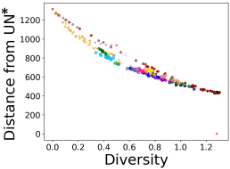
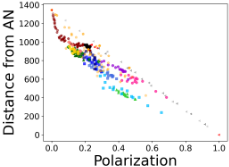
First, we consider Fig. 4. In the left plot, each election from our dataset is represented as a dot whose x/y coordinates are the values of the diversity index and the distance from UN∗ , and whose color corresponds to the statistical culture from which it comes (it is the same as in Fig. 2). The plot on the right is analogous, except that it regards polarization and distance from AN. An analogous plot for agreement and distance from ID is almost perfectly linear. The Pearson correlation coefficient between each of the three indices and the distance from the respective compass election is below -0.9, which means that the correlation is very strong. This is our first indication that the locations on the map of elections, in particular, the one from Fig. 2, can be understood in terms of agreement, diversity, and polarization.
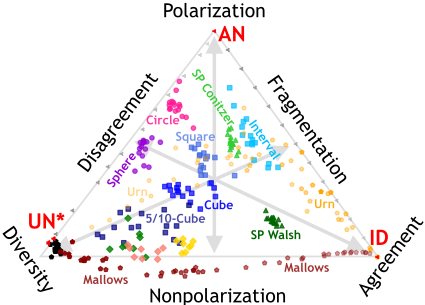
Next, for all three pairs of our indices we plotted our dataset in such a way that each election's x/y coordinates are the values of the respective indices (these plots can be found in the full version of the paper). We observed that each of these plots resembles the original map from Fig. 2. Hence, for the sake of clearer comparison, we took the plot for agreement and diversity indices and, by an affine transformation, converted it to a roughly equilateral triangle spanned between ID, AN, and UN∗ . Fig. 3 presents the result of this operation.
The similarity between Figs. 2 and 3 is striking as most elections can be found in analogous locations. Even the positions of the outliers in the groups areapproximately preserved. Yet, there are also differences. For example, in Fig. 3 elections from most of the statistical cultures are closer to each other than in Fig. 2. Nonetheless, the similarity between these two figures is our second argument for understanding the map in terms of agreement, diversity, and polarization. Specifically, the closer an election is to ID, AN, or UN∗ , the more agreement, polarization, or diversity it exhibits.
6.3 Validation Against Intuition
Finally, let us check our intuitions from Section 5 against the actually computed values of the indices, as presented on the plot from Fig. 3. We make the following observations:
- We see that Mallows elections indeed progress from ID (for which we use norm-ϕ = 0) to IC (for which we use norm-ϕ = 1), with intermediate values of norm-ϕ in between. The model indeed generates elections on the agreement-diversity spectrum.
- Elections generated using the urnmodel with large value of α appear on the agreement-polarization line. Indeed, for very large values of α nearly all the votes are identical, but for smaller values we see polarization effects. Finally, as the values of α go toward 0, the votes become more and more diverse.
- Walsh elections are closer to agreement (ID) and Conitzer elections are closer to polarization (AN).
- High-dimensional Cube elections have fairly high diversity. Circle and Sphere elections are between diversity and polarization.
- Irish elections are between Mallows and highdimensional Cube elections.
All in all, this confirms our intuitions and expectations.
7 Summary
The starting point of our work was an observation that some of the measures of diversity and polarization used in computational social choice literature should, rather, be seen as measures of disagreement. We have proposed two new measures and we have argued that they do capture diversity and polarization. On the negative side, our measures are computationally intractable. Hence, finding a measure that would be easy to compute but that would maintain the intuitive appeal of our ones is an interesting research topic.
Acknowledgements
Krzysztof Sornat was supported by the SNSF Grant 200021_200731/1. This project has received funding from the European Research Council (ERC) under the European Union's Horizon 2020 research and innovation programme (grant agreement No 101002854).


@inproceedings{ijcai2023p299,
  title     = {Diversity, Agreement, and Polarization in Elections},
  author    = {Faliszewski, Piotr and Kaczmarczyk, Andrzej and Sornat, Krzysztof and Szufa, Stanisław and Wąs, Tomasz},
  booktitle = {Proceedings of the Thirty-Second International Joint Conference on
               Artificial Intelligence, {IJCAI-23}},
  publisher = {International Joint Conferences on Artificial Intelligence Organization},
  editor    = {Edith Elkind},
  pages     = {2684--2692},
  year      = {2023},
  month     = {8},
  note      = {Main Track},
  doi       = {10.24963/ijcai.2023/299},
  url       = {https://doi.org/10.24963/ijcai.2023/299},
}
TY - CPAPER TI - Diversity, Agreement, and Polarization in Elections AU - Faliszewski, Piotr AU - Kaczmarczyk, Andrzej AU - Sornat, Krzysztof AU - Szufa, Stanisław AU - Wąs, Tomasz T2 - Proceedings of the Thirty-Second International Joint Conference on Artificial Intelligence, IJCAI-23 PB - International Joint Conferences on Artificial Intelligence Organization PY - 2023 SP - 2684 EP - 2692 DO - 10.24963/ijcai.2023/299 UR - https://doi.org/10.24963/ijcai.2023/299 ER -Copied
Machine-readable versions of this paper, for tools and AI agents:





