
A Hierarchical Approach to Population Training for Human-AI Collaboration
Proceedings of the Thirty-Second International Joint Conference on Artificial Intelligence. Main Track. Pages 3011-3019.
https://doi.org/10.24963/ijcai.2023/336
Keywords
- Machine Learning: ML: Deep reinforcement learning
- Agent-based and Multi-agent Systems: MAS: Human-agent interaction
- Humans and AI: HAI: Human-AI collaboration
Abstract
A major challenge for deep reinforcement learning (DRL) agents is to collaborate with novel partners that were not encountered by them during the training phase. This is specifically worsened by an increased variance in action responses when the DRL agents collaborate with human partners due to the lack of consistency in human behaviors. Recent work have shown that training a single agent as the best response to a diverse population of training partners significantly increases an agent's robustness to novel partners. We further enhance the population-based training approach by introducing a Hierarchical Reinforcement Learning (HRL) based method for Human-AI Collaboration. Our agent is able to learn multiple best-response policies as its low-level policy while at the same time, it learns a high-level policy that acts as a manager which allows the agent to dynamically switch between the low-level best-response policies based on its current partner. We demonstrate that our method is able to dynamically adapt to novel partners of different play styles and skill levels in the 2-player collaborative Overcooked game environment. We also conducted a human study in the same environment to test the effectiveness of our method when partnering with real human subjects. Code is available at https://gitlab.com/marvl-hipt/hipt.
- [Alami et al., 2006] Rachid Alami, Aurélie Clodic, Vincent Montreuil, Emrah Akin Sisbot, and Raja Chatila. Toward human-aware robot task planning. In AAAI spring sympo- sium: to boldly go where no human-robot team has gone before, pages 39-46, 2006.
- [Bacon et al., 2017] Pierre-Luc Bacon, Jean Harb, and Doina Precup. The option-critic architecture. In Proceed- ings of the AAAI Conference on Artificial Intelligence, vol- ume 31, 2017.
- [Bard et al., 2020] Nolan Bard, Jakob N Foerster, Sarath Chandar, Neil Burch, Marc Lanctot, H Francis Song, Emilio Parisotto, Vincent Dumoulin, Subhodeep Moitra, Edward Hughes, et al. The hanabi challenge: A new fron- tier for ai research. Artificial Intelligence, 280:103216, 2020.
- [Berner et al., 2019] Christopher Berner, Greg Brockman, Brooke Chan, Vicki Cheung, Przemysław Debiak, Christy Dennison, David Farhi, Quirin Fischer, Shariq Hashme, Chris Hesse, et al. Dota 2 with large scale deep reinforce- ment learning. arXiv preprint arXiv:1912.06680, 2019.
- [Carroll et al., 2019] Micah Carroll, Rohin Shah, Mark K Ho, Tom Griffiths, Sanjit Seshia, Pieter Abbeel, and Anca Dragan. On the utility of learning about humans for human-ai coordination. Advances in neural information processing systems, 32, 2019.
- [Flet-Berliac, 2019] Yannis Flet-Berliac. The promise of hierarchical reinforcement learning. The Gradient, 2019. https://thegradient.pub/ the-promise-of-hierarchical-reinforcement-learning/. Link
- [Ghost Town Games, 2016] Ghost Town Games. Over- cooked. https://store.steampowered.com/app/448510/ Overcooked/, 2016. Accessed: 2023-01-18. Link
- [Gronauer and Diepold, 2022] Sven Gronauer and Klaus Diepold. Multi-agent deep reinforcement learning: a sur- vey. Artificial Intelligence Review, 55(2):895-943, 2022.
- [Hochreiter and Schmidhuber, 1997] Sepp Hochreiter and Jürgen Schmidhuber. Long short-term memory. Neural computation, 9(8):1735-1780, 1997.
- [Hu et al., 2020] Hengyuan Hu, Adam Lerer, Alex Peysakhovich, and Jakob Foerster. "other-play" for zero-shot coordination. In International Conference on Machine Learning, pages 4399-4410. PMLR, 2020.
- [Hu et al., 2021] Hengyuan Hu, Adam Lerer, Brandon Cui, Luis Pineda, Noam Brown, and Jakob Foerster. Off-belief learning. In International Conference on Machine Learn- ing, pages 4369-4379. PMLR, 2021.
- [Jaques et al., 2019] Natasha Jaques, Angeliki Lazari- dou, Edward Hughes, Caglar Gulcehre, Pedro Ortega, DJ Strouse, Joel Z Leibo, and Nando De Freitas. Social influence as intrinsic motivation for multi-agent deep reinforcement learning. In International conference on machine learning, pages 3040-3049. PMLR, 2019.
- [Kirk et al., 2021] Robert Kirk, Amy Zhang, Edward Grefenstette, and Tim Rocktäschel. A survey of gener- alisation in deep reinforcement learning. arXiv preprint arXiv:2111.09794, 2021.
- [Klien et al., 2004] G. Klien, D.D. Woods, J.M. Bradshaw, R.R. Hoffman, and P.J. Feltovich. Ten challenges for mak- ing automation a "team player" in joint human-agent activ- ity. IEEE Intelligent Systems, 19(6):91-95, 2004.
- [Li et al., 2020] Alexander Li, Carlos Florensa, Ignasi Clav- era, and Pieter Abbeel. Sub-policy adaptation for hierar- chical reinforcement learning. In International Conference on Learning Representations, 2020.
- [Lucas and Allen, 2022] Keane Lucas and Ross E Allen. Any-play: An intrinsic augmentation for zero-shot coor- dination. In Proceedings of the 21st International Con- ference on Autonomous Agents and Multiagent Systems, pages 853-861, 2022.
- [Lupu et al., 2021] Andrei Lupu, Brandon Cui, Hengyuan Hu, and Jakob Foerster. Trajectory diversity for zero-shot coordination. In International Conference on Machine Learning, pages 7204-7213. PMLR, 2021.
- [Mnih et al., 2015] Volodymyr Mnih, Koray Kavukcuoglu, David Silver, Andrei A Rusu, Joel Veness, Marc G Belle- mare, Alex Graves, Martin Riedmiller, Andreas K Fidje- land, Georg Ostrovski, et al. Human-level control through deep reinforcement learning. nature, 518(7540):529-533, 2015.
- [Pateria et al., 2021] Shubham Pateria, Budhitama Sub- agdja, Ah-hwee Tan, and Chai Quek. Hierarchical rein- forcement learning: A comprehensive survey. ACM Com- puting Surveys (CSUR), 54(5):1-35, 2021.
- [Schulman et al., 2015] John Schulman, Philipp Moritz, Sergey Levine, Michael Jordan, and Pieter Abbeel. High- dimensional continuous control using generalized advan- tage estimation. arXiv preprint arXiv:1506.02438, 2015.
- [Schulman et al., 2017] John Schulman, Filip Wolski, Pra- fulla Dhariwal, Alec Radford, and Oleg Klimov. Prox- imal policy optimization algorithms. arXiv preprint arXiv:1707.06347, 2017.
- [Shih et al., 2020] Andy Shih, Arjun Sawhney, Jovana Kondic, Stefano Ermon, and Dorsa Sadigh. On the criti- cal role of conventions in adaptive human-ai collaboration. In International Conference on Learning Representations, 2020.
- [Silver et al., 2016] David Silver, Aja Huang, Chris J Maddi- son, Arthur Guez, Laurent Sifre, George Van Den Driess- che, Julian Schrittwieser, Ioannis Antonoglou, Veda Pan- neershelvam, Marc Lanctot, et al. Mastering the game of go with deep neural networks and tree search. nature, 529(7587):484-489, 2016.
- [Stolle and Precup, 2002] Martin Stolle and Doina Precup. Learning options in reinforcement learning. In Interna- tional Symposium on abstraction, reformulation, and ap- proximation, pages 212-223. Springer, 2002.
- [Strouse et al., 2021] DJ Strouse, Kevin McKee, Matt Botvinick, Edward Hughes, and Richard Everett. Collab- orating with humans without human data. Advances in Neural Information Processing Systems, 34:14502-14515, 2021.
- [Sutton et al., 1999] Richard S. Sutton, Doina Precup, and Satinder Singh. Between mdps and semi-mdps: A frame- work for temporal abstraction in reinforcement learning. Artif. Intell., 112(1-2):181-211, 1999.
- [Vezhnevets et al., 2017] Alexander Sasha Vezhnevets, Si- mon Osindero, Tom Schaul, Nicolas Heess, Max Jader- berg, David Silver, and Koray Kavukcuoglu. Feudal net- works for hierarchical reinforcement learning. In Inter- national Conference on Machine Learning, pages 3540- 3549. PMLR, 2017.
- [Wang et al., 2020] Tonghan Wang, Tarun Gupta, Anuj Ma- hajan, Bei Peng, Shimon Whiteson, and Chongjie Zhang. Rode: Learning roles to decompose multi-agent tasks. In International Conference on Learning Representations, 2020.
- [Yang et al., 2020] Jiachen Yang, Igor Borovikov, and Hongyuan Zha. Hierarchical cooperative multi-agent rein- forcement learning with skill discovery. In Proceedings of the 19th International Conference on Autonomous Agents and MultiAgent Systems, pages 1566-1574, 2020.
- [Zhao et al., 2021] Rui Zhao, Jinming Song, Hu Haifeng, Yang Gao, Yi Wu, Zhongqian Sun, and Yang Wei. Max- imum entropy population based training for zero-shot human-ai coordination. arXiv preprint arXiv:2112.11701, 2021.
References were extracted automatically from the PDF and may contain errors.
Full text extracted automatically from the PDF; figures, tables and equations may differ. The PDF is the version of record.
1 Introduction
The idea of Intelligent agents that can robustly collaborate with humans has long been an aspirational goal in the field of Artificial Intelligence [Klien et al., 2004] and Robotics [Alami et al., 2006]. To do so, agents would have to be able to dynamically adapt their behavior to novel unseen partners. The recent success of Deep Reinforcement Learning (DRL) methods has propelled them as a front-runner candidate in generating such robust collaborative agents. However the early successes of DRL mainly lie in the single-agent [Mnih et al., 2015] or competitive domains [Silver et al., 2016; Berner et al., 2019]. In competitive settings, an optimal DRL agent would be able to outperform its opponent independently of the opponent's behavioral policy. However, DRL agents in cooperative/collaborative settings struggle to achieve good performance with novel partners unseen during training as DRL agents develop cooperative conventions [Shih et al., 2020; Hu et al., 2020] that are only interpretable to its training partner. Multi-agent Reinforcement Learning (MARL) methods [Gronauer and Diepold, 2022] do focus on cooperative domains but mainly deal with teams of agents that are trained jointly for a cooperative task rather than having agents be robust to novel partners. In addition, many DRL methods struggle to generalize well to novel unseen situations [Kirk et al., 2021]. Recent work have shown that training a single RL agent as a best-response greatly increases agents' robustness to novel agent partners [Strouse et al., 2021; Lupu et al., 2021; Zhao et al., 2021]. These methods however only consider partner diversity in terms of conventions/playstyles [Lupu et al., 2021; Strouse et al., 2021], (i.e. how different the agents' policies are from one another) or skill-level [Strouse et al., 2021], (i.e. how capable the agent is at the collaborative task). We propose that truly robust agents would need to not collaborate well with optimal partners of different play styles but also sub-optimal partners of different skill levels To that end, we introduce Hierarchical Population Training (HiPT), a population training method that leverages a hierarchical structure to learn multiple best response policies to collaborate with partners of different skill levels and play-styles. HiPT is inspired by ideas from Hierarchical Reinforcement Learning (HRL) [Pateria et al., 2021], a class of methods in DRL that impose a hierarchical structure on the agent. This hierarchical structure allows the agent to learn a task across multiple states and temporal abstractions. HRL methods typically learn high-level policies which learn multiple sub-goals of the task and lower-level policies that learn primitive actions which execute the said sub-goals. Our key insight is that multiple best-response policies correspond to sub-goals in the HRL framework and could be learned as low-level policies. The high-level policy meanwhile acts as a manager policy that allows the agents to dynamically switch between low-level, best-response policies to adapt to new partners. HiPT has a two-level hierarchical structure that can be trained with the popular PPO algorithm [Schulman et al., 2017] while considering a diverse set of N population partners of varying play styles and skill levels.
We validate HiPT on the two-player cooperative game environment Overcooked [Carroll et al., 2019]. We test our method on a diverse disjoint test set of Self-Play agent partners and against agents trained to mimic human game-play using behavior cloning [Carroll et al., 2019]. We then conducted a large-scale human trial to test our method against real human partners. We show that HiPT outperforms agents of other population-based methods [Strouse et al., 2021] and agents that are trained to adapt to human behavior [Carroll et al., 2019] in overall cooperative capability when partnering with both trained agents and human partners.

We summarize the novel contributions of this work as follows:
- (a) We propose HiPT, an HRL-based method for Human-AI Collaboration that is trained on a population of diverse partners of different play styles and skill levels. (Section 4.1)
- (b) We propose adding influence rewards to train the highlevel policy to encourage the sub-policies to be more distinct. (Section 4.3)
- (c) We show that HiPT outperforms similar Populationbased training methods when partnering with trained agent partners and real human partners. In addition, HiPT is also shown to be preferred as a partner by human partners over FCP [Strouse et al., 2021] and PPOBC [Carroll et al., 2019] (Section 5)
2 RelatedWork
There has been a growing number of works addressing the problem of Human-AI Collaboration. [Carroll et al., 2019] was the recent pioneering work that introduced the Overcooked AI environment and proposed to train PPO agents partnered with agents trained to mimic human gameplay. Though such a model is shown to be more robust to partnering with humans, it requires the collection of human data which could be quite expensive. Strouse et al. [2021] proposed a way to circumvent the process of collecting human data by training a single agent as the best response to a population of diverse partners of varying skill levels by using past checkpoints of the partners. Lupu et al. [2021] and Zhao et al. [2021] also propose using the population training method to increase the robustness of agents in collaborative settings but focus on training partner populations that are diverse in terms of play style by either adding an additional loss term [Lupu et al., 2021] or modifying the reward function [Zhao et al., 2021]. Our method also uses the population training approach but extends the definition of diversity to include both skill level and play style by adopting techniques from both branches of population-based methods. We also design an agent with a specialized hierarchical structure that can learn multiple best response policies to the partner populations.
A separate but related line of research considers the problem of Zero-shot coordination (ZSC) [Hu et al., 2020; Shih et al., 2020; Hu et al., 2021; Lucas and Allen, 2022]. Introduced by Hu et al. [2020], ZSC the framework requires partner agents to be trained independently using the same method. The agents are then paired together and evaluated in cross-play (XP). This class of methods considers a narrower definition of a robust collaborative agent as it does not extend to agents trained with different methods or even human partners but is evaluated in more complex collaborative environments such as Hanabi [Bard et al., 2020]. Though more recent works have considered partners of different methods [Lucas and Allen, 2022]. Our method in contrast solves the problem Human-AI collaboration and evaluates directly partnering with human partners.
One other highly related area to our work is the field of Hierarchical Reinforcement Learning (HRL) [Flet-Berliac, 2019; Pateria et al., 2021]. Sutton et al. [1999] first introduced the idea of learning a task at multiple levels of temporal abstraction in reinforcement learning. Since then, the field has evolved to include a wide range of methods such as the options framework [Stolle and Precup, 2002; Bacon et al., 2017] and feudal learning [Vezhnevets et al., 2017]. Though HRL has mostly been adapted to the domain of single-agent environments, recent years have seen HRL methods being adapted to MARL setting, where teams of agents cooperate on a joint task [Yang et al., 2020; Wang et al., 2020]. To the best of our knowledge, our method is the first to apply HRL to the domain of Human-AI Collaboration or cooperation with unseen novel agents. Our method HiPT is most inspired by the HiPPO [Li et al., 2020] algorithm, which also learns a bi-level policy and is trained using the PPO objective. Our method however is designed for multi-agent cooperative settings with novel partners whereas the original HiPPO work is only evaluated in a single-agent setting. To that end, we reformulate the sub-policies as best response policies rather than individual skills. Furthermore, we added an influence reward component to the high-level policy during training to encourage more distinct sub-policies for the low-level policy.
3 Preliminaries
Multi-agent MDP. The problem of Human-AI collaboration can be formulated as a Multi-agent Markov Decision Process. A Multi-Agent MDP is defined by the tuple
⟨S,A, I, T,R⟩ where I is the set of agents. In this work, we restrict the number of agents to two as we only consider 2player collaborative tasks. S is the set of all possible states, and st ∈ S is the state at time t. A is the set of all possible actions and ait ∈ S is the action taken by agent i at time t. The actions of all agents can be combined to form the joint action at = ⟨a1t , ..., aIt ⟩ at time t. The transition function T (st+1|st, at) determines the transition probability from state st to st+1 given the joint action at. Finally the reward function R(st, at, st+1) is the reward that the agents receive after every state transition. The overall RL objective is for agents to maximize their discounted expected future reward Ri = ∑∞t=0 γ i ri t where γ i is each agents discount factor.
Hierarchical Proximal PolicyOptimization (HiPPO) [Li et al., 2020] is introduced as an augmentation to the Proximal Policy Optimization [Schulman et al., 2017] algorithm by introducing a two-level hierarchical structure to the agent. The agent consists of a high level manager πθh (z|s) and low-level sub-policy πθl (a|z, s). The manager outputs a sub-policy command, z which is the prior for the sub-policy network. The prior z is kept constant for p number of steps which is randomly sampled from a fixed range. Both the high-level manager and the low-level sub-policy are trained using the PPO objective function.
4 Method
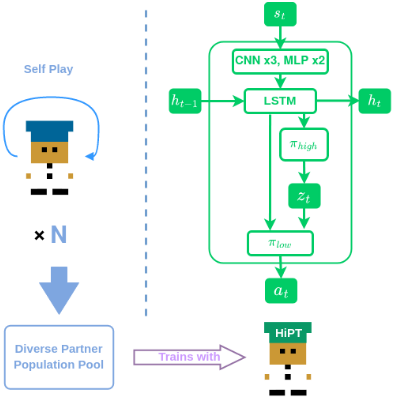
In this section, we describe the Hierarchical Population Training method in detail. We first describe the procedure of training a diverse partner population. We then describe the training procedure of HiPT agent itself. An overview of HiPT can be seen in Figure 2.
4.1 Diverse Partner Population Training
For the training of the partner population, we train a pool of randomly seeded agents using PPO in SP. We consider the diversity of partners across two dimensions:
- Play Styles Formally, we define play style similar to how it is described in [Lupu et al., 2021] referred to as the Best Responses (BR) classes hypothesis, two agents, represented by policies π1 and π2 are said to belong to the same class/share the same play style if the average return of pairing π1 and π2, J(π1, π2) is similar to that of the average self-play return of π1 and π2: JSP (π1) and JSP (π2), i.e. J(π1, π2) ≈ JSP (π1) ≈ JSP (π2).
- Skill Level We define an agent's skill level simply by its average self-play return JSP (π), i.e. a highly skilled agent will obtain a high return in self-play and vice versa.
To ensure that agents in the population will have a diverse set of play styles, we adopt the technique proposed [Lupu et al., 2021] by adding a negative Jensen Shannon Divergence (JSD) term to the population training objective. The JSD term is calculated by:
where H(π) denotes the entropy of the policy and ˆπ is the average policy of the agent population. Intuitively this term encourages different play styles as the more dissimilar the policies are from one another, the higher the value of the JSD term.
To ensure that the partner population contains partners of different skill-level, we follow the procedure proposed by Strouse et.al. [2021] where past agents corresponding to checkpoints agents are included to represent less skilled partners. More specifically, for each agent trained using self-play, we add three versions of the agent to the partner population: the fully trained agent, an agent from a past checkpoint that achieves around half the average return as the fully trained agent, and a randomly initialized agent.
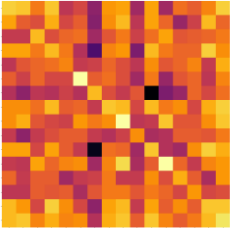
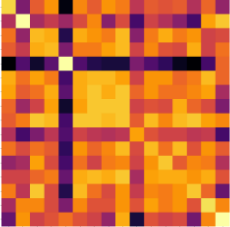
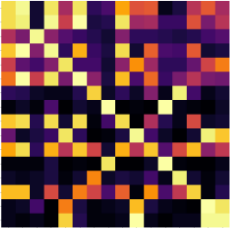
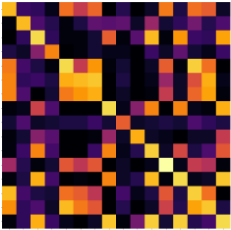
We showcase the resultant diverse partner population by calculating the pairwise crossplay average return of a trained partner population of size 16. We then plotted the returns in the form of a matrix heatmap and show them in Figure 3.
4.2 Hierarchical Population Training
HiPT learns a high-level policy πθhigh (z|s) and low-level policy πθlow (a|z, s). πθhigh (z|s) takes in the environment state, s and outputs the sub-policy prior, z while πθlow (a|z, s) takes in both s and z and outputs the primitive action a. Each sub-policy z is executed for a random p number of steps which are sampled uniformly from a lower and upper bound (pmin, pmax).
In the context of HiPT, the low-level policy represents the best response policies to the partner population, conditioned by the high-level prior z. The high-level policy can then be thought of as a manager policy that chooses the most suitable BR policy as a response to the current partner's behavior. To

(e) Counter Circuit
Figure 3: Heat map showing the average pairwise return of a Diverse Partner Population of 16 SP Agents in Overcooked across 5 separate layouts. Rewards are calculated over 5 episodes of length T = 400. Lighter colored squares represent pairs that achieve higher reward, which indicates that the two agents belong to the same class of play-styles, while darker color square pairs that achieve comparatively low reward, indicating that they are incompatible in terms of play-style. The heatmap shows the population training is able to generate agents with groups of distinct play styles in the Asymmetric Advantages, Forced Coordination, and Counter Circuit layouts, while the classes in Cramped Room and Coordination Ring are less distinct possibly due to the simplicity of the 2 layouts that do not require much variation in play styles. (See Figure 1 for reference to each layout)
.
further ensure that each learned BR sub-policies results in a distinct shift in behavior in the low-level policy we add an additional influence reward to the high-level policy which we detail in the following sub-section.
During the policy rollout stage of training, we uniformly sample a partner policy, πpn from the diverse partner population. We then roll out an entire trajectory episode with πpn as the partner.
4.3 Influence Reward for High-Level Policy
As the high-level manager policy is responsible for picking the most suitable BR sub-policy, We would like to ensure each sub-policy prior, zj results in a distinct change in the low-level policy. In other words, we would like to encourage each zj to have high influence over the behavior of πθlow (a|s, z).
To that end, inspired by [Jaques et al., 2019] during training we award influence reward, rinf to the high-level policy in addition to the base reward received from the environment. The influence reward at each time step is calculated by:
where DKL[·||·] is KL-divergence between two distributions. In our case, we are calculating the divergence between lowlevel policy given prior zt and marginal policy low-level policy πθlow (at|st).
The influence reward models how much a given sub-policy prior, z influences the low-level policy, πθlow (a|s, z). The high-level policy will receive a higher influence reward if the given sub-policy prior zt results in a significantly different low-level policy at time t as compared to a low-level policy that is not given prior zt. The marginal policy πθlow (at|st) can be computed by taking the expectation of the product between the low and high-level policies over the set of priors. Both distributions can be inferred directly at every time step given a discrete set of z values. The full reward for the highlevel policy is calculated by:
Algorithm 1 HiPT Rollout
Input: Set of N agent partners {πp1 , ..., πpN }, high level policy πθhigh (z|s), low-level policy πθlow (a|s, z) Parameter: Execution bounds for low-level policy [pmin, pmax], Influence reward coefficient γ, Environment reward coefficient α 1: Sample random partner πpn ∼ {πp1 , ..., πpN } 2: for t = 0 to T do 3: Sample p ∼ Uniform(pmin, pmax) 4: Sample low level policy prior zt ∼ πθhigh (zt|st) 5: for t′ = t to t + p do 6: Sample action at′ ∼ πθlow (at′ |st′ , zt) 7: Sample partner action apt′ ∼ πpn (at′ |st′ ) 8: Obtain new state st′+1 and environment reward rt′ according to joint action (at′ , apt′ ) 9: Calculate influence reward rinf t′ according to (2) 10: Set rlt′ ← rt′ 11: end for 12: Set t ← t +p 13: Calculate high-level reward according to (3) 14: end for Output: high level trajectory: (s0, z0, rh 0 , sp1 , zp1 , rh p1 , ..., spm ), low-level trajectory: (s0, a0, rl0 , s1, a1, rl0 , ..., sT )
where p is the random step duration of the previous subpolicy. α and γ are the coefficients for the environment and influence reward respectively. As the high-level policy outputs z at a random number of steps, we average out the highlevel reward over p to normalize the value range of rh t .
We further validate the effect of adding the influence reward in an ablation study detailed in Section 5.3. The full rollout algorithm for HiPT is detailed in Algorithm 1. Note that the high-level policies and low-level policies operate at different temporal frequencies, resulting in high level trajectories that are shorter than the episode length, T.
4.4 Training Objective
Following the same procedure as in HiPPO, we then train both the high-level policies and low-level policies on their respective trajectories with the clipped PPO objective [Schulman et al., 2017]:
where ˆ At is the estimated advantage at time t computed using Generalized Advantage Estimation (GAE) [Schulman et al., 2015], rt(θ) is the ratio of probabilities under the new and old policies and ϵ is the clipping parameter. The entire agent is trained end-to-end by summing up the objectives of the high and low-level policies.
5 Experiments
Environment. We focus the evaluation of our method on the open-sourced 1 two-player Overcooked environment by Carroll et. al. [2019] based on the collaborative game Overcooked [Ghost Town Games, 2016].
1 https://github.com/HumanCompatibleAI/overcooked ai
In the game. two agents are tasked to deliver bowls of onion soup through a series of intermediary steps: picking up onions and putting them in the cooking pot for a total of three times, waiting for the soup to finish cooking, picking up a bowl and collecting the soup and finally delivering the soup to the counter. Each successful delivery grants both agents with a +20 reward. The objective of both agents is to maximize the reward in T = 400 time steps.
We evaluate HiPT on the same set 5 of layouts as [Strouse et al., 2021; Carroll et al., 2019], which are Cramped Room, Asymmetric Advantages, Coordination Ring, Forced Coordination, and Counter Circuit. Visualization of layouts is shown in Figure 1
Training and Implementation Details. We train HiPT on all five layouts for 108 environment steps. We set the upper and lower bound of the execution length of the low-level policy, (pmin, pmax) to [20, 40] steps. For the high-level policy reward, we set the influence reward coefficient,γ from (3) to 1000 and linearly anneal it to 1 over the entire training process while the environment reward coefficient α is set to 1.
The network architecture of our agent is outlined in Figure 2. It consists of 3 initial convolutional layers followed by 2 fully connected layers followed by a recurrent LSTM layer [Hochreiter and Schmidhuber, 1997]. The network then splits into the high and low-level policy, both represented by fully connected layers. The prior, z from the high-level policy is represented as a one-hot vector which is then concatenated to the input of the low-level policy. For every layout except Forced Coordination and Counter Circuit, we set the number of sub-policies to learn to 4. For Forced Coordination and Counter Circuit, we set it to 5 and 6 respectively, corresponding to the number of distinct play styles in each population as reflected in Figure 3.
Comparison Baselines. We compare HiPT with two separate baseline methods:
- PPOBC [Carroll et al., 2019] is an agent trained using the standard PPO algorithm but with a behavioral cloned Human Model, abbreviated as BC as its partner during training. The BC human model in turn is trained using human-human trajectory data collected by Carroll et.al. We train a PPOBC for each of the 5 different Overcooked layouts.
- Fictitious Co-Play (FCP) [Strouse et al., 2021]. For our comparison, we train the FCP baseline on the same partner population as HiPT to ensure a fair comparison, i.e. we reduce the number of partners from 32 in the original work to 16 but encourage also more diversity in terms of different play-style in the partner population by adding the JSD loss.
5.1 Evaluation with Novel Trained Agents
We first evaluate HiPT and the baseline comparisons when partnering with two different types of novel trained partner agents:
| Layout | PPOBC | FCP | HiPT |
|---|---|---|---|
| Cramped Room | 106.25 | 172.5 | 174.71 |
| Asymmetric Advantages | 125.83 | 256.67 | 266.88 |
| Coordination Ring | 28.34 | 116.58 | 128.54 |
| Forced Coordination | 31.6 | 69.38 | 75.63 |
| Counter Circuit | 2.71 | 65.63 | 106.46 |
| Layout | PPOBC | FCP | HiPT |
|---|---|---|---|
| Cramped Room | 113 | 148 | 157 |
| Asymmetric Advantages | 200 | 262 | 267 |
| Coordination Ring | 112 | 121 | 149 |
| Forced Coordination | 48 | 44 | 51 |
| Counter Circuit | 32 | 39 | 48 |
Diverse Self-Play Partners. We trained a separate population of diverse agent partners of size 16 with Self-Play following the same procedure outlined in Section 4.1 to act as an evaluation set of partners. To simulate partners of varying skill levels, we evaluate each of the methods on three versions of each SP partner: Fully trained, a past checkpoint with an intermediate return, and a randomly initialized version, following the evaluation scheme in [Strouse et al., 2021].
We average the return across all three skill levels and across both starting positions, (blue and green hat) on all five layouts and present the results in Table 1.
Human Proxy Partners (Hproxy). We follow the procedure outlined in [Carroll et al., 2019] to train a behaviorally cloned human model using the open-sourced human-human trajectory data 2 . Crucially the set of human trajectories used to train Hproxy and the data used to train the BC model are disjoint so as to ensure that PPOBC would not have an unfair advantage of having access to the evaluation model during training. For Hproxy, we similarly average the average return across both starting positions for all 5 layouts and compile them in Table 2.
Our results show that HiPT outperforms both the modified version of FCP and PPOBC when partnered with both types of trained agent partners.
5.2 Ablation Study on the Effect of Adding Influence Reward
We also conduct an ablation study to study the effect of the addition of the influence reward to the high-level policy in HiPT. For each of the 5 different Overcooked layouts, we trained a modified version of the HiPT, with the only change being the absence of the influence reward to the high-level policy. We then partnered this reduced version HiPT with both the evaluation SP partners and Hproxy partners and compare the average return with the full HiPT agent with the influence reward. We present the results of the ablation study in Table 3.
2 https://github.com/HumanCompatibleAI/human aware rl/
Our results show that with the exception of partnering with diverse SP partners in the Forced Coordination layout, the addition of influence reward on the high-level results in consistently better average returns across all layouts when partnered with all types of novel partners.
5.3 EvaluationWith Real Human Partners
We then conduct a user study to evaluate the performance of HiPT as compared other baseline comparisons when partnering with real human partners in Overcooked. We recruit players from Amazon Mechanical Turk 3 to participate in our study (N=72 ; 9.7% female, 52.8% male, 9.7% others; median age 25 - 35 years old). Similar to [Strouse et al., 2021], we used a within-participant design: Each player is invited to play 10 rounds of games. And, each round consists of 2 episodes where the layout is kept the same but the AI partners will be different. At the end of every round, the human player will be required to provide their subjective preference on the 2 agent partners they partnered with.
Upon starting the study, each participant first reads the game instruction and plays 3 tutorial games with an independent AI partner outside of the comparison baselines. Each episode lasts T = 400 steps (one minute). Then, each participant would play the 10 pairs of games and report their preference between the 2 comparing agents on a binary scale (either -1 or +1 for every preference decision made). The identity of the AI partner is masked so the participant could only give their subjective preferences over the agents based on the agent's partnering capabilities. After completing all the games, the participants are requested to complete a demographic survey to indicate their gender, age group, and to provide a self-evaluation of their experience with video games as an estimation of the participant's skill level.
We then perform a repeated measures ANOVA test to compare the effect of AI partners on the reward. There was a statistically significant difference in reward across the players F (2, 142) = 138.8133, p < 0.001.
Finding One: HiPT model performs best with a human player, achieving the highest averaged reward across all layouts. We conduct a post-hoc Tukey's Honestly Significant Difference (HSD) test for pair-wise comparison of HiPT against FCP agent and PPOBC respectively, we found that HiPT when paired with human players resulted in higher average rewards across all layouts. HiPT's mean reward is significantly higher than that of FCP with a mean difference of 19.01 (p < 0.001). HiPT's mean reward is significantly higher than that of PPOBC with a mean difference of 64.49 (p < 0.001). We show the results by layout in Figure 4. In particular, we see a significant improvement for HiPT in the coordination ring and counter circuit layouts when compared with FCP. This resembles the results when validating with a Self-play agent and a Human proxy agent as shown in Table 1 and Table 2. This validates our proposed idea that a hierarchical agent structure increases the robustness of the agent's collaborative capability.
| Layout | Hproxy | diverse SP | ||
|---|---|---|---|---|
| with Influ rew. | w/o Influ rew. | with Influ rew. | w/o Influ rew. | |
| Cramped Room | 157.00 | 155.00 | 174.71 | 174.58 |
| Asymmetric Advantages | 267.00 | 238.00 | 266.88 | 255.63 |
| Coordination Ring | 149.00 | 130.00 | 128.54 | 106.25 |
| Forced Coordination | 51.00 | 36.00 | 75.63 | 80.42 |
| Counter Circuit | 48.00 | 21.00 | 106.46 | 55.00 |
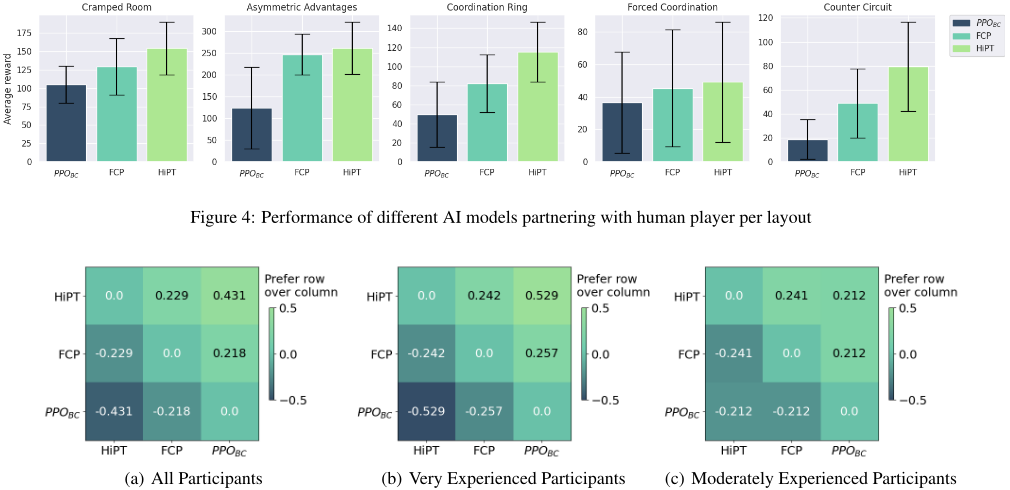
Finding Two: Participants prefer HiPT agent as a partner over all other agents in the preference survey. Outside of the collaborative capability in terms of total reward, we also study the subjective partner preference of the human participants. Overall, HiPT is the most preferred AI partner in our human studies as shown in Figure 5(a). The scale shows the averaged preference between 2 agents on a binary scale. We see a strong correlation between the averaged reward and the participants' preference for an agent. The participants prefer AI partners which could yield a higher reward. We further break down participants' preferences by their self-reported video game experience in Figure 5(b) and Figure 5(c) for very experienced and moderately experienced. Very experienced participants make up the highest portion of the overall number of participants 64.6% while we only receive very few (4)
participants that self-report to have low experience hence we omit the results for that class of participants. In both classes of participants, HiPT remains the preferred partner.
6 Conclusion
In this work, we introduced Hierarchical Population Training (HiPT), a Hierarchical Reinforcement Learning method for Human-AI Collaboration. HiPT builds upon previous population-based training methods for cooperative agents by extending the diversity of population partners to include partners of diverse play styles and skill levels. In addition, a bi-level hierarchical architecture in HiPT to allow it to learn multiple best-response sub-policies to the partner population in the low-level policy. We show training HiPT with a diverse partner population outperforms other similar methods when partnering with both diverse trained agent partners and real human partners. We also show that human partners prefer HiPT over other types of agents in our human study.
Acknowledgments
This research was supported by the National Research Foundation, Prime Minister's Office, Singapore, under its AI Singapore Program (AISG Award No: AISG2-RP-2020-016).
@inproceedings{ijcai2023p336,
  title     = {A Hierarchical Approach to Population Training for Human-AI Collaboration},
  author    = {Loo, Yi and Gong, Chen and Meghjani, Malika},
  booktitle = {Proceedings of the Thirty-Second International Joint Conference on
               Artificial Intelligence, {IJCAI-23}},
  publisher = {International Joint Conferences on Artificial Intelligence Organization},
  editor    = {Edith Elkind},
  pages     = {3011--3019},
  year      = {2023},
  month     = {8},
  note      = {Main Track},
  doi       = {10.24963/ijcai.2023/336},
  url       = {https://doi.org/10.24963/ijcai.2023/336},
}
TY - CPAPER TI - A Hierarchical Approach to Population Training for Human-AI Collaboration AU - Loo, Yi AU - Gong, Chen AU - Meghjani, Malika T2 - Proceedings of the Thirty-Second International Joint Conference on Artificial Intelligence, IJCAI-23 PB - International Joint Conferences on Artificial Intelligence Organization PY - 2023 SP - 3011 EP - 3019 DO - 10.24963/ijcai.2023/336 UR - https://doi.org/10.24963/ijcai.2023/336 ER -Copied
Machine-readable versions of this paper, for tools and AI agents:





