
On Approximating Total Variation Distance
Proceedings of the Thirty-Second International Joint Conference on Artificial Intelligence. Main Track. Pages 3479-3487.
https://doi.org/10.24963/ijcai.2023/387
Keywords
- Machine Learning: ML: Other
Abstract
Total variation distance (TV distance) is a fundamental notion of distance between probability distributions. In this work, we introduce and study the problem of computing the TV distance of two product distributions over the domain {0,1}^n. In particular, we establish the following results.
1. The problem of exactly computing the TV distance of two product distributions is #P-complete. This is in stark contrast with other distance measures such as KL, Chi-square, and Hellinger which tensorize over the marginals leading to efficient algorithms.
2. There is a fully polynomial-time deterministic approximation scheme (FPTAS) for computing the TV distance of two product distributions P and Q where Q is the uniform distribution. This result is extended to the case where Q has a constant number of distinct marginals. In contrast, we show that when P and Q are Bayes net distributions the relative approximation of their TV distance is NP-hard.
- [Arjovsky et al., 2017] Martin Arjovsky, Soumith Chintala, and Léon Bottou. Wasserstein generative adversarial net- works. In Proc. of ICML, pages 214-223. PMLR, 2017.
- [Bhattacharyya et al., 2020] Arnab Bhattacharyya, Sutanu Gayen, Kuldeep S. Meel, and N. V. Vinodchandran. Efficient distance approximation for structured high- dimensional distributions via learning. In Proc. of NeurIPS, 2020.
- [Bhattacharyya et al., 2021] Arnab Bhattacharyya, Sutanu Gayen, Saravanan Kandasamy, and N. V. Vinodchandran. Testing product distributions: A closer look. In Algorith- mic Learning Theory, 16-19 March 2021, Virtual Confer- ence, Worldwide, volume 132 of Proceedings of Machine Learning Research, pages 367-396. PMLR, 2021.
- [Bhattacharyya et al., 2022] Arnab Bhattacharyya, Sutanu Gayen, Kuldeep S. Meel, Dimitrios Myrisiotis, Aduri Pa- van, and N. V. Vinodchandran. On approximating total variation distance. CoRR, abs/2206.07209, 2022.
- [Cook, 1971] Stephen A. Cook. The complexity of theorem- proving procedures. In Michael A. Harrison, Ranan B. Banerji, and Jeffrey D. Ullman, editors, Proc. of STOC, pages 151-158. ACM, 1971.
- [Cortes et al., 2007] Corinna Cortes, Mehryar Mohri, and Ashish Rastogi. L p distance and equivalence of probabilis- tic automata. Int. J. Found. Comput. Sci., 18(4):761-779, 2007.
- [de Colnet and Meel, 2019] Alexis de Colnet and Kuldeep S. Meel. Dual hashing-based algorithms for discrete integra- tion. In Proc. of CP, pages 161-176. Springer, 2019.
- [Dixon et al., 2020] Peter Dixon, Sutanu Gayen, Aduri Pa- van, and N. V. Vinodchandran. Perfect zero knowledge: New upperbounds and relativized separations. In Rafael Pass and Krzysztof Pietrzak, editors, Proc. of TCC, vol- ume 12550 of Lecture Notes in Computer Science, pages 684-704. Springer, 2020.
- [Dyer et al., 1993] Martin E. Dyer, Alan M. Frieze, Ravi Kannan, Ajai Kapoor, Ljubomir Perkovic, and Umesh V. Vazirani. A mildly exponential time algorithm for ap- proximating the number of solutions to a multidimensional knapsack problem. Comb. Probab. Comput., 2:271-284, 1993.
- [Dyer, 2003] Martin E. Dyer. Approximate counting by dy- namic programming. In Proc. of STOC, June 9-11, 2003, San Diego, CA, USA, pages 693-699. ACM, 2003.
- [Feng et al., 2023] Weiming Feng, Heng Guo, Mark Jerrum, and Jiaheng Wang. A simple polynomial-time approxima- tion algorithm for total variation distances between prod- uct distributions. In Proc. of SOSA, 2023.
- [Garey and Johnson, 1979] M. R. Garey and David S. John- son. Computers and Intractability: A Guide to the Theory of NP-Completeness. W. H. Freeman, 1979.
- [Goldreich et al., 1999] Oded Goldreich, Amit Sahai, and Salil P. Vadhan. Can statistical zero knowledge be made non-interactive? or on the relationship of SZK and NISZK. In Proc. of CRYPTO, pages 467-484, 1999.
- [Goodfellow et al., 2014] Ian Goodfellow, Jean Pouget- Abadie, Mehdi Mirza, Bing Xu, David Warde-Farley, Sherjil Ozair, Aaron Courville, and Yoshua Bengio. Gen- erative adversarial nets. Advances in neural information processing systems, 27, 2014.
- [Gopalan et al., 2010] Parikshit Gopalan, Adam R. Kli- vans, and Raghu Meka. Polynomial-time approximation schemes for knapsack and related counting problems us- ing branching programs. Electron. Colloquium Comput. Complex., page 133, 2010.
- [Kiefer, 2018] Stefan Kiefer. On computing the total varia- tion distance of hidden markov models. In Proc. of ICALP, pages 130:1-130:13, 2018.
- [Lyngsø and Pedersen, 2002] Rune B. Lyngsø and Christian N. S. Pedersen. The consensus string problem and the complexity of comparing hidden markov models. J. Com- put. Syst. Sci., 65(3):545-569, 2002.
- [Malka, 2015] Lior Malka. How to achieve perfect simula- tion and a complete problem for non-interactive perfect zero-knowledge. J. Cryptol., 28(3):533-550, 2015.
- [Morris and Sinclair, 2004] Ben Morris and Alistair Sinclair. Random walks on truncated cubes and sampling 0-1 Knap- sack solutions. SIAM J. Comput., 34(1):195-226, 2004.
- [Pearl, 1989] Judea Pearl. Probabilistic reasoning in intel- ligent systems -networks of plausible inference. Morgan Kaufmann series in representation and reasoning. Morgan Kaufmann, 1989.
- [Pote and Meel, 2021] Yash Pote and Kuldeep S. Meel. Test- ing probabilistic circuits. In Marc'Aurelio Ranzato, Alina Beygelzimer, Yann N. Dauphin, Percy Liang, and Jen- nifer Wortman Vaughan, editors, Advances in Neural In- formation Processing Systems 34: Annual Conference on Neural Information Processing Systems 2021, NeurIPS 2021, December 6-14, 2021, virtual, pages 22336-22347, 2021.
- [Sahai and Vadhan, 2003] Amit Sahai and Salil P. Vadhan. A complete problem for statistical zero knowledge. J. ACM, 50(2):196-249, 2003.
- [Smith et al., 2017] David Smith, Sara Rouhani, and Vibhav Gogate. Order statistics for probabilistic graphical mod- els. In Proceedings of the 26th International Joint Confer- ence on Artificial Intelligence, IJCAI'17, page 4625-4631. AAAI Press, 2017. IJCAI
- [Stefankovic et al., 2012] Daniel Stefankovic, Santosh S. Vempala, and Eric Vigoda. A deterministic polynomial- time approximation scheme for counting knapsack solu- tions. SIAM J. Comput., 41(2):356-366, 2012.
- [Stockmeyer, 1976] Larry J. Stockmeyer. The polynomial- time hierarchy. Theor. Comput. Sci., 3(1):1-22, 1976.
- [Toda, 1991] Seinosuke Toda. PP is as hard as the polynomial-time hierarchy. SIAM J. Comput., 20(5):865- 877, 1991.
References were extracted automatically from the PDF and may contain errors.
Full text extracted automatically from the PDF; figures, tables and equations may differ. The PDF is the version of record.
1 Introduction
An overarching theme in modern machine learning is the use of probability distributions to describe data. Datasets are often modeled by high-dimensional distributions with additional structures reflecting correlations among the features. In this context, a basic problem is distance computation: Given two distributions P and Q, compute ρ(P,Q) for a distance measure ρ. For example, P and Q could be the outputs of two unsupervised learning algorithms, and one could ask how much they differ. As another example, a key component of generative adversarial networks [Goodfellow et al., 2014; Arjovsky et al., 2017] is the discriminant which approximates the distance between the model and the true distributions.
Given two distributions P and Q over a finite domain D, their total variation (TV) distance or statistical difference dTV(P,Q) is defined as
which is also equal to ∑x∈D max{0, P(x) - Q(x)}. The total variation distance satisfies certain fundamental properties. First, it has a physical interpretation: The TV distance between two distributions is the maximum bias of any event with respect to the two distributions. Second, it satisfies many mathematically desirable properties: It is bounded, it is a metric, and it is invariant with respect to bijections. Because of these reasons, the total variation distance is one of the main distance measures employed in a wide range of areas including probability and statistics, machine learning, information theory, and pseudorandomness.
In this work, we study the total variation distance from a computational perspective. Given two distributions P and Q over a finite domain D, how hard is it to compute dTV(P, Q)? If P and Q are explicitly specified by the probabilities of all of the points of the (discrete) domain D, summing up the absolute values of the differences in probabilities at all points leads to a simple linear time algorithm. However, in many applications, the distributions of interest are of a high dimension with succinct representations. In these scenarios, since the size of the domain D is very large, an O(|D|) algorithm is highly impractical. Therefore, a fundamental computational question is: Can we design efficient algorithms (with running time polynomial in the size of the representation) for computing the TV distance between two high-dimensional distributions with succinct representations?
The simplest model for a high-dimensional distribution is the product distribution, which is a product of independent Bernoulli trials. More precisely, a product distribution P over D = {0, 1}n is succinctly described by n parameters p1, . . . , pn where each pi ∈ [0, 1] is independently the probability that the i-th coordinate equals 1. Product distributions serve as a great testing ground for various intuitions regarding computational statistics, due to their ubiquity and simplicity. Despite their simplicity, surprisingly little is known about the complexity of computing the TV distance between product distributions. A very recent result shows the existence of a fully polynomial-time randomized approximation scheme (FPRAS) to relatively approximate the TV distance between two product distributions [Feng et al., 2023]. However, this result does not shed light on the complexity of the exact computation of TV distance as well as the existence of deterministic approximation schemes (FPTAS). Understanding the computational landscape of the total variation distance of product distributions is an important question. The present work makes significant progress towards this research goal.
1.1 Our Contributions
Our contributions are the following:
- We show that the exact computation of the total variation distance between two product distributions P and Q is #P-complete (Theorem 4). This hardness result holds even when the distribution Q has at most 3 distinct onedimensional marginals. Hence it is unlikely that there is an efficient algorithm for this computational problem, as an efficient algorithm for this problem would lead to efficient algorithms for many hard counting problems, including that of computing the number of satisfying assignments of a Boolean formula and all of the problems in the Polynomial-time Hierarchy [Stockmeyer, 1976; Toda, 1991].
This is a surprising result, given that for many other distance measures such as Hellinger, Chi-square, and KL, there are efficient algorithms for computing the distance between two product distributions. This is so, as these distances tensorize over their marginals (folklore; see also [Bhattacharyya et al., 2021]), in the sense that they are easily expressible in terms of their one-dimensional marginals.
- We design a fully polynomial-time deterministic approximation scheme (FPTAS) that computes a relative approximation of the TV distance between two product distributions P and Q where Q is the uniform distribution (Theorem 9). Building on the techniques developed, we design an FPTAS for the case when Q has a constant number of distinct one-dimensional marginals (Theorem 12; Theorem 11). This, combined with the earliermentioned hardness result, completely characterizes the complexity of TV distance computation for product distributions when one of the distributions has a constant number of one-dimensional marginals.
- We investigate the complexity of the problem when the distributions P and Q are slightly more general than product distributions. In particular, we show that it is NP-hard to relatively approximate the TV distance between two sparse Bayesian networks [Pearl, 1989] (see Theorem 8).
In summary, our study showcases the rich complexity landscape of the problem of total variation distance computation, even for simple distributions.
2 Preliminaries
We use [n] to denote the ordered set {1, . . . , n}. We will use log to denote log2 and U to denote the uniform distribution over the sample space. Throughout the paper, we shall assume that all probabilities are represented as rational numbers of the form a/b.
A Bernoulli distribution with parameter p is denoted by Bern(p). A product distribution is a product of independent Bernoulli distributions. A product distribution P over {0, 1}n can be described by n parameters p1, . . . , pn where each pi ∈
[0, 1] is the probability that the i-th coordinate equals 1 (such a P is usually denoted by ⊗ni=1 Bern(pi)). For any x ∈ {0, 1}n , the probability of x with respect to the distribution P is given by P(x) = ∏i∈S pi ∏i∈[n]\S (1-pi) ∈ [0, 1], where S ⊆ [n] is such that i ∈ S if and only if the i-th coordinate of x is 1, independently.
DTVPRODUCT is the following computational problem: Given two product distributions P and Q over the sample space {0, 1}n , compute dTV(P, Q). When the distribution Q is the uniform distribution over {0, 1}n , we denote the above problem by DTVPRODUCTUNIF. A Bayes net is specified by a directed acyclic graph (DAG) and a sequence of conditional probability tables (CPTs), one for each of its nodes (and for each setting of the parents of each node). In this way, one may define a probability distribution over the nodes of a Bayes net. We will also consider the problem of computing dTV(P,Q) where P and Q are Bayes net distributions, which we denote by DTVBAYESNET.
A function f from {0, 1}∗ to non-negative integers is in the class #P if there is a polynomial time non-deterministic Turing machine M so that for any x, f(x) is equal to the number of accepting paths of M(x). Our hardness result will make use of the known #P-complete problem #SUBSETPROD which is a counting version of the NP-complete problem SUBSETPROD (see [Garey and Johnson, 1979]; the proof is attributed to Yao). #SUBSETPROD is the following problem: Given integers a1, . . . , an, and a target number T, compute the number of sets S ⊆ [n] such that ∏i∈S ai = T .
We also require a counting version of the KNAPSACK problem, #KNAPSACK which is defined as follows: Given weights a1, . . . , an and capacity b, compute the number of sets S ⊆ [n] such that ∑i∈S ai ≤ b. It is known that #KNAPSACK is #P-complete.
Definition 1. A function f : {0, 1}∗ → R admits a fully polynomial-time approximation scheme (FPTAS) if there is a deterministic algorithm A such that for every input x (of length n) and ϵ > 0, A on inputs x and ε outputs a (1 + ε)- relative approximation of f(x), i.e., a value v that lies in the interval [f(x)/(1 + ε), (1 + ε)f(x)]. The running time of A is polynomial in n, and 1/ε.
We require the following result from [Gopalan et al., 2010].
Lemma 2 ([Gopalan et al., 2010]). There is an FPTAS for #KNAPSACK.
In our work, we shall also use the following adaptation of the framework that was introduced by [Gopalan et al., 2010]. We fix some terminology first. For a set S ⊆ [n] its Hamming weight (or cardinality) |S| is the number of 1's in its characteristic vector in {0, 1}n . Given a vector v in {0, 1}n and a set S = {i1, . . . , ik} ⊆ [n], the projection of v at S is the string vi1 · · · vik .
Lemma 3 (Following [Gopalan et al., 2010]; proof in the extended version [Bhattacharyya et al., 2022]). There is a deterministic algorithm that, given a #KNAPSACK instance (a1, . . . , an, b) of total weight W = ∑i ai + b, δ > 0, a k-size partition S1, . . . , Sk of [n] for some constant k, and r1, . . . , rk ∈ [n] such that ri ≤ |Si|, outputs a (1 + δ)relative approximation of the number of KNAPSACK solutions such that their projections at sets S1, . . . , Sk have Hamming weights r1, . . . , rk, respectively. The running time of this algorithm is polynomial in n, logW, and 1/δ.
3 RelatedWork
Most of the earlier works on computing the TV distance of succinctly represented high-dimensional distributions are about the complexity and feasibility of additive approximations. Sahai and Vadhan [2003] established in a seminal work that additively approximating the TV distance between two distributions that are samplable by Boolean circuits is hard for the complexity class SZK (Statistical Zero Knowledge). The complexity class SZK is fundamental to cryptography and is believed to be computationally hard. Subsequent works captured variations of this theme [Goldreich et al., 1999; Malka, 2015; Dixon et al., 2020]: For example, [Goldreich et al., 1999] showed that the problem of deciding whether a distribution samplable by a Boolean circuit is close or far from the uniform distribution is complete for the complexity class NISZK (Non-Interactive Statistical Zero Knowledge). Another line of work focuses on finding the complexity of computing the TV distance between two hidden Markov models culminating in the results that it is undecidable whether the TV distance is greater than a threshold or not, and that it is #P-hard to additively approximate it [Cortes et al., 2007; Lyngsø and Pedersen, 2002; Kiefer, 2018].
Complementing the above hardness results, [Bhattacharyya et al., 2020] designed efficient algorithms to additively approximate the TV distance of distributions that are efficiently samplable and also efficiently computable (meaning that their probability mass function is efficiently computable). In particular, they designed efficient algorithms for additively approximating the TV distance of structured high dimensional distributions such as Bayesian networks, Ising models, and multivariate Gaussians. In a similar vein, [Pote and Meel, 2021] studied a related property testing variant of TV distance, for distributions encoded by circuits.
Relative approximation of TV distance has received less attention compared to additive approximation. Very recently, [Feng et al., 2023] designed an FPRAS for relatively approximating the TV distance between two product distributions. The current work, in addition to showing that the exact computation of the TV distance between two product distributions is #P-complete, also presents deterministic approximation algorithms for a certain class of product distributions.
The work of [Feng et al., 2023] relies on coupling techniques from probability theory (which appear inherently randomized), whereas we design deterministic algorithms via a reduction to #KNAPSACK for which deterministic approximation schemes exist (see Section 5): [Dyer et al., 1993] gave a subexponential-time approximation algorithm for #KNAPSACK. Later, [Morris and Sinclair, 2004] designed an FPRAS for it. Subsequently, [Dyer, 2003] presented an FPRAS for #KNAPSACK using simpler techniques. Later independent works of Stefankovic, Vempala, and Vigoda [2012] and Gopalan, Klivans, and Meka [2010] gave FPTAS for #KNAPSACK. Our work relies on the algorithms presented in [Gopalan et al., 2010].
Finally, a work that highlights some interesting aspects of product distributions is [Smith et al., 2017], whereby they show that computing r-th order statistics for product distributions is NP-hard.
4 The Hardness of Computing TVDistance
In this section, we establish hardness results. We first show that DTVPRODUCT is #P-complete. Then we show that it is NP-hard to approximate the TV-distance between distributions that are slightly more general than product distributions. More specifically, we show that it is NP-hard to design an approximation algorithm for DTVBAYESNET, even when the underlying Bayes nets are of in-degree two.
4.1 #P-Completeness of DTVPRODUCT
We establish that following result.
Theorem4. DTVPRODUCT is#P-complete. This holds even when one of the distributions has at most 3 distinct onedimensional marginals.
Proof overview: We show the hardness in two steps. In the first step, we introduce a problem called #PMFEQUALS and show that it is #P-hard by a reduction from#SUBSETPROD.
#PMFEQUALS is the following problem: Given a probability vector (p1, . . . , pn) where pi ∈ [0, 1] and a number v, compute the number of x ∈ {0, 1}n such that P(x) = v, where P is the product distribution described by (p1, . . . , pn).
In the second step, we reduce #PMFEQUALS to the problem of computing the TV distance of two product distributions. For this, given a product distribution P, we construct product distributions ˆ P, ˆQ, P ′ ,Q′ such that #PMFEQUALS is a polynomial-time computable function of dTV(P ′ ,Q′ ) and dTV ( ˆ P, ˆQ). In particular, we establish that |{x | P(x) = v}| is equal to (dTV(P ′ , Q′ ) - dTV ( ˆ P, ˆQ)) / (2βv) for an appropriately chosen β. Thus if there is an efficient algorithm for DTVPRODUCT, then that algorithm can be used to efficiently solve the #P-complete problem #SUBSETPROD.
Detailed proof: We begin with the #P-hardness of #PMFEQUALS.
Lemma 5. #PMFEQUALS is #P-hard.
Proof. We will reduce #SUBSETPROD to #PMFEQUALS. The result will then follow from the fact that #SUBSETPROD is #P-hard. Let a1, . . . , an, and T be the numbers of an arbitrary #SUBSETPROD instance, namely IS. We will create a #PMFEQUALS instance IP that has the same number of solutions as IS.
Let pi := ai 1+ai for every i and v := T ∏i∈[n] (1-pi), and observe that ai = pi 1-pi . For any set S ⊆ [n], we have the following equivalences:
where x is such that xi = 1 if and only if i ∈ S. This completes the proof.
We now turn to Theorem 4.
Proof of Theorem 4. The proof that DTVPRODUCT ∈ #P is given in the extended version [Bhattacharyya et al., 2022]. For establishing hardness, we will reduce #PMFEQUALS to DTVPRODUCT. The theorem will then follow from Lemma 5.
Let p1, . . . , pn and v be the numbers in an arbitrary instance of #PMFEQUALS where each pi is represented as an m-bit binary fraction. With this, P(x) can be represented as an nm-bit binary fraction. Thus without loss of generality, we can assume that v is also an nm-bit fraction. We distinguish between two cases depending on whether v < 2-n or v ≥ 2-n . We handle the case where v < 2-n ; the case where v ≥ 2-n is similar and is given in the extended version [Bhattacharyya et al., 2022].
Case A: v < 2-n : First, we construct two distributions ˆ P = Bern(ˆ p1) ⊗ · · · ⊗ Bern(ˆ pn+1) and ˆQ = Bern(ˆ q1) ⊗ · · · ⊗ Bern(ˆ qn+1) over {0, 1}n+1 as follows: ˆ pi := pi for i ∈ [n] and ˆ pn+1 := 1; ˆ qi := 1/2 for i ∈ [n] and ˆ qn+1 := v2n . We have that dTV ( ˆ P, ˆQ) is equal to
We now define two more distributions P ′ and Q′ over {0, 1}n+2 , by making use of the following claim (which is proved in the extended version [Bhattacharyya et al., 2022]).
Claim 6. There exists a β ∈ (0, 1) such that the following hold for all x: If P (x) < v, then P (x) ( 12 + β) < v ( 12 - β); if P(x) > v, then P(x) ( 12 -β) > v ( 12 +β). In particular, we can take β to 1 23nm .
We now define two new distributions P ′ and Q′ as follows: p′i := pi for i ∈ [n], p′n+1 := 1, and p′n+2 := 1 2 +β; q′i := 12 for i ∈ [n], q′n+1 := v2n , and q′n+2 := 1 2 - β where β is as in Claim 6. We establish the following claim.
Proof. We have that dTV(P ′ ,Q′ ) is equal to ∑x∈{0,1}n+2 max(0, P ′ (x) - Q′ (x)) or
The result now follows from Equation (1). The first equality follows from the definitions of P ′ and Q′ (since p′n+1 = 1). Note that when for every x with P(x) < v, by Claim 6, P (x)( 1 2 + β) < v( 12 - β) and if P(x) ≥ v, then P(x)( 12 + β) ≥ v( 1 2 - β). Also when P(x) ≤ v, P(x)( 1 2 + β) is at most v( 12 - β) and when P(x) > v, by Claim 6, we have P (x)( 1 2 - β) > v( 12 + β). These imply the second equality. The last equality holds by an algebraic manipulation.
For that matter |{x | P(x) = v}| can be computed by computing dTV(P ′ , Q′ ) and dTV( ˆ P, ˆQ). Thus the proof follows by Lemma 5. Finally, note that the distribution ˆQ has 2 distinct one-dimensional marginals and Q′ has 3 distinct one-dimensional marginals.
4.2 Hardness of Approximating DTVBAYESNET
In this section, we prove the following.
Theorem 8. Given two probability distributions P and Q that are defined by Bayes nets of in-degree at least two, it is NP-complete to decide whether dTV(P,Q) ̸= 0 or not. Hence the problem of relatively approximating DTVBAYESNET is NP-hard.
Proof. The proof gives a reduction from the satisfiability problem for CNF formulas (which is NP-hard [Cook, 1971]) to deciding whether the total variation distance between two Bayes nets distributions is non-zero or not. Let F be a CNF formula viewed as a Boolean circuit. Assume F has n input variables x1, . . . , xn and m gates Y = {y1, . . . , ym}, where Y is topologically sorted with ym being the output gate. We will define two Bayes net distributions on the same directed acyclic graph G which, intuitively, is the graph of F. (By a graph of a formula we mean the directed acyclic graph that captures the circuit structure of F, whereby the nodes are either AND, OR, NOT, or variable gates, and the edges correspond to wires connecting the gates.)
The vertex set of G is split into two sets X and Y, and a node Z. The set X = {Xi}ni=1 contains n nodes with node Xi corresponding to variable xi and the set Y = {Yi}mi=1 contains m nodes with each node Yi corresponding to gate yi. So totally there are n +m+ 1 nodes. There is directed edge from node Vi to node Vj if the gate/variable corresponding to Vi is an input to Vj.
The distributions P and Q on G are given by CPTs defined as follows. Each Xi is a uniformly random bit. For each Yi, its conditional probability table (CPT) is deterministic: For each of the setting of the parents Yj, Yk the variable Yi takes the value of the gate yi for that setting of its inputs yj, yk. Finally, in the distribution P the variable Z is a random bit and in the distribution Q the variable Z is defined by the value of Ym OR-ed with a random bit.
Note that the formula F computes a Boolean function on the input variables. Let f : {0, 1}n → {0, 1} be this function.
We extend f to {0, 1}m (i.e., f : {0, 1}n → {0, 1}m) to also include the values of the intermediate gates.
With this notation for any binary string XY Z of length n +m+ 1, both P and Q have a probability 0 if Y ̸= f(X). (In the derivation of TV distance that follows, we shall assume that Y = f(X).) Let A := {x | F(x) = 1} and R := {x | F(x) = 0}. Thus 2dTV(P, Q) can be written as
where we have abused the notation P, Q to denote the probabilities P (X, f (X) , Z) , Q(X, f (X) , Z).
We will now compute each sum separately. First, we have that ∑X∈A,Z |P - Q| is equal to ∑X∈A,Z=0 |P - Q| + ∑X∈A,Z=1 |P -Q| (taking cases for the value of Z) or
which is equal to |A| 2n ; then, we have that the quantity ∑X∈R,Z |P - Q| is equal to ∑X∈R,Z=0 |P - Q| + ∑X∈R,Z=1 |P -Q| (taking cases for the value of Z) or
which is equal to 0.
Therefore dTV(P,Q) = |A|/2n+1 . The membership in NP follows because dTV(P,Q) ̸= 0 if and only if there is an X so that P(X) ̸= Q(X); this can be checked in polynomial time for Bayes distributions over finite alphabets. The NPhardness follows because the arbitarry CNF formula F is satisfiable if and only if |A| ̸= 0 if and only if dTV(P,Q) ̸= 0.
The NP-hardness of relative approximation of DTVBAYESNET follows as a relative approximation dTV(P,Q) is non-zero if and only if dTV(P,Q) ̸= 0.
5 Deterministic Approximation Schemes
It is an open problem to design an FPTAS for DTVPRODUCT. In this section, we report progress on this by designing deterministic approximation algorithms for a few interesting subcases. In particular, we first provide an FPTAS for computing the total variation distance between an arbitrary product distribution P and the uniform distribution U, and then extend to the case where Q has O(1) distinct q′i s. The proof of the latter case is given in the extended version [Bhattacharyya et al., 2022].
5.1 Algorithm for DTVPRODUCTUNIF
We establish the following theorem.
Theorem 9. There is an FPTAS for dTV(P,U) where P = Bern(p1) ⊗ · · · ⊗ Bern(pn).
Proof overview: The idea is to reduce an instance of DTVPRODUCTUNIF to several instances of #KNAPSACK. Since the latter problem has an FPTAS (Lemma 2), the theorem follows.
For every subset S ⊆ [n], we assign a non-negative weight YS and show that a "normalized" dTV(P,U) is equal to ∑S YS. We express the problem of computing this summation as multiple #KNAPSACK instances. For this, we first show that each non-zero YS lies in the range [1, V ) (for an appropriate V ). We divide the interval [1, V ) into subintervals of the form [(1+ ε)i , (1+ ε)i+1 ) for various values of i. Let ki be the number of sets S for which YS lies in the i-th interval. Then ∑S ki(1+ε)i yields an (1+ε) approximation of the normalized dTV. However, computing each ki exactly is also #P-hard. Thus we seek an approximation of each ki. We use a re-organization trick of summations and additional techniques to express this as several #KNAPSACK instances. Setting the approximation parameter for #KNAPSACK to ε, leads to a (1 + ε2 )-approximation algorithm. By setting ε := δ/2, we get an (1 + δ)-approximation algorithm.
Detailed proof: We now give detailed technical proof. First we assume, without loss of generality, that no pi is equal to 1/2 since otherwise we can ignore these coordinates i. Moreover, again without loss of generality, we assume that pi > 1/2 for all i, since otherwise we can flip 0 and 1 in the i-th coordinate of both P and U.
Let M be the set of indices i ∈ [n] such that pi = 1. Let A := ∏i/∈M (1-pi) andW := 1 2n ∏i /∈M 1 1-pi be constants, andWS := ∏i∈S\M pi 1-pi , W∅ := 1.
Claim 10. It is the case that dTV(P,U) is equal to A · ∑S⊆[n]:M⊆S max (0, WS - W ).
The second equality holds by the definition of M. The third equality holds as ∏i∈S pi = ∏i∈S\M pi.
For notational simplicity, we assume that each pi is represented using ℓ := poly(n) bits. Thus each non-zero term max(0, P (x) - U(x)) of dTV(P, U) contributes at least m0 := 2-ℓ = 2-poly(n) to dTV(P,U). Hence for any S for which max (0,WS -W) > 0, its value is at least mmin := m0/A ≥ 2-poly(n) . Moreover, max (0,WS -W)
is at most mmax, defined as
by the facts that pi ≤ 1 - 2-poly(n) for i /∈ M (since we use some finite precision of poly(n) bits), (1 - x) /x is nondecreasing in x, and (1-x) /x ≤ 1/x for all x. Therefore mmax ≤ 2poly(n) .
Consider now YS := max (0, WS - W) /mmin which lies in [1, V ) for some V ≤ mmax/mmin ≤ 2poly(n) , and let
be a set of subintervals for integers 0 ≤ i ≤ u - 1 = ⌈log1+ε V ⌉ - 1 ≤ poly(n) - 1 ≤ poly(n) and some 0 < ε < 1 that we will fix later (as a function of δ).
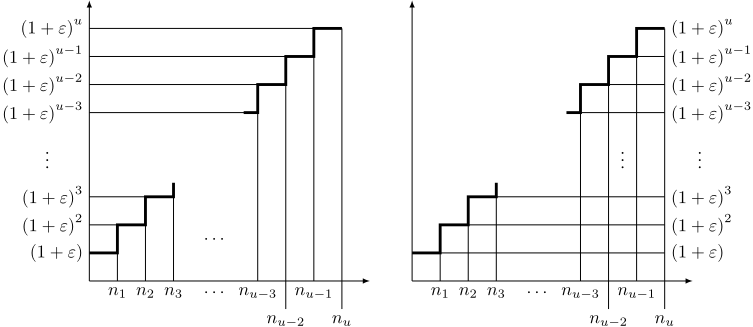
Let the number of sets S such that YS is in [1, (1+ ε)i ) be ni. Let the average contribution in the range [(1+ ε)i-1 , (1+ ε)i ) be Bi. We have the following equation:
Since (1 + ε)i-1 ≤ Bi < (1 + ε)i , the following estimate d is a (1 + ε)-approximation of the RHS:
We use a reorganization trick similar to [de Colnet and Meel, 2019]; see Figure 1.
By using the reorganization trick we have, by Equation (3),
Therefore it suffices to estimate nu - nj for every 1 ≤ j ≤ u - 1. We know that nu = 2n-|M| . By definition, tj := nu - nj counts the sets S such that YS ≥ (1 + ε)j . Let Y := ∏[n]\M Y{i} and observe that YS ≥ (1 + ε)j if and only if Y([n]\M)\S ≤ Y/(1 + ε)j . Due to this bijection, tj also counts the number of sets S such that YS ≤ Y/(1 + ε)j .
For every j, if Y/(1 + ε)j < 1 we define tj := 0. Otherwise, we introduce logarithms to reduce the problem of estimating the number of sets S ⊆ [n] such that max (0,WS -W) /mmin = YS ≤ Y/(1 + ε)j to a #KNAPSACK instance
which can be more commonly written as ∑i∈S\M logwi ≤ B for wi := pi/ (1 - pi) (by the definition of WS) and B := log(mmin · Y/(1+ ε)j +W ). (Note that the latter problem can be reformulated as counting the number of sets S ⊆ [n] \ M such that ∑i∈S wi ≤ B.)
Using Lemma 2 and Equation (4) we can estimate tj up to a (1 + ε)-approximation in deterministic polynomial time, which in turn would give us a (1+ ε)-approximation for d and for that matter a (1+ ε)2 -approximation for dTV(P,U) by Equation (2). Finally, we set ε := Ω(δ/2) so that (1 + ε)2 ≤ (1 + δ) in order to get an approximation ratio of (1 + δ).
The running time is polynomial in n and 1/δ because we ran a polynomial-time approximation algorithm for #KNAPSACK polynomially many times.
5.2 dTV(P,Q) Where QHas O(1) Parameters
We will now extend to the case where Q has at most k distinct parameters. Observe that U can be viewed as having k = 1 distinct parameters (equal to 1/2). Without loss of generality, let Q = ⊗i Bern(qi) = Bern(a1)z1 ⊗· · ·⊗Bern(ak)zk such that z1 + · · · + zk = n. The main result of this section is the following.
Theorem 11. There is an FPTAS for dTV(P,Q) where P is an arbitrary product distribution and Q = ⊗i Bern(qi) = Bern(a1)z1 ⊗ · · · ⊗Bern(ak)zk such that z1 + · · · + zk = n.
For simplicity of exposition, we will show here the result for the simpler case when Q = Bern(a)n and relegate the (very similar) proof of Theorem 11 to the extended version [Bhattacharyya et al., 2022].
Theorem 12. There is an FPTAS for estimating dTV(P,Q) where P is an arbitrary product distribution and Q = Bern(a)n for an 0 ≤ a ≤ 1.
Our approach is to reduce this problem to #KNAPSACK with fixed Hamming weights. If pi ≥ 1/2 for all i, then the latter problem admits an FPTAS due to Lemma 3. In the scenario where there is an i such that pi < 1/2 (in this case the respective KNAPSACK weight wi is negative; see our discussion below), we can switch 0 and 1 in such coordinates to obtain Bern(1 - pi) and Bern(1 - a), respectively. This transformation does not change the distance. We show that such instances can be reduced to #KNAPSACK with two fixed Hamming weights.
Proof of Theorem 12. Let M be the set of indices i ∈ [n] such that pi = 1. We have that dTV(P,Q) is equal to ∑x max (0, P (x) - Q(x)) or
An argument similar to that of Theorem 9 (based again on the fact that we use finite precision) can be used to show that a normalized version of dTV(P,Q) lies in some interval [1, V ) for V ≤ 2poly(n) which again we perceive as [1, V ) = ⋃ui=1 [(1 + ε)i , (1 + ε)i+1 ) for u ≤ poly(n). This enables us to use the same approach as in the proof of Theorem 9. Specifically, we approximate dTV(P, Q) as A·mmin ·d where d is defined as in Equation (3). We then approximate d as in the proof of Theorem 9, with a notable difference being that now we have to use Lemma 3 instead of Lemma 2 for the #KNAPSACK instances to which we reduce the estimation of dTV(P, Q).
Therefore, following Theorem 9, it would suffice to estimate d. According to Equation (4), we shall approximate the quantities tj := nu -nj (ni's as in the proof of Theorem 9), which here count the sets S ⊆ [n] such that
for C = C(j) = mmin · Y/(1 + ε)j and the corresponding values of mmin and Y (see the proof of Theorem 9 for definitions). Notice how the cardinality |S| of S comes up in the RHS of Equation (5). Since this quantity is not known beforehand, we shall consider cases |S| = 1, . . . , n in the #KNAPSACK instances that we will solve. This is the reason we use Lemma 3 instead of Lemma 2.
First assume that wi ≥ 1 for every i (meaning that pi ≥ 1/2 of logwi ≥ 0 for all i); we take logarithms (as in Theorem 9) to reduce this to a #KNAPSACK instance (i.e., ∑i∈S\M logwi ≤ logD) for every fixed |S| = 1, . . . , n. The latter problems can be then solved by the algorithm of Lemma 3 for k = 1 (in the notation of Lemma 3). Finally, we take the sum of all these counts over the possible values of |S| as our estimate of tj. Then our estimate for d will come from Equation (4) for nu = 2n-|M| .
Now, if for some i we have wi < 1 (meaning that pi < 1/2 or logwi < 0 for some i), then we switch 0 and 1 in those coordinates to get Bern(1-pi) and Bern(1-a), respectively. Then, in Q, the first z coin biases are a and the last n-z coin biases are 1 - a without loss of generality. In that case, as before, dTV(P,Q) is
where wi ≥ 1 for every i and vi := qi 1-qi whereby qi is equal to a or 1 - a depending on whether wi was originally ≥ 1 or < 1, respectively.
In this case, for every S, its Hamming weight (if we identify a set S ⊆ [n] with its characteristic vector in {0, 1}n ) in its first z coordinates is s1 and in its last n - z coordinates is s2. Therefore, it suffices to solve a #KNAPSACK instance whereby the quantity ∏i∈S\M wi - C is at most
for C = C(j) = mmin · Y/(1 + ε)j as before (see the proof of Theorem 9). Note that Lemma 3 gives an algorithm for the above #KNAPSACK problem as well.
We then sum over the counts corresponding to all possible disjoint possibilities of s1 and s2 such that s1 + s2 = |S|, for all possible values of |S|, to get our estimate of tj. Then, as earlier, our estimate for d will come from Equation (4) for nu = 2n-|M| .
6 Conclusion
We initiated a systematic study of the computational nature of the TV distance, a widely used notion of distance between probability distributions. Our findings are twofold: On the one hand, we establish hardness results for exactly computing (or approximating) the TV distance (Theorem 4; Theorem 8). On the other hand, we present efficient deterministic approximation algorithms (Theorem 9; Theorem 11; Theorem 12) for its estimation in some special cases of product distributions. To conclude, the main open question that arises from our work is: Does there exist an FPTAS for approximating the total variation distance between two product distributions?
Acknowledgements
The work of AB was supported in part by National Research Foundation Singapore under its NRF Fellowship Programme (NRF-NRFFAI-2019-0002) and an Amazon Faculty Research Award.
The work of SG was supported by an initiation grant from IIT Kanpur and a SERB award CRG/2022/007985.
Pavan's work is partly supported by NSF award 2130536 and part of the work was done while visiting Simons Institute for the Theory of Computing.
Vinod's work is partly supported by NSF award 2130608 and part of the work was done while visiting Simons Institute for the Theory of Computing.
This work was supported in part by National Research Foundation Singapore under its NRF Fellowship Programme [NRF-NRFFAI1-2019-0004] and an Amazon Research Award.
The work was done in part while AB and DM were visiting the Simons Institute for the Theory of Computing.
@inproceedings{ijcai2023p387,
  title     = {On Approximating Total Variation Distance},
  author    = {Bhattacharyya, Arnab and Gayen, Sutanu and Meel, Kuldeep S. and Myrisiotis, Dimitrios and Pavan, A. and Vinodchandran, N. V.},
  booktitle = {Proceedings of the Thirty-Second International Joint Conference on
               Artificial Intelligence, {IJCAI-23}},
  publisher = {International Joint Conferences on Artificial Intelligence Organization},
  editor    = {Edith Elkind},
  pages     = {3479--3487},
  year      = {2023},
  month     = {8},
  note      = {Main Track},
  doi       = {10.24963/ijcai.2023/387},
  url       = {https://doi.org/10.24963/ijcai.2023/387},
}
TY - CPAPER TI - On Approximating Total Variation Distance AU - Bhattacharyya, Arnab AU - Gayen, Sutanu AU - Meel, Kuldeep S. AU - Myrisiotis, Dimitrios AU - Pavan, A. AU - Vinodchandran, N. V. T2 - Proceedings of the Thirty-Second International Joint Conference on Artificial Intelligence, IJCAI-23 PB - International Joint Conferences on Artificial Intelligence Organization PY - 2023 SP - 3479 EP - 3487 DO - 10.24963/ijcai.2023/387 UR - https://doi.org/10.24963/ijcai.2023/387 ER -Copied
Machine-readable versions of this paper, for tools and AI agents:





