
BRExIt: On Opponent Modelling in Expert Iteration
Proceedings of the Thirty-Second International Joint Conference on Artificial Intelligence. Main Track. Pages 3795-3802.
https://doi.org/10.24963/ijcai.2023/422
Keywords
- Machine Learning: ML: Reinforcement learning
- Search: S: Game playing
- Machine Learning: ML: Deep reinforcement learning
Abstract
Finding a best response policy is a central objective in game theory and multi-agent learning, with modern population-based training approaches employing reinforcement learning algorithms as best-response oracles to improve play against candidate opponents (typically previously learnt policies). We propose Best Response Expert Iteration (BRExIt), which accelerates learning in games by incorporating opponent models into the state-of-the-art learning algorithm Expert Iteration (ExIt). BRExIt aims to (1) improve feature shaping in the apprentice, with a policy head predicting opponent policies as an auxiliary task, and (2) bias opponent moves in planning towards the given or learnt opponent model, to generate apprentice targets that better approximate a best response. In an empirical ablation on BRExIt's algorithmic variants against a set of fixed test agents, we provide statistical evidence that BRExIt learns better performing policies than ExIt. Code available at: https://github.com/Danielhp95/on-opponent-modelling-in-expert-iteration-code. Supplementary material available
at https://arxiv.org/abs/2206.00113.
- [Agarwal et al., 2021] Rishabh Agarwal, Max Schwarzer, Pablo Samuel Castro, et al. Deep reinforcement learning at the edge of the statistical precipice. Advances in Neural Information Processing Systems, 34, 2021.
- [Albrecht and Stone, 2018] Stefano V Albrecht and Peter Stone. Autonomous agents modelling other agents: A comprehensive survey and open problems. Artificial In- telligence, 258:66-95, 2018.
- [Anthony et al., 2017] Thomas Anthony, Zheng Tian, and David Barber. Thinking fast and slow with deep learning and tree search. In NIPS, 2017.
- [Balduzzi et al., 2019] David Balduzzi, Marta Garnelo, Yoram Bachrach, et al. Open-ended learning in symmetric zero-sum games. In International Conference on Machine Learning, pages 434-443. PMLR, 2019.
- [Berner et al., 2019] Christopher Berner, Greg Brockman, Brooke Chan, et al. Dota 2 with large scale deep reinforce- ment learning. arXiv preprint arXiv:1912.06680, 2019.
- [Brown, 1951] George W Brown. Iterative solution of games by fictitious play. Activity analysis of production and allo- cation, 13(1):374-376, 1951.
- [Browne et al., 2012] Cameron B Browne, Edward Powley, Daniel Whitehouse, et al. A survey of Monte Carlo Tree Search methods. IEEE Transactions on Computational In- telligence and AI in Games, 4(1):1-43, 2012.
- [Carroll et al., 2019] Micah Carroll, Rohin Shah, Mark K Ho, et al. On the utility of learning about humans for human-ai coordination. In Advances in Neural Informa- tion Processing Systems, pages 5175-5186, 2019.
- [Czarnecki et al., 2020] Wojciech M Czarnecki, Gauthier Gidel, Brendan Tracey, et al. Real world games look like spinning tops. Advances in Neural Information Processing Systems, 33:17443-17454, 2020.
- [Espeholt et al., 2018] Lasse Espeholt, Hubert Soyer, Remi Munos, et al. IMPALA: Scalable Distributed Deep-RL with Importance Weighted Actor-Learner Architectures. CoRR, abs/1802.01561, 2018.
- [Goodman and Lucas, 2020] James Goodman and Simon Lucas. Does it matter how well I know what you're think- ing? opponent modelling in an RTS game. In IEEE Congress on Evolutionary Computation, CEC 2020, pages 1-8. IEEE, 2020.
- [He et al., 2016] He He, Jordan Boyd-Graber, Kevin Kwok, and Hal Daumé III. Opponent modeling in deep reinforce- ment learning. In International Conference on Machine Learning, pages 1804-1813, 2016.
- [Hernandez et al., 2019] Daniel Hernandez, Kevin Denam- ganaï, Yuan Gao, et al. A generalized framework for self- play training. In 2019 IEEE Conference on Games (CoG), pages 1-8. IEEE, 2019.
- [Hernandez-Leal et al., 2017] Pablo Hernandez-Leal, Michael Kaisers, Tim Baarslag, and Enrique Munoz de Cote. A survey of learning in multiagent environments: Dealing with non-stationarity. arxiv 2017. arXiv preprint arXiv:1707.09183, 2017.
- [Hernandez-Leal et al., 2019] Pablo Hernandez-Leal, Bilal Kartal, and Matthew E. Taylor. Agent modeling as auxil- iary task for deep reinforcement learning. In Gillian Smith and Levi Lelis, editors, Proceedings of the Fifteenth AAAI Conference on Artificial Intelligence and Interactive Digi- tal Entertainment, AIIDE 2019, pages 31-37. AAAI Press, 2019.
- [Hong et al., 2018] Zhang-Wei Hong, Shih-Yang Su, Tzu- Yun Shann, et al. A deep policy inference q-network for multi-agent systems. In Proceedings of the 17th Interna- tional Conference on Autonomous Agents and MultiAgent Systems, pages 1388-1396. International Foundation for Autonomous Agents and Multiagent Systems, 2018.
- [Lanctot et al., 2017] Marc Lanctot, Vinicius Zambaldi, Au- drunas Gruslys, et al. A unified game-theoretic approach to multiagent reinforcement learning. Advances in Neural Information Processing Systems, 30:4190-4203, 2017.
- [Liu et al., 2021] Xiangyu Liu, Hangtian Jia, Ying Wen, et al. Towards unifying behavioral and response diversity for open-ended learning in zero-sum games. Advances in Neural Information Processing Systems, 34, 2021.
- [Mnih et al., 2013] Volodymyr Mnih, Koray Kavukcuoglu, David Silver, et al. Playing Atari with Deep Reinforce- ment Learning. CoRR, abs/1312.5602, 2013.
- [Nashed and Zilberstein, 2022] Samer Nashed and Shlomo Zilberstein. A survey of opponent modeling in adversar- ial domains. Journal of Artificial Intelligence Research, 73:277-327, 2022.
- [Oliehoek and Amato, 2014] Frans A Oliehoek and Christo- pher Amato. Best response bayesian reinforcement learn- ing for multiagent systems with state uncertainty. In Proceedings of the Ninth AAMAS Workshop on Multi- Agent Sequential Decision Making in Uncertain Domains (MSDM), 2014.
- [Schaul et al., 2015] Tom Schaul, John Quan, Ioannis Antonoglou, and David Silver. Prioritized Experience Re- play. CoRR, abs/1511.05952, 2015.
- [Schulman et al., 2017] John Schulman, Filip Wolski, Pra- fulla Dhariwal, et al. Proximal policy optimization algo- rithms. CoRR, abs/1707.06347, 2017.
- [Silver et al., 2016] David Silver, Aja Huang, Chris J Mad- dison, et al. Mastering the game of Go with deep neu- ral networks and tree search. Nature, 529(7587):484-489, 2016.
- [Silver et al., 2018] David Silver, Thomas Hubert, Julian Schrittwieser, et al. Mastering Chess and Shogi by Self- Play with a General Reinforcement Learning Algorithm. Science, 362:1140-1144, 2018.
- [Soemers et al., 2020] Dennis JNJ Soemers, Éric Piette, Matthew Stephenson, and Cameron Browne. Manipulat- ing the distributions of experience used for self-play learn- ing in expert iteration. arXiv preprint arXiv:2006.00283, 2020.
- [Timbers et al., 2022] Finbarr Timbers, Nolan Bard, Edward Lockhart, et al. Approximate exploitability: Learning a best response. In Proceedings of the International Joint Conference on Artificial Intelligence (IJCAI), pages 3487- 3493, 2022. IJCAI
- [Vinyals et al., 2019] Oriol Vinyals, Igor Babuschkin, Wo- jciech M Czarnecki, et al. Grandmaster level in star- craft ii using multi-agent reinforcement learning. Nature, 575(7782):350-354, 2019.
- [Willemsen et al., 2021] Daniel Willemsen, Hendrik Baier, and Michael Kaisers. Value targets in off-policy alphazero: a new greedy backup. Neural Computing and Applica- tions, pages 1-14, 2021.
- [Wu, 2019] David J Wu. Accelerating self-play learning in go. arXiv preprint arXiv:1902.10565, 2019.
References were extracted automatically from the PDF and may contain errors.
Full text extracted automatically from the PDF; figures, tables and equations may differ. The PDF is the version of record.
1 Introduction
Reinforcement learning has been successfully applied in increasingly challenging settings, with multi-agent reinforcement learning being one of the frontiers that pose open problems [Hernandez-Leal et al., 2017; Albrecht and Stone, 2018; Nashed and Zilberstein, 2022]. Finding strong policies for multi-agent interactions (games) requires techniques to selectively explore the space of best response policies, and techniques to learn such best response policies from gameplay. We here contribute a method that speeds up the learning of approximate best responses in games.
State-of-the-art training schemes such as population based training with centralized control [Lanctot et al., 2017; Liu et al., 2021] employ a combination of outer-loop training schemes and inner-loop learning agents in a nested loop fashion [Hernandez et al., 2019]. In the outer loop, a combination of fixed policies is chosen via game theoretical analysis to act as static opponents. Within the inner loop, a reinforcement learning (RL) agent repeatedly plays against these static opponents, in order to find an approximate best response policy against them. In theory, any arbitrary RL algorithm could be used as such a policy improvement operator/best response oracle in the inner loop. The best response policy found is then added to the training scheme's population, and the outer loop continues, constructing a population of increasingly stronger policies over time. This technique has been successfully applied in highly complex environments such as Dota 2 [Berner et al., 2019] and Starcraft II [Vinyals et al., 2019], with PPO [Schulman et al., 2017] and IMPALA [Espeholt et al., 2018] respectively used as policy improvement operators.
The large number of training episodes required by modern deep RL (DRL) algorithms as policy improvement operators makes the inner loop of such training schemes a computational bottleneck. In this paper we accelerate approximating best responses by introducing Best Response Expert Iteration (BRExIt). We extend Expert Iteration (ExIt) [Anthony et al., 2017], famously used in AlphaGo [Silver et al., 2016], by introducing opponent models (OMs) in both (1) the apprentice (a deep neural network), with the aim of feature shaping and learning a surrogate model, and (2) the expert (Monte Carlo Tree Search), to bias its search towards approximate best responses to the OMs, yielding better targets for the apprentice. BRExIt thus better exploits OMs that are available in centralized training approaches, or also in Bayesian settings which assume a given set of opponents [Oliehoek and Amato, 2014].
For the case of given OMs that are computationally too demanding for search, but which can be used to generate training games, we also test a variant of BRExIt that uses learned surrogate OMs instead. In the game of Connect4, we find BRExIt learns significantly stronger policies than ExIt with the same computation time, alleviating the computational bottleneck in training towards a best response.
2 RelatedWork
BRExIt stands at the confluence of two streams of literature: improving the sample efficiency of the ExIt framework (Section 2.1), and incorporating opponent models within deep reinforcement learning (Section 2.2).
2.1 Expert Iteration and Improvements
Expert Iteration [Anthony et al., 2017] combines planning and learning during training, with the goal of finding a parameterized policy πθ (where θ ∈ Rn ) that maximizes a reward signal. The trained policy can either be used within a planning algorithm or act as a standalone module during deployment without needing environment models.
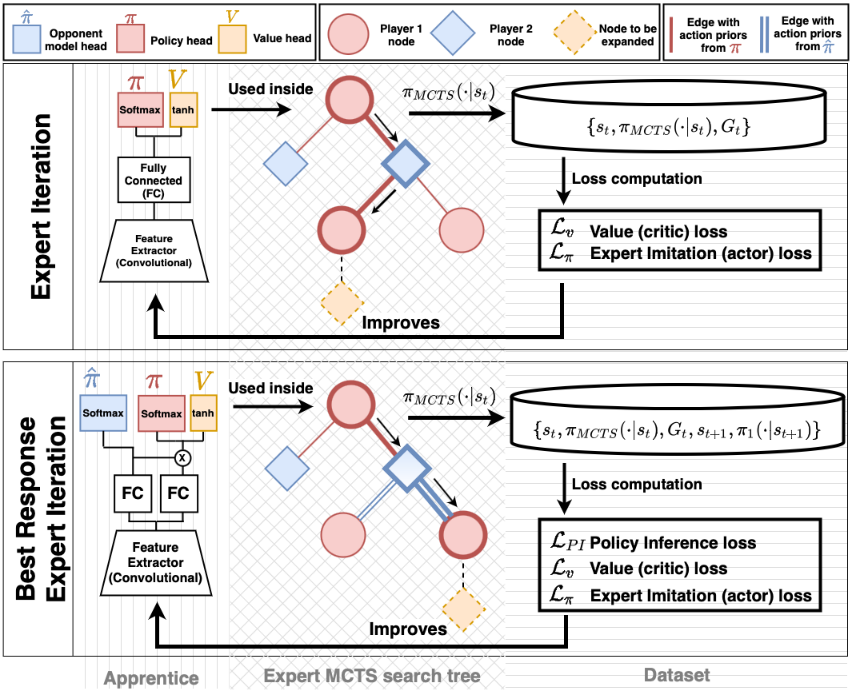
ExIt's two main components are (1) the expert, traditionally an MCTS procedure [Browne et al., 2012], and (2) the apprentice, a parameterized policy πθ, usually a neural network. In short, the expert takes actions in an environment using MCTS, generating a dataset of good quality moves. The apprentice updates its parameters θ to better predict both the expert's actions and future rewards. The expert in turn uses the apprentice inside MCTS to bias its search. Updates to the apprentice yield higher quality expert searches, yielding new and better targets for the apprentice to learn. This iterative improvement constitutes the main ExIt training loop, depicted at the top of Figure 1.
Significant effort has been aimed at improving ExIt, e.g. exploring alternate value targets [Willemsen et al., 2021] or incorporating prioritized experience replay [Schaul et al., 2015], informed exploratory measures [Soemers et al., 2020] or domain specific auxiliary tasks for the apprentice [Wu, 2019]. BRExIt improves upon ExIt by deeply integrating opponent models within it.
2.2 Opponent Modelling in DRL
Policy reconstruction methods predict agent policies from environment observations via OMs [Albrecht and Stone, 2018], which has been shown to be beneficial in collaborative [Carroll et al., 2019], competitive [Nashed and Zilberstein, 2022] and mixed settings [Hong et al., 2018]. Deep Reinforcement Opponent Modelling (DRON) was one of the first works combining DRL with opponent modelling [He et al., 2016]. The authors used two networks, one that learns Q-values using Deep Q-Network (DQN) [Mnih et al., 2013], and another that learns an opponent's policy by observing hand-crafted opponent features. Their key innovation is to combine the output of both networks to compute a Q-function that is conditioned on (a latent encoding of) the approximated opponent's policy. This accounts for a given agent's Q-value dependency on the other agents' policies. Deep Policy Inference Q-Network (DPIQN) [Hong et al., 2018] brings two further innovations: (1) merging both modules into a single neural network, and (2) baking the aforementioned Q function conditioning into the neural network architecture by reusing parameters from the OM module in the Q function.
OMs within MCTS have been shown to improve search [Timbers et al., 2022] when assuming access to ground truth opponent models, or partially correct models [Goodman and Lucas, 2020]. As auxiliary tasks for the apprentice, OMs have been used in ExIt to predict the follow-up move an opponent would play in sequential games [Wu, 2019]. BRExIt both learns opponent models as an auxiliary task, and uses them inside of MCTS.
3 Background
Section 3.1 introduces relevant RL and game theory constructs, followed by the approach to opponent modelling used in BRExIt in Section 3.2 and the inner workings of ExIt in Section 3.3.
3.1 Multiagent Reinforcement Learning
Let E represent a fully observable stochastic game with n agents, state space S, shared action space A and shared policy space Π. Policies are stochastic mappings from states to actions, with πi : S × A → [0, 1] denoting the ith agent's policy, and π = [π1, . . . , πn] the joint policy vector, which can be regarded as a distribution over the joint action space. T : S × A × S → [0, 1] is the transition model (the environment dynamics), determining how an environment state s changes to a new state s′ given a joint action a. Ri : S×A×S →R is agent i's reward function. Git ∈ R is the return from time t for agent i, the accumulated reward obtained by agent i from time t until episode termination; γ ∈ (0, 1] is the environment's discount factor. When considering the viewpoint of a specific agent i, we decompose a joint action vector a = (ai, a-i) and joint policy vector π = (πi,π-i) into the individual action or policy for agent i, and the other agents denoted by -i.
The state-value function V π i : S → R denotes agent i's expected cumulative reward from state s onwards assuming all agents act as prescribed by π.
Agent i's optimal policy depends on the other policies:
Assuming π-i to be stationary, agent i's optimal policy π∗ i is also called a best response π∗ i ∈ BR(π-i), where BR(π-i) denotes the set of all best responses against π-i. Our goal is to train a system to (1) predict and encode what is knowable about the opponents' policies π-i and (2) compute a best response to that.
3.2 Opponent Modelling in DRL
We follow the opponent modelling approach popularized by DPIQN [Hong et al., 2018], which uses a neural network to both learn opponent models and an optimal Q-function. The latter is learnt by minimising the loss function LQ of DQN [Mnih et al., 2013]. Opponent modelling is an auxiliary task, trained by minimising the cross-entropy between one-hot encoded observed action for each agent j, aj , and their corresponding predicted opponent policies at state s, ˆπj(·|s), defined as the policy inference loss LPI in Equation 2. These two losses are combined into LDPIQN with an adaptive weight to improve learning stability.
BRExIt makes use of both the policy inference loss for its OMs and the adaptive learning weight to regularize its critic loss. However, instead of learning a Q-function as a critic, BRExIt learns a state-value function V , as suggested by previous work [Hernandez-Leal et al., 2019].
3.3 Expert Iteration
We use an open-loop MCTS implementation [Silver et al., 2018] as the expert; tree nodes represent environment states s, and edges (s, a) represent taking action a at state s. Each edge stores a set of statistics:
N(s, a) is the number of visits to edge (s, a). Q(s, a) is the mean action-value for (s, a), aggregated from all simulations that have traversed (s, a). P(s, a) is the prior probability of following edge (s, a). ExIt uses the apprentice policy to compute priors, P(s, a) = πθ(a|s). One of our contributions is adding opponent-awareness to the computation of these priors. Finally, index i denotes the player to act in the node and An indicates the available actions.
For every state s encountered by an ExIt agent during a training episode, the expert takes an action a computed by running MCTS from state s and selecting the action of the root node's most visited edge (s, a). During search, the tree is traversed using the same selection strategy as AlphaZero [Silver et al., 2018]. Edges (s, a) are traversed following the most promising action according to the PUCT formula:
where CPUCT is a tunable constant. The apprentice πθ is a distillation of previous MCTS searches, and provides P(s, a), thus biasing MCTS towards actions that were previously computed to be promising. Upon reaching a leaf node with state s′ , we backpropagate a value given by a learnt state value function Vϕ(s′ ) with parameters ϕ ∈ Rn trained to regress against observed returns.
After completing search from a root node representing state s, the policy πMCTS(·|s) can be extracted from the statistics stored on the root node's edges. This policy is stored as a training target for the apprentice's policy head to imitate:
As shown in the top right corner of Figure 1 ExIt builds a dataset containing a datapoint for each timestep t:
The top left corner of Figure 1 shows an actor-critic architecture, used as the apprentice, with a policy head πθ, and a value head Vϕ. A cross-entropy loss is used to train the actor towards imitating the expert's moves, and a mean-square error loss is used to update the critic's state value function towards observed returns Git .
4 BRExIt: Opponent Modelling in ExIt
We present Best Response Expert Iteration (BRExIt), an extension on ExIt that uses opponent modelling for two purposes. First, to enhance the apprentice's architecture with opponent modelling heads, acting as feature shaping mechanisms - see Subsection 4.1. Second, to allow the MCTS expert to approximate a best response against a set of opponents: πMCTS ∈ BR(π-i) - see Subsection 4.3. We visually compare BRExIt and ExIt in Figure 1.
4.1 Learning Opponent Models in Sequential Games
Previous approaches to learn opponent models used observed actions as learning targets, coming from a game theoretical tradition where individual actions can be observed but not the policy that generated them [Brown, 1951]. However, the centralized population-based training schemes which motivate our research already require access during training to all policies in the environment, both for the training agent and the opponents' policies. We further exploit this assumption by separately testing two options for the learning targets in the policy inference loss from Equation 2: the onehot encoded observed opponent actions, or the full distributions over actions computed by the opponents during play. As a clarifying example, imagine a uniform random policy for the game of Rock-Paper-Scissors where it plays rock for a given round. It's on-hot encoded action will be [Rock : 1, Paper : 0, Scirros : 0] and the corresponding full distribution encoding would place equal weight over all actions: [Rock : 13 , Paper : 13 , Scirros : 13 ].
Prior work has typically focused on fully observable simultaneous games, where a shared environment state is used by all agents to compute an action at every timestep. Thus, if agent i wanted to learn models of its opponents' policies, storing (a) each of i's observed shared states and (b) opponent actions, was sufficient to learn opponent models. We extend this to sequential games, where agents take turns acting based on individual states, in the following way. BRExIt augments the dataset collected by ExIt, specified in Equation 6, by adding (1) the state which each opponent agent j ̸= i observed and (2) either only the observed opponent actions or the full ground truth action distributions given by the opponent policies in their corresponding turn. The data collection process for sequential environments is described in Algorithm 1. Formally, for the BRExIt agent acting at timestep t and its no opponents acting at timesteps t + 1 to t + no, BRExIt adds to its dataset either the observed action of every agent j, or their policy πj evaluated at the state of their turn.
4.2 Apprentice Representation
BRExIt's three headed apprentice architecture extends ExIt's actor-critic representation with opponent models as per DPIQN's design [Hernandez-Leal et al., 2019], depicted on the bottom left of Figure 1 for a single opponent. This architecture reuses parameters from the OM as a feature shaping mechanism for both the actor and the critic. It takes as input an environment state st ∈ S for a timestep t, which can correspond to the observed state of any agent. It features 3 outputs: (1) the apprentice's actor policy πθ(st) (2) the state-value critic V πθ,ˆπΨ ϕ (st) (3) the opponent models ˆπψj (st) ∈ ˆπΨ, where Ψ contains the parameters for all opponent models and ψj ⊂ Ψ the parameters for opponent model head j.
On certain sequential games the distribution of states encountered by each agent might differ, and so the actor-critic head and each of the OM heads could each be trained on different state distributions. In practice this means that the output of one of these heads might only be usable if the input state st for a timestep t comes from the distribution it was trained on; however, the OM can in any case help via feature shaping. This does not apply to simultaneous games where all agents observe the same state.
4.3 Opponent Modelling Inside MCTS
BRExIt follows Equation 8 to compute the action priors P(s, a) from Equation 4 for a node with player index j, notably using opponent models in nodes within the search tree that correspond to opponents' turns. This process is exemplified in the lower middle half of Figure 1. Such opponent models can be either the ground truth opponent policies (the real opponent policies π-i) by exploiting centralized training scheme assumptions, or otherwise the apprentice's learnt opponent models ˆπψ . This is a key difference from ExIt, which always uses the apprentice's πθ to compute P(s, a).
By using either the ground truth or learnt opponent models, we initially bias the search towards a best response against the actual policies in the environment. However, note that initial P(s, a) values will be overridden by the aggregated simulation returns Q(s, a), as with infinite compute MCTS
converges to best response against a perfectly rational player, whose actions may deviate from the underlying opponent's policy. Thus, BRExIt's search maintains the asymptotic behaviour of MCTS while simultaneously priming the construction of the tree towards areas which are likely to be explored by the policies in the environment.
In contrast to BRExIt, ExIt biases its expert search towards a best response against the apprentice's own policy, by using the apprentice πθ to compute P (s, a) at every node in the tree. MCTS here assumes that all agents follow the same policy as the apprentice, whereas in reality agents might follow any arbitrary policy. Not trying to exploit the opponents it is trained against, ExIt generates more conservative searches. Recent studies show that this conservativeness can be detrimental in terms of finding diverse sets of policies throughout training for population-based training schemes [Balduzzi et al., 2019; Liu et al., 2021]. Instead, they advocate for a more direct computation of best responses against known opponents as a means to discover a wider area of the policy space. This allows the higher level training scheme to better decide on which opponents to use as targets to guide future exploration. We argue that BRExIt has this property built-in, by actively biasing its search towards a best response against ground truth opponent policies. Future work could investigate this claim.
We could have designed BRExIt to be even more exploitative towards opponent models, by masking actions sampled from these models as part of the environment dynamics. While this would yield actions very specifically targeted to respond to the modelled policies, it makes such best reponses very brittle, and can be problematic especially for imperfect OMs. In contrast, we propose using opponent models as priors in BRExIt, such that planning can still improve upon the opponent policies; this results in more robust learning targets.
Algorithms 1, 2 and 3 depict BRExIt's data collection, model update logic and overarching training loop respectively for a sequential environment. Coloured lines represent our contributions w.r.t ExIt.
5 Experiments &Discussion
We are trying to answer the following two questions: Primarily, is BRExIt more performant than ExIt at distilling a competitive policy against fixed opponents into its apprentice? Secondarily, are full distribution targets for learning opponent models preferable over one-hot action encodings?
The environment: We conducted our experiments in the fully observable, sequential two-player game of Connect4, which is computational amenable and possesses a high degree of skill transitivity [Czarnecki et al., 2020]. We decided on using a single environment in order to obtain statistically significant results through a larger number of runs over granular algorithmic ablations. We acknowledge the limitations of using a single test domain.
Test opponents: We generated two test agents πweak, πstrong by freezing copies of a PPO [Schulman et al., 2017] agent trained under δ = 0-Uniform selfplay [Hernandez et al., 2019] after 200k and 600k episodes. Motivated by population-based training schemes, we also used an additional opponent policy πmixed, which randomly
Algorithm 1: BRExIt data collection
Input: (apprentice πθ, opp. models ˆπψ -i , critic Vϕ) Input: Opponent policies: π-i Input: Environment: E = (P, ρ0) 1 Initialize dataset: D = [ ]; 2 Initialize time t ← 0; 3 Sample initial state s0 ∼ ρ0; 4 while st is not terminal do 5 Search: at, tree =MCTS(st, πθ,π-i, Vψ); 6 Act in the game st+1, rt ∼ P(st, at); 7 Get from tree: πMCTS(st, a) = Nroot(st,a) ∑a′ Nroot(st,a′ ) ; 8 for j = 1, . . . , |π-i| do 9 Sample opp. action: at+j ∼ πj-i (st+j); 10 Act in the game st+j, ∼ P(st+j, at+j) 11 end 12 D∪ {st, πmcts(st), {st+j,πj-i (st+j)}|πo| j=1 , ri}; 13 t ← t + |π-i|; 14 end 15 return D;Algorithm 2: BRExIt model update
Input: Three head network: NN = (πθ, ˆπψ -i , Vϕ) Input: Dataset: D 1 for t = 0, 1, 2, . . . do 2 Sample n datapoints fromD: 3 (st, rt, πMCTS(st, ·), ri, {st+j , πj-i (·|st+1)}| ˆπψ -i | j=1 )1,...,n; 4 MSE value loss: Lv = (v -Vϕ(st))2 ; 5 CE policy loss Lπ = πMCTS(st) log (πθ(st)); 6 CE policy inference loss: LPI = 1 |π-i | ∑|π-i | j=1 πj-i (st+j) log (ˆπψj -i (st+j)); 7 Policy inference weight: λ = 1 √LPI ; 8 Weighted final loss Ltotal = λ(Lv +Lπ) +LPI; 9 Backpropagate ∇Ltotal through θ,ψ,ϕ ; 10 endAlgorithm 3: BRExIt training loop
Input: Three head network: NN = (πθ, ˆπψ -i , Vϕ) Input: Opponent policies: π-i 1 for training iteration = 0, 1, 2, . . . do 2 Algo. 1: D =DatasetCollection(NN, π-i); 3 Algo. 2: NN = UpdateApprentice(NN,D); 4 end 5 return NNselects one of the test agents every episode.
Trained agents: We independently trained 7 types of agents for 48 wall-clock hours each, performing an additive construction from ExIt to BRExIt. ExIt is the original algorithm, ExIt-OMFS denotes ExIt using OMs only for feature shaping. BRExIt-OMS additionally uses learnt OMs during search and BRExIt uses the ground truth OMs during search. For the agents using OMs, we trained both a version using full action distributions as action targets and another with one-hot encoded action targets. Each algorithm was independently trained 10 times against the 3 test opponents, yielding a total of 280 training runs. Following statistical practices [Agarwal et al., 2021] we use Inter Quartile Metrics (IQM) for all results, discarding the worst and best performing 25% runs to obtain performance metrics less susceptible to outliers.
5.1 On BRExIt's Performance vs. ExIt
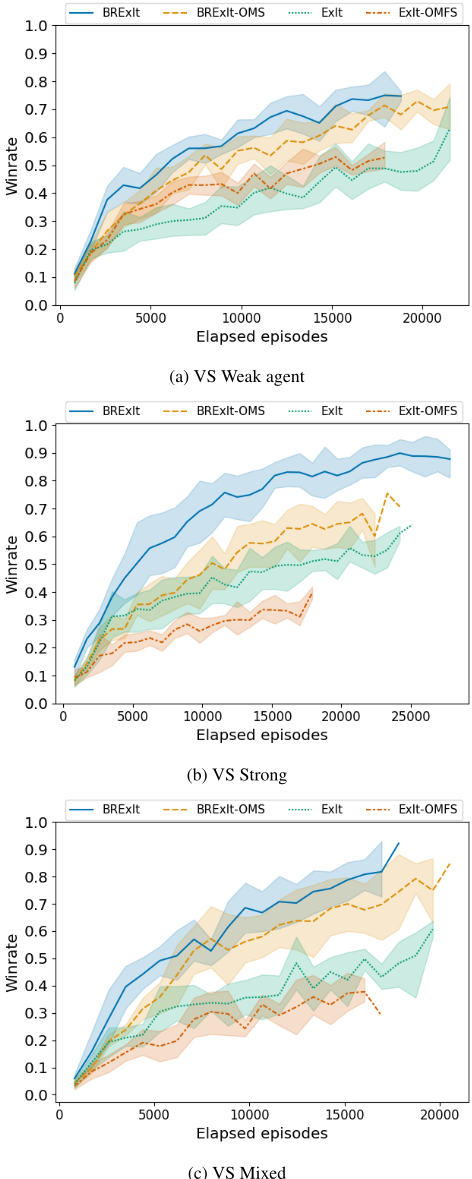
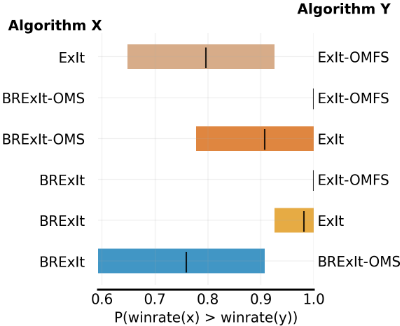
To answer our first question, Figure 2 shows the evolution of the winrate of each of the ablation's apprentice policies throughout training. A datapoint was computed every policy update (i.e every 800 episodes) by evaluating the winrate of the apprentice policy against the opponent over 100 episodes. (Note that the difference in number of episodes between all ablations depends on the average episode length over the 48h of training time, which can vary as a function of both players involved.) Figure 3 analyzes these results and shows the probability of improvement (PoI) that one ablation has over another, defined as the probability that algorithm X would yield an apprentice policy which has a higher winrate against its training opponent that algorithmY [Agarwal et al., 2021]. All agents are using full distribution OM targets here.
Figure 2 shows that BRExIt style agents consistently achieve a higher winrate than ExIt agents. BRExIt regularly outperforms BRExIt-OMS (77% PoI), successfully exploiting the centralized assumption of having opponent policies available during search for extra performance. If opponent policies can only be sampled for training games but not during search, using learnt OMs during search is still beneficial, as we see that BRExIt-OMS consistently outperforms ExIt (90 % PoI). Surprisingly, ExIt-OMFS performs worse than ExIt by a significant margin (the latter has a 80% PoI against the former), providing empirical evidence that OMs with static opponents can be detrimental for ExIt if OMs are not exploited within MCTS. This goes against previous results [Wu, 2019], which explored OMs within ExIt merely as a feature shaping mechanism and claimed modest improvements when predicting the opponent's follow-up move. Differences may be attributed to the fact that we model the opponent policy on the current state, instead of the next state.
In summary, with BRExIt (using ground truth OMs) and BRExIt-OMS (using learnt OMs) featuring a > 97% and > 91% PoI respectively against vanilla ExIt, our empirical results warrant the use of our novel algorithmic variants instead of ExIt whenever opponent policies are available for training.
5.2 On Full Distribution VS One-Hot Targets
To answer our second question, we conducted KolmogorovSmirnov tests comparing full action distribution targets to
(c) VS Mixed one-hot encoded action targets for OMs. The samples we compared were the sets of winrates at the end of training, one datapoint per training run. Table 1 shows the results: There is no statistical difference between agents trained with algorithms using one-hot encoded OM targets when compared to using full action distributions. We obtain p ≫ 0.05 for each algorithmic combination, so we cannot reject the null hypotheses that both data samples come from the same distribution; the only exception being ExIt-OMFS, which shows a statistically significant decrease in performance when using one-hot encoded targets.
Figure 2: The evolution of winrates for each ablation during training vs fixed opponents for 48h wall-clock time. Lines represent the mean value the of final apprentice's winrate over all runs. Higher is better; shaded areas show 95% bootstrap confidence intervals.
These results run contrary to the intuition that richer targets for opponent models will in turn improve the quality of the apprentice's policy. However, we observed that full distributional targets do yield OMs with better prediction capabilities, as indicated by lower loss of the OM during training. This hints at the possibility that OM's usefulness increases only up to a certain degree of accuracy, echoing recent findings [Goodman and Lucas, 2020]. Hence, while BRExIt does require access to ground truth policies during search, search in BRExIt-OMS achieves similar performance with opponent models trained on action observations, which is promising for transferring BRExIt-OMS into practical applications.
6 Conclusion
We investigated the use of opponent modelling within the ExIt framework, introducing the BRExIt algorithm. BRExIt augments ExIt by introducing opponent models both within the expert planning phase, biasing its search towards a best response against the opponent, and within the apprentice's model, to use opponent modelling as an auxiliary task. In Connect4, we demonstrate BRExIt's improved performance compared to ExIt when training policies against fixed agents.
There are multiple avenues for future work. At the level of population based training schemes (such as self-play), future work can focus on measuring whether the quality of populations generated by different training schemes using BRExIt surpasses that of populations where ExIt is used as a policy improvement operator. In addition, search methods can struggle with complex games due to their high branching factor - simultaneous move games for example have combinatorial action spaces - which could be alleviated by using BRExIt's opponent models to narrow down the search space.
| Base Algorithm | Opponent | p-value | Distr. targets signif. better? |
|---|---|---|---|
| BRExIt BRExIt-OMS ExIt-OMFS BRExIt BRExIt-OMS ExIt-OMFS BRExIt BRExIt-OMS ExIt-OMFS | Weak | 0.930 | No |
| Weak | 0.931 | No | |
| Weak | 0.930 | No | |
| Strong | 0.930 | No | |
| Strong | 0.999 | No | |
| Strong | 0.930 | No | |
| Mixed | 0.142 | No | |
| Mixed | 0.930 | No | |
| Mixed | 0.025 | Yes |
@inproceedings{ijcai2023p422,
  title     = {BRExIt: On Opponent Modelling in Expert Iteration},
  author    = {Hernandez, Daniel and Baier, Hendrik and Kaisers, Michael},
  booktitle = {Proceedings of the Thirty-Second International Joint Conference on
               Artificial Intelligence, {IJCAI-23}},
  publisher = {International Joint Conferences on Artificial Intelligence Organization},
  editor    = {Edith Elkind},
  pages     = {3795--3802},
  year      = {2023},
  month     = {8},
  note      = {Main Track},
  doi       = {10.24963/ijcai.2023/422},
  url       = {https://doi.org/10.24963/ijcai.2023/422},
}
TY - CPAPER TI - BRExIt: On Opponent Modelling in Expert Iteration AU - Hernandez, Daniel AU - Baier, Hendrik AU - Kaisers, Michael T2 - Proceedings of the Thirty-Second International Joint Conference on Artificial Intelligence, IJCAI-23 PB - International Joint Conferences on Artificial Intelligence Organization PY - 2023 SP - 3795 EP - 3802 DO - 10.24963/ijcai.2023/422 UR - https://doi.org/10.24963/ijcai.2023/422 ER -Copied
Machine-readable versions of this paper, for tools and AI agents:





