
Expanding the Hyperbolic Kernels: A Curvature-aware Isometric Embedding View
Proceedings of the Thirty-Second International Joint Conference on Artificial Intelligence. Main Track. Pages 4469-4477.
https://doi.org/10.24963/ijcai.2023/497
Keywords
- Machine Learning: ML: Geometric learning
- Machine Learning: ML: Kernel methods
Abstract
Modeling data relation as a hierarchical structure has proven beneficial for many learning scenarios, and the hyperbolic space, with negative curvature, can encode such data hierarchy without distortion. Several recent studies also show that the representation power of the hyperbolic space can be further improved by endowing the kernel methods. Unfortunately, the known kernel methods, developed in hyperbolic space, are limited by the adaptation capacity or distortion issues. This paper addresses the issues through a novel embedding function. To this end, we propose a curvature-aware isometric embedding, which establishes an isometry from the Poincar\'e model to a special reproducing kernel Hilbert space (RKHS). Then we can further define a series of kernels on this RKHS, including several positive definite kernels and an indefinite kernel. Thorough experiments are conducted to demonstrate the superiority of our proposals over existing-known hyperbolic and Euclidean kernels in various learning tasks, e.g., graph learning and zero-shot learning.
- [Akata et al., 2016] Zeynep Akata, Florent Perronnin, Zaid Harchaoui, and Cordelia Schmid. Label-embedding for image classification. IEEE Transactions on Pattern Anal- ysis and Machine Intelligence, 38(7):1425-1438, July 2016.
- [Arcozzi et al., 2007] Nicola Arcozzi, Richard Rochberg, and Eric Sawyer. The diameter space, a restriction of the drury-arveson-hardy space. In Proceedings of the Confer- ence on Function Spaces, pages 21-42. Providence, R.I. : American Mathematical Society, January 2007.
- [Bellet et al., 2015] Aurélien Bellet, Amaury Habrard, and Marc Sebban. Metric learning. Synthesis Lectures on Artificial Intelligence and Machine Learning, 9(1):1-151, 2015.
- [Bishop and Nasrabadi, 2006] Christopher M Bishop and Nasser M Nasrabadi. Pattern Recognition and Machine Learning. Number 4. Springer, 2006.
- [Bojchevski and Günnemann, 2017] Aleksandar Bojchevski and Stephan Günnemann. Deep gaussian embedding of graphs: Unsupervised inductive learning via ranking. arXiv preprint arXiv:1707.03815, 2017.
- [Cannon et al., 1997] James W Cannon, William J Floyd, Richard Kenyon, Walter R Parry, et al. Hyperbolic ge- ometry. Flavors of Geometry, 31:59-115, 1997.
- [Chami et al., 2019] Ines Chami, Zhitao Ying, Christopher Ré, and Jure Leskovec. Hyperbolic graph convolutional neural networks. In Proceedings of the Advances in Neural Information Processing Systems, pages 4869-4880, 2019.
- [Chen et al., 2018] Long Chen, Hanwang Zhang, Jun Xiao, Wei Liu, and Shih-Fu Chang. Zero-shot visual recog- nition using semantics-preserving adversarial embedding networks. In Proceedings of the IEEE Conference on Com- puter Vision and Pattern Recognition, pages 1043-1052, 2018.
- [Cho et al., 2019] Hyunghoon Cho, Benjamin DeMeo, Jian Peng, and Bonnie Berger. Large-margin classification in hyperbolic space. In Proceedings of the International Conference on Artificial Intelligence and Statistics, pages 1832-1840, 2019.
- [Coxeter and Greitzer, 1967] Harold Scott Macdonald Cox- eter and Samuel L Greitzer. Geometry revisited, vol- ume 19. Maa, 1967.
- [Cucerzan, 2007] Silviu Cucerzan. Large-scale named en- tity disambiguation based on wikipedia data. In Proceed- ings of the 2007 Joint Conference on Empirical Methods in Natural Language Processing and Computational Natural Language Learning, pages 708-716, 2007.
- [Duren and Weir, 2007] Peter Duren and Rachel Weir. The pseudohyperbolic metric and bergman spaces in the ball. Transactions of the American Mathematical Society, 359(1):63-76, 2007.
- [Fang et al., 2021] Pengfei Fang, Mehrtash Harandi, and Lars Petersson. Kernel methods in hyperbolic spaces. In Proceedings of the IEEE International Conference on Computer Vision, pages 10665-10674, October 2021.
- [Fang et al., 2023] Pengfei Fang, Mehrtash Harandi, Trung Le, and Dinh Phung. Hyperbolic geometry in computer vision: A survey. arXiv preprint arXiv:2304.10764, 2023.
- [Frome et al., 2013] Andrea Frome, Greg S Corrado, Jon Shlens, Samy Bengio, Jeff Dean, Marc'Aurelio Ranzato, and Tomas Mikolov. Devise: A deep visual-semantic em- bedding model. Advances in neural information process- ing systems, 26, 2013.
- [Ganea et al., 2018a] Octavian Ganea, Gary Becigneul, and Thomas Hofmann. Hyperbolic entailment cones for learn- ing hierarchical embeddings. In Proceedings of the Inter- national Conference on Machine Learning, pages 1632- 1641, 2018.
- [Ganea et al., 2018b] Octavian Ganea, Gary Bécigneul, and Thomas Hofmann. Hyperbolic neural networks. In Pro- ceedings of the Advances in Neural Information Process- ing Systems, volume 31, pages 5345-5355, 2018.
- [Gulcehre et al., 2018] Caglar Gulcehre, Misha Denil, Mateusz Malinowski, Ali Razavi, Razvan Pascanu, Karl Moritz Hermann, Peter Battaglia, Victor Bapst, David Raposo, Adam Santoro, et al. Hyperbolic attention networks. arXiv preprint arXiv:1805.09786, 2018.
- [Jayasumana et al., 2015] Sadeep Jayasumana, Richard Hartley, Mathieu Salzmann, Hongdong Li, and Mehrtash Harandi. Kernel methods on riemannian manifolds with gaussian RBF kernels. PAMI, 2015.
- [Khrulkov et al., 2020] Valentin Khrulkov, Leyla Mir- vakhabova, Evgeniya Ustinova, Ivan Oseledets, and Victor Lempitsky. Hyperbolic image embeddings. In Proceedings of the IEEE Conference on Computer Vision and Pattern Recognition, pages 6418-6428, 2020.
- [Lampert et al., 2013] Christoph H Lampert, Hannes Nick- isch, and Stefan Harmeling. Attribute-based classification for zero-shot visual object categorization. IEEE Trans- actions on Pattern Analysis and Machine Intelligence, 36(3):453-465, 2013.
- [Li et al., 2019] Kai Li, Martin Renqiang Min, and Yun Fu. Rethinking zero-shot learning: A conditional visual clas- sification perspective. In Proceedings of the IEEE Interna- tional Conference on Computer Vision, pages 3583-3592, 2019.
- [Loosli et al., 2015] Gaëlle Loosli, Stéphane Canu, and Cheng Soon Ong. Learning SVM in Kreȋn spaces. IEEE Transactions on Pattern Analysis and Machine Intelli- gence, 38(6):1204-1216, 2015.
- [Nickel and Kiela, 2017] Maximillian Nickel and Douwe Kiela. Poincaré embeddings for learning hierarchical rep- resentations. In Proceedings of the Advances in Neural Information Processing Systems, pages 6338-6347, 2017.
- [Ong et al., 2004] Cheng Soon Ong, Xavier Mary, Stéphane Canu, and Alexander J Smola. Learning with non-positive kernels. In Proceedings of the International Conference on Machine Learning, page 81. ACM, 2004.
- [Platt and others, 1999] John Platt et al. Probabilistic out- puts for support vector machines and comparisons to reg- ularized likelihood methods. Advances in Large Margin Classifiers, 10(3):61-74, 1999.
- [Ratcliffe, 1994] John G Ratcliffe. Foundations of Hyper- bolic Manifolds. Springer, 1994.
- [Rochberg, 2019] Richard Rochberg. Complex hyperbolic geometry and hilbert spaces with complete pick kernels. Journal of Functional Analysis, 276(5):1622 -1679, 2019.
- [Rozemberczki et al., 2019] Benedek Rozemberczki, Ryan Davies, Rik Sarkar, and Charles Sutton. Gemsec: Graph embedding with self clustering. In Proceedings of the IEEE/ACM International Conference on Advances in So- cial Networks Analysis and Mining, pages 65-72. ACM, 2019.
- [Shchur et al., 2018] Oleksandr Shchur, Maximil- ian Mumme, Aleksandar Bojchevski, and Stephan Günnemann. Pitfalls of graph neural network evaluation. arXiv preprint arXiv:1811.05868, 2018.
- [Shimizu et al., 2020] Ryohei Shimizu, Yusuke Mukuta, and Tatsuya Harada. Hyperbolic neural networks++. arXiv preprint arXiv:2006.08210, 2020.
- [Smola and Schölkopf, 1998] Alex J Smola and Bernhard Schölkopf. Learning with kernels, volume 4. Citeseer, 1998.
- [Ungar, 1998] Abraham A Ungar. From pythagoras to ein- stein: the hyperbolic pythagorean theorem. Foundations of physics, 28(8):1283-1321, 1998.
- [Ungar, 2022] Abraham Albert Ungar. Analytic hyperbolic geometry and albert einstein's special theory of relativity , world sci. Publ. Co., Singapore, 2022.
- [Wah et al., 2011] Catherine Wah, Steve Branson, Peter Welinder, Pietro Perona, and Serge Belongie. The caltech- ucsd birds-200-2011 dataset. Technical Report CNS-TR- 2010-001, California Institute of Technology, 2011.
- [Xia et al., 2021] Feng Xia, Ke Sun, Shuo Yu, Abdul Aziz, Liangtian Wan, Shirui Pan, and Huan Liu. Graph learning: A survey. IEEE Transactions on Artificial Intelligence, 2(2):109-127, 2021.
- [Xian et al., 2016] Yongqin Xian, Zeynep Akata, Gaurav Sharma, Quynh Nguyen, Matthias Hein, and Bernt Schiele. Latent embeddings for zero-shot classification. In Proceedings of the IEEE Conference on Computer Vision and Pattern Recognition, pages 69-77, 2016.
- [Xian et al., 2018] Yongqin Xian, Christoph H Lampert, Bernt Schiele, and Zeynep Akata. Zero-shot learning- a comprehensive evaluation of the good, the bad and the ugly. IEEE Transactions on Pattern Analysis and Machine Intelligence, 41(9):2251-2265, 2018.
- [Xu et al., 2017] Haiming Xu, Hui Xue, Xiaohong Chen, and Yunyun Wang. Solving indefinite kernel support vec- tor machine with difference of convex functions program- ming. In Proceedings of the AAAI Conference on Artificial Intelligence, 2017.
- [Zhang and Shi, 2019] Fei Zhang and Guangming Shi. Co- representation network for generalized zero-shot learning. In Proceedings of the International Conference on Ma- chine Learning, pages 7434-7443. PMLR, 2019.
- [Zhang et al., 2017] Li Zhang, Tao Xiang, and Shaogang Gong. Learning a deep embedding model for zero-shot learning. In Proceedings of the IEEE Conference on Com- puter Vision and Pattern Recognition, pages 2021-2030, 2017.
- [Zhao et al., 2006] Bin Zhao, Prithviraj Sen, and Lise Getoor. Entity and elationship labeling in affiliation net- works. In ICML Workshop on Statistical Network Analy- sis, 2006.
References were extracted automatically from the PDF and may contain errors.
Full text extracted automatically from the PDF; figures, tables and equations may differ. The PDF is the version of record.
1 Introduction
This paper studies a curvature-aware isometric embedding to map the hyperbolic representations into an intermediate reproducing kernel Hilbert space (RKHS), where a set of kernels can be further developed.
In recent years, the hyperbolic space has shown its superiority to encode the data hierarchy, since the volume of hyperbolic space increases exponentially with radius [Ganea et al., 2018a; Ganea et al., 2018b]. This property enables the hyperbolic space to encode the graph-structured or treelikeness data with arbitrarily low distortion in case of low dimension, and benefits a lot of data embeddings, e.g., language data [Ganea et al., 2018a], visual data [Khrulkov et al., 2020; Fang et al., 2023], graph data [Cho et al., 2019], etc.
To enjoy the representation power of the hyperbolic space, various learning paradigms, including hyperbolic neural networks [Ganea et al., 2018b; Gulcehre et al., 2018; Shimizu et al., 2020] and hyperbolic kernel machines [Cho et al., 2019; Fang et al., 2021], are developed in the hyperbolic space, gaining substantial improvement over many AI applications. In [Ganea et al., 2018b], the hyperbolic geometry is first integrated into the deep neural network as the embedding space, and some essential hyperbolic neural layers are developed to work with the hyperbolic geometry. To make the hyperbolic space benefit from the rich kernel theories, Cho et al. first propose a hyperbolic polynomial kernel, an indefinite kernel defined in the Lorentz model [Cho et al., 2019]. The proposed kernel improves the SVM classification over graph and language data. As the complementary concept of the indefinite kernel, the positive definite (PD) kernels are further studied in [Fang et al., 2021]. Fang et al. leverage the identity tangent space to approximate the hyperbolic space and propose a set of PD kernels in the tangent space. Those kernels show superior performance on visual recognition tasks. However, the fixed curvature of hyperbolic space limits the adaptation capacity of the kernel [Cho et al., 2019], or the employment of the identity tangent space causes the distortion of hyperbolic data [Fang et al., 2021].
∗Corresponding author.
The work in [Arcozzi et al., 2007] proposes a kernel mapping, which realizes the isometry from the unit Poincar´e model to a special RKHS. In other words, such a mapping is able to address the distortion issue of embedding the hyperbolic data in Euclidean space 1 . Also, many existing successful practices of hyperbolic space also show that the Poincar´e model can adapt different data by tuning the curvature [Ganea et al., 2018b; Chami et al., 2019; Khrulkov et al., 2020; Fang et al., 2021]. The analysis arises a question: can we develop some valid kernels that can jointly preserve the data structure in the hyperbolic space, while fitting the data adaptively?
We answer this question by developing a curvature-aware isometric embedding, yielding the isometry to map data from the Poincar´e model to an RKHS. Then this RKHS, with Euclidean structure, allows us to construct a series of new hyperbolic kernel functions, including PD and indefinite kernels. Enjoying the property of the proposed curvature-aware isometric embedding, our kernels can reduce the distortion of working on hyperbolic data, and also improve the adaptability to different data. These advantages generalize our kernels to different practical applications.
1 The RKHS can be understood as a high-dimensional (or even infinite-dimensional) Euclidean space.
The contributions of this paper are summarized as follows:
- We propose a curvature-aware isometric embedding that realizes an isometry between the Poincar´e model and an RKHS. This mapping can preserve the rich structure of the hyperbolic data, and adapt to different data.
- On top of the embedding function, we develop a series of hyperbolic kernels, including PD kernels and an indefinite kernel. The PD kernels have the curvatureaware hyperbolic linear kernel, the curvature-aware hyperbolic polynomial kernel, the curvature-aware hyperbolic RBF kernel, and the curvature-aware hyperbolic Laplacian kernel, while the indefinite kernel is called the curvature-aware hyperbolic Sigmoid kernel.
- Thorough experiments are performed on different learning scenarios (e.g., graph learning and zero-shot learning) to evaluate the superiority of the proposed kernels, and the adaptation capacity to different data.
2 Preliminaries
2.1 Notations
Throughout the paper, we use Cn , Pnc , Dnc to denote the ndimensional complex space, n-dimensional Poincar´e model with curvature -c, n-dimensional open ball with radius 1/√c. It is worthy noted that we omit the n or c when n = 1 or c = 1 for simplicity. We also denote H as an RKHS and K as a reproducing kernel Kre˘ın space (RKKS). The matrices, vectors and scalars are denoted by bold capital letters (e.g., X), bold lower-case letters (e.g., x) and thin letters (e.g., x), respectively.
2.2 Hyperbolic Geometry
The hyperbolic space is a Riemannian manifold with constant negative curvature [Ratcliffe, 1994]. Five isometric models, including the Poincar´e model, the Lorentz model, the Klein model, the Half-space model and the Hemisphere mode, are used to model the hyperbolic space [Cannon et al., 1997]. In this work, we use Poincar´e model, as in many existing works [Nickel and Kiela, 2017; Ganea et al., 2018b; Fang et al., 2021]. The gyrovector space provides an elegant framework to work with hyperbolic space analytically [Ungar, 2022], and the M¨obius gyrovector space comes in handy to work with Poincar´e model [Ungar, 1998].
Poincar´e model. The n-dimensional Poincar´e model can be characterized as
where Cn and -c represent the n-dimensional complex space and curvature of the Poincar´e model, respectively.
M¨obius Gyrovector Space. A M¨obius gyrovector space is a gyrometric space with gyrometric, known as the M¨obius gyrodistance function which obeys the gyrotriangle inequality [Ungar, 2022]. It provides a set of algebraic formalism to work for the Poincar´e model. That said, one can enjoy from the M¨obius gyrovector space to perform the basic vector operations, e.g., addition, subtraction etc. For any two points zi, zj ∈ Pnc , the M¨obius addition is given by
The M¨obius gyrodistance can be deduced as
where ⊖nc is the M¨obius subtraction.
2.3 Isometry from the Unit Poincar´e Model to an RKHS
Isometry is a mapping that preserves the distance (or metric) between two metric spaces [Coxeter and Greitzer, 1967]. Concretely, the equivalence between pseudo-hyperbolic distance of the unit Poincar´e model and the metric, defined on an RKHS, establish the isometry. In this section, we will show the details of such an isometry realized by a kernel mapping.
Pseudo-hyperbolic Distance
The complex open unit ball Dn ∈ Cn , together with the pseudo-hyperbolic distance and the automorphisms 2 , i.e., M¨obius self-mappings, is the Poincar´e model [Duren and Weir, 2007; Rochberg, 2019]. That is, one can define the unit Poincar´e model Pn , with the pseudo-hyperbolic distance, by utilizing the M¨obius self-mappings [Duren and Weir, 2007].
When n = 1, the M¨obius self-mapping on the unit Poincar´e disk is defined as the M¨obius subtraction in the M¨obius gyrovector space [Duren and Weir, 2007]. Specifically, for zi, zj ∈ P, the mapping is given by
When n > 1, for zi, zj ∈ Cn let Pzi (zj) denote the orthogonal projection of zj to the subspace [zi] = {λzi : λ ∈ C} spanned by zi, and Qzi (zj) = zj - Pzi (zj) be the projection onto the orthogonal complement of [zi]. We further denote szi = (1-‖zi‖2 )1/2 . Then the M¨obius self-mapping on Pn is formulated as
Having the M¨obius self-mappings at hand, one can define the pseudo-hyperbolic distance in the unit Poincar´e ball, given by
where zi, zj ∈ Pn . Then the Eq. (6) can be further transformed to
Note that the Eq. (7) holds for both n = 1 and n > 1. In other words, both the pseudo-hyperbolic distance for the unit Poincar´e disk and the unit Poincar´e ball can be obtained by the M¨obius self-mappings.
2 The automorphism can project the ball to itself. Properties of the automorphism are in the supplementary material.
Drury Arveson Hardy Space
For an n-dimensional open unit ball Dn ∈ Cn , a corresponding Drury Arveson Hardy space, denoted by Dn , can be defined as a RKHS on Dn [Arcozzi et al., 2007]. Specifically, this is realized by a kernel function, given by
where zi, zj ∈ Dn and kz ∈ Dn is the kernel for the point z in Dn .
Denote ˆ kz = kz ‖kz‖ as the unit vector in the direction of kz, one can define the metric for zi, zj ∈ Dn as follows:
Since kz is a vector in Dn , and the right side of Eq. (9) fits the definition of a metric [Bellet et al., 2015], this metric can also be understood as a distance between kzi and kzj in Dn .
In this Drury Arveson Hardy space, one can plug the kernel mapping in Eq. (8) into Eq. (9), obtaining the formulation of the DA metric as
By observing the Eq. (7) and Eq. (10), we can find that the DA metric δDn on Dn equals to the pseudo-hyperbolic distance ρn on Pn . In other words, the unit ball Dn with DA metric δDn is the Poincar´e model Pn [Rochberg, 2019]. Since δDn is also a distance metric between kzi and kzj , the kernel mapping in Eq. (8) can be understood as an isometry from the unit Poincar´e model Pn to the Drury Arveson Hardy space Dn , meaning that the data in the unit Poincar´e model Pn can be embedded into the RKHS without distortion.
3 Isometry from the Curvature-aware Poincar´e Model to an RKHS
Section 2 introduces the isometry, realized by a kernel function, which maps the data from the unit Poincar´e model to an RKHS. Since the isometric mapping can preserves the distance metric in two space, the distortion issue of embedding the hierarchical data can be addressed. Also, recent studies [Fang et al., 2021; Chami et al., 2019] have verified that the curvature of the hyperbolic model influences the down-stream tasks significantly. This suggests generalizing the isometry to the Poincar´e model with adaptive curvature.
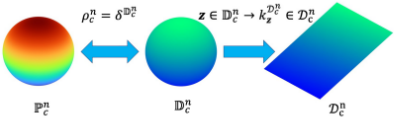
In this section, we propose an curvature-aware isometric embedding from the Poincar´e model to an RKHS. The embedding is realized by a curvature-aware kernel function. Figure 1 shows the process of this isometric-embedding. Specifically, we first define a pseudo-hyperbolic distance ρnc on the Poincar´e model Pnc , and then construct a new kernel kDn c z on the ball Dnc . Given the kernel kDn c z , a mapping fromDnc to the RKHS Dn c is realized and a metric δDnc on the ball Dnc can be defined. Besides, the metric δDnc can also be viewed as a distance measure in Dn c and we can establish the equivalence between the pseudo-hyperbolic distance ρnc and the metric δDnc . Therefore, using δDnc on Dn c as a bridge, an isometry from the Poincar´e ball to the RKHS can be established.
3.1 Generalization of the Pseudo-hyperbolic Distance in Pnc
The pseudo-hyperbolic distance in the unit Poincar´e model is defined via the norm of M¨obius self-mappings (see Eq. (6)) [Duren and Weir, 2007]. To define such a pseudohyperbolic distance in the curvature-aware Poincar´e ball, one needs to generalize the M¨obius self-mapping from Pn to Pnc .
M¨obius Self-mappings
When n = 1, the M¨obius self-mappings of the Poincar´e disk Pc is defined as the M¨obius subtraction:
where zi, zj ∈ Pc and ¯ zi means the complex conjugate of zi. We further generalize the M¨obius self-mapping from Pc to Pnc and propose the pseudo-hyperbolic distance of Pnc in case of n > 1. For zi, zj ∈ Dnc , let P c zi (zj) be the orthogonal projection of zj onto the subspace [zi] spanned by zi, and let Qczi (zj ) = zj -P c zi (zj ) be the projection onto the orthogonal complement of [zi]. Therefore, it holds that: P c zi (zj) = 0 when zi = 0, and P c zi (zj) = 〈zj,zi〉 〈zi,zi〉 zi if zi ̸= 0. Let sczi = √1 - czi 2 , we define the M¨obius self-mappings as
Note that the Eq. (12) can be simplified to ϕczi (zj) = zi-zj 1-c¯ zizj when n = 1.
Here are the properties of the proposed maps ϕczi .
Theorem 1. For every zi ∈ Dnc , ϕczi has the following properties:
- ϕczi (0) = zi, ϕczi (zi) = 0.
- ϕczi is a involution: ϕczi (ϕczi (zj)) = zj.
Proof. The proof is given in supplementary material.
According to Theorem 1, ϕczi is a one-to-one map, and that ϕczi = (ϕczi )-1 . This proves that the M¨obius self-mappings are automorphisms.
Pseudo-hyperbolic Distance
With the M¨obius self-mappings ϕczi at our disposal, we can come up with the pseudo-hyperbolic distance of the ball Dnc , given by
In this case, when n = 1, the pseudo-hyperbolic distance is defined as
where d is the M¨obius gyrodistance (see Eq. (3)) and |.| represents the absolute value of the number. Therefore, the pseudo-hyperbolic distance in Poincar´e disk with curvature -c can be rescaled by the M¨obius gyrodistance between the gyrovectors. When c = 1, it presents to the pseudohyperbolic distance in the unit Poincar´e disk.
Moreover, when n > 1, for zi, zj ∈ Dnc , ϕczi (zj) has the following property:
It is obvious that when c = 1, it becomes the pseudohyperbolic distance defined in the unit Poincar´e ball. Besides, the Eq. (13) is allowed to predigest to the equation as
which can be obtained by rescaling the M¨obius gyrodistance between zi and zj in Eq. (3).
Given the analysis, we have the following theorem.
Theorem 2. The pseudo-hyperbolic distance of the ball Dnc has the properties:
- ρnc (zi, zj) ≥ 0 and ρnc (zi, zj) = 0 if and only if zi = zj , since ϕzi (zj ) = 0 only for zi = zj ;
- ρnc (zi, zj) = ρnc (zj, zi);
- The triangle inequality takes strong form:
Proof. The proof is given in supplementary material.
The Theorem 2 shows the pseudo-hyperbolic distance is a true metric of the open ball Dnc . Furthermore, endowed with the pseudo-hyperbolic distance, the the open ball Dnc is the Poincar´e model Pnc .
3.2 RKHS with a Curvature-aware Kernel
In this section, we propose a new kernel function whose induced RKHS has a distance corresponds to the pseudohyperbolic distance in Poincar´e model.
For zi, zj ∈ Dnc , we define a curvature-aware kernel in the form of
where Dnc = {z ∈ Cn : c‖z‖2 < 1, c > 0} and Dn c is the RKHS with the kernel kDn c z . The kernel is PD and the proof is shown in the supplementary material.
After proposing the kernel, we define a metric on the ball similar to Eq. (9) in the form of
Concretely, it can be written as
by plugging the kernel in Eq. (17) to Eq. (18). When n = 1, the metric (18) can be simplified as
Through comparing Eq. (20) with Eq. (14), we note δDc (zi, zj) = ρc(zi, zj). Therefore, the metric is identified with the pseudo-hyperbolic distance of the Poincar´e disk with curvature -c.
When n > 1, compare Eq. (19) with Eq. (15), we know the metric δDnc (zi, zj ) also equals with the pseudo-hyperbolic distance ρnc (zi, zj). Therefore, the ball Dnc with the metric δDnc (zi, zj) is a Poincar´e model Pnc .
Furthermore, since (18) can also be viewed as distance in the RKHS Dn c by taking kDn c z as a vector in Dn c , the distancepreserved kernel mapping from the Poincar´e model Pnc to the RKHS with kernel kDn c (zi, zj) = 1/(1 - c〈zj , zi〉) realizes an isometry.
4 Curvature-aware Hyperbolic Kernels
In this section, we propose to construct a set of kernels in hyperbolic spaces by leveraging the proposed curvature-aware isometric embedding in Eq. (17).
4.1 Curvature-aware Hyperbolic Linear Kernel
We first come up with the simplest kernel in this context. The embedding in Eq. (17) establishes the isometry from the Poincar´e model Pnc and the RKHS Dn c . That said, this embedding can realize the linear kernel in Dn c , and we term it as curvature-aware hyperbolic linear (CHL) kernel . For zi, zj ∈ Pnc , the CHL kernel is given by
4.2 Curvature-aware Hyperbolic Polynomial Kernel
One popular kernel in the Euclidean space is the polynomial (Poly) kernel, which can encode the high-order statistics of the data. For xi, xj ∈ Cn , it can be expressed as
From the formulation to Eq. (22), we can simply extend it in the Poincar´e model Pnc . Specifically, the inner product, which can be understood as the linear kernel in the Euclidean space, in Eq. (22) can be replaced by Eq. (21), thus we can obtain the curvature-aware hyperbolic polynomial (CHPoly) kernel, formulated by
The proposed kernel is a PD one, and we have provided the proof in the supplementary material.
4.3 Curvature-aware Hyperbolic RBF Kernel
In the Euclidean space, the radial basis function (RBF) kernel is recognized as a powerful kernel due to it property of universal approximation [Smola and Sch¨olkopf, 1998]. It takes the form of
where τ > 0 is the bandwidth parameter of the RBF kernel. It is difficult to extand the RBF kernel to the Poincar´e model since the RBF kernel derived from the geodesic distance in the Poincar´e model is not a valid PD kernel [Fang et al., 2021; Jayasumana et al., 2015; Cho et al., 2019]. Fang et al. first propose a PD RBF in hyperbolic space in case of using the tangent space. In our work, we extend the RBF kernel in Dn c , called curvature-aware hyperbolic RBF (CHRBF) kernel. It can be formulated as
for τ > 0. It is worth noting that
Plug Eq. (26) into Eq. (25), we can obtain the full fumulation of CHRBF kernel as
Of note, in our formulation, the CHRBF kernel is also a valid PD kernel.
4.4 Curvature-aware Hyperbolic Laplacian Kernel
Another famous exponential-type kernel in the Euclidean space is known as the Laplacian (Lap) kernel. Its formulation is given by
Analogously, we can deduce the curvature-aware hyperbolic Laplacian kernel (CHLap) kernel as
Following the process of develop the CHRBF kernel in Eq. (27), one can yield the formulation of CHLap kernel as:
The PD property of CHLap kernel is also proven in the supplementary material.
4.5 Curvature-aware Hyperbolic Sigmoid Kernel
The former proposed kernels are PD. As a complementary concept of the PD kernel, the indefinite kernel has also been studied in the learning community [Ong et al., 2004]. In contrast to PD kernels, the indefinite kernel maps the data to an RKKS with indefinite inner product [Ong et al., 2004]. In [Cho et al., 2019], an indefinite kernel has been investigated and shows its effectiveness. This inspires us to further develop an indefinite kernel using the proposed embedding( Eq. (17) or Eq. (21)). In this case, we leverage the Sigmoid (Sig) kernel to develop an indefinite kernel. For xi, xj ∈ Cn , the Sig kernel can be expressed as
where γ > 0 and θ < 0. This is an indefinite kernel [Bishop and Nasrabadi, 2006]. Plug the Eq. 21 into Eq. 31, we can obtain the curvature-aware hyperbolic Sigmoid (CHSig) kernel for zi, zj ∈ Pnc , as
where γ > 0 and θ < 0. Since the Sig kernel is an indefinite kernel, the proposed CHSig kernel is also an indefinite kernel, which maps the hyperbolic data from the Poincar´e model to an RKKS. The optimization algorithms in RKKSs can be used to address the tasks in hyperbolic space [Loosli et al., 2015; Xu et al., 2017].
5 Experiments
In this section, we conduct thorough experiments to evaluate the superiority of the proposed kernels. Source code and Appendix are available at https://github.com/MMeiYang/Codeand-Appendix-for-Expanding-the-Hyperbolic-Kernels-ACurvature-aware-Isometric-Embedding-View.
5.1 Graph Learning
Learning on the graphs has gained significant attention in the learning community since the graph-structured data are popular to model the message passing networks including social networks, citation networks and communication networks [Xia et al., 2021]. We first evaluate the proposed kernels over the graph data with existing hyperbolic kernels and Euclidean kernels. The hyperbolic kernels include hyperbolic polynomial (HPoly) kernel proposed by [Cho et al., 2019], hyperbolic tangent (HTang) kernel, hyperbolic RBF
| Dataset Kernel | Dim | Hyperbolic Embedding | Euclidean Embedding | ||||||||||||||
|---|---|---|---|---|---|---|---|---|---|---|---|---|---|---|---|---|---|
| CHL | CHPoly | CHRBF | CHLap | CHSig | HTang | HPoly | HRBF | HLap | HBin | EL | EPoly | ERBF | ELap | ESig | |||
| #2 #5 #10 #25 | 84.31.0 89.90.3 90.60.4 90.80.2 | 82.01.8 89.70.4 90.60.3 90.90.3 | 77.50.9 88.00.8 88.40.6 88.40.6 | 80.10.7 88.10.7 88.80.3 88.60.4 | 86.50.5 90.70.4 90.80.4 91.30.4 | 63.30.6 65.20.5 74.00.8 85.80.5 | 66.62.8 81.61.1 86.51.1 88.90.6 | 74.31.0 87.20.8 88.20.7 88.00.5 | 74.81.2 87.90.6 88.50.5 88.20.7 | 67.51.3 86.01.2 88.41.4 89.61.0 | 61.40.2 64.10.6 75.80.9 83.70.3 | 66.00.5 82.50.8 86.40.4 88.50.6 | 67.00.4 84.70.6 86.80.8 87.90.6 | 67.30.3 85.60.7 86.70.6 88.10.6 | 70.70.5 86.50.7 88.90.4 89.40.3 | ||
| Terrorist | #2 #5 #10 #25 | 60.53.6 68.11.1 69.82.2 68.62.8 | 57.62.2 68.41.3 69.41.9 69.12.0 | 63.31.2 67.52.1 68.21.7 66.91.3 | 64.11.1 67.92.1 68.52.4 68.01.4 | 59.90.8 67.61.9 67.72.3 67.81.9 | 49.81.9 49.51.8 51.61.5 53.31.4 | 51.30.7 52.81.3 59.31.6 60.81.7 | 60.51.6 66.32.1 67.01.9 66.41.9 | 62.62.0 67.22.0 66.83.5 67.01.2 | 55.03.0 67.42.1 68.32.1 67.01.5 | 50.01.8 52.50.7 58.71.7 60.32.1 | 51.30.8 56.21.3 65.42.0 66.11.5 | 60.01.6 62.12.3 65.01.3 62.12.7 | 60.92.1 63.81.5 66.61.8 63.22.3 | 61.01.3 61.51.4 64.91.5 65.21.9 | |
| Wiki | #2 #5 #10 #25 | 58.71.5 71.10.6 73.20.6 73.61.0 | 50.52.8 69.41.1 72.30.6 73.10.5 | 47.61.1 66.40.8 68.31.6 69.70.9 | 49.81.8 67.11.1 69.11.6 71.00.9 | 58.41.1 70.90.8 71.81.1 72.10.6 | 18.70.8 30.53.9 38.43.4 59.90.7 | 17.02.5 58.41.2 62.00.4 67.51.6 | 41.42.3 65.11.1 67.40.9 69.71.0 | 43.11.6 66.31.6 68.21.4 69.81.3 | 33.01.7 60.51.3 64.72.1 66.10.8 | 18.20.9 26.62.6 42.71.9 58.41.8 | 18.41.0 45.51.8 57.82.3 64.61.5 | 23.71.0 57.61.4 65.61.5 68.61.5 | 24.41.1 58.51.4 65.21.5 68.11.3 | 25.50.9 62.20.6 67.80.8 70.70.8 | |
| AC | #2 #5 #10 #25 | 76.30.9 86.30.8 89.50.6 89.60.5 | 75.41.1 85.90.8 88.80.5 89.30.4 | 75.70.8 85.50.8 87.60.8 87.50.5 | 77.30.8 85.11.1 88.10.8 87.80.7 | 78.80.7 86.71.0 89.30.6 89.70.4 | 66.01.2 75.91.4 82.00.6 85.40.4 | 61.47.0 79.10.8 86.71.1 87.70.8 | 74.81.3 85.11.0 87.60.7 87.10.7 | 75.90.8 85.11.4 87.60.5 87.00.7 | 72.21.5 84.10.9 87.11.2 87.50.7 | 58.64.0 68.42.5 79.40.4 81.60.8 | 64.94.8 71.63.3 80.03.2 83.41.2 | 72.31.6 79.00.8 85.00.8 86.80.7 | 72.31.3 79.20.6 84.40.9 86.80.6 | 64.94.8 71.63.3 80.03.2 83.41.2 | |
| Cora ML | #2 #5 #10 #25 | 69.00.5 83.60.5 86.00.2 86.10.2 | 68.50.9 84.00.8 85.80.7 86.20.6 | 68.51.0 82.80.8 84.60.3 84.80.8 | 69.20.8 83.60.5 85.10.4 85.60.6 | 70.30.6 84.10.6 85.80.5 86.00.5 | 38.21.6 62.71.5 72.30.9 79.20.4 | 47.80.4 72.51.7 80.80.6 83.50.9 | 67.90.6 82.70.9 84.30.6 84.90.4 | 69.00.7 83.30.5 85.00.6 85.20.7 | 58.71.3 80.71.1 83.70.5 84.90.6 | 39.73.4 45.11.7 62.60.8 72.00.7 | 45.92.0 58.20.9 71.51.1 75.91.3 | 57.00.7 70.70.8 76.20.8 79.00.7 | 57.70.6 71.50.6 77.20.8 78.40.5 | 60.40.4 73.40.6 77.10.4 79.00.6 | |
| Avg. ACC. Top1 | Times | 78.3 6 | 77.3 4 | 75.7 0 | 76.6 1 | 78.3 10 | 60.1 0 | 67.6 0 | 74.8 0 | 75.4 0 | 72.6 0 | 58.0 0 | 65.0 0 | 69.9 0 | 70.3 0 | 70.2 0 | |
(HRBF) kernel, hyperbolic Laplace (HLap) kernel and hyperbolic Binomial (HBin) kernel in [Fang et al., 2021] and the Euclidean kernels includes Euclidean linear (EL) kernel, Euclidean polynomial (EPoly) kernel, Euclidean RBF (ERBF) kernel, Euclidean Laplacian (ELap) kernel and Euclidean Sigmoid (ESig) kernel.
Specifically, the graph are first mapped into the Poincar´e model for hyperbolic kernels, while the graph are mapped into the Euclidean space for Euclidean kernels, and then the graph nodes are classified by kernel SVMs. The details of the SVM solvers for PD and indefinite kernels are in supplementary material.
Datasets and Evaluation Protocol
Five real-world graph datasets including Facebook [Rozemberczki et al., 2019], Terrorist [Zhao et al., 2006], Wiki [Cucerzan, 2007], Amazon Electronics Computers (AC) [Shchur et al., 2018], Cora ML [Bojchevski and G¨unnemann, 2017] are used in this study. Both the hyperbolic space and the Euclidean space are employed as the embedding space with 2, 5, 10, 25 dimensions. The details of the datasets are provided in the supplementary material.
In addition, an one-vs-all (OVA) strategy is utilized to implement multi-class classification and Platt scaling maps the predicted scores on the hold-out data to probabilities for all categories [Platt and others, 1999]. We use the mean classification accuracy (ACC) to measure the performance of all the methods. Due to space limitation, other two performance metrics including area under the ROC curve (AUC) and macro-averaged area under precision recall curve (AUPR) are reported in the supplementary material.
Experimental Results
We first compare our proposed hyperbolic kernel methods with popular Euclidean kernel methods. The results are shown in Table 1. We observe that each of our hyperbolic kernels shows a great improvement against its Euclidean counterpart. For example, our CHL, CHPoly, CHRBF, CHLap and CHSig kernels improve the mean ACC by 20.3%, 12.3%, 5.8%, 6.3% and 8.1% compared with the Euclidean counterparts including EL, EPloy, ERBF, ELap and ESig kernels respectively. This shows that the hyperbolic space is a better option to encode the graph-structured data, and can improve the representation power of the graphs.
Next, the state-of-the-art hyperbolic kernel methods are employed as baseline to further demonstrate the superiority of our proposed kernels. Table 1 illustrates that our methods also obviously improve classification performance compared with existing hyperbolic kernel methods. For example, even the CHRBF kernel with the lowest performance in our proposed hyperbolic kernels improves the ACC value over HTang, HPoly, HRBF, HLap and HBin kernels by 15.6%, 8.1%, 0.9%, 0.3%, 3.1%, respectively. Compared with the HPoly kernel which fixes the curvature of hyperbolic space as -1, the good performance of our proposed kernels on different datasets demonstrates that curvature-aware hyperbolic kernels can improve the adaptability. In addition, comparisons with HTang, HRBF, HLap and HBin kernels further demonstrate the superiority of our method, which shows that the isometry from Poincar´e model to the RKHS reduces the distortion of mapping hyperbolic data to Euclidean space.
5.2 Zero-shot Learning
Zero-shot Learning (ZSL) portrays the problem of recognizing the unseen object by matching its semantic features [Akata et al., 2016; Xian et al., 2018], and can be modeled as a cross-modality matching task. We follow the practice in [Fang et al., 2021] to train the network and the paradigm is shown in Figure 2. For a batch of images, e.g., X = [X1, . . . ,XN], and all semantic embedding, e.g., E = [E1, . . . ,EM], as input, the visual features (e.g., x = [x1, . . . , xN]) and semantic features (e.g., e = [e1, . . . , eM]) are extracted by two neural networks, as x = f(X) and e = g(E). Having two-modality of data at hand, the network can be optimized by the alignment loss.
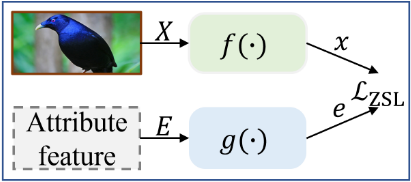
In the experiments, we follow the loss function of baseline in [Fang et al., 2021] to optimize the network. More details about the loss functions for ZSL are demonstrated in supplementary material.
Datasets and Evaluation Protocol
We use CUB [Wah et al., 2011], AWA1 [Lampert et al., 2013] and AWA2 [Akata et al., 2016] to evaluate the ZSL task. The statistics of the dataset is provided in the supplemental material. The model performance is calculated by the harmonic mean (HM) score, i.e., HM= 2×S×U U+S , where S and U denote the mean accuracy of seen and unseen classes respectively.
| Model | CUB | AWA1 | AWA2 | ||||||
|---|---|---|---|---|---|---|---|---|---|
| U | S | HM | U | S | HM | U | S | HM | |
| LATEM [Xian et al., 2016] | 15.2 | 57.3 | 24.0 | 7.3 | 71.7 | 13.3 | 11.5 | 77.3 | 20.0 |
| DEVISE [Frome et al., 2013] | 23.8 | 53.0 | 32.8 | 13.4 | 68.7 | 22.4 | 17.1 | 74.7 | 27.8 |
| DEM [Zhang et al., 2017] | 19.6 | 57.9 | 29.2 | 32.8 | 84.7 | 47.3 | 30.5 | 86.4 | 45.1 |
| ALE [Akata et al., 2016] | 23.7 | 62.8 | 34.4 | 16.8 | 76.1 | 27.5 | 14.0 | 81.8 | 23.9 |
| SP-AEN [Chen et al., 2018] | 34.7 | 70.6 | 46.6 | - | - | - | 23.3 | 90.9 | 37.1 |
| CRnet [Zhang and Shi, 2019] | 45.5 | 56.8 | 50.5 | 58.1 | 74.7 | 65.4 | 52.6 | 78.8 | 63.1 |
| Kai et al. [Li et al., 2019] | 47.4 | 47.6 | 47.5 | 62.7 | 77.0 | 69.1 | 56.4 | 81.4 | 66.7 |
| HTang kernel [Fang et al., 2021] | 40.8 | 58.1 | 47.9 | 52.3 | 85.2 | 64.8 | 37.1 | 88.5 | 52.3 |
| HRBF kernel [Fang et al., 2021] | 44.6 | 57.8 | 50.3 | 59.0 | 84.6 | 69.5 | 42.9 | 89.5 | 57.9 |
| HLap kernel [Fang et al., 2021] | 46.2 | 56.1 | 50.7 | 60.7 | 83.5 | 70.3 | 54.1 | 87.1 | 66.7 |
| HBin kernel [Fang et al., 2021] | 39.8 | 56.9 | 46.8 | 43.7 | 88.9 | 58.6 | 39.8 | 90.5 | 55.4 |
| Baseline [Fang et al., 2021] | 18.6 | 44.6 | 26.3 | 29.8 | 76.4 | 42.9 | 25.5 | 76.4 | 38.2 |
| CHL kernel | 43.3 | 58.3 | 49.7 | 51.2 | 84.7 | 63.8 | 44.5 | 90.8 | 59.8 |
| CHPoly kernel | 41.7 | 58.9 | 48.8 | 51.3 | 85.4 | 64.1 | 42.2 | 90.9 | 57.6 |
| CHRBF kernel | 45.0 | 56.7 | 50.1 | 56.3 | 82.7 | 67.0 | 45.1 | 90.1 | 60.1 |
| CHLap kernel | 45.2 | 56.1 | 50.1 | 53.4 | 88.9 | 66.7 | 44.9 | 90.9 | 60.1 |
| CHSig kernel | 46.9 | 56.5 | 51.3 | 59.3 | 87.2 | 70.6 | 69.2 | 73.5 | 71.3 |
Experimental Results
We first evaluate our methods by comparing them with the baseline. As shown in Table 2, all our kernels show obvious improvements to the baseline. Concretely, compared with the baseline, even proposed simplest CHL kernel improve 23.4%, 20.9% and 21.6% on HM for CUB, AWA1 and AWA2. Besides, the powerful indefinite CHSig kernel further improves the accuracy of ZSL, which demonstrates the superiority of hyperbolic kernel for representation learning.
In addition, to further show the superiority of our method, a series of ZSL methods are applied for comparison, including the non-generative algorithms [Zhang and Shi, 2019; Li et al., 2019]. We note that our proposed CHSig kernel yields the best results on all datasets.
Finally, we compare our methods with the state-of-the-art methods with hyperbolic kernels for ZSL [Fang et al., 2021].
We observe from Table 2 that our methods are still very competitive compared with the existing hyperbolic kernel methods. In particular, our CHSig kernel outperforms existing methods across all 3 datasets, clearly showing the superiority of the proposed kernels.
5.3 Further Studies
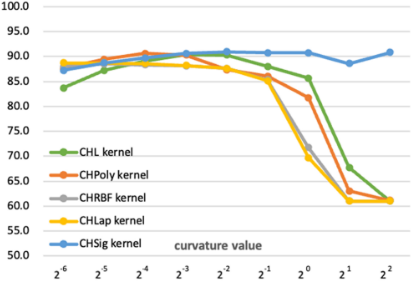
In this part, we study the effect of the curvature of the Poincar´e ball. We conduct this study in the graph learning task. Specifically, the Facebook dataset and five kernels, e.g., CHL kernel, CHPoly kernel, CHRBF kernel, CHLap kernel, and CHSig kernel, are used in this analysis. In the experiments, we set c to {2-6 , 2-5 , 2-4 , 2-3 , 2-2 , 2-1 , 20 , 21 , 22 } while the curvature value is represented as -c. Figure 3 shows the results. We can observe that: (1) In the regime of the small c value, e.g., c < 0.5, the overall trend of classification accuracy of the all kernels is leveled off. (2) However, for PD kernels, it also shows that a large value of the c will degrade the classification performance. (3) The indefinite kernel, i.e., is insensitive to the curvature, indicating its superiority and robustness. This study indeed shows the discrimination of the Poincar´e model can benefit from the curvature.
6 Conclusion
This paper proposed a family of hyperbolic kernels with a new curvature-aware isometric embedding function. This embedding was realized by a kernel mapping, which projected the hyperbolic space to an RKHS. Then we developed a set of kernels including several PD kernels and an indefinite kernel. The proposed kernels can adapt to different data regimes and preserve the raw data's hierarchical structure. Extensive experiments on graph learning and zero-shot learning evaluate the effectiveness of the kernels. We believe the proposed isometric-embedding function can construct more powerful kernel machines.
Acknowledgments
This work was supported by the National Natural Science Foundation of China (No. 62076062) and the Social Development Science and Technology Project of Jiangsu Province ( No.BE2022811). Furthermore, the work was also supported by the Collaborative Innovation Center of Wireless Communications Technology and the Big Data Computing Center of Southeast University.
@inproceedings{ijcai2023p497,
  title     = {Expanding the Hyperbolic Kernels: A Curvature-aware Isometric Embedding View},
  author    = {Yang, Meimei and Fang, Pengfei and Xue, Hui},
  booktitle = {Proceedings of the Thirty-Second International Joint Conference on
               Artificial Intelligence, {IJCAI-23}},
  publisher = {International Joint Conferences on Artificial Intelligence Organization},
  editor    = {Edith Elkind},
  pages     = {4469--4477},
  year      = {2023},
  month     = {8},
  note      = {Main Track},
  doi       = {10.24963/ijcai.2023/497},
  url       = {https://doi.org/10.24963/ijcai.2023/497},
}
TY - CPAPER TI - Expanding the Hyperbolic Kernels: A Curvature-aware Isometric Embedding View AU - Yang, Meimei AU - Fang, Pengfei AU - Xue, Hui T2 - Proceedings of the Thirty-Second International Joint Conference on Artificial Intelligence, IJCAI-23 PB - International Joint Conferences on Artificial Intelligence Organization PY - 2023 SP - 4469 EP - 4477 DO - 10.24963/ijcai.2023/497 UR - https://doi.org/10.24963/ijcai.2023/497 ER -Copied
Machine-readable versions of this paper, for tools and AI agents:





