
MAT: Mixed-Strategy Game of Adversarial Training in Fine-tuning
Proceedings of the Thirty-Second International Joint Conference on Artificial Intelligence. Main Track. Pages 4674-4683.
https://doi.org/10.24963/ijcai.2023/520
Keywords
- Natural Language Processing: NLP: Other
- Machine Learning: ML: Adversarial machine learning
Abstract
Fine-tuning large-scale pre-trained language models has been demonstrated effective for various natural language processing (NLP) tasks. Previous studies have established that incorporating adversarial training during the fine-tuning stage can significantly enhance model generalization and robustness. However, from the perspective of game theory, such utilizations of adversarial training correspond to pure-strategy games, which are inherently limited in terms of the scope of their strategies, thereby still having room for improvement. In order to push the performance boundaries, we propose a novel Mixed-strategy Adversarial Training algorithm (MAT). Methodologically, we derive the Nash equilibrium of a mixed-strategy game for adversarial training using Entropy Mirror Descent to establish MAT by sampling method. To verify the effectiveness of MAT, we conducted extensive benchmark experiments on large-scale pre-trained models, such as BERT and RoBERTa. MAT significantly outperforms the state-of-the-art methods on both the GLUE and ANLI benchmarks in terms of generalization and robustness.
- [Aghajanyan et al., 2021] Armen Aghajanyan, Akshat Shri- vastava, Anchit Gupta, Naman Goyal, Luke Zettlemoyer, and Sonal Gupta. Better fine-tuning by reducing represen- tational collapse. In ICLR, 2021.
- [Ahuja et al., 2020] Kartik Ahuja, Karthikeyan Shanmugam, Kush R. Varshney, and Amit Dhurandhar. Invariant risk minimization games. In ICML, 2020.
- [Arora et al., 2017] Sanjeev Arora, Rong Ge, Yingyu Liang, Tengyu Ma, and Yi Zhang. Generalization and equilibrium in generative adversarial nets (gans). In ICML, 2017.
- [Bar-Haim et al., 2006] Roy Bar-Haim, Ido Dagan, Bill Dolan, Lisa Ferro, Danilo Giampiccolo, Bernardo Magnini, et al. The second PASCAL recognising textual entailment challenge. In Proceedings of the Second PAS- CAL Challenges Workshop on Recognising Textual Entail- ment, 2006.
- [Beck and Teboulle, 2003] Amir Beck and Marc Teboulle. Mirror descent and nonlinear projected subgradient meth- ods for convex optimization. Operations Research Letters, 2003.
- [Bentivogli et al., 2009] Luisa Bentivogli, Bernardo Magnini, Ido Dagan, Hoa Trang Dang, and Danilo Giampiccolo. The fifth PASCAL recognizing textual entailment challenge. In Proceedings of the Second Text Analysis Conference, 2009.
- [Bowman et al., 2015] Samuel R. Bowman, Gabor Angeli, Christopher Potts, and Christopher D. Manning. A large annotated corpus for learning natural language inference. In EMNLP, 2015.
- [Brown et al., 2020] Tom B. Brown, Benjamin Mann, Nick Ryder, Melanie Subbiah, Jared Kaplan, Prafulla Dhariwal, et al. Language models are few-shot learners. In NeurIPS, 2020.
- [Cer et al., 2017] Daniel Cer, Mona Diab, Eneko Agirre, Iñigo Lopez-Gazpio, and Lucia Specia. SemEval-2017 task 1: Semantic textual similarity multilingual and crosslingual focused evaluation. In Proceedings of the 11th International Workshop on Semantic Evaluation (SemEval-2017), 2017.
- [Dagan et al., 2005] Ido Dagan, Oren Glickman, and Bernardo Magnini. The PASCAL recognising textual entailment challenge. In First PASCAL Machine Learning Challenges Workshop, 2005.
- [Daskalakis et al., 2018] Constantinos Daskalakis, Andrew Ilyas, Vasilis Syrgkanis, and Haoyang Zeng. Training gans with optimism. In ICLR, 2018.
- [Devlin et al., 2019] Jacob Devlin, Ming-Wei Chang, Ken- ton Lee, and Kristina Toutanova. BERT: pre-training of deep bidirectional transformers for language understand- ing. In NAACL-HLT, 2019.
- [Dolan and Brockett, 2005] William B. Dolan and Chris Brockett. Automatically constructing a corpus of senten- tial paraphrases. In Proceedings of the Third International Workshop on Paraphrasing, 2005.
- [Giampiccolo et al., 2007] Danilo Giampiccolo, Bernardo Magnini, Ido Dagan, and Bill Dolan. The third PASCAL recognizing textual entailment challenge. In Proceedings of the ACL-PASCAL@ACL 2007 Workshop on Textual En- tailment and Paraphrasing, 2007.
- [Goodfellow et al., 2014] Ian J. Goodfellow, Jean Pouget- Abadie, Mehdi Mirza, Bing Xu, David Warde-Farley, Sherjil Ozair, et al. Generative adversarial nets. In NeurIPS, 2014.
- [Goodfellow et al., 2015] Ian J. Goodfellow, Jonathon Shlens, and Christian Szegedy. Explaining and harnessing adversarial examples. In ICLR, 2015.
- [Hinton et al., 2012] Geoffrey Hinton, Nitish Srivastava, and Kevin Swersky. Rmsprop: Divide the gradient by a run- ning average of its recent magnitude. Coursera, 2012.
- [Hsieh et al., 2019] Ya-Ping Hsieh, Chen Liu, and Volkan Cevher. Finding mixed nash equilibria of generative ad- versarial networks. In ICML, 2019.
- [Iyer et al., 2017] Shankar Iyer, Nikhil Dandekar, and Kor- nel Csernai. First quora dataset release: Question pairs. Technical report, Quora, 2017.
- [Jiang et al., 2020] Haoming Jiang, Pengcheng He, Weizhu Chen, Xiaodong Liu, Jianfeng Gao, and Tuo Zhao. SMART: robust and efficient fine-tuning for pre-trained natural language models through principled regularized optimization. In ACL, 2020.
- [Jin et al., 2020] Di Jin, Zhijing Jin, Joey Tianyi Zhou, and Peter Szolovits. Is BERT really robust? A strong base- line for natural language attack on text classification and entailment. In AAAI, 2020.
- [Kingma and Ba, 2015] Diederik P. Kingma and Jimmy Ba. Adam: A method for stochastic optimization. In ICLR, 2015.
- [Levesque, 2011] Hector J. Levesque. The winograd schema challenge. In AAAI Spring Symposium, 2011.
- [Lhoest et al., 2021] Quentin Lhoest, Albert Villanova del Moral, Yacine Jernite, Abhishek Thakur, Patrick von Platen, Suraj Patil, et al. Datasets: A community library for natural language processing. In EMNLP, 2021.
- [Li et al., 2016] Chunyuan Li, Changyou Chen, David E. Carlson, and Lawrence Carin. Preconditioned stochastic gradient langevin dynamics for deep neural networks. In AAAI, 2016.
- [Liang et al., 2018] Bin Liang, Hongcheng Li, Miaoqiang Su, Pan Bian, Xirong Li, and Wenchang Shi. Deep text classification can be fooled. In IJCAI, 2018. IJCAI
- [Liu et al., 2019] Yinhan Liu, Myle Ott, Naman Goyal, Jingfei Du, Mandar Joshi, Danqi Chen, et al. Roberta: A robustly optimized BERT pretraining approach. CoRR, abs/1907.11692, 2019.
- [Liu et al., 2020] Xiaodong Liu, Hao Cheng, Pengcheng He, Weizhu Chen, Yu Wang, Hoifung Poon, et al. Adver- sarial training for large neural language models. CoRR, abs/2004.08994, 2020.
- [Madry et al., 2018] Aleksander Madry, Aleksandar Makelov, Ludwig Schmidt, Dimitris Tsipras, and Adrian Vladu. Towards deep learning models resistant to adversarial attacks. In ICLR, 2018.
- [Miyato et al., 2017] Takeru Miyato, Andrew M. Dai, and Ian J. Goodfellow. Adversarial training methods for semi- supervised text classification. In ICLR, 2017.
- [Nash, 1951] John Nash. Non-cooperative games. Annals of Mathematics, 54(2):286-295, 1951.
- [Nemirovski and Yudin, 1983] Arkadi Nemirovski and D. Yudin. Problem complexity and method efficiency in optimization. Wiley, 1983.
- [Nie et al., 2020] Yixin Nie, Adina Williams, Emily Dinan, Mohit Bansal, Jason Weston, and Douwe Kiela. Adver- sarial NLI: A new benchmark for natural language under- standing. In ACL, 2020.
- [Paszke et al., 2019] Adam Paszke, Sam Gross, Francisco Massa, Adam Lerer, James Bradbury, Gregory Chanan, et al. Pytorch: An imperative style, high-performance deep learning library. In NeurIPS, 2019.
- [Radford et al., 2018] Alec Radford, Karthik Narasimhan, Tim Salimans, Ilya Sutskever, et al. Improving language understanding by generative pre-training. OpenAI blog, 2018.
- [Radford et al., 2019] Alec Radford, Jeffrey Wu, Rewon Child, David Luan, Dario Amodei, Ilya Sutskever, et al. Language models are unsupervised multitask learners. OpenAI blog, 2019.
- [Raffel et al., 2020] Colin Raffel, Noam Shazeer, Adam Roberts, Katherine Lee, Sharan Narang, Michael Matena, et al. Exploring the limits of transfer learning with a unified text-to-text transformer. The Journal of Machine Learning Research, 2020.
- [Rajpurkar et al., 2016] Pranav Rajpurkar, Jian Zhang, Kon- stantin Lopyrev, and Percy Liang. Squad: 100, 000+ ques- tions for machine comprehension of text. In EMNLP, 2016.
- [Shafahi et al., 2019] Ali Shafahi, Mahyar Najibi, Amin Ghiasi, Zheng Xu, John P. Dickerson, Christoph Studer, et al. Adversarial training for free! In NeurIPS, 2019. [Socher et al., 2013]
- Richard Socher, Alex Perelygin, Jean Wu, Jason Chuang, Christopher D. Manning, Andrew Y. Ng, et al. Recursive deep models for semantic composi- tionality over a sentiment treebank. In EMNLP, 2013.
- [Szegedy et al., 2014] Christian Szegedy, Wojciech Zaremba, Ilya Sutskever, Joan Bruna, Dumitru Er- han, Ian J. Goodfellow, et al. Intriguing properties of neural networks. In ICLR, 2014.
- [Thorne et al., 2018] James Thorne, Andreas Vlachos, Christos Christodoulopoulos, and Arpit Mittal. FEVER: a large-scale dataset for fact extraction and verification. In NAACL-HLT, 2018.
- [Wang et al., 2019] Alex Wang, Amanpreet Singh, Julian Michael, Felix Hill, Omer Levy, and Samuel R. Bowman. GLUE: A multi-task benchmark and analysis platform for natural language understanding. In ICLR, 2019.
- [Wang et al., 2022] Zhen Wang, Yitao Zheng, Hai Zhu, Chang Yang, and Tianyi Chen. Transferable adversarial examples can efficiently fool topic models. Computers & Security, 118:102749, 2022.
- [Warstadt et al., 2019] Alex Warstadt, Amanpreet Singh, and Samuel R. Bowman. Neural network acceptability judgments. Transactions of the Association for Compu- tational Linguistics, 2019.
- [Welling and Teh, 2011] Max Welling and Yee Whye Teh. Bayesian learning via stochastic gradient langevin dynam- ics. In ICML, 2011.
- [Williams et al., 2018] Adina Williams, Nikita Nangia, and Samuel R. Bowman. A broad-coverage challenge corpus for sentence understanding through inference. In NAACL- HLT, 2018.
- [Wolf et al., 2020] Thomas Wolf, Lysandre Debut, Victor Sanh, Julien Chaumond, Clement Delangue, Anthony Moi, et al. Transformers: State-of-the-art natural language processing. In EMNLP, 2020.
- [Zhang et al., 2019] Dinghuai Zhang, Tianyuan Zhang, Yip- ing Lu, Zhanxing Zhu, and Bin Dong. You only propagate once: Accelerating adversarial training via maximal prin- ciple. In NeurIPS, 2019.
- [Zhou et al., 2021] Qi Zhou, Haipeng Chen, Yitao Zheng, and Zhen Wang. Evalda: Efficient evasion attacks towards latent dirichlet allocation. In AAAI, 2021.
- [Zhu et al., 2020] Chen Zhu, Yu Cheng, Zhe Gan, Siqi Sun, Tom Goldstein, and Jingjing Liu. Freelb: Enhanced ad- versarial training for natural language understanding. In ICLR, 2020.
- [Zuo et al., 2021] Simiao Zuo, Chen Liang, Haoming Jiang, Xiaodong Liu, Pengcheng He, Jianfeng Gao, et al. Ad- versarial regularization as stackelberg game: An unrolled optimization approach. In EMNLP, 2021.
References were extracted automatically from the PDF and may contain errors.
Full text extracted automatically from the PDF; figures, tables and equations may differ. The PDF is the version of record.
1 Introduction
Recent years have seen significant advancements in the field of natural language processing (NLP) due to the development of large-scale pre-trained language models such as BERT [Devlin et al., 2019], GPT [Radford et al., 2018; Radford et al., 2019; Brown et al., 2020], and T5 [Raffel et al., 2020]. These models have achieved remarkable success across a wide range of NLP tasks, primarily because of their vast number of parameters and the ability to leverage context information. However, the complexity of these models has presented challenges in model development, training, and usage. As we know, fine-tuning is an increasingly popular and fundamental approach, which adapts a pre-trained model to a downstream task through re-training on a small set of task-specific data. Meanwhile, it has been observed that fine-tuned models are susceptible to overfitting the training data of downstream tasks, which may result in suboptimal generalization performance on unseen data points.
∗Corresponding author.
Recent studies [Liu et al., 2020; Zhu et al., 2020; Jiang et al., 2020; Aghajanyan et al., 2021] have demonstrated that incorporating adversarial training during the fine-tuning stage can alleviate issues of overfitting and effectively improve model generalization in downstream applications. Adversarial training optimizes models by augmenting the training set with adversarial examples, which are typically generated by adding small and carefully selected perturbations to input data. However, from the perspective of game theory, the existing adversarial training methods can be mainly interpreted as pure-strategy games between the model and adversarial perturbations, which are limited in their strategy space. According to the Nash theorem [Nash, 1951], the pure-strategy game is a subset of the mixed-strategy game, and the Nash equilibrium (which represents a stable state of the game) in the pure-strategy game may not exist. Therefore, it is natural to question whether performance can be further improved by interpreting and reformulating adversarial training in light of the theory of the mixed-strategy game.
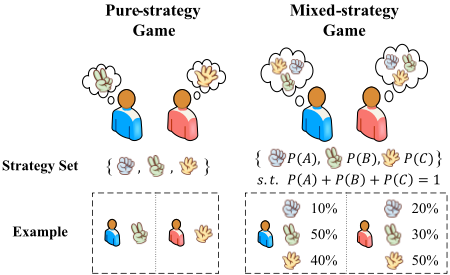
In order to address the question, we view adversarial training as a two-player, complete-information game and propose an approach to improve adversarial training under the setting of a mixed-strategy game. Previous adversarial training methods can be mainly seen as pure-strategy games because both model parameters and adversarial perturbations choose deterministically specified strategies. In contrast, our proposed adversarial training method is based on the mixed strategy, which enables a broader search space for model parameters by leveraging the probabilistic nature of the strategies (as discussed in greater detail in Section 3.1). To illustrate this concept, we can consider a two-player game of rock-paperscissors, as shown in Figure 1. In the mixed-strategy game, the players have a broader range of strategies to choose from.
Our main contributions can be summarized as follows:
- We propose a Mixed-strategy Adversarial Training algorithm (MAT) that aims to further improve the generalization and robustness of fine-tuned NLP models. Specifically, we apply game theory to interpret adversarial training as a mixed-strategy game, and derive a theoretical Nash equilibrium using the Entropy Mirror Descent method. Then we simplify this method through
the use of sampling mechanisms to make the training algorithm practical and implementable in reality.
- We perform thorough experiments to demonstrate the effectiveness of MAT and attain state-of-the-art results on the GLUE [Wang et al., 2019] and ANLI [Nie et al., 2020] benchmarks. Our findings show that applying MAT on the BERT [Devlin et al., 2019] and RoBERTa model [Liu et al., 2019] results in significantly superior performance compared to previous methods.
2 RelatedWork
2.1 Adversarial Training in CV and NLP
Adversarial training was first introduced in the field of computer vision (CV) by Szegedy et al.[2014] and Goodfellow et al.[2015]. Instead of relying solely on clean datasets for training, researchers discovered that augmenting the training set with adversarial examples can effectively protect models against adversarial attacks. Madry et al.[2018] formulated this type of adversarial training as a Min-Max optimization problem, where the adversarial examples are generated by maximizing the deviation of the training objective within the tolerance of visibility. For solving the maximization subproblems, the projected gradient descent (PGD) algorithm is employed to generate perturbations that satisfy the given constraints. Subsequent research by Shafahi et al.[2019] and Zhang et al.[2019] have aimed to improve the efficiency of the PGD algorithm by reducing its time complexity.
Adversarial training in natural language processing (NLP) was introduced by Miyato et al.[2017], who perturbed the word embedding space to alleviate the issue of overfitting during training models from scratch. With the advent of pretrained large-scale models, Zhu et al.[2020] extended adversarial training to the fine-tuning stage of pre-trained models and proposed the FreeLB algorithm. FreeLB adds adversarial perturbations to word embeddings and minimizes the resultant adversarial risk inside different regions around input samples. Jiang et al.[2020] developed the SMART algorithm, which effectively addresses overfitting and aggressive updating issues in the fine-tuning stage through smooth-inducing adversarial regularization and Bregman proximal point optimization. Aghajanyan et al.[2021] further improved upon this by decomposing pre-trained models into a feature extractor and a classifier with separate constraints and modifying adversarial perturbations to be either normal or uniformly distributed noise, significantly reducing the time required to generate adversarial perturbations.
2.2 Game Theory Applications in Deep Learning
Generative adversarial networks (GANs) [Goodfellow et al., 2014] generate synthetic data by mimicking genuine samples, which have become increasingly popular and widely used in various applications. GANs can be primarily interpreted as a game theory problem, which has inspired several training approaches in recent years. Arora et al.[2017] proposed the MIX+GAN protocol, a mixed-strategy GAN training algorithm that uses a small mixture of discriminators and generators. Daskalakis et al.[2018] introduced the Optimistic Mirror Descent (OMD) method for training Wasserstein GANs, and they formally showed that the last iteration of the OMD dynamics converged to a Nash equilibrium in the case of a zero-sum game. Hsieh et al.[2019] optimized the set of probability distributions over the pure strategies of neural networks and suggested a provably convergent GAN training approach. Ahuja et al.[2020] formulated the standard risk minimization paradigm of machine learning in the context of finding the Nash equilibrium of an ensemble game among several environments. Although there is limited research on applying game theory to fine-tuning pre-trained models, Zuo et al.[2021] proposed the SALT approach, which formulates adversarial training as a Stackelberg game in which the follower generates perturbations and the leader optimizes model parameters given these perturbations.
3 Mixed-Strategy Adversarial Training
In this section, we examine adversarial training from a gametheoretic perspective. Specifically, we first generalize the mixed-strategy form of adversarial training in Section 3.1. Then, in Section 3.2, we utilize the Entropy Mirror Descent optimization algorithm to derive a Nash equilibrium for the mixed-strategy adversarial training game. Since the probability distribution of the strategy set is implicitly unknown during model training, we propose a sampling-based simplification of the theoretical algorithm in Section 3.3, resulting in the development of our practical mixed-strategy adversarial training algorithm, referred to as MAT.
Notation. Throughout the paper, we use f(θ, x) to represent the output of the language model f with parameters θ, given input word embeddings x. δ represents adversarial perturbations. DKL(P∥Q) = ∑k pk log(pk/qk) represents the KL-divergence of two discrete distributions P and Q.
3.1 Defining Adversarial Training Game
Without loss of generality, we define the loss function L(θ) for the standard NLP fine-tuning task as follows:
where y is the ground truth, and ℓ measures the deviation between the predicted output f (θ, x) and ground truth y. Moreover, the loss function of adversarial training is defined as:
where ℓs measures the deviation brought by adding adversarial perturbations onto the model inputs, which is chosen according to different tasks. For classification tasks, ℓs is typically chosen as the symmetrized KL-divergence, i.e., ℓs(P,Q) = DKL(P∥Q) + DKL(Q∥P) given two distributions P and Q. For regression tasks, ℓs is chosen as the squared loss. Then, by combining Equation (1) and Equation (2), the target optimization problem for the fine-tuning tasks with adversarial training can be formulated as below:
where λ is a tuning coefficient that balances the two individual loss functions L(θ) and R(θ, δ).
Equation (3) can be interpreted as a potential game problem involving two parties: one for the model trainable parameters and the other one for the adversarial perturbations. The feasible domain of the model parameters can be considered as model strategy space, similar to the adversarial perturbations. Adversarial training can be solely viewed as a game where the model parameters select a strategy from the strategy set Θ, while the adversarial perturbations select a strategy from the strategy set ∆. Clearly, this is a pure-strategy game in which the decisions of both parties are deterministic and non-probabilistic. Existing adversarial training methods are limited to pure-strategy games with a limited strategy space, thus, we aim to extend it to a mixed-strategy game.
By using the mixed strategy, we no longer consider specific values of the model parameters and adversarial perturbations, but instead the probability of each possibility. In practice, we consider the set of all probability distributions over Θ and ∆. Let M(Θ) andM(∆) denote the set of all Borel probability measures on Θ and ∆, respectively. Then we define the following target problem for a mixed-strategy adversarial training game to find the optimal strategy probability distribution µ ∈ M(Θ) and ν ∈ M(∆):
By redefining adversarial training as a mixed-strategy game, we expand the strategy space, enabling the parties to find the optimal distribution for both sides. More strategy options allow for greater flexibility and robustness in the adversarial training process. The game can be solved when a Nash equilibrium is reached, in which no party can benefit by changing its strategy given the strategy of the other party.
3.2 Finding Nash Equilibrium of Mixed-Strategy Adversarial Training Game
In order to determine the Nash equilibrium of the mixedstrategy adversarial training game defined in Equation (4), we turn to iterative optimization methods as a natural selection for solving such problems. These methods involve iteratively searching for the strategies of the players until an approximate Nash equilibrium is reached. In this work, we utilize the Entropy Mirror Descent (EMD) [Beck and Teboulle, 2003], which is a specific form of the Mirror Descent (MD) [Nemirovski and Yudin, 1983]. EMD uses the entropy function as a measure of distance between probability distributions, known as the Bregman divergence. This measure is employed to guide the iterative updating of solutions, allowing us to find the Nash equilibrium of mixed-strategy games.
To proceed, we iteratively update the probability distribution of model parameters and adversarial perturbations by EMD, until an approximate Nash equilibrium is found. To simplify the notation, we abbreviate the game function defined in Equation (4) as G. The update mechanisms for the strategy sequences {µt}Tt=1 and {νt}Tt=1 can be written as:
where ¯µT and ¯ νT are the averages of corresponding sequences, i.e., ¯µT := 1 T ∑Tt=1 µt and ¯ νT := 1 T ∑Tt=1 νt. And (¯µT , ¯ νT ) serves as an approximate Nash equilibrium.
Following Beck and Teboulle [2003], the EMD method replaces the Bregman divergence used in MD with an entropy function Φ. This results in the following iterative updates:
The use of the entropy function in the EMD method allows it to take into account the inherent randomness and uncertainty present in mixed-strategy games, resulting in improved convergence and stability compared to other variants of the MD method. Specifically, the Shannon entropy is used as the measure of distance when the random variable z is discrete, and it is defined as Φ(Z) = ∑ni=1 zi log zi, whereas, the differential entropy is used when z is continuous and it is defined as Φ(Z) = ∫ p(z) log p(z)dz, where p(z) is the probability density function. To complete Equation (5), the next step is to compute the derivatives of G with respect to µ and ν, which are given as follows:
To summarize the above steps, we provide an algorithmic pseudocode as Algorithm 1, which allows us to iteratively converge to the Nash equilibrium of the mixed-strategy adversarial training game theoretically. However, since the density functions of µ and ν are implicit, it is not possible to directly find the Nash equilibrium in practice. Therefore, we require a practical method to estimate these distributions, which will be discussed in Section 3.3.
Algorithm 1 EMD Adversarial Training
Input: Initial Distributions µ1 and ν1, Learning Rate η.
3: µt+1 = EMDη (µt, htµ )
4: end for
6: return ¯µT
Output: Model Parameters Distribution ¯µT .
3.3 FromTheory to Practice
Optimizing the desired risk over the distributions of model parameters and adversarial perturbation as outlined in Algorithm 1 is not practical. To overcome this, the empirical risk needs to be optimized through sampling in order to obtain an approximate distribution, which requires the density function of the sampled distribution.
Following the theorem proposed by Hsieh et al.[2019], which illustrated an explicit form of Infinite-Dimensional Mirror Descent, we can recursively apply EMD iterations to obtain the final density functions of µ and ν as below:
Given Equation (8), the µt and νt can be sampled and approximated by a set of {θ(k) t }Kk=1 and {δ(k) t }Kk=1 . This equation indicates that by starting sampling from µ1, it is possible to recursively estimate the distribution of all {µt}Tt=1 .
The remaining preparation is to estimate hµ and hν , which are the expectations of the partial derivatives of G with respect to µ and ν. A commonly-used method to estimate unknown ground-truth expectations is to use the empirical average. To proceed, given K samples, the partial derivatives of µ and ν in Equation (7) can be approximated as follows:
During model training, maintaining the entire sample set {θ(k) t }Kk=1 and {δ(k) t }Kk=1 can be computationally intensive in terms of both space complexity and time complexity. So we use the mean of samples ¯ θt and ¯ δt instead of all sample points. This allows us to further simplify Equation (9) as:
where ¯ θ and ¯ δ are efficiently calculated by taking the exponential moving average, like ¯ zt+1 ← β ¯ zt + (1 - β)zt.
Now we have only one step left, which is collecting samples from distribution µ and ν. A widely used sampling method is Stochastic Gradient Langevin dynamics (SGLD) [Welling and Teh, 2011], which consists of Stochastic Gradient Descent and Langevin Dynamics. For any probability distribution with density function e-hdz, such as Equation (8), SGLD iterates as fellows:
where γ is the sampling step size, ϵ is the thermal noise, and ξ ∼ N(0, 1) is a standard normal vector. In addition to SGLD, Li et al.[2016] demonstrated that gradient-based optimization algorithms, including RMSprop [Hinton et al.,
Algorithm 2 MAT: Mixed-strategy Adversarial Training
Input: Pre-trained Model Parameters θ1,
Sampling Step Size {γt}Tt=1 ,
Sampling Times K, Thermal Noise ϵ.
- 1: for t = 1, 2, . . . , T -1 do
- 2: Initialize δ(1) t , ¯ δt ← δ(1) t
- 3: for k = 1, 2, . . . , K do
- 4: δ(k+1) t ← δ(k) t +γt∇δλR(¯ θt, δ(k) t ) + √2γtϵξ
- 5: ¯ δt ← β ¯ δt + (1 - β)δ(k+1) t
- 6: end for
- 7: θ(1) t ← θt, ¯ θt ← θt
- 8: for k = 1, 2, . . . , K do
- 11: end for
- 12: θt+1 ← βθt + (1 -β)¯ θt
- 13: end for
- 14: return θT
Output: Fine-tuned Model Parameters θT .
2012] and Adam [Kingma and Ba, 2015], can also perform dynamic sampling. Their sampling iterations are as follows:
where RMSprop and Adam refer to the specific variants of gradient calculations used in accordance with these optimization algorithms. If we substitute ˆhµ and ˆhν from Equation (10) into Equation (11), the SGLD sampling iterations of δ and θ can be written as follows:
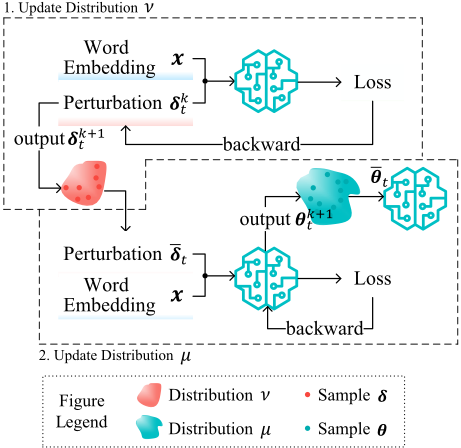
In summary, we entail the substitution of the original distribution with the mean of the distribution, which was approximated through the utilization of samples drawn from said distribution. Upon procuring the approximation of the sequence {µt}Tt=1 , the final Nash equilibrium is executed by calculating the average of this sequence. To provide a clear overview of our method, we outline the whole process in Algorithm 2, which we refer to as MAT (Mixed-strategy Adversarial Training). Additionally, we provide a schematic in Figure 2 to intuitively illustrate the process of MAT.
4 Experiments
In this section, in order to verify the effectiveness of our proposed algorithm, MAT 1 , we conducted a comprehensive evaluation of MAT using two widely recognized natural language understanding benchmarks: GLUE [Wang et al., 2019] and ANLI [Nie et al., 2020]. Additionally, MAT effectively showcase its capacity to enhance model generalization and robustness through a comprehensive comparison of experimental results with previous methods. Further details on the datasets and experiments are provided in the Appendix.
1 Code is available at https://github.com/Charles-Zhong/MAT.
4.1 Models and Benchmarks
BERTModel. BERT [Devlin et al., 2019] is a transformerbased language model widely recognized for its exceptional performance on various NLP tasks. The BERT-base version, which has about 110 Million parameters, is commonly used as a base model for fine-tuning various downstream tasks.
RoBERTa Model. RoBERTa [Liu et al., 2019] is a variant of the BERT model that is trained with more extensive datasets and practical tricks such as dynamic masking, larger batch sizes, and longer training times. The RoBERTa-large version, consisting of a higher number of parameters (356M), is frequently used as a more robust base model for NLP tasks. GLUE Benchmark. GLUE (General Language Understanding Evaluation) [Wang et al., 2019] benchmark is a collection of nine tasks for natural language understanding model training and evaluation. The nine datasets comprising GLUE are CoLA [Warstadt et al., 2019], SST-2 [Socher et al., 2013], MRPC [Dolan and Brockett, 2005], STS-B [Cer et al., 2017], QQP [Iyer et al., 2017], MNLI [Williams et al., 2018], QNLI [Rajpurkar et al., 2016], RTE [Dagan et al., 2005; Bar-Haim et al., 2006; Giampiccolo et al., 2007; Bentivogli et al., 2009], and WNLI [Levesque, 2011]. With the exception of STS-B, which is a regression task, all of the other tasks fall within the classification category.
ANLI Benchmark. ANLI (Adversarial Natural Language Inference) [Nie et al., 2020] is an adversarial benchmark that is compiled through an iterative, adversarial human-andmodel-in-the-loop process. The dataset is divided into three parts, progressively increasing the challenges for language models. ANLI is typically used to measure the robustness of models, i.e., the performance against adversarial attacks.
4.2 Implementation Details
Our implementation of the MAT algorithm is based on the PyTorch framework [Paszke et al., 2019]. In addition, we leverage the Huggingface library, namely transformers [Wolf et al., 2020] and datasets [Lhoest et al., 2021], for loading pretrained models and datasets. The text data in all the datasets are tokenized, and we limit the maximum length to 512 tokens. The hyperparameter settings are determined by combining empirical selection with the use of AutoML toolkits like NNI 2 . The checkpoints of pre-trained models, including BERT-base 3 and RoBERTa-large 4 , are obtained from the Huggingface repository.
During the model training phase, we utilize a range of sampling techniques, including Stochastic Gradient Langevin Dynamics (SGLD) sampling, along with its preconditioned variants such as the RMSProp-preconditioned and Adampreconditioned versions of SGLD. Additionally, we experiment with a range of learning rates, specifically within the interval {1 × 10⁻⁵ , 3 × 10⁻⁵ , 5 × 10⁻⁵ }, and employ various batch sizes, including 8, 16, 32, and 64. To ensure the robustness, we set a maximum norm of adversarial perturbation at 1 × 10⁻⁵ , and implement a clipping mechanism to curtail any perturbations that exceed this threshold. Furthermore, in accordance with previous works, we employ the single-task fine-tuning procedure for the GLUE benchmark, without utilizing any out-of-domain data. With regard to the ANLI benchmark, we follow the experimental setup of Nie et al.[2020] and Jiang et al.[2020] for facilitating comparison with their results, and train RoBERTa-lager model on the combined NLI datasets comprising of MNLI [Williams et al., 2018], SNLI [Bowman et al., 2015], FEVER [Thorne et al., 2018], and ANLI [Nie et al., 2020].
4.3 Generalization Results
In order to evaluate the performance of MAT, we conducted experiments on both BERT-base and RoBERTa-large models, utilizing the GLUE benchmark as the evaluation platform. The obtained results are compared to state-of-the-art adversarial training fine-tuning methods, including FreeLB [Zhu et al., 2020], SMART [Jiang et al., 2020], SALT [Zuo et al., 2021], and R3F [Aghajanyan et al., 2021]. Additionally, we also include several vanilla fine-tuned baseline models from Devlin et al.[2019], Jiang et al.[2020], and Liu et al.[2019] as a point of comparison. The numerical results are present in Table 1 and Table 2, respectively, for BERT-base and RoBERTa-large models. The metrics shown in the tables are Mcc (Matthews correlation coefficient), Acc (Accuracy), F1 (F1 score), and P/SCorr (Pearson and Spearman correlation coefficient), which are 100x scaled up from percentage representations. To facilitate the comparison, the best results
2 https://github.com/microsoft/nni
3 https://huggingface.co/bert-base-uncased
4 https://huggingface.co/roberta-large
| Dataset | CoLA | SST-2 | MRPC | QQP | STS-B | MNLI | QNLI | RTE | Score |
|---|---|---|---|---|---|---|---|---|---|
| Size Metric | 8.6k Mcc | 67.3k Acc | 3.7k Acc/F1 | 364k Acc/F1 | 5.7k P/SCorr | 393k Acc | 104.7k Acc | 2.5k Acc | |
| BERT1 | - | 92.7 | 86.7/- | - | - | 84.4/- | 88.4 | - | - |
| BERT2 | 54.7 | 92.9 | 84.1/89.0 | 90.9/88.3 | 89.2/88.8 | 84.5/84.4 | 91.1 | 63.5 | 81.48 |
| +SMART2 | 59.1 | 93.0 | 87.7/91.3 | 91.5/88.5 | 90.0/89.4 | 85.6/86.0 | 91.7 | 71.2 | 83.75 |
| +SALT3 | 61.0 | 93.6 | 88.4/91.8 | 91.7/88.6 | 90.4/90.0 | 86.1/85.8 | 92.0 | 72.9 | 84.48 |
| +MAT (Ours) | 62.6 | 93.8 | 89.0/92.1 | 91.8/89.0 | 90.5/90.2 | 86.2/86.0 | 92.4 | 74.7 | 85.11 |
| Dataset | CoLA | SST-2 | MRPC | QQP | STS-B | MNLI | QNLI | RTE | Score |
|---|---|---|---|---|---|---|---|---|---|
| Size Metric | 8.6k Mcc | 67.3k Acc | 3.7k Acc/F1 | 364k Acc/F1 | 5.7k P/SCorr | 393k Acc | 104.7k Acc | 2.5k Acc | |
| RoBERTa1 | 68.0 | 96.4 | 90.9/- | 92.2/- | 92.4/- | 90.2/- | 94.7 | 86.6 | 88.93 |
| +FreeLB2 | 71.1 | 96.7 | 91.4/- | 92.6/- | 92.7/- | 90.6/- | 95.0 | 88.1 | 89.78 |
| +SMART3 | 70.6 | 96.9 | 89.2/92.1 | 92.4/89.8 | 92.8/92.6 | 91.1/91.3 | 95.6 | 92.0 | 90.09 |
| +R3F4 | 71.2 | 97.0 | 91.6/- | 92.4/89.8 | - | 91.1/91.3 | 95.3 | 88.5 | - |
| +MAT (Ours) | 71.3 | 97.1 | 91.7/93.9 | 92.5/90.0 | 92.9/92.6 | 91.3/91.4 | 95.7 | 90.6 | 90.35 |
References: 1 [Liu et al., 2019], 2 [Zhu et al., 2020], 3 [Jiang et al., 2020], 4 [Aghajanyan et al., 2021].
Table 2: GLUE results based on the RoBERTa-large model.
are highlighted in bold. Additionally, we also calculate and present the overall GLUE scores for each method, where a higher number indicates superior overall performance.
BERT-base on GLUE. As demonstrated in Table 1, our proposed MAT exhibits a significant improvement in model generalization compared to both vanilla fine-tuning methods and existing state-of-the-art methods such as SMART and SALT, across all individual datasets. Specifically, MAT significantly enhances the model performance on the CoLA and RTE datasets, achieving scores of 62.6 and 74.7, respectively, which represent an improvement of 1.6-7.9 and 1.8-11.2 points compared to competing methods. Furthermore, on the other datasets, MAT also demonstrates a notable superiority in performance. For instance, on large-scale datasets such as QQP and MNLI, MAT achieves the highest scores of 91.8/89.0 and 86.2/86.0, respectively, representing an improvement of 1.9/0.7 and 1.7/1.6 points over vanilla fine-tuning methods, as well as an improvement of 0.1/0.4 and 0.1/0.2 over the previous state-of-the-art method (SALT). Overall, MAT achieves a final score of 85.11, which is substantially ahead of competitors by 0.63 to 3.63 points.
RoBERTa-large on GLUE. As drawn in Table 2, the superiority of MAT still holds on RoBERTa-large model. MAT achieves the best performance on seven-eight datasets, with the remaining dataset ranking second. Remarkably, MAT achieves substantial improvements of 0.26-1.42 points on average and obtains the highest overall score among all methods. These results further demonstrate the effectiveness of MAT in robustly optimizing large-scale transformer models.
4.4 Robustness Results
Besides generalization, the robustness of models has also gained increasing attention [Liang et al., 2018; Jin et al., 2020; Zhou et al., 2021; Wang et al., 2022]. It refers to the ability of a model to maintain its performance when faced with unexpected or malicious inputs. Thus, we evaluate the robustness gained from MAT on the ANLI benchmark.
The experiments were conducted on the dev-set and test-set of ANLI, which results are in Table 3. It is evident that MAT performs significantly better than vanilla fine-tuning [Nie et al., 2020] and SMART [Jiang et al., 2020] across all levels of adversarial challenges. Specifically, MAT reaches 49.3 and 74.7 on dev-sets R3 and test-sets R1, substantially ahead of others by 1.7 and 2.3 points. These results indicate that MAT fine-tuned models exhibit superior robustness against adversarial texts across a wide range of testing scenarios.
| Datasets | MNLI + SNLI + FEVER + ANLI | |||||
|---|---|---|---|---|---|---|
| Evaluation ANLI Part | ANLI-Dev | ANLI-Test | ||||
| R1 | R2 | R3 | R1 | R2 | R3 | |
| RoBERTa1 | 73.8 | 48.9 | 44.4 | - | - | - |
| +SMART2 | 74.5 | 50.9 | 47.6 | 72.4 | 49.8 | 50.3 |
| +MAT (Ours) | 74.8 | 51.0 | 49.3 | 74.7 | 51.1 | 50.5 |
References: 1 [Nie et al., 2020], 2 [Jiang et al., 2020].
Table 3: ANLI results based on the RoBERTa-large model.
| MAT-K | 1 | 5 | 10 | 20 | 30 | 50 |
|---|---|---|---|---|---|---|
| CoLA (Mcc) | 61.5 | 61.7 | 62.6 | 61.6 | 62.2 | 61.4 |
| SST-2 (Acc) | 93.1 | 93.8 | 93.8 | 93.2 | 93.0 | 93.0 |
| MRPC (Acc) | 85.7 | 87.0 | 89.0 | 87.3 | 86.5 | 86.3 |
| MRPC (F1) | 90.0 | 90.9 | 92.1 | 91.1 | 90.3 | 90.2 |
| MAT-λ | 0.1 | 1 | 3 | 5 | 10 | 50 |
|---|---|---|---|---|---|---|
| CoLA (Mcc) | 60.8 | 60.1 | 62.6 | 61.9 | 62.4 | 57.8 |
| SST-2 (Acc) | 93.7 | 93.7 | 93.8 | 93.5 | 93.5 | 92.4 |
| MRPC (Acc) | 86.5 | 88.2 | 88.7 | 89.0 | 86.3 | 85.5 |
| MRPC (F1) | 90.3 | 91.5 | 92.0 | 92.1 | 90.2 | 90.0 |
appropriate number of samples based on the coefficient of the exponential moving average to achieve the best results.
Table 5 presents the experimental results for different values of λs. Based on our hyperparameter tuning experience, we find that choosing a larger λ value is generally beneficial for smaller datasets. Conversely, larger λ values tend to degrade performance on larger datasets. From the results, it can be inferred that the use of adversarial training leads to better generalization of the model over unseen samples.
5 Conclusion
This work introduces a mixed-strategy game into adversarial training for fine-tuning large-scale pre-trained models, by building a game between the model and adversarial perturbations, incorporating the Entropic Mirror Descent for Adversarial Training to derive the Nash equilibrium. To simplify this method for practical usage, we propose the MAT algorithm by a sampling method. The MAT algorithm is evaluated on multiple benchmarks with pre-trained models and compared with previous state-of-the-art methods. The experimental results demonstrate that MAT leads to better performance in both model generalization and robustness. Our work also provides solid practical support for the research of introducing game theory into adversarial training.
4.5 Error Bar Analysis
Training deep learning models is essentially solving a nonconvex optimization problem that may have numerous local optima. Therefore, it is essential to evaluate the reliability of MAT methods by conducting sufficiently repeated experiments with different random starting points.
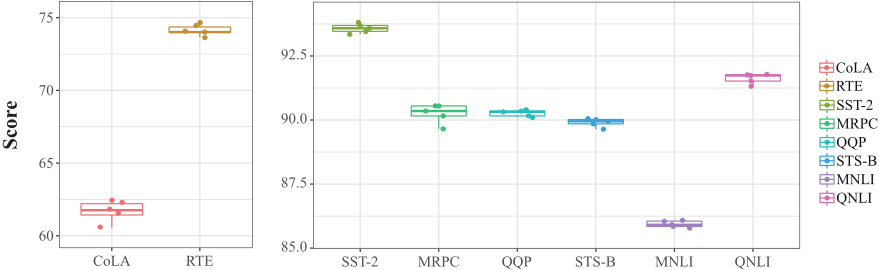
To ensure fair comparisons with other methods, we conducted five experiments applying MAT to the BERT-base model on GLUE benchmarks, each with different random seeds. To visualize our experimental results, we represented them as a box plot in Figure 3. In order to present the results more effectively, we divided all datasets into two parts, displayed on the left and right sides of the graph, with distinct vertical coordinate ranges. For datasets with multiple metrics, such as MRPC, QQP, STS-B, and MNLI, we calculated the average of these metrics to obtain the final score. The results consistently demonstrate that across all five random seeds, both the maximum and median values of our runs are consistently higher than those of other methods. These findings provide strong evidence of the reliability of MAT.
4.6 Ablation Study
In this subsection, we analyze the impact of several vital hyperparameters on the performance of the MAT algorithm. Specifically, we focus on the number of samples K in Equation (9), which is used to approximate the probability distributions, as well as the regularization coefficient λ in Equation (4) that balances the loss of regular training and adversarial training. To investigate the effect of these hyperparameters, we conducted experiments on the BERT-base model using the CoLA, SST-2, and MRPC datasets from the GLUE benchmark, while keeping all other hyperparameters constant.
The impact of the number of samples K on MAT performance is shown in Table 4. Since the exponential moving averages are leveraged in MAT, the model performance may be negatively impacted by both too small and too large values of K. When K is too small, the distributions may not be accurately approximated. On the other hand, if K is set to a large value, the estimated distributions may be overly dependent on the neighbors of the latest iterate, while ignoring other possibilities that may have occurred in previous iterates. Based on these observations, it is recommended to select an
A Datasets
In this supplementary section, we collate and organize the information pertaining to the datasets employed in our experiments. Table 6 presents an overview of the task type, the number of classification categories, and the sample size for each dataset. Additional details concerning the datasets are provided in the following paragraphs.
CoLA Dataset. The Corpus of Linguistic Acceptability (CoLA) is an assemblage of English acceptability judgments extracted from a corpus of literature on linguistic theory. Each example within the dataset is comprised of a sentence and accompanied by a binary label, indicating whether the sentence is deemed grammatically acceptable.
SST-2 Dataset. The Stanford Sentiment Treebank (SST2) dataset is comprised of sentences sourced from movie reviews, along with corresponding human-annotated sentiments. The task is to predict the sentiment of a given sentence, where the dataset utilizes two classification categories (positive/negative) provided labels at the sentence level.
MRPC Dataset. The Microsoft Research Paraphrase Corpus (MRPC) is a corpus of sentence pairs that are automatically obtained from various online news sources and manually annotated to indicate the presence or absence of semantic equivalence within the sentence pairs.
QQP Dataset. The Quora Question Pairs (QQP) dataset is a compilation of question pairs that are extracted from the community question-answering website Quora. The task of QQP dataset is to identify whether a given pair of questions are semantically equivalent or not.
STS-B Dataset. The Semantic Textual Similarity Benchmark (STS-B) dataset is a collection of sentence pairs that are sourced from news headlines, video and image captions, as well as natural language inference data. Each sentence pair within the dataset is annotated by a human, which is accompanied with a similarity score from 0 to 5.
MNLI Dataset. The Multi-genre Natural Language Inference corpus (MNLI) is a comprehensive dataset that is comprised of sentence pairs which are crowd-sourced and annotated with textual entailment labels. The task is to predict the relationship between a given premise sentence and a hypothesis sentence, precisely whether the premise entails the hypothesis (entailment), contradicts the hypothesis (contradiction), or neither (neutral). The premise sentences in this dataset are collected from ten different sources, including transcribed speeches, novels, and government reports.
QNLI Dataset. The Question Natural Language Inference (QNLI) dataset is an adaptation of the Stanford Question Answering Dataset (SQuAD), which comprises question and paragraph pairs. In the original dataset, a sentence within a paragraph sourced from Wikipedia contains the answer to the related question, which is written by an annotator. The transformed task in QNLI is determining whether the context sentence contains the answer to the question.
RTE Dataset. The Recognizing Textual Entailment (RTE) dataset comes from a series of annual textual entailment challenges, specifically RTE1, RTE2, RTE3, and RTE5. This dataset is converted into a binary classification task, where the three classes of the original datasets (neutrality, contradiction, and entailment) are collapsed into two classes (entailment and not entailment) for consistency.
ANLI Dataset. The Adversarial Natural Language Inference (ANLI) dataset is a large-scale benchmark that is constructed through an iterative process of cyclic human-model confrontation. This dataset is divided into three parts, each of which is designed to increase the difficulty progressively for deep neural network models. ANLI is commonly utilized to evaluate the robustness of a model, specifically its ability to perform when faced with adversarial attacks.
B Hyperparameters
Our experiments were conducted on multiple servers that are equipped with NVIDIA V100 and NVIDIA 3090 GPUs. As detailed in the main text of the paper, a combination of empirical methods and the AutoML toolkit (NNI) were employed for the hyperparameters search. As for the sensitivity of the hyperparameters, it is worth noting that the proposed MAT algorithm is not dependent on the meticulous tuning of the hyperparameters, as results that surpass the previous state-ofthe-art were achieved with tiny hyperparameter adjustments. The value ranges of some hyperparameters that were explored during the training process are presented in Table 7.
| Hyperparameter | Search Range |
|---|---|
| Sampling Times K Sampling Step Size γ Beta β Lambda λ | {5, 10, 15, 20, 30} {1×10⁻⁵ , 3×10⁻⁵ , 5×10⁻⁵ } {0.1, 0.3, 0.5, 0.7, 0.9} {0.1, 1, 2, 3, 4, 5} |
| Dataset | CoLA | SST-2 | MRPC | QQP | STS-B | MNLI | QNLI | RTE | ANLI |
|---|---|---|---|---|---|---|---|---|---|
| Task Type Lables | class. 2 | class. 2 | class. 2 | class. 2 | regress. - | class. 3 | class. 2 | class. 2 | class. 3 |
| Train-set | 8,551 | 67,349 | 3,668 | 363,846 | 5,749 | 392,702 | 104,743 | 2,490 | 162,901 |
| Dev-set | 1,043 | 872 | 408 | 40,430 | 1,500 | 19,647 | 5,463 | 277 | 3,200 |
| Test-set | 1,063 | 1,821 | 1,752 | 390,965 | 1,379 | 19,643 | 5,463 | 3,000 | 3,200 |
Table 6: Summary of the datasets in the GLUE and ANLI benchmark.
Acknowledgments
We would like to thank Xinrun Wang and the anonymous reviewers for their helpful discussions and support. This work is supported by the Key R&D Programs of Zhejiang (2022C01018), the Joint Funds of National Natural Science Foundation of China (U21B2001), and the National Natural Science Foundation of China (62176080).
Contribution Statements
We state that Zhehua Zhong and Tianyi Chen contributed equally to this work.
@inproceedings{ijcai2023p520,
  title     = {MAT: Mixed-Strategy Game of Adversarial Training in Fine-tuning},
  author    = {Zhong, Zhehua and Chen, Tianyi and Wang, Zhen},
  booktitle = {Proceedings of the Thirty-Second International Joint Conference on
               Artificial Intelligence, {IJCAI-23}},
  publisher = {International Joint Conferences on Artificial Intelligence Organization},
  editor    = {Edith Elkind},
  pages     = {4674--4683},
  year      = {2023},
  month     = {8},
  note      = {Main Track},
  doi       = {10.24963/ijcai.2023/520},
  url       = {https://doi.org/10.24963/ijcai.2023/520},
}
TY - CPAPER TI - MAT: Mixed-Strategy Game of Adversarial Training in Fine-tuning AU - Zhong, Zhehua AU - Chen, Tianyi AU - Wang, Zhen T2 - Proceedings of the Thirty-Second International Joint Conference on Artificial Intelligence, IJCAI-23 PB - International Joint Conferences on Artificial Intelligence Organization PY - 2023 SP - 4674 EP - 4683 DO - 10.24963/ijcai.2023/520 UR - https://doi.org/10.24963/ijcai.2023/520 ER -Copied
Machine-readable versions of this paper, for tools and AI agents:





