
Regularisation for Efficient Softmax Parameter Generation in Low-Resource Text Classifiers
Proceedings of the Thirty-Second International Joint Conference on Artificial Intelligence. Main Track. Pages 5058-5066.
https://doi.org/10.24963/ijcai.2023/562
Keywords
- Machine Learning: ML: Meta-learning
- Natural Language Processing: NLP: Text classification
- Machine Learning: ML: Few-shot learning
Abstract
Meta-learning has made tremendous progress in recent years and was demonstrated to be particularly suitable in low-resource settings where training data is very limited. However, meta-learning models still require large amounts of training tasks to achieve good generalisation. Since labelled training data may be sparse, self-supervision-based approaches are able to further improve performance on downstream tasks. Although no labelled data is necessary for this training, a large corpus of unlabelled text needs to be available.
In this paper, we improve on recent advances in meta-learning for natural language models that allow training on a diverse set of training tasks for few-shot, low-resource target tasks. We introduce a way to generate new training data with the need for neither more supervised nor unsupervised datasets. We evaluate the method on a diverse set of NLP tasks and show that the model decreases in performance when trained on this data without further adjustments. Therefore, we introduce and evaluate two methods for regularising the training process and show that they not only improve performance when used in conjunction with the new training data but also improve average performance when training only on the original data, compared to the baseline.
- [Andrychowicz et al., 2016] Marcin Andrychowicz, Misha Denil, Sergio Gómez Colmenarejo, Matthew W. Hoff- man, David Pfau, Tom Schaul, Brendan Shillingford, and Nando de Freitas. Learning to learn by gradient descent by gradient descent. In NIPS, 2016.
- [Antoniou et al., 2019] Antreas Antoniou, Harrison Ed- wards, and Amos J. Storkey. How to train your MAML. In ICLR, 2019.
- [Bahdanau et al., 2015] Dzmitry Bahdanau, Kyunghyun Cho, and Yoshua Bengio. Neural machine translation by jointly learning to align and translate. In ICLR, 2015.
- [Bansal et al., 2020a] Trapit Bansal, Rishikesh Jha, and An- drew McCallum. Learning to few-shot learn across diverse natural language classification tasks. In ICCL, 2020.
- [Bansal et al., 2020b] Trapit Bansal, Rishikesh Jha, Tsend- suren Munkhdalai, and Andrew McCallum. Self- supervised meta-learning for few-shot natural language classification tasks. In EMNLP, 2020.
- [Bansal et al., 2021] Trapit Bansal, Karthick Prasad Gu- nasekaran, Tong Wang, Tsendsuren Munkhdalai, and An- drew McCallum. Diverse distributions of self-supervised tasks for meta-learning in NLP. In EMNLP, 2021.
- [Bao et al., 2020] Yujia Bao, Menghua Wu, Shiyu Chang, and Regina Barzilay. Few-shot text classification with distributional signatures. In International Conference on Learning Representations, 2020.
- [Bechtle et al., 2021] Sarah Bechtle, Artem Molchanov, Yevgen Chebotar, Edward Grefenstette, Ludovic Righetti, Gaurav Sukhatme, and Franziska Meier. Meta-learning via learned loss. In ICPR, 2021.
- [Bengio et al., 1991] Y. Bengio, S. Bengio, and J. Cloutier. Learning a synaptic learning rule. In IJCNN, 1991.
- [Bertinetto et al., 2019] Luca Bertinetto, Joao F. Henriques, Philip Torr, and Andrea Vedaldi. Meta-learning with dif- ferentiable closed-form solvers. In ICLR, 2019.
- [Blitzer et al., 2007] John Blitzer, Mark Dredze, and Fer- nando Pereira. Biographies, bollywood, boom-boxes and blenders: Domain adaptation for sentiment classification. In ACL, 2007.
- [Bouazizi and Ohtsuki, 2016] Mondher Bouazizi and To- moaki Ohtsuki. Sentiment analysis: From binary to multi- class classification: A pattern-based approach for multi- class sentiment analysis in twitter. In IEEE ICC, 2016.
- [Bowman et al., 2015] Samuel R. Bowman, Gabor Angeli, Christopher Potts, and Christopher D. Manning. A large annotated corpus for learning natural language inference. In ACL, 2015.
- [Brown et al., 2020] Tom Brown, Benjamin Mann, Nick Ry- der, Melanie Subbiah, Jared D Kaplan, Prafulla Dhari- wal, Arvind Neelakantan, Pranav Shyam, Girish Sastry, Amanda Askell, Sandhini Agarwal, Ariel Herbert-Voss, Gretchen Krueger, Tom Henighan, Rewon Child, Aditya Ramesh, Daniel Ziegler, Jeffrey Wu, Clemens Winter, Chris Hesse, Mark Chen, Eric Sigler, Mateusz Litwin, Scott Gray, Benjamin Chess, Jack Clark, Christopher Berner, Sam McCandlish, Alec Radford, Ilya Sutskever, and Dario Amodei. Language models are few-shot learn- ers. In NIPS, 2020.
- [Chechik et al., 2010] Gal Chechik, Varun Sharma, Uri Shalit, and Samy Bengio. Large scale online learning of image similarity through ranking. JMLR, 2010.
- [Cheng et al., 2016] Jianpeng Cheng, Li Dong, and Mirella Lapata. Long short-term memory-networks for machine reading. In EMNLP, 2016.
- [Cui et al., 2021] Yiming Cui, Wanxiang Che, Ting Liu, Bing Qin, and Ziqing Yang. Pre-training with whole word masking for chinese BERT. IEEE/ACM Trans. Audio, Speech and Lang. Proc., 2021.
- [Cutkosky and Orabona, 2019] Ashok Cutkosky and Francesco Orabona. Momentum-based variance reduction in non-convex SGD. In NIPS, 2019.
- [Deng et al., 2009] Jia Deng, Wei Dong, Richard Socher, Li- Jia Li, Kai Li, and Li Fei-Fei. Imagenet: A large-scale hierarchical image database. In IEEE CVPR, 2009.
- [Devlin et al., 2019] Jacob Devlin, Ming-Wei Chang, Ken- ton Lee, and Kristina Toutanova. BERT: Pre-training of deep bidirectional transformers for language understand- ing. In NAACL, 2019.
- [Fang and Cohn, 2017] Meng Fang and Trevor Cohn. Model transfer for tagging low-resource languages using a bilin- gual dictionary. In ACL, 2017.
- [Finn et al., 2017] Chelsea Finn, Pieter Abbeel, and Sergey Levine. Model-agnostic meta-learning for fast adaptation of deep networks. In PMLR, 2017.
- [Ganin et al., 2016] Yaroslav Ganin, Evgeniya Ustinova, Hana Ajakan, Pascal Germain, Hugo Larochelle, Franc ¸ois Laviolette, Mario March, and Victor Lempitsky. Domain- adversarial training of neural networks. JMLR, 2016.
- [Han et al., 2021] Chengcheng Han, Zeqiu Fan, Dongxiang Zhang, Minghui Qiu, Ming Gao, and Aoying Zhou. Meta- learning adversarial domain adaptation network for few- shot text classification. In IJCNLP, 2021.
- [Hochreiter et al., 2001] Sepp Hochreiter, A. Steven Younger, and Peter R. Conwell. Learning to learn using gradient descent. In ICANN, 2001.
- [Krause et al., 2013] Jonathan Krause, Michael Stark, Jia Deng, and Li Fei-Fei. 3d object representations for fine- grained categorization. In IEEE Workshop on 3D Repre- sentation and Recognition, 3dRR-13 2013, 2013.
- [Li and Malik, 2017] Ke Li and Jitendra Malik. Learning to optimize. In ICLR, 2017.
- [Li and Zhang, 2021] Yue Li and Jiong Zhang. Semi- supervised meta-learning for cross-domain few-shot intent classification. In 1st Workshop on Meta Learning and Its Applications to Natural Language Processing, 2021.
- [Liu et al., 2020] Zequn Liu, Ruiyi Zhang, Yiping Song, and Ming Zhang. When does MAML work the best? an em- pirical study on model-agnostic meta-learning in NLP ap- plications. CoRR, abs/2005.11700, 2020.
- [Luong et al., 2015] Thang Luong, Hieu Pham, and Christo- pher D. Manning. Effective approaches to attention-based neural machine translation. In EMNLP, 2015.
- [Munkhdalai and Yu, 2017] Tsendsuren Munkhdalai and Hong Yu. Meta networks. In PMLR, 2017.
- [Nichol et al., 2018] Alex Nichol, Joshua Achiam, and John Schulman. On first-order meta-learning algorithms. CoRR, abs/1803.02999, 2018.
- [Pires et al., 2019] Telmo Pires, Eva Schlinger, and Dan Gar- rette. How multilingual is multilingual BERT? In ACL, 2019.
- [Radford et al., 2019] Alec Radford, Jeff Wu, Rewon Child, David Luan, Dario Amodei, and Ilya Sutskever. Language models are unsupervised multitask learners. OpenAI Blog, 2019.
- [Ravi and Larochelle, 2017] Sachin Ravi and Hugo Larochelle. Optimization as a model for few-shot learning. In ICLR, 2017.
- [Salameh et al., 2015] Mohammad Salameh, Saif Moham- mad, and Svetlana Kiritchenko. Sentiment after trans- lation: A case-study on arabic social media posts. In NAACL, 2015.
- [Santoro et al., 2016] Adam Santoro, Sergey Bartunov, Matthew Botvinick, Daan Wierstra, and Timothy Lill- icrap. Meta-learning with memory-augmented neural networks. In ICML, 2016.
- [Schmidhuber, 1987] Jurgen Schmidhuber. Evolutionary principles in self-referential learning. on learning now to learn: The meta-meta-meta...-hook. Diploma thesis, Tech- nische Universitat Munchen, Germany, 1987.
- [Schroff et al., 2015] Florian Schroff, Dmitry Kalenichenko, and James Philbin. FaceNet: A unified embedding for face recognition and clustering. IEEE CVPR, 2015.
- [Schultz and Joachims, 2003] Matthew Schultz and Thorsten Joachims. Learning a distance metric from relative comparisons. In NIPS, 2003.
- [Snell et al., 2017] Jake Snell, Kevin Swersky, and Richard Zemel. Prototypical networks for few-shot learning. In NIPS, 2017.
- [Sukhbaatar et al., 2015] Sainbayar Sukhbaatar, Arthur Szlam, Jason Weston, and Rob Fergus. End-to-end memory networks. In NIPS, 2015.
- [Sung et al., 2018] Flood Sung, Yongxin Yang, Li Zhang, Tao Xiang, Philip Torr, and Timothy Hospedales. Learn- ing to compare: Relation network for few-shot learning. In IEEE CVPR, 2018.
- [Tan and Zhang, 2008] Songbo Tan and Jin Zhang. An em- pirical study of sentiment analysis for chinese documents. Expert Systems with Applications, 2008.
- [Tjong Kim Sang and De Meulder, 2003] Erik F. Tjong Kim Sang and Fien De Meulder. Introduction to the CoNLL-2003 shared task: Language-independent named entity recognition. In HLT-NAACL, 2003.
- [van der Maaten and Hinton, 2008] Laurens van der Maaten and Geoffrey Hinton. Viualizing data using t-SNE. JMLR, 2008.
- [Vaswani et al., 2017] Ashish Vaswani, Noam Shazeer, Niki Parmar, Jakob Uszkoreit, Llion Jones, Aidan N Gomez, Łukasz Kaiser, and Illia Polosukhin. Attention is all you need. In NIPS, 2017.
- [Vinyals et al., 2016] Oriol Vinyals, Charles Blundell, Tim- othy Lillicrap, koray kavukcuoglu, and Daan Wierstra. Matching networks for one shot learning. In NIPS, 2016.
- [Wan, 2008] Xiaojun Wan. Using bilingual knowledge and ensemble techniques for unsupervised chinese sentiment analysis. In EMNLP, 2008.
- [Wang et al., 2018] Alex Wang, Amanpreet Singh, Julian Michael, Felix Hill, Omer Levy, and Samuel Bowman. GLUE: A multi-task benchmark and analysis platform for natural language understanding. In EMNLP Workshop BlackboxNLP, 2018.
- [Wang et al., 2021a] Haoxiang Wang, Han Zhao, and Bo Li. Bridging multi-task learning and meta-learning: Towards efficient training and effective adaptation. In ICML, 2021.
- [Wang et al., 2021b] Lingxiao Wang, Kevin Huang, Tengyu Ma, Quanquan Gu, and Jing Huang. Variance-reduced first-order meta-learning for natural language processing tasks. In NAACL, 2021.
- [Xiao et al., 2021] Yubei Xiao, Ke Gong, Pan Zhou, Guolin Zheng, Xiaodan Liang, and Liang Lin. Adversarial meta sampling for multilingual low-resource speech recogni- tion. AAAI, 2021.
- [Yang et al., 2016] Zichao Yang, Diyi Yang, Chris Dyer, Xi- aodong He, Alex Smola, and Eduard Hovy. Hierarchical attention networks for document classification. In NAACL, 2016.
- [Yogatama et al., 2019] Dani Yogatama, Cyprien de Mas- son d'Autume, Jerome T. Connor, Tomás Kociský, Mike Chrzanowski, Lingpeng Kong, Angeliki Lazaridou, Wang Ling, Lei Yu, Chris Dyer, and Phil Blunsom. Learning and evaluating general linguistic intelligence. CoRR, 2019.
- [Zhang et al., 2020] Xuejun Zhang, Yujiang Li, Pengyuan Zhang, and Yonghong Yan. Lingual-agnostic meta- learning for low-resource part-of-speech tagging. In ACL ICITS: IoT and Smart City, 2020.
- [Zhou et al., 2017] Bolei Zhou, Agata Lapedriza, Aditya Khosla, Aude Oliva, and Antonio Torralba. Places: A 10 million image database for scene recognition. IEEE Transactions on Pattern Analysis and Machine Intelli- gence, 2017.
References were extracted automatically from the PDF and may contain errors.
Full text extracted automatically from the PDF; figures, tables and equations may differ. The PDF is the version of record.
1 Introduction
In recent years, self-supervised methods for training large text models have shown tremendous success in many natural language processing (NLP) tasks by training a general language model without the need for supervised data, followed by a fine-tuning step to train the model for a specific task [Devlin et al., 2019; Radford et al., 2019; Brown et al., 2020]. However, this fine-tuning process still requires large amounts of labelled and task-specific data [Yogatama et al., 2019] which often is not available in real-world scenarios [Tan and Zhang, 2008; Wan, 2008; Salameh et al., 2015; Fang and Cohn, 2017].
Another field that has recently received lots of attention is meta-learning [Schmidhuber, 1987; Bengio et al., 1991; Finn et al., 2017] where the goal is to learn a meta-model on many small tasks so that it can be used to more efficiently train a task-specific target model downstream with only a few labelled training examples. One recent development in this field is an optimisation-based learning method that is able to learn a good initialisation point for an arbitrary model architecture so that the initialised model only needs small adjustments during training to converge and is consequently able to achieve good performance for small training sets [Finn et al., 2017].
Although model agnostic, this technique still requires a fixed model architecture and shares all learned initialisation parameters including the final classification layers. This poses a problem for diverse NLP tasks that can have disjoint label spaces as well as different numbers of possible output classes. To solve this problem, a parameter generator can be used to dynamically generate the initial parameters of the classification layer based on samples of the training data [Bansal et al., 2020a]. This generator is part of the metamodel and is optimised during meta-training to produce good initial parameters that can be fine-tuned using only few training examples from the target task. This adjustment allows the use of all available labelled training data during training, even if the number of classes N does not match the target task. Still, it is beneficial for the average model performance to further increase the amount of training data, especially in low-resource settings [Bansal et al., 2020b].
In this paper, we explore ways to leverage training on additional tasks that are generated from the already available data by changing the training objective. Therefore, these datasets require no additional labelled or unlabelled data. More concretely our contributions are:
- A method to generate tasks from the available data with a new training objective
- We demonstrate that this data can not naively be used for training and therefore
- We introduce two different methods to regularise the training process and
- Demonstrate that these techniques are not only effective while training on the newly generated tasks, but also improve average model performance even when only using the original datasets
We evaluate all methods on a diverse set of few-shot NLP tasks to demonstrate their effectiveness and present a detailed analysis of the effects of the proposed methods.
2 Background
2.1 Meta-Learning
Meta-learning describes the process of training a model to be able to quickly adapt to a new task. This is achieved by learning a meta-task over different tasks which is used to optimise the learning process [Schmidhuber, 1987; Bengio et al., 1991; Xiao et al., 2021] which makes meta-learning particularly suitable for low-resource tasks [Vinyals et al., 2016; Bansal et al., 2020a; Bansal et al., 2021; Wang et al., 2021a; Li and Zhang, 2021; Han et al., 2021]. Often a metamodel is trained to update the parameters of the task-specific models [Hochreiter et al., 2001; Andrychowicz et al., 2016; Li and Malik, 2017] which comes with the disadvantage of introducing new parameters that itself need to be optimised during training and therefore introducing a computational overhead to the overall system.
Recent approaches resolve this weakness by using an optimisation-based learning method [Finn et al., 2017; Antoniou et al., 2019; Bechtle et al., 2021] with the goal to learn a set of model parameters θ0 that function as an initialisation point for downstream tasks, so that the model can be fine-tuned to a concrete task with only very few training steps. "Model-Agnostic Meta-Learning" (MAML) [Finn et al., 2017] is an example of such an algorithm that does not impose any constraints on the model architecture. In MAML, the initial model parameters θ0 of a neural network f are learned by sampling a number of training tasks Ti from a set of tasks M = {T1, T2, . . .}. For each task, a training (support) set Ds i ∼ Ti and a validation (query) set Dq i ∼ Ti is sampled. The initial model parameters θ0 are then updated to minimise a task loss function Lsi on Ds i , yielding adjusted model parameters θ∗ i :
where α is the learning rate. This step forms the inner-loop or the update of the fast-parameters. In the outer-loop, the updated parameters θ∗ i are used to calculate an optimised set of initial parameters θ0 by minimising the meta loss over all sampled tasks:
where Lqi is the loss on Dq i , B is the sample size drawn from Ti and β the learning rate of the outer-loop. The calculation of the outer-loop gradients requires the calculation of the second-order derivative to propagate the loss through the inner-loop updates which imposes a serious computational cost. Interestingly, Finn et al. [2017] empirically show that using a first-order approximation of the meta-gradients still yields comparable model performance.
2.2 Few-Shot Learning for Diverse NLP Tasks
Based on the MAML framework, Bansal et al. [2020a] propose a new architecture for few-shot text classification across diverse tasks. While MAML is model-agnostic, it requires a fixed model architecture to tune the initialisation point. In the case of an N-way classifier network trained using categorical cross-entropy however, the last layer of the model needs to have exactly N output neurons. Therefore, the naive MAML optimisation approach limits either the availability of suitable tasks that can be used for meta-training, which is especially problematic for large values of N, or would exclude optimisation of the output layer in the meta-update step for tasks with a different number of classes as the target task. Bansal et al. [2020a] therefore introduce a parameter generator gψ that predicts a set of initial parameters for the output layer using the first batch of training data from Ds i by partitioning the data according to the class labels C n i ← {xj|yj = n} and then predict a set of weight and bias parameters
using each partition where fθ is a pre-trained text-encoder model. The output layers are then formed by stacking the predictions for each partition:
gψ is itself a simple multi-layer neural-network whose parameters are optimised in the outer loop step. The authors evaluate this architecture on a diverse set of text classification tasks by using a text classifier architecture that is composed of the text encoder fθ that feeds into the output layers with the generated parameters. The text encoder is a pre-trained Bidirectional Encoder Representations from Transformers model (BERT) [Devlin et al., 2019] that is fine-tuned during metatraining. Bansal et al. [2020a] call this architecture Learning to generate softmax parameters for diverse classification (LEOPARD).
Since θ0 is only updated once for every task Ti, the set of available Tasks M generally needs to be large, which is a major challenge for meta-learning algorithms [Santoro et al., 2016]. One way to create new tasks is by subsampling a set of labels from tasks with large label spaces [Santoro et al., 2016; Ravi and Larochelle, 2017]. However, while there exist many tasks with a large label space for vision applications [Deng et al., 2009; Krause et al., 2013; Zhou et al., 2017], such datasets are rarer for NLP tasks. Bansal et al. [2020b] therefore introduce Subset Masked Language Modeling Tasks (SMLMT) to generate tasks from unsupervised data by collecting sentences containing N randomly chosen words from the vocabulary and masking all occurrences of those words in k sampled sentences containing one of the N words to create an arbitrary k-shot N-way classification task. The authors show that this approach yields an average improvement in classification accuracy of 3% compared to LEOPARD when this self-supervised training data is used jointly with available supervised data.
3 Methods
3.1 Generation of Training Tasks
We propose yet another method of generating new training tasks that does not rely on new, unsupervised data by using the task affiliation of a sample as its label. This means a new N-way task can be created by sampling N tasks Tn1, . . . , TnN from M. Each datum xni from each task is then assigned the label yni = n, so that the new task Tc becomes a problem of N-way dataset association. We denote the set of possible tasks that can be generated by using all Ncombinations of the datasets used in M by McN while the original tasks are denoted byMo.
3.2 Regularise Parameter Generation for New Datasets
As described in section 2.2, parameter generation uses a single batch of training data. With the introduction of new tasks fromMcN during training, there is the potential for a suboptimal sampling of the first batch of training data in Ti used as the input to the parameter generator gψ where most of the samples in C n i stem from a single class m in the task j from Mo that is part of the combination to create Tj and therefore C n i ≈ C m j . Assuming a fully deterministic fθ and gψ, this would generate the same parameters for classes m and n, yielding a classification layer that is in the extreme case equal to the classification layer for Tj. Therefore, we propose 2 ways of regularising the generation and training of the classification parameters.
Attention for Weighted Average Inputs
We replace the simple mean aggregation on the output of gψ in equation 4 with a weighted average. We calculate the weights using attention [Bahdanau et al., 2015; Cheng et al., 2016], specifically a fixed-query attention [Sukhbaatar et al., 2015; Yang et al., 2016] to compute a weight for each sample. Attention was successfully used to focus on a partial context in long sequences in NLP tasks [Luong et al., 2015; Yang et al., 2016; Vaswani et al., 2017]. Our motivation is for the network to weigh outputs from the generator more if they represent a better initial classification parameter for the current task and therefore counteract the sub-optimal selection of samples. Specifically, we replace equation 4 with an attention mechanism [Bahdanau et al., 2015]:
First, the output of the text-encoder fθ is embedded into a hidden representation uj through a single layer neural network with tanh activation (7). To calculate the attention score of an input sample αj this hidden representation is then multiplied with a fixed query-vector uq and normalised using softmax to ensure ∑j αj = 1 (8). The query-vector uq is tuned jointly withWa and ba during meta-training. Finally, the calculated attention scores are used to weigh the output of the parameter generator gψ for each sample (9).
Triplet-Loss
During classification, the generated parameters of the output layer form a multi-dimensional classification boundary. Since in a low-resource setting the initial weights of the output layers Wi, bi do not have much training data to adapt to, not only is a good initialisation of the parameters essential, but also a quick adaption of those parameters to maximise the classification boundary. While the original LEOPARD architecture uses cross-entropy loss (Lce) to calculate the gradients, we propose the use of the triplet loss function [Schultz and Joachims, 2003; Chechik et al., 2010; Schroff et al., 2015] denoted by Lt to calculate gradients that help to define an effective classification boundary more quickly by minimising the distance between an input and a sample of the same class (positive) while maximising the distance to samples from different classes (negative). The selection of positive and negative samples is called triplet mining. We use semi-hard triplet mining on mini-batches with a margin of 1.0. If no negative sample can be found that satisfies the semi-hard negative constraint of having a distance larger than the positive distance plus margin, the largest negative distance is used.
Since the triplet loss requires the mining of good positive and negative samples which may not always be available in each mini-batch, we use a mixed approach (Lmλ) that combines triplet loss with cross-entropy:
where λ is a hyper-parameter of the model that needs tuning and can be used to weigh the influence of each loss function for the overall loss.
Note that both approaches, while introduced to counteract the problems described above, are used during the training of tasks fromMo andMcN.
4 Experimental Setup
4.1 Training Tasks
We follow Bansal et al. [2020a] in the selection of a subset of datasets from the GLUE [Wang et al., 2018] meta dataset, specifically the MNLI (matched and mismatched), MRPC, QNLI, QQP, RTE, SST-2 and SNLI datasets [Bowman et al., 2015] for training the meta-model. STS-B is excluded due to it being a regression task and WNLI for its small size. For tasks with N>2 classes, a separate train set for every 2-combination of classes is generated to increase the number of tasks that can be used during meta-training.
4.2 Evaluation Tasks
Evaluation for each experiment is performed on a diverse set of tasks with disjoint label spaces and different numbers of classes.
From the Amazon Review Corpus [Blitzer et al., 2007], we use the Product Categories Books, DVD, Electronics and Kitchen. Each dataset contains reviews for products of the category together with an associated product rating. While the original data is separated into 5 rating classes, we map those into N=3 distinct labels {≤2, =4, =5}.
The CoNLL-2003 shared task [Tjong Kim Sang and De Meulder, 2003] is a named entity recognition task. Each input consists of a sentence and a named entity that appears in this sentence with the label being one of N=4 different entity types.
Bansal et al. [2020a] describe a set of tasks that were sourced from crowdflower which are not available from the provided source anymore after the acquisition of the company. Therefore, we provide new sources. All datasets consist of tweets in English with different label spaces depending on the task. The Airline dataset 1 consists of tweets about north American airlines with N=3 labels to classify the sentiment of the text. The Disaster dataset 2 contains tweets with keywords such as crash or bush fire with N=2 classes indicating whether or not the input is about a real disaster. The Emotion dataset 3 contains N=13 different emotions as a classification target. While other authors previously have reduced this label space by combining and selecting labels due to strong similarities between some classes [Bouazizi and Ohtsuki, 2016], we follow Bansal et al. [2020a] and use the unaltered selection. The Political Audience, Political Bias and Political Message 4 tasks all use the same input texts but have different class labels depending on the intended audience (N=2, {national, constituency}), the bias (N=2, {neutral, partisan}) or message (N=9, {policy, personal, ...}) of the input.
A k-shot subset of a dataset is created by choosing k random samples from each of the N classes. We aggregate the mean accuracy for 10 different subsets for each dataset with k ∈ {4, 8, 16} and report the average accuracy and the standard deviation between runs.
4.3 Baseline Experiments
Although Bansal et al. [2020a] provide the sub-sampling of test datasets used in their experiments online, due to corruptions in some of the files we recreated the task data, resulting in a different selection of data points.
To be able to compare any improvements of our approaches, we use Bansal et al. [2020a] as a baseline and evaluate on the same datasets. We copy the previously published results in column LEOPARD. However due to the large variance in the reported accuracies and to preclude any possible differences in the selection of samples for the few-shot subsets we also provide the results of the unmodified architecture on our datasets in the Baseline column.
1 https://www.kaggle.com/datasets/crowdflower/ twitter-airline-sentiment
2 https://www.kaggle.com/datasets/vstepanenko/disaster-tweets
3 https://www.kaggle.com/datasets/pashupatigupta/ emotion-detection-from-text
4 https://www.kaggle.com/datasets/crowdflower/ political-social-media-posts
| Dataset | Loss | ||
|---|---|---|---|
| Mo Mc2 | Lce Lmλ | α | |
| Leopard | • | • | |
| Baseline | • | • | |
| A | • | 0.5 | |
| B | • | • | • |
| Γ | • | 0.5 | • |
| ∆ | • • | • | |
| E | • • | • | • |
| Z | • • | 0.5 | |
| H | • • | 0.5 • | |
| Θ | • | 0.1 | |
| I | • | 1.0 | |
4.4 Experiment Configurations
Table 1 shows a matrix of model and dataset configurations used in the experiments. The Dataset column describes which datasets were used while training the model showing whether additionally generated training data was available or not. The Loss column indicates whether cross-entropy (Lce) or the mixed-loss approach described in section 3.2 (Lmλ) is used where the number is the set value for parameter λ in the experiment. A dot in column α indicates that attention was used in the parameter generator to calculate sample weights as described in section 3.2.
In experiment A, Θ and I the triplet-loss function with different values for λ = {0.1, 0.5, 1.0} and in experiment B the attention weighting is used during training on the original set of tasks respectively to examine the effect of the proposed regularisation methods without introducing new tasks. In experiment ∆ new tasks are introduced, however only the cross-entropy term is used in the loss function to test whether the generated data can naively be used to further train the meta-model on more tasks. Experiment Z uses the additional training tasks in conjunction with the mixed loss function and λ = 0.5 to determine the effectiveness of the triplet-loss regularisation when combining the task sets. Experiment H combines attention-based weighting with mixed-loss to determine if further improvements can be achieved by combining the approaches.
The implementation used for all experiments in this work is available for reference online 5 .
5 Results
This section presents the results of the performed experiments in an objective manner. A thorough analysis of the behaviour of the proposed techniques is presented in the next section.
Table 2 shows the accuracy of the different model configurations presented in the previous section averaged over all datasets.
5 https://gitlab.mi.hdm-stuttgart.de/griesshaber/metanlp
6 Since we calculate the average over all datasets while Bansal et al. [2020a] reserve some datasets for domain transfer experiments, our reported average differs from the reported results, although the accuracy of the separate experiments is approximately the same.
| k | LEOPARD 6 | Baseline 6 | A | B | Γ | ∆ | E | Z | H | Θ | I |
|---|---|---|---|---|---|---|---|---|---|---|---|
| 4 | 46.15 | 45.97 | 47.64 | 47.58 | 47.50 | 43.64 | 48.13 | 48.59 | 48.51 | 46.04 | 37.73 |
| 8 | 50.24 | 50.73 | 51.58 | 51.37 | 51.46 | 48.62 | 52.67 | 53.47 | 53.26 | 51.28 | 40.88 |
| 16 | 53.12 | 52.06 | 53.21 | 53.60 | 52.85 | 52.63 | 54.30 | 55.30 | 54.69 | 52.79 | 41.39 |
5.1 Baseline Results
The aggregated results of our Baseline match the reported results by Bansal et al. [2020a] closely. Therefore, we assume any variation in data selection is unimportant when evaluating the averaged model performance. However, we point out that some individual experiments diverge between the two setups, although in most cases the deviation is within 1 standard deviation from the mean.
5.2 Effect of Regularisation on Baseline Datasets
Experiment A shows an overall improvement to the baseline, indicating that the mixed triplet-loss strategy already helps in the low-resource classification case without introducing new tasks. A similar behaviour, although less pronounced in many experiments, can be observed in experiment B indicating the attention-based sample weighting to have the hypothesised effect of helping the parameter generator to weight the samples used in contrast to using an unweighted average. Combining both methods in experiment Γ, a slight decrease in performance compared to A and B can be observed. This result indicates that the selection of training samples used to generate parameters is essential for a good initialisation of the classification head of the model.
5.3 Training on Generated Datasets
In experiment ∆ the decrease in performance is an indication that, without additional regularisation, the introduced data hinders the meta-learning process. We use a qualitative and quantitative exploration in the next subsection to argue why this behaviour emerges. Experiment E and Z show the results of training on the same data but using the attention and the mixed triplet loss instead of only cross-entropy respectively, which shows a clear improvement, not only with respect to experiment ∆ but even to both baselines. This is an indication that the generated training tasks based on the available data can be used to improve meta-training and thus help the model to initialise with better initial parameters and adapt more quickly. In experiment H both regularisation techniques are combined, however, performance across all configurations of k decreases slightly compared to experiment Z. We conclude that both techniques are effective because they regularise the training process, however applying both methods does not further improve, and in fact hinders the performance due to the added complexity. This is also supported by the performance decrease in experiment Γ described earlier.
5.4 Pure- andMixed Triplet Loss Approaches
Columns A, Θ and I show the importance of the selection of λ in the mixed training loss Lmλ. With a value of λ = 0.1
in experiment Θ, the results are close to the baseline with a maximum change of <1%. Experiment I with λ = 1.0 shows a stark decrease in performance. In the individual experiments one can observe that the accuracy approaches random guessing (≈ 1N ). Only in experiment A with λ = 0.5 an improvement in task accuracy can be observed. The results are discussed further in the next section.
5.5 Comparison
The best average accuracy across all experiments for all tested settings of k is attained in experiment Z using the additional data with Lm0.5 as loss function. This setting is able to achieve an average improvement of +2.87% (+2.62%, +2.74%, +3.24%) over our Baseline results and +2.62% (+2.44%, +3.23%, +2.18%) over the results reported in [Bansal et al., 2020a]. Without additional data, using Lm0.5 (A) we attain an improvement of +1.22% whereas the attention weighted parameter generation (B) achieves +1.28%.
6 Evaluation &Analysis
This section quantitatively and qualitatively explores the effects of the proposed techniques for regularisation on the trained model to better understand their effectiveness and importance.
6.1 Effect of λ for Mixed-Loss Experiments
Experiments A, Θ and I in table 2 show the average performance of the meta-models with different configurations for the hyper-parameter λ (0.5, 0.1 and 1.0 respectively).
These results give insight into the importance of tuning the λ parameter. With a value of λ = 0.1 the effect of the triplet loss seems negligible as the resulting average accuracy is close to the performance of the baseline model for all configurations of k. Using a pure triplet loss function (λ = 1.0) during training however does result in the performance degrading close to random guessing, indicating that the meta-model fails to learn a good initialisation for θ0 and also does not allow efficient optimisation during fine-tuning. This shows using only Lt fails to provide good feedback for optimising the model. We conjecture this is most likely due to the need to mine good triplets, which may be challenging for some low-resource tasks.
The results for λ = 0.5 indicate that this value seems to provide a good balance between optimising the learned representations for the triplet objective of moving anchors close to positive samples but far from negative samples while not completely relying on the mined triplets which seem to be insufficient as indicated by the pure triplet loss experiment.
6.2 Quantitative Analysis of the Regularisation Approaches
As stated in section 3.2, the motivation for the evaluated attention mechanism and triplet loss regularisation techniques is to help with sub-optimal random sampling during parameter generation. Therefore, we analyse the effectiveness of regularisation on a learned few-shot classifier which is trained to predict dataset association between the Rating Books and Rating Kitchen datasets (N = 2) with k = 16. Both datasets are not part ofMo andMc2 and are tasks of sentiment classification, thus the meta-model is trained on other tasks with a similar objective. Since the objective of the test task however is domain association, the fine-tuned classifier should have good separation between the samples of the two datasets at the output (exa-class), whereas artefacts of the sentiment task association (inter-class) may indicate a sub-optimal initialisation of the model on the sentiment classification task.
To quantitatively measure the inter- and exa-class separation, we perform K-means clustering on the embedded model output and calculate the adjusted mutual information (AMI) between the clustering and the true labels. The exa-class AMI (AMIe) can be calculated directly, whereas, for the interclass AMI (AMIi), we perform a separate clustering for each class and report the average value.
Table 3 shows the results for 3 different loss function configurations. The results for the cross-entropy loss (Lce) show a higher adjusted mutual information than any of the triplet loss experiments for the inter-class clustering, indicating that the output representation contains artefacts of the sentiment task. The results of the mixed-loss experiments show a decrease in inter-class AMI with higher values for λ, supporting the hypothesis that the mixed-loss objective regularises the training by providing better feedback for the current task compared to a pure cross-entropy measure. However, note that for λ = 1 the exa-class AMI is lowest, indicating a bad separation between classes in the output representations. This is also supported by the results in section 6.1 that showed that a pure triplet loss function is unable to train a few-shot classifier.
The results for the experiment using the attention-based sample weighting (Lce + α) show that this method also successfully improves exa-class separation, however, inter-class separation is much less effectively reduced. This is expected as the triplet-loss actively tries to minimise the distance to positive samples and maximise the distance to negative samples, while the motivation for attention-based weighting is only to weigh samples more or less depending on their relevance to the task.
6.3 Qualitative Evaluation of the Embedding and Output Spaces
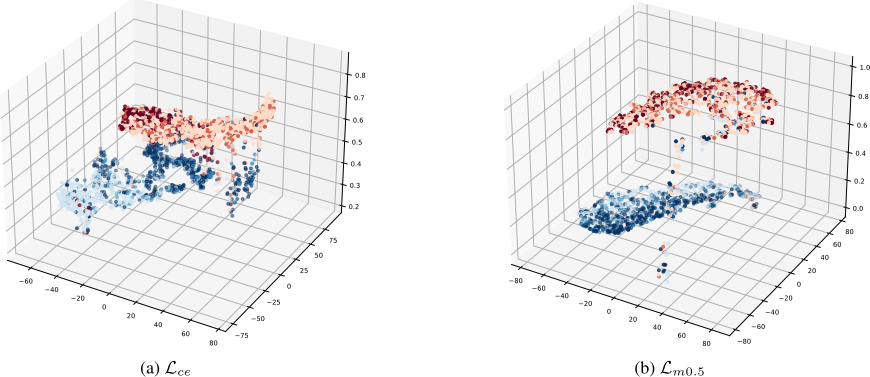
Figure 1 shows a visualisation of the classification boundary of the evaluated classifier. The visualisation is created by embedding the high-dimensional output of the text encoder into a 2-dimensional space using t-SNE [van der Maaten and Hinton, 2008] to get a vector [x1 x2] for each data point. This vector is then extended by another component that represents the 1-d normalised softmax output of the trained network x3 = ((χ0 - χ1) + 1)/2 where χn is the n-th component of the softmax-activated model output to get a value in [0, 1]. The resulting 3-dimensional vector is then coloured red or blue depending on the source dataset while colour saturation shows different classes within the dataset. Therefore, a higher euclidean distance between red and blue clusters indicates a higher exa-class separation while intra-class separation is represented as the distance between clusters of differently shaded dots in the same colour.
| AMIi | AMIe | |
|---|---|---|
| Lce | 0.153 | 0.350 |
| Lm0.1 | 0.017 | 0.439 |
| Lm0.5 | 0.015 | 0.688 |
| Lm1.0 | 0.011 | 0.323 |
| Lce +α | 0.045 | 0.455 |
Subfigure 1b shows a lower variance along the 3rd axis with samples close around the value 0.5, indicating a smaller learned exa-class boundary. Furthermore, within each class, clusters of the same saturation can be seen. This may indicate that the encoder after training still produces embeddings that differ between inter-dataset classes (low intra-class separation).
In contrast, subfigure 1a shows a much broader separation between classes with almost no data points near the classification border. The visualisation also shows less clustering of data points with similar saturation, indicating that this model produces good embeddings for the task without showing artefacts of different classification tasks, supporting the quantitative results.
We interpret this visualisation as another indicator that shows the importance of regularisation when using the generated datasets.
7 RelatedWork
7.1 Meta-Learning
Methods for meta-learning can generally be classified into 3 different approaches; metric-based where the model learns an embedding of data points that is trained by reducing a distance metric between related data points [Vinyals et al., 2016; Snell et al., 2017; Sung et al., 2018], model-based where a meta-model predicts parameters that are used to initialise a task-specific model [Santoro et al., 2016; Munkhdalai and Yu, 2017] and optimisation-based where task specific parameters are obtained through optimisation [Ravi and Larochelle, 2017; Finn et al., 2017; Nichol et al., 2018].
Building on the MAML framework presented in Finn et al. [2017], Bansal et al. [2020a] introduce the LEOPARD architecture by adding a model-based parameter generator for the classification layer to the otherwise optimisation-based MAML architecture.
7.2 Using Additional Data for Training
In Bansal et al. [2020a] they show that an increase of available training data is beneficial for this architecture and create this data using a self-supervised approach called SMLMT. Bansal et al. [2021] further improves on those results by tuning the distributions of the sampled self-supervised tasks. In contrast, our approach does not require any additional data for further training. Li and Zhang [2021] use the method presented in Bansal et al. [2020a] for generating tasks with a metric-based prototypical network [Snell et al., 2017]. They show that the additional self-supervised training data is able to improve downstream performance when used for metalearning as well.
7.3 Regularisation of Meta-Learned NLP Classifiers
Bao et al. [2020] use an attention mechanism based on word statistics that is trained on meta tasks to aggregate pre-trained embeddings for direct classification using a ridge regressor [Bertinetto et al., 2019] instead of predicting softmax parameters. This method requires the meta-tasks to have related, although disjoint classes from the target data. Han et al. [2021] therefore introduce a domain-adversarial approach [Ganin et al., 2016] to generate domain-invariant features in the sentence embeddings.
Liu et al. [2020] empirically show that MAML for NLP applications works best when the general language model is not solely trained during meta-training and the meta-tasks are dissimilar to one another. Wang et al. [2021b] introduce a variance reduction based on the recursive stochastic momentum technique [Cutkosky and Orabona, 2019] to regularise the meta-gradients during training to prevent overfitting on specific tasks.
8 Limitations
The performed experiments were using English datasets exclusively. This choice was made to ensure some comparability between the baseline results presented by Bansal et al. [2020a], the availability of the datasets and the authors' familiarity with the language. However, there exists prior work that shows the effectiveness of both MAML [Zhang et al., 2020] and BERT [Pires et al., 2019; Cui et al., 2021] for different languages.
The process of training a new meta-learning model is relatively expensive since the architecture is quite deep with 110 million parameters only in the BERT text encoder. To train those parameters, a high number of outer-loop training steps need to be performed, each requiring multiple inner-loop optimisation steps. Due to this cost, an extensive hyper-parameter search running many configurations may be prohibitively expensive. Instead, hyper-parameters can be learned as part of the meta-learning procedure as presented in Bansal et al. [2020a]. We performed our experiments on compute nodes with 4x NVIDIA 2080 Ti GPUs where training took 72 hours per experiment with the original dataset and an additional 96 hours for the combined dataset.
9 Conclusion
In this paper, we presented a way to generate new training tasks that only depend on the training data already present and can be used to further train a meta NLP classifier. We also showed that without adjustments, these tasks can hinder the average model performance in low-resource settings and therefore require further adaption of the training procedure to circumvent the negative effects. We propose two methods that can be used to regularise the training and prove their effectiveness on both, training with and without the generated tasks to improve average model performance on a wide variety of low-resource evaluation tasks. We then examined the effect of the proposed methods on the trained model using qualitative and quantitative evaluations as well as the effect of the introduced hyper-parameters.
@inproceedings{ijcai2023p562,
  title     = {Regularisation for Efficient Softmax Parameter Generation in Low-Resource Text Classifiers},
  author    = {Grießhaber, Daniel and Maucher, Johannes and Vu, Ngoc Thang},
  booktitle = {Proceedings of the Thirty-Second International Joint Conference on
               Artificial Intelligence, {IJCAI-23}},
  publisher = {International Joint Conferences on Artificial Intelligence Organization},
  editor    = {Edith Elkind},
  pages     = {5058--5066},
  year      = {2023},
  month     = {8},
  note      = {Main Track},
  doi       = {10.24963/ijcai.2023/562},
  url       = {https://doi.org/10.24963/ijcai.2023/562},
}
TY - CPAPER TI - Regularisation for Efficient Softmax Parameter Generation in Low-Resource Text Classifiers AU - Grießhaber, Daniel AU - Maucher, Johannes AU - Vu, Ngoc Thang T2 - Proceedings of the Thirty-Second International Joint Conference on Artificial Intelligence, IJCAI-23 PB - International Joint Conferences on Artificial Intelligence Organization PY - 2023 SP - 5058 EP - 5066 DO - 10.24963/ijcai.2023/562 UR - https://doi.org/10.24963/ijcai.2023/562 ER -Copied
Machine-readable versions of this paper, for tools and AI agents:





