
Explainable Text Classification via Attentive and Targeted Mixing Data Augmentation
Proceedings of the Thirty-Second International Joint Conference on Artificial Intelligence. Main Track. Pages 5085-5094.
https://doi.org/10.24963/ijcai.2023/565
Keywords
- Natural Language Processing: NLP: Sentiment analysis, stylistic analysis, and argument mining
- Natural Language Processing: NLP: Text classification
- Natural Language Processing: NLP: Tools
Abstract
Mixing data augmentation methods have been widely used in text classification recently. However, existing methods do not control the quality of augmented data and have low model explainability. To tackle these issues, this paper proposes an explainable text classification solution based on attentive and targeted mixing data augmentation, ATMIX. Instead of selecting data for augmentation without control, ATMIX focuses on the misclassified training samples as the target for augmentation to better improve the model's capability. Meanwhile, to generate meaningful augmented samples, it adopts a self-attention mechanism to understand the importance of the subsentences in a text, and cut and mix the subsentences between the misclassified and correctly classified samples wisely. Furthermore, it employs a novel dynamic augmented data selection framework based on the loss function gradient to dynamically optimize the augmented samples for model training. In the end, we develop a new model explainability evaluation method based on subsentence attention and conduct extensive evaluations over multiple real-world text datasets. The results indicate that ATMIX is more effective with higher explainability than the typical classification models, hidden-level, and input-level mixup models.
- [Chen and Ji, 2019] Hanjie Chen and Yangfeng Ji. Improv- ing the explainability of neural sentiment classifiers via data augmentation. arXiv preprint arXiv:1909.04225, 2019.
- [Chen et al., 2020] Jiaao Chen, Zichao Yang, and Diyi Yang. Mixtext: Linguistically-informed interpolation of hidden space for semi-supervised text classification. In Proceed- ings of the 58th Annual Meeting of the Association for Computational Linguistics, pages 2147-2157, 2020.
- [Dabouei et al., 2021] Ali Dabouei, Sobhan Soleymani, Fariborz Taherkhani, and Nasser M Nasrabadi. Supermix: Supervising the mixing data augmentation. In Proceedings of the IEEE/CVF Conference on Computer Vision and Pat- tern Recognition, pages 13794-13803, 2021.
- [Devlin et al., 2019] Jacob Devlin, Ming-Wei Chang, Ken- ton Lee, and Kristina Toutanova. Bert: Pre-training of deep bidirectional transformers for language understand- ing. In Proceedings of the 2019 Conference of the North American Chapter of the Association for Computational Linguistics: Human Language Technologies, Volume 1 (Long and Short Papers), pages 4171-4186, 2019.
- [Edunov et al., 2018] Sergey Edunov, Myle Ott, Michael Auli, and David Grangier. Understanding back-translation at scale. In Proceedings of the 2018 Conference on Em- pirical Methods in Natural Language Processing, pages 489-500, 2018.
- [Ethayarajh et al., 2019] Kawin Ethayarajh, David Duve- naud, and Graeme Hirst. Towards understanding lin- ear word analogies. In Proceedings of the 57th Annual Meeting of the Association for Computational Linguistics, pages 3253-3262, 2019.
- [Feng et al., 2021] Steven Y Feng, Varun Gangal, Jason Wei, Sarath Chandar, Soroush Vosoughi, Teruko Mitamura, and Eduard Hovy. A survey of data augmentation approaches for nlp. In Findings of the Association for Computational Linguistics: ACL-IJCNLP 2021, pages 968-988, 2021.
- [Guo et al., 2019] Hongyu Guo, Yongyi Mao, and Richong Zhang. Augmenting data with mixup for sentence classification: An empirical study. arXiv preprint arXiv:1905.08941, 2019.
- [Guo et al., 2021] Biyang Guo, Sonqiao Han, and Hailiang Huang. What have been learned & what should be learned? an empirical study of how to selectively augment text for classification. arXiv preprint arXiv:2109.00175, 2021.
- [Guo, 2020] Hongyu Guo. Nonlinear mixup: Out-of- manifold data augmentation for text classification. In Pro- ceedings of the AAAI Conference on Artificial Intelligence, pages 4044-4051, 2020.
- [Karimi et al., 2021] Akbar Karimi, Leonardo Rossi, and Andrea Prati. Aeda: An easier data augmentation tech- nique for text classification. In Findings of the Associa- tion for Computational Linguistics: EMNLP 2021, pages 2748-2754, 2021.
- [Kim, 2014] Yoon Kim. Convolutional neural networks for sentence classification. In Proceedings of the 2014 Con- ference on Empirical Methods in Natural Language Pro- cessing (EMNLP), pages 1746-1751, 2014.
- [Lan et al., 2019] Zhenzhong Lan, Mingda Chen, Sebastian Goodman, Kevin Gimpel, Piyush Sharma, and Radu Sori- cut. Albert: A lite bert for self-supervised learning of lan- guage representations. arXiv preprint arXiv:1909.11942, 2019.
- [Levy and Goldberg, 2014] Omer Levy and Yoav Goldberg. Neural word embedding as implicit matrix factorization. Advances in neural information processing systems, 27, 2014.
- [Li et al., 2020] Bohan Li, Hao Zhou, Junxian He, Mingx- uan Wang, Yiming Yang, and Lei Li. On the sentence embeddings from pre-trained language models. arXiv preprint arXiv:2011.05864, 2020.
- [Lundberg and Lee, 2017] Scott M Lundberg and Su-In Lee. A unified approach to interpreting model predictions. Advances in neural information processing systems, 30, 2017.
- [Luque, 2019] Franco M Luque. Atalaya at tass 2019: Data augmentation and robust embeddings for sentiment analy- sis. arXiv preprint arXiv:1909.11241, 2019.
- [Maas et al., 2011] Andrew Maas, Raymond E Daly, Peter T Pham, Dan Huang, Andrew Y Ng, and Christopher Potts. Learning word vectors for sentiment analysis. In Pro- ceedings of the 49th annual meeting of the association for computational linguistics: Human language technologies, pages 142-150, 2011.
- [Quteineh et al., 2020] Husam Quteineh, Spyridon Samoth- rakis, and Richard Sutcliffe. Textual data augmentation for efficient active learning on tiny datasets. In Proceed- ings of the 2020 Conference on Empirical Methods in Nat- ural Language Processing (EMNLP), pages 7400-7410. Association for Computational Linguistics, 2020.
- [Ribeiro et al., 2016] Marco Tulio Ribeiro, Sameer Singh, and Carlos Guestrin. " why should i trust you?" explain- ing the predictions of any classifier. In Proceedings of the 22nd ACM SIGKDD international conference on knowl- edge discovery and data mining, pages 1135-1144, 2016.
- [Ribeiro et al., 2018] Marco Tulio Ribeiro, Sameer Singh, and Carlos Guestrin. Anchors: High-precision model- agnostic explanations. In Proceedings of the AAAI con- ference on artificial intelligence, volume 32, 2018.
- [Sawhney et al., 2022] Ramit Sawhney, Megh Thakkar, Shrey Pandit, Ritesh Soun, Di Jin, Diyi Yang, and Lucie Flek. Dmix: Adaptive distance-aware interpolative mixup. In Proceedings of the 60th Annual Meeting of the Associ- ation for Computational Linguistics (Volume 2: Short Pa- pers), pages 606-612, 2022.
- [Sennrich et al., 2016] Rico Sennrich, Barry Haddow, and Alexandra Birch. Improving neural machine translation models with monolingual data. In Proceedings of the 54th Annual Meeting of the Association for Computational Lin- guistics (Volume 1: Long Papers), pages 86-96, 2016.
- [Socher et al., 2013] Richard Socher, Alex Perelygin, Jean Wu, Jason Chuang, Christopher D Manning, Andrew Y Ng, and Christopher Potts. Recursive deep models for semantic compositionality over a sentiment treebank. In Proceedings of the 2013 conference on empirical methods in natural language processing, pages 1631-1642, 2013.
- [Sun et al., 2020] Lichao Sun, Congying Xia, Wenpeng Yin, Tingting Liang, S Yu Philip, and Lifang He. Mixup- transformer: Dynamic data augmentation for nlp tasks. In Proceedings of the 28th International Conference on Com- putational Linguistics, pages 3436-3440, 2020.
- [Uddin et al., 2020] AFM Shahab Uddin, Mst Sirazam Monira, Wheemyung Shin, TaeChoong Chung, and Sung- Ho Bae. Saliencymix: A saliency guided data augmen- tation strategy for better regularization. In International Conference on Learning Representations, 2020.
- [Vaswani et al., 2017] Ashish Vaswani, Noam Shazeer, Niki Parmar, Jakob Uszkoreit, Llion Jones, Aidan N Gomez, Łukasz Kaiser, and Illia Polosukhin. Attention is all you need. Advances in neural information processing systems, 30, 2017.
- [Wang et al., 2022] Yufei Wang, Can Xu, Qingfeng Sun, Huang Hu, Chongyang Tao, Xiubo Geng, and Daxin Jiang. Promda: Prompt-based data augmentation for low- resource nlu tasks. arXiv preprint arXiv:2202.12499, 2022.
- [Wei and Zou, 2019] Jason Wei and Kai Zou. Eda: Easy data augmentation techniques for boosting performance on text classification tasks. In Proceedings of the 2019 Confer- ence on Empirical Methods in Natural Language Process- ing and the 9th International Joint Conference on Natu- ral Language Processing (EMNLP-IJCNLP), pages 6382- 6388, 2019.
- [Wickramanayake et al., 2021] Sandareka Wickra- manayake, Wynne Hsu, and Mong-Li Lee. Explanation- based data augmentation for image classification. In Advances in Neural Information Processing Systems, 2021.
- [Xie et al., 2020] Qizhe Xie, Zihang Dai, Eduard Hovy, Thang Luong, and Quoc Le. Unsupervised data augmen- tation for consistency training. Advances in Neural Infor- mation Processing Systems, 33:6256-6268, 2020.
- [Yang et al., 2020] Yiben Yang, Chaitanya Malaviya, Jared Fernandez, Swabha Swayamdipta, Ronan Le Bras, Ji- Ping Wang, Chandra Bhagavatula, Yejin Choi, and Doug Downey. Generative data augmentation for commonsense reasoning. In Findings of the Association for Computa- tional Linguistics: EMNLP 2020, pages 1008-1025, 2020.
- [Yoon et al., 2021] Soyoung Yoon, Gyuwan Kim, and Kyu- min Park. Ssmix: Saliency-based span mixup for text clas- sification. In Findings of the Association for Computa- tional Linguistics: ACL-IJCNLP 2021, pages 3225-3234, 2021.
- [Yun et al., 2019] Sangdoo Yun, Dongyoon Han, Seong Joon Oh, Sanghyuk Chun, Junsuk Choe, and Youngjoon Yoo. Cutmix: Regularization strategy to train strong classifiers with localizable features. In Proceedings of the IEEE/CVF international conference on computer vision, pages 6023- 6032, 2019.
- [Zhang and Wallace, 2015] Ye Zhang and Byron Wallace. A sensitivity analysis of (and practitioners' guide to) convo- lutional neural networks for sentence classification. arXiv preprint arXiv:1510.03820, 2015.
- [Zhang et al., 2018] Hongyi Zhang, Moustapha Cisse, Yann N Dauphin, and David Lopez-Paz. mixup: Beyond empirical risk minimization. In International Conference on Learning Representations, 2018.
- [Zhang et al., 2022] Le Zhang, Zichao Yang, and Diyi Yang. Treemix: Compositional constituency-based data augmen- tation for natural language understanding. arXiv preprint arXiv:2205.06153, 2022.
- [Zhao et al., 2022] Minyi Zhao, Lu Zhang, Yi Xu, Jian- dong Ding, Jihong Guan, and Shuigeng Zhou. Ep- ida: An easy plug-in data augmentation framework for high performance text classification. arXiv preprint arXiv:2204.11205, 2022.
- [Zhou et al., 2022] Jing Zhou, Yanan Zheng, Jie Tang, Li Jian, and Zhilin Yang. Flipda: Effective and robust data augmentation for few-shot learning. In Proceedings of the 60th Annual Meeting of the Association for Computational Linguistics (Volume 1: Long Papers), pages 8646-8665, 2022.
References were extracted automatically from the PDF and may contain errors.
Full text extracted automatically from the PDF; figures, tables and equations may differ. The PDF is the version of record.
1 Introduction
Data augmentation technology can generate pseudo samples based on the given data, such as EDA [Wei and Zou, 2019], UDA [Xie et al., 2020], Back-Translation [Edunov et al., 2018; Sennrich et al., 2016], and PromDA[Wang et al., 2022]. It has been applied to many research fields. Mixing data augmentation is a powerful branch of data augmentation. It utilizes linear interpolation or clip mixing to synthesize samples and has achieved huge success in the classification tasks over continuous input characteristics such as computer vision [Zhang et al., 2018; Yun et al., 2019; Uddin et al., 2020; Dabouei et al., 2021].
∗Co-corresponding Author
Mixing data augmentation has recently drawn a lot of attention in text classification tasks as well, such as sentiment classification [Guo et al., 2019; Chen et al., 2020; Yoon et al., 2021; Zhang et al., 2022]. However, employing mixup methods in text classification remains challenging due to the discrete nature of text data and variable sequence lengths. There are two different types of mixup approaches for texts, including the hidden-level mixup and input-level mixup. The hidden-level mixup is to perform the mix operation over the hidden vectors like the word embedding, while the input-level mixup is over the input samples. Similar to computer vision, the input-level mixup becomes more promising in text classification because of its simplicity and ability to capture locality [Yoon et al., 2021; Zhang et al., 2022]. To augment the data, existing works select the raw data blindly or generate the pseudo samples for the mixup randomly. Such approaches result in different issues: 1) as the pseudo samples are generated without much control, a lot of useless samples may be generated for the model training. For example, if the model has already obtained a good classification capability of certain text categories, adding more mixup samples for such categories may not help (or may even harm) the model. 2) the models have low explainability. This is true as the model is trained given a large amount of "random" mixup samples without understanding which data contribute to the predictions.
To tackle the issues mentioned above, we propose an explainable text classification solution based on attentive and targeted mixing data augmentation, ATMIX. In particular, we focus on improving the training and decision-making effect of the text classification model from the perspective of model explainability. ATMIX distinguishes itself from existing approaches in multiple aspects.
First, to improve the effectiveness and explainability of the text classification models, ATMIX is empowered by a new targeted sample augmentation approach. Instead of selecting samples for augmentation randomly, we consider taking the misclassified samples as the targets to assist the model in rectifying the decision boundary. Intuitively, the misclassified samples indicate the lack of capability for a correct prediction, where the model requires further improvement. For those correctly classified samples, the model has already achieved a good "understanding". Therefore, we try to avoid generating samples that may not contribute much to the model improvement. In fact, adding more correctly classified samples in the training may potentially introduce unnatural noise or over-fitting problems.
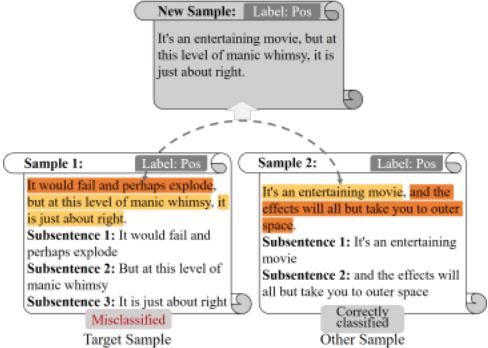
Second, unlike predecessors, we use a self-attention mechanism to obtain the attention distribution of the training samples' subsentences, and cut and mix the subsentences between the misclassified and correctly classified samples to generate new augmented samples wisely. We observe that many text prediction errors are caused by the neglect of the important subsentences in the training samples. As shown in Figure 1 for the sentiment classification, if the model focuses on the sample's subsentence "It would fail and perhaps explode" and ignores "It is just about right", the classification will be likely wrong. Thus, according to the attention values of subsentences, we select local text areas of the same label samples for mixed substitution to shift the model attention. The new sample generated by ATMIX is shown at the top of Figure 1.
Third, due to the difference between augmented and raw samples, some augmented samples may be ineffective and even harmful for model training. Therefore, we iteratively and dynamically choose the augmented samples through a loss gradient-based data selection algorithm in the training process, which can select the relatively optimal augmented data and help the model improve its performance. All of these approaches make the model training more effective/focused/understandable and reduce potential over-fitting problems as well.
The main contributions of this work are summarized as follows:
- We propose a targeted sample augmentation approach to focus the augmentation on the misclassified samples that the model cannot understand well.
- To generate effective augmented samples, we provide a new self-attention-based approach to understand the importance distribution of the text subsentences, and then cut and mix the subsentences based on misclassified and correctly classified samples wisely.
- We propose a loss function gradient-based dynamic augmented data selection training framework. This framework allows the model to dynamically and iteratively select the optimal augmented sample from huge augmented samples with improved performance and reduced training samples required.
- We provide a new model explainability evaluation method based on subsentence attention. We extensively evaluate our proposed model over multiple text datasets. The results indicate ATMIX outperforms typical classification models, the hidden-level and input-level mixup models w.r.t. the performance and explainability significantly.
2 RelatedWork
2.1 Mixing Data Augmentation
Recently, using data augmentation technology in NLP has become more prevalent [Feng et al., 2021]. Some studies consider easy methods to generate new samples, such as replacing words with synonyms [Wei and Zou, 2019; Guo et al., 2021], inserting punctuation marks into text [Karimi et al., 2021], and so on [Wei and Zou, 2019; Guo et al., 2021; Karimi et al., 2021]. A powerful branch of the data augmentation methods is the mixing method which generates new samples by mixing two or more original samples. Though it has achieved huge success in computer vision (CV) [Zhang et al., 2018; Guo, 2020; Yun et al., 2019; Uddin et al., 2020; Dabouei et al., 2021], it remains challenging in NLP, due to the discrete nature of text data and variable sequence lengths. The hidden-level and input-level mixup are two different types of mixing. The hidden-level mixup attempts to mix hidden vectors like embeddings or intermediate representations to achieve text data augmentation for classification [Guo et al., 2019; Chen et al., 2020; Sun et al., 2020]. The input-level mixup aims to mix the samples from the model input level such as SSMix [Yoon et al., 2021] and TreeMix [Zhang et al., 2022], which is used in ATMIX also. However, ATMIX distinguishes itself from them by using the attention value of subsentence, instead of the saliency map or text parsing tree to mix samples. Additionally, ATMIX does not need to synthesize labels, while SSMix and TreeMix have to do so. Furthermore, they have not considered model explainability and the selection of augmented data.
2.2 Selection of Augmented Data
Previous research often focuses on the scale and label of sample generation to assist in model training. However, the synthetic data may introduce harmful noise to interfere with model training. Some scholars try to select or generate augmented data selectively by influence function [Yang et al., 2020], Monte Carlo search tree [Quteineh et al., 2020], spatial distance [Sawhney et al., 2022], information entropy [Zhao et al., 2022] and so on [Wickramanayake et al., 2021; Zhou et al., 2022]. Different from the existing methods, we do not think that all raw samples can produce good results for model training by data augmentation. So we propose a concept of targeted sample augmentation to select the misclassified targeted samples to mix with correctly classified samples based on the subsentence attention, and then use the loss function to obtain the gradient value of the samples to select the augmented samples participating in the model training.
3 Methodology
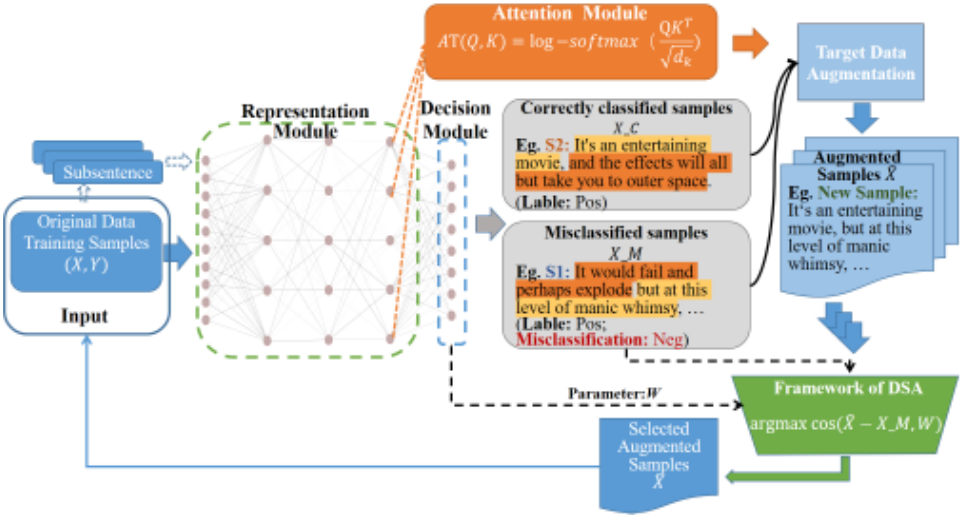
We now describe our framework for attentive explanationbased text classification via targeted sample augmentation, ATMIX. Figure 2 provides the overall structure of model with ATMIX, which consists of three major components including the attention extraction of the training samples and subsentences, the data augmentation of the training samples, and the dynamic selection of augmented samples (DSA).
3.1 Subsentence Attention Acquisition
We observe that many training and classification errors are caused by the misjudgment of the important subsentences of samples in the training process. To make the model training more focused, we select the misclassified training samples as the targeted samples for augmentation in the training process. Subsequently, we cut and extract the subsentences of the training samples according to the commonly used punctuation, which may result in multiple subsentences from each training sample. And then, we use the attention module to get the attention value of subsentences. We learn from the self-attention structure of the transformer model [Vaswani et al., 2017]. As shown in Figure 2, we extract the representation vector R of the sample or subsentence from the representation module. Based on training without additional parameters, we only compare the representation vector of the complete sample with the representation vector of the subsentences to obtain the attention value. The calculation equation is as follows.
where AT(·) indicates the attention function, Q is the subsentence representation vector, KT indicates the transpose matrix of the sample representation vector K, and dk is the dimension of the sample vector. The dot product of two vectors can be approximated as the mutual information between two vectors, which can be regarded as a cooccurrence statistic and used to calculate their semantic similarity [Levy and Goldberg, 2014; Ethayarajh et al., 2019; Li et al., 2020]. When the dot product between the representation vector of the complete sample and the representation vector of the subsentences is higher, the correlation between them becomes stronger. Therefore, the higher the AT ∈ [0, 1] value of the subsentence is, the more important the part represents.
3.2 Data Augmentation
According to the explanatory perspective of the model, it is considered that the subsentence with a higher attention value has a more important impact on the final decision-making result. To some extent, a better understanding of the importance of the subsentence results in better classification results.
To generate effective augmented data, we take the misclassified samples in the training process as the targeted samples to augment. Through data augmentation to assist the model in shifting the attention of misclassified samples to the correct position, we propose a novel method of data augmentation using text mixing. It creates a new training sample (ˆx, ˆ y) by mixing part of the misclassified sample (x1, y1) and the correctly classified sample (x2, y2). Here, x is the training sample and y is the training label. The main idea is that the high AT subsentences of misclassified samples are replaced by the low AT subsentences of the correctly classified samples with a similar label. Defined mixing operations are as follows.
where sub is a subsentence of sample x, sub(x) indicates all of sample x's subsentences, and R(x) indicates the representation vector of sample x. This operation is to reduce the wrong attention of subsentences of the misclassified samples. At the same time, because choosing the lowest attention subsentence of the correctly classified sample to substitute, the model would not ignore the original important subsentences again. The reason for choosing the samples with the same label for mixing is that mixing and substituting samples with the same sentiment polarity will preserve sentiment polarity most of the time [Luque, 2019]. Therefore, this work does not need to consider the label of mixed samples, and the new label ˆ y is consistent with the labels y1 and y2.
3.3 Dynamic Selection of Augmented Samples
Each misclassified training sample can generate a large number of new samples, according to Section 3.2. Taking the SST-1 dataset as an example, a misclassified sample will generate about 500 new samples, and the augmented scale of different datasets is different. When the scale of training data is larger, the richness of the augmented samples becomes greater. Although the scale of new samples is enormous, not every augmented sample can play a positive role in model training, because of the distribution difference between the augmented and the original sample. To this end, we propose a dynamic selection of augmented samples approach based on the gradient value of the loss function, which is applied to the augmentation samples selection of ATMIX. The augmented data selection method is provided below.
Optimal variation of samples. For the optimal selection of augmented samples, we adopt a gradient optimization algorithm to derive the optimal sample augmentation direction by the loss function Loss(·). We take the training data X as the variable of the loss function and the decision module parameter W as the fixed value, and optimize the derivation according to Loss(·), the cross entropy loss function of the model, to obtain the change gradient ∇.
As shown in the equations, Y represents the label of samples, f(·) represents the model prediction results, and b is a constant. The gradient ∇ represents the best direction of X change of the current loss function in the case of parameter W. In the case of fixed parameter W, f(R(X)) and Y are fixed values, so α is a constant between -1 and 0.
Approximate optimal variation. We introduce the data gradient ascent algorithm to generate the augmented samples ˆX, which are regarded as the optimal new samples of the targeted samples X′ in the gradient direction of the boundary change of the loss function, as shown in the following equation.
Since this work adopts the mixing method in the input-level text samples, the difference in the sample vector change can not be completely consistent with the ∇. Therefore, we select the augmented sample ˆX whose change difference of the representation vector has the closest cosine distance with the W. Since ∇ and W are approximate and in the same vector direction, ˆX can be approximately regarded as the optimal change of X′ . The DSA uses this method to carry out a selection process of the augmented samples ˆX. We define this selection operation as:
where ¯X is the selected augmented samples, Mix(x′ ) represents all augmented samples generated by mixing all correctly classified samples of the same category with the targeted sample x′ ∈ X′ .
Dynamic selection. Using the idea of the EM algorithm, the initial training of the model is carried out first. Then the data are augmented under the condition that the parameter W remains unchanged. Then the augmented samples are selected, and the chosen ¯X is added to the next round of training data D. The DSA pseudo-code is as Algorithm 1.
Algorithm 1 Framework of DSA
Input: DATA (X, Y ), Init-parameter W and θ. Output: Classification Model M. 1: Training DATAD = (X, Y ) 2: while epoch do 3: SGD(loss,M(D, θ,W)) ⇒ ˆW, ˆ θ 4: W = ˆW, θ = ˆ θ 5: CorrectX,ErrorX =M(X) 6: if ErrorX! = ∅ then 7: ( ˆX, ˆ Y ) = ∅ 8: for label do 9: ˆXlabel = Mix(ErrorXlabel, CorrectXlabel) 10: ˆ Ylabel = label 11: Insert ( ˆXlabel, ˆ Ylabel) into ( ˆX, ˆ Y ) 12: end for 13: CosDis = cos(R( ˆX) -R(ErrorX),W) 14: ( ¯X, ¯ Y ) = arg max(ˆx,ˆ y) CosDis 15: D = (X, Y ) ∪ ( ¯X, ¯ Y ) 16: end if 17: end while 18: return M4 Experiments and Analysis
4.1 Datasets
To verify the effectiveness of ATMIX, we used five typical sentiment classification datasets, namely three two-category datasets SST-2 [Socher et al., 2013], YELP-2 1 , and IMDB [Maas et al., 2011], and two five-category datasets SST-1 [Socher et al., 2013] and YELP-5 1 . Because the amounts of YELP-2, YELP-5, and IMDB training data are relatively large, we randomly select 1% of YELP-2, YELP-5, and 20% of IMDB for the training. Whereas the amounts of the test sets are consistent with the original datasets. As shown in Table 1, we present the detailed information of five datasets, including the number of labels, the size of the training/testing set, and the average word count of each sample.
4.2 Baseline
We compare ATMIX with five baselines. (1) standard BERT without any mixing augmentation. (2) Mixup [Zhang et al., 2018] applies to mix on the representation layer, which is similar to the senMixup [Guo et al., 2019]. (3) TMix [Chen et al., 2020] mixes hidden states of two samples at a particular layer and forwards the new states to the remaining layers. (4) SSMix [Yoon et al., 2021] mixes input-level samples based on the saliency map. (5) TreeMix [Zhang et al., 2022] mixes input-level samples based on the parsing tree. All mixing methods use the BERT as the backbone model. In addition, we select other two popular language models, TextCNN [Kim, 2014; Zhang and Wallace, 2015] and ALBERT [Lan et al., 2019], as the backbone to verify the effectiveness of ATMIX.
| Name | Label | Train/Test Size | Word Count |
|---|---|---|---|
| SST-2 | 2 | 6920/1821 | 17.34 |
| SST-1 | 5 | 8544/2210 | 17.19 |
| YELP-2 | 2 | 5600/50000 | 135.49 |
| YELP-5 | 5 | 6500/38000 | 133.41 |
| IMDB | 2 | 5000/25000 | 233.52 |
4.3 Experiment Setup
This section provides all the detailed parameter settings for different models.
For the TextCNN, ALBERT, and BERT models, we use the settings as suggested in [Kim, 2014; Zhang and Wallace, 2015; Lan et al., 2019; Devlin et al., 2019] to achieve the best performance. We use Tensorflow to reproduce TextCNN and use PyTorch to reproduce ALBERT and BERT. For TextCNN, we select the random initial parameter for the model and word embeddings, the dropout value is 0.5 without L2 regularization. The maximum input length is 128, and the batch size is 16. For ALBERT, we use the ALBERT-basev2 pre-trained model from Huggingface Hub 1 for initialization. The maximum length and the batch size of the input sequence are 256 and 20 on IMDB, while 128 and 30 on the other datasets. For BERT, we use the BERT-base-uncased pre-trained model from Huggingface Hub 2 for initialization. The maximum length of the input sequence is 256 on IMDB, while 128 on the other datasets.
For other mixing methods, we try to follow the best parameter settings of the original papers for each method as well. TMix and SSMix are the repetitions of previous work [Yoon et al., 2021]. We follow the best settings stated in the original papers: α = 0.2 for Mixup and TMix, and window size is 10% for SSMix. For TMix, we randomly sample the mixing layer [7,9,12]. For TreeMix, we choose the optimal parameters of SST-2 in the original paper to test SST-1, SST-2, YELP-2 and YELP-5. The IMDB experiment for TreeMix is set to the same parameters as the original paper, except the maximum input length is 256, and no scheduler.
All experiments run on NVIDIA Tesla A100 GPUs and the epoch values are 10. The reported results are the average values for 5 runs in each experiment. For ATMIX, to speed up the efficiency of data production and selection, we randomly choose 200 correctly classified samples to mix with targeted samples. Considering the diversity of the augmented samples, we choose to replace some words in the augmented samples with synonyms. Randomly replacing a few words with synonyms can enrich the diversity of the augmented samples and retain the raw label of the training samples. Thus the augmented samples do not lead to the over-fitting problem. So for all the experiments, we use the NLTK 3 tool and the WordNet 4 corpus to replace synonyms. Each new sample replaces only 2 synonyms randomly.
1 https://huggingface.co/ALBERT-base-v2
2 https://huggingface.co/BERT-base-uncased
4 https://wordnet.princeton.edu/
| Model | SST-2 | SST-1 | IMDB | YELP-2 | YELP-5 |
|---|---|---|---|---|---|
| BERT | 91.96 | 53.86 | 89.96 | 92.05 | 56.85 |
| BERT+Mixup | 92.05 | 53.63 | 89.03 | 92.07 | 56.56 |
| BERT+TMix | 92.16 | 53.86 | 90.25 | 92.21 | 56.64 |
| BERT+SSMix | 92.03 | 53.99 | 90.37 | 92.28 | 56.30 |
| BERT+TreeMix | 91.33 | 54.19 | 90.31 | 92.23 | 56.41 |
| BERT+ATMIX(synnum= 2) | 92.24 | 54.49 | 90.73 | 92.48 | 57.05 |
| BERT+ATMIX(synnum= 0) | 92.67 | 54.41 | 90.90 | 92.61 | 56.96 |
| Gain | +0.62 | +0.30 | +0.59 | +0.33 | +0.20 |
| Model | SST-2 | SST-1 | IMDB |
|---|---|---|---|
| TextCNN | 76.63 | 35.08 | 82.83 |
| +ATMIX(1) | 77.05 | 36.82 | 82.64 |
| +ATMIX(2) | 76.36 | 35.73 | 83.62 |
| ALBERT | 90.12 | 47.49 | 90.41 |
| +ATMIX(1) | 91.32 | 49.19 | 90.51 |
| +ATMIX(2) | 91.41 | 48.64 | 90.05 |
| BERT | 91.96 | 53.86 | 89.96 |
| +ATMIX(1) | 92.07 | 54.43 | 90.79 |
| +ATMIX(2) | 92.24 | 54.49 | 90.73 |
4.4 Performance Comparison
We first evaluate the performance comparison between ATMIX and other text mixing methods. Table 2 shows the comparison results which provide the average results over five runs. mixnum is the number of new samples selected from all augmented samples per misclassified sample. For the results shown in Table 2, we uniformly take the experimental situation when the mixnum is 2. At the same time, we also show the impact of the synonym replacement quantity parameter synnum on ATMIX. According to our experiment, synonym replacement has little impact on ATMIX. Even for two-category datasets such as SST-2, YELP2, and IMDB, synnum = 0 performs better. In addition, we find the text mixing methods do not always show superiority over the original model for 5-category datasets, such as SST-1 and YELP-5. However, ATMIX can perform well for 5-category datasets. This result confirms that ATMIX is effective, and outperforms the original BERT model and other mixing methods.
4.5 Generalizability of ATMIX
Next, we show the proposed ATMIX can be applied to different deep learning models to further improve the model performance. Here, we choose the three most popular deep learning models (i.e., TextCNN, ALBERT, and BERT) over datasets including SST-2, SST-1 and IMDB. As a comprehensive study, we showed two different settings of using ATMIX with 1 and 2 as the mixnum. As shown in Table 3, with a different mixnum, the enhanced models perform slightly differently. However, we observe that the enhanced models with ATMIX always outperform the original models. This further confirms ATMIX can be used as a general solution over existing language models with increased performance and explainability.
| Dataset | Correct | Misclassified | Full |
|---|---|---|---|
| SST-1 | 53.17 | 54.41 | 53.06 |
| SST-2 | 91.96 | 92.67 | 91.92 |
4.6 Ablation Experiments
Furthermore, we provide ablation studies. We use the BERT model as the backbone model to conduct ablation experiments. We use ATMIX(mixnum = 2,synnum = 0) and select correctly classified samples, misclassified samples, and full samples as targeted samples for experiments. As shown in Table 4, when the correctly classified samples and full samples are selected as targeted samples for augmentation, the performance is not better than the misclassified samples. Similarly, such results also confirm that not all the raw samples might produce a good performance for the model training by data augmentation.
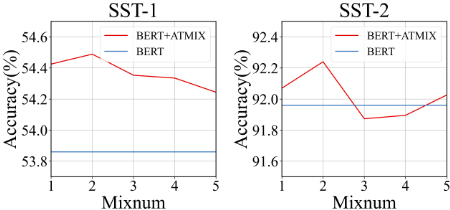
To discover the influence of parameter mixnum on ATMIX, we set the mixnum from 1 to 5, and the experimental results are shown in Figure 3. We can find that in the two datasets, SST-1 and SST-2, with the increase of mixnum, the performance of ATMIX shows a decreasing fluctuation. However, the peak accuracy is achieved when mixnum = 2. Such results also confirm our view that adding more augmented samples to the model training might not be helpful.
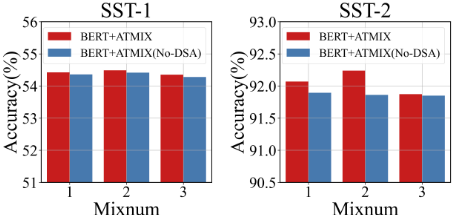
In addition, to verify the effectiveness of the dynamic augmented data selection framework (DSA), we also conduct experiments on SST-1 and SST-2 and set values of mixnum from 1 to 3. Instead of using DSA, we randomly select mixnum samples from the generated samples. And experiments are initialized by seed 0∼4 and report the average result. The results are shown in Figure 4. We can find that the effect of not using DSA is inferior to using DSA. The DSA can play a positive role in ATMIX.
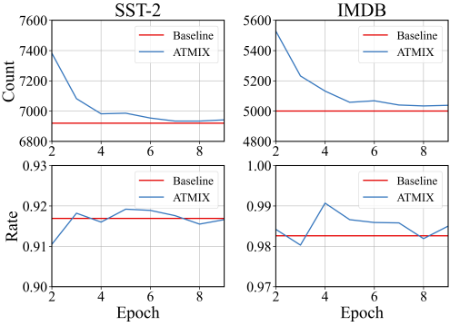
We also track the sample count and the proportion of negative and positive samples generated in ATMIX(mixnum = 2) training for SST-2 and IMDB. The equation for calculating the proportional value is as follows,
As shown in Figure 5, the lines represent the change of values of Baseline and ATMIX with the training epoch. The samples generated by ATMIX gradually decrease with the increase of epoch and have limited influence on the distribution of negative and positive samples. The proportion of deviation from the original distribution of negative and positive samples could not exceed 1% at most. Therefore, we believe that ATMIX can not cause sample imbalance.
4.7 Model Explainability
Explainability becomes important to measure how the model can be interpreted and understood. There are multiple interpretable models proposed, such as SHAP [Lundberg and Lee, 2017], LIME [Ribeiro et al., 2016], Anchor [Ribeiro et al., 2018] and word cosine distance [Chen and Ji, 2019]. Differently, ATMIX provides a new capability to evaluate the model explainability from the perspective of self-attention by further understanding the subsentences in a text towards the classification. Figure 2 illustrates the overall architecture of ATMIX, where the attention module forms a self-attention mechanism independent of model parameters or weights. During training, the self-attention mechanism dynamically monitors the attention distribution of training samples and their subsentences, particularly for misclassified samples. Based on the attention value obtained, the high attention subsentence of the misclassified sample is replaced with a low attention subsentence of correctly classified samples to generate an augmented sample for model training, and to correct the model's attention distribution for misclassified samples. During the testing phase, the attention module of ATMIX can visualize the model's attention distribution of the test sample subsentences and obtain insights into its functioning.
While the existing interpretable models cannot explain the model directly by capturing the attention of subsentences. To this end, we present a new method to evaluate the model's explainability. By comparing the top important subsentences for the model with the human-labeled subsentences, we calculate the accuracy of the model's understanding of the subsentences. The indicators equation is as follows.
where AT(subs) is shown in Equation 1 and indicates the model attention values of subsentences, Annotated(subs) indicates the result of manual annotation, n represents the number of the top essential subsentences in each sample judged by the model, and m represents the number of the top important subsentences in each sample labeled manually.
We manually label 200 samples in the test sets of SST-2 and IMDB respectively. There are many subsentences in each sample in IMDB. Therefore, we label three IMDB training subsentences that affect the sentiment polarity according to our understanding of the importance degree. However, there are fewer subsentences in SST-2, and we only label the subsentence that affects the sample sentiment polarity mostly.
We use BERT as the backbone model to evaluate the subsentence attention of the original model and the four text mixing augmentation methods (Mixup, TMix, SSMix, and ATMIX). As shown in Table 5, for SST-2, because each sample has an average of 2 subsentences, we use ACC@1@1 as an indicator to evaluate the accuracy of subsentences' importance understood by the model. The results show ATMIX can improve the subsentence importance understanding significantly. For IMDB, as samples are longer and have more subsentences, we use ACC@1@1 and ACC@3@3 as the indicators. We observe ATMIX is also the best in extracting important subsentences. These results further confirm ATMIX can pay more attention to the most important subsentences.
| SST-2 | IMDB | ||
|---|---|---|---|
| Model | @1@1 | @1@1 | @3@3 |
| BERT | 69.50 | 21.90 | 48.00 |
| +Mixup | 68.10 | 22.00 | 45.90 |
| +TMix | 63.60 | 18.10 | 42.40 |
| +SSMix | 65.10 | 20.20 | 42.90 |
| +ATMIX | 70.00 | 22.30 | 48.70 |
5 Conclusion
Mixing data augmentation has emerged as a promising solution for text classification. In this paper, we advanced the concept of targeted sample augmentation. And we proposed an explainable text classification solution based on attentive and targeted mixing data augmentation, ATMIX. In particular, we focused on the misclassified samples as the candidates to generate new augmented data to better improve the model's capability in understanding these data. To generate the most meaningful augmented data, we also provided a self-attention-based mechanism to capture the importance of different subsentences in the model and used a cut-andmix approach to mix the subsentences between the correctly classified and misclassified samples. Among a large amount of augmented data samples, we further proposed a loss function gradient-based dynamic data selection training framework, to dynamically select the optimal augmented samples to improve model performance with reduced training samples needed. In the end, we also provided a new model explainability evaluation method based on subsentence attention. To evaluate the performance and explainability of the solution, we performed extensive evaluations with current popular classification models, the models with hidden-level and input-level mixup models. Our results confirmed that the proposed solution outperforms these models significantly in terms of performance and explainability.
In the future, We will continue to study the selection of target data and consider upgrading the framework of DSA. We will consider applying DSA to other data augmentation methods for experiments and expanding it to other research fields. In addition, we will study optimizing the overall calculation process of DSA and searching for the best enhancement selection parameters automatically.
Acknowledgements
This work is supported by the Fundamental Research Funds for the Central Universities Grant (3072022TS0601), the National Natural Science Foundation of China Grant (61771155), the Singapore Institute of Technology Ignition Grant (R-IE2-A405-0001), the Heilongjiang Postdoctoral Foundation Grant (LBH-Z22103), and the China National Key Laboratory Foundation of Underwater Measurement and Control Technology.
@inproceedings{ijcai2023p565,
  title     = {Explainable Text Classification via Attentive and Targeted Mixing Data Augmentation},
  author    = {Jiang, Songhao and Chu, Yan and Wang, Zhengkui and Ma, Tianxing and Wang, Hanlin and Lu, Wenxuan and Zang, Tianning and Wang, Bo},
  booktitle = {Proceedings of the Thirty-Second International Joint Conference on
               Artificial Intelligence, {IJCAI-23}},
  publisher = {International Joint Conferences on Artificial Intelligence Organization},
  editor    = {Edith Elkind},
  pages     = {5085--5094},
  year      = {2023},
  month     = {8},
  note      = {Main Track},
  doi       = {10.24963/ijcai.2023/565},
  url       = {https://doi.org/10.24963/ijcai.2023/565},
}
TY - CPAPER TI - Explainable Text Classification via Attentive and Targeted Mixing Data Augmentation AU - Jiang, Songhao AU - Chu, Yan AU - Wang, Zhengkui AU - Ma, Tianxing AU - Wang, Hanlin AU - Lu, Wenxuan AU - Zang, Tianning AU - Wang, Bo T2 - Proceedings of the Thirty-Second International Joint Conference on Artificial Intelligence, IJCAI-23 PB - International Joint Conferences on Artificial Intelligence Organization PY - 2023 SP - 5085 EP - 5094 DO - 10.24963/ijcai.2023/565 UR - https://doi.org/10.24963/ijcai.2023/565 ER -Copied
Machine-readable versions of this paper, for tools and AI agents:





