
Action Space Reduction for Planning Domains
Proceedings of the Thirty-Second International Joint Conference on Artificial Intelligence. Main Track. Pages 5394-5401.
https://doi.org/10.24963/ijcai.2023/599
Keywords
- Planning and Scheduling: PS: Theoretical foundations of planning
Abstract
Planning tasks succinctly represent labeled transition systems, with each ground action corresponding to a label. This granularity, however, is not necessary for solving planning tasks and can be harmful, especially for model-free methods. In order to apply such methods, the label sets are often manually reduced. In this work, we propose automating this manual process. We characterize a valid label reduction for classical planning tasks and propose an automated way of obtaining such valid reductions by leveraging lifted mutex groups. Our experiments show a significant reduction in the action label space size across a wide collection of planning domains. We demonstrate the benefit of our automated label reduction in two separate use cases: improved sample complexity of model-free reinforcement learning algorithms and speeding up successor generation in lifted planning. The code and supplementary material are available at https://github.com/IBM/Parameter-Seed-Set.
- [Bäckström and Nebel, 1995] Christer Bäckström and Bern- hard Nebel. Complexity results for SAS + planning. Com- put. Intell., 11(4):625-655, 1995.
- [Bamford and Ovalle, 2021] Christopher Bamford and Al- varo Ovalle. Generalising discrete action spaces with con- ditional action trees. In 2021 IEEE Conference on Games (CoG), pages 1-8, 2021.
- [Boutilier et al., 2018] Craig Boutilier, Alon Cohen, Avinatan Hassidim, Yishay Mansour, Ofer Meshi, Martin Mladenov, and Dale Schuurmans. Planning and learning with stochastic action sets. In IJCAI, pages 4674-4682, 2018. IJCAI
- [Corrêa et al., 2020] Augusto B. Corrêa, Florian Pommeren- ing, Malte Helmert, and Guillem Francès. Lifted succes- sor generation using query optimization techniques. In ICAPS, pages 80-89, 2020.
- [Corrêa et al., 2021] Augusto B. Corrêa, Guillem Francès, Florian Pommerening, and Malte Helmert. Delete- relaxation heuristics for lifted classical planning. In ICAPS, pages 94-102, 2021.
- [Dzeroski et al., 2001] Saso Dzeroski, Luc De Raedt, and Kurt Driessens. Relational reinforcement learning. ML, 43(1/2):7-52, 2001.
- [Fern et al., 2006] Alan Fern, Sung Wook Yoon, and Robert Givan. Approximate policy iteration with a policy lan- guage bias: Solving relational markov decision processes. JAIR, 25:75-118, 2006.
- [Fišer, 2020] Daniel Fišer. Lifted fact-alternating mutex groups and pruned grounding of classical planning prob- lems. In AAAI, pages 9835-9842, 2020.
- [Gefen and Brafman, 2011] Avitan Gefen and Ronen I. Braf- man. The minimal seed set problem. In ICAPS, number 1, pages 319-322, 2011.
- [Gehring et al., 2022] Clement Gehring, Masataro Asai, Ro- han Chitnis, Tom Silver, Leslie Pack Kaelbling, Shirin Sohrabi, and Michael Katz. Reinforcement learning for classical planning: Viewing heuristics as dense reward generators. In ICAPS, pages 588-596, 2022.
- [Geißer et al., 2020] Florian Geißer, David Speck, and Thomas Keller. Trial-based heuristic tree search for mdps with factored action spaces. In SOCS, pages 38-47, 2020.
- [Guestrin et al., 2002] Carlos Guestrin, Michail G. Lagoudakis, and Ronald Parr. Coordinated reinforcement learning. In ICML, pages 227-234, 2002.
- [Haslum, 2011] Patrik Haslum. Computing genome edit dis- tances using domain-independent planning. In Scheduling and Planning Applications woRKshop (SPARK) at ICAPS, pages 45-51, 2011.
- [Helmert et al., 2014] Malte Helmert, Patrik Haslum, Jörg Hoffmann, and Raz Nissim. Merge-and-shrink abstrac- tion: A method for generating lower bounds in factored state spaces. Journal of the ACM, 61(3):16:1-63, 2014.
- [Helmert, 2006] Malte Helmert. The Fast Downward plan- ning system. JAIR, 26:191-246, 2006.
- [Helmert, 2009] Malte Helmert. Concise finite-domain rep- resentations for PDDL planning tasks. Artificial Intelli- gence, 173:503-535, 2009.
- [Hoffman et al., 2020] Matt Hoffman, Bobak Shahriari, John Aslanides, Gabriel Barth-Maron, et al. Acme: A re- search framework for distributed reinforcement learning. CoRR, abs/2006.00979, 2020.
- [Huang and Ontañón, 2022] Shengyi Huang and Santiago Ontañón. A closer look at invalid action masking in pol- icy gradient algorithms. In The Thirty Fifth International Florida Artificial Intelligence Research Society FLAIRS, 2022.
- [Kanervisto et al., 2020] Anssi Kanervisto, Christian Scheller, and Ville Hautamäki. Action space shaping in deep reinforcement learning. In 2020 IEEE Conference on Games (CoG), pages 479-486, 2020.
- [Lauer et al., 2021] Pascal Lauer, Álvaro Torralba, Daniel Fiser, Daniel Höller, Julia Wichlacz, and Jörg Hoffmann. Polynomial-time in PDDL input size: Making the delete relaxation feasible for lifted planning. In IJCAI, pages 4119-4126, 2021. IJCAI
- [Matloob and Soutchanski, 2016] Rami Matloob and Mikhail Soutchanski. Exploring organic synthesis with state-of-the-art planning techniques. In Scheduling and Planning Applications woRKshop (SPARK) at ICAPS, pages 52-61, 2016.
- [McDermott, 2000] Drew V. McDermott. The 1998 AI plan- ning systems competition. AI Mag., 21(2):35-55, 2000.
- [Nelson, 2021] Mark J. Nelson. Estimates for the branching factors of atari games. In 2021 IEEE Conference on Games (CoG), pages 1-5, 2021.
- [Pazis and Lagoudakis, 2011] Jason Pazis and Michail G. Lagoudakis. Reinforcement learning in multidimensional continuous action spaces. In IEEE Symposium on Adap- tive Dynamic Programming And Reinforcement, pages 97- 104, 2011.
- [Sievers et al., 2014] Silvan Sievers, Martin Wehrle, and Malte Helmert. Generalized label reduction for merge- and-shrink heuristics. In AAAI, pages 2358-2366, 2014.
- [Silver and Chitnis, 2020] Tom Silver and Rohan Chitnis. Pddlgym: Gym environments from PDDL problems. CoRR, abs/2002.06432, 2020.
- [Ullman, 1989] Jeffrey D. Ullman. Principles of Database and Knowledge-Base Systems, Volume II. Computer Sci- ence Press, 1989.
References were extracted automatically from the PDF and may contain errors.
Full text extracted automatically from the PDF; figures, tables and equations may differ. The PDF is the version of record.
1 Introduction
AI Planning tasks, described in the planning domain description language (PDDL) [McDermott, 2000], induce transition graphs with states as nodes and transitions between states as labeled edges. These labeled transition systems (LTS) feature a unique label for each ground action. They identify transitions induced by the same action on different states with the same label. In practice, these labels are primarily used to distinguish applicable operations in a given state. So, a much smaller, sufficient set of labels might be attainable. Consider a gripper domain [McDermott, 2000] where a robot moves balls between two rooms. Figure 1 depicts a PDDL task in this domain. Consider the lifted action pick and its second parameter ?r:room. All applicable groundings of the action pick in any given state will have the same value for ?r, namely the current room the robot is in. Therefore, this parameter is not essential for distinguishing LTS transitions. Note that it does not mean that the parameter can be omitted from the lifted action, as it is essential for defining action preconditions. On the labeled transition system, however, all labels of the corresponding grounded actions that differ only

(a)
(b)
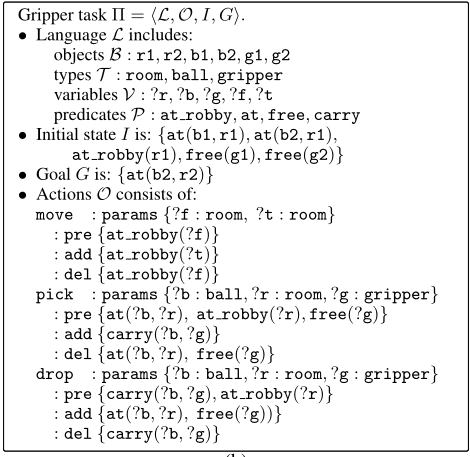
in the room parameter can be safely collapsed into one label, achieving a smaller set of labels.
It is no coincidence that discrete action sets of small sizes are also favored by reinforcement learning (RL) approaches. Choosing from a large collection of mostly irrelevant actions in a state can be detrimental to model-free methods [Huang and Onta˜n´on, 2022]. Most RL benchmarks have only a small number of actions, e.g., Atari benchmarks have at most 18 actions, representing all possible transition labels [Nelson, 2021]. When planning problems are cast as Markov Decision Processes (MDPs), great care is taken in defining small label sets [Silver and Chitnis, 2020; Fern et al., 2006;
Dzeroski et al., 2001]. In PDDLGym [Silver and Chitnis, 2020], the label sets are manually crafted by identifying a subset of lifted action parameters that are inessential for distinguishing two labels in a state. For example, the ?r:room parameter from our Gripper example is manually identified as inessential.
In this work, we propose automating this manual process, exploring ways of automatically reducing action labels in classical planning domains. For that, we characterize a valid label reduction for classical planning tasks and propose a way to automatically obtain such a reduction. Focusing on the reduction of action parameters, we show how lifted mutex groups [Fiˇser, 2020] can be leveraged to automatically identify the inessential parameters of the actions effectively, essentially automating the manual process of Silver and Chitnis [2020]. Our contributions, however, have a wider scope. We formally define the problem of obtaining a parameter seed set and propose to solve this problem by translating it to a delete-free planning task, proving that the solution obtained is a valid label reduction. Then we empirically evaluate our approach on 14 IPC domains and 10 hard-to-ground domains [Lauer et al., 2021; Haslum, 2011; Matloob and Soutchanski, 2016] and show that it achieves a significant reduction in action labels. Finally, we demonstrate the benefits of our approach on two use cases, RL and lifted successor generation [Corrˆea et al., 2020]. We empirically show that the label reduction can help in both cases: it significantly improves the sample efficiency of standard RL agents and speeds up the time to generate applicable ground action in lifted successor generation.
2 Preliminaries
In this section, we first introduce the necessary classical planning notations and then describe lifted mutex groups that we use in our proposed approach.
2.1 PDDL Task
We consider normalized PDDL tasks without axioms and conditional effects [Helmert, 2009]. A normalized PDDL task Π = ⟨L,O, I,G⟩ is defined over a first-order language L, a finite set of lifted actions O, an initial state specification I, and a goal specification G.
A first-order language L = ⟨B, T , V, P⟩ consists of a finite number of objects (B), types (T ), variables (V), and predicates (P). The association between types and objects is defined by a function D : T ↦→ 2B . T contains a special default type t0. Every object is associated with this default type such that D(t0) = B. Every pair of types ti, tj ∈ T satisfy one of the following conditions, either D(ti) ⊆ D(tj) or D(ti) ⊇ D(tj) or D(ti) ∩ D(tj) = ∅. V is a finite set of variable symbols such that each variable is associated with a type in T . All variables are represented with a prefix "?", for example, ?v. A pair of object and variable (o,?v) are compatible if o ∈ D(tv), where tv is the type of variable v. A predicate in P has fixed arity and each argument is associated with a type in T . An atom is a predicate symbol followed by a parenthesized list of arguments, predicate(term1, term2, · · · ) where termi can be a variable or object. For an atom (or a set of atoms) α, free(α) ⊆ V denotes a set of variables in the atom (or the set). If free(α)=∅ then α is called ground atom; otherwise it is called lifted atom. A lifted atom is grounded by replacing every variable with a compatible object. If lifted atoms α and α′ have the same predicate and the types of all the terms in α are subsets of types of respective terms in α′ , we say that α is a subset of α′ . That is, p(?a, ?b)⊑p(?a′ , ?b′ ), if D(ta)⊆D(ta′ ) and D(tb)⊆D(tb′ ). A literal is an atom or negation of an atom.
The initial state specification I is a conjunction of ground atoms with fluent predicates (that can change over time). The goal specification G is a conjunction of ground atoms or their negations. A lifted action o = ⟨head, cost , pre, add, del ⟩ in O consists of the atom head(o), indicating the name and the parameters of the action, an optional cost(o), indicating the cost of performing that operation, the preconditions pre(o), the add-effects add(o), and the delete-effects del(o), each is a conjunction of literals over L. For each action o, the set of action parameters params(o) is defined as free(pre(o)) ∪ free(add(o)) ∪ free(del (o)). Actions with empty parameter sets are called ground actions. Otherwise, an action can be grounded by replacing parameters with compatible objects in the domain.
The set of all ground actions is denoted by O↓. By o↓(P/θ) we denote a set of ground actions induced by assigning objects θ to parameter subset P and grounding the remaining parameters with all the compatible objects. In the gripper example, the ground action set of the lifted action o = pick(?b,?r,?g) induced by the assignment {?b/b1,?g/g1} is o↓ ({?b/b1,?g/g1}) = {pick(b1,r1,g1),pick(b1,r2,g1)}, where the parameters ?b and ?g are replaced with the objects mentioned in the assignment but the parameter ?r is replaced with all room objects, {r1, r2}.
A state s assigns values TRUE and FALSE to all ground atoms with fluent predicates. The initial state s0 of the task assigns value TRUE to all atoms occurring in I, and FALSE to all other fluent ground atoms. A ground action o is applicable in state s if s |= pre(o), that is, the preconditions of o are satisfied in the state s. A ground atom α is TRUE in the successor state if and only if either it has been TRUE in s and α ̸∈ del (o) or α ∈ add(o). A plan for the task is a sequence of ground actions whose subsequent application leads from s0 to some state s∗ with s∗ |= G.
2.2 LiftedMutex Groups
A mutex group is a set of mutually exclusive ground atoms M, of which at any given (reachable from I) state s at most one can be TRUE. That is, for any reachable state s, |M ∩ s| ≤ 1 or equivalently |{α | s |= α, α ∈ M}| ≤ 1. For example, in the gripper domain, {at(b1,r1), at(b1,r2)} is a mutex group as, in any given state, ball b1 can only be in one of the rooms. Any subset of a mutex group is also a mutex group. A lifted mutex group (LMG) is a set of lifted atoms that produces a mutex group when grounded. Formally, a lifted mutex group is defined using an invariant candidate.
An invariant candidate is a tuple c = ⟨vf , vc ,A⟩ where vf (c) (vc (c)) is a finite set of fixed (counted) variables (illustrated in the example below) and A(c) is a finite set of atoms such that all the variables of the atoms are present in either vf (c) or vc (c), i.e. free(A(c))=vf (c)∪vc (c) and vf (c)∩vc (c)=∅. For example, consider an invariant candidate c=⟨{?b},{?r},{at(?b,?r)} ⟩. Different groundings of fixed variables vf (c)={?b} generate different sets of ground atoms and different grounding of counted variable vc (c)={?r} generates ground atoms within each set. We denote the ground atom set with down arrow ↓. One of the ground atom sets for {?b/b1} is c↓(?b/b1)={at(b1,r1), at(b1,r2)} and another ground set for {?b/b2} is c↓(?b/b2) = {at(b2,r1),at(b2,r2)}.
An invariant candidate is called a lifted mutex group if all of its ground atom sets are mutex groups, that is, for any reachable state s and assignment {vf (c)/x}, |{a | s |=a, a∈c↓(vf (c)/x)}|≤1. An LMG with no fixed variable can only generate one ground mutex group. For example, ⟨∅,?r,{at robby(?r)}⟩ only induces ground atoms set {at robby(r1),at robby(r2)}. Fiˇser [2020] provides a method to identify the set of LMGs for a PDDL task. Since an LMG with multiple atoms can be split into multiple LMGs with a single atom each, for simplicity, in this paper we assume each LMG has only one atom.
3 Label Reduction
A planning task can be represented as a labeled transition system, where labels are operations that can be executed in states. These transition labels are identified by the head(o) for ground actions. For example, pick(b1,r1,g1) is a label for the action that picks the ball b1 from room r1 in the gripper g1. A label set L consists of a unique label for each ground action in O↓. The label set size increases exponentially in the number of objects. This work aims to reduce the size of the label set L. We do so by identifying an assignment of labels to planning actions such that it generates a smaller label set L′ while producing an equivalent transition system. We capture this requirement by specifying the criteria for a valid label reduction. A label reduction is valid if it assigns distinct labels to any two ground actions that can be applied in the same reachable state. For example, actions pick(b1,r1,g1) and pick(b2,r2,g1) cannot be applied in the same state as the gripper g1 cannot be in two different rooms in the same state. Thus, assigning the same label to both would be valid. But pick(b1,r1,g1) and pick(b2,r1,g2) can be applied in the same state, and hence cannot be assigned the same label.
Definition 1. A label reduction function ψ : L ↦→L′ is valid if any two distinct ground action labels head(o1), head(o2) ∈ L that are applicable in the same reachable state (s |= pre(o1) ∧ s |= pre(o2)) are assigned distinct labels, that is ψ(head(o1)) ̸= ψ(head(o2)).
This definition ensures that any two actions that are applicable in the same state are distinguishable. For each reduced label, the set of corresponding actions must include at most one applicable action for each reachable state. Noticing the resemblance to predicate mutex groups, we call such action sets applicable action mutex groups.
Definition 2. A set of ground actions O′ is an applicable action mutex group (AAMG) if for any reachable state s, |{o | s |= pre(o), o ∈ O′ }| ≤ 1.
Naturally, any subset of an AAMG is also an AAMG, and any set of actions of size 1 is an AAMG. A partitioning of actions into AAMGs defines a valid label reduction, and vice versa, a valid label reduction defines a partitioning of actions into AAMGs. While one can seek to find the smallest possible valid label reduction, that might require generating the set of all ground actions. To avoid the tedious grounding process, we focus on finding AAMGs for lifted actions.
We find AAMGs for each lifted action separately, by reducing its parameters. For example, consider a lifted action o = pick(?b,?r,?g), as a robot can only be in one specific room in any state, only one specific assignment to ?r is satisfiable in any state. So one possible set of AAMGs can be obtained by defining partial grounding of action o on the subset of parameters obtained after removing ?r. That is o↓({?b/b,?g/g}) | ∀b, g ∈ B} = {{pick(b1,r1,g1),pick(b1,r2,g1)}, {pick(b1,r1,g2),pick(b1,r2,g2)}, ...}.
A partial grounding of parameter subset (X ⊆ params(o)) of a lifted action o induces sets of ground actions where each set corresponds to a particular assignment of objects to parameter subset X. Thus, we want to identify a subset of parameters (X) such that any assignment (c) to this subset results in the ground action set (o↓(X/c)) being an AAMG (like the subset {?b,?g} in the above example). Note that LMGs have a similar property. Any assignment to their fixed variables results in a ground atom set being a mutex group. Next, we show how LMGs can be used to identify the required parameter subset.
Theorem 1. Given a lifted action o and a lifted mutex group l = ⟨vf (l), vc (l), {α}⟩, if p ⊑α for some p ∈ pre(o), then any assignment c to X = params(o) \ vc (l) 1 results in o↓(X/c) being an AAMG.
Proof. Given an assignment vf (l)/c, any state s can only satisfy at most one of the ground atoms from the mutex group l↓(vf /c) (from the definition of LMG). Consequently, as p ∈ pre(o) and p ⊑ α, the state can satisfy at most one of the preconditions of the ground actions in the set o↓(X/c). Hence, o↓(X/c) is an AAMG.
We call an LMG l relevant to a lifted action if an atom p in the precondition satisfies p ⊑ α, where α ∈ A(l). The parameters from set vc (l) of a relevant LMG need not be included in X. Given the assignment to vf (l) ⊆ params(o) the LMG l guarantees a unique assignment to parameters vc (l). Once the assignment to these parameters (vf (l) ∪ vc (l) ⊆ params(o)) are identified, another LMG l′ could now be used to identify the assignment to parameters vc (l′ ) and hence vc (l′ ) can also be removed fromX. Essentially, we can leverage multiple LMGs to further reduce the subset X. Formally, this corresponds to the following problem, which we call parameter seed set:
1 We assume that the variables of the LMG l match the ones of the precondition atom p.
Input: A lifted action o with parameters params(o) and a set of relevant lifted mutex groups L.
Any assignment of objects to the parameter seed set X will result in a unique assignment to all the remaining parameters of o for any reachable state.
Theorem 2. Let o be a lifted action over parameters params(o) and X be a solution to the parameter seed set problem above. Any assignment c of objects to X results in o↓(X/c) being an AAMG.
Proof. Let X1 ⊆ X2 ⊆ . . . ⊆ Xk = params(o) and let l1, . . . , lk-1 be lifted mutex groups such that vf (li) ∈ Xi and Xi+1 = Xi ∪ vc (li). Then, each Xi is a solution to the parameter seed set problem. We prove the claim by induction over the number of lifted mutex groups starting from k. The base claim of o↓(Xk/x) (one lifted mutex group) is AAMG results from Theorem 1. We assume that o↓(Xi+1/ˆ c) is an AAMG for any assignment ˆ c to Xi+1 and prove that o↓(Xi/˜ c) is an AAMG for any assignment ˜ c to Xi. Since li = ⟨vf (li), vc (li),A(li)⟩ is a lifted mutex group with vf (li) ⊆ Xi, we have that li↓(Xi/˜ c) is a mutex group. Let o1, o2 be two ground actions in o↓(Xi/˜ c). If both o1 and o2 belong to o↓(Xi+1/ˆ c), we are done. Otherwise, assume o1 in o↓(Xi+1/c1) and o2 in o↓(Xi+1/c2), where c1 and c2 agree on Xi but differ on Xi+1 \ Xi. However, since Xi+1 =Xi ∪ vc (li), we have Xi+1 \ Xi ⊆ vc (li), making c1 and c2 mutually exclusive. Thus, o↓(Xi/˜ c) is an AAMG.
Different parameter seed sets X correspond to different AAMGs. To find the smallest possible label set L′ , we want to minimize the number of AAMGs and therefore we are looking for a seed set X with a minimum possible total number of assignments. This can be expressed as
As the objective is not linear, we can use an equivalent one instead: argmin X ∑x∈X log(|D(x)|).
The parameter seed set problem is NP-Complete. For the lack of space, the proof, by reducing the bounded parameter seed set decision problem to a seed set decision problem [Gefen and Brafman, 2011], is deferred to the supplementary material. To solve the parameter seed set problem, we cast it as a (delete-free) STRIPS planning task with operation costs. We first find a set L of relevant LMGs. Then, for each lifted action o we define a separate planning task Πo = ⟨Lo, Oo, Io, Go⟩, where
- Language Lo contains a single predicate mark and an object for each parameter in params(o).
- The set Oo consists of two types of actions
- seedx actions are defined for each parameter x ∈ params(o) as seedx := 〈seedx, log(|D(x)|), ∅, {mark(x)}, ∅〉
- getl actions are defined for each relevant LMG l as getl := 〈getl, 0, {mark(x) | x ∈ vf (l)}, {mark(y) | y ∈vc (l)}, ∅〉.
- Initial state Io = ∅
- Goal state Go = {mark(x) | ∀x ∈ params(o)}.
The action seedx marks parameter x ∈ params(o) as an element of the seed set. Action getl indicates that a unique assignment for the parameters x ∈ vc (l) can be identified if all parameters y ∈ vf (l) are known. Therefore, the parameters vc (l) can be reduced. A plan for Πo corresponds to a sequence of seed and getl actions. The parameters marked by seed actions form the seed set, while others are reduced.
Theorem 3. For a plan π of Πo, Xπ = {c | seedc ∈ π}, is a solution to the parameter seed set problem of o.
Proof. Let π be a plan for Πo (assume there are no redundant repetitions of actions in π). Since seed actions have no preconditions, assume these actions come before getl actions, and let π = πsπg denote the partition of π into the two sequences of seed and getl actions, respectively. Let s1 be the state resulting from applying πs in the initial state Io and s1, . . . , sk be the sequence of states along πg applied to s1. Then, we have (i) s1 ⊆ s2 ⊆ . . . ⊆ sk and sk = {mark(x) | x ∈ params(o)}, as well as (ii) si+1 = si ∪ add(getl) = si ∪ {mark(y) | y ∈ vc (l)} for some getl with pre(getl) = {mark(x) | x ∈ vf (l)} ⊆ si. Denoting the parameters of o marked in the state s by Γ(s) = {x | mark(x) ∈ s}, we get that Xπ = Γ(s1).
The cost of a plan π is ∑seedx∈π log(|D(x)|), and therefore a cost-optimal plan will correspond to a parameter seed set with a minimal possible total number of assignments. To summarize, we find a parameter seed-set X for each lifted action such that assigning objects to X will result in a set of ground actions that is an AAMG. Hence, all the ground actions in that set can be assigned the same label. This reduces the size of the label set L.
4 Experiments
Our experimental evaluation is split into three parts. First, we check whether our approach is able to reduce the size of the transition label set and whether the reduction is substantial. The next two parts evaluate the utility of our approach. We test whether our reduction can translate into improved performance in two use cases: learning reinforcement learning policies and lifted successor generation.
4.1 Reduction in the Label Sets
We compare the size of label sets, obtained with and without the proposed reduction, on a representative set of 14 STRIPS domains from various IPC (using the typed versions where available) and 10 hard-to-ground (HTG) domains. We use the Fast Downward [Helmert, 2006] planning system translator to ground the lifted actions. To infer the lifted mutex groups, we use the implementation by Fiˇser [2020] and to solve the parameter seed set planning task we use the Fast Downward planner with A* search. The parameter seed set planning problem described in the previous section uses realvalued costs for the seed actions. However, the Fast Downward planner only allows integer costs. So we scale the realvalued costs of the seed action in our experiments.
| Domain | # reduced | non-seed parameters | |
|---|---|---|---|
| actions | max % (#) | mean % (#) | |
| IPC domains | |||
| blocks | 3/4 | 100.0% (1.00) | 50.00% (0.75) |
| barman | 11/12 | 66.67% (3.00) | 41.94% (1.92) |
| driverlog | 6/6 | 66.67% (2.00) | 47.22% (1.50) |
| thoughtful | 20/21 | 100.0% (6.00) | 73.03% (3.24) |
| gripper | 3/3 | 66.67% (2.00) | 50.00% (1.33) |
| pipesworld | 6/6 | 74.57% (6.12) | 65.69% (5.26) |
| pipesworld (no t.) | 6/6 | 71.43% (5.00) | 59.81% (3.87) |
| pipesworld (no s.) | 4/4 | 68.89% (7.60) | 65.83% (6.88) |
| tpp | 4/4 | 69.52% (4.87) | 60.48% (3.90) |
| freecell | 10/10 | 80.00% (5.00) | 65.29% (3.30) |
| logistics | 6/6 | 66.67% (2.00) | 55.95% (1.76) |
| rovers | 8.62/9 | 77.08% (2.88) | 46.50% (1.73) |
| satellite | 5/5 | 68.52% (2.08) | 51.99% (1.46) |
| visitall | 1/1 | 50.00% (1.00) | 50.00% (1.00) |
| depot | 5/5 | 50.00% (2.00) | 46.67% (1.80) |
| zenotravel | 5/5 | 77.50% (4.10) | 62.23% (2.68) |
| HTG Domains | |||
| visitall-3dim | 3/3 | 75.00% (3.00) | 75.00% (3.00) |
| visitall-4dim | 4/4 | 80.00% (4.00) | 80.00% (4.00) |
| visitall-5dim | 5/5 | 83.33% (5.00) | 83.33% (5.00) |
| blocksworld | 3/4 | 100.0% (1.00) | 50.00% (0.75) |
| GED | 11/14 | 100.0% (3.00) | 61.90% (1.50) |
| GED-split | 19/21 | 100.0% (2.00) | 73.81% (1.38) |
| GED-positional | 0/3 | 0.00% (0.00) | 0.00% (0.00) |
| pipesworld (no s.) | 4/4 | 68.00% (7.26) | 64.10% (6.68) |
| rovers | 0/9 | 0.00% (0.00) | 0.00% (0.00) |
| childsnack parsize1 | 2.5/4 | 63.33% (3.17) | 27.29% (1.17) |
| childsnack parsize2 | 3/4 | 77.78% (4.67) | 36.11% (1.92) |
| childsnack parsize3 | 3/4 | 80.95% (5.67) | 37.95% (2.42) |
| childsnack parsize4 | 3/4 | 83.33% (6.67) | 39.17% (2.92) |
| logistics | 6/6 | 83.33% (2.50) | 65.97% (2.08) |
| OS-MIT | 15.22/52 | 44.41% (4.39) | 7.91% (0.81) |
| OS-alkene | 12/12 | 67.36% (7.11) | 37.28% (3.81) |
| OS-original | 14.85/52 | 45.74% (4.65) | 7.14% (0.76) |
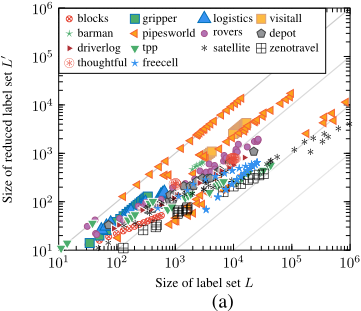
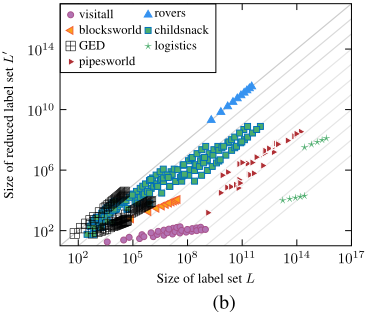
Figure 2 compares the size of the label sets L′ and L, obtained with and without the reduction resp. Figure 2a presents the reduction on each PDDL problem instance for IPC domains and Figure 2b on 7 out of 10 HTG domains (the remaining 3 are available in the supplementary material). Both axes are log-scale. Points below the diagonal indicate instances where the reduced label set is smaller than the original one. The distance from the diagonal indicates the significance of the reduction. Gray dashed lines below the diagonal represent the order of magnitude of the reduction. Our experimental results show a substantial reduction of the label set in most problem instances, going up to 2 orders of magnitude on IPC problems and up to 10 orders of magnitude on hard-to-ground domains.
Table 1 summarizes the number of lifted actions that were reduced by our approach. It also presents the mean and max number of non-seed parameters found in the lifted actions, i.e., |params(o)| - |X|. Each row of the table represents a domain, aggregating results over the instances of that domain. We were able to find non-seed parameters in all 14 IPC domains and all but 2 HTG domains. More than 3 parameters were reduced for some lifted actions in thoughtful, pipesworld, tpp, freecell, zenotravel, visit all, childsnack, and OS-alkene domains. 2 IPC domains and 3 HTG domains have actions with 100% reduction, that is all the parameters of some actions were deemed inessential. Note that the number of reduced parameters (in Table 1) is not necessarily proportional to the reduction in the label set (in Figure 2). Nevertheless, the number of reduced parameters indicates the importance of parameter reduction. The computation time was between 0.25 and 1.73 seconds for the IPC domains and between 0.26 and 4.69 seconds for the HTG domains.
4.2 Learning RL Policies
An MDPM = ⟨S,A, P,R⟩ contains a set of states S, a set of actions A, a transition probability distribution P : S × S × A ↦→ [0, 1], and a reward function R : S ↦→ R. When a PDDL task Π is cast as an MDP M, the set of states S are defined as the set of all states reachable from I of Π, the action set A is defined as the set of labels that is composed of a unique label for each of the ground actions, the probability distribution P is defined to respect the state-transition in the PDDL actions, and the reward function R is defined as some positive integer when s |= G and 0 otherwise. In practice, for each of the ground actions, the head of the ground action head(o) is assigned as the unique label.
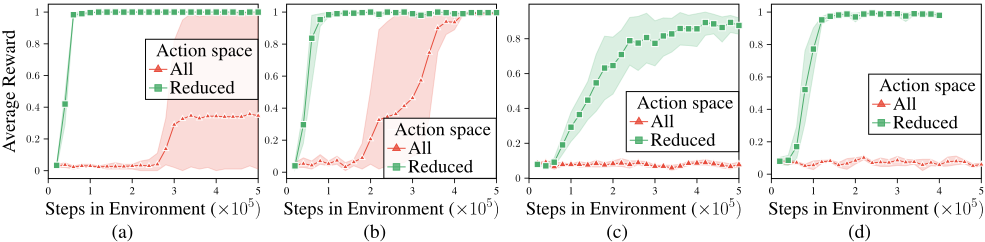
To evaluate the advantage of reducing the label set size in planning as RL, we cast the PDDL task as an MDP with two different action spaces: 1) All: default action space with all ground actions, with head(o) as unique labels, 2) Reduced: reduced action space with one label for each AAMG and compare the learning curves of RL policies. We focus on 4 classical planning domains, ferry, gripper, blocks, and logistics. Since our aim is to evaluate the advantage of reducing the action space, and not the generalization of policies, we fix the number of objects in each domain. We generate 500 unique pairs of initial and goal states in each domain. Of these, 250 pairs were used in training and the remaining were set aside for evaluation. Inspired by the work of Gehring et al. [2022], we use domain-independent planning heuristic, hFF , as a dense reward function and use their code to convert the PDDL problem to an RL environment. We employ the Double DQN implementation from the ACME RL library [Hoffman et al., 2020] to learn a state-action value function and apply a greedy policy π(s) = max a Q(s, a) in our evaluation.
Figure 3 shows learning curves aggregated over 5 runs with different random seeds. For ferry and gripper domains (Figure 3 a and b), the reduction of action labels improves sample efficiency by as many as 300, 000 steps. In blocks and logistics domains (Figure 3 c and d), the baseline without the label reduction was not able to learn a policy. With a reduced label set, the training becomes feasible. It is clear from these plots that reducing the action label sets yields significant gains in terms of sample efficiency. One possible reason that explains these results is the reduction of invalid actions achieved in these environments. As our approach reduces the action labels while maintaining all the valid actions, the number of invalid actions is reduced. This phenomenon of deep RL agents showing performance improvement upon reduction of invalid actions is studied in Huang and Onta˜n´on [2022]. Well aware of this phenomenon, researchers invest significant effort to manually identify small action spaces in planning domains [Silver and Chitnis, 2020; Fern et al., 2006; Dzeroski et al., 2001] and code state-dependent action functions in RL [Boutilier et al., 2018; Huang and Onta˜n´on, 2022; Bamford and Ovalle, 2021]. We automated this manual process for planning domains. Our results show that even in small-scale problems (with 4-7 objects) label reduction is beneficial. In large problems (with many objects) our approach can provide tremendous leverage for training RL algorithms, reducing label set by orders of magnitude.
4.3 Lifted Successor Generation
While planning tasks are often represented in PDDL, using first-order representations, most planners use a propositional or a multi-valued grounded representation [B¨ackstr¨om and Nebel, 1995]. The lifted successor generator by Corrˆea et al. [2020] works directly on a lifted level to generate successor states using database techniques [Ullman, 1989]. A state is represented as a database. Each predicate has a table with the number of columns according to the predicate arity. Each fact in the state forms a row in the table. With this state representation, the task of identifying the applicable actions is equivalent to a join query evaluation. Consider a planning task Π = ⟨L, O, I, G⟩ over a first-order language L = ⟨B, T , V,P⟩. A state s is a database D(s) = ⟨B, {RP,s|P ∈ P}⟩ with objects B as domain and finite set of relations over these objects. The relation RP,s contains all ground atoms of predicate P in state s as tuples. The set of ground actions applicable in s for a lifted action o ∈ O is identified by the conjunctive query
Q(params(o)) :- RP1,s, · · · ,RPn,s where Pi ∈ pre(o). The query result provides tuples of object assignments to the action parameters, which define the ground actions that are applicable in the state.
There are several possible ways of exploiting the additional information of the seed parameters for speeding up join computation. The complexity of the query evaluation is measured in terms of the input and output size of the query. With our seed parameter set, the input and the output of the query can be modified and improvement can be achieved in computation time. To modify the output, one can query only for the seed parameters and derive the assignments for non-seed parameters using the sequence of lifted mutex groups.
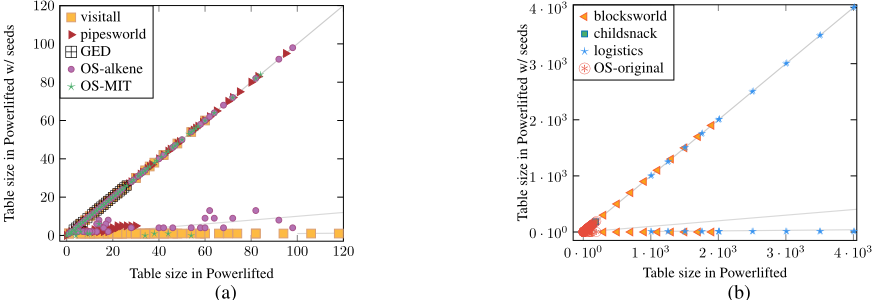
In our preliminary experiment, we modify the procedure of Powerlifted planner [Corrˆea et al., 2020] by pre-processing the tables, hence modifying the input size. Before querying, we join the precondition tables with the corresponding lifted mutex group table, over non-seed parameters. This allows us to reduce the size of the tables in the query. Figure 4 shows the difference in the size of the tables before the query is performed. The X-axis presents the size of the table in Powerlifted and the Y-axis presents the size of the table in Powerlifted with seeds. So, a point below the diagonal indicates reduced sizes. There are 4914, out of 36097 tables, that undergo size reduction, and often a significant one. In 478 out of 811 problems where the join is performed, at least one table is reduced in size. As known from database literature, reducing the size of the tables can help improve join performance [Ullman, 1989]. Our initial results (in supplementary material), comparing the time taken to perform the join and to generate applicable actions show that our approach has the potential to save computational cost. Note that we do not modify the existing query evaluation process. Optimizing the join query using the cardinality of the relations can potentially further improve the processing time. However, query optimization is out of the scope of the current work. Further research is needed into additional variants of improving the lifted successor generation to make it beneficial in other domains.
5 RelatedWork
Various approaches have been studied in RL to reduce the action space. Stochastic action sets [Boutilier et al., 2018] and invalid action masking [Huang and Onta˜n´on, 2022; Bamford and Ovalle, 2021; Kanervisto et al., 2020] restricts the action selected by an agent to a small subset of actions that are feasible in the given state. This is done by assigning zero probability (or -∞ score) to invalid actions. While the stochastic action sets and invalid action masking define a state-dependent subset of feasible actions, our action reduction is independent of the current state.
Another approach to manage a large number of actions in an MDP is by using factored action spaces [Pazis and Lagoudakis, 2011; Geißer et al., 2020; Guestrin et al., 2002]. With factored action space, an action is decomposed into multiple components and represented as either a decision tree or a vector. It is straightforward to convert predicate action space (for example, gripper actions {drop(b1, r2, g1), pick(b2, r1, g2), . . .}) to a factored action space (a0, a1, . . . , an) with a0 denoting the action identifier (for example, drop or pick) and a1, . . . , an, denoting the parameters. Our approach of identifying the parameter seed set can be used to reduce the number of factors in the factored action spaces.
In planning literature, label reduction techniques are used to reduce the number of transition labels in an abstract transition graph [Helmert et al., 2014; Sievers et al., 2014], with the aim to simplify the transition system by creating an equivalence between labeled transitions. Here, the purpose is different: labels of actions that are never applicable together are reduced to the same label while allowing to differentiate between applicable actions in a given state.
6 Discussion and FutureWork
In this work, we have introduced definitions of a valid label reduction and applicable action mutex groups and have shown the connection between the two. We have presented a method for automatically deriving action label reductions for planning tasks based on action parameter reduction. For that, a parameter seed set problem was introduced, and a solution to the problem was suggested by translating it to delete-free planning. Our experimental evaluation shows a significant reduction in action labels when using our approach, across all tested planning domains. This reduction translates both into improved sample efficiency of standard RL agents and into reduced computation time of identifying applicable ground actions in lifted planning, the two example use cases.
Our method, however, does not guarantee the optimality of the valid reduction size, even for the restricted case considered in this work. Finding provably minimal size reductions is an interesting topic for future research. Further, we barely touched on the possible benefits of action parameter reduction for classical planning. We have not explored other methods of speeding up successor computation. Finally, exploring the possible benefits of the action parameter reduction for lifted heuristic computation [Corrˆea et al., 2021; Lauer et al., 2021] is of great promise for lifted planning.
@inproceedings{ijcai2023p599,
  title     = {Action Space Reduction for Planning Domains},
  author    = {Kokel, Harsha and Lee, Junkyu and Katz, Michael and Srinivas, Kavitha and Sohrabi, Shirin},
  booktitle = {Proceedings of the Thirty-Second International Joint Conference on
               Artificial Intelligence, {IJCAI-23}},
  publisher = {International Joint Conferences on Artificial Intelligence Organization},
  editor    = {Edith Elkind},
  pages     = {5394--5401},
  year      = {2023},
  month     = {8},
  note      = {Main Track},
  doi       = {10.24963/ijcai.2023/599},
  url       = {https://doi.org/10.24963/ijcai.2023/599},
}
TY - CPAPER TI - Action Space Reduction for Planning Domains AU - Kokel, Harsha AU - Lee, Junkyu AU - Katz, Michael AU - Srinivas, Kavitha AU - Sohrabi, Shirin T2 - Proceedings of the Thirty-Second International Joint Conference on Artificial Intelligence, IJCAI-23 PB - International Joint Conferences on Artificial Intelligence Organization PY - 2023 SP - 5394 EP - 5401 DO - 10.24963/ijcai.2023/599 UR - https://doi.org/10.24963/ijcai.2023/599 ER -Copied
Machine-readable versions of this paper, for tools and AI agents:





