
RaSa: Relation and Sensitivity Aware Representation Learning for Text-based Person Search
Proceedings of the Thirty-Second International Joint Conference on Artificial Intelligence. Main Track. Pages 555-563.
https://doi.org/10.24963/ijcai.2023/62
Keywords
- Computer Vision: CV: Vision and language
- Computer Vision: CV: Image and video retrieval
- Machine Learning: ML: Multi-modal learning
Abstract
Text-based person search aims to retrieve the specified person images given a textual description. The key to tackling such a challenging task is to learn powerful multi-modal representations. Towards this, we propose a Relation and Sensitivity aware representation learning method (RaSa), including two novel tasks: Relation-Aware learning (RA) and Sensitivity-Aware learning (SA). For one thing, existing methods cluster representations of all positive pairs without distinction and overlook the noise problem caused by the weak positive pairs where the text and the paired image have noise correspondences, thus leading to overfitting learning. RA offsets the overfitting risk by introducing a novel positive relation detection task (i.e., learning to distinguish strong and weak positive pairs). For another thing, learning invariant representation under data augmentation (i.e., being insensitive to some transformations) is a general practice for improving representation's robustness in existing methods. Beyond that, we encourage the representation to perceive the sensitive transformation by SA (i.e., learning to detect the replaced words), thus promoting the representation's robustness. Experiments demonstrate that RaSa outperforms existing state-of-the-art methods by 6.94%, 4.45% and 15.35% in terms of Rank@1 on CUHK-PEDES, ICFG-PEDES and RSTPReid datasets, respectively. Code is available at: https://github.com/Flame-Chasers/RaSa.
- [Cao et al., 2022] Min Cao, Shiping Li, Juntao Li, Liqiang Nie, and Min Zhang. Image-text retrieval: A survey on recent research and development. In Lud De Raedt, editor, Proceedings of the Thirty-First International Joint Con- ference on Artificial Intelligence, IJCAI-22, pages 5410- 5417. International Joint Conferences on Artificial Intelli- gence Organization, 7 2022. Survey Track. IJCAI
- [Chen and He, 2021] Xinlei Chen and Kaiming He. Explor- ing simple siamese representation learning. In Proceed- ings of the IEEE/CVF Conference on Computer Vision and Pattern Recognition, pages 15750-15758, 2021.
- [Chen et al., 2022] Yuhao Chen, Guoqing Zhang, Yujiang Lu, Zhenxing Wang, and Yuhui Zheng. Tipcb: A sim- ple but effective part-based convolutional baseline for text-based person search. Neurocomputing, 494:171-181, 2022.
- [Chuang et al., 2022] Yung-Sung Chuang, Rumen Dan- govski, Hongyin Luo, Yang Zhang, Shiyu Chang, Marin Soljačić, Shang-Wen Li, Scott Yih, Yoon Kim, and James Glass. Diffcse: Difference-based contrastive learning for sentence embeddings. In Proceedings of the 2022 Confer- ence of the North American Chapter of the Association for Computational Linguistics: Human Language Technolo- gies, pages 4207-4218, 2022.
- [Dangovski et al., 2022] Rumen Dangovski, Li Jing, Char- lotte Loh, Seungwook Han, Akash Srivastava, Brian Che- ung, Pulkit Agrawal, and Marin Soljacic. Equivariant self- supervised learning: Encouraging equivariance in repre- sentations. In International Conference on Learning Rep- resentations, 2022.
- [Devlin et al., 2018] Jacob Devlin, Ming-Wei Chang, Ken- ton Lee, and Kristina Toutanova. Bert: Pre-training of deep bidirectional transformers for language understand- ing. arXiv preprint arXiv:1810.04805, 2018.
- [Ding et al., 2021] Zefeng Ding, Changxing Ding, Zhiyin Shao, and Dacheng Tao. Semantically self-aligned net- work for text-to-image part-aware person re-identification. arXiv preprint arXiv:2107.12666, 2021.
- [Dosovitskiy et al., 2020] Alexey Dosovitskiy, Lucas Beyer, Alexander Kolesnikov, Dirk Weissenborn, Xiaohua Zhai, Thomas Unterthiner, Mostafa Dehghani, Matthias Min- derer, Georg Heigold, Sylvain Gelly, et al. An image is worth 16x16 words: Transformers for image recognition at scale. arXiv preprint arXiv:2010.11929, 2020.
- [Gao et al., 2021] Chenyang Gao, Guanyu Cai, Xinyang Jiang, Feng Zheng, Jun Zhang, Yifei Gong, Pai Peng, Xi- aowei Guo, and Xing Sun. Contextual non-local alignment over full-scale representation for text-based person search. arXiv preprint arXiv:2101.03036, 2021.
- [Grill et al., 2020] Jean-Bastien Grill, Florian Strub, Flo- rent Altché, Corentin Tallec, Pierre Richemond, Elena Buchatskaya, Carl Doersch, Bernardo Avila Pires, Zhao- han Guo, Mohammad Gheshlaghi Azar, et al. Bootstrap your own latent-a new approach to self-supervised learn- ing. Advances in neural information processing systems, 33:21271-21284, 2020.
- [Han et al., 2021] Xiao Han, Sen He, Li Zhang, and Tao Xi- ang. Text-based person search with limited data. In 32nd British Machine Vision Conference 2021, BMVC 2021, Online, November 22-25, 2021, page 337, 2021.
- [He et al., 2016] Kaiming He, Xiangyu Zhang, Shaoqing Ren, and Jian Sun. Deep residual learning for image recog- nition. In Proceedings of the IEEE conference on computer vision and pattern recognition, pages 770-778, 2016.
- [He et al., 2020] Kaiming He, Haoqi Fan, Yuxin Wu, Sain- ing Xie, and Ross Girshick. Momentum contrast for unsu- pervised visual representation learning. In Proceedings of the IEEE/CVF conference on computer vision and pattern recognition, pages 9729-9738, 2020.
- [Hochreiter and Schmidhuber, 1997] Sepp Hochreiter and Jürgen Schmidhuber. Long short-term memory. Neural computation, 9(8):1735-1780, 1997.
- [Ji et al., 2021] Deyi Ji, Haoran Wang, Hanzhe Hu, Weihao Gan, Wei Wu, and Junjie Yan. Context-aware graph con- volution network for target re-identification. In Proceed- ings of the AAAI Conference on Artificial Intelligence, vol- ume 35, pages 1646-1654, 2021.
- [Ji et al., 2022] Zhong Ji, Junhua Hu, Deyin Liu, Lin Yuanbo Wu, and Ye Zhao. Asymmetric cross-scale alignment for text-based person search. IEEE Transactions on Multime- dia, pages 1-11, 2022.
- [Li et al., 2017] Shuang Li, Tong Xiao, Hongsheng Li, Bolei Zhou, Dayu Yue, and Xiaogang Wang. Person search with natural language description. In Proceedings of the IEEE Conference on Computer Vision and Pattern Recognition, pages 1970-1979, 2017.
- [Li et al., 2021] Junnan Li, Ramprasaath Selvaraju, Akhilesh Gotmare, Shafiq Joty, Caiming Xiong, and Steven Chu Hong Hoi. Align before fuse: Vision and language representation learning with momentum distil- lation. In M. Ranzato, A. Beygelzimer, Y. Dauphin, P.S. Liang, and J. Wortman Vaughan, editors, Advances in Neural Information Processing Systems, volume 34, pages 9694-9705.
- Curran Associates, Inc., 2021.
- [Li et al., 2022] Shiping Li, Min Cao, and Min Zhang. Learning semantic-aligned feature representation for text- based person search. In ICASSP 2022-2022 IEEE Inter- national Conference on Acoustics, Speech and Signal Pro- cessing (ICASSP), pages 2724-2728. IEEE, 2022.
- [Lin et al., 2014] Tsung-Yi Lin, Michael Maire, Serge Be- longie, James Hays, Pietro Perona, Deva Ramanan, Piotr Dollár, and C Lawrence Zitnick. Microsoft coco: Com- mon objects in context. In European conference on com- puter vision, pages 740-755. Springer, 2014.
- [Niu et al., 2020] Kai Niu, Yan Huang, Wanli Ouyang, and Liang Wang. Improving description-based person re- identification by multi-granularity image-text alignments. IEEE Transactions on Image Processing, 29:5542-5556, 2020.
- [Niu et al., 2022] Kai Niu, Linjiang Huang, Yan Huang, Peng Wang, Liang Wang, and Yanning Zhang. Cross- modal co-occurrence attributes alignments for person search by language. In Proceedings of the 30th ACM In- ternational Conference on Multimedia, pages 4426-4434, 2022.
- [Plummer et al., 2015] Bryan A Plummer, Liwei Wang, Chris M Cervantes, Juan C Caicedo, Julia Hockenmaier, and Svetlana Lazebnik. Flickr30k entities: Collect- ing region-to-phrase correspondences for richer image-to- sentence models. In Proceedings of the IEEE international conference on computer vision, pages 2641-2649, 2015.
- [Radford et al., 2021] Alec Radford, Jong Wook Kim, Chris Hallacy, Aditya Ramesh, Gabriel Goh, Sandhini Agar- wal, Girish Sastry, Amanda Askell, Pamela Mishkin, Jack Clark, et al. Learning transferable visual models from nat- ural language supervision. In International Conference on Machine Learning, pages 8748-8763. PMLR, 2021.
- [Reed et al., 2016] Scott Reed, Zeynep Akata, Honglak Lee, and Bernt Schiele. Learning deep representations of fine- grained visual descriptions. In Proceedings of the IEEE conference on computer vision and pattern recognition, pages 49-58, 2016.
- [Sanh et al., 2019] Victor Sanh, Lysandre Debut, Julien Chaumond, and Thomas Wolf. Distilbert, a distilled ver- sion of bert: smaller, faster, cheaper and lighter. arXiv preprint arXiv:1910.01108, 2019.
- [Shao et al., 2022] Zhiyin Shao, Xinyu Zhang, Meng Fang, Zhifeng Lin, Jian Wang, and Changxing Ding. Learning granularity-unified representations for text-to-image per- son re-identification. In Proceedings of the 30th ACM In- ternational Conference on Multimedia, pages 5566-5574, 2022.
- [Shu et al., 2022] Xiujun Shu, Wei Wen, Haoqian Wu, Keyu Chen, Yiran Song, Ruizhi Qiao, Bo Ren, and Xiao Wang. See finer, see more: Implicit modality alignment for text- based person retrieval. arXiv preprint arXiv:2208.08608, 2022.
- [Suo et al., 2022] Wei Suo, Mengyang Sun, Kai Niu, Yiqi Gao, Peng Wang, Yanning Zhang, and Qi Wu. A simple and robust correlation filtering method for text-based per- son search. In European Conference on Computer Vision, pages 726-742. Springer, 2022.
- [Wang et al., 2020] Zhe Wang, Zhiyuan Fang, Jun Wang, and Yezhou Yang. Vitaa: Visual-textual attributes align- ment in person search by natural language. In European Conference on Computer Vision, pages 402-420. Springer, 2020.
- [Wang et al., 2021] Chengji Wang, Zhiming Luo, Yaojin Lin, and Shaozi Li. Text-based person search via multi- granularity embedding learning. In Proceedings of the Thirtieth International Joint Conference on Artificial In- telligence, IJCAI 2021, Virtual Event / Montreal, Canada, 19-27 August 2021, pages 1068-1074, 2021.
- [Wang et al., 2022a] Tao Wang, Hong Liu, Pinhao Song, Tianyu Guo, and Wei Shi. Pose-guided feature disentan- gling for occluded person re-identification based on trans- former. In Proceedings of the AAAI Conference on Artifi- cial Intelligence, volume 36, pages 2540-2549, 2022.
- [Wang et al., 2022b] Zijie Wang, Aichun Zhu, Jingyi Xue, Xili Wan, Chao Liu, Tian Wang, and Yifeng Li. Caibc: Capturing all-round information beyond color for text- based person retrieval. In Proceedings of the 30th ACM In- ternational Conference on Multimedia, pages 5314-5322, 2022.
- [Wu et al., 2021] Yushuang Wu, Zizheng Yan, Xiaoguang Han, Guanbin Li, Changqing Zou, and Shuguang Cui. Lapscore: Language-guided person search via color rea- soning. In Proceedings of the IEEE/CVF International Conference on Computer Vision, pages 1624-1633, 2021.
- [Yan et al., 2022] Shuanglin Yan, Neng Dong, Liyan Zhang, and Jinhui Tang. Clip-driven fine-grained text-image per- son re-identification. arXiv preprint arXiv:2210.10276, 2022.
- [Yang et al., 2022] Jinyu Yang, Jiali Duan, Son Tran, Yi Xu, Sampath Chanda, Liqun Chen, Belinda Zeng, Trishul Chilimbi, and Junzhou Huang. Vision-language pre- training with triple contrastive learning. In Proceedings of the IEEE/CVF Conference on Computer Vision and Pat- tern Recognition, pages 15671-15680, 2022.
- [Zeng et al., 2021] Pengpeng Zeng, Shuaiqi Jing, Jingkuan Song, Kaixuan Fan, Xiangpeng Li, Liansuo We, and Yuan Guo. Relation-aware aggregation network with auxiliary guidance for text-based person search. World Wide Web, pages 1-18, 2021.
- [Zhang and Lu, 2018] Ying Zhang and Huchuan Lu. Deep cross-modal projection learning for image-text matching. In Proceedings of the European conference on computer vision (ECCV), pages 686-701, 2018.
- [Zheng et al., 2020a] Kecheng Zheng, Wu Liu, Jiawei Liu, Zheng-Jun Zha, and Tao Mei. Hierarchical gumbel atten- tion network for text-based person search. In Proceedings of the 28th ACM International Conference on Multimedia, pages 3441-3449, 2020.
- [Zheng et al., 2020b] Zhedong Zheng, Liang Zheng, Michael Garrett, Yi Yang, Mingliang Xu, and Yi-Dong Shen. Dual-path convolutional image-text embeddings with instance loss. ACM Transactions on Multimedia Computing, Communications, and Applications (TOMM), 16(2):1-23, 2020.
- [Zhu et al., 2021] Aichun Zhu, Zijie Wang, Yifeng Li, Xili Wan, Jing Jin, Tian Wang, Fangqiang Hu, and Gang Hua. Dssl: Deep surroundings-person separation learning for text-based person retrieval. In Proceedings of the 29th ACM International Conference on Multimedia, pages 209- 217, 2021.
References were extracted automatically from the PDF and may contain errors.
Full text extracted automatically from the PDF; figures, tables and equations may differ. The PDF is the version of record.
1 Introduction
Text-based person search [Li et al., 2017; Wang et al., 2021] aims at retrieving the person images in a large-scale person image pool given a query of textual description about that person. This task is related to person re-identification [Ji et al., 2021; Wang et al., 2022a] and text-image retrieval [Cao et al., 2022; Li et al., 2021], which have been very active research topics in recent years. It, however, exhibits unique characteristics and challenges. Compared to person re-identification with image queries, text-based person search with more accessible open-form text queries provides a more user-friendly searching procedure while embracing greater challenges due to the cross-modal search. In addition, compared to general image-text retrieval, text-based person search focuses on cross-modal retrieval specific for the person with more finegrained details, tending to larger intra-class variance as well as smaller inter-class variance, which toughly bottlenecks the retrieval performance.
∗Corresponding author
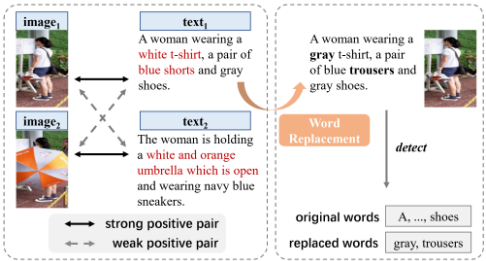
Targeting learning powerful feature representation and achieving cross-modal alignment for text-based person search, researchers have developed a batch of technologies over the past few years [Wu et al., 2021; Shao et al., 2022]. It has been proved that the model armed with reasonable tasks tends to learn better representation. In this paper, we propose a representation learning method, namely RaSa, with two novel tasks: relation-aware learning and sensitivity-aware learning for text-based person search.
Relation-aware Learning. In existingmethods [Han et al., 2021; Li et al., 2022], the de facto optimization objective is to bring image and text representations of the same identity (i.e., positive pairs) together and repel representations of different identities (i.e., negative pairs) away. However, it tends to encounter the following issue. Normally, a textual description is generated by annotating a particular single image in the text-based person search dataset. The text strongly matches the annotated image without a doubt, whereas it is not always well-aligned to other positive images of the same person at the semantic level due to intra-class variation in the image. As shown in Figure 1 (a), the images and texts depict the same person, leading to a positive relation for each imagetext pair. However, there exist two different types of positive relations. text1 (resp. text2) is the exact description of image1 (resp. image2), where they are completely matched and form a strong positive pair. Nevertheless, image1 and text2 (resp. image2 and text1) constitute a weak positive pair with the noise interference. For instance, "white t-shirt" and "blue shorts" in text1 correspond to non-existent objects in image2 due to the occlusion. Existing methods endow the strong and weak positive pairs with equal weight in learning representations, regardless of the noise problem from the weak pairs, eventually leading to overfitting learning.
In order to mitigate the impacts of the noise interference from weak positive pairs, we propose a Relation-Aware learning (RA) task, which is composed of a probabilistic ImageText Matching (p-ITM) task and a Positive Relation Detection (PRD) task. p-ITM is a variant of the commonly-used ITM, aiming to distinguish negative and positive pairs with a probabilistic strong or weak positive inputting, while PRD is designed to explicitly makes a distinction between the strong and weak positive pairs. Therein, p-ITM emphasizes the consistency between strong and weak positive pairs, whereas PRD highlights their difference and can be regarded as the regularization of p-ITM. The model armed with RA can not only learn valuable information from weak positive pairs by p-ITM but also alleviate noise interference from them by PRD, eventually reaching a trade-off.
Sensitivity-aware Learning. Learning invariant representations under a set of manually chosen transformations (also called insensitive transformations in this context) is a general practice for improving the robustness of representation in the existing methods [Chen and He, 2021]. We recognize it but there is more. Inspired by the recent success of equivariant contrastive learning [Dangovski et al., 2022], we explore the sensitive transformation that would hurt performance when applied to learn transformation-invariant representations. Rather than keeping invariance under insensitive transformation, we encourage the learned representations to have the ability to be aware of the sensitive transformation.
Towards this end, we propose a Sensitivity-Aware learning (SA) task. We adopt the word replacement as the sensitive transformation and develop a Momentum-based Replaced Token Detection (m-RTD) pretext task to detect whether a token comes from the original textual description or the replacement, as shown in Figure 1 (b). The closer the replaced word is to the original one (i.e., more confusing word), the more difficult this detection task is. When the model is trained to well solve such a detection task, it is expected to have the ability to learn better representation. With these in mind, we use Masked Language Modeling (MLM) to perform the word replacement, which utilizes the image and the text contextual tokens to predict the masked tokens. Furthermore, considering that the momentum model, a slow-moving average of the online model, can learn more stable representations than the current online model [Grill et al., 2020] to generate more confusing words, we employ MLM from the momentum model to carry out the word replacement. Overall, MLM and m-RTD together form a Sensitivity-Aware learning (SA), which offers powerful surrogate supervision for representation learning.
Our contributions can be summarized as follows:
- We differentiate between strong and weak positive image-text pairs in learning representation and propose a relation-aware learning task.
- We pioneer the idea of learning representation under the sensitive transformation to the text-based person search and develop a sensitivity-aware learning task.
- Extensive experiments demonstrate RaSa outperforms existing state-of-the-art methods by 6.94%, 4.45% and 15.35% in terms of Rank@1 metric on CUHK-PEDES, ICFG-PEDES and RSTPReid datasets, respectively.
2 RelatedWork
2.1 Text-based Person Search
Li et al. [2017] first introduce the text-based person search task and publish a challenging dataset CUHK-PEDES. Following this, a series of methods are proposed to solve this task. Part of methods [Zheng et al., 2020a; Wang et al., 2021] focus on designing a reasonable cross-modal alignment strategy, while others [Zhang and Lu, 2018; Shao et al., 2022] concentrate on learning powerful feature representation. For cross-modal alignment, it begins with global alignment [Zheng et al., 2020b] or local correspondences (e.g., patch-word or region-phrase correspondences) [Chen et al., 2022; Niu et al., 2020], and evolves into self-adaptively learning semantic alignment across different granularity [Li et al., 2022; Gao et al., 2021]. Beyond that, some works [Wang et al., 2020; Zhu et al., 2021] utilize external technologies (e.g., human segmentation, pose estimation or attributes prediction) to assist with the cross-modal alignment. For representation learning, Wu et al. [2021] propose two color-related tasks based on the observation that color plays a key role in textbased person search. Zeng et al. [2021] develop three auxiliary reasoning tasks with gender classification, appearance similarity and image-to-text generation. Ding et al. [2021] firstly notice the noise interference from weak positive pairs and propose to keep the difference between strong and weak positive pairs by manually assigning different margins in the triplet loss. More recently, some works [Han et al., 2021; Shu et al., 2022; Yan et al., 2022] resort to vision-language pretraining models to learn better representations. In this paper, we design two novel tasks: RA and SA. RA detects the type of the positive pair to weaken noise from weak positive pairs, differently from the method [Ding et al., 2021] with the sophisticated trick. SA focuses on representation learning by detecting sensitive transformation, which is under-explored in the previous methods.
2.2 Equivariant Contrastive Learning
Different from contrastive learning [He et al., 2020] that aims to learn transformation-insensitive representations, equivariant contrastive learning [Dangovski et al., 2022] is recently proposed by additionally encouraging the learned representations to have the ability to be aware of sensitive transformations. Mathematically, the notions of insensitivity and sensitivity can be inductively summarized as: f(T(x)) = T ′ (f(x)) where T denotes a group of transformations of an input instance x, and f is an encoder to compute the representation of x. When T ′ is the identity transformation, it can be said that f is trained to be insensitive to T; otherwise, f is sensitive to T. Equivariant contrastive learning has shown its successful application in the fields of computer vision (CV) [Dangovski et al., 2022] and natural language processing (NLP) [Chuang et al., 2022], which inspires us to explore sensitive transformations for learning high-quality representations in the cross-modal retrieval task. In this paper, we develop a sensitivity-aware learning with MLM-based word replacement as the sensitive transformation to encourage the model to perceive the replaced words, thus obtaining more informative and discriminative representations.
3 Method
In this section, we take ALBEF [Li et al., 2021] as the backbone 1 and elaborate on the proposed method RaSa by introducing the modal architecture in Section 3.1 and the optimization objectives involving the proposed RA and SA tasks in Section 3.2.
1 More experiments on other backbones are shown in Appendix.
3.1 Model Architecture
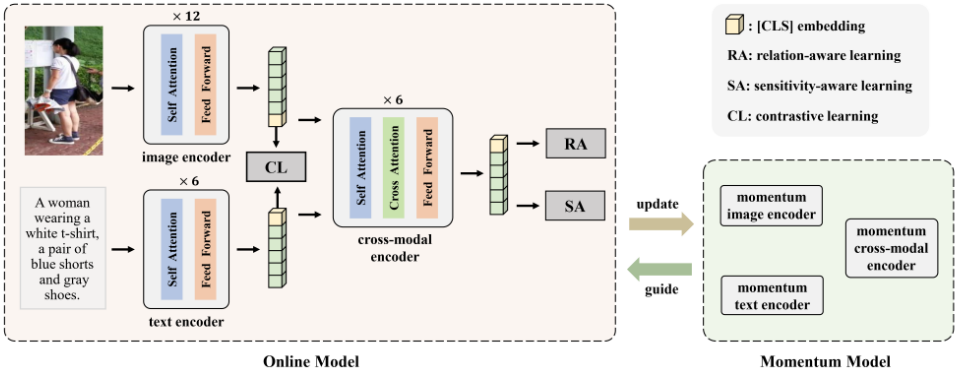
As illustrated in Figure 2, the proposed RaSa consists of two unimodal encoders and a cross-modal encoder. We adopt 12layer and 6-layer transformer blocks for the image and text encoders, respectively. The cross-modal encoder comprises 6-layer transformer blocks, where a cross-attention module is added after the self-attention module in each block. Considering that the textual description usually covers a part of the information in the corresponding image, we employ a textguided asymmetric cross-attention module in the cross-modal encoder, i.e., using the textual representation as query and the visual one as key and value. Simultaneously, we maintain a momentum version of the online model via Exponential Moving Average (EMA). Specifically, EMA is formulated as ˆ θ = mˆ θ + (1 -m)θ, where ˆ θ and θ are the parameters of the momentum and online models, respectively, and m ∈ [0, 1] is a momentum coefficient. The momentum model presents a delayed and more stable version of the online model and is used to guide the online model to learn better representations.
Given an image-text pair (I, T), we first feed the image I into the image encoder to obtain a sequence of visual representations {vcls, v1, · · · , vM} with vcls being the global visual representation and vi (i = 1, · · · ,M) being the patch representation. Similarly, we obtain a sequence of textual representations {tcls, t1, · · · , tN} by feeding the text T into the text encoder, where tcls is the global textual representation and ti (i = 1, · · · ,N) is the token representation. The visual and textual representations are then fed to the cross-modal encoder to obtain a sequence of multi-modal representations {fcls, f1, · · · , fN}, where fcls denotes the joint representation of I and T , and fi (i = 1, · · · , N) can be regarded as the joint representation of the image I and the i-th token in the text T . Simultaneously, the momentummodel is employed to obtain a sequence of momentum representations.
3.2 Optimization Objectives
Relation-aware Learning
The vanilla widely-used ITM predicts whether an inputted image-text pair is positive or negative, defined as:
where H represents a cross-entropy function, yitm is a 2dimension one-hot vector representing the ground-truth label (i.e., [0, 1]⊤ for the positive pair, and [1, 0]⊤ for the negative pair), and ϕitm(I, T ) is the predicted matching probability of the pair that is computed by feeding fcls into a binary classifier, a fully-connected layer followed by a softmax function.
However, it is unreasonable to directly adopt the vanilla ITM in text-based person search. On the one hand, there exists noise interference from weak positive pairs, which would hamper the representation learning. On the other hand, the weak positive pairs contain certain valuable alignment information that can facilitate representation learning. As a result, to reach a balance, we retain a proportion of weak positive pairs in ITM by introducing the probabilistic inputting. Specifically, we input the weak positive pair with a small probability of pw and the strong positive pair with a probability of 1 - pw . To distinguish with the vanilla ITM, we denote the proposed probabilistic ITM as p-ITM.
Furthermore, we continue to alleviate the noise effect of the weak pairs. We propose a Positive Relation Detection (PRD) pretext task to detect the type of the positive pair (i.e., strong or weak), which is formulated as:
where (I, T p ) denotes a positive pair, yprd is the ground truth label (i.e., [1, 0]⊤ for the strong positive pair and [0, 1]⊤ for the weak pair), and ϕprd (I, T p ) is the predicted probability of the pair which is computed by appending a binary classifier to the joint representation fcls of the pair.
Taken together, we define the Relation-Aware learning (RA) task as:
where the weight λ1 is a hyper-parameter.
During the process of the optimization, p-ITM focuses on the consistency between strong and weak positive pairs, while PRD highlights their difference. In essence, PRD plays a role of a regularized compensation for p-ITM. As a whole, RA achieves a trade-off between the benefits of the weak pair and the risk of its side effects.
Sensitivity-aware Learning
Learning invariant representations under the insensitive transformation of data is a common way to enhance the robustness of the learned representations. We go beyond it and propose to learn representations that are aware of the sensitive transformation. Specifically, we adopt the MLM-based word replacement as the sensitive transformation and propose a Momentum-based Replaced Token Detection (m-RTD) pretext task to detect (i.e., being aware of) the replacement.
Given a strong positive pair (I, T s ), MLM loss is formu-
where T msk is a masked text in which each token in the input text T s is randomly masked with a probability of pm, ymlm is a one-hot vector denoting the ground truth of the masked token and ϕmlm(I, T msk ) is the predicted probability for the masked token based on the information of the contextual text T msk and the paired image I.
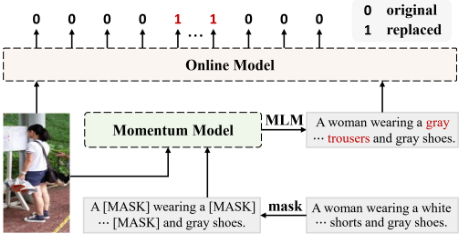
We use the result of MLM from the momentum model as the word replacement, denoted as T rep . The momentum model is a slow-moving of the online model and can learn more stable representations. Therefore, the momentum model is expected to generate more confusing tokens. As m-RTD detects such challenging tokens well, the model is motivated to learn more informative representations to distinguish the tiny differences. Remarkably, besides serving as a generator for the word replacement, MLM also plays a role of token-level optimization, promoting fine-grained representation learning.
Next, m-RTD performs a detection of the MLM-based token replacement. Specifically, the pair (I, T rep ) is inputted to the model to obtain a sequence of multi-modal representations {fcls, f1, ..., fN}, and a binary classifier works on {f1, ..., fN} to predict whether the i-th token is replaced or not. m-RTD minimizes a cross-entropy loss:
where ym-rtd is a one-hot vector denoting the ground truth of the replaced token and ϕm-rtd (I, T rep ) is the predicted replacement probability. We illustrate the pipeline of m-RTD in Figure 3 for clarity.
Overall, Sensitivity-Aware learning (SA) loss is defined as:
where the weight λ2 is a hyper-parameter.
In conclusion, RA works on the global representation fcls and mainly focuses on the correlation between the image and text, which can be regarded as a coarse-grained optimization. As a complement, SA acts on the token representations {f1, ..., fN} and pays more attention to the interaction between the image and textual tokens, exhibiting a fine-grained optimization. The two complementary tasks effectively facilitate representation learning.
Contrastive Learning
The proposed RA and SA are directly applied on the multimodal representations from the cross-modal encoder. Furthermore, we introduce an intermediate Contrastive Learning task (CL) on the representations from the unimodal encoders, so as to make the subsequent cross-modal fusion easier to performmulti-modal representation learning.
Given an image-text pair (I, T), we feed it into the unimodal encoders and obtain the global visual and textual representations vcls and tcls. Then a linear layer is applied to project them to lower-dimensional representations v′cls and t′cls . Meanwhile, we obtain the output of momentum unimodal encoders, denoted as ˆ v′cls and ˆ t′cls . We maintain an image queue ˆQv and a text queue ˆQt to store the recent R projected representations ˆ v′cls and ˆ t′cls , similarly to MoCo [He et al., 2020]. The introduction of the queues implicitly enlarges the batch size, and a larger batch will provide more negative samples, thereby facilitating representation learning.
In CL, the general form of InfoNCE loss is formulated as:
where τ is a learnable temperature parameter, Q denotes a maintained queue, and s(x, x+) = xTx+/∥x∥∥x+∥ measures the cosine similarity between x and x+.
Beyond the widely-used cross-modal image-text contrastive learning (ITC) [Li et al., 2021; Radford et al., 2021], denoted as:
we additionally explore the intra-modal contrastive learning (IMC). The representations of the same person are supposed to stay closer than those of different persons within each modality. IMC loss is formulated as:
Taken together, we define the overall loss for CL as:
Joint Learning
Overall, we formulate the joint optimization objective as:
where λ3 is a hyper-parameter.
During inference, given a query text and a large-scale image pool, we use the predicted matching probability from pITM to rank all images. Considering the inefficiency of the cross-modal encoder with quadratic interaction operation, we refer to ALBEF [Li et al., 2021] and exclude a large number of irrelevant image candidates prior to the cross-modal encoder, thereby speeding up the inference. Specifically, we first calculate each pair's similarity s(tcls, vcls) via the unimodal encoders, and then select the first 128 images with the highest similarities to send them to the cross-modal encoder and compute the p-ITMmatching probabilities for ranking.
| Method | R@1 | R@5 | R@10 | mAP |
|---|---|---|---|---|
| GNA-RNN [Li et al., 2017] | 19.05 | - | 53.64 | - |
| Dual Path [Zheng et al., 2020b] | 44.40 | 66.26 | 75.07 | - |
| CMPM/C [Zhang and Lu, 2018] | 49.37 | 71.69 | 79.27 | - |
| ViTAA [Wang et al., 2020] | 55.97 | 75.84 | 83.52 | - |
| VLP DSSL [Zhu et al., 2021] | 59.98 | 80.41 | 87.56 | - |
| MGEL [Wang et al., 2021] | 60.27 | 80.01 | 86.74 | - |
| w/o ACSA [Ji et al., 2022] | 63.56 | 81.40 | 87.70 | - |
| SAF [Li et al., 2022] | 64.13 | 82.62 | 88.40 | 58.61 |
| TIPCB [Chen et al., 2022] | 64.26 | 83.19 | 89.10 | - |
| CAIBC [Wang et al., 2022b] | 64.43 | 82.87 | 88.37 | - |
| C2A2 [Niu et al., 2022] | 64.82 | 83.54 | 89.77 | - |
| LGUR [Shao et al., 2022] | 65.25 | 83.12 | 89.00 | - |
| PSLD [Han et al., 2021] | 64.08 | 81.73 | 88.19 | 60.08 |
| VLP IVT [Shu et al., 2022] | 65.59 | 83.11 | 89.21 | - |
| CFine [Yan et al., 2022] | 69.57 | 85.93 | 91.15 | - |
| w/ ALBEF(backbone) [Li et al., 2021] | 60.28 | 79.52 | 86.34 | 56.67 |
| RaSa (Ours) | 76.51 | 90.29 | 94.25 | 69.38 |
4 Experiments
We conduct experiments on three text-based person search datasets: CUHK-PEDES [Li et al., 2017], ICFGPEDES [Ding et al., 2021] and RSTPReid [Zhu et al., 2021]. The introduction of each dataset and the implementation details of the proposed method are shown in Appendix.
4.1 Evaluation Protocol
We adopt the widely-used Rank@K (R@K for short, K=1, 5, 10) metric to evaluate the performance of the proposed method. Specifically, given a query text, we rank all the test images via the similarity with the text and the search is deemed to be successful if top-K images contain any corresponding identity. R@K is the percentage of successful searches. We also adopt the mean average precision (mAP) as a complementary metric.
4.2 Backbones
Most text-based person search methods [Li et al., 2022; Shao et al., 2022] rely on two feature extractors pre-trained on unaligned images and texts separately, such as ResNet [He et al., 2016] or ViT [Dosovitskiy et al., 2020] for the visual extractor, Bi-LSTM [Hochreiter and Schmidhuber, 1997] or BERT [Devlin et al., 2018] for the textual extractor. Recently, some works [Shu et al., 2022; Yan et al., 2022] have applied vision-language pretraining (VLP) to text-based person search and obtained impressive results. Following this, we adopt VLP models as the backbone.
The proposed RaSa can be plugged into various backbones. To adequately verify the effectiveness, we conduct RaSa on three VLP models: ALBEFF [Li et al., 2021], TCL [Yang et al., 2022] and CLIP [Radford et al., 2021]. We use ALBEF as the backbone by default in the following experiments, which is pre-trained on 14M image-text pairs and adopts ITC and ITM tasks for image-text retrieval. The details and experiments on TCL and CLIP are shown in Appendix.
| Method | R@1 | R@5 | R@10 | mAP |
|---|---|---|---|---|
| Dual Path [Zheng et al., 2020b] | 38.99 | 59.44 | 68.41 | - |
| CMPM/C [Zhang and Lu, 2018] | 43.51 | 65.44 | 74.26 | - |
| ViTAA [Wang et al., 2020] | 50.98 | 68.79 | 75.78 | - |
| VLP SSAN [Ding et al., 2021] | 54.23 | 72.63 | 79.53 | - |
| w/o SAF [Li et al., 2022] | 54.86 | 72.13 | 79.13 | 32.76 |
| TIPCB [Chen et al., 2022] | 54.96 | 74.72 | 81.89 | - |
| SRCF [Suo et al., 2022] | 57.18 | 75.01 | 81.49 | - |
| LGUR [Shao et al., 2022] | 59.02 | 75.32 | 81.56 | - |
| IVT [Shu et al., 2022] | 56.04 | 73.60 | 80.22 | - |
| VLP CFine [Yan et al., 2022] | 60.83 | 76.55 | 82.42 | - |
| w/ ALBEF(backbone) [Li et al., 2021] | 34.46 | 52.32 | 60.40 | 19.62 |
| RaSa (Ours) | 65.28 | 80.40 | 85.12 | 41.29 |
| Method | R@1 | R@5 | R@10 | mAP |
|---|---|---|---|---|
| DSSL [Zhu et al., 2021] | 32.43 | 55.08 | 63.19 | - |
| SSAN [Ding et al., 2021] | 43.50 | 67.80 | 77.15 | - |
| VLP SAF [Li et al., 2022] | 44.05 | 67.30 | 76.25 | 36.81 |
| w/o CAIBC [Wang et al., 2022b] | 47.35 | 69.55 | 79.00 | - |
| ACSA [Ji et al., 2022] | 48.40 | 71.85 | 81.45 | - |
| C2A2 [Niu et al., 2022] | 51.55 | 76.75 | 85.15 | - |
| IVT [Shu et al., 2022] | 46.70 | 70.00 | 78.80 | - |
| VLP CFine [Yan et al., 2022] | 50.55 | 72.50 | 81.60 | - |
| w/ ALBEF(backbone) [Li et al., 2021] | 50.10 | 73.70 | 82.10 | 41.73 |
| RaSa (Ours) | 66.90 | 86.50 | 91.35 | 52.31 |
4.3 Comparison with State-of-the-art Methods
We compare the proposed RaSa with the existing text-based person search methods on CUHK-PEDES, ICFG-PEDES and RSTPReid, as shown in Table 1, 2 and 3, respectively. RaSa achieves the highest performance in terms of all metrics, outperforming existing state-of-the-art methods by a large margin. Specifically, compared with the current best-performing method CFine [Yan et al., 2022], RaSa gains a significant R@1 improvement of 6.94%, 4.45% and 15.35% on the three datasets, respectively. The comparison clearly demonstrates the effectiveness of RaSa in text-based person search.
4.4 Ablation Study
We analyze the effectiveness and contribution of each optimization objective in RaSa by conducting a series of ablation experiments on CUHK-PEDES, as shown in Table 4.
Effectiveness of Optimization Objectives
RaSa consists of three optimization objectives. CL provides an explicit alignment before the cross-modal fusion. RA implements the deep fusion by the cross-modal encoder with an alleviation of noise interference. And SA encourages the learned representations to be sensitive to the MLM-based token replacement.
We can see from Table 4, (1) RaSa with a single CL achieves a modest performance of 61.35% and 59.44% in Table 4: Comparison of RaSa with different settings on CUHKPEDES. ITM learns from all positive pairs without a probabilistic inputting. s-ITM learns from only strong positive pairs and discards all weak positive pairs. p-ITM uses a probabilistic inputting of strong and weak positive pairs. f-RTD adopts DistilBERT [Sanh et al., 2019] as a fixed generator to produce the replaced tokens. oRTD uses the online model as the generator, while m-RTD is based on the momentum model.
| Module | Setting | R@1 | R@5 | R@10 | mAP |
|---|---|---|---|---|---|
| CL | ITC + IMC | 61.35 | 80.44 | 86.91 | 59.44 |
| +RA | ITM | 71.29 | 86.70 | 91.46 | 67.82 |
| s-ITM | 73.52 | 88.71 | 92.98 | 66.74 | |
| p-ITM | 72.58 | 87.98 | 92.51 | 68.29 | |
| ITM + PRD | 73.03 | 87.75 | 92.45 | 68.45 | |
| p-ITM+ PRD | 74.20 | 89.02 | 92.95 | 68.11 | |
| ++SA | MLM | 74.81 | 89.85 | 93.66 | 68.32 |
| MLM+ f-RTD | 75.13 | 89.93 | 93.47 | 69.17 | |
| MLM+ o-RTD | 75.99 | 90.21 | 94.09 | 69.35 | |
| MLM+m-RTD | 76.51 | 90.29 | 94.25 | 69.38 |
terms of R@1 and mAP, respectively. On account of the modality gap between the image and text and the fine-grained intra-class variation, CL contributes a coarse alignment with a lack of deep interaction across modalities, which is not enough to handle such a challenging retrieval task. (2) When adding RA(p-ITM + PRD), the performance has a remarkable improvement of 12.85% at R@1 and 8.67% at mAP, effectively demonstrating that deep cross-modal fusion with RA is extraordinarily significant to text-based person search. And (3) with the aid of SA(MLM + m-RTD), RaSa achieves the best performance of 76.51% at R@1 and 69.38% at mAP. SA utilizes the visual information and the contextual token information of the corresponding text to detect whether a token has been replaced or not. In order to handle such a challenging detection task, the learned representations are encouraged to be powerful enough to distinguish the tiny difference between the original token and the replaced one.
Analysis of RA
RA contains p-ITM and PRD, where the former focuses on the consistency between the strong and weak positive pairs, while the latter highlights their difference, serving as a regularization of p-ITM.
The vanilla ITM learns from all positive pairs without the probabilistic inputting. However, there exists too much noise interference from weak positive pairs. Intuitively, we can discard all weak positives to get rid of the noise. s-ITM only uses the strong positive pairs and gains a boost of 2.23% at R@1 compared to the vanilla ITM. Nevertheless, such a straightforward way ignores the weak supervision from the weak positives which is also beneficial to representation learning. To reach a trade-off between the benefits of the weak supervision and the risk of side effects, p-ITM resorts to the probabilistic inputting and retains a small proportion of the weak positives. Compared with the vanilla ITM and s-ITM, p-ITM achieves an intermediate performance. Not surprisingly at all, the more noise there exists, the more it affects the retrieval performance. In order to alleviate the impact of the noise, we further propose PRD to perform an explicit distinction between the strong and weak positives, which serve as a regularization for p-ITM. Significantly, no matter whether adding PRD to the vanilla ITM or p-ITM, PRD can obtain consistent performance improvement, which powerfully demonstrates its effectiveness.

Analysis of SA
SA includes MLM and m-RTD. MLM not only plays the role of generating the text with word replacement but also performs a token-level optimization. m-RTD detects the replaced tokens by virtue of the visual information and the contextual token information.
Based on CL and RA, adding a single MLM without the replacement detection task brings a slight boost of 0.61% at R@1. Furthermore, we introduce the detection task and use the momentummodel as the generator to produce the replaced tokens. In order to adequately investigate the effectiveness of the generator, we compare three different variants. (1) Following DiffCSE [Chuang et al., 2022], we use DistilBERT [Sanh et al., 2019] as a fixed generator for the word replacement, which is denoted as f -RTD. From Table 4, RaSa with f-RTD gains a modest performance of 75.13% at R@1. We argue that the generated tokens from a fixed generator can be easily detected as the training advances and thus provides a limited effect on learning representation. (2) oRTD adopts the online model as the generator. RaSa with o-RTD achieves a better performance of 75.99% at R@1. Compared with f-RTD, o-RTD resorts to a dynamic generator which is optimized constantly during the whole training process and can produce more confusing tokens with the proceeding of the model's training, effectively increasing the difficulty of replaced tokens detection and facilitating representation learning. And (3) m-RTD adopts the momentum model as the generator and reaches the best performance of 76.51% at R@1. The momentum model is a slow-moving of the online model and can obtain more stable representations. As the training goes ahead, the momentum model iteratively bootstraps MLM to generate more challenging tokens for detection, which encourages the learned representations to be powerful enough to distinguish the tiny difference and substantially improve results.
Hyper-parameters
In Section 3.2, we use the inputting probability pw to retain a small proportion of weak positive pairs to alleviate the noise, the masking ratio pm to randomly mask tokens to perform the replaced token detection, and the loss weights λ1, λ2, λ3 to make a trade-off. We show how these hyper-parameters impact the performance of RaSa in Figure 4. (1) The best result is achieved at pw = 0.1. The inputting probability pw in RA is introduced to seek a balance between the useful information and the noise from weak positives. A larger pw may introduce too much noise, while a smaller pw hinders the model frommaking full use of the useful information. (2) RaSa performs best at pm = 0.3. A larger pm brings more perturbations to the text, making the detection task too difficult to be carried out. In contrast, when pm goes smaller, SA will contribute less to representation learning. And (3) for the loss weights λ1, λ2 and λ3, they present an overall trend of first increasing and then decreasing. Empirical results show that RaSa performs best when they are set as 0.5.
4.5 Extended Experiments and Visualization
To go a step further and validate the effectiveness of RaSa, we perform extended experiments on two coarse-grained imagetext retrieval datasets (Flickr30K [Plummer et al., 2015] and COCO [Lin et al., 2014]), as well as two fine-grained datasets (CUB [Reed et al., 2016] and Flowers [Reed et al., 2016]). The experimental results are shown in Appendix. Besides, we conduct a series of domain generalization experiments following LGUR [Shao et al., 2022] in Appendix to verify the generalization ability of RaSa. These results clearly demonstrate the effectiveness and the generalization ability of RaSa.
For a qualitative analysis, we also present the retrieval visualization in Appendix, vividly showing the excellent retrieval ability of RaSa.
5 Conclusion
In this paper, we propose a Relation and Sensitivity aware representation learning method (RaSa) for text-based person search, which contains two novel tasks, RA and SA, to learn powerful multi-modal representations. Given that the noise from the weak positive pairs tends to result in overfitting learning, the proposed RA utilizes an explicit detection between strong and weak positive pairs to highlight the difference, serving as a regularization of p-ITM that focuses on their consistency. Beyond learning transformationinsensitive representations, SA encourages the sensitivity to MLM-based token replacement. Extensive experiments on multiple benchmarks demonstrate the effectiveness of RaSa.
Acknowledgments
This work is supported by the National Science Foundation of China under Grant NSFC 62002252, and is also partially supported by the National Science Foundation of China under Grant NSFC 62106165.
@inproceedings{ijcai2023p62,
  title     = {RaSa: Relation and Sensitivity Aware Representation Learning for Text-based Person Search},
  author    = {Bai, Yang and Cao, Min and Gao, Daming and Cao, Ziqiang and Chen, Chen and Fan, Zhenfeng and Nie, Liqiang and Zhang, Min},
  booktitle = {Proceedings of the Thirty-Second International Joint Conference on
               Artificial Intelligence, {IJCAI-23}},
  publisher = {International Joint Conferences on Artificial Intelligence Organization},
  editor    = {Edith Elkind},
  pages     = {555--563},
  year      = {2023},
  month     = {8},
  note      = {Main Track},
  doi       = {10.24963/ijcai.2023/62},
  url       = {https://doi.org/10.24963/ijcai.2023/62},
}
TY - CPAPER TI - RaSa: Relation and Sensitivity Aware Representation Learning for Text-based Person Search AU - Bai, Yang AU - Cao, Min AU - Gao, Daming AU - Cao, Ziqiang AU - Chen, Chen AU - Fan, Zhenfeng AU - Nie, Liqiang AU - Zhang, Min T2 - Proceedings of the Thirty-Second International Joint Conference on Artificial Intelligence, IJCAI-23 PB - International Joint Conferences on Artificial Intelligence Organization PY - 2023 SP - 555 EP - 563 DO - 10.24963/ijcai.2023/62 UR - https://doi.org/10.24963/ijcai.2023/62 ER -Copied
Machine-readable versions of this paper, for tools and AI agents:





