
AI-Assisted Tool for Early Diagnosis and Prevention of Colorectal Cancer in Africa
Proceedings of the Thirty-Second International Joint Conference on Artificial Intelligence. AI for Good - Projects. Pages 6362-6369.
https://doi.org/10.24963/ijcai.2023/706
Keywords
- AI for Good - Projects: Computer Vision
Abstract
Colorectal cancer (CRC) is considered the third most common cancer worldwide and is recently increasing in Africa. It is mostly diagnosed at an advanced state causing high fatality rates, which highlights the importance of CRC early diagnosis. There are various methods used to enable early diagnosis of CRC, which are vital to increase survival rates such as colonoscopy. Recently, there are calls to start an early detection program in Egypt using colonoscopy. It can be used for diagnosis and prevention purposes to detect and remove polyps, which are benign growths that have the risk of turning into cancer. However, there tends to be a high miss rate of polyps from physicians, which motivates machine learning guided polyp segmentation methods in colonoscopy videos to aid physicians. To date, there are no large-scale video polyp segmentation dataset that is focused on African countries. It was shown in AI-assisted systems that under-served populations such as patients with African origin can be misdiagnosed. There is also a potential need in other African countries beyond Egypt to provide a cost efficient tool to record colonoscopy videos using smart phones without relying on video recording equipment. Since most of the equipment used in Africa are old and refurbished, and video recording equipment can get defective. Hence, why we propose to curate a colonoscopy video dataset focused on African patients, provide expert annotations for video polyp segmentation and provide an AI-assisted tool to record colonoscopy videos using smart phones. Our project is based on our core belief in developing research by Africans and increasing the computer vision research capacity in Africa.
- [Awedew et al., 2022] Atalel Fentahun Awedew, Zelalem Asefa, and Woldemariam Beka Belay. Burden and trend of colorectal cancer in 54 countries of africa 2010-2019: a systematic examination for global burden of disease. BMC Gastroenterology, 22(1):204, 2022.
- [Brand Bateman et al., 2020] Lori Brand Bateman, So- maia Khamess, Salah-Eldin Abdelmoneim, Waleed Arafat, Mona N Fouad, Yomna Khamis, Abbas Omar, Randa Salah Abdelmoneim, and Isabel Scarinci. Design- ing an effective colorectal cancer screening program in egypt: a qualitative study of perceptions of egyptian pri- mary care physicians and specialists. The Oncologist, 25(10):e1525-e1531, 2020.
- [Chalya et al., 2015] Phillipo L Chalya, Peter F Rambau, Nestory Masalu, and Samson Simbila. Ten-year surgical experiences with penile cancer at a tertiary care hospital in northwestern tanzania: a retrospective study of 236 pa- tients. World Journal of Surgical Oncology, 13:1-9, 2015.
- [Dutta et al., 2016] A. Dutta, A. Gupta, and A. Zissermann. VGG image annotator (VIA). http://www.robots.ox.ac.uk/ ∼ vgg/software/via/, 2016. Accessed: 2023-01-01. Link
- [Hamdi et al., 2021] Yosr Hamdi, Ines Abdeljaoued-Tej, Afzal Ali Zatchi, Sonia Abdelhak, Samir Boubaker, Joel S Brown, and Alia Benkahla. Cancer in africa: the untold story. Frontiers in Oncology, 11:650117, 2021.
- [HLEGAI, 2019] HLEGAI. Ethics guidelines for trustwor- thy AI. Publications Office., High-Level Expert Group on AI European Commission and Directorate-General for Communications Networks, Content and Technology., 2019.
- [Ji et al., 2022] Ge-Peng Ji, Guobao Xiao, Yu-Cheng Chou, Deng-Ping Fan, Kai Zhao, Geng Chen, and Luc Van Gool. Video polyp segmentation: A deep learning perspective. Machine Intelligence Research, pages 1-19, 2022.
- [Karim et al., 2023] Rezaul Karim, He Zhao, Richard Wildes, and Mennatullah Siam. MED-VT: Multiscale encoder-decoder video transformer with application to object segmentation. In Proceedings of the IEEE/CVF Conference on Computer Vision and Pattern Recognition, 2023.
- [Kowal et al., 2022] Matthew Kowal, Mennatullah Siam, Md Amirul Islam, Neil DB Bruce, Richard P Wildes, and Konstantinos G Derpanis. A deeper dive into what deep spatiotemporal networks encode: Quantifying static vs. dynamic information. In Proceedings of the IEEE/CVF Conference on Computer Vision and Pattern Recognition, pages 13999-14009, 2022.
- [Mamary et al., 2018] A James Mamary, Jeffery I Stewart, Gregory L Kinney, John E Hokanson, Kartik Shenoy, Mark T Dransfield, Marilyn G Foreman, Gwendolyn B Vance, Gerard J Criner, COPDGene® Investigators, et al. Race and gender disparities are evident in copd underdiag- noses across all severities of measured airflow obstruction. Chronic Obstructive Pulmonary Diseases: Journal of the COPD Foundation, 5(3):177, 2018.
- [Marley and Nan, 2016] Andrew R Marley and Hongmei Nan. Epidemiology of colorectal cancer. Interna- tional Journal of Molecular Epidemiology and Genetics, 7(3):105, 2016.
- [Mathers and Loncar, 2006] Colin D Mathers and Dejan Loncar. Projections of global mortality and burden of disease from 2002 to 2030. PLoS Medicine, 3(11):e442, 2006.
- [Miao et al., 2021] Jiaxu Miao, Yunchao Wei, Yu Wu, Chen Liang, Guangrui Li, and Yi Yang. Vspw: A large-scale dataset for video scene parsing in the wild. In Proceedings of the IEEE/CVF Conference on Computer Vision and Pat- tern Recognition, pages 4133-4143, 2021.
- [Misawa et al., 2021] Masashi Misawa, Shin-ei Kudo, Yuichi Mori, Kinichi Hotta, Kazuo Ohtsuka, Takahisa Matsuda, Shoichi Saito, Toyoki Kudo, Toshiyuki Baba, Fumio Ishida, et al. Development of a computer-aided detection system for colonoscopy and a publicly acces- sible large colonoscopy video database (with video). Gastrointestinal Endoscopy, 93(4):960-967, 2021.
- [Obermeyer et al., 2019] Ziad Obermeyer, Brian Powers, Christine Vogeli, and Sendhil Mullainathan. Dissecting racial bias in an algorithm used to manage the health of populations. Science, 366(6464):447-453, 2019.
- [Seyyed-Kalantari et al., 2021] Laleh Seyyed-Kalantari, Haoran Zhang, Matthew McDermott, Irene Y Chen, and Marzyeh Ghassemi. Underdiagnosis bias of artificial intelligence algorithms applied to chest radiographs in under-served patient populations. Nature Medicine, 27(12):2176-2182, 2021.
- [Siam et al., 2019] Mennatullah Siam, Boris N Oreshkin, and Martin Jagersand. Amp: Adaptive masked prox- ies for few-shot segmentation. In Proceedings of the IEEE/CVF International Conference on Computer Vision, pages 5249-5258, 2019.
- [Siam et al., 2020] Mennatullah Siam, Naren Doraiswamy, Boris N. Oreshkin, Hengshuai Yao, and Martin Jagersand. Weakly supervised few-shot object segmentation using co- attention with visual and semantic embeddings. In Pro- ceedings of the Twenty-Ninth International Joint Confer- ence on Artificial Intelligence, IJCAI-20, pages 860-867, 7 2020. Main track.
- [Tazinkeng et al., 2022] Nkengeh N Tazinkeng, Ethan F Pearlstein, Martha Manda-Mapalo, Ayooluwatomiwa D Adekunle, Kelsey Sawyer, Joao Filipe G Monteiro, Kan- wal Bains, Evaristus Chukwudike, Mouhand F Mohamed, Stella-Maris C Egboh, et al. S256 risk factors of colorectal cancer in africa: A systematic review and meta-analysis. Official Journal of the American College of Gastroenterol- ogy, 117(10S):e181, 2022.
- [Vaswani et al., 2017] Ashish Vaswani, Noam Shazeer, Niki Parmar, Jakob Uszkoreit, Llion Jones, Aidan N Gomez, Łukasz Kaiser, and Illia Polosukhin. Attention is all you need. Advances in Neural Information Processing Sys- tems, 30, 2017.
- [Vyas et al., 2020] Darshali A Vyas, Leo G Eisenstein, and David S Jones. Hidden in plain sight-reconsidering the use of race correction in clinical algorithms. New England Journal of Medicine, 383(9):874-882, 2020.
References were extracted automatically from the PDF and may contain errors.
Full text extracted automatically from the PDF; figures, tables and equations may differ. The PDF is the version of record.
1 Problem Statement
One of the United Nations sustainable development goals is to reduce non communicable diseases leading to mortality by one-third by 2030. Cancer as one example, is a serious global health problem that has been studied rigorously. A study for the burden of diseases projected the mortality rate for specifically stomach, liver and colorectal cancer to increase by 2030, to be included in the top 15 leading causes of deaths for both males and females [Mathers and Loncar, 2006]. In this project we focus specifically on colorectal cancer (CRC) which is considered the third most common cancer worldwide and the sixth most common cancer in Africa [Hamdi et al., 2021]. Its recent growth in Africa, specifically the Southern and Northern regions, has been studied and demonstrated [Hamdi et al., 2021]. Thus, Making it a shared problem between both the developing and developed countries. It was also recently demonstrated that CRC incidences and caused deaths in Africa increased with 48% and 41% respectively, from 2010 to 2019 [Awedew et al., 2022]. Most of the CRC cases are diagnosed in an advanced state, this consequently leads to high fatality rates [Chalya et al., 2015; Awedew et al., 2022]. It was stated in a recent work [Ji et al., 2022] that the survival rates of CRC patients at the first stage is over 95%, but it significantly decreases in late stage patients to less than 35%. This highlights the necessity to develop means of early CRC diagnosis and prevention.
Colonoscopy has been demonstrated as a viable means for early CRC diagnosis. It can be used to detect lesions or polyps to be removed for prevention purposes. However, it depends on the physician's expertise and suffers from a high miss rate. Thus, multiple efforts have been conducted to develop computer aided detection systems using machine/deep learning [Misawa et al., 2021; Ji et al., 2022]. A recent largescale dataset and benchmark for video polyp segmentation was released to design better deep learning solutions and aid physicians in detecting polyps [Ji et al., 2022]. However, the current datasets and solutions are mainly customized to developed countries where the aforementioned data was gathered from centers in the US and Japan. In this proposal, we focus on collecting colonoscopy videos from African countries.
Multiple studies [Mamary et al., 2018; Obermeyer et al., 2019; Seyyed-Kalantari et al., 2021; Vyas et al., 2020] have demonstrated the prevalence of bias in AI based healthcare systems which can result in misdiagnosis of patients from under-served populations such as black, Africans and female patients. Although there is not a specific study to date that documents this bias in polyp detection from colonoscopy videos, yet we argue that deep learning approaches are data dependent. Thus, these methods might be affected by the data distribution shift when deployed in the diagnosis of underserved populations. Moreover, most of the African countries conducting colonoscopy use refurbished equipment and can have video recording equipment defective. Therefore, we aim to develop an AI assisted tool to record videos using smart phones, while automatically segmenting the screen and removing artefacts from the recording. Additionally, we aim to gather large-scale dataset for colonoscopy videos from African patients with initial focus on Egypt, Sudan and potentially Tanzania. For our future work we plan to expand to other countries such as South Africa. Consequently, we plan to create a video polyp segmentation (VPS) benchmark on African data that can be used to assess the bias in the current VPS solutions. Moreover, we plan to improve video polyp segmentation techniques using end-to-end learning of transformer based architectures [Vaswani et al., 2017; Karim et al., 2023] and designing a human-in-the-loop annotation tool to speed up the labelling of large-scale colonoscopy video datasets.
2 Societal Impact and Target SDGs
Out of the 17 sustainable development UN goals, the two core goals that we align with is achieving "good health and well being" and "reducing inequalities". Colorectal cancer (CRC) is prevailing in developed countries and is recently increasing in developing countries, but is under-explored in the later, specifically Africa. Since colonoscopy is used as a means for early diagnosis to increase survival rates, we aim to collect an African dataset to bridge the current gap. The large-scale and well established datasets with colonoscopy videos mostly cover patients from developed countries, specifically US and Japan. Hence, the gap in the current literature that focuses mostly on developed countries. Our project is a means toward providing Africans with accessible early diagnosis of CRC to decrease its fatality rates, in order to achieve good health and reduce inequalities. In 2015, as part of the UN sustainable and development goals, it was planned to reduce non communicable diseases leading to mortality by one-third by 2030. CRC is considered the third most common cancer world wide. Thus, working on an inclusive and large-scale dataset and tools to aid both developed and developing countries in CRC early diagnosis, has a direct impact on such a goal.
Moreover, there are recent calls in Egypt specifically to start an early screening program due to the current increase in CRC patients. It is important to understand the major factors that increased CRC risk which was revealed in a recent meta-analysis [Tazinkeng et al., 2022]. It included obesity, carcinogen exposure, tobacco or alcohol use and diets high in carbohydrates, dairy and red meat. Changes in lifestyle and dietary options in Africa due to the effect of urbanization, has lead to such an increase in CRC incidence. Although it might not be the most urgent need in Africa, yet due to the high fatalities from CRC and its recent increase it is still an important problem to tackle.
3 Strategy
Our strategy is to connect the efforts between governmental agencies, public research organisations and academic researchers. In our team we align with the goals of the Canadian Institutes of Health Research (CIHR) which will help us acquire funding, as our project can help both developing and developed countries. We also collaborate with public research organisations in Africa such as Billharz Research Institute, Egypt and Soba University Hospital, Sudan. We plan to connect academics from multiple disciplines including an assistant professor in computer vision specifically focusing on video understanding and video segmentation, a Canada research chair in Internet of Things and an associate professor with works on Health Informatics, and three professors in Hepatology and Gastroenterology department. This multidisciplinary team and collaborators can help us pursue a methodological approach to data collection and designing our AIassisted polyp detection.
Additionally, our team includes a community lead and cofounder of Ro'ya - Computer Vision for Africa 1 . Although it is not officially non-for profit organisation, yet they reflect the African research community with focus on open, accessible and inclusive computer vision research for all members. Our goal is not only collecting an African sourced dataset, but including African researchers to work and collaborate on this dataset to ensure a diverse and accesible research community. In this project African students in Ontario Tech University will be working on this dataset to design AI-assisted polyp segmentation and AI-assisted video recording tools. Moreover, we plan to encourage African students and researchers in Ro'ya and Sisonke Biotik 2 communities to pursue research conducted on our collected dataset. One approach toward this goal can be through organizing challenges on our data as part of the Deep Learning Indaba, which is a conference dedicated to encouraging African research. Additionally, we can organize a summer school on image and video understanding in Africa to help develop the research capacity to work on this dataset.
4 Proposed Approach
4.1 African-Sourced Dataset
In this section we discuss the details of the dataset we propose and the two main phases for data collection and data annotation.
Data Collection
We aim to collect colonoscopy videos between September 2023 to February 2024 from endoscopic centers in Africa, in collaboration with Billharz Research Institute in Egypt, Soba University Hospital in Sudan and potentially the university of Dodoma in Tanzania. This is dependant on the launching time of the early screening program in Egypt. We only focus on patients older than 18 years. Our goal is to create an inclusive dataset, thus we focus on balancing female and male patients that will undergo the colonoscopy. We will use a high definition endoscope and a high definition video recorder to ensure a good quality of the collected dataset. We understand in certain centers in Africa it might not be feasible to have high definition instruments and we aim to investigate other low cost solutions as part of the project. We aim to start with 500 patients, where some might be filtered out due to reasons related to the in-feasibility of labelling their videos.
1 https://ro-ya-cv4africa.github.io/homepage/
2 https://www.sisonkebiotik.africa
Data Preparation and Annotation
Our project goal is to collect a large-scale colonoscopy video database for African patients with the target of more than 200 videos with more than 100K frames collected. We will conduct annotation on two phases, the first phase purpose is to process the video clips and identify initial meta-data that can help us select samples while reducing bias in our dataset. The second phase will include the fine-grained annotation per frame that is required for video polyp detection/segmentation.
In the first phase, we separate videos with and without polyps to ensure balanced sampling of both positive (a.k.a videos with polyps) and negative (a.k.a videos with non polyps) cases. Next, we will focus on splitting and trimming the videos and preparing it into clips with average seven seconds with 30 frames per second for real-time performance. Then, we will mainly focus on categorizing the pathologic diagnosis, identifying the polyps' shape and locations similar to [Misawa et al., 2021] to ensure the diversity of the samples selected later on based on this meta-data. Different locations of the polyps such as, cecum and ascending colon, and polyp shapes such as pedunculated and subpedunculated can be included as part of the meta-data. We will also try to ensure the data diversity in terms of other external factors such as camera focusing distances and speeds.
For the second phase, fine-grained annotation with respect to every frame in a clip will be provided to localize polyps in terms of: (i) visual attributes, (ii) scribbles and (iii) polygons. For the polygon annotations, we will initially use either photoshop or VGG Image Annotator tool [Dutta et al., 2016] on 20% of the collected trimmed clips, to annotate both the recorded screen and polyps. As for the scribble annotations we will provide it for 50% of these clips. The visual attributes include occlusion, out-of-view, scale variation and small object among others following previous work [Ji et al., 2022], to help categorize the difficulty of the clips when performing evaluation.
We will hire three research assistants to perform the aforementioned two-phase labelling and the labels will be examined by two expert endoscopists with domain knowledge in the field to confirm the quality of the annotation. The final annotated clips will be split into training, validation and test splits as 70%, 10%, 20% respectively of the data. We will also reduce the bias in the samples using our meta-data of polyp shape and location when defining the three splits. More importantly, we will ensure our test set to be sampled from unseen patients that are not present in our training set. We will provide our dataset with raw videos and their corresponding annotations to be publicly available as part of our commitment to open access and growing research in Africa around computer vision and machine learning for health. In order to ensure the dataset is used solely for research purposes, we will track the researchers interested to download the dataset after signing an agreement preventing the use of the dataset in commercial purposes.
4.2 AI-Assisted Polyp Detection/Segmentation
In this section, we describe our AI-assisted tool for polyp detection/segmentation and the study of biases in the current state-of-the-art video polyp segmentation (VPS) tools.
AI-Powered Human-in-the-Loop Video Polyp Segmentation
Since we only provide annotations for a subset of our video polyp segmentation dataset, we will explore multiple approaches for efficient learning with limited labels [Siam et al., 2019; Siam et al., 2020]. One major direction we are interested in exploring is designing a human-in-the-loop video annotation tool that leverages medical domain expertise. Our tool will be powered by AI to select the keyframes within a video that needs to be annotated manually with an expert using scribbles, and using this sparse annotation within our transformer based architecture to leverage the labels. Our AIpowered tool will be designed within an interactive framework to allow the domain expert (i.e., research assistant or expert endoscopist) to correct labels and improve the annotation quality with minimal effort.
Exploring Video Polyp Segmentation and its Biases
Multiple studies [Mamary et al., 2018; Obermeyer et al., 2019; Seyyed-Kalantari et al., 2021; Vyas et al., 2020] have demonstrated the prevalence of bias in healthcare systems which can result in misdiagnosis of patients from underserved populations. In [Seyyed-Kalantari et al., 2021] a study over three large-scale chest X-ray datasets for state-of-theart diagnostic algorithms has shown under-diagnosis against under-served populations. The study was focused on sex, race, age and socioeconomic status in which the insurance type acted as a proxy of it. It showed specifically in two of these datasets that female, Black and Hispanic that are less than 20 years old were more vulnerable to under-diagnosis, which would result in potentially delaying access to care for these under-served populations. Additionally, focusing on the intersectional subgroups such as Black female patients tend to face higher biases. Hence, the motivation of our study to focus on African patients, we will study state-of-the-art VPS approaches [Ji et al., 2022] that were trained on large-scale colonoscopy videos collected from centers in Japan and the US [Misawa et al., 2021] and assess their bias.
Consequently, we will work on our video transformer [Vaswani et al., 2017; Karim et al., 2023] based architecture for VPS that is interprettable by design to inspect what the intermediate features learn throughout our AI-assisted VPS model. We will conduct an interpretability study on our deep learning based VPS model to understand what are the features used to identify polyps from non-polyps in a human centered approach. Interpretability of video segmentation models is under-explored with one recent work on videos with natural images [Kowal et al., 2022], we are interested to design novel interpretability mechanisms for our video polyp segmentation models. This will help us reduce biases that could exist in the model itself towards spurious correlations in the data.
VPS4Africa Challenge in DLI 2025
We want to launch an African challenge on video polyp segmentation based on our annotated dataset to encourage research by Africans and for Africans. We will include two tracks in our challenge with an undergraduate track focused on single image segmentation tasks of polyps vs non-polyps, along with a post-graduate track focused on video polyp segmentation. The challenge will be hosted before Deep Learning Indaba 2025 and the winners will be announced in the conference itself as part of an AI Grassroots participatory workshop that forms collaborations across communities. We believe research should be accessible, open, diverse and multidisciplinary, where everyone's contribution is valued and respected. Through this challenge and initiative we hope to spur on a collaborative community with African research excellence. This can bring a more inclusive view to AI research.
5 Case Studies
Our project focuses on curating an African-sourced dataset for colonoscopy videos to aid in the early diagnosis of CRC patients within Africa. The primary case study for our research project is focused on collecting data from an endoscopy center in Egypt in collaboration with Egyptian researchers from Billharz Research Institute and collecting data from other centers in Sudan and Tanzania. In a second stage of the project, we will aim to expand our dataset beyond these three countries to other African countries.
Egypt specifically has CRC incidence rates in individuals under age 40 at 38% [Brand Bateman et al., 2020; Marley and Nan, 2016], which are mostly diagnosed at a later stage. This indicates that it is affecting younger patients and can have high fatality rates. In a previous study [Brand Bateman et al., 2020], it was shown that the median survival rate for CRC patients in Egypt was only two years, which motivates launching and improving the screening program in Egypt toward early CRC diagnosis. We also want to ensure our dataset includes Black patients to better assess biases and expand beyond a single country. Therefore, we aim to collect data from centers in both Sudan and Tanzania with collaborators from universities and public research organisations there.
6 Expected Results and Evaluation Criteria
Our expected outcomes include an African-sourced largescale and diverse dataset for colonoscopy videos. We will report our patients' demographics to ensure diversity in sex and age, along with including at least two African countries. The second outcome will be our expert annotated colonoscopy video dataset for polyp detection with meta-data on polyps and lesions along with fine-grained annotations to localize polyps in videos. We will provide dataset analysis in terms of the polyp shape, location and pathalogical diagnosis to assess the diversity of our dataset. Moreover, following previous practices [Misawa et al., 2021] we seek an external review committee of experts not involved in the project. We randomly sample ten frames from each polyp clip in our manually annotated section of the dataset, to show to the external experts. We ask the external experts to review a certain candidate number of annotated frames to approve on the quality of our annotations.
Our third expected outcome is the development of an interactive annotation tool for colonoscopy videos that can aid in labelling large-scale datasets with minimal efforts and accessibility to the African research community. In order to assess our annotation tool we use two studies, one relying on the labelled section of the data with polygons and another is a user study conducted on a portion of the unlabelled section of the dataset. In the first study, we evaluate using the number of simulated clicks vs. dice coefficient, in order to monitor the improvement of the output annotation with the number of clicks. As for the user study, we will hire three research assistants to annotate the unlabelled section of the dataset using our proposed tool and evaluate the annotation time in seconds vs. the number of images. We ask the users of our tool to annotate until there is no visible improvement possible.
We also aim to provide both our AI-assisted VPS tool that operates in real-time to aid physicians along with a study on the biases that can potentially exhibit current VPS models. These biases can be attributed to the lack of sufficient datasets from developing countries especially Africa, and due to biases exhibited in the model itself which we will assess through different interpretability studies. In order to assess our AI-assisted video polyp segmentation tools, we plan to use standard metrics of dice coefficient and F-measure [Ji et al., 2022] but we also propose to use a metric that provides a better analysis of the method performance temporally through the video consistency metric [Miao et al., 2021]. Lastly, we plan to open challenges on our dataset to African researchers as part of Deep Learning Indaba 2025 to ensure the accessibility of our dataset and to encourage African students pursuing projects that impact their own communities. We plan to evaluate the participation in these challenges in terms of analyzing the countries, gender and race of the participants. Since our goal is to enrich computer vision and machine learning for health research in Africa, we want to avoid bias towards certain regions and rather ensure the participation of under-represented regions within Africa in these challenges.
7 Challenges and Risks
The problem of detecting polyps in colonoscopy videos for the diagnosis of colorectal cancer is a challenging problem and has multiple risks that we discuss here along with our strategies to mitigate them. In Table 1 we list four potential risks, the first of them is regarding the patients samples becoming biased to certain country or sex. By design, our dataset is African-sourced which overcomes the current problems in prevailing video polyp detection/segmentation datasets that are biased to population in developed countries. However, we put an extra effort to ensure balanced sampling of patients in terms of sex. Moreover, our project will initially start from centers in Egypt, Sudan and potentially Tanzania. In the future, our goal is to expand beyond that to other African countries, to reduce the bias toward a certain region. The second risk that can face our project is the leak in patients' private information. We ensure that all private information and meta-data that can be used to identify patients is protected and not released outside the centers collecting the data itself.
| Risks | Ways to mitigate them |
|---|---|
| Biased patients samples Leak in Patients' Private Information Lack of compute resources Lack of financial funding | Expand beyond one African country or region Ensure balanced sampling in patients in terms of sex Patients' private information and meta-data protected and not released Canada's national advanced research computing (ARC) platform NSERC RTI funding NSERC & CIHR Funding Lacuna Funding |
The third risk is the lack of compute resources necessary to train and build the human-in-the-loop annotation or the AI-assisted video polyp detection tool. Since the principal investigator of the project is a faculty member in a Canadian university, we will have access to Canada's national advanced research computing (ARC) platform. Moreover, we will be applying for extra funding to get more compute necessary through NSERC RTI (Research Tools and Instruments) grant program. For the final risk, we plan to apply for grants provided by the Lacuna Fund, NSERC (Natural Sciences and Engineering Research Council) and CIHR (Canada Institutes of Health Research). The last two are Canadian federal funding sources that we are eligible to apply for.
8 Ethical Considerations
The project has multiple ethical considerations that we list along with how we avoid unethical use of this tool or dataset. One major ethical consideration is to ensure the approval to collect data in both Egypt and Sudan and potentially Tanzania. We will undergo Research Ethics Board (REB) approvals before the data collection phase. Another major concern is the privacy of patients which we discussed in Sec. 7, and will be addressed in great details in our REB application. Each center we collect data from will be handling the ethical and privacy concerns of the data collection. We also ensure the de-identification of our healthcare records. It is the process of removing or obscuring identifying information from the data to protect patient privacy while still allowing the data to be used for research, analysis, and other purposes. Examples on this include the removal of direct identifiers (i.e. name, address, etc.), removal of geographic identifiers (e.g. zip code, city, etc.), and the removal of dates (e.g. admission date, discharge date, etc.).
Another ethical consideration we declare is that the dataset will be mainly collected from certain regions, which indicates that other African regions will not be represented in the dataset in the first iteration. Another thing to consider is that Africa generally lacks endoscopy centers in multiple areas. Thus, this project will be biased to patients who have access to such centers, it also might be affected by patients' socio-economic status. Yet, we believe in encouraging research for and by Africans, and we think this is an initial good step toward that direction. In our future work we plan to expand beyond that in terms of more regions. We aim to follow the seven requirements for trustworthy AI listed in EU guidelines [HLEGAI, 2019] to ensure an ethically aligned design of our approach.
9 Implementation Plan and Timeline
We here discuss the implementation plan of our project on two major axes. We start with discussing the timeline for the project that is estimated to span a two-year period, followed by how we will disseminate our project to the public. Our project is subdivided into two major stages as shown in Figure 1, in the first stage we focus on data curation and annotation while in the second stage we focus on building AIpowered tools specific to our problem.
The first stage has three main phases: (i) initial data collection of colonoscopy videos, (ii) phase I of data preparation and annotation (i.e. meta-data annotation and clips preparation), (iii) phase II of data preparation and annotation (i.e. fine-grained per frame annotation to segment the screen and polyps). The first phase of data collection will span September 2023 till February 2024, and phase I of data preparation and annotation will coincide with the previous phase to ensure we have an ongoing feedback on the type of data collection which will span October 2023 till March 2024. Phase I will include meta-data annotation in terms of pathologic diagnosis of lesions, polyp shape and locations as discussed in Sec. 4.1, along with trimming and preparing the short clips.
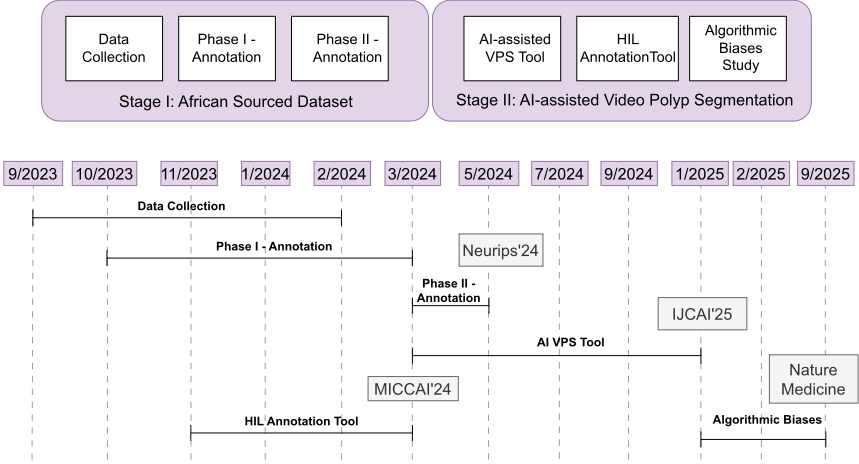
Finally, Phase II will span March till May 2024 to ensure the quality of the fine-grained annotation per frame for polyp detection/segmentation.
Consequently, the second stage is comprised of three phases: (i) building the AI-assisted video polyp segmentation tool, (ii) building and evaluating an AI-powered video polyp annotation tool that allows a human-in-the-loop input, (iii) assessing the biases in current state-of-the-art video polyp segmentation methods along with our proposed approach. The first phase will coincide with the data curation and annotation stage to give initial feedback on the quality of the annotations starting fromMarch 2024 till January 2025. As for the second phases, it will start on November 2023 till March 2024 to help annotate the unlabelled section of the dataset with minimal manual intervention. Note, that this phase does not require the annotation stage to be finalized, since we can use a portion of the already labelled section to assess the quality of the human-in-the-loop annotation tool. Finally, the third phase will start from January 2025 till September 2025 to evaluate the biases that exist in the current approaches with respect to ours.
Our plan to disseminate the proposed works to the public is included in Figure 1, where we will focus on four main publications in top-tier conferences and journals: (i) Neurips 2024 benchmarks and datasets track paper focused on our African-sourced dataset for colonoscopy videos. (ii) MICCAI 2024 paper focused on a human-in-the-loop colonoscopy videos annotation tool. (iii) IJCAI 2025 publication on our African basedAI-assisted video polyp segmentation. (iv) Nature Medicine Journal publication on the biases potentially exhibited in video polyp segmentation along with our fully annotated African-sourced video polyp segmentation dataset.
10 TeamDescription
Bushra Ibnauf Dr. Bushra Ibnauf is an assistant professor in the University of Khartoum/Soba University Hospital, Khartoum, Sudan and a cons. gastroenterologist at Mercy Hospital, Iowa City, IA. He is also a cons. gastroenterologist and hepatologist at Fedail Hospital, Khartoum, Sudan. Previously, he was a gastroenterologist and hepatologist at Dr. Soliman Fakeeh Hospital and King Faisal Specialist Hospital & Research Center, Jeddah, KSA. He was also a cons. gastroenterologist and hepatologist at Wichita Clinic, P.A., Wichita, Kansas, USA. He graduated from the Faculty of Medicine, University of Khartoum, Sudan in 1998 and obtained his Master of Science from the University of Iowa, Scholars in Clinical Investigation, USA. He is an expert in diagnostic colonoscopy techniques.
Mohammed Ahmed Aboul-Ezz. Prof. Mohammed Ahmed Aboul-Ezz is an Associate Professor in Hepatology & Gastroenterology Department, Theodor Bilharz Research Institute, Egypt. He is also a member of Liver Transplantation community in Theodor Bilharz Research Institute. He was a Gastroenterology, Hepatology and Liver Transplant Associate Consultant in the Liver Transplantation unit in Dar AlFouad Hospital. He was a visitor resident of endoscopy in pediatric endoscopy unit in Abou el-Reesh Pediatric Hospital, Cairo University. He was also a resident in the endoscopy unit in 6th October insurance hospital. He has multiple publications in high impact journals within Hepatology and Gastroenterology. He is an expert in diagnostic and therapeutic colonoscopy techniques. He obtained his M.D. from the Faculty of Medicine, Ainshams University, Egypt in 2009 and his M.Sc. from the Faculty of Medicine, Cairo University in 2004. He obtained his MB.B.Ch in 1997 from the Faculty of Medicine, Cairo University.
Ayman Abdel Aziz Prof. Ayman Abdel Aziz is a Professor and the current head of the Hepatology & Gastroenterology Department, Theodor Bilharz Research Institute, Cairo, Egypt. He is also the owner and director of Scope Endoscopy Center, Cairo, Egypt. He is a member of the American Society of the Gastrointestinal Endoscopy. He was a Gastroenterology Fellow, in Indiana University Medical Center, Indiana, USA. He obtained his M.D. from the faculty of Medicine, Cairo University, Egypt in 2010 and his M.Sc. from the Faculty of Medicine, Cairo University in 2004. He obtained his MB.B.Ch in 1998 from the Faculty of Medicine, Cairo University. He has multiple publications in high impact journals within Hepatology and Gastroenterology. He is an expert in diagnostic and therapeutic colonoscopy techniques and he was a faculty member of the international workshop on therapeutic endoscopy, Cairo, Egypt in 2004, 2005, 2008 and 2009.
Khalid Elgazzar Prof. Khalid Elgazzar is a Canada Research Chair in Internet of Things and Associate Professor with the Faculty of Engineering and Applied Science at Ontario Tech University, Canada. He also holds an adjunct professor position at Queen's University. Dr. Elgazzar is the founder and director of the IoT Research Lab at Ontario Tech University. Prior to joining Ontario Tech, he was an assistant professor at University of Louisiana at Lafayette and a research scientist at Carnegie Mellon School of Computer Science, USA. Dr. Elgazzar was named the recipient of the outstanding achievement in sponsored research award from UL Lafayette in 2017 and the distinguished research award from Queen's University in 2014. He also received several recognitions and best paper awards at top international venues. Dr. Elgazzar is a leading authority in the areas of Internet of Things (IoT), intelligent software systems, real-time data analytics, and mobile computing. Dr. Elgazzar is currently an associate editor for Frontiers Internet of Things Journal, Springer Peer-to-Peer Networking and Applications, Future Internet, and others. He also chaired several IEEE conferences and symposia on mobile computing, communications and IoT. Dr. Elgazzar is a Senior IEEE Member and an active volunteer in technical program committees and organizing committees in both IEEE and ACM events.
Mennatullah Siam. Dr. Mennatullah Siam is an assistant professor with the Faculty of Engineering and Applied Science at Ontario Tech University, Oshawa, Canada. She is the founder of Image and Video Understanding (IVU) Lab and the principal investigator of this project. Prior to joining Ontario Tech she was a postdoctoral researcher in the department of Electrical Engineering and Computer Sciences in York University, Toronto, Canada and affiliated with Vector institute. She received PhD degree from Computing Science department in University of Alberta, Edmonton, Canada in 2021 and MSc degree in Informatics from Nile University, Egypt in 2013. She also received her B. Sc. degree from Computer Science in Ainshams University, Cairo in 2010. She was a recipient of Alberta Innovates Foundations Technology and Verna Tate graduate scholarships, and a recipient of VISTA postdoc fellowship. Her research is focused on video understanding, video object segmentation, interpretability of video understanding models, few-shot object segmentation and video understanding where she has published multiple works in top-tier computer vision (CVPR, ICCV), artifical intelligence (IJCAI) and robotics (ICRA, IROS) conferences. She co-organized the Learning with Limited Labelled Data for Image and Video understanding (L3D-IVU) workshops in conjunction with CVPR 2022 and 2023. She was also on the technical committee member in Medical Image Learning with Limited and Noisy Data (MILLand) Workshop in MICCAI 2022 and 2023. She gave multiple talks about her research work as one of the earliest to tackle both few-shot video object segmentation and the interpretability of video object segmentation models, some of her talks were presented in Samsung AI, Vector Institute, and Black in AI Workshop in conjunction with Neurips 2022. She is also a co-founder of Ro'ya-CV4Africa community that focuses on Computer Vision for Africans and by Africans.
@inproceedings{ijcai2023p706,
  title     = {AI-Assisted Tool for Early Diagnosis and Prevention of Colorectal Cancer in Africa},
  author    = {Ibnauf, Bushra and Aboul Ezz, Mohammed and Abdel Aziz, Ayman and Elgazzar, Khalid and Siam, Mennatullah},
  booktitle = {Proceedings of the Thirty-Second International Joint Conference on
               Artificial Intelligence, {IJCAI-23}},
  publisher = {International Joint Conferences on Artificial Intelligence Organization},
  editor    = {Edith Elkind},
  pages     = {6362--6369},
  year      = {2023},
  month     = {8},
  note      = {AI for Good - Projects},
  doi       = {10.24963/ijcai.2023/706},
  url       = {https://doi.org/10.24963/ijcai.2023/706},
}
TY - CPAPER TI - AI-Assisted Tool for Early Diagnosis and Prevention of Colorectal Cancer in Africa AU - Ibnauf, Bushra AU - Aboul Ezz, Mohammed AU - Abdel Aziz, Ayman AU - Elgazzar, Khalid AU - Siam, Mennatullah T2 - Proceedings of the Thirty-Second International Joint Conference on Artificial Intelligence, IJCAI-23 PB - International Joint Conferences on Artificial Intelligence Organization PY - 2023 SP - 6362 EP - 6369 DO - 10.24963/ijcai.2023/706 UR - https://doi.org/10.24963/ijcai.2023/706 ER -Copied
Machine-readable versions of this paper, for tools and AI agents:





