
Harnessing Neighborhood Modeling and Asymmetry Preservation for Digraph Representation Learning
Proceedings of the Thirty-Second International Joint Conference on Artificial Intelligence. Sister Conferences Best Papers. Pages 6519-6524.
https://doi.org/10.24963/ijcai.2023/731
Keywords
- Sister Conferences Best Papers: Machine Learning
- Sister Conferences Best Papers: Data Mining
- Sister Conferences Best Papers: Knowledge Representation and Reasoning
Abstract
Digraph Representation Learning aims to learn representations for directed homogeneous graphs (digraphs). Prior work is largely constrained or has poor generalizability across tasks. Most Graph Neural Networks exhibit poor performance on digraphs due to the neglect of modeling neighborhoods and preserving asymmetry. In this paper, we address these notable challenges by leveraging hyperbolic collaborative learning from multi-ordered partitioned neighborhoods and asymmetry-preserving regularizers. Our resulting formalism, Digraph Hyperbolic Networks (D-HYPR), is versatile for multiple tasks including node classification, link presence prediction, and link property prediction. The efficacy of D-HYPR was meticulously examined against 21 previous techniques, using 8 real-world digraph datasets. D-HYPR statistically significantly outperforms the current state of the art. We release our code at https://github. com/hongluzhou/dhypr.
- [Chami et al., 2019] Ines Chami, Zhitao Ying, Christopher Ré, and Jure Leskovec. Hyperbolic graph convolutional neural networks. In Advances in neural information pro- cessing systems, pages 4868-4879, 2019.
- [Ganea et al., 2018] Octavian Ganea, Gary Bécigneul, and Thomas Hofmann. Hyperbolic neural networks. In Ad- vances in neural information processing systems, pages 5345-5355, 2018.
- [Gong and Cheng, 2019] Liyu Gong and Qiang Cheng. Ex- ploiting edge features for graph neural networks. In Pro- ceedings of the IEEE/CVF Conference on Computer Vision and Pattern Recognition, pages 9211-9219, 2019.
- [Grover and Leskovec, 2016] Aditya Grover and Jure Leskovec. node2vec: Scalable feature learning for networks. In Proceedings of the 22nd ACM SIGKDD international conference on Knowledge discovery and data mining, pages 855-864, 2016.
- [Khosla et al., 2019] Megha Khosla, Jurek Leonhardt, Wolf- gang Nejdl, and Avishek Anand. Node representation learning for directed graphs. In Joint European Confer- ence on Machine Learning and Knowledge Discovery in Databases, pages 395-411. Springer, 2019.
- [Kipf and Welling, 2016a] Thomas N Kipf and Max Welling. Semi-supervised classification with graph con- volutional networks. arXiv preprint arXiv:1609.02907, 2016.
- [Kipf and Welling, 2016b] Thomas N Kipf and Max Welling. Variational graph auto-encoders. arXiv preprint arXiv:1611.07308, 2016.
- [Krioukov et al., 2010] Dmitri Krioukov, Fragkiskos Pa- padopoulos, Maksim Kitsak, Amin Vahdat, and Marián Boguná. Hyperbolic geometry of complex networks. Physical Review E, 82(3):036106, 2010.
- [Ma et al., 2019] Yi Ma, Jianye Hao, Yaodong Yang, Han Li, Junqi Jin, and Guangyong Chen. Spectral-based graph convolutional network for directed graphs. arXiv preprint arXiv:1907.08990, 2019.
- [McPherson et al., 2001] Miller McPherson, Lynn Smith- Lovin, and James M Cook. Birds of a feather: Homophily in social networks. Annual review of sociology, 27(1):415- 444, 2001.
- [Mitzenmacher, 2004] Michael Mitzenmacher. A brief his- tory of generative models for power law and lognormal distributions. Internet mathematics, 1(2):226-251, 2004.
- [Ou et al., 2016] Mingdong Ou, Peng Cui, Jian Pei, Ziwei Zhang, and Wenwu Zhu. Asymmetric transitivity preserv- ing graph embedding. In Proceedings of the 22nd ACM SIGKDD international conference on Knowledge discov- ery and data mining, pages 1105-1114, 2016.
- [Salha et al., 2019] Guillaume Salha, Stratis Limnios, Ro- main Hennequin, Viet-Anh Tran, and Michalis Vazirgian- nis. Gravity-inspired graph autoencoders for directed link prediction. In Proceedings of the 28th ACM International Conference on Information and Knowledge Management, pages 589-598, 2019.
- [Shi et al., 2019] Lei Shi, Yifan Zhang, Jian Cheng, and Hanqing Lu. Skeleton-based action recognition with di- rected graph neural networks. In Proceedings of the IEEE/CVF Conference on Computer Vision and Pattern Recognition, pages 7912-7921, 2019.
- [Sim et al., 2021] Aaron Sim, Maciej L Wiatrak, Angus Brayne, Páidí Creed, and Saee Paliwal. Directed graph embeddings in pseudo-riemannian manifolds. In Inter- national Conference on Machine Learning, pages 9681- 9690. PMLR, 2021.
- [Sun et al., 2019] Jiankai Sun, Bortik Bandyopadhyay, Armin Bashizade, Jiongqian Liang, P Sadayappan, and Srinivasan Parthasarathy. Atp: Directed graph embedding with asymmetric transitivity preservation. In Proceed- ings of the AAAI Conference on Artificial Intelligence, volume 33, pages 265-272, 2019.
- [Thost and Chen, 2021] Veronika Thost and Jie Chen. Di- rected acyclic graph neural networks. International Con- ference on Learning Representations, 2021.
- [Tong et al., 2020a] Zekun Tong, Yuxuan Liang, Chang- sheng Sun, Xinke Li, David Rosenblum, and Andrew Lim. Digraph inception convolutional networks. Advances in Neural Information Processing Systems, 33, 2020.
- [Tong et al., 2020b] Zekun Tong, Yuxuan Liang, Chang- sheng Sun, David S Rosenblum, and Andrew Lim. Di- rected graph convolutional network. arXiv preprint arXiv:2004.13970, 2020.
- [Veličković et al., 2017] Petar Veličković, Guillem Cucurull, Arantxa Casanova, Adriana Romero, Pietro Lio, and Yoshua Bengio. Graph attention networks. arXiv preprint arXiv:1710.10903, 2017.
- [Zhang et al., 2021a] Xitong Zhang, Nathan Brugnone, Michael Perlmutter, and Matthew Hirn. Magnet: A mag- netic neural network for directed graphs. Advances in Neu- ral Information Processing Systems, 34, 2021.
- [Zhang et al., 2021b] Yiding Zhang, Xiao Wang, Chuan Shi, Xunqiang Jiang, and Yanfang Fanny Ye. Hyperbolic graph attention network. IEEE Transactions on Big Data, 2021.
- [Zhou et al., 2017] Chang Zhou, Yuqiong Liu, Xiaofei Liu, Zhongyi Liu, and Jun Gao. Scalable graph embedding for asymmetric proximity. In Proceedings of the AAAI Con- ference on Artificial Intelligence, volume 31, 2017.
- [Zhou et al., 2020] Jie Zhou, Ganqu Cui, Shengding Hu, Zhengyan Zhang, Cheng Yang, Zhiyuan Liu, Lifeng Wang, Changcheng Li, and Maosong Sun. Graph neural networks: A review of methods and applications. AI Open, 1:57-81, 2020.
- [Zhou et al., 2022] Honglu Zhou, Advith Chegu, Samuel S Sohn, Zuohui Fu, Gerard De Melo, and Mubbasir Ka- padia. D-hypr: Harnessing neighborhood modeling and asymmetry preservation for digraph representation learn- ing. In Proceedings of the 31st ACM International Con- ference on Information & Knowledge Management, pages 2732-2742, 2022.
- [Zhu et al., 2020] Shichao Zhu, Shirui Pan, Chuan Zhou, Jia Wu, Yanan Cao, and Bin Wang. Graph geometry interac- tion learning. In Advances in Neural Information Process- ing Systems, 2020.
References were extracted automatically from the PDF and may contain errors.
Full text extracted automatically from the PDF; figures, tables and equations may differ. The PDF is the version of record.
1 Introduction
Directionality is intrinsic to numerous real-world graphs [Ou et al., 2016]. Digraph Representation Learning (DRL) aims to learn representations for directed homogeneous graphs (digraphs) [Tong et al., 2020a; Zhang et al., 2021a]. Early DRL techniques include factorization and random walk-based approaches [Ou et al., 2016; Sun et al., 2019; Zhou et al., 2017; Khosla et al., 2019]. Yet, these methods face scalability issues or sensitivity to noise. Graph Neural Networks (GNNs) have seen recent success [Zhou et al., 2020], but they mainly focus on undirected graphs. There are two notable challenges that hinder their effectiveness on digraphs.
Challenge 1: Neighborhood Modeling. Node neighborhoods in a graph can carry distinct semantic meanings. Existing GNN techniques often simplify digraphs to undirected graphs or consider only direct out-neighbors [Kipf and Welling, 2016b; Veliˇckovi´c et al., 2017; Chami et al., 2019;
∗ Published at the 31st ACM International Conference on Information & Knowledge Management - Received the Best Paper Award
Zhu et al., 2020], which can lead to a loss of original structure and ultimately subpar results on digraph-specific tasks.
Challenge 2: Asymmetry Preservation. Learning objectives based on symmetrical measures used by popular GNNs fail to capture asymmetric connections in digraphs [Salha et al., 2019]. Applications based on link prediction or graph topology learning are particularly affected when models fail to preserve digraph structural asymmetry.
Spectral-based DRL GNNs have sought to address the first challenge but struggle when applying models to graphs with different structures [Zhang et al., 2021a]. Solutions for the second challenge, such as viewing edge directions as edge features [Gong and Cheng, 2019] or parametrizing the node pair likelihood function by a neural network [Shi et al., 2019], neglect the first challenge. Moreover, prior DRL techniques are often constrained to directed acyclic graphs [Thost and Chen, 2021], are transductive [Sim et al., 2021], or lack broad applicability and generalizability across tasks [Sim et al., 2021; Tong et al., 2020b; Ma et al., 2019].
We propose Digraph HYPERbolic Networks (D-HYPR), which use hyperbolic collaborative learning and asymmetrypreserving regularizers to tackle these challenges. Our approach comprises: (1) Modeling node neighborhoods using collaborative learning from multi-ordered and partitioned neighborhoods with larger receptive fields, (2) Using hyperbolic space to avoid distortion in neighborhood modeling, (3) Preserving asymmetry with socio-psychology-inspired regularizers, and (4) Ensuring flexibility through a messagepassing-based GNN formalism for general digraphs.
Our contributions are three-fold: (1) D-HYPR that considers unique node neighborhoods and asymmetric relationships in digraphs, (2) Benchmarking across 8 real-world digraphs and 21 prior methods, revealing D-HYPR's superiority, and (3) Capability of generating meaningful low-dimensional embeddings, an efficiency boon for large-scale applications.
2 Preliminaries
Let G = (V, E) be a homogeneous graph with vertex set V and edge set E; e ∈ E is an ordered pair e = (i, j) between vertices i and j. The adjacency matrix of G can be denoted as A = {0, 1}|V|×|V| . G is a digraph when ∃(i, j), Ai,j ̸= Aj,i. Nodes are described by a feature matrix X0,E ∈ R|V|×d , i.e., each node i ∈ V has a d-dimensional Euclidean feature x0,E i .
The superscript E indicates that the vector lies in a Euclidean space, while H denotes a hyperbolic vector. 0 denotes the input layer. The goal of DRL is to learn a mapping
that maps nodes to low-dimensional (d′ ≪ |V|) vectors.
The Poincar´e ball model [Ganea et al., 2018] is defined by the n-dimensional manifold Dnc = {x ∈ Rn : c ∥x∥ < 1} equipped with the Riemannian metric: gcx = λ2x gE , where λx := 2 1-c∥x∥2 , gE = In is the Euclidean metric tensor, and c > 0 (we refer to -c as the curvature). Dnc is the open ball of radius 1/√c. The connections between hyperbolic space and tangent space are established by the exponential map expcx : TxDnc →Dnc and logarithmic map logcx : Dnc → TxDnc :
where x, y ∈ Dnc , v ∈ TxDnc , and ⊕c denotes M¨obius addition, and
The M¨obius scalar multiplication (Eq. 5) and M¨obius matrix multiplication of x ∈ Dnc \{0} (Eq. 6) are
where r ∈ R and M ∈ Rm×n . The induced distance function on (Dnc , gc ) is given by
3 Methodology
Hyperbolic Embedding Learning. D-HYPR utilizes hyperbolic GNNs over Euclidean counterparts as the backbone for DRL. Given G and x0,E i , we obtain x0,H i by applying expc0 0 (·), where c0 is learned in training. Hyperbolic message passing (Eqs. 8 to 10) is then performed by multiple layers, forming the Hyperbolic Graph Embedding Layers. The layer is indexed by ℓ, ranging from 1 to a pre-defined integer l. (1) Hyperbolic Feature Transformation is performed by
where W ℓ ∈ RF ℓ×F ℓ-1 is the weight matrix, and b ∈ DF ℓ cℓ-1 denotes the bias (both are learned).
(2) Hyperbolic Neighbor Aggregation results in hℓ,H i ,
where N(i) = {j : (i, j) ∈ E} denotes the set of neighbors of i ∈ V. We apply out-degree normalization of the adjacency matrix to obtain the aggregation weights eij .
(3) Non-Linear Activation with Trainable Curvatures. The output hyperbolic representation of node i in layer ℓ is set as
where σ(·) represents the ReLU non-linearity function.
Neighborhood Collaborative Learning. D-HYPR considers four primary neighborhood types. To achieve this, four types of k-order proximity matrix are defined:
(1) diffusion in Akdin ,
where A1din = A⊺ , · is the inner product and 1 is the indicator function. Akdin (i, j) = 1 if there is a directed path from node j to node i of length exactly k. (2) diffusion out Akdout ,
where A1dout = A. Akdout (i, j) = 1 if there is a directed path from node i to node j of length exactly k.
(3) common in Akcin ,
where i ̸= j ̸= p. Akcin (i, j) = 1 if node i and node j have a common in-neighbor k hops away.
(4) common out Akcout ,
where i ̸= j ̸= p. Akcout (i, j) = 1 if node i and node j have a common out-neighbor k hops away.
We compute these matrices for k = 1 to K (K is a hyperparameter) which replace the adjacency matrix as input to Hyperbolic Graph Embedding Layers that output 4K hyperbolic vectors. Subsequently, the hyperbolic average of the 4K vectors yields zfuse i . We then apply Eq. (9) with the learned curvature -cl and equal aggregation weights. The resulting output, zl,H i , is the final hyperbolic embedding of node i.
Asymmetry-Preserving Regularizers. We adopt the hyperbolic Fermi-Dirac decoder [Krioukov et al., 2010] to account for homophily [McPherson et al., 2001]. The decoder defines the likelihood of a node pair (i, j) as
where r=2 and t=1 (default), and dDd′ cl (·, ·) is defined in Eq. 7.
We then preserve the individual asymmetric node connectivity to account for preferential attachment [Mitzenmacher,
2004] by learning a mass for each node. This design [Salha et al., 2019] is derived from Newton's theory of universal gravitation. To incorporate this design into D-HYPR based in hyperbolic space instead of Euclidean, we first perform zl,E i = logcl 0 (zl,H i ), and then employ a Euclidean linear layer to learn mi ∈ R (mass of node i). The likelihood of node pair (i, j) is computed by
where γ(·) denotes the sigmoid function, and λ ∈ R is a hyper-parameter. p(i, j)g ̸= p(j, i)g. Eqs. (16) and (15) both serve as self-supervised regularizers by minimizing the binary cross-entropy loss with negative sampling to estimate the likelihood of each node pair. However, Eq. (16) is employed one layer after where Eq. (15) is used. Thus, even though dDd′ cl (·, ·) also appears in Eq. (16), we find that Eq. (15) provides auxiliary guidance for the model to better construct the final hyperbolic embedding space.
| 4-Dim | GCN [Kipf and Welling, 2016a] GAT [Veliˇckovi´c et al., 2017] HGCN [Chami et al., 2019] D-HYPR (ours) | 78.96±0.4 79.38±0.2 78.72 ± ∗ |
| 0.0 | ||
| 79.83±0.0 | ||
| GCN [Kipf andWelling, 2016a] | 78.76 ±0.1 | |
| GAT [Veliˇckovi´c et al., 2017] | 79.41±0.2 | |
| 8-Dim HGCN [Chami et al., 2019] | 79.23±0.2 | |
| D-HYPR (ours) | ∗ 79.47±0.3 | |
| GCN [Kipf and Welling, 2016a] | 79.39± 0.1 | |
| GAT [Veliˇckovi´c et al., 2017] | 79.66± 0.1 | |
| 32-Dim HGCN [Chami et al., 2019] | 79.21 ± 0.2 | |
| D-HYPR (ours) | ∗ 79.73 ± 0.2 |
4 Experiments
In all tables, the best score is bolded, the second best is underlined, and the third best is in italic. Relative gains are computed as (BEST - SECOND)/SECOND. ∗ indicates statistically superior performance of the best to the second best at a significance level of 0.001 using a standard paired t-test. Values after ± are standard deviations.
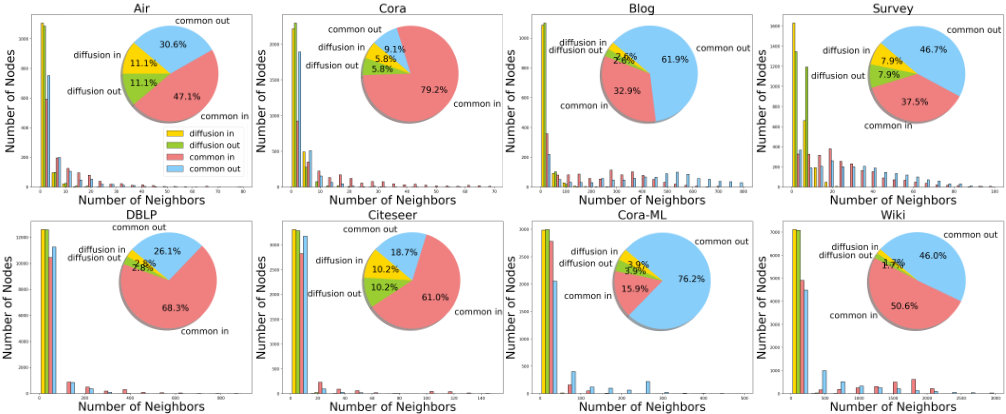
NeighborhoodAnalyses. We provide neighborhood analyses of datasets in Fig. 1, where pie charts show the ratio of the 4 types of neighborhoods in each dataset (K=1). Unlike the diffusion in/out neighborhood that traditional GNNs typically use, common in/out neighborhood consists of more neighbors, which suggests that neighborhood collaborative learning benefits from encoding additional context. For each neighborhood type, we also plot a histogram showing the distribution of the number of neighbors a node has over the entire graph. We observe asymptotical power-law nodedegree distributions (i.e., scale-free) for most neighborhoods. Link Prediction (LP). We list the results in Table 2 and Table 3. One advantage of hyperbolic digraph embedding is low data distortion even with a low-dimensional embedding space. The superior performance of D-HYPR is evidentthe highest relative gain of D-HYPR is 21.43% on AP over the Cora dataset. As the dimensionality increases, the gap from D-HYPR to the other methods decreases, but D-HYPR remains the best-performing method.
| Model (Dataset: Cora) | 4-Dim | 8-Dim | ||
|---|---|---|---|---|
| AUC | AP | AUC | AP | |
| GCN [Kipf and Welling, 2016a] | 65.92 (61.00) | 65.92 (59.97) | 70.89 (65.67) | 71.26 (65.28) |
| VGAE [Kipf and Welling, 2016b] | 63.86 (56.90) | 63.86 (55.39) | 66.60 (60.33) | 66.60 (58.75) |
| GAT [Veliˇckovi´c et al., 2017] | 68.18 (64.73) | 68.18 64.31) | 72.70 (68.70) | 73.93 (69.08) |
| Gravity GCN † [Salha et al., 2019] | 70.37 (65.80) | 70.37 (64.65) | 75.29 (71.85) | 77.17 (72.50) |
| Gravity VGAE † [Salha et al., 2019] | 66.74 (61.79) | 66.74 (60.61) | 71.04 (65.45) | 71.04 (64.15) |
| DGCN † [Tong et al., 2020b] | 75.33 (71.88) | 71.95 (68.58) | 79.01 (75.30) | 79.01 (74.28) |
| DiGCN † [Tong et al., 2020a] | 70.61 (65.81) | 67.11 (61.57) | 74.63 (70.65) | 74.88 (69.86) |
| MagNet † [Zhang et al., 2021a] | 77.45 (55.93) | 79.32 (56.84) | 77.46 (66.82) | 76.59 (63.96) |
| HAT § [Zhang et al., 2021b] | 76.25 (72.84) | 74.38 (70.27) | 82.58 (77.82) | 82.05 (77.39) |
| HGCN § [Chami et al., 2019] | 80.02 (67.37) | 82.16 (66.66) | 85.05 (83.07) | 88.04 (84.63) |
| D-HYPR (ours) †§ | 86.08 (∗ 83.99) | 88.74 (∗ 85.33) | 88.88 (∗ 86.31) | 91.13 (∗ 87.76) |
| Relative Gains (%) | 7.57 (15.31) | 8.01 (21.43) | 4.5 (3.9) | 3.51 (3.7) |
| Model (Metric: AUC) | Air | Cora | Blog | Survey | DBLP |
|---|---|---|---|---|---|
| MLP | 81.29 (76.52) | 84.47 (81.67) | 93.31 (92.48) | 91.21 (89.98) | 51.22 (49.98) |
| NERD † [Khosla et al., 2019] | 60.62 (56.39) | 65.62 (62.02) | 95.03 (94.00) | 77.12 (69.30) | 95.78 (95.37) |
| ATP † [Sun et al., 2019] | 68.99 (66.40) | 88.47 (86.44) | 85.05 (83.46) | 73.53 (71.47) | 60.43 (59.21) |
| APP † [Zhou et al., 2017] | 85.08 (82.72) | 86.65 (85.50) | 92.33 (91.65) | 91.16 (90.34) | 95.58 (95.33) |
| GCN [Kipf and Welling, 2016a] | 76.71 (72.27) | 80.77 (78.73) | 91.87 (90.18) | 89.29 (87.98) | 92.98 (92.34) |
| VGAE [Kipf and Welling, 2016b] | 77.79 (73.75) | 80.80 (79.24) | 92.25 (91.39) | 90.07 (88.78) | 93.36 (92.64) |
| GAT [Veliˇckovi´c et al., 2017] | 84.21 (80.24) | 85.40 (82.58) | 92.69 (89.95) | 92.01 (91.05 ) | 95.94 (95.62) |
| Gravity GCN † [Salha et al., 2019] | 85.16 (82.22) | 85.62 (83.87) | 95.11 (94.46) | 91.63 (90.86) | 96.89 (96.78) |
| Gravity VGAE † [Salha et al., 2019] | 83.98 (80.06) | 87.17 (84.46) | 96.15 (95.59) | 91.64 (90.96) | 95.98 (95.57) |
| DGCN † [Tong et al., 2020b] | 77.83 (73.68) | 83.57 (81.34) | 87.74 (86.74) | 90.47 (89.49) | 92.26 (91.83) |
| DiGCN † [Tong et al., 2020a] | 75.35 (71.27) | 81.80 (78.90) | 91.98 (90.50) | 89.85 (88.17) | 89.99 (89.72) |
| MagNet † [Zhang et al., 2021a] | 79.32 (75.58) | 82.77 (71.90) | 91.83 (90.81) | 86.65 (84.81) | 81.89 (80.57) |
| HNN § [Ganea et al., 2018] | 88.42 (85.79) | 88.75 (86.33) | 95.80 (95.39) | 92.07 (91.39) | 97.43 (97.14) |
| HGCN § [Chami et al., 2019] | 88.26 (86.12) | 89.24 (87.68) | 95.64 (95.23) | 92.15 (91.50) | 97.54 (97.33) |
| D-HYPR (ours) †§ | 89.07 (86.33) | 89.50 (∗ 88.22) | 96.19 (95.62) | 92.56 (∗ 91.96) | 97.66 (∗ 97.38) |
| Relative Gains (%) | 0.74 (0.24) | 0.29 (0.62) | 0.04 (0.03) | 0.44 (0.50) | 0.12 (0.05) |
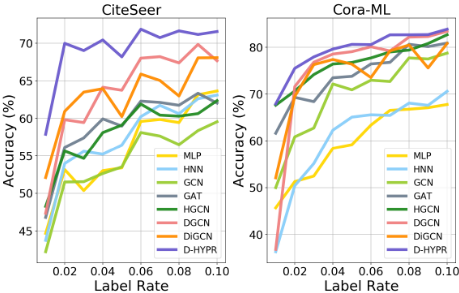
Semi-supervised Node Classification (NC). We follow prior work [Grover and Leskovec, 2016] in reporting the results when the number of nodes labeled for training is varied between 1% and 10%. According to Fig. 2, D-HYPR consistently outperforms the baselines, and tends to perform well at fairly low label rates. D-HYPR statistical significantly outperforms the state-of-the-art (SOTA) methods.
Link Sign Prediction (SP). Table 1 reports the results which show D-HYPR is the most effective GNN model. Similar to LP and NC tasks, the effectiveness of D-HYPR is the most striking using a 4 dimensional embedding space.
Please refer to [Zhou et al., 2022] for additional details regarding the datasets and experimental setup, as well as additional analyses and comparisons with more SOTA techniques.
5 Conclusion
We propose D-HYPR: the Digraph HYPERbolic Network, as a novel GNN-based formalism for Digraph Representation Learning (DRL) by addressing Neighborhood Modeling and Asymmetry Preservation. Through rigorous evaluation, we empirically demonstrate the superiority of D-HYPR. D-HYPR retains effectiveness given a low budget of embedding dimensionality or labeled training samples, which is desirable for real-world applications.
Acknowledgments
The research was supported in part by NSF awards: IIS1703883, IIS-1955404, IIS-1955365, RETTL-2119265, and EAGER-2122119. This material is based upon work supported by the U.S. Department of Homeland Security under Grant Award Number 22STESE00001 01 01.
Disclaimer: The views and conclusions contained in this document are those of the authors and should not be interpreted as necessarily representing the official policies, either expressed or implied, of the U.S. Department of Homeland Security.
@inproceedings{ijcai2023p731,
  title     = {Harnessing Neighborhood Modeling and Asymmetry Preservation for Digraph Representation Learning},
  author    = {Zhou, Honglu and Chegu, Advith and Sohn, Samuel S. and Fu, Zuohui and de Melo, Gerard and Kapadia, Mubbasir},
  booktitle = {Proceedings of the Thirty-Second International Joint Conference on
               Artificial Intelligence, {IJCAI-23}},
  publisher = {International Joint Conferences on Artificial Intelligence Organization},
  editor    = {Edith Elkind},
  pages     = {6519--6524},
  year      = {2023},
  month     = {8},
  note      = {Sister Conferences Best Papers},
  doi       = {10.24963/ijcai.2023/731},
  url       = {https://doi.org/10.24963/ijcai.2023/731},
}
TY - CPAPER TI - Harnessing Neighborhood Modeling and Asymmetry Preservation for Digraph Representation Learning AU - Zhou, Honglu AU - Chegu, Advith AU - Sohn, Samuel S. AU - Fu, Zuohui AU - de Melo, Gerard AU - Kapadia, Mubbasir T2 - Proceedings of the Thirty-Second International Joint Conference on Artificial Intelligence, IJCAI-23 PB - International Joint Conferences on Artificial Intelligence Organization PY - 2023 SP - 6519 EP - 6524 DO - 10.24963/ijcai.2023/731 UR - https://doi.org/10.24963/ijcai.2023/731 ER -Copied
Machine-readable versions of this paper, for tools and AI agents:





