
Optimized Crystallographic Graph Generation for Material Science
Proceedings of the Thirty-Second International Joint Conference on Artificial Intelligence. Demo Track. Pages 7145-7148.
https://doi.org/10.24963/ijcai.2023/836
Keywords
- Multidisciplinary Topics and Applications: MDA: Energy, environment and sustainability
- Multidisciplinary Topics and Applications: MDA: Life sciences
- Multidisciplinary Topics and Applications: MDA: Physical sciences
- Machine Learning: ML: Feature extraction, selection and dimensionality reduction
Abstract
Graph neural networks are widely used in machine learning applied to chemistry, and in particular for material science discovery. For crystalline materials, however, generating graph-based representation from geometrical information for neural networks is not a trivial task. The periodicity of crystalline needs efficient implementations to be processed in real-time under a massively parallel environment. With the aim of training graph-based generative models of new material discovery, we propose an efficient tool to generate cutoff graphs and k-nearest-neighbours graphs of periodic structures within GPU optimization. We provide pyMatGraph a Pytorch-compatible framework to generate graphs in real-time during the training of neural network architecture. Our tool can update a graph of a structure, making generative models able to update the geometry and process the updated graph during the forward propagation on the GPU side. Our code is publicly available at https://github.com/aklipf/mat-graph.
- [Chen et al., 2019] Chi Chen, Weike Ye, Yunxing Zuo, Chen Zheng, and Shyue Ping Ong. Graph networks as a univer- sal machine learning framework for molecules and crys- tals. Chemistry of Materials, 31(9):3564-3572, 2019.
- [Choudhary and DeCost, 2021] Kamal Choudhary and Brian DeCost. Atomistic line graph neural network for improved materials property predictions. npj Computa- tional Materials, 7(1):185, Nov 2021.
- [Ekström Kelvinius et al., 2022] Filip Ekström Kelvinius, Rickard Armiento, and Fredrik Lindsten. Graph-based machine learning beyond stable materials and relaxed crystal structures. Phys. Rev. Materials, 6:033801, Mar 2022.
- [Gasteiger et al., 2020a] Johannes Gasteiger, Shankari Giri, Johannes T. Margraf, and Stephan Günnemann. Fast and uncertainty-aware directional message passing for non-equilibrium molecules. In Machine Learning for Molecules Workshop, NeurIPS, 2020.
- [Gasteiger et al., 2020b] Johannes Gasteiger, Janek Groß, and Stephan Günnemann. Directional message passing for molecular graphs. In International Conference on Learn- ing Representations (ICLR), 2020.
- [Gibson et al., 2022] Jason Gibson, Ajinkya Hire, and Richard G. Hennig. Data-augmentation for graph neu- ral network learning of the relaxed energies of unrelaxed structures. npj Computational Materials, 8(1):211, Sep 2022.
- [Jain et al., 2013] Anubhav Jain, Shyue Ping Ong, Geoffroy Hautier, Wei Chen, William Davidson Richards, Stephen Dacek, Shreyas Cholia, Dan Gunter, David Skinner, Ger- brand Ceder, et al. Commentary: The materials project: A materials genome approach to accelerating materials inno- vation. APL materials, 1(1):011002, 2013.
- [Jørgensen et al., 2018] Peter Bjørn Jørgensen, Karsten Wedel Jacobsen, and Mikkel N. Schmidt. Neural message passing with edge updates for predicting properties of molecules and materials. arXiv preprint arXiv:1806.03146, 2018.
- [Klicpera et al., 2021] Johannes Klicpera, Florian Becker, and Stephan Günnemann. Gemnet: Universal directional graph neural networks for molecules. In A. Beygelz- imer, Y. Dauphin, P. Liang, and J. Wortman Vaughan, edi- tors, Advances in Neural Information Processing Systems, 2021.
- [Klipfel et al., 2023] Astrid Klipfel, Olivier Peltre, Najwa Harrati, Yaël Fregier, Adlane Sayede, and Zied Bouraoui. Equivariant message passing neural network for crystal material discovery. In Thirty-Seventh AAAI Conference on Artificial Intelligence, AAAI 2023. AAAI Press, 2023.
- [Long et al., 2021] Teng Long, Nuno M. Fortunato, Ingo Opahle, Yixuan Zhang, Ilias Samathrakis, Chen Shen, Oliver Gutfleisch, and Hongbin Zhang. Constrained crys- tals deep convolutional generative adversarial network for the inverse design of crystal structures. npj Computational Materials, 7(1):66, May 2021.
- [Satorras et al., 2021] Víctor Garcia Satorras, Emiel Hooge- boom, and Max Welling. E(n) equivariant graph neural networks. In Marina Meila and Tong Zhang, editors, Pro- ceedings of the 38th International Conference on Machine Learning, volume 139 of Proceedings of Machine Learn- ing Research, pages 9323-9332. PMLR, 18-24 Jul 2021.
- [Schütt et al., 2017] Kristof Schütt, Pieter-Jan Kindermans, Huziel Enoc Sauceda Felix, Stefan Chmiela, Alexan- dre Tkatchenko, and Klaus-Robert Müller. Schnet: A continuous-filter convolutional neural network for model- ing quantum interactions. In NIPS, pages 992-1002, 2017.
- [Xie et al., 2022] Tian Xie, Xiang Fu, Octavian-Eugen Ganea, Regina Barzilay, and Tommi S. Jaakkola. Crys- tal diffusion variational autoencoder for periodic material generation. In International Conference on Learning Rep- resentations, 2022.
References were extracted automatically from the PDF and may contain errors.
Full text extracted automatically from the PDF; figures, tables and equations may differ. The PDF is the version of record.
1 Introdution
New materials discovery is a fundamental challenge in material sciences where high-throughput screening based on machine learning models is largely employed to obtain materials with desired properties. Crystalline (crystal) material generation has recently received considerable attention, e.g. [Xie et al., 2022; Gibson et al., 2022; Klipfel et al., 2023]. In our setting, we are interested in generating new crystal materials for developing new solar panels with a band gap enabling hydrolyse. This helps to solve problems related to clean energy production and storage, which is one of the major challenges facing our society. It can also be used to produce hydrocarbons from CO2, helping to reduce the carbon footprint of human activities.
From organic chemistry to material science, Graph Neural Networks (GNN) have received increasing attention in a variety of tasks such as classification [Sch¨utt et al., 2017; Jørgensen et al., 2018; Gasteiger et al., 2020b; Gasteiger et al., 2020a; Chen et al., 2019; Choudhary and DeCost, 2021; Klicpera et al., 2021] and generation [Satorras et al., 2021;
Xie et al., 2022; Long et al., 2021; Ekstr¨om Kelvinius et al., 2022; Gibson et al., 2022]. Notice that organic molecules are composed of wide carbon chains with a limited variety of atoms, while crystal materials are three-dimensional periodic structures composed of a wide variety of chemical bonds and atoms. The periodic structure of crystals is often represented as a parallelepiped tiling, a.k.a crystal lattice or unit cell. While generating graph-based representations of organic molecules is straightforward, the periodic structure of crystals makes difficult graph processing when training a generative model, and in particular when a massively parallel environment is required. More precisely, generative models may update the geometry of a chemical structure during forward propagation. However, since the graph associated with a given structure is built from the local environment of atoms, a modification of the geometry leads to the modifications of the graph associated with the structure. Consequently, building a generative model with a dynamic graph is hard to achieve on a periodic structure compared to organic molecules.
When training graph-based generative models for material discovery, cutoff distance is a commonly used technique [Sch¨utt et al., 2017; Gasteiger et al., 2020b; Jørgensen et al., 2018]. It designates a relative distance threshold value above which no interaction between nodes is considered. In the same vein, [Jørgensen et al., 2018; Chen et al., 2019] suggests that k-nearest-neighbours (KNN) graphs can also be a good choice for GNN models. KNN-graph is a type of graph where all the nodes are connected to the k-nearest nodes. When processing small molecules, any naive strategy of computing the interatomic distances is feasible, allowing to compute KNN or cutoff graph in a short amount of time and reasonable memory. However, for periodic structures which are infinite, the search area should be carefully selected to avoid unnecessary calculation and memory saturation. In fact, the volume of the search space expands with the cube of the search radius. As such, possible graphs should be generated in milliseconds to be usable in practice during the training process. Moreover, a periodic structure is represented with a multi-graph where a given node can share multiple edges with another and with itself which brings more complexity to the graph generation process. Finally, for big structures, a processing strategy suitable for massively parallel environments should be used in order to deal with a batch of multiple structures at the same time.
To address the aforementioned issues, we propose an efficient tool that solves KNN and cutoff graph generation for crystalline materials. We provide a compatible implementation with PyTorch that performs on GPUs 1 . We used an approach inspired by the KD-tree search algorithm adapted for periodic structures and propose a data structure adapted to massively parallel environments (GPUs) that effectively keeps track of the KNN of each atom. We empirically show the benefits of using our tool.
2 Crystallographic Graph Generation
A crystalline structure can be defined with a cloud of atoms and a repetition pattern that represent periodicity. The repetition pattern is often described as a parallelepiped called a lattice or a cell. The periodic structure is obtained with the tiling of the space by the crystal cell. Consequently, a given atom inside of the cell has multiple positions because of the tiling in space and the local environment of an atom which can overlap with adjacent repetition.
2.1 Crystallographic Graph
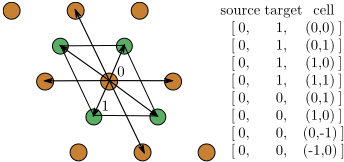
We follow [Klipfel et al., 2023] to define the graph associated with a crystal material as an oriented graph where each edge is represented by triplets containing the index of the source node, the index of the destination node and the relative cell coordinate of the destination node. Figure 1 illustrates this representation. Notice that the definition of graph provided in [Klipfel et al., 2023] generalizes to most of the graph definitions proposed in previous works [Jørgensen et al., 2018; Chen et al., 2019; Satorras et al., 2021]. We now recall the formal definition of crystalline structure [Klipfel et al., 2023].
Definition 1. The representation space of featured materials MF is the disjoint union ∐n∈N MFn where:
Chemical materials are represented in M = MN, with atomic numbers as feature sequence z.
MFn is an infinite set of triplet ρ, x, z that represents all possible materials with n atoms. The atomic number has a chemistry reference, e.g. 1 for hydrogen or 6 for carbon.
1 Code available at https://github.com/aklipf/mat-graph
Definition 2. We call directed 2-graph Γ = (Γ0, Γ1, Γ2) a triplet of sets together with applications:
- π1 : Γ1 → Γ0 × Γ0, written π1(γ) = (src(γ), tgt(γ))
- π2 : Γ2 →Γ0 ×Γ0 ×Γ0
We call Γ a directed 1-graph when Γ2 = ∅.
The aforementioned graphs are often called multi-graphs or hyper-graphs because they generalise 1-graphs to dimensions ≥ 1. They are directed because we do not assume any symmetry on Γ w.r.t vertice permutations. Recall that π1 and π2 may not be injective.
Definition 3. Let M = (ρ, x, z) in MFn be a material and ci > 0 for 1 ≤ i ≤ n denotes cutoff distances. We define a directed 2-graph Γ = ΓM,c by the graded components:
- Γ0 = {1, . . . , n}
- Γ1 = {(i, j, τ) ∈ Γ0×Γ0×Zd ∣∣ ||ρ(xj -xi+τ)|| < ci}
- Γ2 = {(γ, γ ′ ) ∈ Γ1 × Γ1 ∣∣ src(γ) = src(γ ′ )}
This graph construction includes many definitions of material graphs, making it versatile and usable in most contexts. This definition includes a graph built from a constant cutoff distance (i.e. ci is constant), a graph built from k nearest neighbour or built from chemical properties such as the covalent radii. For more detail, we refer to [Klipfel et al., 2023].
2.2 Generation Process
To handle the periodic nature of crystalline, we adapt our graph generation process to work in a torus space. To this end, graph generation is performed by exploring the direct repetition of a cell where we start by evaluating the adjacent cell and extend the search area until we find all the edges. Our graph generation method is built upon two main parts: a searching algorithm and an ordered stack. Combined, the generation process follows an iterative process limiting the RAM usage by splitting the search area. Our generation process remains fast since only a few iterations are required, avoiding useless search areas.
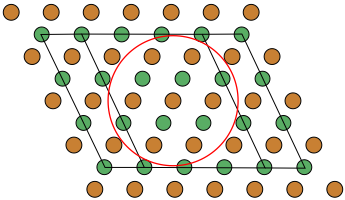
Searching procedure Our search procedure is based on a classic KD-tree search strategy. As shown in Figure 2, a search radius is used to represent the area where connected nodes can exist. On the other side, we expand the explored area up to a search radius. As the search radius is defined with the KNN in the case of a KNN-graph, the search radius decreases over time when a new area is explored. The search procedure pseudo-code is given by Algorithm 1.
| Algorithm 1 KNN graph generation algorithm | |
|---|---|
| Input: | |
| k: the k nearest ρ: the shape x: the position Output: 1: | connected atoms of the lattice of the crystal of the nodes inside the lattice a set of edges dmax i ←∞ |
| 2: border | ← (0, 0, 0) any(dmax |
| 3: | Γ1 ← {∅} |
| 4: | |
| while i > closest distance(border, ρ)) do dmax ) | |
| 5: | extension ← next evaluated area(border, i |
| 6: | γ ← evaluate area(ρ, x, extension) |
| 7: | Γ1 ← push nearest(Γ1, γ, k) |
| 8: | border ← border + extension |
| 9: | dmax i ←max(i′ ,j,τ)∈Γ1|i′=i di′ jτ |
| 10: | end while |
| 11: | return Γ1 |
Ordered stack To keep track of the k closest points already discovered by our search procedure, we proposed an efficient data structure to store points. Our ordered stack first concatenates new data and then sorts them by distance. After that, the edges are filtered to keep only the KNN in the case of a KNN-graph or the edges under a given cutoff distance in the case of a cutoff-graph.
Algorithm 2 Push edges in and ordered stack
Input: k: the k shortest edges Γ1: a list of edges γ: the list of edges to merge Output: the list of the k shortest edges 1: Γ′1 ←Γ1 ∥ γ 2: Γ′1 ← sort by distance(Γ′1 ) 3: Γ′1 ← stable sort by source index(Γ′1 ) 4: dki ← k nearest distancei(Γ′1 ) 5: Γ′1 ← {(i, j, τ) ∈ Γ′1 |d(i,j,τ) ≤ dki } 6: return Γ′1In addition to graph generation, our tool provides additional functionalities such as:
- Symmetric graph: as some GNN require symmetric directed graphs to perform specific message-passing schema, our tool includes a procedure that makes a given graph symmetric by adding missing edges while guaranteeing the uniqueness of the edges.
- Triplets generation: We provide an implementation to generate triplets composed of two edges sharing the same source nodes during the run-time. This task is important because recent works use triplets information
| knn | cutoff distance | |||||
|---|---|---|---|---|---|---|
| 16 | 32 | 64 | 3.0 | 5.0 | 8.0 | |
| CPU | 1029.6 | 1120.1 | 1669.3 | 968.3 | 1214.4 | 2829.9 |
| GPU | 25.2 | 25.8 | 37.7 | 20.5 | 34.0 | 57.8 |
| batch | 0.053 | 0.055 | 0.080 | 0.043 | 0.072 | 0.123 |
| batch size | 32 | 64 | 128 | 256 | 512 |
| batch (ms) | 22.0 | 24.7 | 35.0 | 59.3 | 97.5 |
|---|---|---|---|---|---|
| total (s) | 82.2 | 46.2 | 32.7 | 27.7 | 22.8 |
| RAM (Mo) | 565.6 | 1079.6 | 2300.1 | 2991.0 | 4811.2 |
during inference [Klipfel et al., 2023; Xie et al., 2022; Klicpera et al., 2021].
3 Performance Evaluation
To evaluate the performance of our tool, we conducted experiments on Materials project [Jain et al., 2013] which is a dataset composed of 133420 crystalline materials studied with ab inito calculation. We considered the same setting as [Xie et al., 2022] where structures composed of more than 64 atoms are removed since they are in general considered outliers. The experiments are performed on an Nvidia quadro RTX 8000 GPU.
CPU vs GPU We compared the time required to process all the structures for our tool with and without GPU optimization. We used a fixed batch size of 256 structures and generated the structures for the 16, the 32 and the 64 nearest neighbours of atoms. As shown in table 1, the KNN-graph generated on GPU is up to 40 times faster than an equivalent CPU library.
Complexity, inference time andRAMusage To check the time complexity of our method, we compare the generation time of one batch with various KNN settings in Table 1 and batch size in Table 2). Experiments on batch size have been performed for a KNN-graph with 32 neighbours.
4 Conclusion
We propose an efficient tool to convert crystalline materials into graphs. Our library allows for reducing the time spent during prepossessing. More importantly, the graph conversion is quick enough to be used during the training process without the prepossessing step and updates the graph while updating the geometry of a given structure. Our tool opens new possibilities in generative networks for material science.
Acknowledgments
This work has been supported by ANR-22-CE23-0002 ERIANA, ANR-20-THIA-0004 and by HPC resources from GENCI-IDRIS (Grant 2022-[AD011013338]).
@inproceedings{ijcai2023p836,
  title     = {Optimized Crystallographic Graph Generation for Material Science},
  author    = {Klipfel, Astrid and Frégier, Yaël and Sayede, Adlane and Bouraoui, Zied},
  booktitle = {Proceedings of the Thirty-Second International Joint Conference on
               Artificial Intelligence, {IJCAI-23}},
  publisher = {International Joint Conferences on Artificial Intelligence Organization},
  editor    = {Edith Elkind},
  pages     = {7145--7148},
  year      = {2023},
  month     = {8},
  note      = {Demo Track},
  doi       = {10.24963/ijcai.2023/836},
  url       = {https://doi.org/10.24963/ijcai.2023/836},
}
TY - CPAPER TI - Optimized Crystallographic Graph Generation for Material Science AU - Klipfel, Astrid AU - Frégier, Yaël AU - Sayede, Adlane AU - Bouraoui, Zied T2 - Proceedings of the Thirty-Second International Joint Conference on Artificial Intelligence, IJCAI-23 PB - International Joint Conferences on Artificial Intelligence Organization PY - 2023 SP - 7145 EP - 7148 DO - 10.24963/ijcai.2023/836 UR - https://doi.org/10.24963/ijcai.2023/836 ER -Copied
Machine-readable versions of this paper, for tools and AI agents:





