
Modeling the Impact of Policy Interventions for Sustainable Development
Proceedings of the Thirty-Second International Joint Conference on Artificial Intelligence. Demo Track. Pages 7167-7170.
https://doi.org/10.24963/ijcai.2023/841
Keywords
- Multidisciplinary Topics and Applications: MDA: Computational sustainability
- Machine Learning: ML: Explainable/Interpretable machine learning
- Multidisciplinary Topics and Applications: MDA: Energy, environment and sustainability
- AI Ethics, Trust, Fairness: ETF: AI and law, governance, regulation
- Uncertainty in AI: UAI: Bayesian networks
Abstract
There is an increasing demand to design policy interventions to achieve various targets specified by the UN Sustainable Development Goals by 2030. Designing interventions is a complex task given that the system may often respond in unexpected ways to a given intervention. This could be due to interventions towards a given target, affecting other unrelated variables, and/or interventions leading to acute disparities in nearby geographic areas. In order to address such issues, we propose a novel concept called Stress Modeling that analyzes the holistic impact of a policy intervention by taking into account the interactions within a system, after the intervention. The simulation is based on the postulate that complex systems of interacting entities tend to settle down into "low energy'' configurations by minimizing differentials in capabilities of neighbouring entities. The simulation shows how policy impact percolates through geospatial boundaries over time and can be applied at any granularity. The theory and the corresponding package have been explained along with a case study analyzing a fertilizer policy in the Agro-climatic Zones of the state of Karnataka, India.
- [Bassin et al., 2022] Pooja Bassin, Niharika Sri Parasa, Sri- nath Srinivasa, and Sridhar Mandyam. Big data manage- ment for policy support in sustainable development. In Shelly Sachdeva, Yutaka Watanobe, and Subhash Bhalla, editors, Big-Data-Analytics in Astronomy, Science, and Engineering, pages 3-15, Cham, 2022. Springer Interna- tional Publishing.
- [Bassin, 2022] Pooja Bassin. Network learning on open data to aid policy making. In Sebastian Link, Iris Reinhartz- Berger, Jelena Zdravkovic, Dominik Bork, and Srinath Srinivasa, editors, Proceedings of the ER Forum and PhD Symposium 2022 co-located with 41st International Con- ference on Conceptual Modeling (ER 2022), Virtual Event, Hyderabad, India, October 17, 2022, volume 3211 of CEUR Workshop Proceedings. CEUR-WS.org, 2022.
- [Branchi and Feltrin, 2019a] Bruna Branchi and Marina Fel- trin. Dashboard and composite indicator for monitoring sustainable development. International Journal of Inno- vation Education and Research, 7:316-327, 05 2019.
- [Branchi and Feltrin, 2019b] Bruna Branchi and Marina Fel- trin. Dashboard and composite indicator for monitoring sustainable development. International Journal of Inno- vation Education and Research, 7:316-327, 05 2019.
- [Costanza and Patten, 1995] Robert Costanza and Bernard C Patten. Defining and predicting sustainability. Ecological economics, 15(3):193-196, 1995.
- [Cucurachi and Suh, 2017] Stefano Cucurachi and Sangwon Suh. Cause-effect analysis for sustainable development policy. Environmental Reviews, 25(3):358-379, 2017.
- Das, a] The dashboard of sustainability. https://www. Link
- Das, b] Sdg india index and dashboard 2020-21. https: //sdgindiaindex.niti.gov.in/#/. Accessed: 2023-01-30. Link
- [Fonseca et al., 2020] Luis Miguel Fonseca, José Pedro Domingues, and Alina Mihaela Dima. Mapping the sus- tainable development goals relationships. Sustainability, 12(8):3359, 2020.
- [Head, 2020] Michael G Head. A real-time policy dashboard can aid global transparency in the response to coronavirus disease 2019. International Health, 12(5):373-374, 07 2020.
- [Kiciman et al., 2022] Emre Kiciman, Eleanor Dillon, Dar- ren Edge, Adam Foster, Agrin Hilmkil, Joel Jennings, Chao Ma, Robert Osazuwa Ness, Nick Pawlowski, Amit Sharma, and Cheng Zhang. A causal ai suite for decision- making. In NeurIPS 2022 Workshop on Causality for Real- world Impact, December 2022.
- [Kuklys, 2005] Wiebke Kuklys. Amartya Sen's capability approach: Theoretical insights and empirical applica- tions. Springer, 2005.
- [Nilsson et al., 2016] Måns Nilsson, Dave Griggs, and Mar- tin Visbeck. Policy: Map the interactions between sustain- able development goals. Nature, 534:320-322, 06 2016.
- [Srinivasa, 2019] S. Srinivasa. The Theory of Being: Systems Science from a Traditional Indian Perspective. Indepen- dently Published, 2019.
- [van Laarhoven et al., 1987] Peter.J van Laarhoven, Yasut- sugu Ohki, and Demsew Teferra. Simulated Annealing: Theory and Applications. Kluwer Academic Publishers, Dordrecht, Boston, 01 1987.
- [Wu et al., 2022] Xutong Wu, Bojie Fu, Shuai Wang, Shuang Song, Yingjie Li, Zhenci Xu, Yongping Wei, and Jianguo Liu. Decoupling of sdgs followed by re-coupling as sustainable development progresses. Nature Sustain- ability, 5(5):452-459, 2022.
References were extracted automatically from the PDF and may contain errors.
Full text extracted automatically from the PDF; figures, tables and equations may differ. The PDF is the version of record.
1 Introduction &Contribution
Policy interventions are the primary mechanisms adopted by several countries towards improving their indicators and achieving targets on the UN Sustainable Development Goals (SDGs). While most such interventions are administered in a piecemeal fashion, researchers have stressed the need for a holistic approach that incorporates interactions between different indicators and geographical regions [Nilsson et al., 2016; Cucurachi and Suh, 2017; Wu et al., 2022; Fonseca et al., 2020]. In order to ensure coherent policy/strategy making, there is a need to identify what is the impact of an intervention over time and how the impact percolates geospatial entities.
There is an increasing understanding that sustainability cannot be modeled as a goal-achievement problem. As argued by Constanza and Patten [1995], sustainability is not a goal that can be achieved, but an assertion about the future. Merely achieving a given target does not also guarantee that this achievement will sustain. Sustainability needs to be investigated along with an abstract notion of capability [Kuklys, 2005]. Both these variables need to be considered and optimized together. While capability can be understood in terms of goal-achievement, sustainably improving capabilities is more of a state maintenance problem. The SDG targets that the UN has set to achieve can be perceived as an enhancement of the capabilities rather than an achievement of sustainability. It is more accurate to say that sustainable development basically means sustainable improvement of capabilities.
In any complex system, individual entities with capabilities interact with their neighboring entities. These interactions, whether by design or otherwise, impact the system's current state continually till the system settles down to some stable configuration. The capability of the system in a stable configuration may or may not be the intended capability meant to be achieved by a policy intervention. Some forms of capability enhancement interventions may serve to perturb the system strongly enough such that it settles down into a different stable state, with a correspondingly different set of capabilities. Thus, the question of creating policies to improve sustainability in a region can be perceived as perturbing the system or the region under consideration from its current stable state into another stable state, such that the new capabilities it achieves are productive for the people.
As noted by Nilsson et al. [2016], policymakers and planners usually operate in silos and often fail to notice how the interventions of one sector affect another, positively or negatively. In this light, our work aims to develop a methodology to model the capability enhancement intervention and the following interactions to shift the system to a new state. We propose a concept called Stress Modeling which is based on the postulate that a complex system of interacting entities tends to settle down in "low energy" configurations by minimizing capability differentials between interacting components [Srinivasa, 2019; van Laarhoven et al., 1987]. The capability differential between neighboring entities is called stress. Each entity within the system strives to reduce the stress it experiences. We have implemented Stress Modeling to study the evolution of the impact of capability enhancement interventions.
Sustainability monitoring dashboards are common [Branchi and Feltrin, 2019a; Branchi and Feltrin, 2019b; Das, b]; however, being confined to monitoring, they remain inadequate for policymakers to analyze the impact of an intervention. Tools like Dashboard of Sustainability [Das, a; Head, 2020] allow policymakers to view the impact of policies in real-time, but do not allow dynamic simulations of policies or predict possible equilibrium states. Only tools and models that are based on causal inference [Kiciman et al., 2022] support intervention simulations and analysis of possible impact. Even among them, Stress Modeling is novel as it takes into account the interactions of the entities in the system and the percolation of policy impact through both time and space.
The sections below discuss the mathematical approach and utility of Stress Modeling in the ongoing project Karnataka Data Lake 1 funded by the Government of Karnataka, India.
2 Stress Modeling
Formally, our model comprises an undirected graph G = (V,E), where the nodes V represent the set of entities of the system, under consideration. Edges of the form (u, v) represent adjacency where capability changes in one are assumed to impact the other. Let the set of neighbors of a given node v be represented as Γ(v). Each node v ∈ V is associated with a capability vector ⃗ c(v) of m dimensions, where the ith dimension is represented as ⃗ ci(v). In the implementation of the package, the undirected graph G = (V,E) is an object of GraphCreator. Users can input a custom neighborhood graph, use one of the package's PreComputed graphs, or can generate it from a shape file using the method ShapetoAdjFile(). The capabilities are encapsulated in a Value object, which is an attribute of GraphCreator, using the post-intervention capability values supplied by the user.
Policy interventions are essentially capability enhancement interventions. They translate to changing one or more m dimensions of ⃗ c(v) of one or more nodes v ∈ V . Let a policy intervention result in the change of the capability vector of node v from ⃗ c(v) to ⃗ c′ (v). This would affect the neighbors of v and their respective capability vectors. We model the capability stress experienced by a node v as:
Here L2(·, ·) is the L2 or Euclidean distance between the two vectors and is calculated as:
Each node in the network then computes an adjustment to its capability vector based on minimizing its stress with its neighbors. The stable optimal vector ⃗ co (v) for node v:
1 https://avalokana.karnataka.gov.in/DataLake/DataLake
Minimization of stress is implemented as a gradient descent routine (StressReduction.GradientDescent), where each node computes several candidate changes to its present capability vector and then chooses the one with the highest gradient towards minimizing the stress. It is well known that the mean minimizes the sum of Euclidean distance to a set of n points. Hence, in every iteration, the capability of each node moves towards the centroid of the polygon formed by the capability vectors of its neighbors in mdimensional space. Thus, the capability vector ⃗ c(v)new after this iteration is,
The network is said to have reached a new equilibrium or sustainable state when stress reduction routines converge for all the nodes. The variation of capability vectors until convergence is captured in an object of the class ResultObject.
The package provides basic visualization as part of the Visualize method to show the change in capability vectors over the iterations of Stress Modeling. Our result object can be used to analyze the merit of any policy intervention w.r.t what kind of side-effects and push-backs it caused in the system.
Our model is available as a PyPI package 2 along with documentation and code 3 that can be used for geospatial systems, as explained in the demo video 4 .
3 Case Study: Impact of Increasing NPK Fertilizers on Agro-climatic Zones of Karnataka
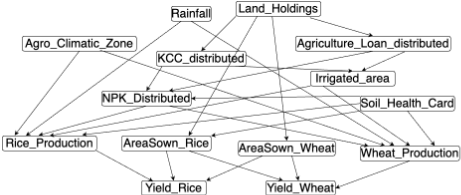
On the basis of the distribution of soil characteristics, rainfall, and major cropping system, India is divided into 15 Agro-climatic Zones (ACZ). These zones are means to apply climatological information to improve agricultural productivity. Using the taxonomy described in Section 2, the graph was set up with the 10 ACZ of the state of Karnataka, India: North East Transition Zone (NETZ), Northeastern Dry Zone (NEDZ), Northern Dry Zone (NDZ), Central Dry Zone (CDZ), Eastern Dry Zone (EDZ), Southern Dry Zone (SDZ), Southern Transition Zone (STZ), North Transition Zone (NTZ), Hill Zone (HZ), Coastal Zone (CZ) 5 . The edges connect geographically adjacent ACZ. The capability vector has 2 dimensions ["Wheat Yield", "Rice Yield"], both of which are target variables of the Bayesian network in Figure 1.
2 https://pypi.org/project/StressModellingPackageTest
3 https://github.com/sowmithnandan/StressModellingPackageTest
3.1 Intervention and Stress Modeling
For each ACZ, the Bayesian network for rice and wheat yield (Figure 1) is trained using the Karnataka At A Glance dataset 6 . Nitrogen (N), Potassium (K), and Phosphorus (P) are the primary nutrients required for crops. An ideal ratio of NPK is essential for sustainable plant growth hence, the NPK distributed (Figure1) variable was chosen to intervene.
The intervention was performed by conditioning it to high for all the ACZ in the state of Karnataka. This altered the categorical distribution of the target variables (Rice and Wheat yield) in each zone. A scalar value for each dimension of the capability vector can be obtained from the categorical probability distribution by using any method from the Scalarization class like L2 Norm, ATE etc., or any user-defined function. We used L2 Norm in this case. We get the value for all dimensions of the capability vector for each ACZ and with that, the system is set up. Finally, the Stress Modeling routine was run for 10 iterations to get the final result 7 .
3.2 Results and Inferences
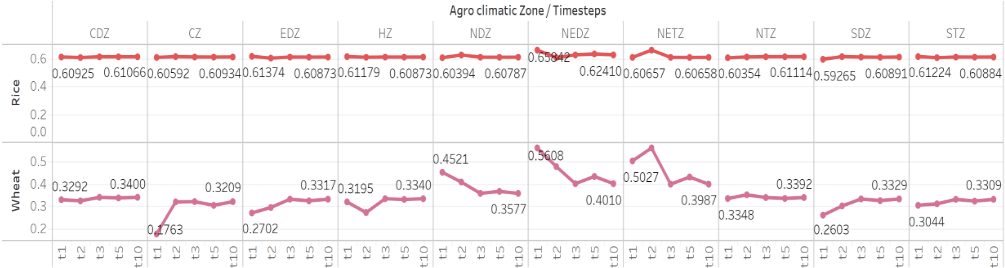
The following can be inferred post Stress Modeling 8 as shown in Figure 2 in corroboration with the domain experts from the Planning and Statistics Department, Government of Karnataka, India 9 .
· Effect of fertilizers on rice in coastal regions:
In Coastal regions (CZ), the intervention seems to have no immediate impact on rice yield and there is little change throughout the iterations of Stress Modeling. This implies that increasing NPK fertilizer levels does not enhance rice yield, even in the long run.
5 https://e-krishiuasb.karnataka.gov.in/Weather/ViewWeatherData.aspx
8 https://kdl.iiitb.ac.in/stress-modelling/
9 https://planning.karnataka.gov.in/english
· Wheat yield in the Northern regions:
The northern ACZ (NDZ, NETZ, NEDZ) have higher wheat yield values than other zones throughout Stress Modeling. This is in agreement with the observed wheat yield in the northern dry regions of Karnataka.
· Spike observed during Stress Modeling:
After the policy intervention, an increase in wheat yield is observed in NETZ till it reaches a peak. It then plunges and gradually settles down to a new yield score. Even though the policy may show an immediate effect, its percolation on neighboring areas prompts the target variables to settle down to a different equilibrium after a few time steps.
4 Conclusions, Limitations and FutureWork
Stress Modeling is a novel way to analyze the holistic impact of interventions in complex systems and how the influence percolates through geospatial entities over time. The associated package can be installed and used by all Python users to study policy effects at any granularity 10,11 . Currently, Stress Modeling is being used as a significant component of the Policy Enunciator of the Policy Support System architecture [Bassin, 2022; Bassin et al., 2022].
Stress Modeling ties in with the concept of computational sustainability. A future direction would be to define notions such as stability, resilience, and fairness within this framework and test them at different equilibrium states. The stress modeled in this work is "external" and is experienced by entities because of the neighborhood/environment. Stress can also be incurred between the dimensions of the capability vector. Internal Stress Modeling could be introduced in the future to cater to the influence caused by the interdependencies of different dimensions of a given capability vector.
10 https://rb.gy/qtftud 11 https://rb.gy/tn3xpw
Acknowledgments
The authors thank the Planning, Programme Monitoring and Statistics Department, Government of Karnataka, India. We thank the Sustainable Development Goals Coordination Centre, Haryana, India. Finally, we would like to show our appreciation for the tool Netica (by Norsys Software Corp).
@inproceedings{ijcai2023p841,
  title     = {Modeling the Impact of Policy Interventions for Sustainable Development},
  author    = {Rachuri, Sowmith Nandan and Malavalli, Arpitha and Parasa, Niharika Sri and Bassin, Pooja and Srinivasa, Srinath},
  booktitle = {Proceedings of the Thirty-Second International Joint Conference on
               Artificial Intelligence, {IJCAI-23}},
  publisher = {International Joint Conferences on Artificial Intelligence Organization},
  editor    = {Edith Elkind},
  pages     = {7167--7170},
  year      = {2023},
  month     = {8},
  note      = {Demo Track},
  doi       = {10.24963/ijcai.2023/841},
  url       = {https://doi.org/10.24963/ijcai.2023/841},
}
TY - CPAPER TI - Modeling the Impact of Policy Interventions for Sustainable Development AU - Rachuri, Sowmith Nandan AU - Malavalli, Arpitha AU - Parasa, Niharika Sri AU - Bassin, Pooja AU - Srinivasa, Srinath T2 - Proceedings of the Thirty-Second International Joint Conference on Artificial Intelligence, IJCAI-23 PB - International Joint Conferences on Artificial Intelligence Organization PY - 2023 SP - 7167 EP - 7170 DO - 10.24963/ijcai.2023/841 UR - https://doi.org/10.24963/ijcai.2023/841 ER -Copied
Machine-readable versions of this paper, for tools and AI agents:





