
LingGe: An Automatic Ancient Chinese Poem-to-Song Generation System
Proceedings of the Thirty-Second International Joint Conference on Artificial Intelligence. Demo Track. Pages 7171-7174.
https://doi.org/10.24963/ijcai.2023/842
Keywords
- Multidisciplinary Topics and Applications: MDA: Arts and creativity
- Multidisciplinary Topics and Applications: MDA: Other
Abstract
This paper presents a novel system, named LingGe ("伶歌" in Chinese), to generate songs for ancient Chinese poems automatically. LingGe takes the poem as the lyric, composes music conditioned on the lyric, and finally outputs a full song including the singing and the accompaniment. It consists of four modules: rhythm recognition, melody generation, accompaniment generation, and audio synthesis. Firstly, the rhythm recognition module analyzes the song structure and rhythm according to the poem. Secondly, the melody generation module assembles the rhythm into the template and then generates the melody. Thirdly, the accompaniment generation module predicts the accompaniment in harmony with the melody. Finally, the audio synthesis module generates singing and accompaniment audio and then mixes them to obtain songs. The results show that LingGe can generate high-quality and expressive songs for ancient Chinese poems, both in harmony and rhythm.
- [Bao et al., 2018] Hangbo Bao, Shaohan Huang, Furu Wei, Lei Cui, Yuehua Wu, Chuanqi Tan, Songhao Piao, and M. Zhou. Neural melody composition from lyrics. In Nat- ural Language Processing and Chinese Computing, 2018.
- [Huang et al., 2021] Rongjie Huang, Feiyang Chen, Yi Ren, Jinglin Liu, Chenye Cui, and Zhou Zhao. Multi-singer: Fast multi-singer singing voice vocoder with a large-scale corpus. Proceedings of the 29th ACM International Con- ference on Multimedia, 2021.
- [Ju et al., 2021] Zeqian Ju, Peiling Lu, Xu Tan, Rui Wang, Chen Zhang, Songruoyao Wu, Ke jun Zhang, Xiang- Yang Li, Tao Qin, and Tie-Yan Liu. Telemelody: Lyric- to-melody generation with a template-based two-stage method. In Conference on Empirical Methods in Natural Language Processing, 2021.
- [Kong et al., 2020] Jungil Kong, Jaehyeon Kim, and Jaeky- oung Bae. Hifi-gan: Generative adversarial networks for efficient and high fidelity speech synthesis. Advances in Neural Information Processing Systems, 33:17022-17033, 2020.
- [Lee et al., 2019] Hsin-Pei Lee, Jhih-Sheng Fang, and Wei- Yun Ma. icomposer: An automatic songwriting system for chinese popular music. In North American Chapter of the Association for Computational Linguistics, 2019.
- [Liu et al., 2021] Jinglin Liu, Chengxi Li, Yi Ren, Feiyang Chen, and Zhou Zhao. Diffsinger: Singing voice synthesis via shallow diffusion mechanism. In AAAI Conference on Artificial Intelligence, 2021.
- [Lv et al., 2022] Ang Lv, Xu Tan, Tao Qin, Tie-Yan Liu, and Rui Yan. Re-creation of creations: A new paradigm for lyric-to-melody generation. ArXiv, abs/2208.05697, 2022. IJCAI
- [Newmarch and Newmarch, 2017] Jan Newmarch and Jan Newmarch. Fluidsynth. Linux Sound Programming, pages 351-353, 2017.
- [Qian et al., 2022] Tao Qian, Jiatong Shi, Shuai Guo, Peter Wu, and Qin Jin. Training strategies for automatic song writing: A unified framework perspective. ICASSP 2022 - 2022 IEEE International Conference on Acoustics, Speech and Signal Processing (ICASSP), pages 4738-4742, 2022.
- [Sheng et al., 2021] Zhonghao Sheng, Kaitao Song, Xu Tan, Yi Ren, Wei Ye, Shikun Zhang, and Tao Qin. Songmass: Automatic song writing with pre-training and alignment constraint. In Proceedings of the AAAI Conference on Ar- tificial Intelligence, volume 35, pages 13798-13805, 2021.
- [Vaswani et al., 2017] Ashish Vaswani, Noam Shazeer, Niki Parmar, Jakob Uszkoreit, Llion Jones, Aidan N Gomez, Łukasz Kaiser, and Illia Polosukhin. Attention is all you need. Advances in neural information processing systems, 30, 2017.
- [Wang et al., 2020] Ziyu Wang, K. Chen, Junyan Jiang, Yiyi Zhang, Maoran Xu, Shuqi Dai, Xianbin Gu, and Gus Xia. Pop909: A pop-song dataset for music arrangement gen- eration. In International Society for Music Information Retrieval Conference, 2020.
- [Yu and Canales, 2019] Yi Yu and Simon Canales. Condi- tional lstm-gan for melody generation from lyrics. ACM Transactions on Multimedia Computing, Communica- tions, and Applications (TOMM), 17:1 -20, 2019.
References were extracted automatically from the PDF and may contain errors.
Full text extracted automatically from the PDF; figures, tables and equations may differ. The PDF is the version of record.
1 Introduction
Ancient Chinese poem 1 is an important intangible cultural heritage of China and an artistic carrier of thought, culture, spirit, and emotion with more than thousands of years in history. Unlike modern Chinese poems, it is typically written in classical Chinese and follows specific rules, forms, tones, and rhyme schemes. In ancient years, these poems could be sung into songs with corresponding melodies. However, most of these melodies have been lost for historical reasons. Therefore, it is significant and attractive to recreate melodies and songs for ancient Chinese poems. Technically, it can be formulated as the lyric-to-melody generation task.
In recent years, with the rapid development of artificial intelligence, automatic lyric-to-melody generation has achieved remarkable progress. Previous studies usually adopt endto-end models to directly generate melodies from lyrics, which requires a large amount of paired lyric-melody data to sufficiently learn the strict lyric-melody feature alignments [Bao et al., 2018; Yu and Canales, 2019; Lee et al., 2019;
1 https://en.wikipedia.org/wiki/Classical Chinese poetry
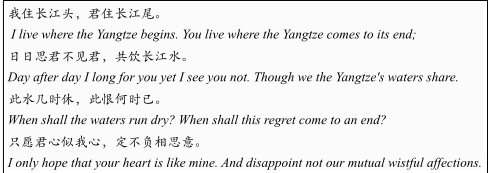
Sheng et al., 2021; Qian et al., 2022]. However, the paired data is hard and expensive to collect, which limits the performance of these methods. To alleviate this problem, other studies decompose the lyric-to-melody task into two generation stages [Ju et al., 2021], or retrieve pre-generated music pieces from the database according to the key lyric features [Lv et al., 2022]. However, these methods suffer from the data noise produced by auto-labeling tools or neglect the inner rhythm of lyrics, which reduces the melody quality. Moreover, previous systems fail to generate rhythms 2 in harmony with the ancient Chinese poem written in classical Chinese. Briefly, the ancient Chinese poem-to-song generation still needs to be explored.
In this paper, we propose an automatic ancient Chinese poem-to-song generation system called LingGe 3 . LingGe takes the poem as the lyric and generates songs conditioned on the lyric. It comprises four modules: rhythm recognition, melody generation, accompaniment generation, and audio synthesis. In the rhythm recognition module, we introduce prior expert knowledge to analyze the song structure and obtain a consistent rhythm with the lyric. In the melody generation module, we assemble the rhythm into the template and employ a template-to-melody model [Ju et al., 2021] to generate melodies. Unlike previous systems, we trained the template-to-melody model on our collected dataset including 28931 melodies with high-quality chord 4 annotations to enhance the quality of generated melodies. In the accompaniment generation module, we integrate a Transformer model [Vaswani et al., 2017] to predict harmonious accompaniment, which further enhances the performance. Finally, we adopt the audio synthesis module to synthesize singing and accompaniment audio and then mix them to obtain songs. Specifically, we train a singing voice synthesis model based on DiffSinger [Liu et al., 2021] to generate the singing audio. The results show that LingGe can generate high-quality songs for ancient Chinese poems both in harmony and rhythm.
2 https://en.wikipedia.org/wiki/Rhythm#Composite rhythm
3 Demo webpage: https://boya-music.github.io/lingge
2 Dataset Construction
For training the melody generation module, we crawled melodies with high-quality chord annotations from online websites. Then, we applied the following normalization steps and finally obtained the dataset with 28931 melodies: (1) Keep only MIDI files with a constant tempo and 4/4 5 time signature. (2) Remove empty bars. (3) Normalize the tonality 6 to "C major" or "A minor" since other tonalities can be transposed to these two tonalities based on their scales 7 . (4) Normalize the chord annotations into "C major" or "A minor" tonalities. Next, we extracted the template from the melody and represented the paired template-melody with symbolic tokens. For the melody, we represent them as note sequences where each note is symbolized by four consecutive tokens (bar, position, pitch, and duration). For the template, we will describe the details of template extraction in Section 3.2.
4 https://en.wikipedia.org/wiki/Chord (music)
5 4/4 denotes that each beat is a 1/4 note and each bar has 4 beats.
6 https://en.wikipedia.org/wiki/Tonality
7 https://en.wikipedia.org/wiki/Scale (music)
For training the accompaniment generation module, we adopted POP909 dataset [Wang et al., 2020], which contains 909 songs with detailed annotations including the melody track, the chord progression, and the accompaniment track with broken chords style. We combine the melody notes and the chord progression as the input, where each note is symbolized by five consecutive tokens (bar, position, pitch, duration, and chord). Similarly, we represent the accompaniment notes as the output, where each note is symbolized by four consecutive tokens (bar, position, pitch, and duration).
For training the audio synthesis module, we collected a 6hour singing voice synthesis dataset including 100 songs performed by a qualified female vocalist. All the audio files are recorded in a recording studio and sampled at 24kHz with 16bit quantization. All the songs are phonetically labeled with phoneme boundaries, syllable boundaries, and pitch manually. To improve the training efficiency, we decompose the recorded songs into short utterances according to the rest and the lyric semantic information.
3 Poem-to-Song Generation
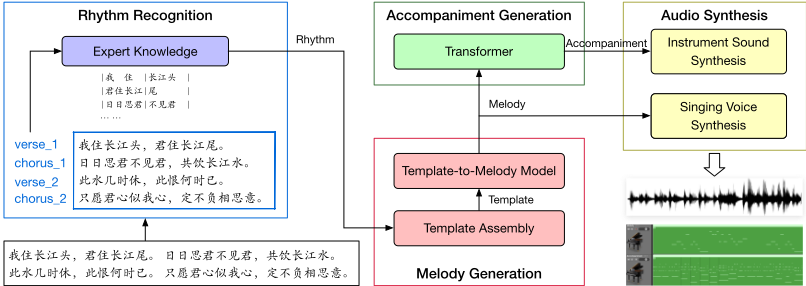
As shown in Figure 2, LingGe contains four modules: (1) a rhythm recognition module that analyzes the song structure and the rhythm according to the poem, (2) a melody generation module that assembles the rhythm into the template and then generates melodies, (3) an accompaniment generation module that predicts the accompaniment in harmony with the melody, (4) an audio synthesis module that generates singing audio and accompaniment audio, and mixes them into songs.
3.1 RhythmRecognition
Ancient Chinese poem is typically written in classical Chinese following specific metrics and forms, which has a good structure and is neat in antithesis. Therefore, we carefully design the rule-based rhythm recognition module to guarantee the harmony of rhythm. First, given the lyric (i.e., an ancient Chinese poem) with specific metrics, we parse the song structure into four sections: verse 1, chorus 1, verse 2, and chorus 2. Due to the restriction of metrics, similar sections (e.g., all verses, all choruses) are symmetrical in the number of phrases and syllables. Thus, we also share the rhythm and the melody between similar sections to keep consistent. Then, we analyze the rhythm of each section phrase by phrase based on expert knowledge. Specifically, we develop several possible rhythm patterns for phrases of each length in advance. For example, a 5-syllable phrase can be segmented into two bars with a rhythm of "|2|3|" or "|4|1|". For a new song, we sample rhythm patterns according to the phrase length and then arrange all sections sequentially to obtain the complete rhythm.
3.2 Melody Generation
To alleviate the data scarcity problem in poem-to-song generation, we first extract templates from our melody dataset, then train a template-to-melody model, and finally assemble the lyric-based rhythm into the template to generate melodies. Template extraction. We extracted musical elements including tonality, chord progression 8 , rhythm pattern, pitch 9 pattern, and cadence 10 from melodies, and then combine them into a template. Unlike TeleMelody [Ju et al., 2021], we introduce the novel pitch pattern to constrain the melody trend. Specifically, we detect several melodic movement features ("conjunct", "disjunct", "auxiliary notes", "repeated notes", "chord notes", and "others") and integrate these features into the template. Tonality and chord progression are annotated in the original dataset. Rhythm patterns can be inferred based on the position information of notes in melodies. Cadence can be inferred based on note duration.
Training. We adopt the Transformer [Vaswani et al., 2017] architecture as the template-to-melody model including a 6layer encoder and a 6-layer decoder, and then train it on our collected paired template-melody dataset. It predicts the melody in an auto-regressive manner.
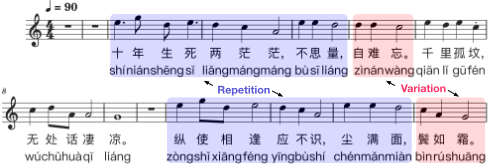
Inference. We assemble the lyric-based rhythm into the template. Specifically, the tonality is set to "C major". The cadence is inferred by the punctuation of the lyric. The chord progression is sampled from some popular chord progressions. To improve the melody aesthetic, we collect a database where pitch patterns are collected according to the syllable length from our training set in advance. For each phrase, we sample a pitch pattern from the database and then share the same pitch pattern with other phrases with equal syllable lengths. Thus, phrases with equal syllable length will have a similar pitch trend, which brings repetitions and variations into the generated melody. Finally, we polish the generated melody with several heuristic arrangement rules.
3.3 Accompaniment Generation
To further improve the performance, we train a Transformer model to generate harmonious accompaniment. After the melody is generated, it takes the melody notes and the chord progression as the input and then decodes the accompaniment notes with broken chords style. To make the song more natural, we add intro, bridge and outro sections and generate corresponding accompaniment notes.
8 https://en.wikipedia.org/wiki/Chord progression
9 https://en.wikipedia.org/wiki/Pitch (music)
10 https://en.wikipedia.org/wiki/Cadence
3.4 Audio Synthesis
To further enrich the song, we synthesize the singing and accompaniment audio. For the singing, we train a singing voice synthesis model to generate expressive singing voices based on lyrics and melodies. It consists of an acoustic model that produces the mel-spectrogram conditioned on the music score and a vocoder that reconstructs the singing voice from the mel-spectrogram. We use the diffusion-based DiffSinger [Liu et al., 2021] as the acoustic model, which can be efficiently trained by optimizing ELBO without adversarial feedback, and generates realistic mel-spectrograms strongly matching the ground truth distribution. Meanwhile, we use the HiFiGAN model [Kong et al., 2020] as the vocoder, which can efficiently synthesize high-quality speech audio. Specifically, we pretrained the HiFi-GAN vocoder on the OpenSinger dataset [Huang et al., 2021], which is a large-scale, multisinger Chinese singing voice dataset. To ensure the generalization, we further fine-tuned the pre-trained vocoder on our singing dataset. For the accompaniment, we employ the fluidsynth [Newmarch and Newmarch, 2017] tool to generate audio with piano timbre. Finally, we mix the singing and accompaniment audio into the complete song for the poem.
4 Results
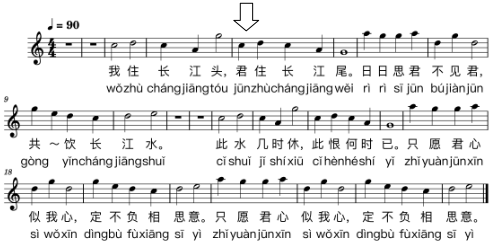
Figure 3 shows a composition result generated by LingGe. More audible results are available on the demo webpage 3 . It demonstrates the following points: (1) The structure and rhythm of the song are consistent with the poem. (2) The melody is harmonious, with musical composition skills (e.g., repetitions, variations), suitable for the lyrics. (3) The accompaniment is in harmony with the melody. (4) The singing voice is natural and expressive.
5 Conclusion
In this paper, we develop a novel system, LingGe, to challenge the task of generating songs for ancient Chinese poems. LingGe consists of four modules: rhythm recognition, melody generation, accompaniment generation, and audio synthesis. The rhythm recognition module analyzes the song structure and rhythm. The melody generation module assembles the template and generates the melody. The accompaniment generation module predicts the accompaniment from the melody. Finally, the audio synthesis module generates the singing and accompaniment audio and then mixes them into a complete song. The results show that LingGe can generate high-quality and expressive songs from ancient Chinese poems automatically.
@inproceedings{ijcai2023p842,
  title     = {LingGe: An Automatic Ancient Chinese Poem-to-Song Generation System},
  author    = {Shan, Yong and Zhang, Jinchao and Ren, Huiying and Qiu, Yao and Zhou, Jie},
  booktitle = {Proceedings of the Thirty-Second International Joint Conference on
               Artificial Intelligence, {IJCAI-23}},
  publisher = {International Joint Conferences on Artificial Intelligence Organization},
  editor    = {Edith Elkind},
  pages     = {7171--7174},
  year      = {2023},
  month     = {8},
  note      = {Demo Track},
  doi       = {10.24963/ijcai.2023/842},
  url       = {https://doi.org/10.24963/ijcai.2023/842},
}
TY - CPAPER TI - LingGe: An Automatic Ancient Chinese Poem-to-Song Generation System AU - Shan, Yong AU - Zhang, Jinchao AU - Ren, Huiying AU - Qiu, Yao AU - Zhou, Jie T2 - Proceedings of the Thirty-Second International Joint Conference on Artificial Intelligence, IJCAI-23 PB - International Joint Conferences on Artificial Intelligence Organization PY - 2023 SP - 7171 EP - 7174 DO - 10.24963/ijcai.2023/842 UR - https://doi.org/10.24963/ijcai.2023/842 ER -Copied
Machine-readable versions of this paper, for tools and AI agents:





