
VideoMaster: A Multimodal Micro Game Video Recreator
Proceedings of the Thirty-Second International Joint Conference on Artificial Intelligence. Demo Track. Pages 7179-7182.
https://doi.org/10.24963/ijcai.2023/844
Keywords
- Computer Vision: CV: Video analysis and understanding
- Natural Language Processing: NLP: Applications
- Computer Vision: CV: Applications
- Natural Language Processing: NLP: Language generation
- Computer Vision: CV: Vision and language
- Machine Learning: ML: Multi-modal learning
- Computer Vision: CV: Segmentation
- Natural Language Processing: NLP: Speech
- Multidisciplinary Topics and Applications: MDA: Arts and creativity
Abstract
To free human from laborious video production, this paper proposes the building of VideoMaster, a multimodal system equipped with four capabilities: highlight extraction, video describing, video dubbing and video editing. It extracts interesting episodes from long game videos, generates subtitles for each episode, reads the subtitles through synthesized speech, and finally re-creates a better short video through video editing. Notably, VideoMaster takes a combination of deep learning and traditional computer vision techniques to extract highlights with fine-to-coarse labels, utilizes a novel framework named PCSG-v (probabilistic context sensitive grammar for video) for video description generation, and imitates a target speaker's voice to read the description. To the best of our knowledge, VideoMaster is the first multimedia system that can automatically produce product-level micro-videos without heavy human annotation.
- [Borsos et al., 2022] Zalán Borsos, Raphaël Marinier, et al. Audiolm: a language modeling approach to audio genera- tion. arXiv:2209.03143, 2022.
- [Bradski and Kaehler, 2008] Gary Bradski and Adrian Kaehler. Learning OpenCV: Computer vision with the OpenCV library. O'Reilly Media, Inc., 2008.
- [Derpanis, 2010] Konstantinos G Derpanis. Overview of the ransac algorithm. Image Rochester NY, 4(1):2-3, 2010.
- [He et al., 2016] Kaiming He, Xiangyu Zhang, Shaoqing Ren, and Jian Sun. Deep residual learning for image recog- nition. In CVPR, 2016.
- [LeCun et al., 1998] Yann LeCun, Léon Bottou, Yoshua Bengio, and Patrick Haffner. Gradient-based learning ap- plied to document recognition. Proceedings of the IEEE, 86(11):2278-2324, 1998.
- [Leutenegger et al., 2011] Stefan Leutenegger, Margarita Chli, and Roland Y Siegwart. Brisk: Binary robust in- variant scalable keypoints. In ICCV, pages 2548-2555, 2011.
- [Li et al., 2021] Tingtian Li, Zixun Sun, Haoruo Zhang, Jin Li, Ziming Wu, Hui Zhan, Yipeng Yu, and Hengcan Shi. Deep music retrieval for fine-grained videos by exploiting cross-modal-encoded voice-overs. In Proceedings of the 44th International ACM SIGIR Conference on Research and Development in Information Retrieval, SIGIR '21, page 1880-1884, 2021.
- [Lowe, 2004] G Lowe. Sift-the scale invariant feature trans- form. Int. J, 2:91-110, 2004.
- [Ouyang et al., 2022] Long Ouyang, Jeff Wu, Xu Jiang, et al. Training language models to follow instructions with hu- man feedback. arXiv:2203.02155, 2022.
- [Ramesh et al., 2022] Aditya Ramesh, Prafulla Dhariwal, Alex Nichol, Casey Chu, and Mark Chen. Hierarchi- cal text-conditional image generation with clip latents. arXiv:2204.06125, 2022.
- [Ren et al., 2015] Shaoqing Ren, Kaiming He, Ross Gir- shick, and Jian Sun. Faster r-cnn: Towards real-time ob- ject detection with region proposal networks. In NeurIPS, 2015.
- [Rombach et al., 2022] Robin Rombach, Andreas Blattmann, Dominik Lorenz, Patrick Esser, and Björn Ommer. High-resolution image synthesis with latent diffusion models. In CVPR, pages 10684-10695, 2022.
- [Rublee et al., 2011] Ethan Rublee, Vincent Rabaud, Kurt Konolige, and Gary Bradski. Orb: An efficient alternative to sift or surf. In ICCV, 2011.
- [Saharia et al., 2022] Chitwan Saharia, William Chan, Saurabh Saxena, et al. Photorealistic text-to-image diffusion models with deep language understanding. arXiv:2205.11487, 2022.
- [Scao et al., 2022] Teven Le Scao, Angela Fan, et al. Bloom: A 176b-parameter open-access multilingual language model. arXiv:2211.05100, 2022.
- [Singer et al., 2022] Uriel Singer, Adam Polyak, Thomas Hayes, et al. Make-a-video: Text-to-video generation without text-video data. arXiv:2209.14792, 2022.
- [Thanh et al., 2009] Nguyen Duc Thanh, Wanqing Li, and Philip Ogunbona. An improved template matching method for object detection. In ACCV, 2009.
- [Wang et al., 2017a] Junjie Wang, Bihuan Chen, Lei Wei, and Yang Liu. Skyfire: Data-driven seed generation for fuzzing. In S&P, 2017.
- [Wang et al., 2017b] Yuxuan Wang, R.J. Skerry-Ryan, et al. Tacotron: Towards end-to-end speech synthesis. In IN- TERSPEECH, 2017.
- [Wang et al., 2018] Yuxuan Wang, Daisy Stanton, et al. Style tokens: Unsupervised style modeling, control and transfer in end-to-end speech synthesis. In ICML, 2018.
- [Xiao et al., 2022] Xinyu Xiao, Zixun Sun, Tingtian Li, and Yipeng Yu. Relational graph reasoning transformer for im- age captioning. In 2022 IEEE International Conference on Multimedia and Expo (ICME), pages 1-6, 2022.
- [Yang et al., 2022] Kevin Yang, Nanyun Peng, Yuandong Tian, and Dan Klein. Re3: Generating longer stories with recursive reprompting and revision. In EMNLP, 2022.
- [Yu et al., 2021] Yipeng Yu, Zirui Tu, Longyu Lu, Xiao Chen, Hui Zhan, and Zixun Sun. Text2video: Automatic video generation based on text scripts. In Proceedings of the 29th ACM International Conference on Multimedia, MM '21, page 2753-2755, 2021.
- [Zhang and Krieger, 2011] Yi Zhang and Hans-Ulrich Krieger. Large-scale corpus-driven pcfg approximation of an hpsg. In IWPT, pages 198-208, 2011.
- [Zhang et al., 2019] Yaping Zhang, Shuai Nie, Wenju Liu, Xing Xu, Dongxiang Zhang, and Heng Tao Shen. Sequence-to-sequence domain adaptation network for ro- bust text image recognition. In CVPR, 2019.
References were extracted automatically from the PDF and may contain errors.
Full text extracted automatically from the PDF; figures, tables and equations may differ. The PDF is the version of record.
1 SystemArchitecture
VideoMaster includes four components as shown in Figure 1. The system receives a long raw video of a mobile MOBA game named "Honor Of Kings" from E-sports live websites. The final output is a re-created short video with subtitles and dubbing which is more appealing.
1.1 Highlight Extraction
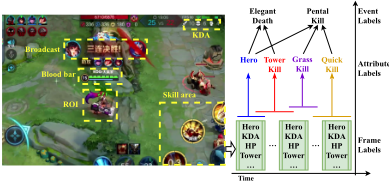
As video frames of a game are usually well structured and have timely broadcasts, both deep learning [Ren et al., 2015; LeCun et al., 1998; Zhang et al., 2019; He et al., 2016] and traditional methods [Thanh et al., 2009; Bradski and Kaehler, 2008; Lowe, 2004; Derpanis, 2010; Rublee et al., 2011; Leutenegger et al., 2011] are adopted in our work. As shown in Figure 2, each raw video is split into frame sequences with a frame rate of 2, then event labels and attribute labels can be figured out after the element information (Broadcast, KDA, ROI, etc.) of each frame are calculated. A highlight occurs 5 seconds before and after an event.
∗Yipeng Yu is the corresponding author
1.2 Video Describing
Video describing is to generate text description for each highlight video episode in details [Xiao et al., 2022]. Each generated text description is used as the subtitle for each highlight. At first a relation graph of all the 101 game champions is built. Then we collect a small amount of natural video description, and holistically incorporate them to enrich the grammars and text of the proposed PCSG-v framework. PCSG-v is a variant of PCFG [Zhang and Krieger, 2011; Wang et al., 2017a]. It is a 4-tuple G = (N, Σ, R, S), where
- N is finite set of non-terminal symbols.
- Σ is a finite set of pseudo terminal symbols. Each pseudo terminal symbol γ comes from γ → [c1]λ1[p1] | λ2[p2] | · · · | [cm]λm[pm] with m ≥ 1. c is an alternative Boolean value depends on context of events and attributes or context of the value of preceding pseudo terminal symbols, namely the text generated before. λ can be a number, word, phrase, clause, or sentence selected from video description collection and champion relation graph. pi is the probability of λi to be selected, and ∑mi=1 pi = 1. If ci exists and it is False then λi and pi will be deleted, and value of pi will be divided into equal parts and then given to other λ. c makes text selection and collocation more accurate and diverse, and p makes text selection more diverse with preference.
- R is a finite set of probabilistic and contextaware production rules of the form α → [d1]β1 1 [q1] | β1 2 β2 2 [q2] | · · · | [dn]β1n · · · βtn [qn] with n ≥ 1 and t ≥ 1. d is an alternative Boolean value depends on context of events and attributes. qi is the probability of βi sequence to be selected, and ∑ni=1 qi = 1. α ∈ N, and βi ∈ (N ∪Σ) for i = 1 · · · n. Most of the rules are translated from sentences of video description collection. if di exists and it is False then βi sequence and qi will be deleted, and value of qi will be divided into equal parts and then given to other β sequences. d makes sentence structures and sentence combination more accurate and diverse, and q makes sentence structures and sentence combination more diverse with preference.
- and S ∈ N is a distinguished start symbol.
In simple terms, PCSG-v is used to generate text descrip- Episode 2
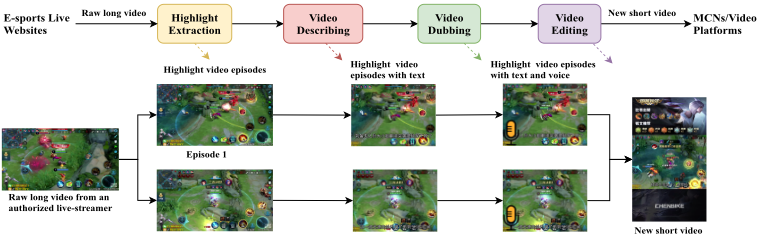
Figure 1: An overview of VideoMaster system.
tion for each short video with its labels of event and attribute provided by highlight extraction module as input. During the generation, PCSG-v will select text and infer relations between game champions from the relation graph. The more words and more production rules, the more diverse text our framework can generate.
1.3 Video Dubbing
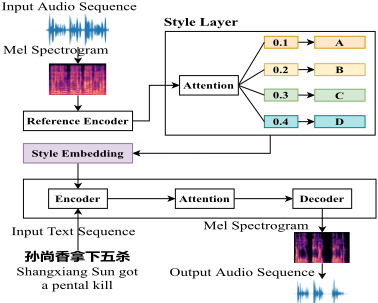
Video dubbing reads the generated subtitles using someone's voice. To synthesize speech directly from a game commentator, we implement a text-to-speech model based on Style Tokens Tacotron [Wang et al., 2018; Wang et al., 2017b] which is shown in Figure 3. First, the reference encoder extracts the identify-feature from the input log-mel spectrogram to generate the reference embedding. Then, in the style token layer, the attention module learns the similarity between the input reference embedding and the randomly initialized tokens, to output a set of weights, representing the contribution of each token to the style embedding. Finally, the resulting style embedding is passed to the encoder-decoder with the input text sequence. Note that the style layer can be jointly trained with the encoder-decoder by optimizing the reconstruct loss of the encoder-decoder, where the log-mel spectrogram of the training target is used as the ground-truth. The speech synthesis model is trained on the public mandarin speech dataset THCHS-30 and audios from the game commentator (only 301 corpus about 10 minutes).
1.4 Video Editing
Video editing assembles the multimodal materials into sequences and creates new videos which are more fascinating. The following editing operations are taken in our system based on FFmpeg:
- Cutting. Highlight video episodes are cutting from raw live videos. The cuts are supposed to be narratively complete and fast-paced to make the flow of video ideal.
- Transition. Transitions are introduced to make the switch between video episodes more natural and keep the pace of the video controlled.
- Subtitle. The text description is presented in the form of subtitle, which is appearing along with the video scenes.
- Dubbing. The audio commentary is added in sync with the subtitle to achieve visual-audio consistency.
- Music. Music which have the same emotion as the videos are played as background music. Video soundtrack is of great importance in setting the mood and evoking emotions from audience [Li et al., 2021].
- Sticker. Funny stickers are inserted into videos according to the frame labels and hero coordinates.
- Backdrop. The video episodes are cropped and put on a background portrait image, which makes the produced videos adapt to mobile devices.
2 Results and Demonstrations
2.1 Highlight Extraction
We randomly sampled 1000 highlight videos and recorded their true labels, then a mean precision of 92.95% and recall of 81.46% are obtained. In our case, precision is more important than recall, thus such a recall can be acceptable. Bad cases happened when video frames are not clear or blocked.
| Rater | Evaluation#1 | Evaluation#2 | Evaluation#3 | ||||
|---|---|---|---|---|---|---|---|
| Human | Machine | Human vs Machine | Machine | ||||
| Clarity↑ | Naturalness↑ | Clarity↑ | Naturalness↑ | Similarity↑ | Clarity↑ | Naturalness↑ | |
| 1 | 5.00±0.00 | 5.00±0.00 | 4.46±0.50 | 3.21±1.00 | 2.58±0.95 | 4.21±0.59 | 3.08±0.82 |
| 2 | 4.97±0.03 | 4.99±0.01 | 4.13±0.80 | 3.18±1.18 | 3.17±0.75 | 4.16±0.72 | 3.44±0.85 |
| 3 | 4.77±0.22 | 4.77±0.18 | 4.07±0.65 | 3.21±0.96 | 3.83±0.58 | 3.70±0.54 | 3.34±0.53 |
| 4 | 4.82±0.18 | 4.82±0.15 | 4.19±0.65 | 3.38±1.09 | 3.71±1.43 | 4.17±0.97 | 3.69±1.31 |
| 5 | 4.84±0.16 | 4.85±0.13 | 4.26±0.64 | 3.50±1.08 | 3.58±0.25 | 4.29±0.25 | 3.78±0.46 |
| 6 | 4.86±0.14 | 4.87±0.11 | 4.29±0.65 | 3.48±1.06 | 2.33±0.84 | 4.51±0.54 | 3.87±0.86 |
| Mean | 4.88 | 4.88 | 4.23 | 3.33 | 3.20 | 4.17 | 3.53 |
2.2 Text Description
Human rating. We randomly sampled 1000 highlight videos with generated description and labels of event and attribute for human evaluation. We recruited another 6 helpers (3 males and 3 females who enjoy playing the mobile game) to score Fluency, Attractivity, Relevance and Diversity. The rating criteria is as follows: 5-very good, 4-good, 3-neutral, 2-bad, 1-very bad. The mean rating scores are 4.11, 4.02, 4.47 and 4.00, respectively, which tells that our methods are able to generate good description on all of the four metrics.
Methods comparison. We also made a qualitative comparison between current methods in Table 2. Each method was measured on five metrics: Interpretability (Inte.), Controllability (Cont.), Flexibility (Flex.), Portability (Port.) and Annotation (Anno.), and each metric was scored from 1 to 5. The higher the score, the more consistent with the metric. As we can see, PCSG-v is best on all of the five metrics.
2.3 Speech Synthesis
As the purpose is to transfer the speech of human game commentator to machine, we conducted three human evaluation for video dubbing in terms of clarity, naturalness and similarity. The rating criteria for "clarity" and "naturalness" is as follows: 5-very good, 4-good, 3-neutral, 2-bad, 1-very bad, and that for "similarity" is as follows: 5-almost the same, 4very like, 3-like, 2-a bit like, 1-not like. Six human raters were recruited to give their scores. Evaluation results are shown in Table 1. Evaluation#1 and Evaluation#2 were conducted on a small dataset of 24 testing samples. Raters don't know which speech is from human and which speech is from machine in Evaluation#1, while raters know which speech is from human and which speech is from machine in Evaluation#2. We can see that machine gets a 4.23 score between "very good" and "good" in clarity which is close to 4.88 of human, a 3.33 score between "good" and "neutral" in naturalness, and a 3.20 score between "very like" and "like" in similarity. Evaluation#3 was conducted on a dataset of 100 test samples, each test sample has a text generated by PCSG-v and a speech synthesized by machine. The results show that machine gets a 4.17 score between "very good" and "good" in clarity and 3.53 score between "good" and "neutral" in naturalness.
| Method | Inte.↑ | Cont.↑ | Flex.↑ | Port.↑ | Anno.↓ |
|---|---|---|---|---|---|
| End2end | 1 | 1 | 1 | 2 | 5 |
| Summarization | 4 | 2 | 1 | 3 | 3 |
| Template | 5 | 5 | 2 | 3 | 2 |
| PCFG | 5 | 5 | 3 | 3 | 2 |
| PCSG | 5 | 5 | 4 | 4 | 2 |
| PCSG-v | 5 | 5 | 5 | 4 | 2 |
2.4 Demonstrations
Compared with raw videos from E-sports live websites which are tedious and short of storytelling, the resulting videos 1 produced by our system are time-saving (from about 30 minutes to about 1 minutes), memory-saving (from about 100 MiB to about 20 MiB), more expressive and rhythmic. Cutting and reorganizing highlight episodes make video brief, fast-paced and attractive. Subtitle and audio commentary not only help viewers have a better understanding of events, but also provide funny text and charming voice. Background music helps set the mood and evoke emotions from viewers. Stickers enrich videos and show current temperature. Moreover, video editing module in our system can be easily updated according to the usage of the re-created videos.
3 Conclusions
In this paper, we present VideoMaster, an intelligent multimodal system for automatic micro game video recreation. The system is but a first attempt to build a fully functional video generator capable of cutting, subtitling, dubbing and editing without heavy manual annotation. VideoMaster is not yet perfect and has limitation and rooms for improvement. Moreover, Compared to the latest AIGC (artificial intelligence generated content) work [Ouyang et al., 2022; Scao et al., 2022; Yang et al., 2022; Rombach et al., 2022; Ramesh et al., 2022; Borsos et al., 2022; Singer et al., 2022; Saharia et al., 2022; Yu et al., 2021], VideoMaster is able to generate multimodal content without losing controllability, quality, novelty and artistry, and it is more cost-effective. In the future work, VideoMaster will be applied to non-game videos.
1 Weiyun (https://share.weiyun.com/e53rrZSK) or Google Drive
@inproceedings{ijcai2023p844,
  title     = {VideoMaster: A Multimodal Micro Game Video Recreator},
  author    = {Yu, Yipeng and Chen, Xiao and Zhan, Hui},
  booktitle = {Proceedings of the Thirty-Second International Joint Conference on
               Artificial Intelligence, {IJCAI-23}},
  publisher = {International Joint Conferences on Artificial Intelligence Organization},
  editor    = {Edith Elkind},
  pages     = {7179--7182},
  year      = {2023},
  month     = {8},
  note      = {Demo Track},
  doi       = {10.24963/ijcai.2023/844},
  url       = {https://doi.org/10.24963/ijcai.2023/844},
}
TY - CPAPER TI - VideoMaster: A Multimodal Micro Game Video Recreator AU - Yu, Yipeng AU - Chen, Xiao AU - Zhan, Hui T2 - Proceedings of the Thirty-Second International Joint Conference on Artificial Intelligence, IJCAI-23 PB - International Joint Conferences on Artificial Intelligence Organization PY - 2023 SP - 7179 EP - 7182 DO - 10.24963/ijcai.2023/844 UR - https://doi.org/10.24963/ijcai.2023/844 ER -Copied
Machine-readable versions of this paper, for tools and AI agents:





