
An Interactive Game-based Multi-Agent AI System for Children’s Social and Emotional Development
Proceedings of the Thirty-Fourth International Joint Conference on Artificial Intelligence. AI and Social Good. Pages 9555-9563.
https://doi.org/10.24963/ijcai.2025/1062
Keywords
- Agent-based and Multi-agent Systems: General
- Humans and AI: General
- Multidisciplinary Topics and Applications: General
- Knowledge Representation and Reasoning: General
Abstract
The earliest years of life, from birth to elementary school, are the most critical time for children's social and emotional development. Recently, schools and workplaces have become increasingly concerned with cultivating social and emotional skills, especially with the decline of face-to-face interaction and the pervasive influence of modern communications technology. This paper proposes a game in development that navigates this challenge and aims to facilitate skill development in children ages 3-10 by having them identify, understand, feel their emotions, and regulate their actions. Using an established framework for social and emotional learning, it employs multi-agent artificial intelligence-based interactive gaming that generates dynamic scenarios and adjusts learning experiences based on individual child's or group's needs over time. We discuss the various modes of this game and its target frameworks, along with ways to evaluate effectiveness in facilitating social and emotional skill development.
- [Bierman et al., 2010] Karen L Bierman, John D Coie, Ken- neth A Dodge, Mark T Greenberg, John E Lochman, Robert J McMahon, and Ellen Pinderhughes. The ef- fects of a multiyear universal social-emotional learning program: The role of student and school characteristics. Journal of consulting and clinical psychology, 78(2):156, 2010. Collaborative for Academic and Learning, 2025] Social Collaborative for Academic and Emotional Learning. Fundamentals of sel, 2025. Accessed: Feb. 11, 2025.
- [DeepSeek-AI, 2024] DeepSeek-AI. Deepseek-v2: A strong, economical, and efficient mixture-of-experts lan- guage model, 2024.
- [Durlak et al., 2011] Joseph A. Durlak, Roger P. Weissberg, Allison B. Dymnicki, Rebecca D. Taylor, and Kriston B. Schellinger. The impact of enhancing students' social and emotional learning: A meta-analysis of school-based uni- versal interventions. Child Development, 82(1):405-432, 2011.
- [Girela-Serrano et al., 2024] Braulio M Girela-Serrano, Alexander DV Spiers, Liu Ruotong, Shivani Gangadia, Mireille B Toledano, and Martina Di Simplicio. Impact of mobile phones and wireless devices use on children and adolescents' mental health: a systematic review. European child & adolescent psychiatry, 33(6):1621-1651, 2024.
- [Graziano and Hart, 2016] Paulo A Graziano and Katie Hart. Beyond behavior modification: Benefits of social- emotional/self-regulation training for preschoolers with behavior problems. Journal of school psychology, 58:91- 111, 2016.
- [Gresham and Elliott, 1990] Frank M. Gresham and Stephen N. Elliott. Social Skills Rating System: Manual. American Guidance Service, Circle Pines, MN, 1990.
- [Hamidzadeh et al., 2019] Nahid Hamidzadeh, Samira Vak- ili, Leila Kashani-Vahid, Atefeh Irani, and Hadi Moradi. Effectiveness of EmoGalaxy video game on social skills of children with oppositional defiant disorder. In Proceed- ings of the 1st International Serious Games Symposium (ISGS), pages 18-24. IEEE, December 2019.
- [Housman, 2017] Donna K Housman. The importance of emotional competence and self-regulation from birth: A case for the evidence-based emotional cognitive social early learning approach. International Journal of Child Care and Education Policy, 11(1):13, 2017.
- [Huang et al., 2024] Xu Huang, Weiwen Liu, Xiaolong Chen, Xingmei Wang, Hao Wang, Defu Lian, Yasheng Wang, Ruiming Tang, and Enhong Chen. Understanding the planning of llm agents: A survey, 2024.
- [Levy and Levy, 2017] G. Levy and A. Levy. What Should Danny Do? Elon Books, third edition, 2017.
- [McCoy et al., 2010] Josh McCoy, Mike Treanor, Ben Samuel, Brandon Tearse, Michael Mateas, and Noah Wardrip-Fruin. Comme il faut: A system for authoring playable social models. In Proceedings of the Seventh AAAI Conference on Artificial Intelligence and Interactive Digital Entertainment, AIIDE'11, pages 158-163. AAAI Press, 2010.
- [McCulloch et al., 2009] Peter McCulloch, Douglas G. Alt- man, William B. Campbell, David R. Flum, Paul Glasziou, John C. Marshall, Jon Nicholl, and the IDEAL group. No surgical innovation without evaluation: the ideal recom- mendations. The Lancet, 374(9695):1105-1112, 2009.
- [Operto et al., 2020] Francesca Felicia Operto, Grazia Maria Giovanna Pastorino, Jessyka Marciano, Valeria de Simone, Anna Pia Volini, Miriam Olivieri, Roberto Buonaiuto, Luigi Vetri, Andrea Viggiano, and Giangen- naro Coppola. Digital devices use and language skills in children between 8 and 36 month. Brain Sciences, 10(9):656, 2020.
- [Park et al., 2023] Joon Sung Park, Joseph C. O'Brien, Car- rie J. Cai, Meredith Ringel Morris, Percy Liang, and Michael S. Bernstein. Generative agents: Interactive sim- ulacra of human behavior. In Proceedings of the 36th Annual ACM Symposium on User Interface Software and Technology, UIST '23. Association for Computing Ma- chinery, 2023.
- [Pea et al., 2012] Roy Pea, Clifford Nass, Lyn Meheula, Marcus Rance, Aman Kumar, Holden Bamford, Matthew Nass, Aneesh Simha, Benjamin Stillerman, Steven Yang, et al. Media use, face-to-face communication, media mul- titasking, and social well-being among 8-to 12-year-old girls. Developmental psychology, 48(2):327, 2012.
- [Pechtel and Pizzagalli, 2011] Pia Pechtel and Diego A Piz- zagalli. Effects of early life stress on cognitive and af- fective function: an integrated review of human literature. Psychopharmacology, 214:55-70, 2011.
- [Saitadze and Lalayants, 2021] Inga Saitadze and Marina Lalayants. Mechanisms that mitigate the effects of child poverty and improve children's cognitive and social- emotional development: a systematic review. Child & Family Social Work, 26(3):289-308, 2021.
- [Segrin, 2019] Chris Segrin. Indirect effects of social skills on health through stress and loneliness. Health communi- cation, 34(1):118-124, 2019.
- [Spensley, 2022] Stacy Spensley. The Feelings Activity Book for Toddlers: 50 Fun Activities to Identify, Understand, and Manage Big Feelings. Callisto Kids, 2022. Accessed: Feb. 11, 2025.
- [Steinhardt et al., 2024] Jacob Steinhardt, Bill Lin, Michael Yang, Amanda Askell, Mark Ho, and Richard Ngo. In- creased compute efficiency and the diffusion of ai capabil- ities, 2024. [Stewart, 2017] Whitney Stewart. Mindful kids: 50 mindful- ness activities for kindness, focus, and calm, 2017. Ac- cessed: Feb. 11, 2025.
- [Taylor et al., 2017] Rebecca D. Taylor, Eva Oberle, Joseph A. Durlak, and Roger P. Weissberg. Promoting positive youth development through school-based social and emotional learning interventions: A meta-analysis of follow-up effects. Child Development, 88(4):1156-1171, 2017.
- [Webster-Stratton et al., 2001] Carolyn Webster-Stratton, Jamila Reid, and Mary Hammond. Social skills and problem-solving training for children with early-onset conduct problems: Who benefits? The Journal of Child Psychology and Psychiatry and Allied Disciplines, 42(7):943-952, 2001.
References were extracted automatically from the PDF and may contain errors.
Full text extracted automatically from the PDF; figures, tables and equations may differ. The PDF is the version of record.
1 Introduction
Social and emotional learning (SEL) is defined as an integral part of education and human development [Collaborative for Academic and Learning, 2025]. It is the vital process through which every young individual and adult adopts and implements the required knowledge, skills, and attitudes to develop healthy self-identities, manage emotions and achieve personal as well as collective goals, feel and exhibit empathy towards others, establish and maintain supportive relationships, and above all, make responsible and caring decisions. Enhanced ability to understand and manage our own emotions often leads to:
- Effective conflict resolution and problem-solving in social settings
- Better adaptation and responsible decision-making under challenging situations
- Improved ability to build strong relationships
- Improved mental and, hence, physical well-being
Overall, better social-emotional skills are associated with better quality of life with greater success in personal, academic, and professional life, while deficits in such skills have been associated with increased stress, loneliness, and poorer psychological well-being [Segrin, 2019].
Social and emotional learning (SEL) is crucial in fostering children's ability to understand and manage emotions, establish positive relationships, and make responsible decisions. Implementing SEL programs in early childhood is particularly beneficial, as this period is marked by rapid development and elevated neural plasticity and malleability of social and emotional skills. Early training interventions can lead to significant improvements in children's social behaviors, emotional regulation, and academic performance in the near term. Long-term, SEL interventions reduced problem behaviors including aggression, and emotional distress, which can otherwise impede learning and development resulting in better academic outcomes. Very early childhood interventions may be particularly effective given the high degree of neuroplasticity during the critical first 5 to 6 years of life [Bierman et al., 2010; Graziano and Hart, 2016; Housman, 2017]. Moreover, children with significant behavioral difficulties including conduct disorder may benefit particularly well from SEL interventions although negative parenting can negate these effects [Webster-Stratton et al., 2001]. Poverty and stress are associated with reduced social and emotional, cognitive, and physical development. Families who have limited access to academic resources and enrichment experiences exacerbating the effects of early deprivation on the developing brain. Poverty also increases parental stress with negative effects on caregiving which may be worsened if the parents themselves have poorer social and emotional skills. SEL interventions have been shown to be beneficial in children and their families coping with poverty [Saitadze and Lalayants, 2021].
While social-emotional skills are critical for personal, academic, and professional success, traditional teachingmethods may not be sufficient for addressing this gap, as they often rely on spontaneous real-life experiences, which might not always occur in a structured or supportive environment. The plethora of SEL books and textual resources offer excellent support but fails to provide dynamic content or storytelling that can mimic real-life situations/events.
Adding to the complexity of the situation, the everincreasing prevalence of digital communication tools, such as texting, video calling, and social media, has raised concerns about their impact on children's and adolescents' social and emotional development. Research has indicated that while these technologies can be beneficial in maintaining or even enhancing feelings of connectedness, such as during the COVID-19 pandemic [Girela-Serrano et al., 2024], they may also contribute to social and emotional skill deficits when overused or as a replacement for face-to-face interactions [Pea et al., 2012].
However, digital interaction is deeply embedded in modern communication, education, and entertainment, and efforts to remove it completely from children's lives are unlikely and unrealistic. Instead, a more pragmatic approach is to harness engaging and immersive training and educational games to counteract the negative effects of technology. By gamifying social skill development within AI-moderated, interactive digital environments, we can create structured opportunities for children to practice real-time social interactions in a way that is both appealing and developmentally appropriate and adjusts to suit individual's needs. This approach is particularly crucial for children whose parents may themselves struggle with social skills, limiting opportunities for guided interpersonal learning at home. Rather than reinforcing passive or isolating screen engagement, AI-driven social games can scaffold and reinforce real-world social behaviors, serving as a bridge between digital interaction and meaningful in-person connections.
The challenge is to leverage technology to improve socialemotional learning (SEL) while mitigating the negative effects of digital overuse. Contrary to much of the negative literature on technology's impact on SEL, research actually suggests that human-mediated (traditional and virtual) play is the most favorable tool for SEL growth.
Our proposed solution is to design an interactive AI-driven game, Camo Chameleon, that:
- Simulates real-world social interactions in an engaging, structured environment.
- Uses AI to create dynamic learning experiences tailored to each child's progress.
- Provides opportunities for guided social-emotional learning that bridge the gap between technology use and real-world skill development.
- Can be seamlessly integrated into both classrooms and homes, ensuring that SEL growth is supported in multiple learning environments.
2 RelatedWork
2.1 Books and Textual Resources
Our project is also inspired by several children's books and textual resources for SEL. One notable mention is the storybook "What Should Danny Do" [Levy and Levy, 2017], which provides children the power to choose amongst nine endings of a story. The reader gets to decide how the story, essentially an event in the protagonist, Danny's, day-to-day life will unfold by making choices for Danny. "The Feelings Activity Book For Toddlers" [Spensley, 2022] is another valuable resource that provides 50 fun activities to help toddlers identify and process their feelings and regulate their actions. Activities, for example, include mirror faces to mirror your feelings, super smash to smash out that angry feeling, a cozy kit that encourages a child to think of items ahead of time that might help them soothe when they feel stressed and many more. In a similar vein, we look up the "Kind Kids" 50 mindfulness activity cards [Stewart, 2017] with unique games and crafts that help children build compassion, empathy, and respect for themselves and their community. The cards, appropriate for children aged 4 to 10 years, include hands-on solo and group activities for home and classroom settings, created by preschool mindfulness experts Dr. Helen Maffini and Whitney Stewart.
2.2 Games and Papers
Black & White, released by Lionhead Studios in 2001, was one of the first major games to incorporate AI, using it to create autonomous agent interactions that shaped the game's emergent gameplay. Players took on the role of a god-like figure, influencing NPCs (Non-Player Characters) and training a creature that learned through reinforcement learning, aligning its behavior with the player's moral choices. By leveraging AI to simulate decision-making, emotional responses, and evolving behaviors, the game became a powerful exploration of morality, a theme closely related to social-emotional learning (SEL). Now, more than 20 years later, advancements in AI allow us to take this concept further, developing an innovative game like Camo Chameleon that specifically focuses on SEL, using cutting-edge AI to create more nuanced interactions and learning experiences.
These advancements in AI include recent developments in large language models, which are among the most powerful tools in natural language processing. Beyond language generation, these models can observe, reason, and plan as autonomous agents [Huang et al., 2024]. In [Park et al., 2023], researchers developed NPCs in a sandbox environment similar to The Sims using an agent server and an environment server. Their findings demonstrated that these agents could behave in human-like ways - planning and attending parties, forming relationships, and engaging in social interactions without direct human intervention. However, the study also revealed key limitations, such as inconsistencies emerging when too many agents interacted, a lack of long-term memory leading to incoherence, and difficulty maintaining narrative consistency across extended simulations. We aim to build upon these findings by addressing these challenges, ensuring our AI-driven in Camo Chameleon can maintain logical and emotionally coherent interactions in a way that enhances social-emotional learning. With the rapid advancements in AI, particularly in improving long-term memory and contextual recall in large language models, we can create NPCs that exhibit more stable, realistic, and emotionally intelligent behaviors over time.
Relationship building within Camo Chameleon draws from principles of both structured social interaction frameworks, such as Comme il Faut (CiF) [McCoy et al., 2010], and dynamic relationship modeling through network science. Specifically, we incorporate insights from scale-free and small-world networks to capture emergent social structures while also leveraging reinforcement learning to enable adaptive agent behaviors. By integrating elements from both approaches, we aim to create NPCs that engage in meaningful social interactions while evolving their relationships in a realistic and dynamic manner.
Finally and most importantly, our game draws from research on improving cognitive abilities through video game play, particularly from [McCulloch et al., 2009], which is commonly used in health-based video games. We are also inspired by the study effectiveness study of EmoGalaxy video game on social skills of children with oppositional defiant disorder (ODD) [Hamidzadeh et al., 2019], which examined how video games designed for emotion regulation can enhance social skills in children with ODD. This study demonstrated that structured gameplay could significantly improve social skills in participants, highlighting the potential of game-based interventions in fostering emotional and behavioral development. Their approach to assessment, utilizing standardized social skills rating scales and controlled experimental design, informed our own methods for evaluating the effectiveness of Camo Chameleon in promoting social-emotional learning.
2.3 CASEL-based Framework
The Collaborative for Advancing Social and Emotional Learning (CASEL) [Collaborative for Academic and Learning, 2025] introduced the term "Social and Emotional Learning" (SEL) to encapsulate the essential skills for healthy human development and learning, especially for schools. We are using CASEL and its five core competencies-selfawareness, self-management, social awareness, relationship skills, and responsible decision-making-as the framework for our game to effectively integrate Social-Emotional Learning (SEL).
Our game's dynamic system and multiple modes are designed to cater to different age groups and their specific social-emotional learning needs as they develop.
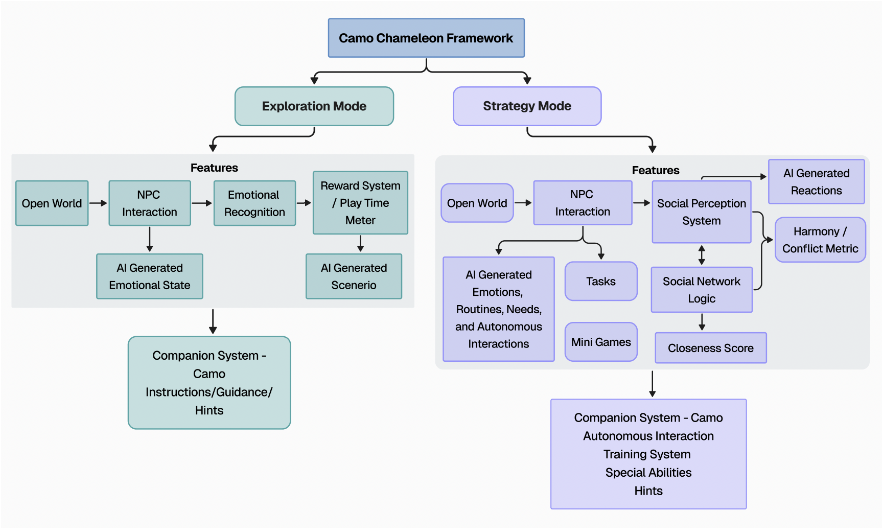
Exploration Mode builds foundational SEL skills by focusing on emotion identification, basic social interactions, and self-regulation. Through open-world exploration and NPC interactions, younger players engage in guided social experiences that help them recognize emotions, practice empathy, and develop essential social behaviors in a structured environment. This game mode will be intended for students ages 3 to 10 years old.
Strategy Mode introduces more complex SEL challenges, emphasizing theory of mind, advanced relationship-building, and decision-making. Players navigate social dynamics, predict NPCs' thoughts based on visual and contextual clues, and make strategic choices to foster meaningful relationships, helping older players refine their emotional intelligence in nuanced, real-world-like scenarios. By aligning gameplay with developmentally appropriate SEL needs, Camo Chameleon provides an adaptable learning environment that grows with the player, ensuring a continuous and personalized approach to social-emotional development. This game mode will be intended for students 8 years and older.
3 Our Game: Camo Chameleon
As described in Subsection 2.3, the interactive game, Camo Chameleon, comprises two modes: Exploration Mode and Strategy Mode.
3.1 ExplorationMode
Exploration Mode is designed as an interactive open-world experience that integrates three interconnected servers to generate dynamic, emergent social-emotional learning (SEL) scenarios. These servers-the agent server, game environment server, and scenario server-work together to create realistic non-playable characters (NPCs), immersive interactions, and evolving storylines based on player choices.
The agent server is responsible for procedurally generating the persona of each NPC. This includes assigning a name, gender, emotional state, and social role (such as occupation or community member). Once these character traits are established, a large language model (LLM) generates a unique backstory for the NPC, which is stored in the NPC's memory system. This memory system allows NPCs to retain information about past interactions with players, enabling them to respond dynamically over time.
The game environment server takes the character traits from the agent server and maps them onto game objects, such as generating an avatar that visually represents the NPC. The NPC's facial expressions and body gestures dynamically reflect their assigned emotional state and social role, making interactions feel more immersive and realistic. Players navigate their characters through an open-world environment and choose which NPCs to interact with. Upon engaging with an NPC, a menu will pop up, prompting the player to guess the NPC's emotional state based on visual and contextual cues.
As players correctly identify the emotional states of NPCs, they fill up a "Play Time Meter." Once full, the next interaction triggers a structured SEL scenario generated by the scenario server. The scenario server receives data from both the agent server and the game environment server, using this information to generate a social-emotional learning event tailored to the player's recent interactions. This scenario functions as an immersive, emergent storyline, much like interactive SEL cartoons, but within an open-ended video game format. The scenario is then sent back to the agent server where each NPC-associated agent involved in the scenario begins making decisions on how to behave in the scenario (specific dialogue, movements, actions, etc.) through the use of LLMs. This information is then sent to the game environment server, which parses it into executable actions, allowing it to unfold dynamically in real-time. The agent server updates the NPC's memory based on how the scenario unfolds, ensuring that future interactions reflect past experiences.
This system enables evolving, personalized social learning that surpasses scripted lessons. Students start by identifying basic emotions, progressing to more complex ones over time. Early scenarios require minimal interaction, gradually incorporating simple, menu-based choices. This builds a strong foundation in emotional understanding while easing them into complex, immersive social dynamics.
3.2 StrategyMode
Strategy Mode is designed as an interactive open-world experience that develops theory of mind (ToM) by challenging players to infer emotions, anticipate NPC perspectives, navigate complex social dynamics, and explore dynamic relationships. It integrates three interconnected servers-the agent server, game environment server, and social dynamics server-to create emergent, player-driven social interactions. These servers work together to ensure that NPCs remember past interactions, form evolving relationships, and respond intelligently to player behavior, fostering a realistic and adaptive social ecosystem. Similar to exploration mode, agent characteristics are procedurally generated and an LLM creates a backstory for each agent based on these characteristics. These characters map onto specific avatars, facial expressions and gestures within the game environment. The agents within the agent server will create their own goals, actions, and routines using an LLM that takes into consideration their characteristics and backstory at a given time. These goals, actions, and routines will be sent to the game environment server where they will be parsed and executed.
Players are free to explore and interact with the world as they please. The core set of actions they can take are talking to NPCs, building structures, completing tasks, and expressing emotions with their own character's avatar. These actions can be used in combination to influence perceptions of NPCs and build relationships. Players will want to manage their relationships well in order to foster trust, encourage cooperation, unlock group events, and create a socially supportive environment where NPCs are more likely to help each other, leading to a more stable and thriving community.
Conversely, if they manage their relationships poorly, NPCs will become distrustful, social conflicts will escalate, certain areas may become inaccessible due to tensions, and interactions will become more challenging as rivalries and isolation spread throughout the environment.
Based on player interaction and autonomous NPC interaction, the state of the game environment will change. These changes will be sent to the agent server, where they will be parsed and stored within a memory stream. Agents will continuously update their feelings, goals, behaviors, and routines. These changes will then affect their corresponding NPC behavior and relationship dynamics within the game environment.
Data from both the agent server and the game environment server will continuously be sent to the social dynamics server. The social dynamics server will ensure that NPC interactions remain coherent as the player interacts with the world and the agents interact autonomously. It will achieve this by leveraging Comme il Faut's structured framework for social interactions, ensuring consistent and contextually appropriate NPC behavior. Additionally, by incorporating scale-free and closeworld network principles, the system will create realistic relationship patterns, where NPCs form organic social hierarchies, maintain long-term connections, and interact within bounded yet evolving social structures that mirror real-world dynamics.
Unlike Exploration Mode, which focuses on emotion recognition and structured SEL scenarios, Strategy Mode requires players to manage social conflicts, influence group relationships, and make strategic decisions, reinforcing advanced social-emotional learning in an immersive and interactive way. NPCs retain memory of past interactions, allowing them to provide meaningful, real-time feedback based on the player's decisions. By requiring players to infer emotions, adapt to social cues, and navigate evolving relationships, Strategy Mode fosters an active, dynamic learning environment.
3.3 Algorithms for Social-Emotional Learning in Camo Chameleon
To create an adaptive and engaging social-emotional learning (SEL) experience, Camo Chameleon leverages AI-driven models inspired by network science, reinforcement learning, and emotion modeling. These algorithms enable the game's NPCs to evolve socially, form meaningful relationships, and respond dynamically to players' emotions and interactions.
We focus on three primary computational models:
Network-based Relationship Modeling - NPCs build and strengthen social bonds using principles from scale-free and small-world networks, ensuring realistic peer-group formation.
Emotion Modeling for Decision-Making - NPCs track emotional states over time, influencing their decisions, responses to players, and group dynamics.
Reinforcement Learning for NPC Adaptation - NPCs adjust their behavior through reward-based learning, reinforcing positive social interactions and discouraging negative ones.
These models work together to create autonomous NPC agents that learn, adapt, and interact in a socially coherent way, helping players develop SEL skills through natural, game-based interactions.
3.4 Network Science for NPC Social Structures Scale-Free Network Degree Distribution
To ensure NPCs develop realistic social structures, we use a scale-free network model, where some NPCs naturally become more socially connected than others, mimicking realworld social influence and peer dynamics.
where:
- P(k) = Probability of an NPC having k social connections.
- γ = Exponent controlling how many NPCs become highly influential social hubs (typically 2 < γ < 3).
Small-World Network Rewiring Probability
NPCs don't just form random friendships-they balance local friend groups and occasional long-range connections, helping players practice social adaptability.
where:
- L(p) = Average shortest path length at rewiring probability p
- Lregular = Path length in a structured, close-knit social circle
- Lrandom = Path length in a fully random social network
3.5 NPCRelationship Dynamics
Relationship Strength Update
Each NPC tracks relationship strength with others, which updates based on positive and negative interactions:
where:
- Wij(t) = Social bond strength between NPC i and NPC j at time t
- η = Learning rate (how quickly relationships evolve)
- Iij(t) = Interaction intensity (stronger bonds from frequent positive interactions)
NPC Relationship States
NPCs don't just have numerical relationship values-they also categorize relationships into friendships, rivalries, or neutral states.
where:
- Rij(t) = Relationship state (friend, rival, neutral)
- Sij(t) = Direct social exchange effect (e.g., helping strengthens friendship)
- Iik(t)Wkj = Influence frommutual social connections
3.6 NPC EmotionModeling
(Ensures NPCs have emotional states that influence social interactions.)
Emotion State Update
NPC emotions carry over time rather than resetting instantly, making interactions feel more human-like.
where:
- Ei(t) = Emotion score of NPC i at time t
- α = Decay factor (howmuch past emotions influence the present)
- Ri(t) = Reinforcement from social interactions
Peer Influence on Emotion
Emotions spread within friend groups, modeling real-world emotional influence.
where:
- N(i) = Set of NPCs socially connected to i
- Wij = Strength of social connection between NPC i and NPC j
- Ej = Emotion level of NPC j
3.7 NPC Social Decision-Making Using Reinforcement Learning
Bellman Equation for NPC Learning
NPCs use reinforcement learning to optimize social decisions:
where:
- Q(s, a) = Expected reward for taking action a in social state s
- r = Immediate reward (e.g., gaining a friend)
- γ = Discount factor (weights short-term vs. long-term gains)
Social Exchange Probability
NPCs decide whether to engage in an interaction based on relationship state & emotion.
where:
- Tij = Probability of NPC i interacting with NPC j
- Rij = Current relationship strength
- Ei,Ej = Emotional states of NPCs
- C = Contextual factors (e.g., location, recent events)
4 Implementation Plan
4.1 Foreseen Case Studies
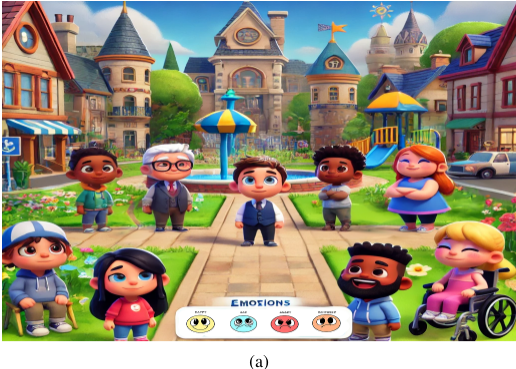
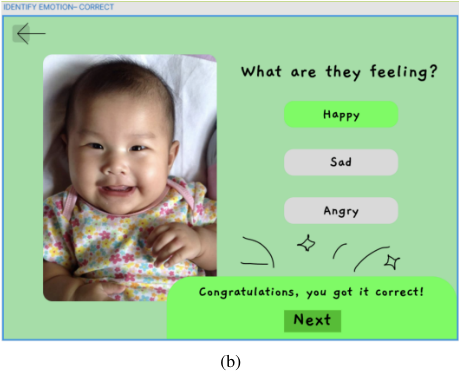
Foreseen case studies are for two distinct age groups of children: i) 2 - 5 years, and ii) 5 - 10 years. We have collaborated with Moving Grace Montessori School (MGMS) in New Orleans, USA to perform the first beta-testing of Camo Chameleon on children in the age range of 3-5 years. Children in this group are suitable to play the exploration mode of the game, starting with the chosen NPC's emotion identification in an open-world scenario. Fig. 2a shows one such mock scene generated by ChatGPT for emotion identification. However, our game (under development) is designed to generate more realistic images such as in Fig. 2b in an open-world scenario, using a combination of procedural and generative AI techniques. Insights from MGMS's director and seasoned Montessori teacher, Ms. Amanda Stage, revealed that capping each gaming session to 10 - 15 minutes works best for holding the short attention span of such young children while avoiding any fatigue from exposure to technology/digital media. The game will be introduced during summer camp, in 2025, to be played in small groups supporting further back-and-forth conversations between the students and teachers regarding feelings and different situations that can bring up those feelings in the children's daily lives. The game prompts encourage such conversations keeping the sessions human-centric and interactive.
We are in talks with a few elementary and middle schools in the greater New Orleans area to run beta testing of Camo Chameleon's exploration and strategy mode on children aged 5-10.
4.2 Impacts
Our study contributes to the growing body of research demonstrating the long-term benefits of social and emotional learning (SEL) interventions. Meta-analyses of SEL programs have shown significant improvements in students' socialemotional skills, well-being, attitudes, and academic performance, with effects persisting months to years after intervention [Taylor et al., 2017; Durlak et al., 2011]. SEL has been linked to enhanced developmental trajectories, including higher graduation rates and positive behavioral outcomes, regardless of socioeconomic background or school location [Taylor et al., 2017].Additionally, SEL interventions have resulted in an 11-percentile-point gain in academic achievement and have been effectively implemented by school staff [Durlak et al., 2011]. By integrating AI-driven SEL learning experiences, our approach builds on this foundation, offering scalable and adaptive interventions that can further reinforce social-emotional skill development and contribute to lasting positive outcomes for youth.
4.3 Evaluation Criteria
To assess the effectiveness of Camo Chameleon in enhancing social-emotional learning (SEL) skills, we will use the Social Skills Rating Scale (SSRS) [Gresham and Elliott, 1990]. The SSRS evaluates three key domains of social behavior: cooperation, assertiveness, and self-control. These domains map onto CASEL's SEL competencies, specifically measuring relationship skills, self-awareness, social awareness, selfmanagement, and responsible decision-making. The assessment will involve a pre-test and post-test questionnaire where players rate their own behaviors and social interactions based on Likert-scale responses. Additionally, in-game data will track how often players engage in cooperative behaviors, recognize emotions in NPCs, and regulate their responses in social situations. By integrating self-reported assessments with in-game behavioral analytics, our study aims to provide a comprehensive evaluation of how Camo Chameleon supports SEL development in an interactive and engaging environment.
4.4 Challenges and Limitations
One primary challenge in implementing this gaming project is to maintain the delicate balance between positive use and overuse of digital technology by children. Given the extant literature describing the negative effects on children's social and emotional development from technology overuse [Pechtel and Pizzagalli, 2011; Operto et al., 2020], is more technology the answer to improving face-to-face social skills? This is a paradox: technology has played a significant role in diminishing face-to-face social skills, but we suggest that it also presents an opportunity to develop interventions in a novel way via augmenting but not replacing human social interaction. To ensure this, Camo Chameleon is designed to be played with a facilitator or in group and not by the child solely. It's interactive prompting encourages the child to interact with his surrounding community and short sessions prevent a passive or isolating screen engagement. Other limitations such as ethical and scalability issues are described under respective sections below.
4.5 Ethical Considerations
We will obtain appropriate IRB approval for all user studies related to this project. Our approach prioritizes ethical integrity in content generation, data privacy, and bias mitigation. To prevent copyright infringement in our procedural generation, we implement strict guardrails ensuring that all generated content is either original or properly licensed. In handling user data, we follow best practices in data protection by anonymizing data where necessary and using it solely to enhance the learning experience while maintaining compliance with privacy regulations. Additionally, we take proactive measures to mitigate racial bias in character generation, emotional displays, and lesson content by leveraging diverse datasets, conducting continuous audits, and incorporating expert reviews to ensure fair and inclusive representation.
4.6 Implementation Plan and Needs
This project develops collaborations between researchers from different departments, including Computer Science and Psychology, as well as establish direct research-education associations by creating collaborations between the university and schools. It was implemented by a team of researchers and professors from AI, gaming, and psychology, involving graduate and undergraduate students, as well as educators from New Orleans schools. This interdisciplinary nature of the project will ensure that the interactive multi-agent game is more impactful and ethical for children's social-emotional development. In the summer of 2025, we plan to implement beta testing at MGMS school students and by 2025 winter we plan to offer a demo to 5-10 K-8 schools and perform longitudinal studies.
4.7 Scalability and Economic Sustainability of the Solution
The scalability of Camo Chameleon is supported by the large and growing demand for social-emotional learning (SEL) solutions, making it an attractive tool for schools, families, and mental health professionals. With millions of young learners worldwide requiring SEL support, the game has multiple distribution channels, including direct integration into school classrooms, at-home learning for families, therapy centers, pediatricians, and educational conferences focused on SEL and child development.
Economically, the primary limiting factor is computational cost, particularly for AI-driven components such as large language models (LLMs) and social simulation systems. However, as AI research advances and models become more efficient, the cost of compute will decrease, allowing for greater incorporation of AI-driven personalization, more immersive experiences, and richer social simulations [DeepSeek-AI, 2024] [Steinhardt et al., 2024]. This progression will enable Camo Chameleon to continuously improve in educational impact while maintaining affordability. By leveraging the expanding accessibility of AI and the strong demand for SEL programs, Camo Chameleon is positioned as a scalable and economically sustainable solution for improving children's social-emotional learning on a large scale.
5 Conclusion
Our proposed project, Camo Chameleon, leverages hybrid AI-driven procedural generation to enhance social-emotional learning (SEL) through adaptive and interactive experiences. Building on established SEL research, our approach integrates scalable, personalized learning environments while ensuring copyright protection, data privacy, and bias mitigation. As AI models become more computationally efficient and cost-effective, the potential for accessible, high-impact SEL programs grows. Camo Chameleon represents a step forward in bridging AI innovation with education, fostering emotional intelligence and positive social development for the next generation. With successful implementation, it can be enhanced in future to extend support and intervention for non-neurotypical children which might improve their learning experience, emotional regulation, and social behavior.
Ethical Statement
We demonstrated two mock scenarios in the paper, 2a and 2b, generated using ChatGPT(DALL-E) and Wireframe, respectively. In developing Camo Chameleon, we prioritize fairness, privacy, and responsible AI. Our procedural generation follows strict copyright safeguards, and user data is securely handled in compliance with privacy regulations. To ensure equity and inclusivity, we actively mitigate racial bias in character generation, emotional displays, and lesson content through diverse datasets, audits, and expert review. Our commitment to ethical AI ensures a safe and meaningful learning experience for all users.
Acknowledgments
We are grateful to the reviewers for their helpful suggestions. We would like to acknowledge StartupUNO, facilitated by TheBeachUNO, for providing a valuable platform where our idea evolved through their program, helping us identify key areas where these solutions are needed. We are also grateful for the funding we received by winning their competition, which supported our development. Additionally, we extend our thanks to Chlo´e Wiley, our industry advisor, whose extensive experience in education provided invaluable insights throughout the process.
@inproceedings{ijcai2025p1062,
  title     = {An Interactive Game-based Multi-Agent AI System for Children’s Social and Emotional Development},
  author    = {Banerjee, Shreya and Saneei, Soheil and Pham, Lisa and Alexander Beaton, Elliott and Fordjour Ansah, Henry and Samuel, Ben and Spicer, Jenny and Hammad, Huda and Stage, Amanda},
  booktitle = {Proceedings of the Thirty-Fourth International Joint Conference on
               Artificial Intelligence, {IJCAI-25}},
  publisher = {International Joint Conferences on Artificial Intelligence Organization},
  editor    = {James Kwok},
  pages     = {9555--9563},
  year      = {2025},
  month     = {8},
  note      = {AI and Social Good},
  doi       = {10.24963/ijcai.2025/1062},
  url       = {https://doi.org/10.24963/ijcai.2025/1062},
}
TY - CPAPER TI - An Interactive Game-based Multi-Agent AI System for Children’s Social and Emotional Development AU - Banerjee, Shreya AU - Saneei, Soheil AU - Pham, Lisa AU - Alexander Beaton, Elliott AU - Fordjour Ansah, Henry AU - Samuel, Ben AU - Spicer, Jenny AU - Hammad, Huda AU - Stage, Amanda T2 - Proceedings of the Thirty-Fourth International Joint Conference on Artificial Intelligence, IJCAI-25 PB - International Joint Conferences on Artificial Intelligence Organization PY - 2025 SP - 9555 EP - 9563 DO - 10.24963/ijcai.2025/1062 UR - https://doi.org/10.24963/ijcai.2025/1062 ER -Copied
Machine-readable versions of this paper, for tools and AI agents:





