
LLM-based Collaborative Agents with Pedagogy-guided Interaction Modeling for Timely Instructive Feedback Generation in Task-oriented Group Discussions
Proceedings of the Thirty-Fourth International Joint Conference on Artificial Intelligence. AI and Social Good. Pages 9972-9980.
https://doi.org/10.24963/ijcai.2025/1108
Keywords
- Agent-based and Multi-agent Systems: General
- Humans and AI: General
- Multidisciplinary Topics and Applications: General
- Natural Language Processing: General
Abstract
Large language models (LLMs) fundamentally reshape learning and teaching models, shifting tutoring systems from supporting individual learning to facilitating collaborative learning (CL) like task-oriented group discussions. However, existing AI tutors struggle to guide CL, as they seldom model the interactions between AI tutors and students. Therefore, they cannot scaffold students to complete tasks collaboratively, which impairs learning outcomes and pedagogy adaptability. Additionally, existing AI tutors fail to make use of CL theories to generate instructive feedback, which leads to undesirable interactions such as over-instruction and limits students' autonomy. In this paper, we propose an LLM-based collaborative agent that innovatively leverages pedagogical strategies to sense discussion stages, detect learning issues, identify the timing of intervention, and generate instructive feedback. To develop the agent, we first design a prompting strategy based on a CL theory, that is, the Community of Inquiry, to cultivate the agent to understand the discussion status. Second, a multi-agent interaction framework is proposed to simulate the collaborative learning behavior between AI tutors and students. Meanwhile, a synthetic task-oriented group discussion dataset, namely CLTeach, is generated, which consists of 27k manually-verified multi-party dialogues with fine-grained annotations of instructive feedback and explanations. Lastly, we use CLTeach to fine-tune the LLM agent, ultimately enabling it to generate instructive feedback at the right time to support students in CL. Extensive experiments demonstrate that our agent achieves state-of-the-art performance in feedback generation and has the potential to mimic human teachers effectively.
- [Achiam et al., 2023] Josh Achiam, Steven Adler, Sandhini Agarwal, Lama Ahmad, Ilge Akkaya, Florencia Leoni Aleman, Diogo Almeida, Janko Altenschmidt, Sam Alt- man, Shyamal Anadkat, et al. Gpt-4 technical report. arXiv preprint arXiv:2303.08774, 2023.
- [Akyol and Garrison, 2011] Zehra Akyol and D Randy Gar- rison. Assessing metacognition in an online community of inquiry. The Internet and higher education, 14(3):183- 190, 2011.
- [Bai et al., 2023] Jinze Bai, Shuai Bai, Yunfei Chu, Zeyu Cui, Kai Dang, Xiaodong Deng, Yang Fan, Wenbin Ge, Yu Han, Fei Huang, et al. Qwen technical report. arXiv preprint arXiv:2309.16609, 2023.
- [Cai et al., 2024] Zhenyao Cai, Seehee Park, Nia Nixon, and Shayan Doroudi. Advancing knowledge together: inte- grating large language model-based conversational ai in small group collaborative learning. In Extended Abstracts of the CHI Conference on Human Factors in Computing Systems, pages 1-9, 2024.
- [Carletta et al., 2005] Jean Carletta, Simone Ashby, Se- bastien Bourban, Mike Flynn, Mael Guillemot, Thomas Hain, Jaroslav Kadlec, Vasilis Karaiskos, Wessel Kraaij, Melissa Kronenthal, et al. The ami meeting corpus: A pre-announcement. In International workshop on ma- chine learning for multimodal interaction, pages 28-39. Springer, 2005.
- [Chen et al., 2024] Jiahao Chen, Zitao Liu, Mingliang Hou, Xiangyu Zhao, and Weiqi Luo. Multi-turn classroom di- alogue dataset: Assessing student performance from one- on-one conversations. In Proceedings of the 33rd ACM International Conference on Information and Knowledge Management, pages 5333-5337, 2024.
- [Dan et al., 2023] Yuhao Dan, Zhikai Lei, Yiyang Gu, Yong Li, Jianghao Yin, Jiaju Lin, Linhao Ye, Zhiyan Tie, Yougen Zhou, Yilei Wang, et al. Educhat: A large-scale language model-based chatbot system for intelligent edu- cation. arXiv preprint arXiv:2308.02773, 2023.
- [Ding et al., 2024] Yuyang Ding, Hanglei Hu, Jie Zhou, Qin Chen, Bo Jiang, and Liang He. Boosting large language models with socratic method for conversational mathemat- ics teaching. In Proceedings of the 33rd ACM Interna- tional Conference on Information and Knowledge Man- agement, pages 3730-3735, 2024.
- [Gan et al., 2023] Wensheng Gan, Zhenlian Qi, Jiayang Wu, and Jerry Chun-Wei Lin. Large language models in ed- ucation: Vision and opportunities. In 2023 IEEE inter- national conference on big data (BigData), pages 4776- 4785. IEEE, 2023.
- [Garrison and Arbaugh, 2007] D Randy Garrison and J Ben Arbaugh. Researching the community of inquiry frame- work: Review, issues, and future directions. The Internet and higher education, 10(3):157-172, 2007.
- [Garrison, 2022] DR Garrison. Shared metacognition in a community of inquiry. Online learning, 26(1):6-18, 2022.
- [Gottipati et al., 2013] Swapna Gottipati, Minghui Qiu, Yanchuan Sim, Jing Jiang, and Noah A. Smith. Learn- ing topics and positions from Debatepedia. In David Yarowsky, Timothy Baldwin, Anna Korhonen, Karen Livescu, and Steven Bethard, editors, Proceedings of the 2013 Conference on Empirical Methods in Natural Lan- guage Processing, pages 1858-1868, Seattle, Washington, USA, October 2013. Association for Computational Lin- guistics.
- [Han et al., 2023] Jieun Han, Haneul Yoo, Yoonsu Kim, Junho Myung, Minsun Kim, Hyunseung Lim, Juho Kim, Tak Yeon Lee, Hwajung Hong, So-Yeon Ahn, et al. Recipe: How to integrate chatgpt into efl writing educa- tion. In Proceedings of the Tenth ACM Conference on Learning@ Scale, pages 416-420, 2023.
- [Holstein et al., 2019] Kenneth Holstein, Bruce M McLaren, and Vincent Aleven. Designing for complementarity: Teacher and student needs for orchestration support in ai- enhanced classrooms. In Artificial Intelligence in Educa- tion: 20th International Conference, AIED 2019, Chicago, IL, USA, June 25-29, 2019, Proceedings, Part I 20, pages 157-171. Springer, 2019.
- [Hu et al., 2021] Edward J Hu, Yelong Shen, Phillip Wallis, Zeyuan Allen-Zhu, Yuanzhi Li, Shean Wang, Lu Wang, and Weizhu Chen. Lora: Low-rank adaptation of large language models. arXiv preprint arXiv:2106.09685, 2021.
- [Janin et al., 2003] Adam Janin, Don Baron, Jane Edwards, Dan Ellis, David Gelbart, Nelson Morgan, Barbara Peskin, Thilo Pfau, Elizabeth Shriberg, Andreas Stolcke, et al. The icsi meeting corpus. In 2003 IEEE International Confer- ence on Acoustics, Speech, and Signal Processing, 2003. Proceedings.(ICASSP'03)., volume 1, pages I-I. IEEE, 2003.
- [Jiang et al., 2023] Albert Q Jiang, Alexandre Sablayrolles, Arthur Mensch, Chris Bamford, Devendra Singh Chaplot, Diego de las Casas, Florian Bressand, Gianna Lengyel, Guillaume Lample, Lucile Saulnier, et al. Mistral 7b. arXiv preprint arXiv:2310.06825, 2023.
- [Jin et al., 2024] Hyoungwook Jin, Seonghee Lee, Hyungyu Shin, and Juho Kim. Teach ai how to code: Using large llnguage models as teachable agents for programming ed- ucation. In Proceedings of the CHI Conference on Human Factors in Computing Systems, pages 1-28, 2024.
- [Joshi et al., 2017] Mandar Joshi, Eunsol Choi, Daniel Weld, and Luke Zettlemoyer. TriviaQA: A large scale dis- tantly supervised challenge dataset for reading compre- hension. In Regina Barzilay and Min-Yen Kan, editors, Proceedings of the 55th Annual Meeting of the Associa- tion for Computational Linguistics (Volume 1: Long Pa- pers), pages 1601-1611, Vancouver, Canada, July 2017. Association for Computational Linguistics.
- [Karadzhov et al., 2023] Georgi Karadzhov, Tom Stafford, and Andreas Vlachos. Delidata: A dataset for delibera- tion in multi-party problem solving. Proceedings of the ACM on Human-Computer Interaction, 7(CSCW2):1-25, 2023.
- [Laal and Laal, 2012] Marjan Laal and Mozhgan Laal. Col- laborative learning: What is it? Procedia-Social and Be- havioral Sciences, 31:491-495, 2012.
- [Lin, 2004] Chin-Yew Lin. ROUGE: A package for auto- matic evaluation of summaries. In Text Summarization Branches Out, pages 74-81, Barcelona, Spain, July 2004. Association for Computational Linguistics.
- [Liu et al., 2024a] Jiayu Liu, Zhenya Huang, Tong Xiao, Jing Sha, Jinze Wu, Qi Liu, Shijin Wang, and Enhong Chen. Socraticlm: Exploring socratic personalized teach- ing with large language models. In The Thirty-eighth An- nual Conference on Neural Information Processing Sys- tems, 2024.
- [Liu et al., 2024b] Zhengyuan Liu, Stella Xin Yin, Geyu Lin, and Nancy F. Chen. Personality-aware student simulation for conversational intelligent tutoring systems. In Pro- ceedings of the 2024 Conference on Empirical Methods in Natural Language Processing, pages 626-642, Miami, Florida, USA, November 2024. Association for Computa- tional Linguistics.
- [Macina et al., 2023] Jakub Macina, Nico Daheim, Sankalan Pal Chowdhury, Tanmay Sinha, Manu Ka- pur, Iryna Gurevych, and Mrinmaya Sachan. Mathdial: A dialogue tutoring dataset with rich pedagogical properties grounded in math reasoning problems. arXiv preprint arXiv:2305.14536, 2023.
- [Nguyen et al., 2024] Ha Nguyen, Victoria Nguyen, Saríah López-Fierro, Sara Ludovise, and Rossella Santagata. Simulating climate change discussion with large language models: Considerations for science communication at scale. In Proceedings of the Eleventh ACM Conference on Learning @ Scale, L@S '24, page 28-38, New York, NY, USA, 2024. Association for Computing Machinery.
- [Pal Chowdhury et al., 2024] Sankalan Pal Chowdhury, Vilém Zouhar, and Mrinmaya Sachan. Autotutor meets large language models: A language model tutor with rich pedagogy and guardrails. In Proceedings of the Eleventh ACM Conference on Learning@ Scale, pages 5-15, 2024.
- [Papineni et al., 2002] Kishore Papineni, Salim Roukos, Todd Ward, and Wei-Jing Zhu. Bleu: A method for au- tomatic evaluation of machine translation. In Proceedings of the 40th annual meeting of the Association for Compu- tational Linguistics, pages 311-318, 2002.
- [Rafailov et al., 2024] Rafael Rafailov, Archit Sharma, Eric Mitchell, Christopher D Manning, Stefano Ermon, and Chelsea Finn. Direct preference optimization: Your lan- guage model is secretly a reward model. Advances in Neu- ral Information Processing Systems, 36, 2024.
- [Rajpurkar et al., 2016] Pranav Rajpurkar, Jian Zhang, Kon- stantin Lopyrev, and Percy Liang. SQuAD: 100,000+ questions for machine comprehension of text. In Jian Su, Kevin Duh, and Xavier Carreras, editors, Proceedings of the 2016 Conference on Empirical Methods in Natural Language Processing, pages 2383-2392, Austin, Texas, November 2016. Association for Computational Linguis- tics. [Shani et al., 2024]
- Lior Shani, Aviv Rosenberg, Asaf Cas- sel, Oran Lang, Daniele Calandriello, Avital Zipori, Hila Noga, Orgad Keller, Bilal Piot, Idan Szpektor, et al. Multi- turn reinforcement learning from preference human feed- back. arXiv preprint arXiv:2405.14655, 2024.
- [Shea and Bidjerano, 2009] Peter Shea and Temi Bidjerano. Cognitive presence and online learner engagement: A cluster analysis of the community of inquiry framework. Journal of Computing in Higher Education, 21:199-217, 2009.
- [Shea and Bidjerano, 2010] Peter Shea and Temi Bidjerano. Learning presence: Towards a theory of self-efficacy, self- regulation, and the development of a communities of in- quiry in online and blended learning environments. Com- puters & education, 55(4):1721-1731, 2010.
- [Shea et al., 2012] Peter Shea, Suzanne Hayes, Sedef Uzuner Smith, Jason Vickers, Temi Bidjerano, Alexandra Pickett, Mary Gozza-Cohen, Jane Wilde, and Shoubang Jian. Learning presence: Additional research on a new conceptual element within the community of inquiry (coi) framework. The internet and higher education, 15(2):89-95, 2012.
- [Sonkar et al., 2023] Shashank Sonkar, Naiming Liu, Deb- shila Mallick, and Richard Baraniuk. CLASS: A design framework for building intelligent tutoring systems based on learning science principles. In Findings of the Associ- ation for Computational Linguistics: EMNLP 2023, pages 1941-1961, Singapore, December 2023. Association for Computational Linguistics.
- [Sonkar et al., 2024] Shashank Sonkar, Kangqi Ni, Sapana Chaudhary, and Richard Baraniuk. Pedagogical alignment of large language models. In Findings of the Associa- tion for Computational Linguistics: EMNLP 2024, pages 13641-13650, Miami, Florida, USA, November 2024. As- sociation for Computational Linguistics.
- [Wang et al., 2024] Shen Wang, Tianlong Xu, Hang Li, Chaoli Zhang, Joleen Liang, Jiliang Tang, Philip S Yu, and Qingsong Wen. Large language models for education: A survey and outlook. arXiv preprint arXiv:2403.18105, 2024.
- [Wei et al., 2021] Jason Wei, Maarten Bosma, Vincent Y Zhao, Kelvin Guu, Adams Wei Yu, Brian Lester, Nan Du, Andrew M Dai, and Quoc V Le. Finetuned lan- guage models are zero-shot learners. arXiv preprint arXiv:2109.01652, 2021.
- [Xu and Zhang, 2023] Songlin Xu and Xinyu Zhang. Lever- aging generative artificial intelligence to simulate student learning behavior. arXiv preprint arXiv:2310.19206, 2023.
References were extracted automatically from the PDF and may contain errors.
Full text extracted automatically from the PDF; figures, tables and equations may differ. The PDF is the version of record.
1 Introduction
Driven by large language models (LLMs), LLM-based tutoring systems designed for individual learning make significant advancements, promoting in-depth research [Liu et al., 2024a] and practical applications [Dan et al., 2023] in AI-empowered education. With the growing importance of 21st-century skills including teamwork and critical thinking, developing advanced AI tutors to facilitate collaborative learning (CL), such as task-oriented group discussion (ToGD), has received increasing attention [Wang et al., 2024; Gan et al., 2023].
†Corresponding authors.
Collaborative learning is an effective pedagogical approach for facilitating domain-specific knowledge construction and enhancing students' problem-solving skills through group interaction and communication [Laal and Laal, 2012]. Online ToGD is a typical means of CL, which has been widely adopted in frontline teaching. Students can fully lead the discussion. However, it is common for the discussion to go offtopic, and some students may not engage actively, eventually impairing the learning outcomes in CL. To improve the quality of CL, frontline teachers were sent to moderate discussions, but this also brought extra workload to the already overburdened teachers, the quality of the moderation largely depended on the teachers' abilities. Developing an AI tutor to assist frontline teachers in moderating ToGD remains an open problem.
Naively prompting the general-purpose LLMs for ToGD fails to generate instructive feedback for students at the right time because it does not have the guidance of CL theories or knowledge. One problem is that the LLMs will provide answers to students directly instead of guiding students to solve the problem collaboratively. Students will conform to the dominant ideas presented by the AI tutor, stifling critical thinking and independent analysis. The other problem is that the LLMs tend to reply to every student's post, which disrupts collaboration and makes CL become invalid. Providing instructive feedback at the right time without disrupting collaboration among students is the successful key of the AI tutor for CL [Holstein et al., 2019].
Fine-tuning the LLMs using student-generated discussion data is not sufficient to achieve the above goal. The absence of teacher-student interactions hinders LLM from generating higher-quality instructive feedback through learning the impact of teacher feedback on the following discussion among students. Teacher-student interactions also tell the timing of intervention for LLM to learn when should give the instructive feedback. Although there exists several teacher-student dialogue datasets [Macina et al., 2023; Chen et al., 2024; Shani et al., 2024], unfortunately, they are one-on-one conversations and have nothing to do with collaboration. Conducting real-world experiments to collect large-scale teacherfacilitated discussion data is time-consuming and with extremely high cost.
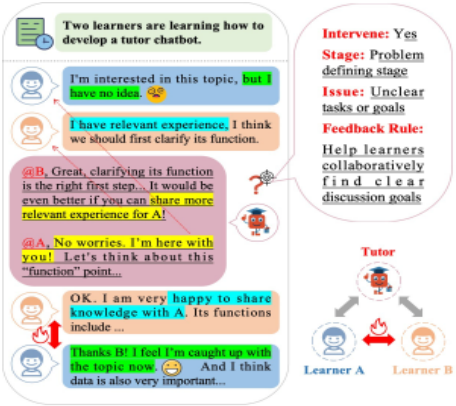
In this paper, we study an important yet overlooked problem, which is timely instructive feedback generation in ToGD. To solve this problem, we confront two major technical challenges. The first is to discover and learn the unknown impact of AI tutors' feedback on the following discussion among students. The second challenge is to ensure the pedagogy adaptability of the generated instructive feedback. This requires the model to be able to understand the overall discussion situation like a real teacher, promptly identify the problems encountered by each student in the discussion, and generate guiding feedback accordingly.
To overcome these challenges, we propose a novel LLMbased collaborative agent, incorporating pedagogical strategies to sense discussion stages, detect learning issues, identify the timing of intervention, and generate instructive feedback. To ensure the pedagogy adaptability, we leverage a CL theory, the Community of Inquiry (CoI) [Garrison and Arbaugh, 2007], to supervise the entire design of our LLM-based collaborative agent. CoI is the primary framework for designing collaborative learning environments, which is crucial for establishing a sense of community and interpersonal connections among students [Garrison, 2022]. It encourages group members to reflect on their understanding and progress regularly, identify areas for improvement or adjust their learning strategies. According to the CoI, the existing study [Akyol and Garrison, 2011] gives specific discussion stages, types of issues students may encounter in the discussion, and the corresponding feedback rules. This inspires us to design a prompting strategy based on the CoI and the work [Akyol and Garrison, 2011] to cultivate the agent to understand the overall discussion situation and promptly identify the problems encountered by each student. We fine-tune the prompted LLM using a labeled student group discussion dataset, further improving its performance in identifying five discussion stages and forty learning problems and making intervention decisions. An example is shown in Figure 1.
To discover and learn the unknown impact of AI tutors' feedback on the following discussion among students, we devise a multi-agent framework to simulate the collaborative learning behavior between a tutor agent and multiple student agents by automatically performing the ToGD. It simulates how a teacher provides feedback to students and how students react collaboratively after receiving the instructive feedback. Meanwhile, a synthetic ToGD dataset, namely CLTeach, is generated, which consists of 27k manually-verified multiparty dialogues with fine-grained annotations of instructive feedback and explanations. These synthetic data enable us to further fine-tune the LLM agent, learning the impact of AI tutors on students' collaborative behavior to generate instructive feedback at the right time without disrupting collaboration among students.
Our main contributions are summarized as follows:
- A new holistic approach of building a collaborative LLM agent as an AI tutor to effectively moderate ToGD like a real teacher 1 . It contains a novel CoI-based prompting strategy with fine-tuning to ensure the pedagogy adaptability of the generated instructive feedback. A multiagent framework is designed to discover and learn the impact of AI tutors on students' collaborative behavior to generate instructive feedback.
- A new ToGD dataset consists of 27k manually verified multi-party LLM-involved dialogues with fine-grained annotations, which can drive future research on studying human-LLM agent interactions.
- Extensive experiments demonstrate that our LLM-based collaborative agents achieve SOTA performance in providing students with timely instructive feedback without disrupting the collaboration process.
The literature review will be presented in the next section. Section 3 will introduce the technical details of our LLMbased collaborative agent, followed by the experimental results in Section 4 before concluding.
2 RelatedWork
2.1 LLM-based Tutoring Systems
LLM-based tutoring systems have gained attention in recent years due to their ability to provide personalized and scalable educational support [Liu et al., 2024a; Gan et al., 2023]. To activate LLMs' potential for diverse educational contexts, some studies explore the effectiveness of generalpurpose LLMs like ChatGPT in facilitating knowledge acquisition, especially in STEM education [Ding et al., 2024], language learning [Liu et al., 2024b], and writing support [Han et al., 2023]. AMWPTutor is proposed by [Pal Chowdhury et al., 2024] to guide students for math word problems, which demonstrates that GPT4 [Achiam et al., 2023]
1 Source codes and datasets are available via https://github.com/ CharlesYang030/Collaborative-Agents.
has good teaching quality on two datasets with mathematical problems and solutions. A scaffolding dataset and a CLASS framework are proposed by [Sonkar et al., 2023] to enable LLMs to guide students in a step-by-step way. This highlights the LLMs' abilities to break down biology questions into manageable subproblems and provide encouraging responses to students. Although these studies shows the promising prospects to enhance LLMs with pedagogical strategies, they focus mainly on one-on-one teaching. The investigation of LLM-based tutoring systems within collaborative learning (CL) remains underexplored [Gan et al., 2023; Cai et al., 2024]. However, it is necessary to have a skilled facilitator to guide the discussions, ask questions that spark new ideas, cultivate an environment that values diverse perspectives, establish the tone of discussions, and redirect the conversation when it strays off course [Cai et al., 2024]. Existing systems for CL rely on predefined scripts to initiate / conclude topics or pose simple follow-up questions. This often leads to undesirable interactions such as the reduction of student motivation due to rigid guidance. This does not meet the expectations that students can complete common goals collaboratively and efficiently in an engaged environment. In addition, these systems do not emphasize the collaborative performance between students and AI tutors, resulting in their inability to model multi-party collaboration well.
2.2 Teaching Datasets
Multi-party collaborative dialogues are the key factor for building a CL agent. Unfortunately, existing multi-party dialogues, such as AMI [Carletta et al., 2005] and ICSI [Janin et al., 2003], are mainly designed for meeting summarization and they lack role annotations. Thus, they are not suitable for training a CL agent. Constructing collaborative dialogues requires the interactions between a tutor and diverse students, while collecting data from the real world is costly. The work [Nguyen et al., 2024] prompts GPT4 to role-play as different personas with various demographics and levels of concern about climate change. They highlight the feasibility of simulating tutorless discussions about social issues with multiple LLM agents. The work [Liu et al., 2024a] utilizes deanteacher-student agents to generate data but the part of multiparty dialogue only involves isolate interactions between the teacher with each student. This cannot present the collaborations among students under the guidance from teachers. However, this paves the way to leverage a multi-agent framework to model collaborative behaviors and generate synthetic dialogue data.
2.3 Community of Inquiry
The Community of Inquiry (CoI) theory, widely applied in online and blended learning, emphasizes cognitive, social, and teaching presences to foster collaborative learning [Shea and Bidjerano, 2010]. The research [Shea et al., 2012] has explored CoI's role in discussion stages, highlighting its effectiveness in structuring collaborative dialogue from exploration to resolution [Akyol and Garrison, 2011]. Some studies show its potential in addressing learning issues, such as unclear goals and someone's lack of involvement, by enabling critical discourse and reflective thinking [Shea and Bidjerano, 2009]. Moreover, CoI promotes shared metacognition [Garrison, 2022], as students collaboratively regulate their learning processes, monitor progress, and resolve conflicts. Although no studies have yet integrated CoI with AI tools to support ToGD, this provides theoretical support for our work.
3 Our LLM-based Collaborative Agent
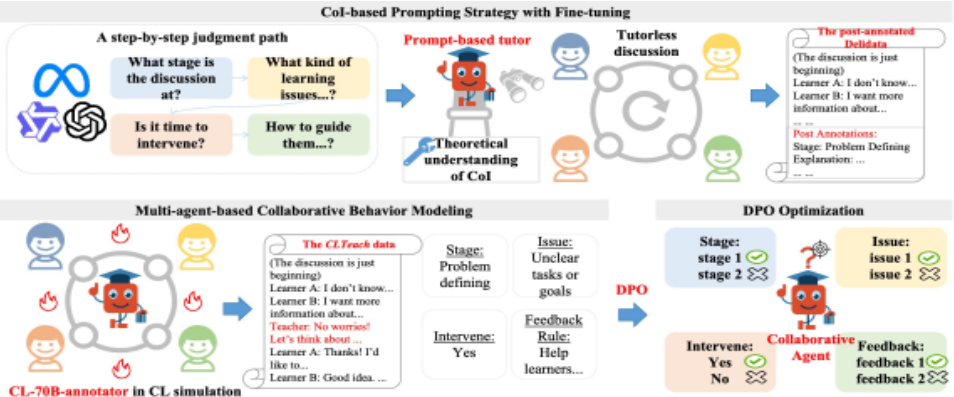
Inspired by CoI, we propose an LLM-based collaborative agent to effectively moderate ToGD like a real teacher, as shown in Figure 2. A CoI-based prompting strategy with fine-tuning is used to ensure the pedagogy adaptability for the ToGD status recognition. With the reliable instructionfollowing ability, the agent is then integrated into the multiagent framework with diverse Student agents, to generate synthetic data. The agent is further fine-tuned to generate instructive feedback at the right time without disrupting collaboration among students.
3.1 CoI-based Prompting Strategy with Fine-tuning for ToGD Status Recognition
Thanks to the expertise provided by educational scientists from the Education University of Hong Kong, we first designed a prompting strategy that unified the standards of stages, issues, intervention, and feedback rules in ToGD. Specifically, we define five progressive stages including problem defining, exploration, integration, resolution, and reflection. For each stage, there are eight common learning issues. For instance, at the problem defining stage, the issues include unclear tasks or goal, lack of motivation to participate and so on. At resolution stage, the issues contain lack of practical solution, difficulty in reaching consensus and so on. Then, the conditions for intervention are defined. For example, intervention is needed when students engage in superficial discussions or non-exploratory thinking without clear direction. When a discussion is just beginning and moving forward, there is no need to intervene. If a learning issue arises during the discussion and intervention is needed, there is a targeted feedback rule for this case. For example, the feedback rule for the unclear tasks or goal issue is to guide students to clarify the task goals and ensure a shared understanding. Each feedback rule also has several example sentences. All stages, issues, intervention conditions and feedback rules have clear definitions.
To alleviate the prompting burden for LLM, we propose a step-by-step judgment path. Specifically, we treat taskoriented group discussions as multi-party dialogues, where multiple students L = {l1, l2, ..., ln}(n >= 2) and a single agent A interact with each other under a given topic Θ. In limited turns T = {t1, t2, ..., tn}, the dialogue consists of the sequence of utterances U = {ut1 , ut2 , ..., utn } and each utterance is represented as a tuple ut = (ct, st, t), where ct is the utterance content, st is one of the speakers S = L ∪ A, and t is the turn. When a student speaks at a turn t, a dialogue history Ht = {u1, u2, ..., uu-1, ut-2} contains utterances up to and including the turn t. Under the step-by-step judgment path, given a dialogue history Ht and a topic Θ, the agent A is required to successively output stage results Rstage t , issue results Rissue t , intervention results Rintervention t , and instructive feedback Rfeedback t by following Eq.1 to Eq. 4:
where f denotes generative functions.
To validate the effectiveness of the proposed prompting strategy, we use a Llama3.1-70B-Instruct model to postannotate Delidata [Karadzhov et al., 2023]. Llama3.1-70BInstruct is selected because it is an open-source model with impressive performance in various instruction tasks, which is good for reproducibility. Delidata is constructed under a psychology game environment where participants are required to complete the game collaboratively. It records 500 group discussions including 14,000 utterances with role labels (without tutor). Delidata is chosen since it presents the collaborations in a tutorless discussion, compared to other datasets. After that, we recruit four student helpers from The Education University of Hong Kong, whose background is Education Science, to manually validate the LLM-generated annotations. An evaluation of the post-annotated Delidata is conducted using Fleiss' Kappa, yielding an agreement score of 0.81 and a valid data ratio of 87.24%. This ensures the effectiveness of our prompting strategy and the reliability of these annotations. The data is further refined manually and its statistics are displayed in Table 1. The proportions of the exploration stage and the integration stage are 40.04% and 31.33% respectively. This reflects that students are indeed more likely to encounter more issues in the early stages of the discussion in a real-world CL environment. This also shows the importance of having a tutor agent to facilitate CL in a tutorless discussion.
Unfortunately, we identify 5.7% of cases involving garbled text and 7.06% involving failure to follow instructions. These errors are caused by the LLMs' inherent high sensitivity to prompts before they are fine-tuned. On one hand, this will impair the interaction ability of the agent, resulting in its poor performance in real teaching scenarios for CL. On the other hand, this will also hinder the agent from understanding CL theories to identify discussion stages and learning issues and make intervention decisions. Therefore, we finetune the Llama3.1-70B-Instruct model using the instruction tuning method [Wei et al., 2021] by not masking the prompt, to further cultivate the agent to understand the overall discussion situation. The fine-tuned Llama3.1-70B-Instruct model is named CL-70B-vanilla, which have further theoretical understanding of CL and improved instruction-following ability for the ToGD task. It is deployed in the interaction framework as a vanilla tutor.
3.2 Multi-agent-based Collaborative Behavior Modeling and Data Generation
Previous studies [Nguyen et al., 2024; Jin et al., 2024; Xu and Zhang, 2023] demonstrate the potential of LLMs in simulating virtual students by defining the student profiles such as education, major, interests, speaking style and tone. Inspired by this, we propose a multi-agent interaction framework in which the CL-70B-valilla model interact with multiple student agents. Firstly, we select a set of topics from Debatepedia [Gottipati et al., 2013] as the initial topics. Debatepedia is a collaborative online encyclopedia documenting arguments for and against various debates on a wide range of deep topics suitable for in-depth discussions. Instead, existing public question-answering datasets [Rajpurkar et al., 2016; Joshi et al., 2017] mainly cover simple questions, such as "What is the molecular formula of water?". Each virtual discussion room has a topic, where at least two and at most five student agents are instantiated with different profiles and prior knowledge about the topic. To reflect how students react collaboratively after receiving the instructive feedback, student agents are required to monitor their own shared metacognition [Garrison, 2022]. Shared metacognition refers to the awareness and regulation for individual learning and group learning among participants in a community of inquiry [Akyol and Garrison, 2011; Garrison, 2022]. It reflects the change of social presence, teaching presence and cognitive presence of participants in CL. Following [Garrison, 2022], we respectively use 13 levels of self-regulation for individual learning and 13 levels of co-regulation for group learning, to prompt student agents to adjust their responses based on their levels of shared metacognition. Examples of the self-regulation for individual learning and the co-regulation for group learning are shown as follow:
| The CLTeach dataset | ||
|---|---|---|
| Item | The post-annotated Delidata | The interaction dataset |
| Discussion | 454 | 319 |
| Utterance | 13,361 | 13,849 |
| Average tokens of feedback | 69.98 | 85.48 |
| Problem defining stage | 9.90% σ = 1.77 | 3.36% σ = 0.31 |
| Exploration | 40.04% | 10.83% |
| stage | σ = 3.37 | σ = 1.36 |
| Integration stage | ||
| 31.33% | 25.71% | |
| σ = 3.26 | σ = 1.59 | |
| Resolution stage | 12.51% | 30.06% |
| σ = 2.37 | σ = 1.84 | |
| Reflection stage | 6.22% | 30.04% |
| σ = 2.47 | ||
| σ = | ||
| Agreement score | 0.83 | |
| 0.81 | ||
| 2.54 |
-------------------------
When I am engaged in the learning process as an individual: SELF-REGULATION
I1: I am aware of my effort.
I2: I am aware of my thinking.
... ...
I12: I assess how I approach the problem.
I13: I assess my strategies.
When I am engaged in the learning process as a member of a group: CO-REGULATION
G1: I pay attention to the ideas of others.
G2: I listen to the comments of others.
... ...
G12: I help the learning of others.
G13: I monitor the learning of others.
- - - - - - - - - - - - - - - - - - - - - - - - -
This allows more authentic collaborative behavior modeling than forcing collaborators follow the one-input-one-output paradigm. The maximum number of discussion turns is set as 50. The discussion will end if it reach 50 turns.
After multi-agent simulation, an interaction dataset across a wide range of topics is generated. The dataset is refined and verified by the student helpers, yielding an agreement score of 0.83 and a valid data ratio of 91.14%. Its statistics is presented in Table 1. Compared to the post-annotated Delidata, the proportions of the integration stage, the resolution stage, and the reflection stage are 25.71%, 30.06 and 30.04% respectively. This suggests that students generally need guidance in the later stages of the discussion in the simulated CL environment. With the involvement of a tutor, this also reflects that students are more likely to get through the early stages that often involve a lot of information exploration and integration.
3.3 Instructive Feedback Generation
The post-annotated Delidata reflects the changes of discussion stages and learning issues encountered by collaborators in a real ToGD. The interaction dataset shows the nuances of teacher-student collaborative behaviors in a simulated ToGD. They both involve the learnable information for the agent to generate timely instructive feedback without disrupting collaboration among students. Therefore, they are combined into a dataset named CLTeach to optimize our final agent jointly.
However, we realize that human teachers often make a teaching decision depending on preferences in different situations. The teaching decision is not either-or [Sonkar et al., 2024]. For example, when students exchange their ideas, this discussion is sometimes identified as the exploration stage and sometimes as the integration stage. when students are encountering conflicting viewpoints, human teachers perhaps provide a leading guidance to all students to alleviate the common conflict, or they perhaps encourage a specific student to lead the discussion and allow them try to resolve the issue on their own. Such decision margin can be changed by the teacher's preference. If the agent can simulate the learning from preferences, it will have more flexible decision-making ability to generate high-quality instructive feedback.
The supervised fine-tuning (SFT) approach is widely used to optimize generative language models by cross-entropy loss functions to minimize the difference between the labeled data distribution and the model generated distribution. The training data for SFT contains only one targeted answer (decision). In other words, given a training data (x, y) where x denotes the inquiry and y denotes the answer, language models are optimized in a mapping mode of only one absolutely correct answer y. Direct preference optimization (DPO) [Rafailov et al., 2024] is a recently proposed efficient and simple finetuning method. Given training data with a pair of answers (x, yw, yl) where yw indicates the preferred answer and yl indicates the non-preferred answer, language models are optimized to maximize the probability of generating the preferred answer yw by following:
where fθ denotes a scoring function for a given input x and output y, β denotes a temperature parameter for controlling the intensity of the preference difference, and σ denotes a sigmoid function used to represent the probability that yw is preferred over yl.
| The post-annotated Delidata | The interaction dataset | |||||||||||
|---|---|---|---|---|---|---|---|---|---|---|---|---|
| Model | Intervention | Stage | Issue | Feedback | Intervention | Stage | Issue | Feedback | ||||
| F1-score | BLEU | Rouge-L | BERTscore | F1-score | BLEU | Rouge-L | BERTscore | |||||
| Mistral-7B-Instruct | 44.61 | 10.24 | 4.79 | 2.55 | 6.0 | 2.59 | 38.24 | 7.99 | 0.0 | 4.19 | 2.85 | 0.80 |
| Qwen2.5-7B-Instruct | 42.97 | 8.73 | 4.20 | 2.78 | 6.21 | 3.31 | 40.55 | 7.11 | 1.43 | 5.73 | 4.22 | 1.69 |
| Llama3.1-8B-Instruct | 45.55 | 14.15 | 5.29 | 3.24 | 11.52 | 5.43 | 43.93 | 12.12 | 2.92 | 7.23 | 6.32 | 3.01 |
| GPT-4o-mini | 44.34 | 14.20 | 6.46 | 2.98 | 10.18 | 5.56 | 42.47 | 14.33 | 3.57 | 8.14 | 6.53 | 4.67 |
| GPT-4o | 50.14 | 27.98 | 11.95 | 4.04 | 14.82 | 8.78 | 49.80 | 21.24 | 6.23 | 11.65 | 10.98 | 6.77 |
| Our agent | 68.99 | 56.67 | 50.12 | 12.34 | 30.10 | 33.22 | 66.71 | 58.14 | 44.59 | 25.22 | 37.16 | 41.74 |
| w/o post-annotated Delidata | 56.14 | 42.68 | 33.15 | 7.29 | 22.32 | 26.68 | 56.04 | 44.32 | 32.57 | 15.15 | 22.35 | 30.97 |
| w/o interaction data | 52.81 | 39.00 | 24.10 | 8.68 | 23.15 | 26.77 | 49.78 | 40.59 | 28.98 | 13.40 | 20.71 | 24.56 |
| w/o decision making | 64.70 | 50.07 | 46.88 | 10.46 | 26.51 | 32.88 | 63.93 | 53.51 | 37.39 | 20.15 | 28.55 | 33.67 |
We believe that human teachers' decision-making process is closer to DPO than SFT. Therefore, we reform the CLTeach dataset into preference-style data required by DPO. The standard decision as yw from CLTeach is paired with another random but not repeated decision as yl. This is a straightforward method, and it indeed saves the cost of humans labeling preferences and scales up the learnable information. The agent can gain more learnable knowledge from the preferencestyle data. Considering the inference speed, a Llama3.18B-Instruct model is fine-tuned on the preference-style data, which is relatively efficient and meets the needs for the interaction with users in real-world ToGD.
4 Experiments and Results
4.1 Implementation details
Baseline. We compare several mainstream LLMs with our collaborative agent for this task, including closesource LLMs (GPT-4o and GPT-4o mini) and open-source lightweight LLMs (Llama3.1-8B-Instruct, Mistral-7BInstruct [Jiang et al., 2023], and Qwen2.5-7B-Instruct[Bai et al., 2023]).
Dataset. We split 80% of the CLTeach dataset as the training set and 20% as the test set respectively. All data is in English. Setting. The experiments are implemented Pytorch 2.4.0 and 4 A800 (80G) GPUs. We employ LoRA [Hu et al., 2021] to fine-tune models, where the learning rate is 5e-5, the epoch is 3 and the compute type is bf16. For the close-source LLMs (GPT-4o and GPT-4o mini), we test them through OpenAI APIs. For the balance between inference speed and the dialogue history, the context length is set as 4096 tokens. A classification metric (F1-score) is used to assess agents' performance on intervention decisions, stage identification, and issue detection. The generative metrics (BLEU [Papineni et al., 2002], Rouge-L [Lin, 2004], and BERTscore [Cai et al., 2024]) are used to assess the quality of agents' feedback content.
4.2 Main Results
The comparison results between our collaborative agent and the baseline models on the test sets are shown in Table 2. Our agent achieves the state-of-the-art teaching performance, especially in feedback generation. Compared to GPT-4o, the agent attains 18.85% improvement for intervention, 28.69% for stage, 38.17% for issue, and 24.44% BERTscore improvement in the post-annotated Delidata. Similarly, it attains 16.91% for intervention, 36.9% for stage, 38.36% for issue, and 34.97% BERTscore improvement in the interaction dataset. These results shows that our collaborative agent has impressive pedagogical adaptability for facilitating CL. It outperforms GPT-4o and it is far superior to those general-purpose LLMs, demonstrating the effectiveness of the pedagogy-guided interaction modeling. The Llama3.18B-Instruct model is the backbone of our collaborative agent. Compared to it, our agent has improved in all metrics, proving the advantages of the manually-verified LLM-generated annotations to enhance the agent to explore and learn the collaboration information among AI tutors and students. In addition, we find that the these baseline models performs worse on the interaction data than on the post-annotated Delidata. This shows the difficulty of guiding CL in an interaction environment.
4.3 Ablation Study
An ablation study is conducted to reveal the contribution of each module of our approach, and the results are also reported in Table 2. When the agent is fine-tuned on only the postannotated Delidata (w/o interaction data), the teaching performance of the agent drops 16.18% for intervention, 17.67% for stage, 26.02% for issue, and 6.45% for BERTscore in the post-annotated Delidata, 16.93% for intervention, 17.55% for stage, 15.61 for issue, and 17.18% for BERTscore in the interaction dataset. These results are reduced more than the situation where the agent is fine-tuned on only the interaction dataset (w/o post-annotated Delidata). This means that collaborative behavior modeling is the most crucial component for developing a CL agent, since the generated data enables the contextual pedagogy adaptability of the agent to imitate more appropriate teaching behaviors in a CL environment.
When the agent is fine-tuned by SFT (w/o decision making), its performance is not degraded as severely as in the above two cases, but it is still degraded. This shows that using DPO contributes to gaining more learnable knowledge from preference-style decisions.
4.4 Effectiveness of Facilitating CL
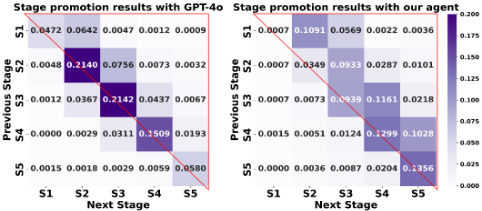
To further investigate the effectiveness of facilitating CL and the actual applicability of models, thirty additional topics from Debatepedia are selected to initiate new discussion rooms. Our collaborative agent and GPT-4o are respectively used to interact with the same set of student agents following the multi-agent interaction framework. We analyze every two consecutive stages identified by models to observe whether the discussion process is facilitated. The stage promotion result is shown is Figure 3. Stage(n,m) represents the promotion from previous stage n to next stage m (n < m). Theoretically, if a discussion is promoted ideally, the upper right corner of the stage-promotion heatmap will be darker. The stage promotion results with our collaborative agent achieve 10.91% Stage(1,2), 9.33% Stage(2,3), 11.61% Stage(3,4), and 10.28% Stage(4,5). Compared to GPT-4o, our agent can promote the discussion stages more smoothly. In other words, students are more likely to move forward to next stages without disrupting the collaboration. Moreover, GPT-4o tends to guide students in mid-stages (stage 2. exploration to stage 4. resolution), while our agent tends to guide in later stages (stage 3. integration to stage 5. reflection). This suggests that the discussion is more likely to enter the later stages under the guidance of our agent due to the effective feedback.
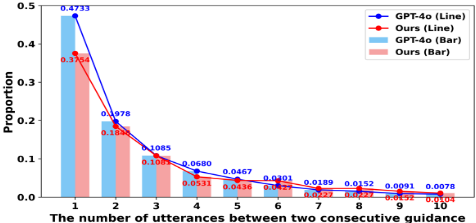
To reveal the teaching behaviors of models, we calculate the proportions of the number (1-10) of utterances between each two consecutive guidance for GPT-4o and our agent, as shown in Figure 4. Compared to our agent, the guidance frequency of GPT-4o is more intensive, which may lead to overinstruction and reduce Student autonomy. The average number of utterances of each student in discussions is 8.991 for GPT-4o and 12.465 for our agent respectively. This indicates that those students guided by our agent are more engaged.
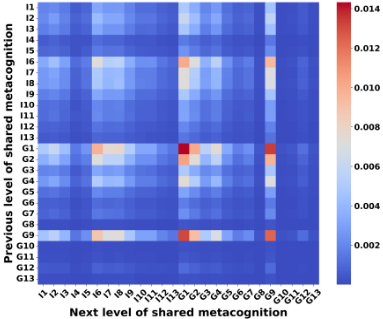
We also visualize the promotion of students' shared metacognition with the guidance of our agent, as shown in Figure 5. Students often move from the cognition of individual learning I6 (I am aware of my existing knowledge) to the cognition of group learning G1 (I pay attention to the ideas of others) and G9 (I respond to the contributions that others make). This shows that students undergone a positive cognitive transformation from individual to collective in CL.
In summary, our agent can effectively drive discussions, enhance student engagement, and guide positive cognitive changes with high-quality instructive feedback.
5 Conclusion
This paper studies the problem of the AI tutor in moderating ToGD and proposes an LLM-based collaborative agent to generate instructive feedback at the right time without disrupting collaboration among students. It features an innovative CoI-based prompting strategy combined with fine-tuning to enhance the pedagogy adaptability of the generated instructive feedback. Additionally, a multi-agent framework is proposed to enable LLMs to explore and learn how AI tutors influence students' collaborative behaviors in order to produce effective instructive feedback. Meanwhile, a multi-party LLM-involved dialogue dataset with fine-grained annotations is produced. This dataset has the potential to advance future research on human-LLM agent interactions. Extensive experiments demonstrate that our LLM-based collaborative agent achieves SOTA performance in providing students with timely instructive feedback without disrupting the collaboration process.
Although our LLM-based collaborative agent performs very well in facilitating ToGD in empirical experiments, its effectiveness has not yet been validated in authentic classroom settings. Moreover, our LLM-based collaborative agent has no verification of the improvement of students' learning outcomes, e.g., academic performance. In the near future, we will conduct in-class trials and collect student data to further validate the effectiveness of our agents.
Acknowledgments
The work is fully conducted at The Education University of Hong Kong (EdUHK) and supported by grants from National Natural Science Foundation of China (No. 62372189) and EdUHK-ECNU projects (No. 02184 and No. 02185).
@inproceedings{ijcai2025p1108,
  title     = {LLM-based Collaborative Agents with Pedagogy-guided Interaction Modeling for Timely Instructive Feedback Generation in Task-oriented Group Discussions},
  author    = {Yang, Qihao and Yang, Yu and An, Sixu and Hao, Tianyong and Xu, Guandong},
  booktitle = {Proceedings of the Thirty-Fourth International Joint Conference on
               Artificial Intelligence, {IJCAI-25}},
  publisher = {International Joint Conferences on Artificial Intelligence Organization},
  editor    = {James Kwok},
  pages     = {9972--9980},
  year      = {2025},
  month     = {8},
  note      = {AI and Social Good},
  doi       = {10.24963/ijcai.2025/1108},
  url       = {https://doi.org/10.24963/ijcai.2025/1108},
}
TY - CPAPER TI - LLM-based Collaborative Agents with Pedagogy-guided Interaction Modeling for Timely Instructive Feedback Generation in Task-oriented Group Discussions AU - Yang, Qihao AU - Yang, Yu AU - An, Sixu AU - Hao, Tianyong AU - Xu, Guandong T2 - Proceedings of the Thirty-Fourth International Joint Conference on Artificial Intelligence, IJCAI-25 PB - International Joint Conferences on Artificial Intelligence Organization PY - 2025 SP - 9972 EP - 9980 DO - 10.24963/ijcai.2025/1108 UR - https://doi.org/10.24963/ijcai.2025/1108 ER -Copied
Machine-readable versions of this paper, for tools and AI agents:





