
Reinforcement Learning for Hybrid Charging Stations Planning and Operation Considering Fixed and Mobile Chargers
Proceedings of the Thirty-Fourth International Joint Conference on Artificial Intelligence. AI and Social Good. Pages 10017-10025.
https://doi.org/10.24963/ijcai.2025/1113
Keywords
- Planning and Scheduling: General
- Machine Learning: General
Abstract
efficient and adaptable charging infrastructure. Fixed-location charging stations often suffer from underutilization or congestion due to fluctuating demand, while mobile chargers offer flexibility by relocating as needed. This paper studies the optimal planning and operation of hybrid charging infrastructures that combine both fixed and mobile chargers within urban road networks. We formulate the Hybrid Charging Station Planning and Operation (HCSPO) problem, jointly optimizing the placement of fixed stations and the scheduling of mobile chargers. A charging demand prediction model based on Model Predictive Control (MPC) supports dynamic decision-making. To solve the HCSPO problem, we propose a deep reinforcement learning approach enhanced with heuristic scheduling. Experiments on real-world urban scenarios show that our method improves infrastructure availability—achieving up to 244.4% increase in coverage—and reduces user inconvenience with up to 79.8% shorter waiting times, compared to existing solutions.
- [Afshar et al., 2021] Shahab Afshar, Pablo Macedo, Farog Mohamed, and Vahid Disfani. Mobile charging stations for electric vehicles -a review. Renewable and Sustain- able Energy Reviews, 152:111654, 2021.
- [Beyazıt and Tas ¸cıkaraoglu, 2023] Muhammed Ali Beyazıt and Akın Tas ¸cıkaraoglu. Electric vehicle charging through mobile charging station deployment in coupled distribu- tion and transportation networks. Sustainable Energy, Grids and Networks, 35:101102, 2023.
- [Cai et al., 2014] Hua Cai, Xiaoping Jia, Anthony S. F. Chiu, Xiaojun Hu, and Ming Xu. Siting public electric vehicle charging stations in beijing using big-data informed travel patterns of the taxi fleet. Transportation Research Part D: Transport and Environment, 33:39-46, 2014.
- [Hwang et al., 2015] Seong Wook Hwang, Sang Jin Kweon, and Jose A. Ventura. Infrastructure development for al- ternative fuel vehicles on a highway road system. Trans- portation Research Part E: Logistics and Transportation Review, 77:170-183, 2015.
- [Kchaou Boujelben and Gicquel, 2019] Mouna Kchaou Boujelben and Celine Gicquel. Efficient solution approaches for locating electric vehicle fast charging stations under driving range uncertainty. Computers and Operations Research, 109:288-299, 2019.
- [Kchaou-Boujelben and Gicquel, 2020] Mouna Kchaou- Boujelben and Céline Gicquel. Locating electric vehicle charging stations under uncertain battery energy status and power consumption. Computers and Industrial Engineering, 149:106752-106752, 2020.
- [Kchaou-Boujelben, 2021] Mouna Kchaou-Boujelben. Charging station location problem: A comprehensive re- view on models and solution approaches. Transportation Research Part C: Emerging Technologies, 132, 2021.
- [Kong et al., 2019] Weiwei Kong, Yugong Luo, Guixuan Feng, Keqiang Li, and Huei Peng. Optimal location plan- ning method of fast charging station for electric vehicles considering operators, drivers, vehicles, traffic flow and power grid. Energy, 186, 2019.
- [Lee and Han, 2017] Chungmok Lee and Jinil Han. Benders-and-price approach for electric vehicle charg- ing station location problem under probabilistic travel range. Transportation Research Part B: Methodological, 106:130-152, 2017.
- [Li et al., 2017] Meng Li, Yinghao Jia, Zuojun Shen, and Fang He. Improving the electrification rate of the vehicle miles traveled in beijing: A data-driven approach. Trans- portation Research Part A: Policy and Practice, 97:106- 120, 2017.
- [Li et al., 2024] Hua Li, Dongmin Son, and Bongju Jeong. Electric vehicle charging scheduling with mobile charg- ing stations. Journal of Cleaner Production, 434:140162, 2024.
- [Liu et al., 2019] Qiyu Liu, Yuxiang Zeng, Lei Chen, and Xiuwen Zheng. Social-aware optimal electric vehicle charger deployment on road network. In Proceedings of the 27th ACM SIGSPATIAL International Conference on Advances in Geographic Information Systems, SIGSPA- TIAL '19, page 398-407, New York, NY, USA, 2019. As- sociation for Computing Machinery.
- [Liu et al., 2024] Linfeng Liu, Su Liu, Jiagao Wu, and Jia Xu. A placement strategy for idle mobile charging sta- tions in ioev: From the view of charging demand force. IEEE Transactions on Intelligent Transportation Systems, 25(5):3870-3884, 2024.
- [Qu et al., 2024] Haohao Qu, Haoxuan Kuang, Qiuxuan Wang, Jun Li, and Linlin You. A physics-informed and attention-based graph learning approach for regional elec- tric vehicle charging demand prediction. IEEE Transac- tions on Intelligent Transportation Systems, pages 1-14, 2024.
- [Raffin et al., 2021] Antonin Raffin, Ashley Hill, Adam Gleave, Anssi Kanervisto, Maximilian Ernestus, and Noah Dormann. Stable-baselines3: Reliable reinforcement learning implementations. Journal of Machine Learning Research, 22(268):1-8, 2021.
- [Shahraki et al., 2015] Narges Shahraki, Hua Cai, Metin Turkay, and Ming Xu. Optimal locations of electric public charging stations using real world vehicle travel patterns. Transportation Research Part D: Transport and Environ- ment, 41:165-176, 2015.
- [Shih et al., 2019] Shun-Yao Shih, Fan-Keng Sun, and Hung yi Lee. Temporal pattern attention for multivariate time series forecasting, 2019.
- [Tang et al., 2020] Peng Tang, Fang He, Xi Lin, and Meng Li. Online-to-offline mobile charging system for electric vehicles: Strategic planning and online operation. Trans- portation Research Part D: Transport and Environment, 87:102522, 2020.
- [Ting et al., 2024] Lo Pang-Yun Ting, Chi-Chun Lin, Shih- Hsun Lin, Yu-Lin Chu, and Kun-Ta Chuang. Multi-agent reinforcement learning for online placement of mobile ev charging stations. In De-Nian Yang, Xing Xie, Vincent S. Tseng, Jian Pei, Jen-Wei Huang, and Jerry Chun-Wei Lin, editors, Advances in Knowledge Discovery and Data Min- ing, pages 284-296, Singapore, 2024. Springer Nature Singapore.
- [Tu et al., 2016] Wei Tu, Qingquan Li, Zhixiang Fang, Shih lung Shaw, Baoding Zhou, and Xiaomeng Chang. Optimizing the locations of electric taxi charging sta- tions: A spatial-temporal demand coverage approach. Transportation Research Part C: Emerging Technologies, 65:172-189, 2016.
- [Veličković et al., 2018] Petar Veličković, Guillem Cucurull, Arantxa Casanova, Adriana Romero, Pietro Liò, and Yoshua Bengio. Graph attention networks, 2018.
- [von Wahl et al., 2022] Leonie von Wahl, Nicolas Tem- pelmeier, Ashutosh Sao, and Elena Demidova. Rein- forcement learning-based placement of charging stations in urban road networks. In Proceedings of the 28th ACM SIGKDD Conference on Knowledge Discovery and Data Mining, KDD '22, page 3992-4000, New York, NY, USA, 2022. Association for Computing Machinery.
- [von Wahl et al., 2023] Leonie von Wahl, Clara Mautsch, Stefan Ladwig, Michael Nolting, and Nicolas Tem- pelmeier. Towards data-driven planning of mobile charg- ing infrastructure for electric vehicles. In Proceedings of the 1st ACM SIGSPATIAL International Workshop on Sus- tainable Mobility, SuMob '23, page 13-22, New York, NY, USA, 2023. Association for Computing Machinery.
- [Wang et al., 2023] Shiqi Wang, Yuze Li, Anthony Chen, and Chengxiang Zhuge. Electrification of a citywide bus network: A data-driven micro-simulation approach. Transportation Research Part D: Transport and Environ- ment, 116:103644-103644, 2023.
- [Xiang et al., 2019] Yue Xiang, Zhuozhen Jiang, Chenghong Gu, Fei Teng, Xiangyu Wei, and Yang Wang. Electric ve- hicle charging in smart grid: A spatial-temporal simulation method. Energy, 189, 2019.
- [Yang et al., 2017] Jie Yang, Jing Dong, and Liang Hu. A data-driven optimization-based approach for siting and sizing of electric taxi charging stations. Transportation Re- search Part C: Emerging Technologies, 77:462-477, 2017.
- [Yin et al., 2023] Wanjun Yin, Jianbo Ji, and Xuan Qin. Study on optimal configuration of ev charging stations based on second-order cone. Energy, 284, 2023.
References were extracted automatically from the PDF and may contain errors.
Full text extracted automatically from the PDF; figures, tables and equations may differ. The PDF is the version of record.
1 Introduction
The transition towards vehicle electrification is rapidly advancing, driven by its substantial societal and environmental benefits. However, the widespread adoption of electric vehicles (EVs) hinges on the availability and efficiency of charging infrastructure [von Wahl et al., 2022], which requires a comprehensive and adaptable planning approach to accommodate the increasing demand. A critical challenge in this process is accounting for the dynamic nature of charging demand, which is often overlooked in traditional station planning methods.
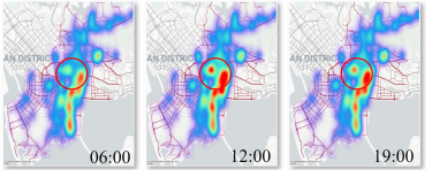
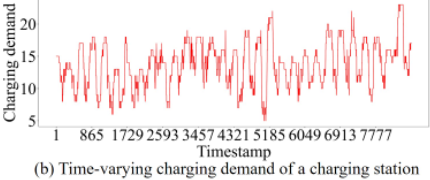
As shown in Figure 1, panel (a) presents a heat map of charging demand across Nanshan District in Shenzhen, China, highlighting how demand distribution varies throughout the day, from 6:00 AM to 7:00 PM. Meanwhile, panel (b) depicts the time series of charging demand for a specific station in Shenzhen, further illustrating the fluctuations in demand at a granular level. These spatio-temporal patterns collectively emphasize the dynamic nature of charging demand in urban areas.
∗Corresponding author. Email: yuxliang@outlook.com
While traditional charging stations with fixed-location chargers offer cost and grid stability benefits, their spatial rigidity leads to inefficiencies, especially in addressing demand-supply mismatches from fluctuating demand. For example, sizing infrastructure for peak demand causes underutilization during off-peak hours, while sizing for off-peak leads to congestion during peaks. These limitations highlight the need for adaptive infrastructure that can reconfigure in response to changing demand.
Emerging mobile chargers (MCs) have recently gained attention as a flexible supplement to urban charging networks [Afshar et al., 2021]. Unlike fixed chargers, mobile chargers can be dynamically scheduled to align with changing demand patterns, offering a promising solution to the limitations of traditional charging infrastructure. In addition to addressing the limitations of fixed charging stations, the integration of MCs can also benefit the configuration of fixed charging stations. For example, in areas with demand surges, MCs can be scheduled for temporary service, eliminating the need for installing fixed stations in these locations. This approach ensures that fixed stations are deployed where demand is more consistent, improving overall system efficiency.
Considering optimization for both fixed and mobile charging infrastructures, this paper introduces a novel hybrid charging station planning and operation (HCSPO) problem, which aims to integrate the optimal planning of fixed charging stations with dynamic operation of mobile chargers. Specifically, we formulate the HCSPO problem within urban road networks to optimize the locations and configurations of fixed charging stations and to dynamically schedule mobile chargers to support real-time charging needs.
To enhance decision-making, we incorporate a charging demand prediction model based on Model Predictive Control (MPC) to provide foresight into demand fluctuations. Our solution leverages a reinforcement learning (RL) method, augmented with heuristic techniques, to adaptively optimize the planning and operation of the HCSPO problem. This integrated approach effectively bridges the strategic planning of fixed charging stations with the operational dynamics of mobile chargers, contributing to the sustainability and accessibility of urban transportation networks.
In summary, the contributions of this paper are as follows:
- We formulate the HCSPO problem into a rolling horizon framework within road networks, integrating the planning of fixed stations with mobile charging operations. Our approach incorporates a demand prediction model based on an MPC policy to enhance decision-making.
- We propose an adaptive RL algorithm, enhanced with heuristic scheduling techniques, to efficiently tackle the HCSPO problem, ensuring optimal planning and operation of both fixed and mobile infrastructures.
- We conduct extensive experiments on real-world dataset, which demonstrates our approach outperforms other baselines, offering superior societal benefits, including improved sustainability and user satisfaction.
2 RelatedWork
This section reviews related work on charging station planning and mobile charging infrastructure operations.
EV charging station planning is often modeled as a variant of the Facility Location Problem. However, many approaches rely on simplified assumptions about charging demand [Kchaou-Boujelben, 2021], which may not reflect actual spatio-temporal distributions. Some studies simulate EV recharging behavior using real-world datasets like GPS records [Cai et al., 2014; Li et al., 2017; Shahraki et al., 2015; Yang et al., 2017; Hwang et al., 2015], while others, such as [Li et al., 2017; Tu et al., 2016], use taxi trajectories. Recent research also explores dynamic and stochastic environments [Wang et al., 2023; Kchaou Boujelben and Gicquel, 2019; Kchaou-Boujelben and Gicquel, 2020; Lee and Han, 2017; Kong et al., 2019; Yin et al., 2023; Xiang et al., 2019].
Mobile charging station placement is gaining traction. For example, [Tang et al., 2020] proposes a two-phase framework to determine MCS placement, scheduling, and relocation, which is widely adopted in MCS placement and scheduling studies, including depot and fleet locations [Ting et al., 2024; Liu et al., 2024; Li et al., 2024; Beyazıt and Tas¸cıkarao˘glu, 2023; von Wahl et al., 2023]. Some studies validate approaches with real-world data, including GPS trajectories [Ting et al., 2024; Liu et al., 2024]. [Liu et al., 2024] uses a Markov Decision Process (MDP) to reduce delays and increase the proportion of charged EVs, while [Ting et al., 2024] extends the two-phase method with a multi-agent RL algorithm for dynamic MCS operation.
While substantial research exists on both fixed-location and mobile charging infrastructures, to our best knowledge, no study has integrated these within a single framework. This paper proposes an adaptive RL approach that simultaneously determines fixed station locations and configurations while dynamically scheduling mobile chargers.
3 Problem Statement
In this section, we formally define the HCSPO problem and provide the following key definitions:
Definition 1 (Road Network). Let G = (V, E) be a directed weighted graph with V the set of vertices and E the set of edges. The vertices are the road network junctions, while the edges represent the roads direction-wise.
Definition 2 (Dynamic Charging Demand). Considering the time-varied nature of charging demand, Let the recording dem1,...,|T| (v) = [dem1 (v), dem2 (v), · · · , dem|T| (v)] denote the charging demand of vertex v over the operation horizon divided into |T| time slots.
Definition 3 (Charging Station). A charging station (CS) s within the road network G is defined as a tuple s = (v, x), where v ∈ V is the location node, x = (x1, . . . , xn) is a vector of length n ∈ N with xi ∈ N being the number of fixed chargers of type i at s. We denote the set of all possible CSs as S. We set a limit on the number of fixed chargers of each s by ∑i xi ≤ K.
Definition 4 (Mobile Charger and Depot). A mobile charger (MC) m can be defined as m = (l1,··· ,|T | m , τ 1,··· ,|T| m , q1,··· ,|T| m ), which denotes the current location, accessible time (arrival time after scheduling decision) and remaining electricity of m at different time slots t ∈ T. Each schedule for MCs is batched with size of kMC as a fleet. In addition, we define mobile depots j ∈ J as the initial locations of MCs before scheduling and where they return to recharge when their batteries deplete, i.e., l1m = j ∈ J.
Definition 5 (Charging Plan). A charging plan P = (S,M) on G includes an assignment of vertices to stations s ∈ S including the configuration of fixed chargers and the scheduling of each mobile charger among all time slots.
We use a utility function (see Eq. (16)) to evaluate the effectiveness of a charging plan. We set a limit on the budget to install fixed stations via Eq. 1.
Here, feei represents the installation cost of the i-th type of fixed charger, iMC(m) is a binary variable where iMC(m) =
1 indicates that mobile charger m is employed; otherwise, it remains idle throughout the entire horizon. feeMC denotes the operational cost of each mobile charger, and Budget refers to the total budget allocated for the system.
We formalize HCSPO as follows. Given a road network G = (V,E), time slots T = 1, . . . , |T|, historical node-level demand, and perfect foresight of future demand, we seek a charging plan that satisfies all demand and maximizes a utility that balances social benefit against installation cost and queuing loss.
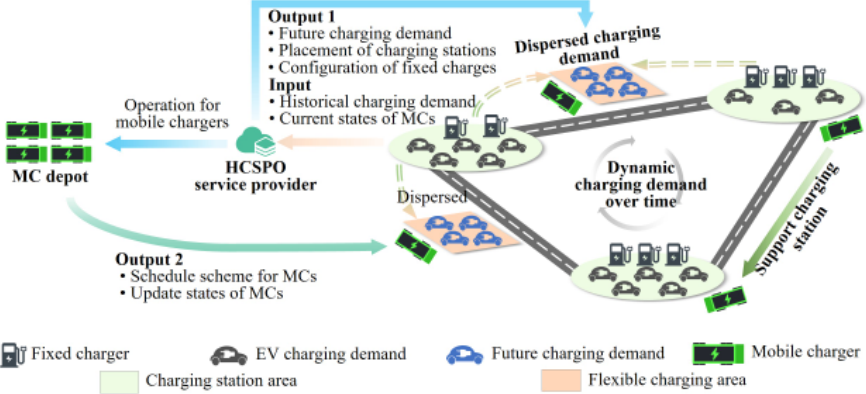
Figure 2 summarizes the workflow: before operation, the provider forecasts demand from historical data, selects station locations/configurations, and schedules mobile chargers to flexibly serve areas beyond fixed stations and ease peak-hour congestion.
4 SystemFramework
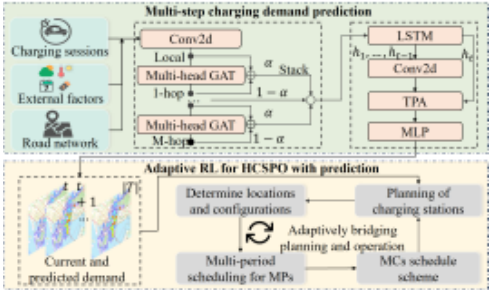
This section outlines the HCSPO system framework (Figure 3). We begin with a multi-step charging demand prediction model based on historical data. Next, we adapt the utility model from [von Wahl et al., 2022] into a rolling horizon framework that incorporates current and future demand for MPC-based decision-making. Finally, we propose two mobile charger scheduling strategies integrated with fixed station planning.
4.1 Multi-step Charging Demand Prediction
To anticipate future charging needs, we formulate a multistep demand prediction problem as:
where dem denotes historical node-level demand and F includes exogenous features (e.g., weather, day type). We adopt a spatiotemporal forecasting model inspired by [Qu et al., 2024], which integrates a Graph Embedding Module and a Multivariate Decoder. The embedding module captures temporal trends via CNN and spatial correlations via GAT [Veliˇckovi´c et al., 2018], enhanced by residual connections. The decoder uses TPA-LSTM [Shih et al., 2019] to extract long-term temporal dependencies with multi-hop attention, enabling accurate multi-step forecasting over the graph. This predicted demand guides downstream optimization of CS and MC operations.
4.2 Utility Function
This section introduces a utility model to evaluate the effectiveness of a charging plan. Building on the utility model designed by [von Wahl et al., 2022], we extend this model into a rolling horizon framework to assess the performance of a charging plan under time-varying demand. We also introduce a queuing loss metric that measures the number of EVs leaving the queue due to excessive wait times for recharging.
Benefit
The benefit function measures the coverage of the road network by charging infrastructures. Intuitively, nodes supported by a greater number of charging infrastructures suggest higher benefits. To quantify this, we define the influential radius of a charging station (CS) s as the distance within which it attracts EVs from nearby nodes, influenced by its charging supply capacity.
We first define the charging supply capacity as the total power provided by both fixed chargers and mobile chargers (if any) at time slot t, which can be calculated as follows:
where ci denotes the charging power provided by each fixed charger of type i, cMC is the charging power provided by each mobile charger (MC), and iMC(m, s, t) : M×V ×T ↦→ {0, 1} is an indicator function that equals 1 if m is scheduled to s at time slot t, and 0 otherwise. δ ∈ [0, 1] is the invalid time discount factor since MCs could not offer charging capacity while scheduling, which will be described in Section 4.3. Once the capacity of a CS s is determined, the influential radius of s at time slot t is: Rt (s) = Rmax 1 1+exp(- ˜ Ct (s)) , where Rmax denotes the maximum influential radius (a model parameter), and - ˜ C t (s) represents the scaled capacity of s at t.
Next, we define the coverage of node v at t, covt (v), as the set of stations whose influential radius can cover v: covt (v) = {s ∈ P | dist(v, s) < Rt (s)}, where dist(v, s) is the distance between v and s. The benefit of the charging plan P is then formulated as follows:
Cost
We evaluate the cost of a charging plan P in terms of travel time, charging time and waiting time. However, since the presence of dynamic charging demand and MCs scheduling, EVs from the same node may visit different CSs at different time slots. Thus we also need to extend cost function into a rolling horizon context. In order to estimate travel time, we first define an indicator function iCS(v, s) : V ×S ↦→ {0, 1} to be 1 if s is the CS assigned to v according to Station Seeking Algorithm in [Liu et al., 2019], and 0 otherwise. Then the travel time of P is:
where vel = const is the average vehicle speed.
Next, we estimate the charging time and waiting time using the Pollaczek-Khintchine formula, as in [von Wahl et al., 2022]. However, this approach assumes no limits on queue length, considering only the stability of the queuing system. In real-world applications, charging demand can vary over time, and demand may occasionally exceed station capacity. To address this, instead of enforcing stability constraints, we set a maximum average waiting time, Wmax. Specifically, if the waiting time for a queue with length s exceeds Wmax, no new EV will join the queue. Let
be the service rate of s at t (where B = const is the electricity required for recharging each EV). According to Pollaczek-Khintchine formula, estimated number of approaching EVs at t Dt (s) is:
Then the average waiting time of station s with no stability constraints is:
where
is the stability constraints for queuing system in [von Wahl et al., 2022; Liu et al., 2019]. When we set maximumW(s) to Wmax, and replace it with W(s) into Eq. (6), (8) and (9), we can obtain the maximumDtmax through:
Therefore, we estimate the corrected number of EVs approaching CS s at t as follows:
and corrected ˜W t (s) can be obtained by:
And we estimate charging time of charging plan P through
Finally, we aggregate the travel time, charging time, and waiting time for a charging plan (P) into a single cost function:
where α ∈ [0, 1] is a weighting parameter.
Queuing Loss
Since we have introduced the maximum waiting time Wmax and corrected estimated number of EVs ˜Dt (s) in Section 4.2, a metric so-called queuing loss is introduced to measure the loss of those demand for avoiding long waiting time, i.e.,
Finally, we model utility function by combining three evaluation metrics through:
where λb, λc and λq are trade-off weights.
4.3 Mobile Chargers Scheduling
We propose two heuristic strategies for scheduling mobile chargers (MCs): supporting overloaded charging stations and establishing flexible charging areas. Additionally, we introduce policies for MC adjustment and recall to adapt to dynamic demand.
Supporting Charging Stations
To support overloaded charging stations, we employ a heuristic strategy: (1) identify the station s with the highest loss, calculated as λc · (waiting+charging)+λq · queuing loss; (2) sort all idle MCs by their distance to s; (3) select the nearest idle MC with sufficient energy (> cMC) and not currently scheduled; (4) assign it to s and update the station's service capacity and related metrics accordingly.
Establishing Flexible Charging Areas
To supplement fixed charging stations, we employ a heuristic strategy: (1) identify the non-CS node v with the highest cumulative demand demt:|T| (v); (2) sort all idle MCs by their distance to v; (3) select the nearest idle MC with sufficient energy (> cMC) and not currently scheduled; (4) dispatch it to v to establish a temporary charging site without fixed infrastructure; (5) update system metrics such as capacity C, service rate µ, and adjusted demand ˜D accordingly.
Adjustment and Recall Policy for MCs
Relocating a MC m incurs a scheduling delay during which it cannot provide service. The next arrival time after scheduling is given by τ t+1 m = dist(ltm, lt+1 m )/vel. To account for the service loss during this period, we define a discount factor:
where H is the duration of a time slot.
Since MCs have limited battery capacity, their remaining energy is updated as:
If qtm < cMC, the MC is recalled to a depot j for recharging. The required energy is q = BMC - qtm, and the updated arrival time becomes τ t+1 m = dist(ltm, j)/vel +C ′ /q, where C ′ is the charging power.
5 Reinforcement Learning Framework
We propose an adaptive reinforcement learning framework (ARL-HCSPO) to jointly optimize station placement, fixed charger setup, and mobile charger scheduling, using demand prediction (Section 4.1) and utility modeling (Section 4.2) to shape the reward in dynamic environments.
Observation. The observation Oi at episode step i consists of two components: planning observation for CSs, denoted as OiCS and operation observation for MCs, denoted as OiM C. The planning observation is defined as follows OiCS = {(lonv, latv, dem1,··· ,|T| v , x)v |∀v ∈ V }, where lonv and latv are the coordinate of node v, and x =
(x1, · · · , xn) is the configuration of fixed chargers, which is only applicable when v is a CS.
Then we define the operation observation using equation OiMC = {(l1,··· ,|T| m , q1,··· ,|T| m , τ 1,··· ,|T| m )m |∀m ∈ M }, which captures the location, arrival time after scheduling and
remaining electricity of all time slots t ∈ T .
Action. We adopt a five-action space inspired by [von Wahl et al., 2022], serving as neighborhood operations to modify the charging plan:
- Create by Demand: Add a CS at the node with highest demand using a precomputed capacity-cost lookup table over n charger types.
- Create by Benefit: Add a CS at the node with lowest coverage; configuration follows the same lookup rule.
- Increase by Demand: Add one charger to the node with highest demand.
- Increase by Benefit: Add one charger to a CS near the lowest-benefit node.
- Relocate: Move a charger from the lowest-benefit CS to the one with the highest unmet demand (e.g., waiting time or queuing loss).
To balance planning and real-time operation, after each action step i, we schedule mobile chargers (MCs) based on the updated plan. This coordination ensures flexibility for demand surges via MCs, while CSs provide stable long-term coverage.
Reward. Given the utility function described in Section 4.2, we define the reward function between transition as the difference between P i+1 and P i , i.e., ri = utility(P i+1 ) - utility(P i ).
6 Experiments
In this section, we will introduce how we perform our ARLHCSPO method on a real-world application.
6.1 Datasets
We evaluate our approach on the road network of Nanshan District, Shenzhen, China, comprising 1663 nodes and 2964 edges, similar to [von Wahl et al., 2022]. Existing charging station locations are collected from [Qu et al., 2024] and used as a baseline. Due to the lack of precise charging demand data at the road level, we use charging session data from [Qu et al., 2024] for charging demand estimation, allocating nodelevel demand via inverse distance weighting from each node to the nearest CS.
6.2 EvaluationMetric and Implementation
Based on the utility function in Section 4.2, we evaluate the effectiveness of the charging plan generated by our approach using several metrics: benefit, cost, queuing loss, travel, charging, and waiting.
In the utility model, we use the following parameters as default setting: α = 0.4, λb = 0.4, λc = 0.4, λq = 0.2, n = 3, k = 25, Budget = 5.4e7 CNY, E = 35 kwh, rmax = 2.5 km, H = 60 min, T=3, Wmax = 30 min, |M| = 30, kMC =
10, cMC = 42 kw, BMC = 105 kwh. The rated charging power of fixed chargers, c1, c2 and c3 are set to 7kw, 22kw and 50kw, respectively, with corresponding installation fees of 2700 CNY, 6750 CNY and 252000 CNY. The operation cost for each MC is 59400 CNY.
RL in this paper is applied on Stable Baselines 3 [Raffin et al., 2021], implemented using DQN as basic model to train an optimal policy. We set learning rate to 0.01, buffer size to 10000, batch size to 128. The maximum number of training steps is set to 30000.
6.3 Baselines
To evaluate the effectiveness of our method (ARL-HCSPO), we compare it with several state-of-the-art baselines under the same budget constraint (Eq. 1). Since baselines do not utilize mobile chargers, they are allowed to deploy more fixed chargers for fairness.
- EXISTING PLAN: Uses the real-world deployment of location-fixed charging stations as a reference to quantify improvement.
- HIGHEST DEMAND: A greedy strategy that selects nodes with the highest cumulative demand until the budget is depleted; charger configurations follow our action space setup.
- BOUNDING&OPTIMIZING+: Based on [von Wahl et al., 2022], this method enhances [Liu et al., 2019] by integrating a configuration lookup table for greedy allocation.
- PCRL: A reinforcement learning-based approach from [von Wahl et al., 2022] for optimizing fixed CS placement in real-world scenarios.
6.4 Experimental Results
In this experiment we apply our approach as well as other baselines to solve HCSPO problem on Nanshan district, Shenzhen datasets.
Evaluation
Table 1 presents the performance metrics of our approach compared to other baselines, where ARL-HCSPO consistently outperforms across all metrics. Notably, the benefit metric sees a significant improvement at 205.1%, vastly exceeding other methods, indicating that our approach can substantially enhance the availability of charging infrastructure across the road network. Additionally, a 40.5% reduction in the cost metric demonstrates our approach's ability to improve EV owners' charging satisfaction, especially reflected in waiting metric with a 79.8% reduction.
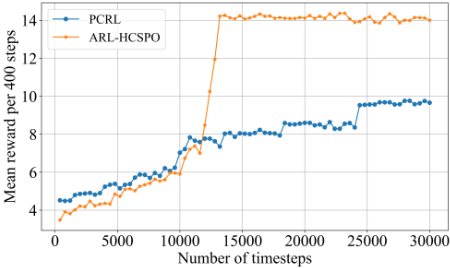
For RL-based approach, i.e., PCRL and ARL-HCSPO, we initialize charging plan as empty before training. Figure 4 illustrates the training evolution of our approach compared to PCRL. As shown, our method (in blue) outperforms PCRL (in orange) by achieving higher episode rewards with more stable convergence.
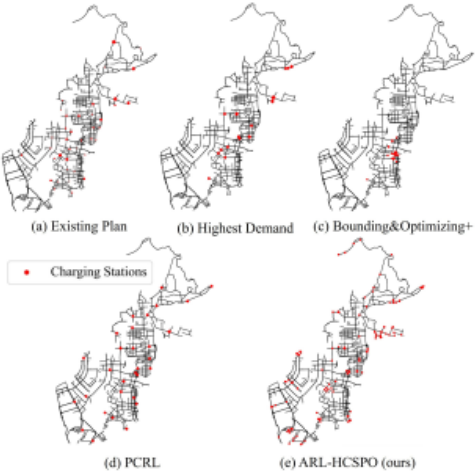
Figure 5 depicts the distribution of charging stations generated by various methods. On this dataset, both the BOUNDING$OPTIMIZING+ and HIGH DEMAND approaches fail to show significant improvement over the EXISTING PLAN. In contrast, both PCRL and ARL-HCSPO exhibit noticeable enhancements, with ARL-HCSPO achieving the most extensive CS coverage, due to the integration of mobile charger scheduling. Moreover, ARL-HCSPO results in a more evenly distributed network of CSs across the road system.
Ablation Study
To evaluate the effectiveness of each module within ARLHCSPO, we compare our approach against three variants: (1) ARL-HCSPO (W/O MPC), which excludes the MPC policy; (2) ARL-HCSPO (W/O MCS1), which removes the supporting charging station scheduling strategy; and (3) ARL-HCSPO (W/O MCS2), which omits the flexible charging areas scheduling strategy.
The results in Table 2 indicate that all variants improve upon the EXISTING PLAN. Comparing our approach with ARL-HCSPO (W/O MPC), we observe a significant 82.3% increase in the benefit metric, alongside modest gains in other metrics, underscoring the value of incorporating the demand prediction model and MPC policy. Additionally, the analysis of the two MC scheduling strategies reveals different focal points: ARL-HCSPO (W/O MCS1) emphasizes maximizing benefit, achieving a peak benefit of 205.7%, slightly exceeding ARL-HCSPO (205.1%). Conversely, ARL-HCSPO (W/O MCS2) prioritizes costefficiency, recording the lowest cost at 48.5%, with significant reductions in travel (29.1%) and waiting (11.9%).
| Approach | benefit ↑ | cost ↓ | travel ↓ | charging ↓ | waiting ↓ | queuing loss ↓ |
|---|---|---|---|---|---|---|
| EXISTING PLAN | 100% | 100% | 100% | 100% | 100% | 100% |
| HIGHEST DEMAND | 93% | 90% | 91.9% | 90.4% | 72.7% | 98.2% |
| BOUNDING&OPTIMIZING+ | 78% | 97.3% | 98.5% | 123.2% | 73.2% | 95.7% |
| PCRL | 126% | 63.8% | 71.1% | 44.9% | 21% | 94.2% |
| ARL-HCSPO (ours) | 205.1% | 59.5% | 52.8% | 43.3% | 20.2% | 86.7% |
| Approach | benefit ↑ | cost ↓ | travel ↓ | charging ↓ | waiting ↓ | queuing loss ↓ |
|---|---|---|---|---|---|---|
| EXISTING PLAN | 100% | 100% | 100% | 100% | 100% | 100% |
| ARL-HCSPO (W/O MPC) | 122.8% | 62.7% | 68.6% | 45.4% | 20.2% | 91.9% |
| ARL-HCSPO (W/O MCS1) | 205.7% | 63.9% | 70.2% | 42.6% | 26.2% | 93% |
| ARL-HCSPO (W/O MCS2) | 141.3% | 48.5% | 29.1% | 45.3% | 11.9% | 67.8% |
| ARL-HCSPO | 205.1% | 59.5% | 52.8% | 43.3% | 20.2% | 86.7% |
The results from ARL-HCSPO demonstrate that a balanced approach, combining both strategies, can deliver a substantial benef it increase of 63.8% with only an 11% increase in cost compared to ARL-HCSPO (W/O MCS2).
Effect of K
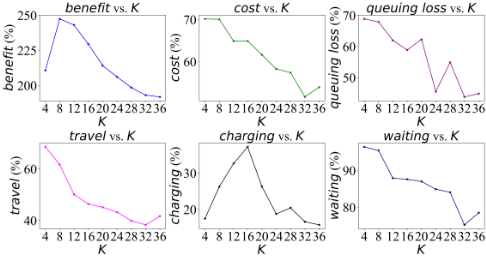
The maximum number of fixed chargers, K, is a critical factor in determining the effectiveness of our approach. Figure 6 illustrates the impact of varying K values on different performance metrics when applying ARL-HCSPO. The results for all metrics are normalized by the scaled-down value of the EXISTING PLAN, as shown in Table 1.
For the benefit metric, increasing K from 4 to 36 results in an optimal value of 244.4% at K = 8, after which there is a moderate decline. In contrast, metrics such as cost, travel, and waiting continue to improve as K increases, reaching their optimal values of 51.6%, 38.3%, and 75.2%, respectively, at K = 32. The queuing loss metric exhibits some fluctuation but generally trends downward.
In summary, while increasing K improves performance in terms of cost and queuing loss, it is important to strike a balance by keeping K within a smaller range to optimize benefit. This balance is crucial for improving the overall supply of charging infrastructure.
Further sensitivity analysis could provide valuable managerial insights for future applications.
7 Conclusion
In conclusion, this paper presents a comprehensive solution to the HCSPO problem by integrating fixed charging station planning with dynamic mobile charger operation. We propose a demand prediction model and two heuristic scheduling strategies for mobile chargers, solved using an adaptive reinforcement learning algorithm. Extensive experiments on real-world datasets show that our method outperforms existing approaches across multiple metrics, offering an efficient solution to dynamic EV charging demand challenges.
Acknowledgments
This work is mainly supported by the Guangdong Basic and Applied Basic Research Foundation (No. 2025A1515011994). This work is also supported by the National Natural Science Foundation of China (No. 62402414), Guangzhou Municipal Science and Technology Project (No. 2023A03J0011), the Guangzhou Industrial Information and Intelligent Key Laboratory Project (No. 2024A03J0628), and a grant from State Key Laboratory of Resources and Environmental Information System, and Guangdong Provincial Key Lab of Integrated Communication, Sensing and Computation for Ubiquitous Internet of Things (No. 2023B1212010007).
@inproceedings{ijcai2025p1113,
  title     = {Reinforcement Learning for Hybrid Charging Stations Planning and Operation Considering Fixed and Mobile Chargers},
  author    = {Zhu, Yanchen and Zou, Honghui and Liu, Chufan and Luo, Yuyu and Wu, Yuankai and Liang, Yuxuan},
  booktitle = {Proceedings of the Thirty-Fourth International Joint Conference on
               Artificial Intelligence, {IJCAI-25}},
  publisher = {International Joint Conferences on Artificial Intelligence Organization},
  editor    = {James Kwok},
  pages     = {10017--10025},
  year      = {2025},
  month     = {8},
  note      = {AI and Social Good},
  doi       = {10.24963/ijcai.2025/1113},
  url       = {https://doi.org/10.24963/ijcai.2025/1113},
}
TY - CPAPER TI - Reinforcement Learning for Hybrid Charging Stations Planning and Operation Considering Fixed and Mobile Chargers AU - Zhu, Yanchen AU - Zou, Honghui AU - Liu, Chufan AU - Luo, Yuyu AU - Wu, Yuankai AU - Liang, Yuxuan T2 - Proceedings of the Thirty-Fourth International Joint Conference on Artificial Intelligence, IJCAI-25 PB - International Joint Conferences on Artificial Intelligence Organization PY - 2025 SP - 10017 EP - 10025 DO - 10.24963/ijcai.2025/1113 UR - https://doi.org/10.24963/ijcai.2025/1113 ER -Copied
Machine-readable versions of this paper, for tools and AI agents:





