
Reflective Verbal Reward Design for Pluralistic Alignment
Proceedings of the Thirty-Fourth International Joint Conference on Artificial Intelligence. Human-Centred AI. Pages 10271-10279.
https://doi.org/10.24963/ijcai.2025/1141
Keywords
- IJCAI25: Human-Centred AI
Abstract
AI agents are commonly aligned with "human values" through reinforcement learning from human feedback (RLHF), where a single reward model is learned from aggregated human feedback and used to align an agent's behavior. However, human values are not homogeneous--different people hold distinct and sometimes conflicting values. Aggregating feedback into a single reward model risks disproportionately suppressing minority preferences. To address this, we present a novel reward modeling approach for learning individualized reward models. Our approach uses a language model to guide users through reflective dialogues where they critique agent behavior and construct their preferences. This personalized dialogue history, containing the user's reflections and critiqued examples, is then used as context for another language model that serves as an individualized reward function (what we call a "verbal reward model") for evaluating new trajectories. In studies with 30 participants, our method achieved a 9-12% improvement in accuracy over non-reflective verbal reward models while being more sample efficient than traditional supervised learning methods.
- [Arakawa and Yakura, 2024] Riku Arakawa and Hiromu Yakura. Coaching copilot: blended form of an llm- powered chatbot and a human coach to effectively support self-reflection for leadership growth. In Proceedings of the 6th ACM Conference on Conversational User Interfaces, pages 1-14, 2024.
- [Awad et al., 2018] Edmond Awad, Sohan Dsouza, Richard Kim, Jonathan Schulz, Joseph Henrich, Azim Shariff, Jean-Franc ¸ois Bonnefon, and Iyad Rahwan. The moral machine experiment. Nature, 563(7729):59-64, 2018.
- [Bai et al., 2022] Yuntao Bai, Andy Jones, Kamal Ndousse, Amanda Askell, Anna Chen, Nova DasSarma, Dawn Drain, Stanislav Fort, Deep Ganguli, Tom Henighan, Nicholas Joseph, Saurav Kadavath, Jackson Kernion, Tom Conerly, Sheer El-Showk, Nelson Elhage, Zac Hatfield- Dodds, Danny Hernandez, Tristan Hume, Scott John- ston, Shauna Kravec, Liane Lovitt, Neel Nanda, Cather- ine Olsson, Dario Amodei, Tom Brown, Jack Clark, Sam McCandlish, Chris Olah, Ben Mann, and Jared Kaplan. Training a Helpful and Harmless Assistant with Rein- forcement Learning from Human Feedback, April 2022. arXiv:2204.05862 [cs].
- [Behari et al., 2024] Nikhil Behari, Edwin Zhang, Yunfan Zhao, Aparna Taneja, Dheeraj Nagaraj, and Milind Tambe. A decision-language model (dlm) for dynamic restless multi-armed bandit tasks in public health. arXiv preprint arXiv:2402.14807, 2024.
- [Bentvelzen et al., 2022] Marit Bentvelzen, Paweł W. Woźniak, Pia S.F. Herbes, Evropi Stefanidi, and Jas- min Niess. Revisiting Reflection in HCI: Four Design Resources for Technologies that Support Reflection. Proceedings of the ACM on Interactive, Mobile, Wearable and Ubiquitous Technologies, 6(1):2:1-2:27, March 2022.
- [Braun and Clarke, 2006] Virginia Braun and Victoria Clarke. Using thematic analysis in psychology. Qualita- tive Research in Psychology, 3(2):77-101, 2006.
- [Bridge and Sawilowsky, 1999] Patrick D Bridge and Shlomo S Sawilowsky. Increasing physicians' awareness of the impact of statistics on research outcomes: com- parative power of the t-test and wilcoxon rank-sum test in small samples applied research. Journal of Clinical Epidemiology, 52(3):229-235, 1999.
- [Chakraborty et al., 2024] Souradip Chakraborty, Jiahao Qiu, Hui Yuan, Alec Koppel, Furong Huang, Dinesh Manocha, Amrit Bedi, and Mengdi Wang. Maxmin-rlhf: Towards equitable alignment of large language models with diverse human preferences. In ICML 2024 Workshop on Models of Human Feedback for AI Alignment, 2024.
- [Conitzer et al., 2024] Vincent Conitzer, Rachel Freedman, Jobst Heitzig, Wesley H. Holliday, Bob M. Jacobs, Nathan Lambert, Milan Mosse, Eric Pacuit, Stuart Russell, Hailey Schoelkopf, Emanuel Tewolde, and William S. Zwicker. Position: Social choice should guide AI alignment in deal- ing with diverse human feedback. In Ruslan Salakhutdi- nov, Zico Kolter, Katherine Heller, Adrian Weller, Nuria Oliver, Jonathan Scarlett, and Felix Berkenkamp, editors, Proceedings of the 41st International Conference on Ma- chine Learning, volume 235 of Proceedings of Machine Learning Research, pages 9346-9360. PMLR, 21-27 Jul 2024.
- [Evans, 2019] Jonathan St BT Evans. Reflections on reflec- tion: The nature and function of type 2 processes in dual- process theories of reasoning. Thinking & Reasoning, 25(4):383-415, 2019.
- [Fischhoff, 1991] Baruch Fischhoff. Value elicitation: Is there anything in there? American Psychologist, 46(8):835, 1991.
- [Fishkin and Luskin, 2005] James S Fishkin and Robert C Luskin. Experimenting with a democratic ideal: Delibera- tive polling and public opinion. Acta politica, 40:284-298, 2005.
- [Fleck and Fitzpatrick, 2010] Rowanne Fleck and Geraldine Fitzpatrick. Reflecting on reflection: framing a design landscape. In Proceedings of the 22nd Conference of the Computer-Human Interaction Special Interest Group of Australia on Computer-Human Interaction, pages 216- 223, 2010.
- [Friedman et al., 2013] Batya Friedman, Peter H Kahn, Alan Borning, and Alina Huldtgren. Value sensitive design and information systems. Early Engagement and New Tech- nologies: Opening Up the Laboratory, pages 55-95, 2013.
- [Hauser et al., 2014] John R Hauser, Songting Dong, and Min Ding. Self-reflection and articulated consumer pref- erences. Journal of Product Innovation Management, 31(1):17-32, 2014.
- [Hejna and Sadigh, 2022] Joseph Hejna and Dorsa Sadigh. Few-shot preference learning for human-in-the-loop RL. In 6th Annual Conference on Robot Learning, 2022.
- [Jaccard, 1912] Paul Jaccard. The distribution of the flora in the alpine zone. New Phytologist, 11(2):37-50, 1912.
- [Kocielnik et al., 2018] Rafal Kocielnik, Lillian Xiao, Daniel Avrahami, and Gary Hsieh. Reflection Com- panion: A Conversational System for Engaging Users in Reflection on Physical Activity. Proceedings of the ACM on Interactive, Mobile, Wearable and Ubiquitous Technologies, 2(2):70:1-70:26, July 2018.
- [Kwon et al., 2022] Minae Kwon, Sang Michael Xie, Kale- sha Bullard, and Dorsa Sadigh. Reward design with lan- guage models. In The Eleventh International Conference on Learning Representations, 2022.
- [Landis and Koch, 1977] J Richard Landis and Gary G Koch. The measurement of observer agreement for cat- egorical data. Biometrics, pages 159-174, 1977.
- [Le Dantec et al., 2009] Christopher A Le Dantec, Erika Shehan Poole, and Susan P Wyche. Values as lived experience: evolving value sensitive design in support of value discovery. In Proceedings of the SIGCHI Conference on Human Factors in Computing Systems, pages 1141-1150, 2009.
- [Lichtenstein and Slovic, 2006] Sarah Lichtenstein and Paul Slovic. The construction of preference: An overview. The construction of preference, 1:1-40, 2006.
- [Ma et al., 2024] Yecheng Jason Ma, William Liang, Guanzhi Wang, De-An Huang, Osbert Bastani, Dinesh Jayaraman, Yuke Zhu, Linxi Fan, and Anima Anandku- mar. Eureka: Human-level reward design via coding large language models. In The Twelfth International Conference on Learning Representations, 2024.
- [Poddar et al., 2024] Sriyash Poddar, Yanming Wan, Hamish Ivison, Abhishek Gupta, and Natasha Jaques. Personal- izing reinforcement learning from human feedback with variational preference learning. In The Thirty-eighth An- nual Conference on Neural Information Processing Sys- tems, 2024.
- [Schwartz, 1992] Shalom H Schwartz. Universals in the con- tent and structure of values: Theoretical advances and em- pirical tests in 20 countries. Advances in Experimental Social Psychology/Academic Press, 1992.
- [Siththaranjan et al., 2023] Anand Siththaranjan, Cassidy Laidlaw, and Dylan Hadfield-Menell. Understanding hid- den context in preference learning: Consequences for rlhf. In The Twelfth International Conference on Learning Rep- resentations, 2023.
- [Ver Donck et al., 2020] Niki Ver Donck, Geert Van- der Stichele, Isabelle Huys, et al. Improving patient preference elicitation by applying concepts from the consumer research field: narrative literature review. Interactive Journal of Medical Research, 9(1):e13684, 2020.
- [Verma et al., 2024] Shresth Verma, Niclas Boehmer, Lingkai Kong, and Milind Tambe. Balancing act: Pri- oritization strategies for LLM-designed restless bandit rewards. In Workshop on Socially Responsible Language Modelling Research, 2024.
- [Wolfbauer et al., 2022] Irmtraud Wolfbauer, Viktoria Pammer-Schindler, Katharina Maitz, and Carolyn P. Rose. A Script for Conversational Reflection Guidance: A Field Study on Developing Reflection Competence With Ap- prentices. IEEE Transactions on Learning Technologies, 15(5):554-566, October 2022.
- [Xie et al., 2024] Tianbao Xie, Siheng Zhao, Chen Henry Wu, Yitao Liu, Qian Luo, Victor Zhong, Yanchao Yang, and Tao Yu. Text2reward: Reward shaping with language models for reinforcement learning. In The Twelfth Inter- national Conference on Learning Representations, 2024.
References were extracted automatically from the PDF and may contain errors.
Full text extracted automatically from the PDF; figures, tables and equations may differ. The PDF is the version of record.
1 Introduction
Effectively aligning AI systems with human values requires addressing the inherent diversity and context-dependence of those values [Schwartz, 1992; Friedman et al., 2013; Le Dantec et al., 2009]. However, prevalent alignment techniques, such as RLHF [Bai et al., 2022], typically train a single reward model from preferences aggregated across multiple users. By default, these singular models implicitly make trade-offs among competing values and can disproportionately suppress minority viewpoints [Siththaranjan et al., 2023; Chakraborty et al., 2024].
In response to this shortcoming, recent work has explored approaches that better preserve the diversity of human values [Siththaranjan et al., 2023; Chakraborty et al., 2024;
∗The behavioral studies in this paper were approved by the University of Waterloo's Human Research Ethics Board (File 46074).
Poddar et al., 2024]. While the specifics differ, these approaches broadly increase the granularity of the reward signal to account for differences in opinion. For example, some methods learn multiple distinct reward models to capture different preference clusters [Chakraborty et al., 2024]. Others learn reward models that output distributions rather than scalar values to represent uncertainty and variation in preferences [Siththaranjan et al., 2023], and others learn individualized reward models [Poddar et al., 2024].
These higher-granularity approaches offer benefits for collective and individual alignment. In collective settings where we must aggregate preferences across many stakeholders, having granular representations of preferences enables making transparent choices about balancing competing values by explicitly aggregating rewards. Rather than implicitly averaging preferences, we can optimize for desired properties like egalitarian welfare. Meanwhile, for personal AI assistants, techniques that learn high granularity preference representations can give rewards that are more representative of the given user compared to the population average. However, a challenge exists: While a single reward model can leverage data from all users to learn a scalar reward, higher-granularity approaches must learn more complex patterns (e.g., preference distributions [Siththaranjan et al., 2023] or personalized reward functions [Poddar et al., 2024]), which are more challenging to estimate due to their increased dimensionality and sparser per-pattern data coverage.
A further complication arises from the process of preference construction in complex and novel domains, where humans actively construct their preferences rather than simply reveal them [Lichtenstein and Slovic, 2006]. While current reward modeling approaches typically rely on passive data collection and straightforward labeling, this may be insufficient: the process of constructing preferences benefits from deliberate reflection, which helps individuals transform their latent values into concrete preferences [Fischhoff, 1991]. This insight is supported by findings from psychology, consumer research, and deliberative polling, which demonstrate that prompting people to actively contemplate their underlying values and reasoning processes leads to more welldefined and considered preferences [Hauser et al., 2014; Ver Donck et al., 2020; Fishkin and Luskin, 2005].
To address these two challenges, we introduce InteractiveReflective Dialogue Alignment (IRDA), a system that uses large language models (LLMs) to learn personalized reward functions through interactive dialogue. IRDA combines three components: (1) reflective verbal preference elicitation that guides users in articulating their values, (2) active learning to strategically select examples for human critique, and (3) LLM-driven verbal reward modeling where the LLM directly serves as the reward function by leveraging its incontext learning ability to generalize from sparse user feedback. IRDA's architecture confronts the preference construction problem by replacing passive labeling with LLM-guided dialogues that provoke deliberate, context-sensitive reflection (System 2 cognition). At the same time, its data-efficient learning strategy (active few-shot learning) mitigates the difficulty of learning personalized reward functions.
We evaluated IRDA with two user studies involving 30 participants in total. The first study (21 participants) focused on building a reward model for each user's personal definition of "respectful behavior," while the second (9 participants) explored ethical decision-making in autonomous vehicles. Across both studies, participants differed widely in their value judgments, and our system was able to capture these individual definitions of value-aligned behavior more accurately than baseline approaches.
Our contributions are as follows:
- A novel pipeline for aligning AI agents to individual values, informed by AI, HCI, and social science.
- A comprehensive evaluation in two distinct domains, demonstrating that our system captures individual preferences more accurately than baselines.
- Empirical characterization of how individuals diverge in their conceptions of value-aligned AI behavior.
- Insights for future research on interactive systems that help end users construct, refine, and operationalize their latent values.
2 RelatedWork
Pluralistic Alignment. Recent work has highlighted the importance of moving beyond monolithic reward models and toward approaches that capture heterogeneous or uncertain human preferences in AI alignment. For instance, distributional preference learning (DPL) estimates an entire distribution over possible reward values, thereby accommodating hidden context and diverse annotator criteria [Siththaranjan et al., 2023]. Similarly, methods like MaxMin-RLHF learn a mixture of reward models and optimize an egalitarian objective to avoid disproportionately favoring majority viewpoints [Chakraborty et al., 2024]. Others have proposed userspecific latent variables that personalize reward models without requiring extensive per-user labels [Poddar et al., 2024] or have leveraged meta-learning to reduce feedback requirements [Hejna and Sadigh, 2022]. However, these approaches assume users have direct access to their preferences in novel contexts despite evidence from preference elicitation and psychology literature suggesting otherwise. Our work complements these advances by actively eliciting fine-grained, userspecific preferences and helping users turn their latent values into concrete preferences through guided reflection.
Verbal Reward Design. A separate line of research explores using large language models (LLMs) to act as or generate reward functions. Some methods prompt LLMs to propose reward code, which is then used to train RL policies via standard optimization [Ma et al., 2024; Xie et al., 2024; Verma et al., 2024; Behari et al., 2024]. Other methods directly treat an LLM as a proxy reward function by prompting it with desired behavior descriptions [Kwon et al., 2022]. These LLM-based approaches have made reward specification more accessible, particularly in domains where handcrafting objectives is difficult. However, they treat preference specification as a one-way street, where users tell the LLM what they want. Our system makes it a two-way dialogue, using LLMs both to help users clarify their preferences and to translate those preferences into reward functions.
Reflection as a Path to Expressing Latent Preferences. Preferences are rarely pre-defined artifacts waiting to be extracted; instead, in new contexts, they form through reflective processes that turn latent values into concrete preferences [Fischhoff, 1991]. In consumer and behavioral research, explicitly prompting users to reflect on trade-offs or alternative perspectives fosters more stable and revealing preference statements [Hauser et al., 2014; Ver Donck et al., 2020]. We build on this insight by weaving reflection into an LLM-based alignment pipeline, enabling users to clarify and externalize their values for AI systems.
Designing Reflection into Dialogue Systems. Within HCI, frameworks like Fleck and Fitzpatrick's [Fleck and Fitzpatrick, 2010] outline how technologies can scaffold reflective thinking, while studies show that structured prompts-scripted or adaptive-support deeper introspection over time [Kocielnik et al., 2018; Wolfbauer et al., 2022; Bentvelzen et al., 2022]. Recent advances in LLM-driven agents further enable flexible "reflective dialogues," guiding users to articulate emergent values and transform them into actionable preferences [Arakawa and Yakura, 2024]. Our contribution is to extend these dialogues to preference elicitation for AI alignment, using LLMs to help users iteratively refine how an AI agent should act.
3 Interactive-Reflective Dialogue Alignment (IRDA) System
We present the Interactive-Reflective Dialogue Alignment (IRDA) system, which enables non-expert users to iteratively define a value concept and construct a corresponding reward model for agent training. Our approach is founded on the insight that human values are refined through a process of reflection and iterative feedback [Fischhoff, 1991]. To this end, IRDA employs a dual-loop framework that first elicits user feedback through a preference construction loop over a diversity-based pool of trajectories and then refines the model via an uncertainty reduction loop over a separate pool.
To begin, let TD denote the diversity-based pool of trajectories, where each trajectory τ = (s0, a0, . . . , sT ) represents a sequence of states and actions executed by the agent. We extract features φ(τ) ∈ Rd from each trajectory and partition TD into k clusters {C1, . . . ,Ck} using k-means clustering:
with cluster centroids
For each cluster, we select a representative trajectory:
In the initial preference construction loop, the user specifies a value concept (e.g., "respectfulness") and provides qualitative feedback ei on each centroid trajectory (e.g., "This is not respectful because..."). Each trajectory is encoded into an ASCII representation α(τ), and the resulting feedback is aggregated as
Once the feedback is collected, an LLM is queried on the entire Df b to generate a hypothesis about what features the user is using to make their decisions, H , and alternative features the user could consider A :
The user is then asked to respond to the generated hypotheses and alternatives, explaining why these features are or are not significant to their decision-making. This is intended to help the user reflect on their values, which can update their mental modelMu. IfMu does change, the user returns to the beginning of the preference construction loop.
Once the user confirms that Mu is stable, the system transitions to the uncertainty reduction loop. In this stage, we consider a separate uncertainty-based pool of trajectories, TU. We iteratively refine our reward model on this pool. The reward model is based on an LLM that is prompted to assess whether a trajectory is aligned or not. The LLM is given the entire conversation history C (which includes all user feedback, system prompts, and responses), the encoded trajectory α(τ), and environment details such as symbol meanings and action spaces (EnvDesc) and outputs token probabilities for labels such as "respectful" and "disrespectful." Specifically, the alignment probability pθ(1|τ) and misalignment probability pθ (1|τ) are computed as
where pθ(1|τ) is the token probability for the "aligned" token (e.g., "respectful") and pθ (0|τ) is the token probability for the "misaligned" token (e.g., "disrespectful").
The associated uncertainty is defined by
and the trajectory with maximum uncertainty is selected,
Algorithm 1 Interactive-Reflective Dialogue Alignment
- 1: Input: TD, TU, value v, threshold ε, EnvDesc
- 2: Preprocessing: For each τ ∈ TD, extract φ(τ); cluster via k-means; select representatives {τ cent i }.
- 3: repeat Preference Construction Loop
- 4: For each τ cent i , obtain/update label ei; form
- 5: Query the LLMwith Df b to yield feature hypotheses H and alternatives A .
- 6: User responds to (H ,A ) and refinesMu.
- 7: until User confirmsMu is stable
- 8: repeat Uncertainty Reduction Loop
- 9: for each τ ∈ TU do
- 10: pθ (1|τ), pθ (0|τ) = fLLM(EnvDesc, C , α(τ))
- 11: U(τ ) = 1 - | pθ (1|τ ) - pθ (0|τ )|
- 12: end for
- 13: τ ∗ = argmaxτ∈TU U(τ).
- 14: Query the user for e∗ on τ ∗ ; update
- 15: until U(τ ∗ ) < ε
- 16: Final RewardModel: For any new τ, define
- 17: Return: R(·).
and the user is queried for an explanation e∗ regarding τ ∗ . This new feedback (α(τ ∗ ),e∗ ) is appended to Df b, and the uncertainty reduction loop is repeated until U(τ ∗ ) < ε for a set threshold ε.
The final reward model is an LLM that, using the complete conversation history C and all accumulated feedback Df b, classifies new trajectories as aligned or misaligned with the user's value. It outputs a binary decision based on token probabilities:
This process, beginning with diversity-based sampling, followed by preference construction, and culminating in uncertainty-driven refinement, yields a final LLM-based reward model. This final LLM-based reward model uses the entire conversation history and all explained examples. The full process is formalized in Algorithm 1.
4 Study Design &Methodology
We evaluated our system (implemented with gpt-3.5) in two studies: Study 1 investigates the utility of our system for learning about participants' definition of respectful agent behavior. Study 2 investigates the utility of our system for learning about participants' decision-making in moral dilemmas involving an agent (autonomous vehicle). Our studies employ a within-subject design, collecting data from each participant to train and test each method. Our studies aim to answer the following three questions:
- RQ1: How do individuals' interpretations of valuealigned AI behavior differ?
RQ2: Does structured reflection enhance verbal reward modeling?
- RQ3: When is individualized verbal reward modeling effective?
4.1 Environments
Multi-Agent Apple Farming Environment (Study 1). A 6×6 grid contains apples and garbage, with one "main" (blue) agent and three "background" (gray) agents. Each agent "owns" one of four 3×3 orchards. Two background agents remain stationary, and one moves freely. The main agent is rewarded by picking apples (none for collecting garbage). Participants assess whether the blue agent behaves "respectfully."
Moral Machine Environment (Study 2). Adapted from [Awad et al., 2018], this environment features ethical dilemmas in which an autonomous vehicle must stay on course or swerve, potentially harming different combinations of pedestrians or passengers (including children, adults, the elderly, and animals). Each outcome varies in factors like legality, social status, and species. Participants decide which outcome the car should choose.
4.2 Participants
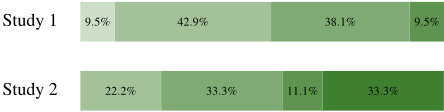
In Study 1, we recruited 21 participants from the University of Waterloo (18 to 39 age range, M=23.86, 7 self-identified as male and 14 as female). When asked to rate their level of familiarity with reinforcement learning on a 5-point Likert ranging from "very unfamiliar" (1) to "very familiar" (5), the mean level of familiarity was 2.48, with the mode and median being 2. The Likert-scale data for Study 1 (Figure 1, top bar) highlights that more than half of participants were "unfamiliar" or "very unfamiliar" with reinforcement learning.
In Study 2, we recruited 9 participants from the University of Waterloo (18 to 33 age range, M=25.66, 6 self-identified as male and 3 as female). When asked to rate their level of familiarity with reinforcement learning on a 5-point Likert scale ranging from "very unfamiliar" to "very familiar," the mean level of familiarity was 3.55, with the mode and median being 3. The Likert-scale data for Study 2 is visualized in Figure 1 (bottom).
4.3 Procedure
Participants used our system to specify how they would like the agent to act. Participants then labeled 50 scenarios and were interviewed.
Introduction (∼5min) - After participants completed the consent form and demographic questions, we thoroughly explained the environment mechanics so that differences reflected their opinions rather than assumptions about the setup.
Dialogue - The participant began by conversing with the system about the agent's behavior following the process described in Section 3. To control the amount of time users spent, we limited the user to one preference construction loop and one uncertainty reduction loop.
Labeling - Following the participants' dialogue interaction with the system, participants labeled 50 scenarios. Each participant labeled the same scenarios, which allowed us to assess how much the participants agreed on the labels.
Semi-structured Interview (∼10min) - After completing the labeling task, participants were asked about their ability to communicate their decision-making to the system, including their capacity to articulate label choices, any difficulties in decision-making, and potential changes in their labeling behavior over time.
4.4 Baseline Comparisons
We compared IRDA to another verbal reward design system and various supervised learning methods.
Verbal Baseline (L B )
Kwon et al. [2022] proposed a reward modeling pipeline for text-based environments where the user selects multiple examples from a palette of examples of the agent behaving as they would desire, accompanied by explanations. We modify their pipeline in the following way: Instead of asking the user to select examples from a handcrafted palette, we choose the examples the user sees with the diversity- and uncertaintybased sampling procedures described and in section 3. This system differs from IRDA in that it does not engage the user in reflective dialogue.
Supervised Learning Baselines
We evaluated our approach against neural network-based supervised learning methods, including both individual models per participant and collective models trained on aggregated data. In Study 1, we implemented multi-layer perceptron models (one hidden layer, 32 neurons) using a tensor encoding of the trajectory: individual models (MLP ind i ) for each participant i and a collective model (MLP col ) trained on all participant data. Study 2 expanded this comparison to include both MLP models with 26-dimensional Moral Machine scenario vectors and convolutional neural networks (CNN ind i and CNN col ) using scenario image inputs. The CNNs used two convolutional layers (16 and 32 filters) with max pooling, followed by fully connected layers reducing to 64 dimensions. Each supervised learning model was incrementally trained with up to 30 examples per participant using the Adam optimizer (learning rate 0.001).
4.5 Analysis
To answer our research questions, we employ a mixedmethods approach, combining quantitative analyses of model performance and inter-annotator agreement with qualitative analyses of participant decision-making processes and experiences. The mapping between research questions and analysis methods is shown in Table 1.
| Analysis Method | RQ1 | RQ2 | RQ3 |
|---|---|---|---|
| Inter-Annotator Agreement | ✓ | ✓ | |
| Evaluation of Verbal Reward Model Performance Comparison to Supervised Learning | ✓ | ✓ | ✓ |
| Qualitative Analysis of Participant Decision Making Analysis of Feature Similarity Between Participants | ✓ ✓ | ✓ | |
| Interview Thematic Analysis | ✓ | ✓ |
Inter-Annotator Agreement
We assess the inter-annotator agreement between participants on the test set of scenarios they labeled in each study. Since each participant labeled the same test scenarios, we can use Fleiss' kappa value to quantify the inter-annotator agreement between the participants [Landis and Koch, 1977]. Generally, kappa statistics below 0 indicate "poor" agreement and kappa statistics above 0.8 indicate "nearly perfect" agreement [Landis and Koch, 1977].
Evaluation of Verbal Reward Model Performance
We evaluated our system against a baseline without dialogic reflection using a performance metric P, where P IRDA i and P B i represent participant i's metrics for our system and baseline, respectively. Study 1 used balanced accuracy due to class imbalance, while Study 2 used accuracy. For each participant, both systems generated rewards for 20 non-training scenarios, yielding 20 pairs of P values. We conducted three statistical tests on the P values:
- We bootstrapped 95% confidence intervals for the mean by resampling 10,000 times with replacement.
- For each participant, we calculated the difference ∆Pi = P IRDA i -P B i and bootstrapped these differences in the same way.
- P values were compared using the Wilcoxon signedrank test, chosen for its robustness to non-normal distributions and reduced false positives [Bridge and Sawilowsky, 1999].
Comparison to Supervised Learning
We compared our verbal system (IRDA) to traditional supervised learning approaches. Both the individual models (MLP ind i and CNN ind i ) and the collective models (MLP col and CNN col ) were trained incrementally, gradually increasing the number of samples used per participant. This methodology allowed us to analyze how model performance evolved with increasing data availability. For each increment, we calculated P ind i and P col i for each participant i. To ensure robustness, we bootstrapped these values with replacement using 10,000 resamples.
Qualitative Analysis of Participant Decision Making
We conducted a detailed analysis of the message exchanges between participants and the system to gain insight into participants' decision-making processes. We employed an inductive coding approach, systematically reviewing the messages to identify key features and criteria that participants used in their decision-making. Our coding process involved multiple passes through the data, with iterative refinement of the codebook to ensure it captured the full range of decisionmaking strategies observed.
Analysis of Feature Similarity Between Participants
To quantify how similar participants were in their use of decision-making features, we employed the Jaccard similarity coefficient. This measure calculates the overlap between two sets of items, which, in our case, are features the two participants used to make decisions [Jaccard, 1912]. We computed the Jaccard similarity coefficient for every pair of participants, using the set of decision-making features each participant employed (as identified in our qualitative analysis). To estimate the overall similarity across our participant pool, we then calculated the mean of these pairwise Jaccard coefficients. We used bootstrapping with 10,000 resamples to determine the 95% confidence intervals.
Thematic Analysis of Interview Data
We conducted semi-structured interviews with participants to understand their experiences. The interview transcripts were analyzed using a thematic analysis approach guided by the principles outlined by Braun and Clarke [2006]. We followed a six-phase process: familiarization with the data, generating initial codes, searching for themes, reviewing themes, defining and naming themes, and producing the report.
5 Results: Study 1 - Multi-Agent Apple Farming
On average, participants took 15 minutes 57 seconds (SD = 6 min. 43 sec., range: 6 min. 59 sec. - 30 min. 55 sec.) to complete the dialogue with the system and 13 minutes 37 seconds (SD= 3 min. 2 sec., range: 6 min. 55 sec. - 18 min. 26 sec.) to complete the labeling of 50 trajectories. Of 21 participants, 7 (33.3%) entered the preference construction loop for one iteration.
S1 - Inter-Annotator Agreement
We observed a Fleiss' kappa value between all participants' labels on the 50 labeled trajectories of κ = 0.336, indicating "fair" agreement among participants [Landis and Koch, 1977]. The Fleiss' kappa statistic of 0.336 we observed lends credence to the idea that human values and preferences are subjective and personal.
S1 - Evaluation of Verbal Reward Model Performance
On average, the reward models produced by IRDA achieved significantly higher balanced accuracy scores (measured in percentages) than the baseline system (L B ) by 9% (95% CI: [5%, 13%], M = 68% vs. M = 59%, p=.002). This indicates that structured reflection is beneficial.
S1 - Comparison to Supervised Learning
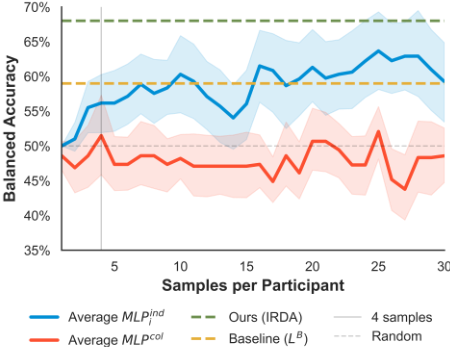
With all 30 training samples, the average balanced accuracy of the individual models (MLP ind i ) was 59% (95% CI: [53%, 65%]) while the collective model (MLP col ) achieved 48% (95% CI: [46%, 50%]). This indicates that participant value definitions varied widely. Figure 2 illustrates the relationship between model performance and the number of samples provided per participant.
S1 - Qualitative Analysis of Participant Decision Making
Although our system can align AI agents with various values, we focused on respect to examine how individuals interpret even a single value differently. Analysis of participant conversations revealed 12 distinct behavioral features used to evaluate respectful agent behavior (see supplementary material for a list and definitions). Usage varied widely - P1 relied solely on whether agents stayed in their quadrant, while P5, P7, and P10 each employed seven features. Only one participant pair shared identical feature sets, and most participants combined them using hierarchical and conditional rules. While the agent staying in its quadrant was the most common feature, features varied in temporal scope, from static properties (current quadrant location) to multistep sequences (collecting garbage before apples).
S1 - Analysis of Feature Similarity Between Participants
We observed an average Jaccard similarity coefficient between all pairs of participants' feature usage of J = 0.357, with a 95% confidence interval of (0.333,0.3813).
S1 - Thematic Analysis of Interview Data
Our thematic analysis revealed two main themes: participants' evolving definitions of respect and the system's impact on this evolution.
Evolving Definitions of Respect. Participants' understanding of respect developed through system interaction. Initial definitions focused on simple concepts like spatial boundaries and task-specific behaviors (P4, P6, P7, P10, P19). Through engagement with examples and system feedback, these views became more nuanced. Participants who encountered examples challenging their initial perspectives often expanded their conceptualization of respect (P3, P8, P10, P13, P18, P19, P20). This evolution aligns with consumer research showing that reflection and realistic decision-making improve preference reporting [Hauser et al., 2014].
Specific Impact of System Hypothesis. The system's hypotheses and alternative features actively shaped participants' respect definitions. The presentation of alternatives prompted reevaluation and revision of initial concepts (P3, P8, P13, P18, P20). While some participants maintained their original views (e.g., P19), the system's suggestions helped others refine their understanding (P13, P18) or consider new perspectives (P3, P20), demonstrating the value of reflective dialogue.
6 Results: Study 2 - The Moral Machine
On average, participants took 18 minutes 28 seconds (SD = 7 min. 15 sec., range: 12 min. 0 sec. - 34 min. 34 sec.) to complete the dialogue with the system and 11 minutes 51 seconds (SD = 4 min. 15 sec., range: 4 min. 46 sec. - 17 min. 04 sec.) to complete the labeling of 50 trajectories. Of 9 participants, 1 (11.1%) entered the preference construction loop for one iteration.
S2 - Inter-Annotator Agreement
We observed a Fleiss' kappa value between all participants' labels on the 50 labeled trajectories of κ = 0.460, indicating "moderate" (higher than "fair") agreement among participants [Landis and Koch, 1977].
S2 - Evaluation of Verbal Reward Model Performance
On average, the reward models produced by IRDA received higher accuracy scores (measured in percentages) than the baseline system (L B ) by 12% (95% CI: [4%, 27%], M = 65% vs. M = 53%, p=.05). This adds more evidence in favor of the effectiveness of structured reflection.
S2 - Comparison to Supervised Learning
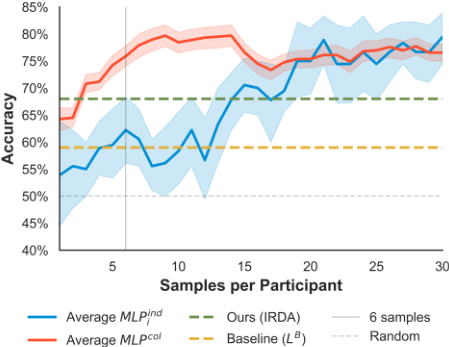
With 30 training samples, individual MLPs achieved 79% accuracy (95% CI: [74%, 84%]) while the collective MLP reached 77% (95% CI: [75%, 78%]). For CNNs, individual models achieved 67% accuracy (95% CI: [61%, 73%]) while the collective model (CNN col ) reached 77% (95% CI: [70%, 83%]). Figure 3 shows performance versus sample count. These results suggest that collective methods excel with high participant agreement, particularly for complex learning problems like CNN-based image processing, where sample pooling proves beneficial.
S2 - Qualitative Analysis of Participant Decision Making
By analyzing the participants' conversations with our system, we identified nine features they used in their decision-making in Study 2 (see supplementary material for a list and definitions). The most common features were minimizing casualties (8/9 participants) and traffic rule compliance (8/9 participants). Most participants combined features conditionally and hierarchically.
S2 - Analysis of Feature Similarity Between Participants We observed an average Jaccard similarity coefficient between all pairs of participants' feature usage of J = 0.464, with a 95% confidence interval of (0.403,0.526).
S2 - Thematic Analysis of Interview Data
Through our thematic analysis, we found two main themes: (1) Participants' definitions of ethical decision making evolved throughout the activity, and (2) participants' decisions were primarily based on explicit reasoning but sometimes relied on intuition.
Decision-making Evolution. Participants' decisionmaking evolved differently during the study. Some expanded their criteria as they encountered more scenarios (P3: "realized the need to consider new factors when initial factors were equal"), reinforcing Study 1's findings about preference evolution. Others maintained consistent frameworks throughout (P2: "rules remained consistent").
Intuition vs. Explicit Reasoning. While most participants could articulate clear reasoning, some relied on intuition for complex scenarios. P7 reported using "first instinct" or "vibes" for several challenging cases.
7 Discussion
Our results suggest that value diversity exists in the context of AI alignment and that verbal reward modeling with LLMguided reflection can be an effective method for learning individualized reward models that preserve this value diversity.
Value Diversity (RQ1). In Study 1, focusing on respectful behavior, we observed substantial diversity in how participants defined and evaluated respect. The low inter-annotator agreement (κ = 0.336) and feature similarity (J = 0.357) suggest fundamental differences in value interpretation rather than noise. This was further evidenced by the stark performance gap between individual and collective models - while individual models achieved 59% accuracy with just 30 samples, collective models failed to surpass random performance despite access to 21 times more data.
Study 2, examining ethical decisions in autonomous vehicles, revealed more homogeneous preferences (κ = 0.460, J = 0.464). Here, collective models outperformed individual approaches. This contrast between studies highlights how value diversity varies by context and challenges the assumption that universal values can be embedded in AI systems.
The Effectiveness of Reflection (RQ2). Our reflectionbased approach was effective in both contexts, outperforming baseline methods even when participants held fixed opinions. This suggests that structured reflection enhances preference communication regardless of preference malleability, aligning with dual-process theories in cognitive psychology that suggest reflection can enhance articulation [Evans, 2019]. Given this, we suggest preference elicitation requires more sophisticated interaction paradigms than simple feedback collection and should engage users in reflection.
Contextual Efficacy of Verbal RMs (RQ3). The effectiveness of our approach varies with context: it excels with heterogeneous preferences and limited samples but becomes less critical when preferences are homogeneous and data is abundant. This suggests a complementary approach to value alignment, where methods are selected based on preference heterogeneity and data availability.
Limitations and Future Work. Our participant pool was relatively homogeneous, so results may not generalize to broader populations or values. Additionally, repeatedly querying an LLM at training time can become prohibitively expensive, limiting scalability for large-scale RL tasks. An alternative is having the LLM produce a standalone codebased reward function, which is more computationally efficient but less flexible. Future work should evaluate this approach in more diverse settings (including LLM alignment tasks) and develop principled methods for aggregating individualized reward models. Social choice offers one promising path for navigating these aggregation decisions [Conitzer et al., 2024]. In sum, our findings highlight the importance of reflection-based elicitation for capturing preferences and underscore the need for methods designed to accommodate genuine value pluralism in AI alignment.
8 Open Science and Reproducibility
All stimuli, a list of identified behavioral features with descriptions, and prompts are available in our project's OSF repository.
Acknowledgments
This work was supported by NSERC Discovery Grants RGPIN-03402-2023 and RGPIN-50503-11794.
@inproceedings{ijcai2025p1141,
  title     = {Reflective Verbal Reward Design for Pluralistic Alignment},
  author    = {Blair, Carter and Larson, Kate and Law, Edith},
  booktitle = {Proceedings of the Thirty-Fourth International Joint Conference on
               Artificial Intelligence, {IJCAI-25}},
  publisher = {International Joint Conferences on Artificial Intelligence Organization},
  editor    = {James Kwok},
  pages     = {10271--10279},
  year      = {2025},
  month     = {8},
  note      = {Human-Centred AI},
  doi       = {10.24963/ijcai.2025/1141},
  url       = {https://doi.org/10.24963/ijcai.2025/1141},
}
TY - CPAPER TI - Reflective Verbal Reward Design for Pluralistic Alignment AU - Blair, Carter AU - Larson, Kate AU - Law, Edith T2 - Proceedings of the Thirty-Fourth International Joint Conference on Artificial Intelligence, IJCAI-25 PB - International Joint Conferences on Artificial Intelligence Organization PY - 2025 SP - 10271 EP - 10279 DO - 10.24963/ijcai.2025/1141 UR - https://doi.org/10.24963/ijcai.2025/1141 ER -Copied
Machine-readable versions of this paper, for tools and AI agents:





