
Understanding PII Leakage in Large Language Models: A Systematic Survey
Proceedings of the Thirty-Fourth International Joint Conference on Artificial Intelligence. Survey Track. Pages 10409-10417.
https://doi.org/10.24963/ijcai.2025/1156
Keywords
- AI Ethics, Trust, Fairness: ETF: Safety and robustness
- Natural Language Processing: NLP: Language models
- AI Ethics, Trust, Fairness: ETF: Ethical, legal and societal issues
- Multidisciplinary Topics and Applications: MTA: Security and privacy
Abstract
Large Language Models (LLMs) have demonstrated exceptional success across a variety of tasks, particularly in natural language processing, leading to their growing integration into numerous facets of daily life. However, this widespread deployment has raised substantial privacy concerns, especially regarding personally identifiable information (PII), which can be directly associated with specific individuals. The leakage of such information presents significant real-world privacy threats. In this paper, we conduct a systematic investigation into existing research on PII leakage in LLMs, encompassing commonly utilized PII datasets, evaluation metrics, and current studies on both PII leakage attacks and defensive strategies. Finally, we identify unresolved challenges in the current research landscape and suggest future research directions.
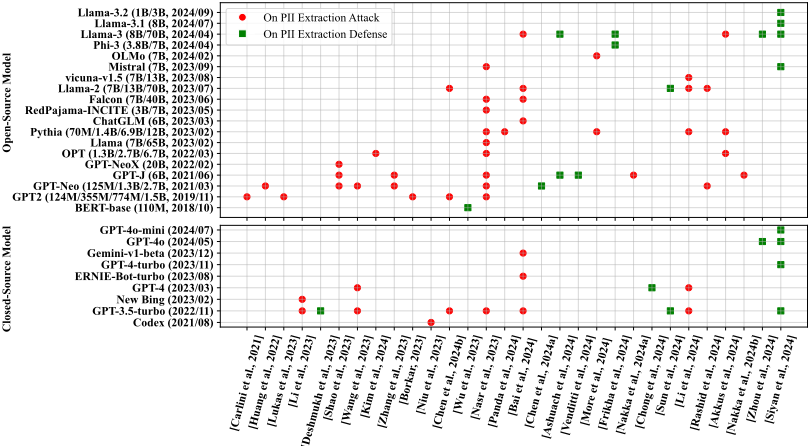
- GPT-J (6B, 2021/06)
- GPT-NeoX (20B, 2022/02) OPT (1.3B/2.7B/6.7B, 2022/03) Llama (7B/65B, 2023/02)
- Pythia (70M/1.4B/6.9B/12B, 2023/02) ChatGLM (6B, 2023/03)
- RedPajama-INCITE (3B/7B, 2023/05) Falcon (7B/40B, 2023/06) Llama-2 (7B/13B/70B, 2023/07) vicuna-v1.5 (7B/13B, 2023/08)
- Mistral (7B, 2023/09) OLMo (7B, 2024/02) Phi-3 (3.8B/7B, 2024/04) Llama-3 (8B/70B, 2024/04) Llama-3.1 (8B, 2024/07) Llama-3.2 (1B/3B, 2024/09)
- K im et al ., 20 24 ] [
- N iu et al ., 20 23 ] [
- P an da et al ., 20 24 ] [
- N ak ka et al ., 20 24 a] [
- S un et al ., 20 24 ] [
- N ak ka et al ., 20 24 b]
- S iy an et al ., 20 24 ] Codex (2021/08) GPT-3.5-turbo (2022/11) New Bing (2023/02) GPT-4 (2023/03)
- Open-Source Model Closed-Source Model On PII Extraction Attack On PII Extraction Defense References [Afreen et al., 2020]
- Asad Afreen, Moosa Aslam, and Saad Ahmed. Analysis of fileless malware and its evasive be- havior. In ICCWS, pages 1-8. IEEE, 2020.
- [Akkus et al., 2024] Atilla Akkus, Mingjie Li, Junjie Chu, Michael Backes, Yang Zhang, and Sinem Sav. Generated data with fake privacy: Hidden dangers of fine-tuning large language models on generated data. arXiv:2409.11423, 2024.
- [Ashuach et al., 2024] Tomer Ashuach, Martin Tutek, and Yonatan Belinkov. Revs: Unlearning sensitive informa- tion in language models via rank editing in the vocabulary space. arXiv:2406.09325, 2024.
- [Bai et al., 2024] Yang Bai, Ge Pei, Jindong Gu, Yong Yang, and Xingjun Ma. Special characters attack: Toward scal- able training data extraction from large language models. arXiv:2405.05990, 2024.
- [Biderman et al., 2024] Stella Biderman, Usvsn Prashanth, Lintang Sutawika, Hailey Schoelkopf, Quentin Anthony, Shivanshu Purohit, and Edward Raff. Emergent and pre- dictable memorization in large language models. NeurIPS, 36, 2024.
- [Borkar, 2023] Jaydeep Borkar. What can we learn from data leakage and unlearning for law? arXiv:2307.10476, 2023.
- [Carlini et al., 2019] Nicholas Carlini, Chang Liu, Úlfar Er- lingsson, Jernej Kos, and Dawn Song. The secret sharer: Evaluating and testing unintended memorization in neural networks. In USENIX Security, pages 267-284, 2019.
- [Carlini et al., 2021] Nicholas Carlini, Florian Tramer, Eric Wallace, Matthew Jagielski, Ariel Herbert-Voss, Kather- ine Lee, Adam Roberts, Tom Brown, Dawn Song, et al. Extracting training data from large language models. In USENIX Security, pages 2633-2650, 2021.
- [Carlini et al., 2022] Nicholas Carlini, Daphne Ippolito, Matthew Jagielski, Katherine Lee, Florian Tramer, and Chiyuan Zhang. Quantifying memorization across neural language models. arXiv:2202.07646, 2022.
- [Carlini et al., 2023] Nicolas Carlini, Jamie Hayes, Milad Nasr, Matthew Jagielski, Vikash Sehwag, Florian Tramer, Borja Balle, Daphne Ippolito, and Eric Wallace. Extract- ing training data from diffusion models. In USENIX Secu- rity, pages 5253-5270, 2023.
- [Chen et al., 2024a] Ruizhe Chen, Tianxiang Hu, Yang Feng, and Zuozhu Liu. Learnable privacy neurons local- ization in language models. arXiv:2405.10989, 2024.
- [Chen et al., 2024b] Xiaoyi Chen, Siyuan Tang, Rui Zhu, Shijun Yan, Lei Jin, Zihao Wang, Liya Su, Zhikun Zhang, XiaoFeng Wang, and Haixu Tang. The janus interface: How fine-tuning in large language models amplifies the privacy risks. In ACM CCS, pages 1285-1299, 2024.
- [Chong et al., 2024] Chun Jie Chong, Chenxi Hou, Zhihao Yao, and Seyed Mohammadjavad Seyed Talebi. Casper: Prompt sanitization for protecting user privacy in web- based large language models. arXiv:2408.07004, 2024.
- [Deng et al., 2024] Gelei Deng, Yi Liu, Yuekang Li, Kai- long Wang, Ying Zhang, Zefeng Li, Haoyu Wang, Tianwei Zhang, and Yang Liu. Masterkey: Automated jailbreaking of large language model chatbots. In ISOC NDSS, 2024.
- [Deshmukh et al., 2023] Ajinkya Deshmukh, Saumya Ban- thia, and Anantha Sharma. Life of pii-a pii obfuscation transformer. arXiv:2305.09550, 2023.
- [Frikha et al., 2024] Ahmed Frikha, Nassim Walha, Kr- ishna Kanth Nakka, Ricardo Mendes, Xue Jiang, and Xue- bing Zhou. Incognitext: Privacy-enhancing conditional text anonymization via llm-based private attribute random- ization. arXiv:2407.02956, 2024.
- [Hoory et al., 2021] Shlomo Hoory, Amir Feder, Avichai Tendler, Sofia Erell, Alon Peled-Cohen, Itay Laish, Hootan Nakhost, Uri Stemmer, et al. Learning and eval- uating a differentially private pre-trained language model. In EMNLP, pages 1178-1189, 2021.
- [Huang et al., 2022] Jie Huang, Hanyin Shao, and Kevin Chen-Chuan Chang. Are large pre-trained language mod- els leaking your personal information? In EMNLP, pages 2038-2047, December 2022.
- [Jang et al., 2022] Joel Jang, Dongkeun Yoon, Sohee Yang, Sungmin Cha, Moontae Lee, Lajanugen Logeswaran, and Minjoon Seo. Knowledge unlearning for mitigating pri- vacy risks in language models. arXiv:2210.01504, 2022.
- [Kandpal et al., 2022] Nikhil Kandpal, Eric Wallace, and Colin Raffel. Deduplicating training data mitigates privacy risks in language models. In International Conference on Machine Learning, pages 10697-10707. PMLR, 2022.
- [Kim et al., 2024] Siwon Kim, Sangdoo Yun, Hwaran Lee, Martin Gubri, Sungroh Yoon, and Seong Joon Oh. Propile: Probing privacy leakage in large language mod- els. NeurIPS, 36, 2024.
- [Li et al., 2023] Haoran Li, Dadi Guo, Wei Fan, Mingshi Xu, Jie Huang, Fanpu Meng, and Yangqiu Song. Multi-step jailbreaking privacy attacks on chatgpt. In EMNLP, pages 4138-4153, 2023.
- [Li et al., 2024] Qinbin Li, Junyuan Hong, Chulin Xie, Jef- frey Tan, Rachel Xin, Junyi Hou, Xavier Yin, Zhun Wang, Dan Hendrycks, Zhangyang Wang, et al. Llm- pbe: Assessing data privacy in large language models. arXiv:2408.12787, 2024.
- [Lukas et al., 2023] Nils Lukas, Ahmed Salem, Robert Sim, Shruti Tople, Lukas Wutschitz, and Santiago Zanella- Béguelin. Analyzing leakage of personally identifiable in- formation in language models. In 2023 IEEE Symposium on Security and Privacy (SP), pages 346-363. IEEE, 2023.
- [McCallister et al., 2010] Erika McCallister, Timothy Grance, and Karen A Scarfone. Sp 800-122. guide to protecting the confidentiality of personally identifiable information (pii), 2010.
- [Meng et al., 2022] Kevin Meng, Arnab Sen Sharma, Alex Andonian, Yonatan Belinkov, and David Bau. Mass- editing memory in a transformer. arXiv:2210.07229, 2022.
- [More et al., 2024] Yash More, Prakhar Ganesh, and Gol- noosh Farnadi. Towards more realistic extraction attacks: An adversarial perspective. arXiv:2407.02596, 2024.
- [Nakka et al., 2024a] Krishna Kanth Nakka, Ahmed Frikha, Ricardo Mendes, Xue Jiang, and Xuebing Zhou. Pii- compass: Guiding llm training data extraction prompts to- wards the target pii via grounding. In Proceedings of the Fifth Workshop on Privacy in Natural Language Process- ing, pages 63-73, 2024.
- [Nakka et al., 2024b] Krishna Kanth Nakka, Ahmed Frikha, Ricardo Mendes, Xue Jiang, and Xuebing Zhou. Pii- scope: A benchmark for training data pii leakage assess- ment in llms. arXiv:2410.06704, 2024.
- [Nasr et al., 2023] Milad Nasr, Nicholas Carlini, Jonathan Hayase, Matthew Jagielski, A Feder Cooper, Daphne Ippolito, Christopher A Choquette-Choo, Eric Wallace, Florian Tramèr, and Katherine Lee. Scalable extrac- tion of training data from (production) language models. arXiv:2311.17035, 2023.
- [Niu et al., 2023] Liang Niu, Shujaat Mirza, Zayd Maradni, and Christina Pöpper. {CodexLeaks}: Privacy leaks from code generation language models in {GitHub} copilot. In USENIX Security, 2023.
- [Ouyang et al., 2022] Long Ouyang, Jeffrey Wu, Xu Jiang, Diogo Almeida, Carroll Wainwright, Pamela Mishkin, Chong Zhang, Sandhini Agarwal, Katarina Slama, Alex Ray, et al. Training language models to follow instructions with human feedback. NeurIPS, 2022.
- [Panda et al., 2024] Ashwinee Panda, Christopher A. Choquette-Choo, Zhengming Zhang, Yaoqing Yang, and Prateek Mittal. Teach llms to phish: Stealing private information from language models. In ICLR, 2024.
- [Radford et al., 2019] Alec Radford, Jeffrey Wu, Rewon Child, David Luan, Dario Amodei, Ilya Sutskever, et al. Language models are unsupervised multitask learners. OpenAI blog, 1(8):9, 2019.
- [Rashid et al., 2025] Md Rafi Ur Rashid, Jing Liu, Toshiaki Koike-Akino, Ye Wang, and Shagufta Mehnaz. Forget to flourish: Leveraging machine-unlearning on pretrained language models for privacy leakage. Proceedings of the AAAI Conference on Artificial Intelligence, 39, 2025.
- [Shao et al., 2024] Hanyin Shao, Jie Huang, Shen Zheng, and Kevin Chen-Chuan Chang. Quantifying association capabilities of large language models and its implications on privacy leakage. In EACL, pages 814-825, 2024.
- [Shen et al., 2024] Xinyue Shen, Zeyuan Chen, Michael Backes, Yun Shen, and Yang Zhang. "do anything now"': Characterizing and evaluating in-the-wild jailbreak prompts on large language models. In ACM CCS, 2024.
- [Siyan et al., 2024] Li Siyan, Vethavikashini Chithrra Raghuram, Omar Khattab, Julia Hirschberg, and Zhou Yu. Papillon: Privacy preservation from internet-based and local language model ensembles. arXiv preprint arXiv:2410.17127, 2024.
- [Staab et al., 2024] Robin Staab, Mark Vero, Mislav Balunović, and Martin Vechev. Beyond memorization: Violating privacy via inference with large language models. In ICLR, 2024.
- [Sun et al., 2024] Xiongtao Sun, Gan Liu, Zhipeng He, Hui Li, and Xiaoguang Li. Deprompt: Desensitization and evaluation of personal identifiable information in large lan- guage model prompts. arXiv:2408.08930, 2024.
- [Venditti et al., 2024] Davide Venditti, Elena Sofia Ruzzetti, Giancarlo A Xompero, Cristina Giannone, Andrea Favalli, Raniero Romagnoli, and Fabio Massimo Zanzotto. En- hancing data privacy in large language models through pri- vate association editing. arXiv:2406.18221, 2024.
- [Wang et al., 2023] Boxin Wang, Weixin Chen, Hengzhi Pei, Chulin Xie, Mintong Kang, Chenhui Zhang, Chejian Xu, Zidi Xiong, Ritik Dutta, Rylan Schaeffer, et al. Decod- ingtrust: A comprehensive assessment of trustworthiness in gpt models. In NeurIPS, 2023.
- [Wu et al., 2023] Xinwei Wu, Junzhuo Li, Minghui Xu, Wei- long Dong, Shuangzhi Wu, Chao Bian, and Deyi Xiong. Depn: Detecting and editing privacy neurons in pretrained language models. arXiv:2310.20138, 2023.
- [Yan et al., 2024] Biwei Yan, Kun Li, Minghui Xu, Yueyan Dong, Yue Zhang, Zhaochun Ren, and Xiuzhen Cheng. On protecting the data privacy of large language models (llms): A survey. arXiv:2403.05156, 2024.
- [Yao et al., 2024] Yifan Yao, Jinhao Duan, Kaidi Xu, Yuan- fang Cai, Zhibo Sun, and Yue Zhang. A survey on large language model (llm) security and privacy: The good, the bad, and the ugly. High-Confidence Computing, page 100211, 2024.
- [Yu et al., 2021] Da Yu, Saurabh Naik, Arturs Backurs, Sivakanth Gopi, Huseyin A Inan, Gautam Kamath, Janard- han Kulkarni, Yin Tat Lee, et al. Differentially private fine-tuning of language models. arXiv:2110.06500, 2021.
- [Yu et al., 2024] Jiahao Yu, Xingwei Lin, Zheng Yu, and Xinyu Xing. {LLM-Fuzzer}: Scaling assessment of large language model jailbreaks. In USENIX Security, pages 4657-4674, 2024.
- [Zhang et al., 2023] Zhexin Zhang, Jiaxin Wen, and Minlie Huang. Ethicist: Targeted training data extraction through loss smoothed soft prompting and calibrated confidence estimation. In ACL, pages 12674-12687, 2023.
- [Zhou et al., 2024] Jijie Zhou, Eryue Xu, Yaoyao Wu, and Tianshi Li. Rescriber: Smaller-llm-powered user-led data minimization for navigating privacy trade-offs in llm- based conversational agent. arXiv:2410.11876, 2024.
- [Zou et al., 2023] Andy Zou, Zifan Wang, Nicholas Carlini, Milad Nasr, J Zico Kolter, and Matt Fredrikson. Universal and transferable adversarial attacks on aligned language models. arXiv:2307.15043, 2023.
References were extracted automatically from the PDF and may contain errors.
Full text extracted automatically from the PDF; figures, tables and equations may differ. The PDF is the version of record.
1 Introduction
In recent years, large language models (LLMs) have achieved notable advancements, enabling their broad integration into diverse real-world applications. However, this rapid adoption has also amplified security risks, particularly concerning privacy leakage. LLMs are primarily trained on extensive, publicly available datasets from the Internet, including personal blogs, online forums, Wikipedia, and institutional websites [Radford et al., 2019; Ouyang et al., 2022], which often contain substantial amounts of unauthorized personal information. Due to the absence of robust privacy protection measures in most datasets, there exists a significant risk of exposing personal privacy information, the scale of which can be considerable. This threat becomes particularly alarming when LLMs are capable of accurately generating specific personal private information, commonly referred to as personally identifiable information (PII) [McCallister et al., 2010].
PII encompasses personal data such as names, email addresses, phone numbers, occupations, home addresses, educational backgrounds, and even social security numbers or private passwords [Lukas et al., 2023]. The inadvertent leakage of PII embedded in the training data of LLMs can lead to severe consequences, including identity theft, fraud, and cyberattacks. Furthermore, PII included in user prompts may be memorized and unintentionally disclosed by LLMs [Staab et al., 2024]. More critically, adversaries can actively exploit query-based attacks by crafting prompts to elicit PII outputs from the LLM, thereby enabling PII extraction. As a result, protecting LLMs and users from PII leakage has emerged as a critical challenge in both research and practical deployment.
∗Haitao Xu is the corresponding author.
While substantial research has been conducted on privacy leakage in LLMs, investigations specifically targeting PII leakage remain in their early stages. Two categories of privacy leakage research have involved the exposure of PII. The first category primarily explores the utilization of jailbreak techniques to circumvent the security constraints and ethical guidelines of language models, thereby obtaining unauthorized information [Deng et al., 2024; Shen et al., 2024]. This line of research focuses on developing methods to prompt LLMs to respond to PII-related inquiries without refusal [Zou et al., 2023; Yu et al., 2024], rather than generating verifiably authentic PII. The second category concentrates on the leakage of training data within LLMs, which may include PII. However, this body of work is constrained by the fact that only a relatively small fraction of the extracted PII is genuine, as the extraction of PII demands a significantly higher level of precision compared to the extraction of general training data.
Figure 1 provides an overview of the growing number of studies on PII leakage from 2021 to 2024, encompassing both attack and defense perspectives. Specifically, the figure enumerates the models involved and the corresponding timelines of each study. It shows that studies on PII leakage have covered both open-source models (e.g., GPT-2 and BERT) and closed-source models (e.g., GPT-3.5 and GPT-4). However, a comprehensive investigation into PII leakage in LLMs has yet to be conducted. Similarly, existing surveys on privacy leakage [Yan et al., 2024; Yao et al., 2024] have not provided a thorough analysis of PII leakage, making it challenging to gain a holistic understanding of the overall landscape of this field. To address this gap, this paper aims to deliver an extensive survey of PII leakage issues in LLMs, with a particular focus on attack and defense methods for PII extraction. Our primary contributions are as follows:
- We introduce the commonly used datasets and evaluation metrics for PII leakage and analyze their application scenarios in PII leakage research.
- We conduct a systematic and comprehensive survey of PII leakage attack and defense methods, presenting core techniques and target LLMs of each study. We categorize these methods, analyze their strengths and limitations, and summarize their evaluation results for comparative analysis.
- We discuss the limitations of current PII leakage research and propose several future research directions and perspectives, providing insights and inspiration for further studies.
The remainder of this paper is structured as follows: §2 introduces the background of PII leakage; §3 outlines the commonly used datasets and evaluation metrics for PII leakage; §4 reviews existing techniques for PII leakage attacks; §5 presents defense methods against PII leakage; §6 explores future research directions; and §7 concludes the paper.
2 Background
In this section, we provide definitions and classifications of PII and PII leakage in LLMs and introduce two model capabilities of LLMs that can lead to PII leakage.
2.1 PII
Personally identifiable information (PII) refers to any data that can potentially identify a specific individual [McCallister et al., 2010]. PII can be categorized into two distinct types: Direct Identifiers and Quasi-Identifiers. Direct identifiers are data elements that, on their own, can directly identify a specific individual, such as email addresses, phone numbers, and social security numbers. In contrast, quasi-identifiers are data points that, while not individually sufficient for identification, can be combined with other information to potentially identify an individual, such as name, dates of birth, or zip code.
2.2 PII Leakage
PII leakage occurs when an individual's sensitive personal information is disclosed without their consent. In the context of LLMs, PII leakage can occur through the following scenarios:
- Training Data Leakage via Adversarial Prompts. An attacker crafts carefully designed prompts to induce the LLM to reproduce large portions of its training data verbatim, from which PII can be extracted [Carlini et al., 2021; Carlini et al., 2023].
- PII Extraction via Targeted and Non-Targeted Queries. An attacker can design queries to prompt the LLM to disclose one or more pieces of PII about an individual. PII extraction attacks on LLMs can be categorized into two types: targeted PII extraction and non-targeted PII extraction, as outlined by [Chen et al., 2024b; Zhang et al., 2023]. Targeted PII extraction involves using partial PII already known to the attacker to guide the LLM in revealing additional PII about a specific individual. In contrast, nontargeted PII extraction leverages known PII of individuals within a specific profession to induce the LLM to disclose PII of as many individuals as possible in the same field.
- PII Exposure via Fine-Tuning or User Prompts. When a user fine-tunes LLMs with a dataset containing PII or inputs prompts that include PII, the model may memorize this information, leading to unintended leakage in subse-
quent queries. Additionally, the fine-tuning process itself can weaken the LLM's security mechanisms, exacerbating PII leakage from training data [Chen et al., 2024b].
2.3 LLMCapabilities Contributing to PII Leakage
According to [Huang et al., 2022], two capabilities of LLM could lead to privacy leakage: (i) Memorization: When an attacker provides the context of PII in the training data, LLMs can output the corresponding PII. (ii) Association: When an attacker queries an individual's information with providing their name, LLMs can infer and output the PII associated with that individual. [Carlini et al., 2019] demonstrated that neural networks inevitably develop unintended memorization during training. This phenomenon refers to the unintended storage and potential leakage of rare or unique sequences from the training data, such as credit card numbers, social security numbers, or other private information. [Biderman et al., 2024] studied the memorization capability of models and identified the phenomenon of emergent memorization, where models do not gradually memorize data but instead exhibit a sudden increase in memorization once their scale surpasses a certain threshold. [Shao et al., 2024] investigated the association capabilities of LLMs. Their study demonstrated that PII could be extracted without requiring the exact prefix of the target information in the training data, highlighting vulnerabilities in the association mechanisms of LLMs.
3 Evaluation
In this section, we introduce datasets and evaluation metrics commonly used in existing research on PII leakage.
3.1 Datasets
The following datasets have been widely employed as test sets or ground truth for evaluating PII leakage.
- Enron. The Enron dataset 1 is a widely used public dataset comprising approximately 500,000 emails from Enron employees (2000-2002), including extensive PII such as names, email addresses, and phone numbers. Known for its large scale and rich metadata, it has been utilized to train models like Pythia and is frequently referenced in PII extraction research [Huang et al., 2022; Li et al., 2023; Nakka et al., 2024a; Wang et al., 2023].
- WikiText. Released by DeepMind in 2017, WikiText 2 contains over 100 million tokens from verified Wikipedia articles, including PII like names and birth dates. Studies such as [Borkar, 2023; Panda et al., 2024; Chen et al., 2024b] have used it for fine-tuning to examine PII leakage risks.
- Pile. The Pile 3 , a large-scale 825GB text dataset from EleutherAI, aggregates sources such as books, research papers, articles, GitHub repositories, Wikipedia, social media, and blogs. Since Enron dataset is part of the Pile, it also contains significant PII, including names, email addresses, and phone numbers. It has been used to train opensource models (e.g., GPT-Neo) and validate PII extraction in [Zhang et al., 2023; Shao et al., 2024; Kim et al., 2024].
1 https://www.cs.cmu.edu/∼enron/
2 https://huggingface.co/datasets/Salesforce/wikitext
- Common Crawl. The Common Crawl dataset 4 is a largescale web archive regularly updated through web crawlers, gathering public webpages from across the globe. As of December 2024, Common Crawl includes 2.64 billion webpages (394TB). It contains diverse PII and serves as training data for models like GPT-3. Its subsets, including RefinedWeb 5 , Dolma 6 , and RedPajama 7 , have been used in studies like [Nasr et al., 2023] to verify PII authenticity.
- Ai4Privacy. Designed for privacy research, Ai4Privacy 8 is an open-source dataset containing annotated PII from social media, emails, online shopping, and healthcare records. It features PII-Masking-300k 9 , specifically used for training and testing PII extraction in LLMs. Ai4Privacy has been employed in [Rashid et al., 2025; Chen et al., 2024b].
- Industry Datasets. Several industry-specific datasets are also used as test sets for PII extraction. For example, [Afreen et al., 2020] uses the litigation case dataset ECHR 10 and the healthcare information dataset YelpHealth 11 , while [Li et al., 2023] uses a self-built academic institution page dataset. [Rashid et al., 2025] uses the news dataset MIND 12 , and [Akkus et al., 2024] uses the legal text dataset Freelaw 13 , which is also a subset of the Pile. These datasets contain PII relevant to their respective professions, typically including personal information such as names, email addresses, physical addresses, and phone numbers.
3.2 Performance Metrics
The following metrics are commonly employed in studies on PII leakage.
- TP and Accuracy. The primary metrics are True Positive (TP) and Accuracy. TP represents the number of correctly extracted PII instances, while accuracy measures the proportion of correct extractions among all attempts. Accuracy is often represented as Attack Success Rate (ASR), Extraction Rate, or Hit Rate. If extracting the same PII involves multiple attempts and at least one successful attempt is counted as TP, accuracy is often referred to as Top-n Accuracy or hit@n [Li et al., 2023], where n denotes the number of execution attempts.
- Recall and Precision. When ground truth is unavailable for the extracted PII, additional verification is required. Recall measures the proportion of verifiably identified PII instances among all assessed instances and is often synonymous with ASR or extraction rate. When evaluating the effectiveness of the procedure in determining the validity of PII, Precision is used to measure the proportion of verifiable PII instances among all instances identified as PII.
5 https://huggingface.co/datasets/tiiuae/falcon-refinedweb
7 https://github.com/togethercomputer/RedPajama-Data
9 https://huggingface.co/datasets/ai4privacy/pii-masking-300k
11 https://business.yelp.com/data/resources/open-dataset/
13 https://github.com/thoppe/The-Pile-FreeLaw
- Exact Match and Partial Match. For certain types of PII that can be divided into multiple substructures, TP for PII extraction can be further categorized into Exact Match and Partial Match [Wang et al., 2023]. Exact match refers to cases where the extracted PII is identical to the ground truth, while partial match indicates cases where the extracted PII shares some substructure (e.g., email domain or prefix) with the ground truth.
- String Similarity. For PII in string format without substructures, string similarity, such as Cosine Similarity and Longest Common Subsequence (LCS), are used to measure extraction accuracy. Cosine similarity calculates the cosine of the angle between two strings treated as word frequency vectors, while LCS measures the length of the longest common subsequence between two strings [More et al., 2024].
- Other Metrics. Additional metrics, such as Attack Cost and Bypass Rate [Chen et al., 2024b], may also be utilized. Attack cost measures the financial overhead of PII extraction, while bypass rate quantifies the frequency of PII appearing in all LLM responses, indicating the effectiveness in circumventing the LLM's security alignment strategies.
4 Attack
In this section, we examine mainstream PII extraction attacks, categorized into three types: those originating from leaked training data, those executed through crafted prompts, and those conducted via fine-tuning, as detailed in §2.2. Table 1 provides a comparative analysis of representative studies on PII extraction from 2021 to 2024, focusing on core techniques, prompt formats, targeted victim LLMs, evaluation datasets, and the highest reported evaluation results. The common prompt formats for PII extraction (4th column) are summarized below, with a comprehensive review of these studies reserved for §4.1-§4.3.
Common Prompt Formats for PII Extraction. Prompts utilized in studies on PII extraction can be classified into five formats: (1) Natural Language: Direct queries, such as What is the email of Jane Doe?, designed to elicit PII from the LLM; (2) Text Completion: Incomplete passages, e.g., Jane Doe [mailto:, prompting the LLM to fill in missing PII, such as an email address; (3) Template: Structured prompts, e.g., {"name": "Jane Doe", "email":, formatted in JSON or SQL to query the LLM; (4) True-Prefix: Real textual prefixes from training data, where a prompt matching the prefix (e.g., <prefix>) increases the likelihood of the LLM generating the associated PII (e.g., <PII>); (5) Few-Shot: Providing the LLM with a small set of labeled examples to facilitate task understanding.
As shown in Table 1, the true-prefix method is mainly utilized in fine-tuned PII extraction tasks and often yields superior evaluation outcomes. The text completion approach is most frequently adopted for PII extraction via crafted prompts, whereas both true-prefix and natural language techniques are commonly applied for extracting PII from leaked training data. Furthermore, the few-shot techniques typically enhances evaluation results compared to scenarios where few-shot learning is absent, as evidenced by studies [Huang et al., 2022; Chen et al., 2024b].
4.1 Attack Type 1: Extracting PII fromLeaked Training Data
This category of PII extraction attacks involves prompting the LLM to generate extensive training data, from which PII is extracted using methods like regular expressions. Early work [Carlini et al., 2021] introduced a training data extraction attack that utilized black-box querying and model sampling techniques, extracting 78 PII samples (including names, addresses, and emails) from 1,800 candidate outputs.
Subsequent studies disrupt model alignment to exploit the LLM's memory capabilities. [Nasr et al., 2023] developed a divergence attack, employing repetitive word generation prompts to deviate the model from its standard behavior. This approach resulted in 16.9% of 15,000 generated responses containing memorized PII, with 85.8% of it being authentic. Similarly, [Bai et al., 2024] proposed an attack leveraging special characters in prompts to trigger the release of memorized PII, particularly phone numbers and emails. These methods highlight that inducing continuous, nonsensical outputs can inadvertently expose PII.
In contrast to general data leakage, [Zhang et al., 2023] investigates targeted extraction, where attackers reconstruct missing content using partial knowledge. By optimizing model responses with a loss smoothing mechanism and employing local normalization for candidate suffixes, the study shows that longer prefixes improve PII extraction accuracy, while excessively long suffixes may impede reconstruction.
4.2 Attack Type 2: Extracting PII via Crafted Prompts
Recent research has focused on extracting PII from LLMs through carefully crafted prompts, utilizing memorization and association to enhance effectiveness. [Huang et al., 2022] evaluated techniques such as direct querying, text completion, in-context learning, and few-shot learning to assess the impact of memorization and association on PII leakage, as discussed in §2.3. The study revealed that memorization poses a greater risk, as LLMs tend to recall and expose repeated data. While association is less effective for direct PII extraction, it facilitates inference and reconstruction when sufficient context is provided, with larger models exhibiting higher leakage risks. [Shao et al., 2024] further quantified association capabilities, designing tasks to measure LLMs' ability to infer missing PII based on statistical patterns, confirming that larger models demonstrate stronger inference abilities.
Other studies explore inference techniques for PII extraction and verification. [Lukas et al., 2023] introduced a gamebased framework defining three PII leakage attacks: blackbox extraction via blank queries, PII reconstruction from context, and PII inference (extending reconstruction by providing candidate options), achieving up to 10 times more PII leakage. [Niu et al., 2023] investigated PII risks in codegeneration models like GitHub Copilot, optimizing prompts with code-formatted prefixes to induce PII-containing completions. Using blind membership inference, the study found that 16.8 out of 1,000 Copilot queries resulted in PII leakage.
Emerging strategies focus on optimizing prompt formats for enhanced PII extraction. [Li et al., 2023] proposed a multi-step jailbreaking attack inspired by Chain-of-Thought (CoT), dividing the process into sub-tasks to bypass security alignment, achieving a 59.09% extraction rate for frequent Enron email addresses on GPT-3.5. [Nakka et al., 2024a] demonstrated that adding unrelated PII as a prefix improved extraction rates by 5 to 18 times, particularly for phone numbers. [Kim et al., 2024] extended research into white-box attacks, using soft prompt tuning to refine black-box prompts, increasing extraction success rates from 0.0047% to 1.3%.
| Attack Type | Representative Studies | Core Techniques | PII Extraction Prompt Format | Targeted Victim LLMs | Dataset | Highest Reported Evaluation Results |
|---|---|---|---|---|---|---|
| PII Extraction from Leaked Training Data | [Carlini et al., 2021] | multi-strategy model sampling | true-prefix | GPT-2 | - | 78 Extracted PII of 1800 extracted data (TP) |
| [Nasr et al., 2023] | prompt-guided LLMmisalignment | natural language | GPT-2, LLama-2 Falcon and et al. | Pile, RefinedWeb RedPajama, Dolma | 2175 Extracted PII of 15000 extracted data (TP) | |
| [Bai et al., 2024] | prompt with special characters | natural language | Falcon, GPT-3.5 LLama-2 and et al. | - | 3.6% for GPT-3.5 (Accuracy for PII) | |
| [Zhang et al., 2023] | loss smoothed soft prompting | true-prefix | GPT-Neo | Pile | 62.8% (Recall for correct predicted suffix) | |
| PII Extraction through Crafted Prompts | [Huang et al., 2022] | measuring memorization and association | true-prefix, text completion, few -shot, template | GPT-Neo | Enron | 37.06% (5-shot Accuracy for email) |
| [Shao et al., 2024] | measuring LLM's association capability | true-prefix template text completion | GPT-Neo, GPT-J-6B GPT-NeoX | Pile | 3.31% for GPT-NEOX (Accuracy for email) | |
| [Lukas et al., 2023] | PII reconstruction and inference | text completion | GPT-2 | ECHR, Enron Yelp-Health | 70% in ECHR (Accuracy for PII) | |
| [Niu et al., 2023] | membership inference for PII validation | template | Codex (GPT-3) | - | 1.68% (top-5 Accuracy for PII) | |
| [Li et al., 2023] | COT prompting for PII extraction | natural language text completion | GPT-3.5 | Enron, Academic Institution Page | 59.09% in Enron (Accuracy for email) | |
| [Nakka et al., 2024a] | adding other PII as true prefix | true-prefix text completion | GPT-J-6B | Enron | 6.86% (top-2308 Accuracy for phone) | |
| [Kim et al., 2024] | soft prompt tuning | text completion | OPT-1.3B | Pile | 1.3% (Accuracy for phone) | |
| PII Extraction through Fine-tuning | [Chen et al., 2024b] | PII recovery via fine-tuning | text completion few-shot | GPT-2, GPT-3.5 Llama-2 and et al. | Enron, Ai4Privacy ECHR, WikiText | 69.90% for GPT-3.5 in Enron (5-shot Accuracy for email) |
| [Akkus et al., 2024] | fine-tuning with LLM-generated data | true-prefix, text completion, few -shot, template | Pythia Suite Llama-3 and et al. | Enron, Freelaw | 58 extracted email in Enron for Pythia-2.8b (TP) | |
| [Panda et al., 2024] | adding posion prefix via fine-tuning | true-prefix | Pythia Suite | Enron, WikiText | 50% in Enron (PII accuracy) | |
| [Borkar, 2023] | PII extraction after fine-tuning | true-prefix | GPT-2 | Enron, WikiText-103 Common Crawl | 44 Extracted email in Enron (TP) | |
| [Rashid et al., 2025] | bounded unlearning for posioning | true-prefix | Llama2-7B GPT-Neo-1.3B | MIND, WikiText-103 Ai4Privacy | 177 Extracted PII of 500 extracted data in MIND for LLama2-7B(TP) |
4.3 Attack Type 3: Extracting PII via Fine-tuning
Fine-tuning adapts pre-trained models to specific tasks but significantly heightens PII leakage risks. [Chen et al., 2024b] fine-tuned LLMs on a small PII-containing dataset until its perplexity fell below a threshold, reinforcing memorization. Notably, fine-tuning could also restore forgotten PII from the original training data. Experiments on targeted and nontargeted PII extraction revealed that fine-tuning APIs are highly susceptible, and conventional privacy mechanisms fail to counter this attack. In contrast, [Akkus et al., 2024] investigated fine-tuning on LLM-generated PII datasets. Using Pythia fine-tuned on Enron to produce synthetic PII, they fine-tuned another LLM and observed that it still leaked real PII, despite training on seemingly unrelated synthetic data. [Panda et al., 2024] introduced a neural phishing attack, embedding a poison prefix into the fine-tuning dataset. After training, attackers with partial prior knowledge and the poison prefix could extract PII, particularly numeric data like phone numbers. Even if a PII instance appeared only once, the model memorized and later reproduced it.
Research has explored unlearning to mitigate PII leakage induced by fine-tuning. [Borkar, 2023] found that removing easily extractable data increased the vulnerability of new data. Using a fine-tuned GPT-2 model trained on the WikiText-103 dataset, they showed that fine-tuned LLMs leak PII not only from fine-tuning but also from pre-training. [Rashid et al., 2025] proposed bounded unlearning, a poisoning technique that amplifies privacy leakage by maximizing loss on noise data. Their evaluation showed that poisoned fine-tuned models were more prone to membership inference and PII extraction attacks, making it easier to identify training datasets. Despite amplifying PII leakage, fine-tuning did not significantly impair overall model performance.
4.4 Evaluation Benchmarks for PII Extraction
Several studies have proposed benchmarks to evaluate PII leakage. [Nakka et al., 2024b] introduced PII-Scope, a comprehensive benchmark assessing LLMs' PII leakage across various privacy attack scenarios, including true-prefix [Carlini et al., 2021; Carlini et al., 2022], template [Huang et al., 2022], few-shot [Huang et al., 2022], PII-Compass [Nakka et al., 2024a], and soft prompt embeddings attacks [Kim et al.,
2024]. Evaluations under single-query, multi-query, and finetuning conditions reveal that existing PII attacks can triple extraction efficiency with limited query budgets. [Wang et al., 2023] evaluated GPT-3.5 and GPT-4 for PII leakage using Enron, targeting email addresses. Employing techniques such as direct queries, code completion, and few-shot prompting, the study found that GPT-4 and GPT-3.5 achieved PII extraction rates of 48.19% and 44.47%, respectively.
[Li et al., 2024] proposed LLM-PBE, a privacy evaluation framework encompassing multiple attacks, including data extraction, membership inference, jailbreaking, and prompt leaking. It assesses privacy risks across LLM's lifecycle, from training to deployment. Experiments on Llama-2 demonstrated that data type, length, and pretraining size influence privacy risks, with richer contextual PII more likely to be memorized during fine-tuning. The study also highlighted that training data containing sensitive personal or domainspecific information increases the risk of unintended PII leakage. [More et al., 2024] investigated extraction attacks from an adversarial perspective, integrating multiple attack strategies and leveraging defense-unprocessed model checkpoints. The study explored how model size and prompt variations affect attack performance, incorporating LLM-PBE [Li et al., 2024] to measure extraction risks across model checkpoints and sizes. Results indicated that access to multiple model checkpoints significantly increases PII extraction rates.
4.5 Comparison between PII Extraction Attacks
PII extraction based on leaked training data benefits from a simple attack setup, requiring only natural language or trueprefix prompts to retrieve large amounts of training data, even from smaller models like GPT-2 and GPT-Neo. For instance, [Zhang et al., 2023] achieved up to 62.8% recall in PII extraction using a predicted suffix verbatim approach. However, a major limitation is that only a small portion of the retrieved training data contains PII.
In contrast, PII extraction via crafted prompts employs diverse prompt formats and targets LLMs of varying parameter sizes, closely mirroring real-world attack scenarios. Studies such as [Lukas et al., 2023; Li et al., 2023] report high success rates in targeted PII extraction. Nevertheless, its generalizability is questionable, as evaluations often rely on limited datasets and define success based on extracting PII even once across multiple attempts, inflating reported accuracy.
Fine-tuning-based PII extraction can retrieve PII not only from fine-tuning datasets but also from the original training data, often with high accuracy. However, it requires trueprefix prompts for effective extraction, limiting its applicability when the fine-tuning or training dataset is unknown. Additionally, this method becomes ineffective when access to fine-tuning interfaces is restricted.
5 Defense
The core defense techniques against PII extraction attacks can be categorized as follows:
- Defense during Model Training. This approach addresses sensitive information during the training phase. Common techniques include data cleaning [Kandpal et al., 2022] and
- differential privacy [Hoory et al., 2021]. While iterative data cleaning enhances privacy protection, it requires retraining the model, which is computationally expensive.
- Defense via Model Adaptation. This approach modifies parameters or structures of a trained LLM. Techniques include model editing [Meng et al., 2022], fine-tuning [Yu et al., 2021], and unlearning [Jang et al., 2022]. Although cost-effective by reducing training costs, residual memorization of sensitive data may persist.
- Defense during Query Execution. This approach alters user queries (e.g., by modifying or filtering prompts) during LLM execution to prevent sensitive data exposure.
Since most publicly available LLMs are pre-trained models, retraining is often impractical for users, making posttraining defenses through model adaptation or query-time interventions more prevalent. Table 2 reviews recent studies on post-training defenses against PII leakage.
| Defenses | Representative Studies | Core Techniques | Involved LLMs |
|---|---|---|---|
| Defense via Model Adaptation | [Chen et al., 2024a] | deactivate neurons storing PII | GPT-Neo |
| [Wu et al., 2023] | privacy attribution score ranking | BERT | |
| [Ashuach et al., 2024] | privacy rank editing for neuron | GPT-J-6B | |
| [Venditti et al., 2024] | private association editing for neuron | GPT-J-6B | |
| Defense during Query Execution | [Zhou et al., 2024] | user-led data minimization | Llama3-8B GPT-4o |
| [Sun et al., 2024] | generative desensitization | BERT, GPT-3.5 Llama-3 and et al. | |
| [Frikha et al., 2024] | private attribute randomization | Llama3 Phi-3 | |
| [Deshmukh et al., 2023] | PII obfuscation | GPT-3.5 | |
| [Chong et al., 2024] | local LLM-based topic identification | GPT-3.5 | |
| [Siyan et al., 2024] | local LLM privacy filtering | GPT-4o-mini Llama-3 and et al. |
5.1 Defense viaModel Adaptation
This category of defenses focuses on PII unlearning and editing PII-related neurons in LLMs. [Chen et al., 2024a] employs learnable binary weight masks to identify and deactivate neurons storing PII. Experiments reveal that most privacy neurons are located in MLP layers, and deactivating them reduces PII memorization accuracy on the Enron dataset from 45.83% to 5.60%. Similarly, [Wu et al., 2023] uses gradient attribution to assign privacy scores to neurons, identifying high-risk neurons and erasing their activation values to prevent PII retention. The study finds that privacy neurons are concentrated in the upper Transformer layers and aggregate over time during training. Inspired by [Wu et al., 2023], [Ashuach et al., 2024] proposes REVS (Rank Editing in the Vocabulary Space), which identifies sensitive tokens, maps them into the vocabulary space to locate critical layers and neurons influencing token generation, and lowers their ranking in the model's output. This approach reduces memorization while maintaining general text generation capabilities, achieving 99.95% deletion accuracy on SSNs and 97.22% on emails. [Venditti et al., 2024] introduces Private Association Editing (PAE) to modify key neurons and disrupt associations between PII and its owner. By defining PAE rules for data removal and replacement and adjusting key parameters in FeedForward Networks, PAE reduces privacy leakage by 60.52% under a 200-token prompt attack on the Enron dataset.
5.2 Defense during Query Execution
Defenses at query time primarily focus on detecting and replacing user PII before it is processed by a LLM.
PII Replacement. [Zhou et al., 2024] introduces a user-led data minimization approach, developing Rescriber, a browser extension that enables users to proactively detect and replace PII with placeholders or general expressions. Supporting both Llama3-8B and GPT-4o, it achieves 0.74 precision and 0.87 recall for PII detection in GPT-4o. [Sun et al., 2024] proposes a prompt-level privacy framework combining fine-tuned PII identification (95.95% accuracy) with adversarial desensitization, replacing PII with misleading or generalized data. It also incorporates adversarial perturbation by injecting special symbols, complicating PII reconstruction while maintaining model comprehension. [Frikha et al., 2024] develops IncogniText, which uses Private Attribute Randomization (PAR) to replace real attributes with multiple plausible fabricated ones. Evaluations on Llama-based models show a reduction in correctly predicted private attributes from 71.2% to 15.4%. [Deshmukh et al., 2023] introduces a Transformer-based PII obfuscation framework that replaces sensitive data with FauxPII while preserving usability. Its API automatically obfuscates input before LLM processing and restores transformed data in the output, leveraging user provided tokens, NER, and part-of-speech substitution to balance privacy and utility.
Locally Deployed LLMs for Privacy. [Chong et al., 2024] presents Casper, a client-side privacy filter that removes PII before sending queries to LLMs. It employs a three-layer filtering system: Rule-Based, ML-Based NER, and Local LLM Topic Identification, achieving 98.5% PII detection accuracy and 89.9% topic detection accuracy on 4,000 synthetic queries. [Siyan et al., 2024] proposes PAPILLON, a hybrid approach combining local and remote LLMs. Upon receiving a user's prompt, a local LLM filters the input to remove or transform PII before forwarding partially desensitized queries to a remote API-based LLM when necessary. Compared to GPT-4o-mini, PAPILLON reduces privacy leakage from 100% to 7.5%, with only a slight response quality drop from 88.2% to 85.5%.
6 Challenges and Future Directions
In this section, we discuss unresolved issues in PII leakage and propose future research directions.
Evaluation of PII Extraction Methods on Diverse Datasets. As shown in Table 1, many studies rely heavily on the Enron dataset, particularly those achieving high attack efficacy, such as [Chen et al., 2024b; Li et al., 2023], whose extraction accuracy is evaluated exclusively on Enron. However, the effectiveness of these techniques on other datasets remains unclear. Additionally, the Enron's PII is limited to specific professions, raising concerns about the generalizability of extraction methods. Future research should focus on constructing large-scale PII datasets encompassing a wider range of professions to enable comprehensive evaluations.
Increased Focus on Non-Targeted PII Extraction. As categorized in §2.2, most PII extraction techniques in §4 are targeted, with only a few studies exploring non-targeted approaches, such as training data leakage-based methods [Carlini et al., 2021; Lukas et al., 2023] and fine-tuning-based methods like [Chen et al., 2024b]. Given that non-targeted extraction is better suited for retrieving extensive PII from LLMs, future research should prioritize developing and evaluating non-targeted PII extraction techniques to better assess the scale and severity of PII leakage.
Comprehensive Evaluation and Benchmarking of PII Leakage. While prior research often evaluates individual PII extraction methods, broader security assessments considering multiple privacy leakage techniques are limited, with notable efforts in [Nakka et al., 2024b; Li et al., 2024]. Additionally, there is a lack of standardized evaluation datasets or comprehensive PII query prompt benchmarks. Future work should establish an extensive PII leakage evaluation framework and benchmark to enhance LLM privacy protections and enable thorough assessments of real-world PII leakage threats.
Malicious User Prompt Detection. Current PII leakage defenses primarily focus on detecting and replacing userinputted PII but rarely analyze the malicious intent behind prompts. [Chong et al., 2024] explores using local LLMs to analyze prompt topics. Future research should leverage NLP techniques to assess prompt intent, detect PII in LLM outputs, and develop defenses against extraction attacks. Capturing and analyzing wild PII extraction prompts could also improve proactive detection mechanisms.
Semantic-Level PII Extraction and Defense. Most existing PII extraction and defense techniques rely on direct matching of PII entities. However, if PII is represented in obfuscated natural language or indirect hints, new privacy risks may arise. Future research should explore context-aware PII identification and LLM-based semantic parsing to develop novel attack and defense mechanisms capable of detecting and mitigating indirect PII leakage.
7 Conclusion
In this paper, we present a comprehensive survey on PII leakage in LLMs. We begin by defining and categorizing PII leakage, followed by a systematic review of datasets and evaluation metrics commonly used. We then categorize and analyze attack and defense techniques, outlining the current research landscape. Finally, we discuss existing challenges, propose future research directions, and provide insights to guide further exploration.
Acknowledgments
This work was supported in part by the National Key R&D Program of China (No.2023YFB3106800) and the National Natural Science Foundation of China (No.62272410).
@inproceedings{ijcai2025p1156,
  title     = {Understanding PII Leakage in Large Language Models: A Systematic Survey},
  author    = {Cheng, Shuai and Li, Zhao and Meng, Shu and Ren, Mengxia and Xu, Haitao and Hao, Shuai and Yue, Chuan and Zhang, Fan},
  booktitle = {Proceedings of the Thirty-Fourth International Joint Conference on
               Artificial Intelligence, {IJCAI-25}},
  publisher = {International Joint Conferences on Artificial Intelligence Organization},
  editor    = {James Kwok},
  pages     = {10409--10417},
  year      = {2025},
  month     = {8},
  note      = {Survey Track},
  doi       = {10.24963/ijcai.2025/1156},
  url       = {https://doi.org/10.24963/ijcai.2025/1156},
}
TY - CPAPER TI - Understanding PII Leakage in Large Language Models: A Systematic Survey AU - Cheng, Shuai AU - Li, Zhao AU - Meng, Shu AU - Ren, Mengxia AU - Xu, Haitao AU - Hao, Shuai AU - Yue, Chuan AU - Zhang, Fan T2 - Proceedings of the Thirty-Fourth International Joint Conference on Artificial Intelligence, IJCAI-25 PB - International Joint Conferences on Artificial Intelligence Organization PY - 2025 SP - 10409 EP - 10417 DO - 10.24963/ijcai.2025/1156 UR - https://doi.org/10.24963/ijcai.2025/1156 ER -Copied
Machine-readable versions of this paper, for tools and AI agents:





