
Domain Prompt Learning with Quaternion Networks (Extended Abstract)
Proceedings of the Thirty-Fourth International Joint Conference on Artificial Intelligence. Sister Conferences Best Papers. Pages 10881-10884.
https://doi.org/10.24963/ijcai.2025/1209
Keywords
- Sister Conferences Best Papers: Computer Vision
- Sister Conferences Best Papers: Multidisciplinary Topics and Applications
- Sister Conferences Best Papers: Machine Learning
Abstract
Foundational vision-language models (VLMs) like CLIP have revolutionized image recognition, but adapting them to specialized domains with limited data remains challenging. We propose Domain Prompt Learning with Quaternion Networks (DPLQ), which leverages domain-specific foundation models and quaternion-based prompt tuning to effectively transfer recognition capabilities. Our method achieves state-of-the-art results in remote sensing and medical imaging tasks. This extended abstract highlights the key contributions and performance of DPLQ.
- [Cao et al., 2024] Qinglong Cao, Zhengqin Xu, Yuntian Chen, Chao Ma, and Xiaokang Yang. Domain prompt learning with quaternion networks. In Proceedings of the IEEE/CVF Conference on Computer Vision and Pattern Recognition, pages 26637-26646, 2024.
- [Cheng et al., 2017] Gong Cheng, Junwei Han, and Xiao- qiang Lu. Remote sensing image scene classification: Benchmark and state of the art. Proceedings of the IEEE, 105(10):1865-1883, 2017.
- [Dai and Yang, 2011] Dengxin Dai and Wen Yang. Satellite image classification via two-layer sparse coding with bi- ased image representation. IEEE Transactions on Geo- science and Remote Sensing, 8(1):173-176, 2011.
- [Hashemi, 2023] Seyed Mohammad Hossein Hashemi. Crystal clean: Brain tumors mri dataset, 2023.
- [Kather et al., 2016] JN Kather, CA Weis, F Bianconi, SM Melchers, LR Schad, T Gaiser, A Marx, and Zollner F. Multi-class texture analysis in colorectal cancer histology. Scientific Reports, 2016.
- [Khattak et al., 2023] Muhammad Uzair Khattak, Hanoona Rasheed, Muhammad Maaz, Salman Khan, and Fa- had Shahbaz Khan. Maple: Multi-modal prompt learning. In Proceedings of the IEEE/CVF Conference on Computer Vision and Pattern Recognition, 2023.
- [Lu et al., 2017] Xiaoqiang Lu, Binqiang Wang, Xiangtao Zheng, and Xuelong Li. Exploring models and data for remote sensing image caption generation. IEEE Trans- actions on Geoscience and Remote Sensing, 56(4):2183- 2195, 2017.
- [Nickparvar, 2021] Msoud Nickparvar. Brain tumor mri dataset, 2021.
- [Qi et al., 2020] Xiaoman Qi, Panpan Zhu, Yuebin Wang, Liqiang Zhang, Junhuan Peng, Mengfan Wu, Jialong Chen, Xudong Zhao, Ning Zang, and P Takis Mathiopou- los. Mlrsnet: A multi-label high spatial resolution re- mote sensing dataset for semantic scene understanding. ISPRS Journal of Photogrammetry and Remote Sensing, 169:337-350, 2020.
- [Xia et al., 2017] Gui-Song Xia, Jingwen Hu, Fan Hu, Baoguang Shi, Xiang Bai, Yanfei Zhong, Liangpei Zhang, and Xiaoqiang Lu. Aid: A benchmark data set for performance evaluation of aerial scene classification. IEEE Transactions on Geoscience and Remote Sensing, 55:3965-3981, 2017.
- [Yang and Newsam, 2010] Yi Yang and Shawn Newsam. Bag-of-visual-words and spatial extensions for land-use classification. In Proceedings of the 18th SIGSPATIAL In- ternational Conference on Advances in Geographic Infor- mation Systems, 2010.
- [Zhou et al., 2018] Weixun Zhou, Shawn Newsam, Cong- min Li, and Zhenfeng Shao. Patternnet: A benchmark dataset for performance evaluation of remote sensing im- age retrieval. ISPRS Journal of Photogrammetry and Re- mote Sensing, 145:197-209, 2018.
- [Zhou et al., 2022a] Kaiyang Zhou, Jingkang Yang, Chen Change Loy, and Ziwei Liu. Conditional prompt learning for vision-language models. In Proceedings of the IEEE/CVF Conference on Computer Vision and Pattern Recognition, 2022.
- [Zhou et al., 2022b] Kaiyang Zhou, Jingkang Yang, Chen Change Loy, and Ziwei Liu. Learning to prompt for vision-language models. International Journal of Computer Vision, 130(9):2337-2348, 2022.
- [Zou et al., 2015] Qin Zou, Lihao Ni, Tong Zhang, and Qian Wang. Deep learning based feature selection for remote sensing scene classification. IEEE Geoscience and Remote Sensing Letters, 12(11):2321-2325, 2015.
References were extracted automatically from the PDF and may contain errors.
Full text extracted automatically from the PDF; figures, tables and equations may differ. The PDF is the version of record.
1 Introduction
Foundational Vision-Language Models (VLMs) such as CLIP have demonstrated strong generalization capabilities across natural image datasets by leveraging massive paired image-text data during training. However, these models often underperform when applied directly to specialized domains like remote sensing or medical imaging, due to substantial domain gaps. Prompt learning has emerged as a lightweight and efficient method for adapting VLMs without retraining the entire network. Nevertheless, existing prompt learning methods primarily focus on manipulating language prompts, neglecting the visual modality and domain-specific characteristics. To bridge this gap, we propose Domain Prompt Learning with Quaternion Networks (DPLQ), a novel framework that introduces external domain knowledge into both vision and language branches through quaternion representations. By explicitly modeling orthogonal cross-modal relationships, DPLQ facilitates a more robust adaptation of VLMs to specialized fields.
2 Method Overview
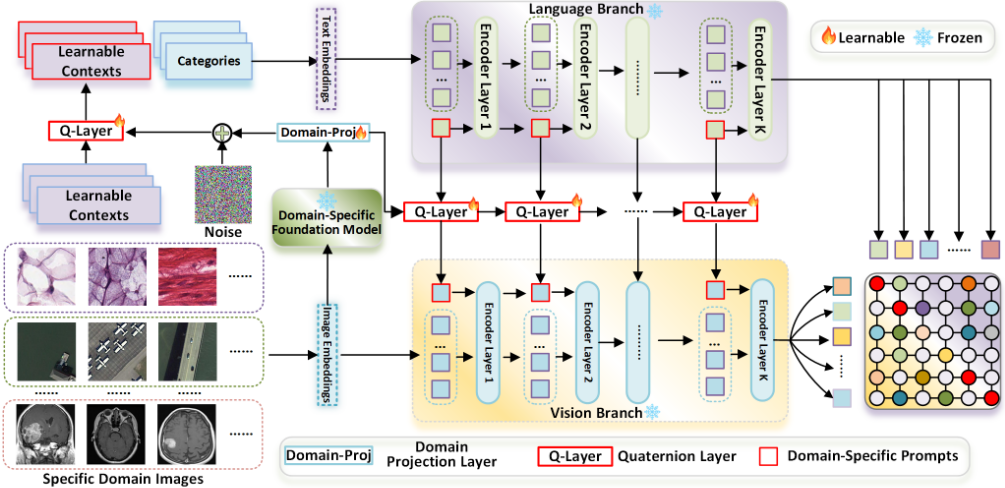
Aims to prompt VLMs efficiently from a generalized domain to specific domains like remote sensing and medical images, domain prompt learning with quaternion networks is proposed to facilitate the integration of domain-specific knowledge from large-scale foundation models into VLMs. Illustrated in Figure 1, the quaternion network enables the identification of cross-modal relationships between domainspecific vision features from the foundation model and generalized contextual embeddings from the language branch. Subsequently, this information is utilized to map the generalized contextual embeddings into the specialized domain. Furthermore, well-aligned vision-language relationships in pretrained VLMs are leveraged to propagate domain-specific information from the specialized language branch into the vision branch.
* This paper is an extended abstract of the work published at CVPR 2024, titled Domain Prompt Learning with Quaternion Networks [Cao et al., 2024].
Our DPLQ framework consists of three key stages:
- Domain-Specific Feature Extraction: We utilize largescale pretrained domain-specific foundation models to extract rich visual features pertinent to the target domain. These features serve as external guidance to steer prompt learning towards domain-relevant representations.
- Quaternion-Based Prompt Fusion: The extracted domain-specific visual features and the learnable language context embeddings are fused within a quaternion hidden space. In this space, visual features are placed on the imaginary axis while language prompts occupy the real axis, enabling orthogonal modeling of cross-modal relationships. Additionally, Gaussian noise scaled by the domain features is injected into the quaternion space to enhance robustness against overfitting.
- Dual-Branch Prompt Injection: Prompt tokens derived from the quaternion space are hierarchically injected into both the language and vision encoders of the VLM. This dual-branch prompting ensures that domainspecific knowledge is effectively propagated throughout the network, enhancing the alignment between visual and textual representations.
This design enables efficient domain adaptation by exploiting the strong alignment properties of pre-trained VLMs while introducing targeted modifications driven by external domain knowledge.
3 Experimental Validation
We conduct extensive experiments to validate the effectiveness of DPLQ on a range of domain-specific datasets, and the results are shown in Table 1 and Table 2. Our evaluations cover two major domains: remote sensing and medical imaging.
| Method | MLRSNet | PatternNet | RSSCN7 | ||||||
|---|---|---|---|---|---|---|---|---|---|
| Base | Novel | HM | Base | Novel | HM | Base | Novel | HM | |
| CLIP | 64.50 | 60.30 | 62.33 | 70.60 | 62.60 | 66.36 | 66.70 | 95.30 | 78.48 |
| CoOp | 79.37 | 58.90 | 67.62 | 87.30 | 64.20 | 73.99 | 84.80 | 89.13 | 86.91 |
| CoCoOp | 83.30 | 59.50 | 69.42 | 93.70 | 59.90 | 73.08 | 90.97 | 90.00 | 90.48 |
| MaPLe | 85.23 | 59.60 | 70.15 | 95.30 | 57.90 | 72.03 | 91.67 | 93.70 | 92.67 |
| Ours (ViTAE) | 88.96 | 57.10 | 69.56 | 97.07 | 62.37 | 75.94 | 91.53 | 94.53 | 93.01 |
| Ours (ViT) | 87.07 | 59.00 | 70.34 | 95.80 | 66.20 | 78.30 | 91.20 | 95.57 | 93.33 |
| Method | Base | AID Novel | HM | Base | RSICD Novel | HM | Base | UCM Novel | HM |
| CLIP | 73.50 | 70.40 | 71.92 | 71.50 | 60.20 | 65.37 | 80.60 | 68.00 | 73.77 |
| CoOp | 87.63 | 70.37 | 78.06 | 88.43 | 60.20 | 71.63 | 93.60 | 74.53 | 82.98 |
| CoCoOp | 92.63 | 65.73 | 76.89 | 92.37 | 58.80 | 71.86 | 95.23 | 71.57 | 81.72 |
| MaPLe | 92.73 | 74.57 | 82.66 | 93.93 | 56.27 | 70.38 | 97.70 | 70.90 | 82.17 |
| Ours (ViTAE) | 94.03 | 74.97 | 83.43 | 94.57 | 65.20 | 77.19 | 97.10 | 72.10 | 82.75 |
| Ours (ViT) | 94.50 | 75.77 | 84.10 | 95.67 | 64.83 | 77.29 | 97.90 | 73.30 | 83.83 |
| Method | WHURS19 | NWPU | Avg (8) | ||||||
| Base | Novel | HM | Base | Novel | HM | Base | Novel | HM | |
| CLIP | 73.10 | 90.80 | 80.99 | 69.00 | 63.00 | 65.87 | 71.19 | 71.33 | 70.63 |
| CoOp | 95.20 | 82.40 | 88.34 | 84.53 | 66.97 | 74.73 | 87.61 | 70.84 | 78.03 |
| CoCoOp | 97.10 | 77.00 | 85.89 | 89.27 | 69.37 | 78.07 | 91.82 | 68.98 | 78.43 |
| MaPLe | 97.70 | 88.03 | 92.61 | 90.70 | 72.70 | 80.71 | 93.12 | 71.71 | 80.42 |
| Ours (ViTAE) | 98.80 | 89.90 | 94.41 | 91.60 | 71.23 | 80.14 | 94.28 | 73.43 | 82.05 |
| Ours (ViT) | 98.80 | 90.80 | 94.63 | 91.70 | 75.03 | 82.53 | 94.08 | 75.06 | 83.50 |
Remote Sensing. As shown in Table 1, we benchmark our method on eight remote sensing datasets, including MLRSNet [Qi et al., 2020], PatternNet [Zhou et al.,
| Average over datasets | BTMRI | ||||||
|---|---|---|---|---|---|---|---|
| Base | Novel | HM | Base | Novel | HM | ||
| CLIP | 49.83 | 41.83 | 45.18 | CLIP | 50.60 | 51.20 | 50.89 |
| CoOp | 51.59 | 43.77 | 46.81 | CoOp | 48.93 | 53.30 | 51.02 |
| CoCoOp | 64.45 | 43.16 | 49.45 | CoCoOp | 52.37 | 52.80 | 52.58 |
| MaPLe | 62.39 | 44.40 | 49.01 | MaPLe | 53.67 | 61.60 | 57.36 |
| Ours | 74.36 | 44.74 | 53.36 | Ours | 60.97 | 56.30 | 58.54 |
| CHMNIST | CCBTM | ||||||
|---|---|---|---|---|---|---|---|
| Base | Novel | HM | Base | Novel | HM | ||
| CLIP | 31.60 | 27.40 | 29.35 | CLIP | 67.30 | 46.90 | 55.28 |
| CoOp | 41.70 | 25.67 | 31.78 | CoOp | 64.13 | 52.33 | 57.63 |
| CoCoOp | 74.30 | 25.30 | 37.74 | CoCoOp | 66.67 | 51.37 | 58.03 |
| MaPLe | 74.03 | 25.10 | 37.49 | MaPLe | 59.47 | 46.50 | 52.19 |
| Ours | 87.80 | 26.60 | 40.83 | Ours | 74.30 | 51.33 | 60.72 |
2018], RSSCN7 [Zou et al., 2015], AID [Xia et al., 2017], RSICD [Lu et al., 2017], UCM [Yang and Newsam, 2010], WHURS19 [Dai and Yang, 2011], and NWPU [Cheng et al., 2017]. DPLQ consistently outperforms state-of-the-art prompt learning baselines such as CoOp [Zhou et al., 2022b], CoCoOp [Zhou et al., 2022a], and MaPLe [Khattak et al., 2023]. Notably, with the ViT backbone, our method achieves an average harmonic mean (HM) accuracy of 83.5%, surpassing MaPLe's 80.4%.
Medical Imaging. For medical domain evaluation, as shown in Table 1, we use three datasets:BTMRI [Nickparvar, 2021], CCBTM [Hashemi, 2023], and CHMNIST [Kather et al., 2016]. Guided by the MedSAM foundation model, DPLQ significantly improves performance over baseline methods, achieving an average HM of 53.36%, compared to CoCoOp [Zhou et al., 2022a]'s 49.45%.
Ablation Studies. We perform detailed ablation studies to assess the contribution of each component. Results show that quaternion modeling, dual-branch prompting, and controlled noise injection all contribute to performance gains. Without quaternion networks, performance drops notably, underscoring the importance of orthogonal inter-modal fusion.
Generalization. DPLQ also demonstrates strong generalization capabilities in cross-dataset evaluations and domain generalization settings, further highlighting its robustness and adaptability. While the proposed method does not achieve top performance on each dataset, it excels with an average accuracy of 73.60%, corresponding to a 1.35% improvement over MaPLe.
4 Conclusion
In this work, we propose Domain Prompt Learning with Quaternion Networks (DPLQ) to address the challenge of adapting large-scale VLMs to specialized domains. By leveraging external domain-specific foundation models and introducing a novel quaternion-based prompt learning strategy, DPLQ effectively transfers general recognition abilities into specialized fields. Our method not only injects domainspecific information into both vision and language modalities but also models cross-modal relationships through the orthogonal structure of quaternion networks. Extensive experiments demonstrate that DPLQ achieves new state-of-the-art results on a variety of remote sensing and medical imaging datasets, confirming its effectiveness and generalization capabilities. We believe DPLQ provides a promising foundation for future research on efficient and robust domain adaptation for VLMs.
Ethical Statement
There are no ethical issues.
Acknowledgments
This work was supported by NSFC Grants (62106116, 62322113, 62376156), China Meteorological Administration Grant (QBZ202316), Natural Science Foundation of Ningbo (2023J027), and the High Performance Computing Centers at Eastern Institute of Technology and Ningbo Institute of Digital Twin.
@inproceedings{ijcai2025p1209,
  title     = {Domain Prompt Learning with Quaternion Networks (Extended Abstract)},
  author    = {Cao, Qinglong and Xu, Zhengqin and Chen, Yuntian and Ma, Chao and Yang, Xiaokang},
  booktitle = {Proceedings of the Thirty-Fourth International Joint Conference on
               Artificial Intelligence, {IJCAI-25}},
  publisher = {International Joint Conferences on Artificial Intelligence Organization},
  editor    = {James Kwok},
  pages     = {10881--10884},
  year      = {2025},
  month     = {8},
  note      = {Sister Conferences Best Papers},
  doi       = {10.24963/ijcai.2025/1209},
  url       = {https://doi.org/10.24963/ijcai.2025/1209},
}
TY - CPAPER TI - Domain Prompt Learning with Quaternion Networks (Extended Abstract) AU - Cao, Qinglong AU - Xu, Zhengqin AU - Chen, Yuntian AU - Ma, Chao AU - Yang, Xiaokang T2 - Proceedings of the Thirty-Fourth International Joint Conference on Artificial Intelligence, IJCAI-25 PB - International Joint Conferences on Artificial Intelligence Organization PY - 2025 SP - 10881 EP - 10884 DO - 10.24963/ijcai.2025/1209 UR - https://doi.org/10.24963/ijcai.2025/1209 ER -Copied
Machine-readable versions of this paper, for tools and AI agents:





